
Scottish Cultural Pioneers: The Importance of Martyn Bennett
Review of Brave New Music: The Martyn Bennett Story, Gary West, Luath Press £20.
Alan McClure
Gary West’s portrait of one of Scotland’s most enigmatic and influential artists comes at a welcome time in contemporary music, reminding us as it does that music is a profoundly human endeavor, one which takes place in a continuum stretching back beyond history.
Few artists illustrate this with quite as much vision and passion as Martyn Bennett, who grew up steeped in the traditions of folk song, piping and what he would come to celebrate as ‘bothy culture,’ and who refused to see these traditions as museum pieces to be forever preserved in aspic. This book considers how he came to this belief, and how he turned it into some of the most memorable, exciting and original music that Scotland has produced in the modern age.
Full disclosure – I was not very familiar with Bennett’s work prior to reading Brave New Music, and I had no inkling of the level of reverence, love and respect that remains undimmed twenty years after his untimely death at the age of 33. I am profoundly grateful to have found this story, and crucially this music, and should note that from the first page the story of Martyn’s life was sufficiently inspiring to keep me reading even without prior knowledge of the man’s importance.
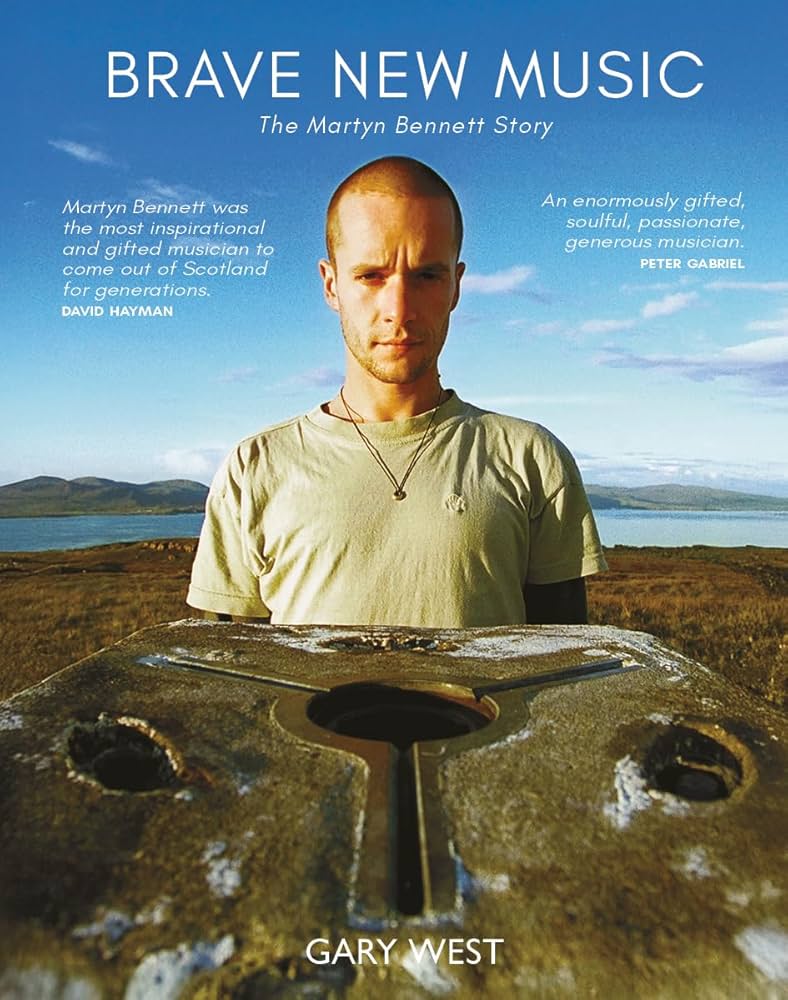
Modestly reminding the reader early on that ‘writing about music is like dancing about architecture’, West wisely focuses on the people and relationships which shaped Bennett’s musical journey and the tale unfolds like an Iain Banks novel – the serendipity, the connections, the visceral scene-setting and, crucially, the almost inconceivable talent of the chief protagonist.
Who was Martyn Bennett?
Born in Newfoundland in 1971 in a cultural milieu that included ex-pat Gaels, Mi’kmaq and French Canadians, Martyn’s early family life included deep cultural dives with his mother, celebrated folklorist Margaret Bennett. Perhaps equally influential was his geologist father Ian’s fascination with landscape: much of the ensuing story notes Martyn’s passion for the great outdoors, a love which informed his music perhaps as much as his knowledge of tradition.
Having moved to Scotland with Margaret at the age of five, following his parents’ separation, reminiscences about the young Martyn universally portray him as a lad of unusual curiosity, interested in and alert to the people around him and the workings of the world. Interestingly, Ian Bennett is at pains to refute ideas of musical prodigality, stating that music played almost no part in his early memories of Martyn, even when, through Ian’s own modest musical explorations, there was every opportunity for Martyn to join in. This is not in any way to denigrate Martyn’s talent: rather, it is a welcome demythologization, a reminder that no-one’s life is determined from the outset, and a crucial recognition that, without the support and encouragement of those around him, Martyn’s musical talent might never have come to the fore. There is a lesson here for parents everywhere – our role need not be to direct our children into particular channels, but rather to provide the environment which allows their fascinations free-rein.
Nevertheless, by the age of eight Martyn was learning the pipes with David Taylor, who had ‘never seen anyone learn the chanter so fast’ and who gave him ‘a month’s worth of lessons at our first meeting.’ Taylor also noted, in his capacity as History teacher, that Martyn was equally impressive as a visual artist, making meticulous sketches of the instruments, people and places that entranced him.
Whatever Ian Bennett’s protestations, it’s clear that Martyn had an early determination to engage with the world: that music was to become his chief medium for this is hardly surprising. Early aptitude at the pipes remains something of a meal-ticket in Scotland today, and I personally know at least one young piper currently busking his way around the world with this unique instrument. For Martyn, opportunities to play were frequent and fun, and however focused and driven he was it’s difficult to doubt that he enjoyed the praise and admiration that could come with competitive piping. But expertise in a single discipline was never going to be enough for this young lad.
Almost uniquely for a musician coming from a trad background, at fourteen Martyn’s phenomenal piping gained him entry to Edinburgh’s Broughton School of Music. This gives us an early hint that age-old boundaries between musical communities were already being broken down: Martyn seems to have been exactly the right person at the right time. The discipline and talent which had allowed him to master the pipes, coupled with the expertise available to him at Broughton, saw him throw himself into classical violin (at which he obtained the skills of a professional Classical soloist), musical scoring, piano and, crucially, collaboration.
The list of Martyn’s achievements at Broughton is extensive and intimidating, and he appears to have knocked over career milestones in an effortless express-lane to brilliance. By the time he moved on to RSAMD his classical music was as respected as his traditional work. Outside hours, a different kind of music would prove just as enchanting, as the thrilling beats of electronic dance music captured his imagination.
Writing about Martyn’s Music and the Power of Grit
Despite West’s caveat about writing about music, when he chooses to do so he does it quite beautifully. Describing Martyn’s piece Shputnik in Glenshiel, which appears on Martyn’s second album, Bothy Culture, West writes:
The piece itself is a whirling dance tune, the melody circles in a few bars that become hypnotic as they are repeated, flavoured by the Middle East and the Scottish west Highlands, indistinguishable from each other as they burl around the dance floor.
Seminal performances, and indeed whole albums, are described with all the excitement and passion of a true devotee, albeit one with some serious musical chops of his own, and it is very clear that this biography is a passion project for West. I defy any reader to avoid the music so described – myself, I wasted no time, and Bothy Culture and Bennett’s final album Grit were the constant soundtrack to my reading of this book.
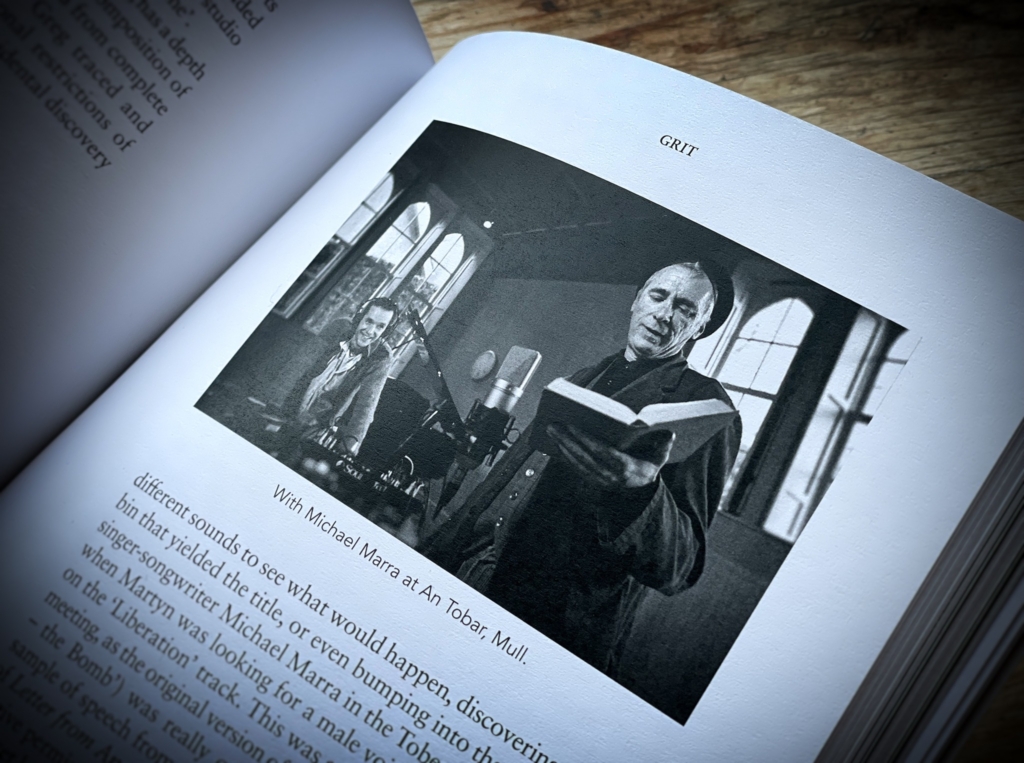
It goes without saying that they are utterly remarkable, rare examples of musical fusion that enhance, rather than exploit, the traditions they draw from, bringing ageless folk songs and stories to a new generation and (just perhaps) giving contemporary traditionalists the permission they may need to enjoy the best of the possibilities presented by music technology. The recordings are as multi-faceted as the man, and it is always the folklore and music that take centre stage, never the musician’s ego.
Martyn’s final years were as cruel as his early ones had been inspirational: diagnosed with cancer in the year 2000, with his musical reputation undisputed and his potential making waves across musical genres, Martyn’s treatment was harrowing and physically diminishing. The one-time prodigious instrumentalist now found himself unable to muster the strength or stamina needed to play the instruments which were so much a part of him. In a desperate display of fury and frustration he destroyed them, including two pairs of Highland pipes which had survived the world wars. This incident, hinted at throughout the book before being described in all its upsetting detail, might have been the end for a less dedicated musician. For Bennett, losing access to his beloved instruments meant no such thing.
Rather, he pursued his investigations into music technology, using his bone-deep knowledge of form and a collector’s instinct for which his mother must surely take credit to create Grit, a dazzling album which combines the ancient and the modern to create something entirely distinctive. The human voice is revealed as a vehicle of rhythm, emotion and atmosphere as the album encompasses Gaelic, Scots and Traveller songs and tales, which emerge from the soundscape like ships through the haar. Martyn is curator rather than performer, and the respect he feels for each of his collaborators is writ large across every beat and orchestral swell.
Given the arc of Martyn’s life, there is the inevitable danger of seeing this final album as a culmination of everything that had gone before, as the goal towards which all of his passionate investigations and experiments had been heading. West is not immune to this, but can be forgiven for the weight he grants this album as his description of its inception and production is as insightful as any part of the book. Of course, had Bennett’s life not been cut so short, there is no telling what he might have gone on to achieve, and Grit may have paled in comparison to what came after. That it stands as a memorial to a man who appears to have been loved and admired by all who came across him, hung forever with superlatives and what-might-have-beens, is perhaps no bad thing.
Martyn Bennett lived several musical lifetimes in a span of years insufficient for most to complete even one. To say his work remains influential is an understatement – careers could be built attempting even a part of what Martyn envisioned, and the freedom now available to musicians from the traditional disciplines comes in no small part from the vision of this remarkable man. For those already in the know, Martyn remains a beacon and an inspiration. For those who have yet to cross his path, this book offers an excellent entry point: a beautiful book about a beautiful soul.

We are supported only by our readers. We don't have corporate backers and we don't take advertising, so we rely entirely on your support.
Help to support independent Scottish journalism
Beautiful. Still listen to Martyn probably every month one way or another. This is a great book, project a long time in the making, Gary did a great job. Full credit must also go to the absolute star that is BJ Stewart, who took these photographs. In fact I think BJ’s photo of Martyn taken at Meall an Inbhire which is the cover of GRIT and also the cover of this book, is one of the most iconic Scottish photos of the last decades.
Aww….thanks Peter. That’s really kind of you. So glad you enjoyed the book. All the best.
A magical genius born at a magical period of renaissance of Scottish traditional music, whose influence will live on forever.
Yes Davy, sadly missed
I was aware of the name, Martyn Bennett, but hadn’t really paid much attention to his music. On the strength of this review I have started listening on Spotify. Truly wonderful stuff.
An absolute genius taken too soon.
I loved his haunting arrangements and genres.
Must go back through my catalogue again!
wonderful music… that transformed head and heart