
Unite the Kingdom!
The optics of the ‘Unite the Kingdom’ march in London yesterday were interesting. The flags were predominantly the St George’s Cross, which was appropriate for a march designed for the former leader of the English Defence League. But there was also the Butcher’s Apron and a smattering of Israeli flags. There were very few arrests (reportedly twenty-five from a crowd of 110,000), presumably because these people weren’t opposing genocide. Last weekend over 900 peaceful protestors were arrested for holding up signs. Two-tier policing, you could say.
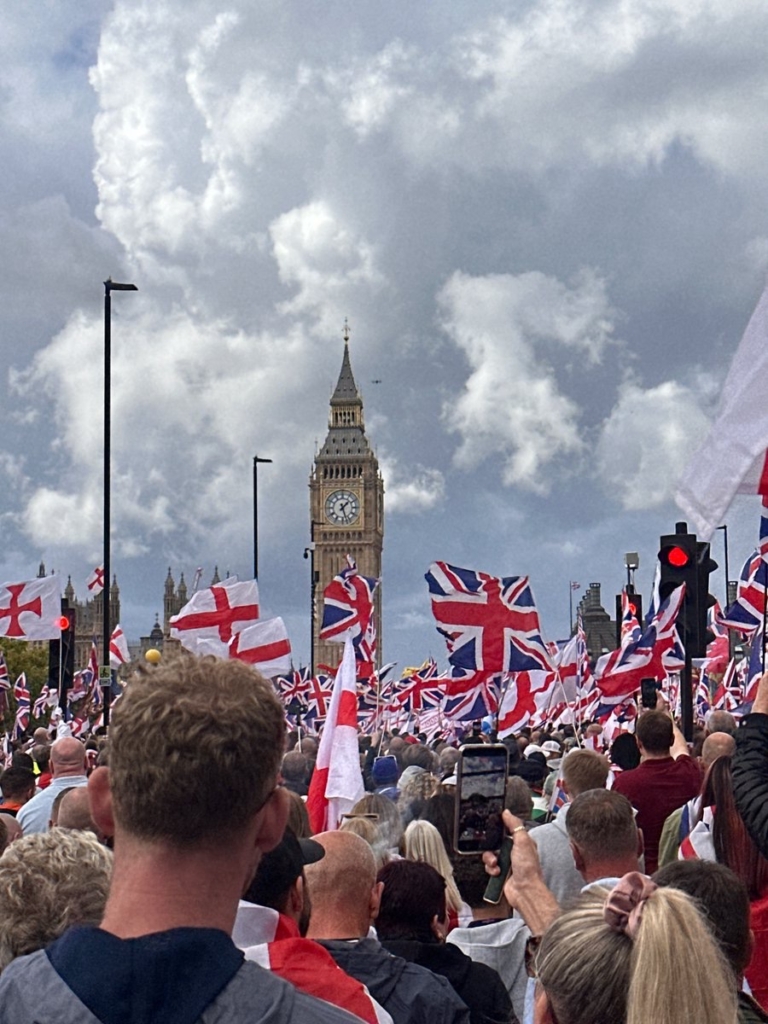
‘Unite the Kingdom’ sounds like some Arthurian plotline, but it does rest on the idea of a Britain that exists and can exist, and needs ‘uniting’, all of which seems far-fetched at this stage. Uniting the Kingdom seems like a noble cause at first, until you realise that ‘the Kingdom’ will be ‘united’ by the stench of burnt-out asylum hostels and the rancid rhetoric of Katie Hopkins, Tommy Robinson and Éric Zemmour.
Some were a bit more philosophical about the whole thing. The left-leaning Labour MP Clive Lewis posted this tweet about his pal who was on the march, telling us: “He wore a Union Jack, not a St George’s Cross as he said that one had been hijacked by racists.”
Such commentary is blissfully unaware of how the Union flag plays outside of England as a symbol of ‘unity’.
Lewis explained that: “He wasn’t there for Hopkins, Musk, or any of the professional ‘grifters’ as he put it. He was there to feel part of something bigger, though he admitted there were a lot of, in his words, “assholes” there. He’s an electrician. He’s smart. He’s not racist, but he’s not “PC” either. He’s not a fan of Keir Starmer but he also believes Farage would be a disaster. Oh yes, he’s a bundle of contradictions! But aren’t we all? I don’t know what ‘box’ we put him or the millions like him in. And I think pretending they’re all racists or fascists would be a massive mistake. Some were. But not all.”
Lewis continued: “That’s what I saw in my friend’s photos. Not just anger, but a demand for belonging. We’ve replaced collective experience with atomisation. Without getting too nostalgic, programmes like the BBC’s Generation Game once pulled in millions every Saturday night, giving us something we could all talk about on Monday morning. Now we watch Netflix, Disney+, Prime, or Paramount, alone, in algorithmic silos. Football used to be affordable and rooted in community; now it’s millionaires playing for the profitability of billionaires. The NHS, the post office, the railways – all chipped away, run down, sold off or centralised, leaving people feeling powerless and disconnected.”
All of this is true, but would make more sense if many of these things hadn’t been done under Labour governments, and would be more compelling if the current Labour government wasn’t clinging to a policy of appeasing and aping the far-right in a desperate attempt to remain in office.
There is a question of agency and choice here. The choice to join such an event can’t be explained away by the loss of Bruce Forsyth or the algorithm, or SKY’s sponsorship of the English Premier League. When you want to ‘belong to something,’ who dons a Union Jack and goes along to a march organised by Tommy Robinson?
The Musk-Robinson Alliance
Yesterday in London, Lampost Climbers made common-cause with Elon Musk who intervened in British politics saying: “Something’s got to be done. There’s got to be a dissolution of parliament and a new vote held.”
Echoing his former boss, Musk – in a video link to the far-right activist Stephen Yaxley-Lennon, told the crowd that “Violence is coming” and that “You either fight back or you die”. It should be noted that Musk, reputedly the second richest man in the world, actively supports the AfD in Germany, Advance UK and Tommy Robinson over Nigel Farage. For Musk, Farage isn’t extreme enough.
Hope Not Hate reported that Tommy Robinson joined Ben Habib’s Advance UK in August and is urging his followers to do the same. So, while all of the attention has been on Farage’s party’s advances, there is also the potential for a more extreme version to emerge backed with Musk’s money. Even as Farage lays out the most extreme plan for Britain in your lifeline [This is Not Normal – Bella Caledonia] he can still be described by Robinson as full of ‘establishment lies‘.
The trajectory of English politics (and Disaster Nationalism everywhere) is ever-rightwards, with seemingly no threshold, no railguard and no counter-narrative to thwart the advance of the far-right.
Clustered Publics
There are competing explanations for this upsurge of nativist politics, white nationalism, far-right populism, neo-fascism, or whatever words you want to use to describe the protest on Saturday. It’s post-Brexit England where none of the genies let out of the bottle have been put away. None of the dark energy that Brexit released has been satisfied. Nor will they ever be.
There’s certainly the complete failure of the Labour ‘alternative’ to make a material difference to peoples lives, and in doing so, countering the story that ‘the country’s’ demise was down to the people seeking asylum in Britain.
There’s certainly the impact of the tabloid media which has championed Farage and his followers as clickbait for years, as has the state broadcaster (Reform, with 0.6% of all MPs, featured in 25% of BBC’s recent 10pm news bulletins).
There’s certainly also the impact of social media, brilliantly un-packed earlier in the summer by William Davies [TV Meets Fruit Machine: Faragist TikTok]. Davies notes the phenomenon of ‘TikTokisation’, where the goal of every platform is to keep serving up whatever content seems likeliest to retain a user’s attention “for another few seconds, no matter how useless, weird or unpleasant.” He writes:
“TikTokisation deepens an already existing anxiety about the decline of text-based news consumption (manifest not only in falling newspaper sales, but slackening attention to online news sources as well). As early as 2001, the legal scholar Cass Sunstein expressed his fear that the internet would be a cause of political ghettoisation. Algorithmic curation is a powerful mechanism for realising that fear. The political and media theorist Paolo Gerbaudo has argued that platforms such as TikTok shrug at liberal ideals of a diverse and shared public sphere, accelerating our drift towards ‘clustered publics’, in which parallel communities are generated around niche interests and identities, but whose governing logic (what distinguishes the cluster and where its boundaries lie) can never be known.
There is another familiar worry, that social media platforms have an inbuilt propensity to push extreme content, with the result that users are lured into the hands of the radical and far right.”
So it’s a perfect storm, a toxic soup of social alienation, political failure, grotesque social inequality, manipulation by (anti) social media, and exploitation by bad-faith actors and Tech Lords.
There’s also the deterioration of standards in public life, and this doesn’t just mean corrupt politicians and an entire system that people have become alienated from. It also means things like this;
Fox News casually suggesting that we mass murder homeless people
Fox News casually suggesting that we mass murder homeless people.
“Or involuntary lethal injection or something. Just kill them.”
Universal healthcare, housing, and anti-poverty programs are considered more “radical” on Fox News than mass murder.pic.twitter.com/3dPRjoGnqk
— Melanie D’Arrigo (@DarrigoMelanie) September 13, 2025
Or this:
Oh wow, he really said that. pic.twitter.com/UVRA6Fj04r
— Alex Cole (@acnewsitics) September 13, 2025
It adds to the feeling of violence that saturates our world today, nothing more than the collusion with ongoing genocide and ethnic cleansing does.
But the homeless issue – and the eugenics response – points to a feature of Late Capitalist political culture. As Jason L Myles puts it:
“Homeless encampments have grown far beyond their stereotypical urban landscape and have begun to consume areas of middle class suburban bedroom communities that were designed to shield residents from such sights. This is not the screenplay of the opening scene of a science fiction movie; this is the current state of one of the richest countries in the world.”
The answer, like almost everything is not to confront, resolve or transcend the problem, it’s just to remove it. So the answer to climate crisis is just to change nothing. The answer to fuel poverty is to change nothing. The answer to crushing poverty is Food Banks.
So far, so dystopian.
What routes out of this are there?
So, Now What?
In terms of specific solutions to the crisis of British politics represented by Unite the Kingdom! There aren’t easy answers.
The issue of silo culture and the attention economy described by Paolo Gerbaudo & Co are a global phenomenon, not a local one. They can only be resolved by a mixture of media literacy; an analogue revolution and a takedown of techlord power, none of which seem immediately likely.
It may be that if Musk/Robinson/Farage/Habib succeed in creating an English ethno-state, and taking power at Westminster, such will be the revulsion that a counter-politics emerges. It may well be that such a politics is already emergent in the forms of Your Party or the newly resurgent Green Party. But success for such groups would require a level of discipline and openness, savvy and ‘cut through’ that we have never seen by a British Left for eighty years. Having said that, the collapse of centrism means that ‘populism’ isn’t confined to the right.
It may be that the chaotic and borderline criminal (or not so borderline) characters that Reform and Advance attract are jailed for any number of offences, as we’ve already seen happen. Though that movement’s ability to throw up and fund any number of replacement candidates and figureheads should not be underestimated. These are not really charismatic people, they are well-funded people.
Or, it may be that the emergence of such a putrid form of ‘right-wing populism’ may create the conditions for Scotland to finally unite and leave. But this is of course, highly problematic, both in terms of the state of the independence movement and the reality of becoming the northern neighbour of what such a state would look like. However, history doesn’t always deal you the hand you want, and if the choice was between being part of a Farage-led British ethno-state, or a Scottish democracy, few would have difficulty choosing.
The problem is that if what we are seeing is systems’ collapse then the only real solution is system change. Scottish independence, in and of itself would not necessarily meet that challenge/criteria. It would be a seismic change to Britain, or the British constitution, but the problems and crisis we face are way beyond the merely constitutional.
Instead of escaping through the escape-hatch of such a hellish scenario, it would be far better to help create the conditions for an alter-England /alter-post Britain to emerge. Instead of this seemingly inevitable slide we would need to fight with radical forces in England, Wales and Ireland for an alternative prospectus: Hope Not Hate, Republics not Kingdoms, peace not violence, joy not fear.

We are supported only by our readers. We don't have corporate backers and we don't take advertising, so we rely entirely on your support.
Help to support independent Scottish journalism
Spot on! A brilliant analysis.
Useful, Mike. It’s tempting for those of us active in the antiracist movement in the 70s to want to replay RAR and ANL. I’m sure that coming together positively has an important role and that we need to find ways out of our silos. We need to be alert to every opportunity to build alliances against the far right using the opportunities offered by new ways of mobilising as through social media I think that has to be a priority.
Polling indicates that support for Reform is age related with highest support in the over 65 cohorts and lowest in the under 24 cohort. This would indicate that mainstream media is having a significant impact on building support for Reform. I don’t think Farage’s pub bore persona is very attractive to younger people or Scottish voters. Having said that there are other right wing influencers who have a greater reach with young people)especially young men). They tend to be more radical than Farage but they prepare the ground further to the right for Farage to move onto.
I am a bit wary of people in Scotland having any influence on other parts of IK. From my experience people outside Scotland in UK are pretty ill informed about Scotland on the rare occasion they actually get round to thinking about us. Saving the English from themselves was a rather patronising line used by opponents of independence in 2014 referendum.
I would be willing to bet that some of the few saltines on evidence at Westminster on Saturday were waved by expat Scots. This is not to say that we do not face a challenge from far right in Scotland but IMO we should concentrate on that and dissociating ourselves from UK as most effective way to fight it.
I should add as some evidence for keeping ourselves separate from England is football hooliganism. In the late 70’s the Tartan Army’s behaviour was pretty appalling (I was at Wembley in 1979 and witnessed some real hooliganism). As the English fans developed a reputation for hooliganism in early 80’s the Tartan Army’s reputation improved to the point they are now welcomed everywhere. It may not have been the only reason but the wish not to be seen to be the same as English fans was a significant factor in improving behaviour of Scottish fans. Do not underestimate this factor in attitude of people living in Scotland – it may appear churlish at times but it can also be a useful motivation at times.
Excellent piece as always. I’m trying to get my head round Clive Lewis’ and his Union Jack-toting electrician pal. Sure, most of the people on the march – and possibly those screaming outside hotels in Scotland – are not signed-up members of far-right organisations. And perhaps it serves little purpose to scream ‘fascist scum’ back at them. But come on, Clive, choosing to go on a march so clearly defined by its anti-immigration message is not just ‘wanting to feel part of something bigger’: there are other ways of doing that – joining the anti-racist mobilisations for a start. Yes, we need to understand what’s behind this mobilisation (surely it’s not really that complicated: it’s Brexit all over again), but it needs to be opposed far more forcefully than Clive Lewis seems prepared to do. And he’s one of the better ones.
One thing is for sure though: the slogan ‘Better Together’ now comes across as a sick joke…
Listening to World At One today it’s clear that there is a normalisation operation going on, to represent Saturday’s protest as an entirely natural assertion of Anglo-British identity. Very dishonest especially from Trevor Phillips.
It fits the BBC narrative to normalise the right as in their pushing of Farage too
Yes, indeed, I felt exactly the same. Trevor Phillips was recycling what he’d had published in The Times and it was not convincing in either place. The BBC also introduced that section of the programme with a report from a journalist from The Spectator who had been present at Unite the Kingdom march – as if that was going to be an entirely unbiased take on who was there and what their motives were (it wasn’t).
https://quickshare.samsungcloud.com/6X3wuMr4MfjQ
It Ain’t Right
KId cry’s out in the middle of the night
Can’t stand the pain cos dem belly is tight
It ain’t right
It ain’t right
Bad situation , won’t feed the whole nation tonight
Some have enough, some nothing at all
A very few really have it all
It ain’t right
It ain’t right
It’s the same in every nation,
unequal situation tonight
-We can join to change this plight
-We have the choice to make it right
-Make it right
-Get down to City Hall , change the system till it falls , tonight
Colonial ways are from yesterday
Rich get rich , poor all pay
It ain’t right
It ain’t right
It”‘s the same in every land so
Don’t sit on your hands tonight
The many people, fed full of lies
Blame each other, so the greedy still rise
And blind our sight
That ain’t right
It’s time to make a stand, put the power in our hands tonight
-Page and screen shares only their voice
-But face to face we make a different noise
– Shine a Light
– Become a people’s nation , join a new conversation tonight
Look at what they did
call it messin with the Kid
Look at what they did
You can call it what you want
I call it messin with the Kid
The boys decide how to share the cake
Hand out some crumbs then take,take,take
It ain’t right
So make it right
Their day’s gone , from now on, everybody gets a bite
-Gotta start to dismantle their might
-Change can come if we fight the one fight
-With all our might
-To stop more destitution
Demand a new solution tonight
Look at what they did
I call it messin with the Kid
Look at what they did
I call it messin with the kid
Brilliant!
Call to Action
The brainwashing of people online has no borders…it is taking hold on our side of the Atlantic , including here in Scotland.
If not already too late, we need to stop it in its tracks : by developing a fairer, equal , tolerant, and crucially, a participative society with the full powers of Independence, giving people the information and control to influence the changes they want to see in their own lives and own areas.
The alternative unfolding in front of us doesn’t bear thinking about.
No time for pontificating – deliver a massive SNP majority in 2026 to create the tipping point to Independence, it is the only short term route to change for the better for the many people in Scotland
(and a beacon for change elsewhere, including , through time, our neighbours in England, )
So love them or loathe them , join, support and develop the SNP and deliver change ….it is too dangerous to sit on our hands or undermine our only realistic alternative!
In the face of 150,00 people this blog is very deaf.
is your logic just that we should all agree with whoever has a big march?
Exactly!
What are the voices telling you, Mechell][e?
I think it unlikely that Clive Lewis is ‘blissfully unaware of how the Union flag plays outside of England as a symbol of ‘unity’’. He was one of the speakers at the Tom Nairn ‘Break Up of Britain’ conference in Edinburgh on 18 November 2023. He spoke well, with a clear understanding of Scotland’s current constitutional predicament. Is his attempt to offer excuses for participation in aggressive fascist displays just another exercise in cynical political positioning? Kenny McAskill has been making similar noises in a Scottish context.
What has Kenny been saying?
That we shouldn’t be harsh on people attracted by the politics of Reform.
Alba are barely registering in polling for next years Holyrood election. I suspect Kenny is desperately searching for conservative, disillusioned independence supporters. I also suspect Alba will not increase but continue to lose support with this misguided policy.
@John, in the context of this ‘Unite the Kingdom’ stuff, albeit it seems as 2-dimensional as a flag, Alba have made one of their most prominent policies (in a clear difference with the SNP), a Scottish Republic, and have apparently joined in the #NotMyKing protests:
https://www.albaparty.org/scotlands_constitution
(it’s a pretty basic and policy-lite website, which is not very encouraging, although it has a news page where you can find the recently published thoughts of Kenny MacAskill)
In my view, someone who claims to support Scottish political independence but wants to retain the British imperial monarchy is just a unionist of a particular stripe. Same for NATO support, another policy of difference between SNP and Alba, although both are anti-nuclear-weapons.
If the articles I’ve read are accurate, the ‘Unite the Kingdom’ lobby are pushing an unreflective, mythological and completely unrealistic ‘take pride in British history’ approach, which is increasingly coming into conflict with modern research (partly in response to European empires losing sway globally, while global culture is more likely to portray the British as stock villains rather than, say, the short-lived Nazis) and indeed incomers with different histories — Zeinab Badawi recounts in An African History of Africa (2004) how confused she was a child watching Khartoum (1966) where General Gordon was portrayed as the hero and the Mahdi the villain.
The worst thing that happened to many peoples was the arrival of the British. And people aware of that, yet still demand pride in British history, must surely feel a touch of
#karmaphobia
SD – we all have policies that we want an independent Scotland to implement eg I am a republican but I am happy to leave this to the Scottish electorate post independence. If we all go around with our own personal demands for independence and name calling other independence supporters who have different opinions we will never achieve independence.
@John, it is not a matter of name-calling, under the British imperial monarchy, Scotland would still be in a union of crowns (or worse). Republicanism is hardly a personal demand, open your eyes to the trends.
You may believe that a satisfactory form of Scottish independence may be achieved by a kind of milquetoast approach of offending nobody, but my reading is that as long as the British imperial establishment is ruling the roost, we will never escape its political influence.
A case in point is treason legislation. Another is oaths of allegiance. Another is the civil service and other lifelong oaths to British official secrecy. There are many more ways that Scotland would be entangled in such a web, that needs to be broken before a Scottish transition to independence could be fair and unfoulled. The Irish independence movement woke up to this a long time ago, I’m not sure why the Scottish equivalent hasn’t caught up yet.
Tying your colours to the royalist mast will only jeopardise Scottish Independence when, not if, more royal scandals emerge. It’s not as if the Palace has been sitting on royal good news stories. Again, no balance sheet applies. There is common cause to be had with republicans protesting against both Donald Trump and Charles Windsor, which clearly opposes the Unite the Kingdom crowd.
See answer from David McCann below.
Calling someone that wants an independent Scotland but prefers to retain the monarchy may not agree with our wishes but it is a legitimate position- see Australia, Canada etc. To start calling these people unionists is divisive and self defeating.
Ah.
As a dyed in the wool republican, the first thing we should be concentrating on is securing our independence.
After that, anything is possible.
There is little realization here that Reform has changed the political weather in Scotland.
First, immigration is now an important political issue – as it is across Europe – in a way that, only a few years ago, it was not. The left in Scotland instinctively views immigration positively; right now, this is unlikely to an election winning policy.
Next, it has shown itself capable of winning a significant number of votes; a number which quite plausibly will continue to increase. In the 2024 General Election it won 168,000 votes, 7% of the total and almost double the Green vote. In the Hamilton by election, this rose to 26% of the vote and Gerry Hassan suggested (Bella Caledonia 6 June 2025) Reform could easily have won that seat.
Third, it has helped bring about street level campaigning on the immigration issue; something Scotland would do well without.
Finally, it has shown up the electoral weakness of the left. (I do not regard SLAB or the SNP as being part of the left.) Here the left is relying on denunciation in a manner which shows no sign of bearing fruit. Significantly, the left in Scotland has all but abandoned the ballot box just as Reform sees it as the road not just to influence but to real political power.
I like the idea that you just abandon principle in the face of whatever weather the political climate throws up in order to gain electoral advantage. You don’t ‘denounce’ something in order to get votes, you ‘denounce’ something because you don’t believe in it, otherwise you are a political opportunist.
There is no doubt that Reform has gained significant support because of fears around immigration, but you don’t counter the rise of the far right by just capitulating to them – you counter them by a combination of anti-fascist organisation, counter narratives and implementing policies that have material benefit for people in their lives.
The question of immigration – through the wars many in the west have instigated, and the climate emergency – isnt going away anytime soon. So either you have a Fortress Europe/Britain/Scotland with detention camps, forced deportations and kidnapping people off the streets as seen in the USA, and as laid out by Farage, or you seek better alternatives.
Sweden and Denmark, countries with a far stronger social democratic tradition than Scotland, have demonstrated in recent years that it is possible to control immigration without recourse to the extreme measures you refer to. The governments did this in response to political pressure. This is how democracy is supposed to, and can, work.
You refer to ‘anti-fascist organization.’ To all intents and purposes there are no fascists in Scotland.
And to ‘implementing policies that have material benefit for people’. This requires political power. The Scottish left is as far from political power as Hibs are from winning the Champions’ League.
It’s important to keep some perspective. The most recent poll puts Reform on 16% in Scotland. Clearly they have a degree of support here – but we already knew that as UKIP had won an MEP in 2016. So far it is nothing like the level of support in England and Wales.
Correction: it was the Brexit Party, and they won one MEP in 2019, on 15% of the vote.
The one Brexit MEP was David Coburn, quite a clown.
FA – there are significant differences between Scotland and England. The population in England has increased significantly in last 10 years in Scotland it has barely increased therefore the impact of immigration has been different across both countries. Scotland has therefore not surprisingly never seen immigration as such an important issue as England. It is becoming more important in Scotland because of the media coverage in England influencing Scotland. (evidence – Reform has increasing support in older people who get most news from msm). The issue of hotels hosting asylum seekers is an issue in Scotland but that has spread from England and there are sufficient right wing zealots in Scotland to capitalise on this issue. Perhaps if asylum seekers were housed in more affluent areas rather most impoverished communities this would help!)
Nigel Farage personna (like Boris Johnson) seems to strike a chord with many in England but is disliked by most people in Scotland.
Reform are making progress in Scotland for a variety of reasons:
1)economic stagnation and struggling public services which can be traced back to bankers induced economic crash in 2008.
2)dissatisfaction with SNP brought on by missteps, lack of progress with independence and incumbency after 18 years in power at Holyrood. I would add the SNP government is demonised by a large section of media (who are opposed to independence).
3)dissatisfaction with Labour brought on by missteps and incumbency after barely a year at Westminster. (Labour benefited from SNP incumbency at last years GE but have very quickly squandered it.)
4)dislike of Conservatives after Johnson and Truss.
In short, although there are extreme right wing supporters of Reform (including some former Tory voter) the majority of their support is probably coming from socially conservative voters scunnerred with Tories, Labour and SNP.
Re your assertion that there are no left wing parties the SNP are a social Democratic Party which is centre left and Green Party policies are more left wing than SNP in many areas. There is also the Scottish Socialist Party but their support is minimal and there will soon be Jeremy Corbyn’s new party which will probably be about as left wing as SNP.
The best way to tackle Reform in Scotland is to address their policies on cutting public spending and services along with their hostility to NHS. They also have little interest in Scotland and Holyrood and their candidates in Scotland are failed Tories.
Well not sure it’s that great a showing, despite the wacky claims of the right that there was actually or a million and a half, instead of the 100 to 200,000 that we’re probably there, that’s not such a big crowd for a country with a population the size of England, compare that proportion, to the 150,000 that attended the indi march in Glasgow 5 year’s back as a proportion of our population it’s far more representative. Maybe time mor twenty to 50 somethings came out on indie marches.
They also had gospel singers, I wonder what they were called the Badenoch Baptist blue notes ?
150,000 people rock up united because they aren’t alter post Britain enough.
However there is Always Gaza!
On the topic of “the worst thing that happened to many peoples was the arrival of the British”, the powerful 2018 movie The Nightingale takes us to the land the British called Tasmania (warning: British atrocities, extreme racism and misogyny, and R rating):
https://www.imdb.com/title/tt4068576/?ref_=nv_sr_srsg_1_tt_8_nm_0_in_0_q_the%2520nightingale