
The Political Disorder of Late Britain
British politics is undergoing a huge upheaval, as parties of the Left struggle to be born and the mainstream two-party system collapses. British politics is dividing along two axis: between the left and far-right, but also between the latent and remaining constitutional question.
The radically changing landscape of British politics looks likely to continue, with ongoing speculation about Sir Keir Starmer’s future and Andy Burnham doing an unconvincing job of denying he is on manoeuvres. Whether a Burnham could succeed in saving a badly discredited Labour government is pure speculation. Some polling suggests he could [The new battle for Labour’s soul Andy Burnham is on a collision course with Starmer and Reeves].
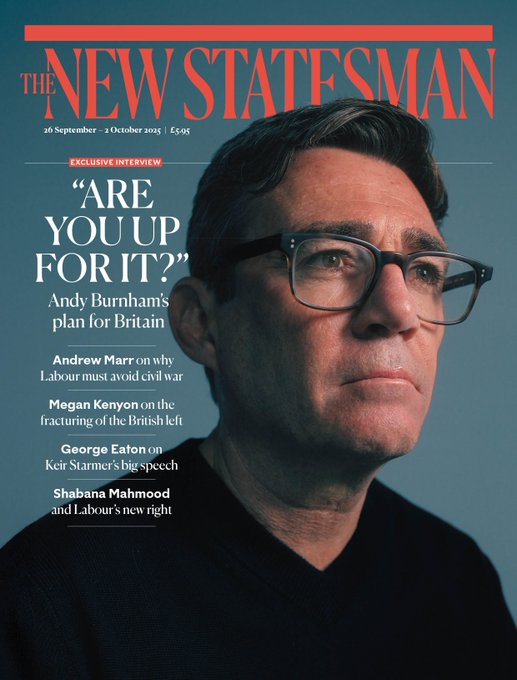
I think it’s unlikely. The damage done to Labour’s standing by their commitment to the genocidal ‘war’ in Palestine is a historic mistake and a moral failure that a change at the top can’t undo. Secondly, Andy Burnham is not so far politically from Starmer, another New Labour politician. And thirdly, such scenarios ignore the political fallout of ditching Starmer and inserting Burnham. That’s going to be messy.
Kemi, Zack and Sultana
Meanwhile, many are predicting Kemi Badenoch will also be given the heave if, as seems highly likely she ‘leads’ them to come fourth or fifth in the Scottish and Welsh elections next year.
Such potential casualties are of course, the result of Reform’s seemingly inexorable rise, even if Farage does seem desperate in rolling out his ‘their eating the Swans’ line. But not a week goes by without a poll coming out showing Reform in the ascendancy. This week was no exception with polling from Find Out Now showing:
Westminster Voting Intention: RFM: 33% (-1) LAB: 17% (+1) LDM: 16% (+3) CON: 14% (-2) GRN: 12% (=)
This is the two-party state collapsing in real time. Some, such as the journalist Sam Freedman are now predicting that the collapse will only accelerate. He writes: “Though Badenoch was undoubtedly a poor choice, the challenges she faces, and any successor would face, need to be seen in a global context. The centre-right is failing everywhere. The CDU is hanging on in Germany, but the AfD is leading in some polls now. Even Japan’s LDP, which has been in power for all but six of the last 70 years, is in trouble. Elsewhere, the centre-right is either barely alive, in opposition, or in coalition with the radical right.”
“Whether the Tories can buck the trend is a critical question because if they fully disintegrated it would put Reform in a position where they could hit 40% and win a comfortable majority.”
So far, so dire.
If the two main parties that have dominated British politics since the post-war era are in terminal decline, there are other forces at play. Despite the travesty of the Your Party ‘launch’ (ably picked apart by Darren McGarvey here), there are small signs of reconciliation. As Andy Beckett points out, while Zack Polanski’s Green Party has roared to a membership of 80,000, Your Party registered ten times that amount in a few weeks.
As Beckett writes [Corbyn and Sultana have a half-formed party with huge potential, and our politics needs it]:
“The three most popular parties – Reform, Labour and the Tories – are ever tougher on crime and immigrants, and deferential to big business. All three prioritise the same socially conservative voters. All three believe that economic growth can be driven by deregulation and the City of London, as though the 2008 financial crisis never happened.”
“The lack of an effective leftwing party since then – with the brief exception of the best days of Corbyn’s Labour leadership in 2017 and 2018 – is one of the main reasons our politics is so stuck and angry. Without a party that seriously addresses this country’s socially corrosive inequality, the exploitative and dysfunctional character of the privatised utilities and wider British capitalism, and the racist myths that dominate the debate about immigration and multiculturalism, mainstream politics will continue to move rightwards without solving, and often inflaming, the problems it claims to be addressing.”
It remains to be seen if Your Party can survive its own relentless self-harming, but there is no doubt it has massive potential. We will know by the end of November, when its founding conference meets.
Holyrood Calling
But here in Scotland, other forces are at play. A new poll just out from Survation shows the following:
New Scottish Parliament poll, Survation 4-16 Sep (changes vs 2-5 May): List: SNP ~ 31% (+2) Lab ~ 18% (nc) RUK ~ 16% (-4) Con ~ 13% (+1) LD ~ 11% (+1) Grn ~ 8% (-1) Alba ~ 2% (-1) Constituency: SNP ~ 37% (+4) Lab ~ 20% (+1) RUK ~ 18% (-1) Con ~ 11% (nc) LD ~ 7% (-4) Grn ~ 5% (nc) Alba ~ 1% (nc)
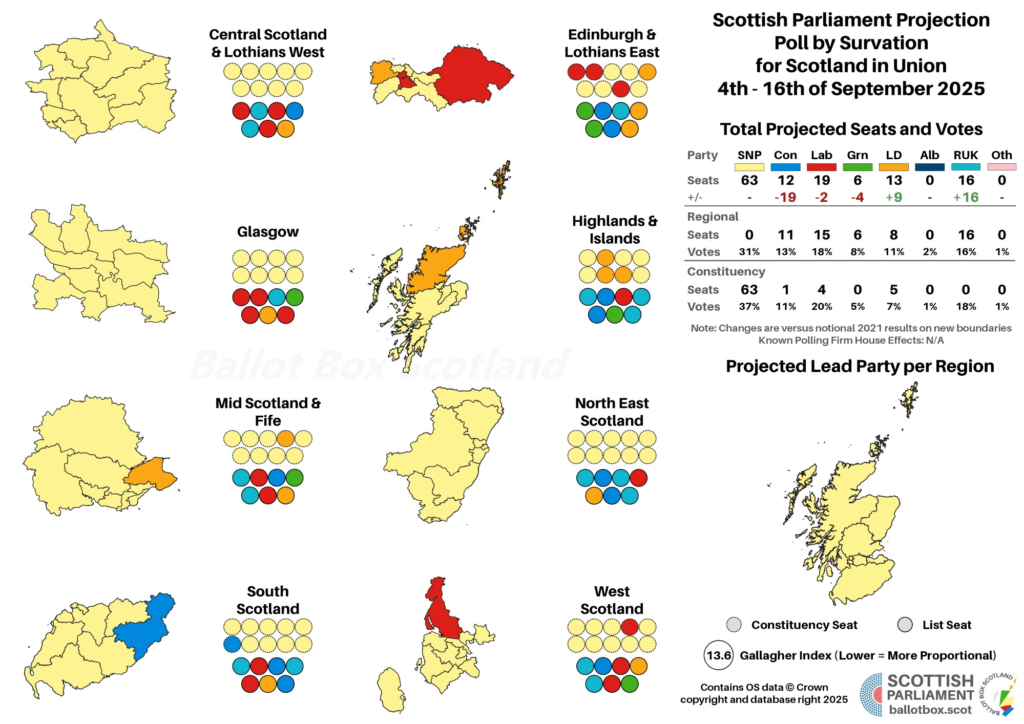
This would create an overwhelming pro-independence majority (69/60).
The Survation poll run found that Reform UK would come third in both the constituency and list votes at the 2026 Holyrood elections next May. For the Scottish Parliament constituency vote, the poll put the SNP on 37%, Labour on 20%, Reform UK on 18%, the Conservatives on 11%, the Liberal Democrats on 7%, the Greens on 5%, and Alba on 1%.
This would be a remarkable result for the SNP after so many years in office, a breakthrough for Reform UK and a disaster for Labour, the Tories and Alba.
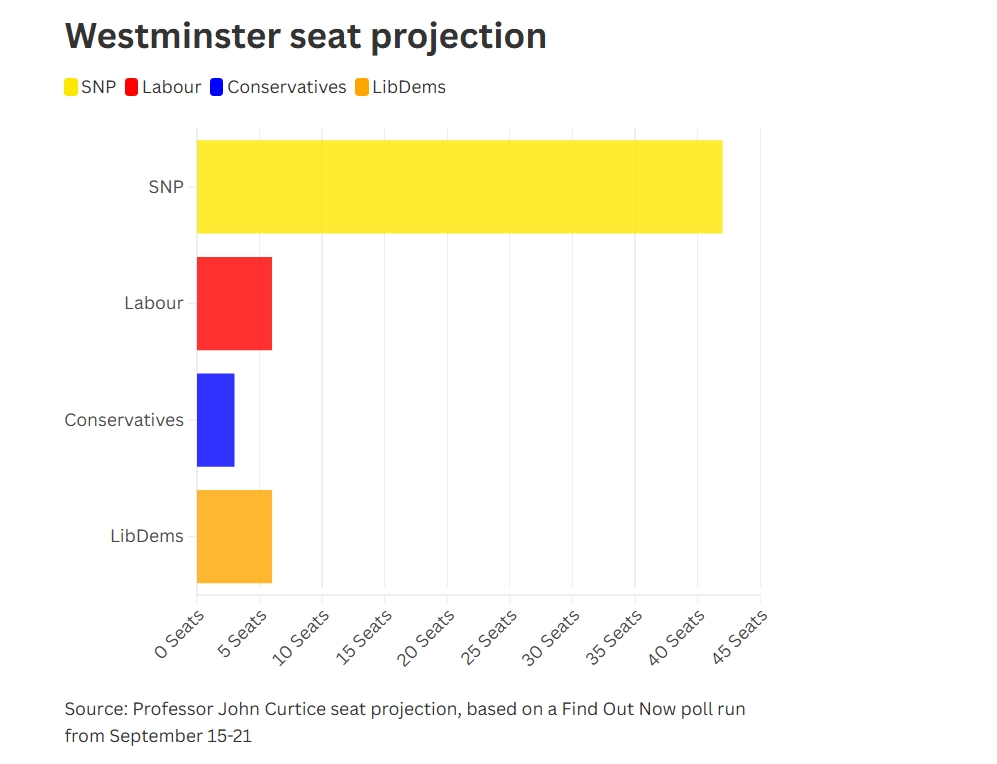
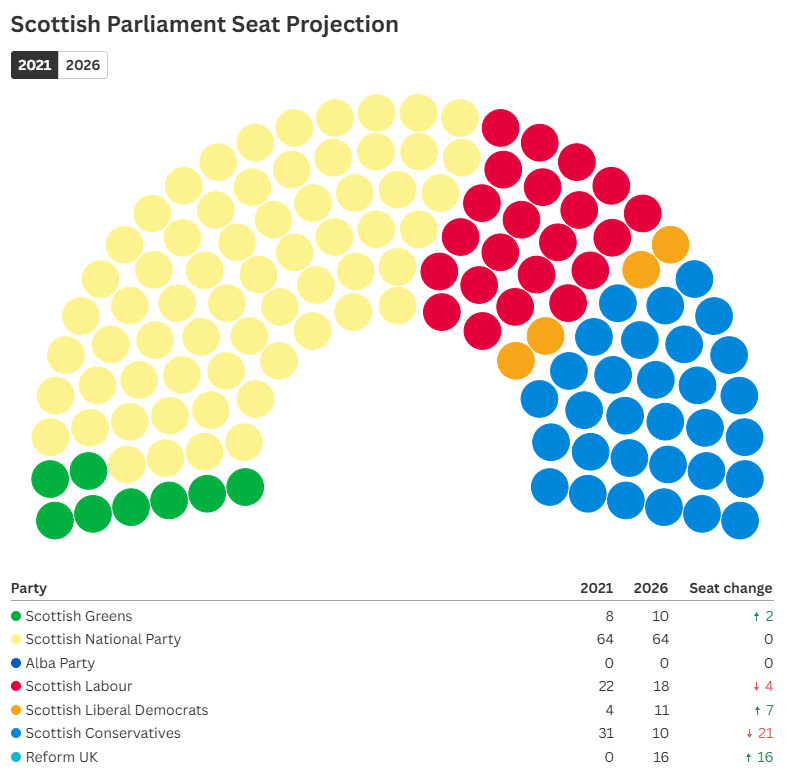
Another poll by Find Out Now for The National gave the SNP significant leads over the rest of the field in both Westminster and Holyrood voting intention. It showed that Labour would lose all but six of their Westminster seats if a new General Election were held tomorrow – and face dropping behind Reform UK at next year’s Holyrood elections.
Scenario Planning
There is then a possibility of a Farage administration being elected at the next General Election without a single Scottish MP and a pro-independence majority at Holyrood. I have said elsewhere why there are no circumstances in which a Farage regime is positive, even if it did cause a surge of support for independence. But it is simply a fact that this scenario is possible.
The collapse of Labour and the Conservatives makes the whole UK electoral map extremely unstable and unpredictable.
Some have suggested other outcomes as the prospect of a Reform victory looms. Some have suggested a scenario in which Andy Burnham defeats Keir Starmer in a Labour leadership contest, then forms an electoral pact with the Lib Dems and Green Party to form a united front against Reform, then wins the next general election and avoids catastrophe.
I think that’s called wishful thinking.
There are other factors to consider, such as the growing controversy around Morgan McSweeney, his undeclared donations of £739,000 and his links to Israel. Or the X factor, which is how Your Party emerges from its current crisis, and how the Green Party under Zack Polanski continues to thrive and grow. Or whether Reform UK manages under the scrutiny of a campaign, questions about Nigel Farage’s financial shenanigans or even their vulnerability to an attack from the right.
In Scotland, there is another question looming. There is not a single poll which shows Alba taking a single seat. Yet there are people urging you to vote for Alba, or the ISP (or Liberate/Salvo or the other one) to create a ‘super majority’. This seems irrational given the polling numbers and next May may be the endgame for the Alba party. A reminder that when Alba’s leader Kenny McAskill ran for Alloa and Grangemouth he got just 1.5% of the vote, losing out to Eva Comrie, who was an Alba splinter candidate (she got 2.1%).
A lot of this is chaos as the hegemony of British politics disintegrates. Polling is speculation, and all could change in the coming months. But there are possibilities that out of this chaos comes a better future for Scotland.

We are supported only by our readers. We don't have corporate backers and we don't take advertising, so we rely entirely on your support.
Help to support independent Scottish journalism
Imagine what the SNP vote share would have been if they had been remotely competent and had moved on such matters as radical land reform.
True, in many ways their polling figures are remarkable, and I think they are almost divorced from performance.
Scottish electorate:
1)Things aren’t great just now
2)SNP aren’t great
3)SNP have been in power too long
4)Independence isn’t going to happen anytime soon.
Why not vote for someone else?
Scottish electorate:
5)I’m not that desperate!
Frankly, I don’t think this fairly conventional form of orthodox opinion is satisfactory. Within the constraints of the Holyrood PR system (a Party List, concocted by Westminster to keep control over candidate selection away from the elector, to protect the Party system); the Scottish electorate manage what they do to defend their first priority; less to further the SNP, than to keep the major Westminster Parties out of power in Holyrood. If there was a total Scottish political census, a conviction in the mind of the electorate, we would have independence. The electorate is trying to play a game of political cat-and-mouse with Westminster. They know Holyrood gives Scotland potentially both leverage, and an ‘out’ from the chaos of the UK (Brexit wiped 4% off UK GDP, and now it is hitting home – that cost is circa £150Bn per year, and it cannot be recouped by any trade deals anywhere; and Brexit caused the immigration spike problem, because we lost the EU returns policy with Brexit – again the spike develops post the Brexit deal); but the Scottish electorate (which is very cautious) is not yet prepared to create the momentum to press the destruct button on the UK, yet. Partly, because they do not understand just how Bad Brexit is, and will be for the next generation, and they do not understand the GDP and (as important the trade deficit), allends up hitting the Budget defcit, on way or another; and that invokes the inherent austitiry policies built into the Fiscal Rules.
Westminster elections do not tell you anything. electors are not voting for Conservative or Labour (or even Reform); they vote for a Single Transferable Party, built on exactly the same principles, whoever is in power: the politics is determined solely by the Fiscal Rules; which change but only within very narrow limits. It seems neither the electorate, nor media understand the Fiscal Rules, or how they work; or how deeply embedded (along with BoE so-called ‘independence’) the Fiscal Rules are immovably established in everything in Government. The rest is PR and window-dressing.
Polling is a real mess at the moment, particularly in Scotland, and perhaps as a consequence, so is our perception of what’s going on. This is also skewed by The National’s Clickbait headlines and articles, and Yes.Scot’s memes.
Whilst a lot of people are playing up the latest National/Find Out Now poll, including both main pro-indy parties, barely anyone seems to be comparing it to their previous Indy poll back in early April, which showed the Indy Yes vote four points higher than it is now.
The well respected Ballot Box Scotland had already rejected Find Out Now polling from their own Scottish poll tracking, on the grounds of it being, and I quote here, “bollocks”. As for ‘Scot Goes Populist’, I gave up on their analysis way back in 2021 when they were bigging-up Alba at the expense of the SGP, in total contradiction to what polling was telling us. It turned out of course that the polling was right, and the host was an Alba supporter, not only unable to be objective, but was positively biased.
Just yesterday I heard someone, who really should know better, claim that “opinion polls [for Indy] are routinely over 50%”, which is a bit of a stretch, when they are currently quite mixed, with some finding for, some finding against. This “routinely” pattern hasn’t really been the case since early 2021, when pro-Indy polling was the norm for over a year, going back to 2019. And at the risk of defying the phrase, “correlation does not imply causation”, it started going backwards at about the same time as Alba appeared.
There was a return to pro-Indy polling around the Supreme Court case but that had waned by early 2023. I count that there 47 indy polls in 2023, only eight were pro-indy, five of which were from Find Out Now, including one from Alba and another from Scot Goes Populist.
I would also throw in here that last December 2024, when pro-Indy polling started to pick up again, The National ran a headline, “Poll: Scottish independence support at highest level in four years”, which I knew straight away was “bollocks” as well, from knowing about how polling had been around the SC case (as above). If you read the article, it tells you that this was only the case for this particular pollster, not all pollsters, something that Yes.Scot didn’t care about when they ran with the headline and the numbers, without this context, as a meme.
I can’t help but think that Yes.Scot (the SNP pro-indy campaign) not only wanted to run just with the headline, they didn’t want to draw attention to the fact that that rather than it being the highest placed poll for four years, it was actually just under two, which was not long after the SC decision on Indyref. Put another way, pro-Indy polling had not been the same since then and had only picked up again late last year as we started to see the “Starmer’s Labour” effect (really busting the correlation/causation thing there).
Even so, pro-Indy polling is not the norm, it’s still currently pretty mixed.
Compound this with concerns about the 2014 weighting still being used by some pollsters, which could well be skewing some polls against indy, because of the death of more older pro-union voters than pro-indy, and the voting age being reached by more pro-indy youths than pro-union youths since then, then we really have a mess from the pollsters to start with, let alone not being able to get objective analysis on those polls, except from a mere one or two sources.
Hi – yes agreed polls and polling data are a mess, its true. I deliberately quoted several different polls and tried to paint a broader picture. Rather than make any claims about polling for Yes, just pointing out that the breakdown in business as usual in British politics has ramifications way beyond Westminster.
RJ – very good overview of polling which is influenced by how question is asked and probably the ‘inherent bias’ of polling company. This shows the complete folly of those who say that an independence referendum should be held only when polling indicates a certain level of support for independence. The right to hold a referendum in a democracy can only be based on votes cast. The question – is it democratic to make decision on holding an independence referendum in Scotland based on votes cast in Scotland or in UK.?
If the answer is UK then Scotland doesn’t have democratic path to independence.
Which politicians are prepared to deal with the fallout (sometimes literally) from the British Empire?
https://www.bbc.co.uk/iplayer/episode/l0057hbn/nuclear-test-veterans-campaign-for-recognition
… once they get into office, of course.
“Hence shall we see,
If power change purpose, what our seemers be.
They exit.”
Duke, Shakespeare’s Measure for Measure, Act 1 scene 3
The British nuclear test veterans are among the most dangerous political threats to the British Establishment ever allowed on the BBC. They may even be able to right some wrongs for subject peoples.
It is essential to understand how much of an outlier (and obviously outright liar) the British Empire is here. Everyone else has paid compensation. We had Elizabeth Windsor saying ‘no’, just as she refused to apologise for Canadian Indigenous Residential Schools’ atrocities and abuses when even the Pope was forced into a (qualified and very belated) apology.
Watch this space (and their appearance at the Labour Party Conference). But hey, the British state is burying some of its secrets in a repository in the far north of Scotland, apparently, or is that another red herring? The MoD loves its secrecy. Banana republic, did someone say? Can’t the British even run a military dictatorship properly?