
Off the Map
As the political landscape of Britain shifts and morphs under the crisis of disbelief and the loss of credibility of governing parties and elites, so too does the landscape of Scottish politics. As the SNP party conference comes to a close, we are left with a roadmap for independence as laid out by First Minister John Swinney, along with a flurry of rebuttals, alternatives, and responses from across the political spectrum. We’re trying to map out the alternative visions and understand what’s going on.
The SNP Vision
After a passionate debate, the conference rejected a rebel amendment put by more than 40 local branches that set out a more fundamentalist strategy of treating next year’s election as a de facto referendum, meaning that if the SNP and other pro-independence parties win a majority of the popular vote in 2026, it should be treated as a mandate to open independence negotiations directly.
In his speech in Aberdeen John Swinney said:
“It was in part Scottish revulsion at the policies of Margaret Thatcher that catapulted Scotland towards the creation of a Scottish Parliament, and the rebirth of self-government. We became in Westminster language a “devolved nation”. Today, I believe it will be revulsion at Westminster’s race to the right that will change Scotland’s status again.
From a so-called devolved nation, to what we can be:
- A modern, outward-looking, inclusive compassionate country.
- Not a devolved nation
- But the world’s newest independent nation.
That, conference, is the fresh start Scotland needs.”
The direction chosen by the SNP member has divided some groups within the Yes movement who wanted a broad alliance of independence-supporting parties, and are dismayed at the SNPs ‘Vote SNP 1&2’ strategy. In his blog Robin McAlpine was scathing, writing: “I don’t think there is anyone in Scottish politics who is taking it seriously. Not a soul thinks this is actually going to happen.”
Not quite, Believe in Scotland announced a plan to work more closely with the SNP, decalring it: “An exciting first step to a stronger Yes movement – BiS is reaching out across the Yes movement to Reset. Reunite. Rebuild and Win.” [A New Step Towards Independence and a First Step Towards Unity: Believe in Scotland and SNP Sign Working Agreement].
The SNP move was denounced by the Scottish Greens whose co-leader Ross Greer hit back and insisted that a vote for the Scottish Greens is also a vote for independence. “Support for Scottish independence is bigger than any one party, and it is totally counterproductive for the SNP to suggest otherwise,” he said.
The Great Betrayal
The explosion of discontent with the SNP, and rage at their electoral strategy, has created a flurry of new parties and projects from the movement’s nativist wing.
Among them is Liberate Scotland: “Liberate Scotland is a bold new political party established in 2025, dedicated solely to achieving Scotland’s independence. While other parties have become mired in vanity projects and distractions, we focus on what truly matters: independence.”
Liberate Scotland is led by Eva Comrie, Colette Walker (leader of the Independence for Scotland Party), and David McHutchon leader of the Sovereignty Party (who are standing eleven candidates at Holyrood).
Liberate Scotland say they are standing twenty-two candidates at the Holyrood elections and further recruitment is in planning. They have said they have reached out to other pro-independence parties such as Alba. Their official social media account declared: “Liberate Scot is standing in Constituencies & Lists if Alba & Kenny MacAskill stood with #LiberateScotland there would be a better chance of getting genuine pro Indy candidates inside Holyrood.”
This has resonated with some within the independence movement who have called the SNP strategy ‘the great betrayal’ …
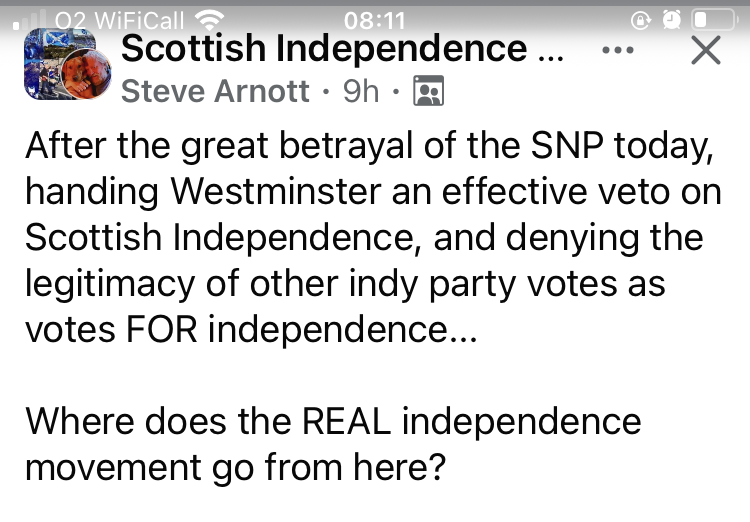
The suggestion now is that the response should be to “begin the rebuild, starting with the Constituency vote Liberate Scotland, List Vote Alba.”
This is a strange take for a number of reasons.
The various pro-independence parties have been engaged in a full-on attack on the SNP for a number of years with an ongoing critique of their various failings and uselessness. I’m not sure how they imagined the SNP was going to enter into an electoral pact with parties that have this level of hostility to them, or who barely register in polling?
It is, admittedly, a stretch of the imagination to believe that the SNP could replicate the success of the 2011 election campaign and gain an overall majority at Holyrood next year.
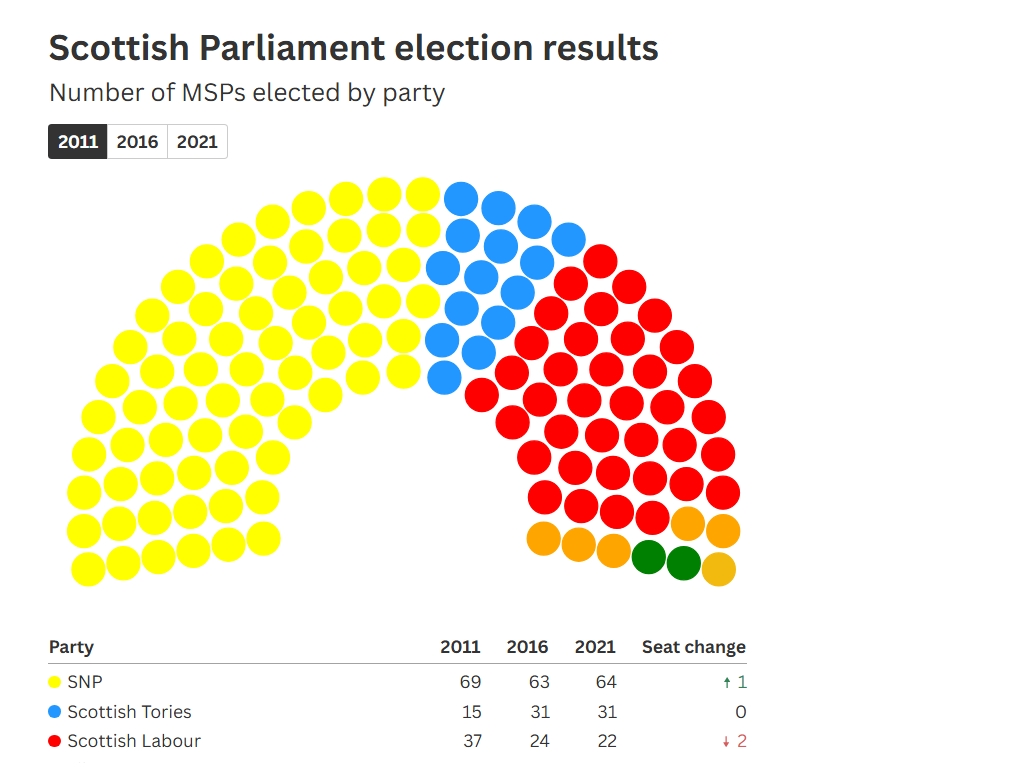 But how much more unlikely is it that the ISP/Sovereignty/Liberate/Alba get elected? This isn’t really credible.
While Liberate Scotland attempt to make an electoral pact with the Alba Party, Liberation Scotland (not to be confused) attempts to take Scotland’s case to the UN.
None of this can be taken seriously.
The widespread discontent with the SNP is real and valid, but the alternative proposals aren’t. The wings of the independence movement which seethe with anger at the SNP’s ‘betrayal’ have an odd timeline in which their demands for independence must be enacted NOW but their alternative pathways look like taking years or decades to fulfill.
In other shifts, we see the Green party leader Zack Polanski, riding high in the polls and upsetting all the right people, announce that he is in favour of Scottish and Welsh independence.
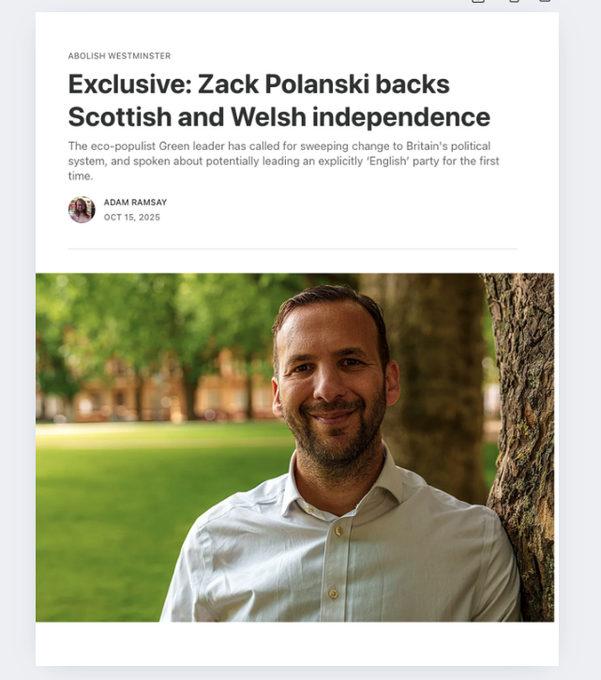
I mention this not because Jack Polanski is an answer to Scottish independence but as an example of how British politics is changing dramatically. Poll after poll shows Reform UK with its toxic political agenda on the ascendancy and Labour and the Conservative vote collapsing.
It is as if everyone has gone back to their default settings: the SNP to an electoral strategy for survival; the nationalist Left is talking to itself; and sections of the independence movement have retreated into bizarre silos of their own making.
We are off the map and need new routes and methods of orientation to navigate by. Deifying Alex Salmond or raging against ‘traitors’ does very little to progress the cause of self-determination in the real world. As ever, the need is to build political movements based in reality and involving talking to people outwith the movement and beyond the silos, in the real world.

We are supported only by our readers. We don't have corporate backers and we don't take advertising, so we rely entirely on your support.
Help to support independent Scottish journalism
Surely widening the base just dilutes the message. It didn’t work in Catalonia, the jury is out in Scotland.
That’s a killer point, I think. It’s not entirely uncharted territory.
On social media at least, Daniel Cetrà from University of Barcelona has been making the same informed observations for ages.
(His website is https://danielcetra.com/ and on xtwitter at https://x.com/DaniCetra)
“The various pro-independence parties have been engaged in a full-on attack on the SNP for a number of years with an ongoing critique of their various failings and uselessness. I’m not sure how they imagined the SNP was going to enter into an electoral pact with parties that have this level of hostility to them, or who barely register in polling?”
Time to wake up and smell the coffee! These who chose not to ‘ wheest for Indy’ have been proven completely wrong. They are a very small minority completely undermining the case for Independence.
The disproportionate coverage given to their cancerous attacks on the SNP and alternative routes completely dismissed by the electorate is also a huge part of the problem.
The Greens offer an alternative if someone wishes a greater emphasis on environmental policies , but they are unlikely to be implemented within the Union.
So anyone serious about Scotland becoming Independent must realise that the SNP is the vehicle to deliver it. It is the vehicle to communicate with the electorate at large and persuade them Indpendence is the best option to improve their own lives in their own area.
Everyone of course will be able to seek to gain support for policies differing from the SNP in an Independent Scotland .
At the moment though, with the exception of the Greens, and Believe in Scotland the views and thoughts of any other pro Independence organisations are without any support or making any impact t in the wider public.
It is questionable why any pro Independence commentator ( or Nespaper!) serious about using their platform to promote and petsuade the electorate about the case for Indroendence would choose to give airtime to them … other than for clickbait!….although proven to be successful here
How can you say that the SNP is the vehicle to deliver independence? It’s been eleven years now with three leaders. They are no longer interested in pushing for independence because some of them don’t want it, some of them don’t want it enough and all of them have no idea how to deliver it. I might like my Nissan Micra but when it’s rusted to bits, cannae start and the tyres are flat it’s time to get a new vehicle.
Mike, the reason the fringes are setting up parties and organisations is due to recognition of the SNP’s lack of ambition and cynical treatment towards their supporters. Frustration should not be mocked. All these groups should not be your target, there’s only one group to blame for our predicament and that is the SNP.
The fringes will remain on the fringe. Look at the percentage for Alba in opinion polls, for example – 1%.
I know that Alex, that is not the point.
Hi – I’m aware of why there is such frustration and I share that frustration. I am not mocking just pointing out the absurdity of arguing that the solution is now is: “begin the rebuild, starting with the Constituency vote Liberate Scotland, List Vote Alba.”
“While Liberate Scotland attempt to make an electoral pact with the Alba Party, Liberation Scotland (not to be confused) attempts to take Scotland’s case to the UN.
None of this can be taken seriously.”
I’m sorry, what? Are you lumping in Liberation Scotland (not to be confused) with Liberate Scotland?
Are you confused, or am I?
Whilst I concur over Liberate Scotland (the parties/candidates group), Liberation Scotland has already appeared at the UN, their case has already been applauded by delegates.
Murray & Baird appeared again in support of New Caledonia, which not only boosted visibility but demonstrated that they understood the nature of decolonisation and the case that needs to be made – which is more than can be said of the SNP – as responses seen from MPs/MSPs thus far indicate a fundamental lack of knowledge or understanding on their part of what the UN case is about, or how it works (I’m trying to collate them, btw, I’d like more to go on but this has been the theme so far – write to your pro-Indy MP/MSP and put them on the spot about what they think of Liberation Scotland – as seems to be the case, they may have at least one serious misunderstanding about it, if they know much at all).
I also seem to recall the SNP ScotGov going to the highest court it could to see on getting an independence referendum. It seems that such action is only acceptable when the SNP does it, not any other group of activists.
If you have lumped Liberation Scotland in with the ‘no-hopers’, you really need to explain why, because from this vantage point, they have a prima facie case which seems to tick the boxes that say that Scotland is indeed a colony (NSGT) and therefore Scotland is entitled to decolonise (have a referendum) without interference from the UK.
It seems to me at this point to be the most likely plan to succeed in getting us the right to Indyref, second of which is waiting for Zack Polanski to become PM and his allowing a Section 30, because contrary to what the SNP are telling… err… themselves really, no one believes any other PM is going to enable a S30 regardless of the makeup of the Scot Parly that asks for it.
(By the way, it is long-standing Greens policy that Scotland’s policy is a matter for the SGP, and the sub group of the Wales Greens also decide it for Wales, and they are both pro-Indy. It therefore follows that an E&W Greens Leader & PM would accede on a S30, as well as Indy for Wales).
Radio Jammor has posted some projections that demonstrate that the SNP is not only short of its 2021 tally – which was short of a majority – but that an increase in SNP1&2 votes will not gain them more than two list seats to their likely constituency haul this time around, would still leave them short of a majority, whereas SNP1SGP2 pretty much everywhere in Scotland, could mean a mass of additional pro-Indy Scot Green MSPs, at the expense of the Unionist parties. Put simply, that list vote is far more important and and has far more effect for the SGP.
The SNP would have been better off just asking their supporters to vote for them and shut-up on why, instead of going full gung-ho over getting no more than two additional seats on the list, at the expense of the SGP, who could lose most of what they have if everyone did what the SNP wants. This actually puts the pro-Indy majority at risk, if the SNP does not maintain its current level in the polls, next May, and given how many they have p***ed off since 2021, they are deluding themselves if they think their support will improve between now and May on their 2021 showing.
But sure, set your own arbitrary level for being able to ask for a S30, as opposed to the simple democratic one of a simple majority of any and all MSPs, and give the UK Gov another reason to deny such if you fall short – as the SNP are highly likely to do.
What is the end goal of Liberation Scotland’s attempt to have Scotland designated as a colony?
Answered above:
“If you have lumped Liberation Scotland in with the ‘no-hopers’, you really need to explain why, because from this vantage point, they have a prima facie case which seems to tick the boxes that say that Scotland is indeed a colony (NSGT) and therefore Scotland is entitled to decolonise (have a referendum) without interference from the UK.”
Does this need further clarification? This would be the right to vote on independence without needing to ask Westminster or go through the Scotland Act. Put another way, Liberation Scotland is seeking from the UN what ScotGov sought from the Supreme Court; Scotland’s right to self-determination.
What did you think it was?
But we still need to build grassroots support for self determination no matter what at the UN. That body is sadly depleted and we need to be realistic about what we can expect from them. Whereas mass popular support is harder to ignore.
WE do need to build grassroots support for self determination but we also need to reach beyond the base, sorry if that was what you were suggesting. Roz Foyers speech was very good and interesting and there is a huge opportunity as people who leant their vote to Labour in 2024 leave in droves. This already seen in polling. You’re right that the Scotland Demands Better demo in Edinburgh is a great opportunity but I think there needs to be a more fundamental review, critique of the case so far and it for it to be re-made. I also think that the issue of how you build deeper institutional support across society is key, so that stakeholders such as unions, housing activists, anti-poverty campaigners and other civil bodies are on board to build a huge coalition in support is needed, and not just for them to be passively in support but building and understanding the case. The efforts up until now have been shallow, low-brow, superficial and self-indulgent.
Don’t disagree on needing more support for Indy, but not the rest. First of all, popular support has been ignored since 2014, the “No” side has not lived up to its ‘federalism’ claim, which has proved to not only be a false claim but essentially not possible, with England holding sway, as well as the ‘internal market’, etc.
Subsequent demands/requests for a S30 were ignored, despite the mandate of the majority vote in the Scot Parly.
The UN can give us the right to a referendum that Westminster denies us. The UK cannot ‘veto’ this, as some claim, because the veto does not apply to either the Decolonisation Committee or the General Assembly, where the matter is decided, but to the Security Council (and new member states at the UN, which would only be relevant after we’ve already voted on Indy and gone Indy).
I might add that the UN recognising that we are a non-self governing territory AKA colony would destroy the pretence of ‘union of equals’, federalism, etc, which in itself is likely to open blinkered eyes and raise support for a “Yes” vote.
The bigger question is why don’t the SNP or the SGP support this, at least verbally? Whilst Liberation Scotland has to be a membership org to qualify to get in the room, and not be a political party of itself, that doesn’t prevent parties from saying, “We support this, we wish it luck”, as it is another route to Indy.
I think it has a lot to do with the realisation that the parties cannot do this themselves and are essentially powerless to act, except benevolently and say to their members & supporters that it’s OK to be a part of this and support it.
They haven’t done that.
As mentioned before, some of the elected members have demonstrated significant ignorance or error within their personal mentions of this, and you’d expect them to be better informed. It seems most are hedging their bets and staying quiet, but Liberation Scotland are already presenting at the UN, three years now after their inception. They have better resources than I do – and I don’t claim to be 100% on all this myself – but my knowledge certainly seems to eclipse theirs.
Yes I do think this needs further clarification. Both the process and the legality are obscure and not understood by the general population.
You asked a succinct question and I gave a pretty succinct answer. I can try with the rest but for details, you really need to delve into the websites and documents and speeches on the Lib Scotland site and in the SSRG videos on Youtube. You have at least the resources available to you as I do.
The criteria is best described by Alf Baird, whose appearance at the UN in Geneva can be found at https://www.youtube.com/watch?v=wFZtgZos9A0.
“The UN criteria for classification as a non-self-governing territory is articulated in general assembly resolution 1541 and includes three key indicators. (1) The territory is geographically separate from the administering power. (2) The people of the territory are ethnically, culturally or linguistically distinct from the dominant population of the administering power (England/UK). (3) And the territory lacks a full measure of self-government. Scotland satisfies all three indicators.”
Re 1: Scotland has a long-standing border, regardless of whether or not there are border controls on all parts of it.
Re 2: The “or” is important here, as I don’t think ‘ethnically’ will fly (personal opinion), although plenty of argument can be made about the ‘indigenous’ but culturally should, as does Scots language, which they can and do argue has been suppressed since 1707.
Murray wore his traditional kilt & regalia to demonstrate that Scottish culture is universally recognised as distinct and Baird spoke well on post-colonial theory, which arises from the study of former colonies, and how colonised peoples can react and adopt the traits of the “Administrative Power” (UN term for the colonising power), which over time means people have no understanding of the difference between being colonised or completely free. For a classic example, see our blog post on Pete Wishart (“We regret to announce… Pete Wishart has been colonised”).
Re 3: We clearly do not have a full measure of Government, with a 26 year old devolved government with limited powers, which we now know explicitly forbids self-determination of our own accord, without the OK of the UK Gov, who can arbitrarily refuse as there is no objective criteria in place for enabling such (despite what the SNP might have people believe).
The end-game here is to get a ruling that means Scotland can bypass the UK and have a referendum as and when it chooses.
As for process, that seems to be a little murky and I am trying to get clarity on that myself. It seems that the matter bounces between the Decolonisation Committee and the General Assembly. The UK is only involved with the latter. It cannot stop this, cannot veto this, but at some point will undoubtedly get to speak to it.
I might add that a “no” on being a colony may still bring a positive outcome. The UN may address the matter of self-determination of Scotland and its status as a nation, as well as that of the UK, and how it registered itself – and Scotland – with the UN originally, with either outcome. This could prove to be a win-win situation, but at the moment, that’s some way off and speculative.
To be clear, I’m well aware of the project but I think its deeply problematic.
Oh, an addendum: if you think Liberation Scotland could do a better job of communicating what it is doing, I would be inclined to agree.
There does seem to be something of a ‘bunker mentality’ there, following on from efforts to hijack the website (Unionists or MI5, or perhaps crooks after donations, who knows), but the lack of support from the main parties I think has led to them feeling somewhat isolated from all sides and not so willing to put their heads above the parapet, communicating more internally than externally.
They already believe the SNP are ‘briefing’ against them, which I think they lack evidence for, but may not be wrong about. For all they really know, it could just be Pete Wishart doing all the mouthing behind the scenes (I suspect him of speaking to a Nat journo and filling his head with rubbish on this), but this is where the paranoia comes from and is set alight by.
I don’t think it helps that the ‘central cast’ of Liberation Scotland includes the likes of Craig Murray and Sara Salyers and their Alba history, even if their participation and knowledge is proving to be central here. This may well go to the heart of why the SNP & SGP are both essentially quiet on this, not offering support, and with individual exceptions that frankly lack knowledge and merit, not condemning it, either.
Why is it deeply problematic? You make this accusation without any explanation or basis. Are you Pete Wishart in disguise, or has he just bent your ear?
Seriously, explain yourself. What are you seeing or thinking that no one else has managed to articulate in three years? Because no one actually has articulated any negative reason that has any merit whatsoever on taking this to the UN.
I see no problem whatsoever in a people forming a Liberation Movement – because that is what was needed – to go to the UN to argue over Scotland’s political status, when we all know the situation Scotland and Scots are in is BS and undemocratic and we are getting nowhere within the UK.
Are we a colony and therefore can we decolonise, or are we a nation with rights already that means we can decide if we want to leave the UK of our own accord?
The question is being asked at the highest international level. What is so problematic about that?
It’s not an accusation it’s an observation, and no Pete Wishart hasn’t bent my ear. Never met him, don’t know him. Don’t hate him either.
Why is it problematic? I think for a variety of reasons. I have POC on my whassap among independence supporters who argue that it is problematic to label Scotland as a colony in the same way as some of the nations and peoples who were subject to brutal repression of the British Empire. Our colonisation is/was different and this difference matters.
Second is about process. I didn’t elect Alf Baird or Craig Murray to represent me.
Third, the process of ‘decolonisation’ is an actual thing with people working on it for years. It’s a complex process that we wrote a series of articles about it by writers of colour. You might read it?
“Why is it problematic? I think for a variety of reasons. I have POC on my whassap among independence supporters who argue that it is problematic to label Scotland as a colony in the same way as some of the nations and peoples who were subject to brutal repression of the British Empire. Our colonisation is/was different and this difference matters.”
That’s at best arguable, as it still amounts to the same thing as actually occurred in Scotland. Think deportations and clearances. The wars, the economic depression, the exploitation of resources. That argument boils down to no instance ever being exactly the same, but whether there are sufficient similarities with colonised countries for Scotland to meet the criteria, not the least of which, is ‘full measure of government’.
As has been mentioned elsewhere, the people having the most trouble accepting this are Scots, for the very reason that they have been colonised and subject to centuries of propaganda and colonisation! There seems to be a better understanding of all this at the UN than within Scotland.
They applauded when Murray called England a “force for evil”. These other countries that have been decolonised had their own “parcel of rogues”. They get that better than Scots do. Why? They’ve been decolonised. They’re past it.
But most importantly, again, that kind of discussion is looking at it from the wrong perspective, of making comparisons with other countries as opposed to thinking of this as a case in law, with objective criteria, and whether Scotland meets the criteria that the UN sets out. It is their criteria that matters, not anyone else’s subjective definition of the word colony.
“Second is about process. I didn’t elect Alf Baird or Craig Murray to represent me.”
That’s not quite how it is, but not knowing that is on you. You’ve had three years to join. The AGM is tomorrow. You’re bitching about your own choice to not be involved rather than a lack of actual democratic choice with it. I frankly expect better from you than a complaint like that, where more fingers point back at you than elsewhere.
“Third, the process of ‘decolonisation’ is an actual thing with people working on it for years. It’s a complex process that we wrote a series of articles about it by writers of colour. You might read it?”
I don’t need it. I’m not the one struggling with the concept.
I’m broadly aware of what it is and can be, so if I do feel inclined to gen up more, I can do so, but I’m good for now, thanks.
It’s also a bit different from what we’re really talking about, because that all comes later, if/when the UN says, ‘Scotland is a colony’, and shock and realisation sets in. At this stage, we don’t know for sure if that is going to be an issue at all, but really, how is that going to be that much different from staunch unionists needing to adjust to a Yes vote and independence, should that happen, and removing/replacing the British establishment from independent Scottish life?
Seems to me that independence may well put some people into therapy, one way or another, however it comes about, so why hold an issue over this way as opposed to any other, when you’re going to have similar issues whichever way it happens?
You’re usually far more objective than you are being here, and I can’t help wonder why?
I’m going to throw in that I can be dismissive of Alba as a party and its chances at an election, as well as others, because objectively, there are really only two parties to consider, but at the same time be open to something like Liberation Scotland, which does admittedly have these smaller party members involved with it, but acting in an individual capacity and not as a political party.
Can you say the same? What is your real beef here? Because these points you make are really poor, and it smells like there is more behind it than you are saying.
Or are you the one struggling with the concept of being colonised? Perhaps you should read Radio Jammor’s blog posts.
Despite the flaws that I’ve seen behind the scenes (such as presenting their own case to Scots and getting it better understood, which we’ve already seen noticeable improvements in of late), which they can get over, or address as they go, and are certainly far from insurmountable, they are mounting a credible case at the UN which could result in an independence referendum being held, but better than a S30 instance, as it would be one where the UK can’t interfere.
So what’s the problem with that? Why all these hurdles being thrown in the way of giving this its due? They are there! They have started! It isn’t pie in the sky. Take it seriously!
I can’t help but think that the usual party political lines are being applied here, by too many people, to an organisation that it is not, of itself, party political.
Is that true of you? I think it just might be.
Arguing that the colonisation of Scotland was the same as the colonisation of indigenous people across the world by the British Empire is wild. I’ve invited you to explore the idea of decolonisation and you can’t be bothered.
Cannot the SG hold a referendum anyway? I know it would not be binding so would be consultative but I don’t think there is anything stopping them organising a vote. I am wondering what difference any UN mandate would really have – persuading the UK government that such a vote had to be binding? Would the UK government have to go along with it? Either way, you would still be in the same position and with the same problem – unless the majority of the populace across the UK and crucially, the vast majority in Scotland believe in the legitimacy of the vote, it could be boycotted by many and so won’t give the legitimate mandate required, UN approval or not.
I respect those trying this approach, it has raised lots of interesting questions about colonialism but the problem is do the majority of people really think Scotland is a colony of England, like say, India, the US or even Ireland was? I don’t think they do because, well, it isn’t.
Niemand – ultimately why does a vote on independence in Scotland require majority support across UK? Having lived elsewhere in Uk I can tell you that majority basically don’t really have strong feelings on Scottish independence if they think about it at all. Imagine the response if UK had allowed EU the final say on whether UK could hold a referendum on leaving EU?
You then talk about a vast majority in Scotland as a vague term. How would you define it and how you ascertain that there was this level of support? Opinion polling is in my opinion undemocratic and no way to decide such issues. The outcome can be easily distorted depending on how the data is collected.
The long and short of this whole debate shows that a Holyrood mandate is by far the best democratic method of assessing whether there should be an independence referendum. Westminster should accept this and negotiate with Holyrood how this mandate should be exercised.
The best democratic way of assessing whether Scotland should be an independent country or not is by a referendum as the 85% turnout at last referendum proved. Westminster’s refusal to agree to Holyrood request to hold another referendum after 10 years (& Brexit) is primarily down to fear that Yes may well win this time.
Meantime Scotland is stuck in a kafkaesque situation where Westminster can block indefinitely the wishes of Scottish electorate while the British nationalist Reform train is hurtling down the track towards us.
I was only speculating on what would work, not the rights and wrongs – any referendum would need major support in Scotland to work (I agree England is not so relevant, just helpful given the large populace inevitably having a strong influence on the UK government, though the EU comparison does not work for fairly obvious, if annoying reasons).
If those who did not support a referendum because they did not consider the colonial argument correct even with UN approval, just did not vote (and campaigned for that) and if that was focussed on one group (i.e. unionists I suppose) then do you think the vote would have legitimacy? This was not an issue in 2014 shown by the turnout.
This is all speculation but cannot be ignored – a referendum only works if it can show a genuine mandate and certainly given the import of the decision here. Can you imagine a declaration of independence based on a voter turnout of, say, less than 50% going well?
Niemand – there is a principle here which is that whether Scotland should be independent or not should be up to Scottish electorate to decide alone. If Westminster rather than Holyrood holds the power as to whether a referendum should be held this in effect means that Westminster has the power on independence in Scotland rather than Holyrood. Westminster is elected by British electorate (90% outwith Scotland) so in effect this means that Scottish electorate do not have the overall right to decide their democratic future.
If Westminster continues to oppose another referendum then an SNP government at Holyrood will have little option but to speedily look for alternative routes to allow electorate in Scotland to express their wishes. One alternative is Holyrood holding a referendum without Westminster consent in which case I am sure the opponents of independence would try to boycott and invalidate it. In such circumstances the supporters of independence would need to exceed their vote of 2014 and probably the No vote (37% of total electorate). This level of support is possible especially if there is the likelihood of a Reform government at Westminster and the Yes side (especially SNP) layout clear pathway to achieve independence in light of a successful vote.
“Cannot the SG hold a referendum anyway?”
No. It won’t get on the floor. Look back at how the matter went from the Scot Parly to the Supreme Court (SC). The Lord Advocate (LA) could not certify or qualify that the matter was within the competency of the Scottish Parliament so it went to the SC for a ruling. The ruling was that it was not, therefore the LA check would fail.
Polls are arranged by local authorities and would need a legal basis to compel them to act & provide all the polling stations, booths, ballots, pencils, staff, lists, etc.
“I respect those trying this approach, it has raised lots of interesting questions about colonialism but the problem is do the majority of people really think Scotland is a colony of England, like say, India, the US or even Ireland was? I don’t think they do because, well, it isn’t.”
This is the ‘Pete Wishart argument’ and it is fundamentally flawed and totally (and in his case, wilfully) misunderstands the entire thing.
Think of the UN as a court that is making a legal ruling. Because essentially, it is.
The UN has criteria that defines what a non-self governing territory AKA colony is (see previous posts in this topic), because there is an objective set of criteria that can be applied. How you, or I, or Pete Wishart, or anyone else “feels” about Scotland being a colony, is irrelevant. As with a guilty or not guilty verdict, or any other verdict or court decision, the court tells us the outcome, not the other way around. It will base its judgement on evidence provided to it by Liberation Scotland, as I am sure it will also take evidence from the UK.
Therefore any Unionist whining on not accepting the legitimacy of being called a colony will have no basis for doing so. That would have already been determined. If they don’t want to vote, all the more for a majority for us.
As Professor Baird points out, post-colonial theory informs us that those colonised know no other situation, so their understanding of what a colony or being colonised is, is based on what the coloniser tells us it is, which is particularly applicable here, because it is England/UK and when English is still regarded as the primary language in the world.
Again, see other posts in this topic, or check Radio Jammor’s blog posts, “Scotland a colony? But I dinna want to be called a colony!” and “We regret to announce… Pete Wishart has been colonised”. Both of those deal with your particular issues.
Someone objective needs to look at this matter with objective criteria and tell us if we are a colony or not. Something so immeasurable or intangible or subjective as how you feel or think about whether Scotland is a colony, is impossible to accurately gauge, especially from those who are arguably colonised, and is therefore useless as a determining factor in this or in any kind of legal matter. So why give that any kind of credence here?
If the verdict is that we are a colony, that is instant legitimacy and we got the right to decolonise. Scotland gets added to the list of non-self governing territories that still remain as such.
This ruling would confirm the lie of “federalism” and the “Voluntary member of a Union”. And as already said, a “no” decision still may have positive repercussions, because, what then is Scotland’s political status, if not that of a colony? Do we not have the right to self-determination as a nation, per the UN charter?
This means the right to hold a vote on independence, the Scotland Act be damned, because it will be superseded. Indeed, I’m not sure whether or not Holyrood would have anything to do with it. This is an area where I’m still seeking clarity and confirmation, but as I currently understand it (which I stand to be corrected on), this would be overseen by the UN with international observers. The UK would have nothing to do with Scotland holding it, so it follows that the devolved government would have nothing to do with it, either.
Let’s also remember that if this does succeed, it hasn’t had anything to do with the Scottish Parliament at any point thus far.
There is also the point that if it is accepted that Scotland is a colony, what does that mean for the UK at the UN?
How people feel about the colony question or indeed others regarding independence is not at all irrelevant, quite the opposite, which is why what you are saying is largely falling on deaf ears. You cannot base a case on technicalities – and besides I have looked at the UN criteria and the arguments of Baird etc and they don’t stack up on all the criteria anyway (e.g. colonial ‘occupation’ i.e. all those English simply living in Scotland?). Scotland is not a colony of England and that is not a Wishart argument, it is mine. I dunno, just maybe the UN would agree it is and it would be very interesting to see what happened then. If it led to a referendum then great, a victory for the approach, but if the campaign was then one about colonialism, then that could well backfire because of what people *feel* about that and may make any referendum lack validity for quite a few voters.
John, I agree about the principles but that was not what I was arguing. In a way, what I was talking about is when principles intersect with / face up to reality and practicality. Only by considering this will change happen and at least some of the principles put into practice.
@Niemand, yes, the United Nations has a formal process and a Special Committee on Decolonization (C-24) that meets every year:
https://www.un.org/dppa/decolonization/en/c24/about
I would suggest this is where the serious stuff is discussed. In its latest 2025 session, various colonies of the UK/British Empire were discussed. Scotland is not among them.
Even if in future some organ of the United Nations rules that Scotland is a colony, that doesn’t mean it has ever been such a colony historically, or was a colony at the last referendum on Independence. Historically, Scotland (as a mass collective effort) tried and failed to establish its own colonial regime at Darien, and this ‘disaster’ was an important factor in Scottish support for the Treaty of Union, along with access to English ports and the slave trade. So many modern states were established without anything approaching universal franchise that democratic consent hardly seems relevant (beyond rather abstract discussions of general will etc).
In any case, Scots were very prominent participants in British Empire and colonisation right the way through society, so it’s no use claiming that this was an elite project (and of course some Scots got rich in the Caribbean plantations, opium trade or British military service and became part of the elite, some founding political dynasties).
Niemand – many thanks for your response. I, personally, have never thought of Scotland as a colony though it will be interesting to see what UN says. Notice how, despite the UK’s government continuing denial of genocide in Gaza, the UN declaration on this issue has undermined the government’s denial. As regards the practical difficulties in alternative routes to independence in face of ongoing Westminster refusal to support a referendum you are right but I would respond by saying that history shows that where there is a will there is a way. The question for SNP if they form next Holyrood government with a pro independence majority will be do they have the will to find a way? If they don’t have the willingness to find an alternative way to independence, especially if it looks as if Reform will form next Westminster government, the SNP will lose all credibility as the political wing of independence movement.
Sleeping Dog you are correct to point out Scotland’s previous history of colonialism both prior to and post 1707. The wish to make a complete break from this colonial past is one factor in my support for independence.
And the other thing about the Scotland as colony trope that is not being said here, perhaps out of politeness, is that people like Alf Baird are nativists and out-and-out anti-English, who seriously discuss the deportation of English people from Scotland, ‘the colonial occupation force’, plus others they do not consider true-born Scots because immigration is diluting Scottishness generally. They wish at the very least to disenfranchise such tax-paying voters from any future referendum. They deny the iniquities of Scots working for the British Empire as exaggerated and even then, done only as the actions of the brainwashed colonised (or ‘traitors’ who took the ‘bribes’). In fact everything wrong with Scotland is a result of the apparent colonial condition, leaving Scots a bit like zombies who, not knowing that, don’t even know their own minds.
You do not have to look very hard to find all these views expressed by Baird and some of his acolytes. They are blood and soil nationalists whose views in an English guise would be those of Reform or even the BNP. And that is without discussing the deeply reactionary social conservatism.
It is shame as there is a kind of colonial-like relationship between England and Scotland, pretty obviously, that could be discussed and used as good arguments for independence, but it is way more complicated than Alf Baird’s continual references to colonial theorists talking about Western powers’ empires of the classic colonial era that do not map across no matter how much he says they do. Endless repetition and assertion is not an argument, but it gets round having to actually address the fallacies and bigotry.
Yes, indeed. There are also clear links between elements of the nationalist movement and the far-right, for example links between members of Sovereignty and the Scottish Family Party and the Freedom Alliance among others. I’m not sure how useful it is to surface all of this but I’ve been tracking it for some time.
When you have colonial status it opens up routes to a referendum via the international community, not the colonial power, the fact that England is the continuing state, ie it’s statute books go back to magnacarta, while Scotland was whipped off the record means no new state as was hoped in the act of union was created, Scotland has been absorbed into England, hence it’s colonial status, never mind many of the other criteria Scotland meets, so it’s to give another avenue to the people and make them aware of the context of themselves in the loved reality of the UK, not good morning Britain land.
This is a thinking person’s item needing some thinking time.
I left SNP recently after 35 years and the recent “Fresh Start” proposed at Conference last week, in my opinion, justifies this. Why does the SNP leadership not see the obvious. The Polls for SNP are at 30% and the polls for Independence are around 50%. Surely we should be trying to combine forces – talk to each other to create a “super Group majority”. It seems so obvious, it’s in plain sight.
The huge elephant in the room from that Conference (and Fresh Start) is the Currency, Yes I have seen Kate Forbes interview and she did well. But this was a brilliant opportunity to highlight the benefits of creating our own Currency. SNP after so much power has created a glass ceiling on the subject. are they feart?
Scottish Currency Group is well prepared for this, both organising it and giving huge benefit to Scottish people.
A good simple example is that with our own currency, we could create/fund the building of 10,000 council houses without any increase in taxation. What’s not to like about that?
We need to challenge the unseeing SNP.
As far as the SNP are concerned, this is settled. They have agreed to move to a Scottish currency after starting with the pound.
As is par for the course with the SNP (and tbf politicians generally), the language is vague and woolly so as to give them the maximum wiggle room on delivery. You’re not likely to get movement on that. That’s politicians for you.
I don’t agree that it was the elephant in the room as much as their daft deceit over the 2011 referendum result needing to be repeated to enable a S30. This is purely about getting as many SNP MSPs as they possibly can, no matter how it may affect the pro-Indy majority.
Whilst I am sympathetic to your views on currency and believe you do have the right plan on it, clearly the SNP think the country will need time to adjust, right or wrong.
There is also the SNP needing to move slowly away from its Growth Commission recommendation. A purely political consideration, although I agree that on the face of it, they do seem to be settling at least on the appearance of a longer lead-in that we might like on changing currency. Again however, they are being vague enough so that it could be sooner than it suggests. Or not.
No, there are two problems with currency, which are to get the SNP to commit to a more radical and faster implementation of a Scottish currency, and use the time between a Yes vote and Indy day one to do most if not all of the implementation, but the other is to actually communicate policy, because there still seems to be plenty of people of either side of independence who do not have a clue what it is, and still think policy on it hasn’t moved since 2014.
Clearly we need to have our own Scottish currency alive and ready to go on the day we actually leave the UK and become a functioning independent nation. That’s likely to be some time after the public vote to leave is achieved, as negotiations with Westminster will be necessary to agree how the separation can be achieved. Think land borders, pensions, energy sales etc to be thrashed out with Westminster.
We also need to decide on which European body suits our needs most: EU, EFTA or EEA, then negotiate our membership. Similar discussions will be needed re our currency’s international acceptance and the linkage of our banking system internationally. There’s also the process of arranging embassies with foreign powers, joining the UN etc.
My guess is we’ll need at best three years to complete all these steps before we can become truly independent and internationally active. The critical mistake of 2014 was the suicidal policy of piggy-backing the GB£ without Westminster’s agreement and thereby having our entire economy under Westminster’s control. When Radio Jammor writes of SNP ‘moving to a Scottish currency after starting with the pound’, I read that as meaning that we’d use the GB£ until the negotiations are settled and we are ready to leave the UK and become a truly independent and active state.
This would also require the UK to accept our people’s decision to leave and to continue the status quo re Scotland’s finances until the necessary negotiations are complete. We all know we’re dealing with ‘Perfidious Albion’, so we need to prevent them from slowing the process in order to maximise extraction of Scotland’s assets e.g. energy, water, VAT etc.
“When Radio Jammor writes of SNP ‘moving to a Scottish currency after starting with the pound’, I read that as meaning that we’d use the GB£ until the negotiations are settled and we are ready to leave the UK and become a truly independent and active state.”
The SNP language is so woolly and vague, it could be read that way, but I don’t think you should. I would read it as meaning that the SNP will continue with the UK£ after day one of Indy and will at some point move to a Scottish currency.
I also think you forget that the SNP previously set a fixed date for independence, for March 2016, 18 months after Indyref, if there was a “Yes” vote. TBF I don’t think they could have gone into the referendum with anything woolly, such as, ‘whenever we finish negotiations with the UK and have a currency ready to go’. The No campaign would have had a field day with that.
I would expect something similar in the event of Indyref2.
What does ‘independence’ actually mean? It seems nobody is really talking about this. It isn’t a binary choice. My personal experience over the last five years has ben that every party in Scotland has betrayed its members and is bought and sold for international corporate gold. None of them would give us independence from the billionaires and fascists who now own Westminster.
This means that the only ‘independence’ currently on offer is a sham. Under the SNP, we currently have a deeply corrupt Scotland where no authority can be held to account and the rule of law and democracy are both effectively dead. But it would be no better under any other existing party, except possibly the English and Welsh Greens, who don’t stand here.
The destruction and depopulation of the highlands for corporate greed is unforgivable, and putting some people and organisations above the law is unforgivable. There is nothing ‘green’ about a freeport, which just gives away our sovereignty to corporate crime. That is but one betrayal among many. Such a parcel of rogues in a nation.
I simply do not believe that the SNP have any intention of delivering independence. It is just a political game they play with us. Even if it actually happened, any so-called ‘independence’ delivered by the SNP would be in name only. Scotland would still be dictated to by billionaires and fascists, just as other former colonies are still controlled through debt and sometimes ‘regime change’. The Americans and others would still own and exploit our oil and other resources. The chances of actually removing Faslane and leaving NATO are effectively nil with the SNP in charge, because they are just a puppet government, and do as they are told. A neoliberal ‘independence’ is no better than Vichy France or Quisling’s Norway. Swinney’s weasel words are all about keeping the SNP in power and all others out, and keeping the plutocrats who now own Washington and Westminster happy. The less I say about the utter betrayal of me and other long-established members and activists by the Scottish Greens, the better.
There is currently no party in Scotland I can vote for. I need a positive reason to vote. I need a candidate who will stand up for constituents. people and planet every time, if necessary against a party machine and party donors and influencers. Voting for a ‘least worst’ candidate is a wasted vote. At the last local election, and again at the Westminster election, having contacted candidates, I spoiled my ballot. Sadly it looks like this could be a third time. A pox on them all.
The principle of Scotland’s self-determination is simply not negotiable, and it does not require Westminster’s (or Trump’s, or Musk’s, or Thiel’s, or the World Economic Forum’s) approval. It is legally enshrined in the Claim of Right, which even the king has sworn to uphold. We need politicians who will fearlessly stand up for that principle. If there is a majority in the Scots Parliament, from any party, that will do that, it can simply be enacted. Holyrood is the voice of the sovereign people of Scotland. It is not a mere County Council, as Westminster would have it. We just needs candidates, of any party, Unionists included, who will stand up for that principle. Having established that, let us have a public ebate about what a genuinely independent Scotland would look like.
For me at least, the first requirement must be that all are equal before the law, with equal access to the law, and ‘crown immunity’ is abolished. And the ECHR is firmly embedded in our domestic legislation to make our human rights defensible. And all our authorities at all levels must be fully accountable to the public. We urgently need to kick out the private water companies from Scotland where they are draining public money into their private pockets. We need a moratorium on electricity and telecomms infrastructure pending a full independent review of the pros and cons. The national energy grids, our roads, railways, telecomms networks must be inalienably and fully in public hands. We need to decentralise governance and localise and democratise power. Let’s learn from the Scandinavian countries. We need to stop giving away our resources and start putting people and planet before corporate greed. We need to build a network of more circular economies, that respect the interrelationship of people and nature, and reduce our reliance on fast-collapsing globalism.
Most if not all of this could be done right now, but which party will deliver these things? So far not one of them. They all distract us with their political games.
You do not mention “Our Party’. They seem to be signed up to Scottish self-determination. It will be interesting to see if they can take off because if they do it will be a game changer.
“You do not mention “Our Party’. They seem to be signed up to Scottish self-determination. It will be interesting to see if they can take off because if they do it will be a game changer.”
1. They barely exist. 2. There is no evidence that they are signed-up to “Scottish self-determination”. What is you source?
“Jim Monaghan is a member of the steering group Collective Scotland which is tasked with setting up the as-yet-unnamed party north of the Border and previously told The National it would be open to “candidates and members” on both sides of the constitutional debate.
He has now clarified the Corbyn-Sultana project’s stance, saying: “We’re so far away now from having a position on that.” – July 2025. Do you have something more recent?
@John Wood, yes, even if somehow this future SNP-controlled path led to some kind of formal secession from the UK, it would be a mandate for a Scottish Establishment in hock to at least two Empires (the British and USAmerican), who would control the constitutional process and quickly eliminate radical and moderate alternatives (I imagine).
This exclusionary SNP approach would put off people who see Scottish Independence as the surest way of getting rid of the SNP, with its royalist, NATO, nuclearist, neoliberal, neocolonialist, War-on-Nature baggage/deathwish, who would be (are) ripe for infiltration and taking over by foreign interests long before ink on a new constitution dried or a new state was recognised, or a new flag raised.
Sadly in all of this, the discussion has centred around the questionable, problematic and notional Will of the Scottish People, not the Health of the biomes within the designated land, sea and air areas and volumes that a new jurisdiction would occupy. We have the science to ask the question, what is good for the non-humans? What would an Independent Scotland do for the living planet?
#biocracynow
Well said
I’m not convinced about reverting to default. Roz Foyer spoke to the SNP conference in a very interesting move supporting independence and providing a roll call of SNP successes. What was the STUC backing about? sounds like a very hopeful move there. And the Scotland Demands Better demo in Edinburgh on the 25th is a great opportunity for supporters of independence to be there, making the argument as to how wew can do better in an independent country.
I read this shortly after seeing the latest polling from Caerphilly byelection campaign with Plaid and REform neck and neck. Apparently many Labour voters have moved to Reform. We must take note.
Cathie – from my reading the shift from Labour to Reform in Caerphilly poll was mainly amongst older voters while the shift to Plaid was younger voters. I lived in Wales and there are significant differences with Scotland with more people feeling both British & Welsh and far more support for Royal Family. I am not so sure that quite as many Labour voters will switch to Reform on Scotland as in Wales but Tories will be swallowed up by Reform in both countries.
The big similarity is the apparent collapse in Labour vote after being main party in Wales for many years which mimics what happened in Scotland in last 20 years. The rise in support for Labour at 2024 GE in Scotland may well turn out to be an aberration due to disillusionment with Westminster and Holyrood governments and Labour not having been tainted by being in power for over a decade.
“I also think that the issue of how you build deeper institutional support across society is key, so that stakeholders such as unions, housing activists, anti-poverty campaigners and other civil bodies are on board to build a huge coalition in support is needed, and not just for them to be passively in support but building “and understanding the case. The efforts up until now have been shallow, low-brow, superficial and self-indulgent.”
The ignorance of what the SNP do and have done is breathtaking. Of course it may not be ignorance just willfully refusing to share, promote , endorse or even discuss it ……Is Roz Foyer speaking at the SNP conference shallow etc?
Clearly, the SNP are seeking to maximise their support in the coming election, and to extract every last seat they can under the current system. But then so are the Greens and Alba, who depend on pro-independence supporters to vote for them on the list. None of this is surprising. What is surprising is that it should create so much ill-feeling – though I suspect that much of this is performative. It does not follow from the SNP’s electoral strategy that they think that they are only only they are pro-independence: why in that case would they have bothered with signing a collaboration agreement with Believe in Scotland?
As always, there’s party politics, and there’s movement politics. Unsurprisingly, they are sometimes in tension. I wish both the SNP and the Scottish Greens well in the forthcoming election and will get on with promoting a broad, and healthily diverse, pro-independence movement – starting with developing pro-independence support for next weekend’s Scotland Deserves Better march rightly highlighted by Cathie Lloyd.
Paddy, whilst there isn’t really anything new or surprising about the political party free-for-all at Holyrood yet again, it doesn’t make it any less disappointing.
What’s particularly bad this time around is this utter nonsense and deceit from the SNP over the 2011 results and taking them as a necessary precedent that will give us a S30, when no one outside of gullible SNP voters believes that.
This is not 2011, there isn’t 27% polling in favour of Indy, there wasn’t the uncertainty over whether or not Holyrood could legislate for a referendum or not, which Salmond had as a card he could negotiate with, and potentially go around Westminster and make happen (at , so Cameron, thinking it was an easy win and wanting at least some control over the referendum, as well as wanting to appear magnanimous, enabled it.
None of those circumstances exist now, so no one believes that Starmer will allow such (especially seeing as he has already said “no”), and the only way it might happen anytime in the foreseeable future, will be if Zack Polanski becomes PM.
This is notwithstanding the likelihood that the SNP will fail on this anyway, as they did in 2016 and 2021, and when they are polling at a lower level than 2021 and after aggravating a lot of people in the last five years who might have otherwise voted for them – oh and the fact that the regional list is still going to massively restrict their ability to pick up anything more than two MSPs from the list, because of the likely level of constituency wins still being so high, even if less than 2021.
Indeed, the SNP1&2 stance may lose the pro-Indy majority if the SNP vote takes any kind of tumble from where it is now and SNP1 voters don’t vote SGP2 in enough numbers to make up the SNP constituency shortfall with SGP list MSPs. The list vote means much more to the Greens than it does to the SNP.
It all begs the question as to whether or not Swinney will even ask for a S30 if there is, as polling indicates, a pro-Indy majority rather than an SNP majority. It then also begs the question that if he does ask in that situation, whether or not Starmer (or whoever is PM) might reject it on the very grounds the SNP have offered up, as not having a party majority.
In any event, a ‘no’ remains a democratic outrage, but we could have a situation where the SNP has raised the bar of their own accord, which the PM, who can use any arbitrary excuse they like, might gladly accept and use the one the SNP has given them.
What then for the SNP and its standing within the Indy movement?
Ugh, ignore the “(at” in the third paragraph above, was going to add something there and neglected to remove what I started to write after I changed my mind.
Edit button, where art thou?
Sadly the SNP are not a credible party of independence anymore. In fact, they seem determined to avoid it ever happening. Alex Salmond was the last serious independence leader. The overall majority he achieved for the SNP was done by presenting list candidates as ‘Alex Salond for First Minister’ rather than SNP, neatly avoiding the trap set by our voting system. Alex Salmond for First Minister also came alphabetically at the top of the list of candidates, where no-one could miss it. After complaints from the Unionist parties, that was ruled out in future. So Salmond created ‘Alba’ with the idea that people could vote Alba on the list and ASNP on tin the constituencies. But ever since, the ASNP have demanded SNP 1 and 2, which shoots themselves in the foot. I think the SNP, for some reason, turned into a ‘Vichy’ party. Their freeports, and their NPF4, are just policies straight from the Charles’s friends at the World Economic Forum.
This may be as much as anything because they have internalised the psychology of the colonised, who after centuries of imperial contempt for them, come to believe that they are too wee too poor too stupid to think and act for themselves. Still, if we really believe that Zack Polanski really holds the key to independence, it’s deeply ironic that he and his party do not stand in Scotland! It is actually nonsense that we require the approval of British Prime Minister to take back our self-determination.
No colony – and yes, Scotland most certainly is a colony – has ever achieved its independence by waiting on the election of a friendly British Prime Minister. Our independence is and always was entirely in our own hands, although we can certainly expect Westminster (and the king of course) to fight us by any means they can. These are people who are right now committing genocide in Palestine. They think nothing of it. Wait for support for Scottish independence to be proscribed. It could easily become an arrestable offence to display a Saltire!
The dissolution of the UK is going to happen anyway. It is the inevitable tide of history. Instead of being afraid of Charles II and his Prime Minister, we just need to assert ourselves – peacefully but firmly. And it has to have a direction to it. Just saying we are not ‘better together’ with Westminster, but offering no actual alternative to its neoliberalism is not good enough. That’s why I think Your Party is the best potential vehicle, assuming it takes off. It covers England Scotland and Wales and so far, it seems, is in favour of Scottish self determination. With its stated principles how could it not be?
https://www.thenational.scot/news/25423117.zarah-sultana-sends-message-scottish-branch-party/
I hink this is most likely to happen through ‘Your Party’
“Arguing that the colonisation of Scotland was the same as the colonisation of indigenous people across the world by the British Empire is wild. I’ve invited you to explore the idea of decolonisation and you can’t be bothered.”
Outrageous response.
Second part first; I already told you – and you wilfully ignored – that I understand what decolonisation is and would mean here, and you ignored my point in response that you are going to get similar issues regardless of how Indy comes about. Seems I understand it better than you do.
“Arguing that the colonisation of Scotland was the same as the colonisation of indigenous people across the world by the British Empire is wild.”
That’s you wilfully misrepresenting what was actually stated, and utterly failing to grasp that this is not a game of “my colonisation was bigger and worse than your colonisation”.
Your problem is that you cannot conceive that it could have happened here to white people, as opposed to “POC” thousands of miles away. You think you’re above it. You think it couldn’t possibly have happened to you. You think this can only apply to ‘them’, not you.
You’re more like Pete Wishart than you realise. Now go and read post-colonial theory. You’re demonstrating the signs of having been colonised, just as he has.
Your additional problem is that you still do not comprehend that this is a legal case, and you don’t present it to the gallery, you present it to the court, because it is the court that decides.
I don’t care if there is a league table of colonised nations which Scotland comes last in, Dalglish is out injured and Alan Rough is in goal. The actual goal here is to be recognised as it having happened here. It’s not a question of degree, it’s a question of yes or no. The ballgame is being in the ballgame. And that does not get decided by anecdotal evidence and comparison to exactly what happened elsewhere, which is exactly what you are doing. It gets decided against objective criteria, already laid out and repeated here, if you might bother to properly read the rest of the comments. Because you clearly haven’t bothered yourself to check the resolution referred to, the commentary Alf Baird made, or the other speeches and presentations made, to demonstrate how Scotland meets the stated criteria of being a colony.
I don’t know that this case will pass muster, but it’s worth a shot based on what the criteria is and what did happen in and to Scotland.
Hopefully their legal, political, diplomatic and presentation skills at the UN are better than they have demonstrated on other domestic matters. But tbf, so far, so good.
But most of all, your responses, and inclusion of Liberation Scotland in this piece, you have repeatedly demonstrated as being based on your own ignorance rather than any significant knowledge, which is why you’re wrong to lump it in, even if some of the people involved are the same as those you do rightly include.
I’m done here, particularly after those unimpressive and cheap shots.
I hope you are not done here! I agree that Scotland is a colonised country.
That colonisation was a slow but exponential process, starting in Roman times. The various Angles, Saxons, Jutes, Frisians, and other Northern European tribes, having joined forces and taken over the Roman province of Britannia, also took over its claim to rule the whole island. And ever since the English and Welsh alike have claimed to be the successors of Rome, although ‘Britannia’ only ever really referred to the southern part of the island of Alba (or Albion). Tacitus puts a rousing speech into the mouth of Calgacus before the battle of Mons Graupius that still resonates today. The tribes around the Roman frontier region however could be bribed and bought off, and benefit from cross border trade. That frontier was always a region rather than a binary line.
The Normans and their successors, especially of course Edward I made inroads into southern Scotland, but during the medieval period the far north and west of the country was ruled by the kingdom of Norway. There has been an internal process of colonisation that continued into the 16th century.
it was not until James VI went down to London and invented ‘Great Britain’ that colonisation of Scotland as a whole began in earnest. James was also responsible for ‘planting’ Ulster. The Highlands especially were indeed regarded by London as wild ‘native’ people who needed to be subdued and suppressed. Throughout the 17th century the crown followed a policy of divide and rule here as it did everywhere. James didn’t manage to incorporate the Scottish Parliament into England’s, but Cromwell, Europe’s first military dictator, nevertheless invaded Scotland with a ‘Parliamentary’ army. Then we had the coup d’etat of 1707. Some Scots understandably saw their future as serving the growing Empire, just as happened in every colony.
The final act of military conquest was in 1746. A military infrastructure of roads, forts, barracks, etc was imposed and there was ferocious ethnic cleansing of the Highlands, mass murder, and horrific abuse of innocent ordinary people, including even those who had supported the Hanoverian cause. The land and assets re seized and ruthlessly exploited and destroyed. Colonial attitudes persisted, and I think we are still seeing the psychological and economic consequences today. No-one wants to think about all that. Suddenly the Empire no longer seems something to be ‘proud’ of. Many families contain ancestors who suffered, and may also have ancestors who contributed to the horror by commission or omission. In the Highlands, history is best forgotten. Scotland played an active part in the slave trade and the dispossessed and deported found themselves forced to kill and dispossess native peoples elsewhere. But all this is a standard pattern that was repeated across the British Empire and o doubt many others, including Rome.
The ‘entitled’ attitudes of those in power continue today, although the British Empire has been taken over by America. As Nietszche said, morality is for slaves. The current horror in Palestine is just the latest example. A few weeks ago, Trump gave a fawning speech at Windsor castle, praising the British Empire and America’s debt to it. Today, there are ‘No Kings’ protests across America: https://www.bbc.co.uk/news/articles/c93xgyp1zv4o
But Scotland remains silent. Flower of Scotland, When will we see your like again? Not anywhere in the SNP, or any other current political party I think.