
The Empire is Alive and Kicking and its Legacy Still With Us
The Empire is Alive and Kicking and its Legacy Still With Us
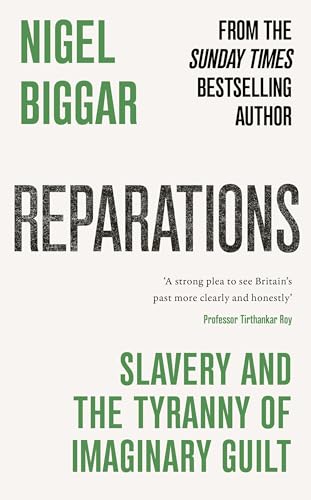
Nigel Biggar, Reparations: Slavery and the Tyranny of Imaginary Guilt, Forum, £20.
Review by Alan Lester
Nigel Biggar is the right-wing’s pro-Empire champion. In Colonialism: A Moral Reckoning he went into battle against historians and anti-racist campaigners who identify British colonialism’s record of violence and racism. Judging his own selective history of the British empire, he found it to be morally justified. Now Biggar is fighting off demands for reparations for Britain’s complicity in Atlantic slavery. He has found no shortage of support in the right-leaning press. Dismissing critics of Biggar’s previous work, as unfit, “intellectually or morally, to kiss Biggar’s boots”, Simon Heffer concludes in The Telegraph, “Let this be the end of the ‘reparations’ bilge”. Biggar himself has been gifted articles promoting the book in the The Telegraph and the Daily Mail, The Telegraph has interviewed him and The Spectator has published another affirmative review and podcast interview.
Biggar decides that calls for reparations are best represented by Brattle and Beckles. The Brattle report was a theoretical exercise to establish what Britain might owe Caribbean countries, in principle, for the unpaid wages of generations of enslaved workers, trauma and compound interest. It would amount to some $17 trillion. Despite what Biggar says, that is not what is being demanded. Hilary Beckles is the Caribbean historian who has long championed reparations claims by focusing on Britain’s involvement in trans-Atlantic slavery and undermining him as untrustworthy is one of Biggar’s main objectives. His most valid critique is that Beckles’ initial attempt to argue for reparations denied African slave traders’ complicity in trans-Atlantic trafficking.
At no point, however, does Biggar discuss the nature of the reparative measures that are actually being demanded by CARICOM, the association of Caribbean states. Perhaps this is because they sound far more reasonable than the spectre of hard-pressed British taxpayers paying unimaginable sums to people for whom they have no personal responsibility. It might have saved a lot of time if Biggar had concentrated less on Brattle and Beckles and more on CARICOM’s insistence on developmental assistance, partial debt relief and technological aid, along with a formal apology. In many respects, these demands accord with what Biggar himself ultimately judges reasonable: selective aid from a relatively wealthy Britain to relatively poor Caribbean states for which Britain had responsibility over several centuries, and with which it retains ‘cultural, institutional, legal and sometimes constitutional links’.
Rather than explore such common ground though, Biggar devotes the bulk of his book to exonerating Britain from criticism, berating those who highlight its historic crimes, and excusing the nation from a sense of guilt that is largely illusory.
The History
Biggar is mainly right about historic slavery in general. It has been a constant feature of human history on all inhabited continents. Slave trading from Africa predated the Europeans’ trans-Atlantic slave trade which came along with the exploitation of the New World. Although he presents the very highest, implausible, estimate for the numbers of Africans trafficked into various parts of the Muslim world, it is reasonable to assume that this trafficking was on a scale roughly equivalent to the trans-Atlantic trade, albeit over a far longer duration.
Like many others though, Biggar describes Barbary, Ottoman, Omani and Sahelian slaveries alike as ‘Islamic’, while eschewing description of the trans-Atlantic slave trade as ‘Christian’. He does not point out why historians can pin down the numbers involved in the slave trade to the New World (12.5 million at least) far more accurately than those falling prey to these other slave trades: because the Europeans’ trafficking and plantation agriculture was a novel system of capital accumulation requiring meticulous account books. Each captive was itemised as a unit of capital stock upon which credit could be leveraged, as well as unpaid labour for a planation economy whose investors were often absentees living in Britain.
Biggar is aware that forms of enslavement differed; that in the ‘Muslim’ world and within Africa, slavery was more often female-oriented and domestic, more a signification of wealth than a means to generate it. But he is inconsistent on whether non-European forms of slavery should be seen as any ‘milder’. When discussing Britons’ complicity in trans-Atlantic slavery, he argues that all slave practices were equally inhumane, but when he explains why the British tolerated African domestic forms of slavery as they extended control over parts of the continent in the aftermath of abolition, he explains that this was slavery in its mildest form.
Biggar also neglects to mention another key characteristic of trans-Atlantic slavery: its explicitly racial dimension. In the slave codes of British American and Caribbean colonies the words ‘Negro’ and ‘slave’ were interchangeable because, uniquely, only Black people were held captive, overwhelmingly by white people. Although some Black people became free (fewer than in African and ‘Islamic’ slave societies), status and the inter-generational transmission of wealth continued to be defined by race long after abolition.
Biggar cites the recent and most comprehensive history of trans-Atlantic slavery by the historian who has done most to enumerate it, David Eltis. However, only insofar as Eltis is sceptical about slavery’s relative significance for Britain’s Industrial Revolution and draws historians’ attention to other nations’ slave trading. Eltis’ contextualisation of the Europeans’ Atlantic plantation system, dominated by Britain between the 1740s and 1807, is less convenient.
Unremarked by Biggar, Eltis writes that “the consequences” of Europeans’ pioneering capital-intensive system of slavery were “much more devastating than the huge transcontinental land-based slave trafficking that existed in Eurasia in the preceding centuries.” He approves of “raising the profile of the slave trade in the catalogue of catastrophic cruelties that our species has inflicted on itself” and, most inconveniently for Biggar, confirms that “By contrast” with every other form of slavery, ancient or modern, the enslavement of Africans in the Atlantic continues to feed into deep modern social inequities”. Eltis concludes that “the transatlantic slave trade” will “come to be treated with the detachment that historians assume in evaluating, say, the slave trade generated by the Roman, Mongol, Islamic, and Latin empires” only “when Black/White income differentials” and other measures of disparity in criminal justice, health, housing and education, associated with it “disappear”.
Biggar might draw selectively on Eltis to quibble with the scale of trans-Atlantic slavery’s contribution to Britain’s Industrial Revolution, but he cannot deny that it was one of its propellants. He might lean on Eltis to point to the absence of early industrialisation in Portugal, which engaged in slave trading more prolifically and over a longer period than Britain, and he might argue that Britain’s institutional and resource advantages (mainly in accessible coal reserves) were the real causes of its early industrialisation. But such is the weight of recent historical research on slavery’s role within the British economy (not Eltis’ specialism), that it is no longer plausible to conceive of the Industrial Revolution without its input. Unless, that is, one tries to do so counterfactually.
Klas Rönnbäck estimates that direct and indirect economic activities connected with the African slave trade and plantation slavery was equivalent to 11% of Great Britain’s eighteenth-century GDP overall. Plantations in the American colonies were almost three times as economically valuable as Scotland, twice as valuable as Ireland and perhaps equivalent to industrialising Lancashire and Yorkshire combined. Joseph Inikori estimated that in 1770, the slave trade and the broader plantation economy combined were furnishing as much as fifty-five percent of Great Britain’s gross fixed capital formation investment, a measure of how much of the new value added in an economy is invested rather than consumed. Industrialisation was a cake made of various ingredients. Without slavery as one of those ingredients, Britain’s pioneering form of it would have turned out very differently.
Since he is unable entirely to extricate slavery from Britain’s economic prosperity, Biggar tries to get the nation off the hook by emphasising its leading role first in the abolition of slavery and then in the subsequent development of the Caribbean. Surely these must mean that any moral and economic dues have already been paid?
British antislavery should not be discounted: it could be a powerful reformative force, not just in the Atlantic world but the Indian Ocean arena too. Britain did indeed lead the way in coercing other countries to abolish their trans-Atlantic slave trades. However, that did not amount to an abandonment of white Britons’ coercion of Black people’s labour. Antislavery was a genuine force but it resulted in imperial interventions only where it coincided with other, more self-interested objectives. Indeed, much of the history of the British Empire in the second half of the nineteenth century was driven by the need to reconcile antislavery rhetoric with the right to exploit the resources and labour of new colonies. Interventions in the name of antislavery were the precursor to the Scramble for Africa, again led by Britain.
Even as the Royal Navy’s West Africa Squadron was suppressing what slave-trading it could in the Atlantic, the captives it supposedly ‘freed’ were assigned to work for colonists in West Africa, the Caribbean and Central and South America as unpaid ‘apprentices’; domestic forms of slavery continued in British-ruled India as well as African protectorates and colonies until such time as their suppression might bring Britons other strategic or economic advantages and, of course no enslaved person in the Caribbean received recompense of any kind when slavery was abolished, whilst their owners were paid a sum of £20 million, equivalent to 40 per cent of annual Treasury revenue in compensation. Much of this windfall was invested in new colonising ventures overseas, in consolidating Britain’s industrial and financial advantages at home, and in absentee owners’ family inheritances.
Biggar cites the historian Howard Johnson (in The Oxford History of the British Empire), who wrote of the development schemes devised by the British government for its colonies from 1929 through to the post-WWII period, to argue that development assistance should also be considered as prior reparation. However, his citation is, once again, remarkably selective.
Johnson notes that such schemes were belated, reluctant measures forced by waves of strikes, riots and protests. These were prompted by “great disparities in the distribution of wealth and privilege along racial lines” and Britain’s failure to discharge its governmental responsibilities for the descendants of enslaved peoples’ welfare. In 1938 the Poor Man’s Improvement Land Settlement and Labour Association, a peasant organisation founded by Robert E. Rumble in Jamaica, petitioned the government: “We want freedom in this hundredth year of our Emancipation. We are still economic Slaves, burdened in paying rent to Landlords who are sucking out our vitalities”’.
The tipping point came when the US government and American fruit and mining companies complained that Britain’s failure to attend to immiseration was jeopardising the security of investment. Even then, Johnson notes that the main objective of the first development scheme devised in London was to relieve unemployment in Britain’s heavy industry. W. Arthur Lewis, a West Indian and former Colonial Office official commented in 1945 that “the use of a microscope would hardly reveal any progress on the development side”.
Furthermore, Johnson argues that any developmental effect was curtailed by Britain’s decision to freeze Caribbean colonial governments’ sterling reserve assets so they could be used to prop up Britain’s own wartime economy. Far from seeing development as British recompense for slavery as Biggar suggests, Johnson argues that Britain continued actively to underdevelop the Caribbean.
The Moral Arguments
Biggar may be wrong about developmental assistance, but he is right that others practised slavery too, that many African polities were complicit, and that slavery was merely one among other factors that made Britian rich. Surprisingly for a theologian though, he fails to establish why any of these observations are relevant for a moral case against British reparative justice.
He acknowledges that slavery was wrong. If others practise a wrong too, does that make it less of a wrong? If the Church of England, whose reparative scheme he targets, engaged in less slave trading than some have claimed, and less profitably than has been claimed, but was still invested in the trafficking of some 40,000 captives, does that mean it no longer has anything to atone for? How many people would it have had to have invested in trafficking, and what kind of profits should it have made, for it to have incurred a moral obligation?
If Britain led the way in abolishing trans-Atlantic slavery but immediately introduced and maintained exploitative racial hierarchies over ever greater swathes of the world, does that mean it is morally cleansed of complicity? Wasn’t the leader of the antislavery campaign in the House of Commons, Thomas Fowell Buxton, morally right when saying in 1823 that something more than the mere cessation and partial suppression of enslavement was needed: “We owe large and liberal atonement … We still have it in our power to make some compensation”. And wasn’t his fellow abolitionist George Stephen right that compensation paid to enslavers rather than the enslaved was a further, “indirect participation in the crime”? Finally, since Africans also engaged extensively in the selling of other people, does that mean that the Europeans who profited are exempt from complicity? Biggar provides answers to none of these moral questions. He does not even ask them.
Precedents
Of course, even a prima facie moral case does not mean that reparations will ensue. Reparations have been much-demanded in modern history and little-conceded. Biggar mentions perhaps the closest precedent for any British-Commonwealth reparative negotiation: that between the Federal Republic of Germany, Israel, and the Jewish Claims Conference representing the Jewish diaspora after the Holocaust. He draws a negative lesson. The German reparations ‘made good sense’, he asserts, only because they were paid to people who had directly experienced the trauma and their “surviving family members”: a clear disconnect from slavery reparations claims. His argument though, is based on a misrepresentation of the German precedent.
Germany has paid reparations over a span of decades, far more to the benefit of contemporary Jewish descendants than to Holocaust survivors and their immediate descendants. In an ongoing programme begun in 1952, Germany has distributed 80 billion Euros, helping to pay for Israel’s electrification, merchant shipping and militarisation. There are lessons to be drawn from the German precedent, just not that which Biggar draws. The agreement did not reflect any legal precedent and was unrelated to any established body of law. Many Germans fiercely opposed even a discussion about reparations at a time when much of the German population itself was struggling to survive, and many Jews thought of reparations as anathema if they suggested any kind of atonement or reconciliation. Palestinian leaders were also appalled, given that 750,000 Palestinians had just been displaced by the state that was to benefit. There was no attempt to gloss over ‘the unspeakable and criminal acts perpetrated against the Jewish people’, but equally there was ‘no suggestion that the German people … should bear any guilt for these crimes’. Interestingly, the fact that people other than Germans, even including some Jews, were complicit in the surrender of Jews to the Nazi authorities, was disregarded in the interest of securing agreement.
Although reconciliation was never the agreement’s official aim, it steered Germany and Israel towards mutually beneficial relationships, which have only recently been strained due to the genocide in Gaza. Israel’s signatory, Foreign Minister Moshe Sharett declared that that ‘The settlement will play a crucial role … as a historic precedent for the whole world’. The former UN Special Rapporteur Pablo de Greiff described it as ‘the historical referent for most reparations programs’ to this day’, and it has indeed been cited as a precedent in reparative justice cases in Cambodia, Rwanda and South Africa.
The German precedent suggests that the parties involved in reparations discussions make it up as they go along, usually amidst contending claims and outright opposition to any form of agreement. But the most important lesson is that of realpolitik: reparations will be negotiated only where there is a convergence of interest.
The West German government was willing to enter negotiations because it needed new allies, legitimacy and a restoration of German global leverage. Reparations were not just a matter of morality; they were an investment in Germany’s future as a globally respected and relevant state. The pertinent question is whether any British government might come to see the national interest being advanced through relationship-building, the restoration of legitimacy and perhaps even moral leadership within the Commonwealth?
There is in fact, an even closer precedent for the kind of conversation that CARICOM is demanding, although it has been forgotten. It was the unrealised promise of British developmental assistance for the Caribbean that Howard Johnson noted. Just before freezing Caribbean assets, in 1938 the British government formed the Barbados and Trinidad Commissions of Inquiry into the riots and strikes. It published a report that “drew attention to defective social services and recommended improvements in the health service, sanitation and housing”. For a moment, British officials were poised to offer “a long-term policy of reconstruction for the West Indian colonies, requiring substantial Treasury assistance”. They recommended a West Indian Welfare Fund, to be financed by an annual grant of £1m (£57m today) from the British Government over a twenty-year period. In 1940, when the commission’s findings were published, the Colonial Office “recognised the propaganda value which such a programme of colonial development would have during wartime”. The Colonial Development and Welfare act of 1940 promised £5m (£285m today) annually for ten years on “everything which ministers to the physical, mental, or moral development of the colonial peoples of whom we are trustees”. In today’s terms that would be a package of £2.9 billion, already promised but never delivered because of Britian’s wartime reliance on Caribbean resources.
To me it seems a shame that Biggar concludes his account not with the constructive search for common ground around such additional developmental assistance, which might, if only he were able to accept national critique, be acknowledged as reparative. However, instead he digresses into the histories of British settler colonialism in Australia and Canada in an effort to exonerate British settlers of culpability for the destruction of Indigenous societies. Restoring the tarnished reputation of British colonialism and pride in the British nation is Biggar’s real objective. Any constructive discussion of reparative justice for trans-Atlantic slavery, one of the greatest crimes against humanity in modern history, must be sacrificed to that end.

We are supported only by our readers. We don't have corporate backers and we don't take advertising, so we rely entirely on your support.
Help to support independent Scottish journalism
Why not give poorer nations aid because it’s our human duty to aid them, like Zakat? I think that is basically how UK government aid works anyway.
Alan appears to think that he sould be fined and maybe imprisoned for the sins of his forebearers 200 years ago. Maybe he flagellates himself every night for all I know.
I don’t see how reparations can conceivably be defined as ‘self-flagellation’ by the author or anyone else
Thanks for the comment. There’s a difference between distributive justice or charity/aid and reparative justice. The latter requires admission of a wrong and some commitment to put it right. Aid has been repeatedly cut and is now spent increasingly within Britain, leaving places like Jamaica less prepared to respond to natural disasters, and aid flows are counteracted by interest payments on debts incurred in Caribbean nations’ attempts to develop. Finally I said nothing about fines or imprisonment and I’d be really grateful if you could get any image of me self-flagellating that you’ve bizarrely decided to conjure up out of your head? Thanks.
Well, yes, Biggar is merely the tatty, pop-eyed, stuffed animal strapped inelegantly to the radiator grille of the ever-trundling British Imperial trash-wagon as its hangers-on rake up discarded ideas from the dustbin of history.
I think Caricom sum up their point on maldevelopment thus:
“For 400 years the trade and production policies of Europe could be summed up in the British slogan: ‘not a nail is to be made in the colonies’.”
If you consider mental enslavement too, then you have the Great British narco-state’s Opium Wars, Christian missionaries, culturecide and propaganda campaigns. There are many kinds of unfree/forced labour in the formal and informal British Empire that surely merit more scrutiny. Even British subjects were pressed into navy etc, whilst seedier kinds of human exploitation also reportedly happened under royal prerogatives at home.
Further, the West India Interest appears largely to have captured Parliament, at least up until the ‘Great’ Reform Act of 1832. Because of the dynastic nature of British politics, dynasties formed through chattel slavery, imperial military service and colonisation profiteers still hold political office and influence today. It’s a long shadow.
https://en.wikipedia.org/wiki/West_India_Interest
The Guardian has commemorated the anniversary of the 5th Pan-African Congress in Manchester which provided some pithy quotes and context about the resistance to British colonial rule in 1945. Incidentally, Zeinab Badawi’s An African History of Africa (2024) deals with the issues of African slavery on West and East coasts with apparent clarity.
But yes, the British Empire is still here (and still falling foul of United Nations decolonisation efforts). I read somewhere that a big tranche of Hong Kong documents might be available to historians for the first time in the foreseeable future. Combined with the growing republican pressure for royal transparency, the desecretisation pipeline might be coughing up a few shocks soon.
Thanks. Clare Anderson’s work is great on the various forms of unfree labour in the British Empire, both before and after the abolition of slavery.
This is an interesting thread, with some useful sources. The reparations debate (inviting politicised sides to be taken), however serves to occlude the history; treating what historical research has been carried out to date has revealed everything that is needed to understand the underlying historical issues. This is false.
Part of the problem is that the first, critically important historian to challenge the inadequacy of the British orthodox history of slavery (an exercise in apologetics) was Eric Williams courageous ‘Capitalism and Slavery (1944), much against the mainstream historical grain. After Williams the history had to be rewritten; but Williams was a Marxist writing in a toxic ideological age, that turned the historical debate into a rehearsal of then current political ideological dogmas, from which it has never quite emerged unscathed. Much of it has not aged well, and it now goes round in circles.
More valuable work is still to be done. One obvious area is a comparison between American plantation slavery, and British Caribbean plantation slavery. The brutal facts requiring inspection here, are the slave attrition rates. The slavery business model developed in the eighteenth century, slowly bifurcated following American Independence, in the US and the Caribbean, on this critical matter. America slowly became less dependent on the slave trade, as they discovered that an environment in which slave reproduction was not repressed, and that stimulated birth and survival rates (deliberately or not), did not depend so heavily on replenishment from the expensive African slave trade.
In the Caribbean, the slave death rate was extremely high for a variety of reasons, the slave plantation business model remained totally dependent on the slave trade, and the British did not adapt to changing circumstances. The internal tensions were greater, and highlighted by the autonomy and successful resistance of the Maroons. The real crisis on which abolition of the slave trade rested was the Haitian revolution (an alarming signal not lost on the British Government). At that point the writing was on the wall for the formal collapse of slavery in the colonies (but not informally – the business model continued, largely unchanged in practical terms – there were serious uprisings, and brutal suppressions of the manumitted into the 1860s, because the conditions did not materially change greatly). Even the plantation owners were looking for a way out by the mid 1820s; and abolition was achieved in 1833, by the Government paying the slaveholders vast sums to free them (the slaves received nothing, but a largely formal and technical ‘freedom’). The history of abolition needs some more rewriting, and the relationship between the abolition settlement, and the financing of industrialisation in Britain in the 1830s and 1840s also needs reworked. There is much still to do. I have, of course packaged too much in a short comment; but i think it needed said. Cut it any way you like; you need not read 21st century standards into the 19th century, to see this is is not a pretty picture.
“treating what historical research has been carried out to date has revealed everything that is needed to understand the underlying historical issues. This is false.”
This should read: “treating what historical research has been carried out to date as revealing everything that is needed, to understand the underlying historical issues. This is false.”
Festina lente.
I agree John!
@John S Warren, I am pretty sure that the appalling nature of British racialised chattel slavery was put into the public domain very early on (perhaps you consider these ‘first drafts of history’), not least by some of those who had been enslaved, like Olaudah Equiano. And abolitionists like Elizabeth Heyrick were campaigning for consumer boycotts very much like movements today, which shows joined-up or systems thinking. The state version was blockades (I hadn’t come across Jules Verne’s The Blockade Runners — Les forceurs de blocus — until recently, which describes Scottish complicity in breaking the Northern USA’s blockade on the slaveholding Confederacy, as featured in Episode 3 of BBC documentary series Clydebuilt: The Ships that Built the Commonwealth).
Verne’s literary career is interesting in terms of what editors and translators may have achieved in suppressing his critical ideas, and surely that was the fate of many others. Perhaps we just don’t read as much critical British history because it is written in languages other than English and not (well) translated or made accessible. I think this is one of the issues that Atlantic History was developed for, to break imperial history out of its silos and to weave other historical narratives into a coherent graspable system.
https://en.wikipedia.org/wiki/Atlantic_history
Certainly we should avoid temptations to whitewash the reputations of the opponents of the evil British racialised chattel slavery and colonialism. The Jamaican Maroons were complicit in perpetuating slavery on the island, returning runaways to the plantation owners as part of a treaty that at least one modern Maroon spokesperson has recently apologised for.
You are surely correct to suggest that our core of ethics is timeless and beyond place or culture. It is based on our shared biology, after all. Christians didn’t invent the Golden Rule. However, in Europe and certainly Britain they did perfect a form of hypocrisy and cant which lives on today. Their descendant powers are still blockading, invading, destabilising and otherwise terrorising Caribbean nations today, which of course are suffering the effects of the long march towards industrial poisoning of the planet.
Another aspect of the plantation era, highlighted by Tao Leigh Goffe in Dark Laboratory: on Columbus, the Caribbean and the origins of the climate crisis (2025), was the irresponsibly experimental nature of British colonisation, with gentleman colonisers playing god in their domains, disrupting natural ecosystems with monocultures, fertilisers and imported species. Of course beneath this veneer of scientific capitalism, missionary zeal and formal accounting practices was a deeply degenerate culture of sadism and sexual abuse maintained by extreme terror and ‘conditioning’ experiments. There must have been thousands of Thomas Thistlewoods.
So, in some ways this culture never really changed, these plantation dynasties still hold considerable power and influence, and very few people who were at the dark heart of it or benefited from it later seem to have made public demonstrations of contrition.
#royalreparations
Interesting comments – thanks!
You have misunderstood my reference to Eric Williams. The critical issue I was addressing, was the historiography of slavery, that has insidiously informed the terms of the debate in which Biggar participates, in very regrettable ways. The first casualty is always the understanding of the history; and it damages the researching and writing of history. Indeed the purpose is often cynically, to achieve exactly that; influence the writing of history. The whole underlying point I was making was that the debate on reparations is a modern debate completely detached from the history; a history which is largely ignored for today’s current ideological obsessions (that will in historical perspective come to look absurd and even incomprehensible). I deplore all ideology. It is an infestation, but very hard to eradicate.
And no, I did not “suggest that our core of ethics is timeless and beyond place or culture”; I do not approve of approaching the understanding of history from that Solomon-like, Olympian height. It is invariably a very bad move – facile and glib; and overlooks the fact that we are all subject to the overpowering cultural power of the time in which we live; whatever we may think we know. History is littered with the failed vanities of that assumption, and retrospectively such ‘history’, when written does not age well. And that was the point I actually made. Historians should step into the past with humility, for all modern humans (in every age) have a great deal to be humble about; and the history we step into is (we really need to remember) the history – the real history whatever the nature of that history which is recorded, well or badly – of which we are only a little more than the unconscious carriers of the legacy it has left us to live through.
@John S Warren, I may have misunderstood what you meant by ‘the British orthodox history of slavery’ if you excluded earlier critics like presumably Karl Marx himself (not usually considered a professional historian, right enough). I tend to be sceptical of Historical Firstism, which is often partisan — even ideological, as is the Great Man (Occasionally Woman) View of History.
I am not sure what reparations the enslaved peoples of the British Empire demanded, expected, were promised and so on. I am sure that this is not merely a “modern debate completely detached from the history”. After all, the same kinds of people were talking about 40 acres and a mule during the USAmerican Civil War:
https://en.wikipedia.org/wiki/Forty_acres_and_a_mule
which must be considered as some kind of recompense for enslaved people c.1865.
Oh dear. You have quite misrepresented what I said about core ethics coming from our shared biology. I didn’t mean humans, I meant all life on this planet. Opposite from any Olympian viewpoint, I am talking about the most basic ground-up emergent properties. Nothing theocratic, mystical or humanocentric about that. It was a point about universalism, and by implication a rejection of the commonly-asserted view that values somehow belong to ‘an Age’, which is a category mistake. Of course, it is very difficult for Christians to argue coherently that their handed-down-and-scribed instructions should be interpreted differently in different times (and places? and circumstances?), but many of them try.
I would say that humanism (ditto Christianity and similar religions) is more redolent of ‘failed vanity’ than anything I have said. We humans are neither the centre of the universe nor the sole participants in history (see developments in Deep History, Natural History and Big History). We could learn a lot about governance from the non-human world. Aside from questions of Will, human slavery is essentially Unhealthy, regardless of time or place. This is why it is not enough to end the British Empire to merely create modern states in its place, but also a reason to look more deeply into the conditioning of humans that allows the Empire to grind on even today, long after its horrific crimes have been exposed.
The conversation has got rather confused but I think it worth mentioning that the slave trade (and indeed colonialism) was opposed in Britain as immoral at least from the 18th century and notably by the intellectual elite of the time. Of course they were a minority but it is not difficult to find their writing on it.
Defenders of it often cited that the slaves were better off as slaves, compared the way they lived before – they were undergoing ‘improvement’. How much this crass idea was due to ignorance, willed ignorance, or simply a knowing lie is open to question
@Niemand, indeed, the history such opposition is the topic of Insurgent Empire: Anticolonial Resistance and British Dissent by Priyamvada Gopal (2019/2020). A much earlier but much narrower work is Bernard Porter’s Critics of Empire: British Radicals and the Imperial Challenge (1968).
It might be useful to get a historian’s viewpoint on Historical Firstism. A relatively mild example would be the claim that William Shakespeare coined 1,700 words in English, though linguistic scholars (I was on a course they taught) found perhaps a dozen could be found ‘first’ printed in Shakespeare’s surviving works (which isn’t proof of invention). Because if you look elsewhere, you might find earlier examples. The historical record is necessarily spotty, incomplete, contested, fabricated, suppressed, copied etc. Whereas there are often reasons to big-up named individuals (by some remarkable coincidence, most of these ‘geniuses’ have tended to be relatively privileged white males; see also Bletchley Park).
One of the worser abuses is to claim things like ‘nobody thought slavery was wrong then’ which of course dehumanises any enslaved people who most certainly objected (which is why enslaved populations are terrorised; Romans built ergastula, after all, and you can see existing torture/maiming/shackling/terror instruments/prisons/forts/ships today).
What we really, really need is a history of censorship. I suspect this area of scholarship is heavily censored in the British Empire, necessarily so.
In a way, the idea that nobody thought slavery is wrong flies in the face of basic human sensibility and is absurd. Rationalisations for its acceptance less so, e.g. how ‘crucial’ it apparently became to the British economy. What did surprise me when I looked into it was the opposition to colonialism especially as it manifested in the 18th century, something you hear much less about.
One aspect of both is that they evolved, unregulated and were key parts of free traders making a living and were not much part of government business, initially anyway – I am not at all knowledgeable of detail. So they became established over many decades and thus intertwined with trade, the economy, society, basic thinking about peoples and race, ‘savages’ being ‘civilised’ etc, and it is much harder to simply stop doing something once it is established and accepted, even when that acceptance has its uneasiness and outright opposition. I am sure we could think of things like that going on right now.
The upshot of that is not to talk about everyone back then thinking it was all okay because people were ‘different’ then, but to understand that moral equivocation, excusing immorality for personal gain and demonising groups of people are constants of the complexities of being human and as true today as at any point in history.
Where all that leaves the idea of reparations, I do not know, but if we are to talk about morality, a basic question is, is it moral to make people suffer now for the sins of *some* of their fathers, and which would of course include the sons and daughters of those sinned against?
I’ve just watched the first episode of Empire with David Olusoga, available on BBC iPlayer, where the legacy of the British Empire is discussed with contributions from people around the world:
https://www.bbc.co.uk/programmes/m002hytf