
‘Liberation’ and the JTPI Fallout
Until recently, the nativist turn of the nationalist movement has been left ignored. The idea that a Scottish democracy should be established by an appeal to the UN is so ridiculous that most people have just bypassed it – but these ideas now need to be addressed. The multitude of tiny parties, projects and campaigns that best express these tendencies (many of which contain the very same handful of people) have some things in common: a disabling sense of victimhood; a reactionary puritanical sense of ethnic nationalism; a cultural conservativism that’s often deeply reactionary; communications that are riddled with anti-English sentiment; and a nostalgic commitment to fossil fuel. In short, it’s back to the 70s.
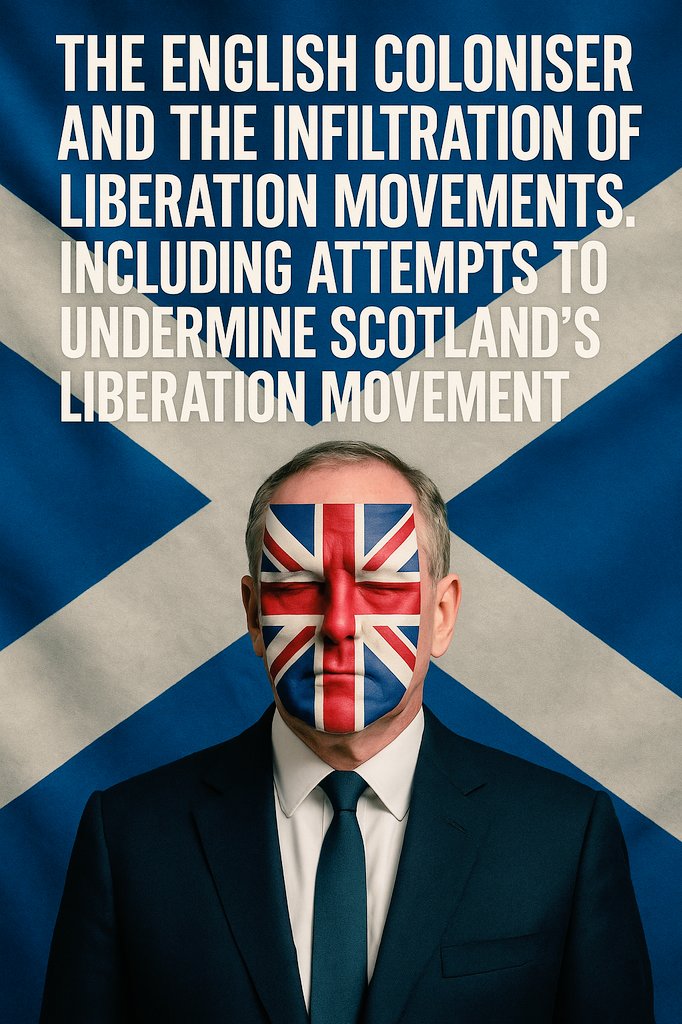
The efforts by a handful of individuals, including former British Ambassador Craig Murray, Alf Baird and Sarah Salyers to petition the UN to ‘decolonise Scotland’ has been chuntering away in the background for some months now through bodies including ‘Salvo‘, ‘Liberate Scotland‘, ‘Liberation Scotland’ and various others.
The whole thing bust out into the open again this week as Liberation and Salvo’s relationship with the JPTi, (Justice for All, International) very publicly fell apart. JPTi, a legal NGO that had been advising Liberation/Salvo published a statement here [Liberation Scotland Threw JPTi Under the Train of Geopolitics]:
“Geneva, 10 November 2025 — Justice pour Tous Internationale (JPTi) has officially terminated its cooperation with Liberation Scotland (LS) and SalvoScot Ltd. following a material breach of contract and a profound act of disloyalty that undermined months of dedicated and successful international advocacy at the United Nations. This rupture, regrettably, reflects not merely a contractual failure but a deeper capitulation to the pressures and distortions of contemporary geopolitics.”
The statement goes on:
“On 7 October 2025, JPTi prepared and shared with Liberation Scotland and SalvoScot Ltd. its draft statement for delivery before the Fourth Committee of the United Nations General Assembly in New York, under the agenda item concerning French Polynesia. The draft statement, as originally formulated, recognised and commended the Government of President Moetai Brotherson for its significant progress toward achieving enhanced autonomy through lawful and constructive means, rather than through an abrupt and dogmatic pursuit of independence.”
“In particular, JPTi’s statement highlighted the July and August 2025 legislative reforms in French Polynesia on consumer protection, labour rights, environmental safeguards, and sustainable economic development, as well as the June 2025 establishment of one of the world’s largest marine protected areas—spanning five million km², with twenty per cent under strict protection—a milestone of global importance for climate and ocean stewardship. These initiatives were presented as tangible evidence of the Polynesian people’s capacity to govern responsibly when empowered, thereby strengthening their claim to self-determination within a robust framework of autonomy.”
“Accordingly, in its draft statement, JPTi recommended that the Fourth Committee reaffirm that the right to self-determination cannot be diminished by partial autonomy, and that it urge France to fulfil its Article 73(e) obligations under the UN Charter and agree to a long-overdue UN visiting mission. This draft was duly shared with LS and Salvo for consultation. Following an internal exchange, and in the spirit of cooperation, JPTi agreed to revise the wording of its intervention to align it with the preferences of the Liberation Scotland Committee, despite the fact that the subject matter concerned French Polynesia and not Scotland.”
“As in its previous engagements, JPTi also intervened on the question of Western Sahara, reaffirming its longstanding support for the effective exercise of the right to self-determination and for peaceful, UN-supervised decolonisation processes in accordance with international law. The participation of LS and Salvo representatives in the Fourth Committee—facilitated, coordinated, and supported logistically by JPTi—was an undeniable success, drawing positive feedback and expressions of appreciation from members of the Liberation Scotland Committee and observers within the United Nations system.”
“On 18 October 2025, pursuant to the Phase II Memorandum of Understanding with LS and Salvo, JPTi submitted its draft report outlining the outcomes of the mission, summarising its advocacy achievements in New York and Geneva, and proposing a strategic roadmap for continued engagement with the United Nations in both headquarters. Only a few hours later, JPTi unexpectedly received a letter of termination from Liberation Scotland—sent without any prior consultation, discussion, or warning.”
The fallout has been pretty spectacular, though Craig Murray has described it as “a storm in a teacup.”
But is it? Some of the fallout appears to be a dispute over payments, but others are more fundamental.
Sharof Azizov, (who is the sole proprietor of Justice Pour Tous Internationale) writes:
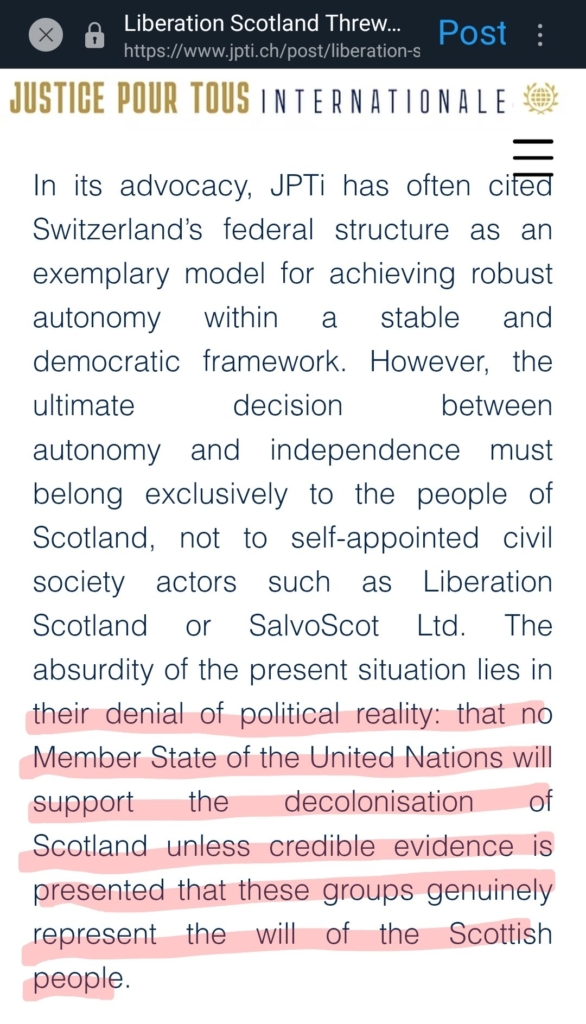
“In its advocacy, JPTi has often cited Switzerland’s federal structure as an exemplary model for achieving robust autonomy within a stable and democratic framework. However, the ultimate decision between autonomy and independence must belong exclusively to the people of Scotland, not to self-appointed civil society actors such as Liberation Scotland or SalvoScot Ltd. The absurdity of the present situation lies in their denial of political reality: that no Member State of the United Nations will support the decolonisation of Scotland unless credible evidence is presented that these groups genuinely represent the will of the Scottish people.”
This is, if you think about it, genuinely hilarious.
I enquired to the former British Ambassador on what basis he had gone to the UN. He replied, “Liberation Scotland asked me to go.” It’s a circular argument but it doesn’t really solve the issue that Mr Azizov makes, which is one of legitimacy.
The former British Ambassador responded to my question saying: “A colonised people virtually always find that the local “democratic” administration that governs on behalf of the coloniser becomes a puppet administration, that pays no more than lip service to Independence while enjoying the perks of privilege as the colonial elite. A liberation organisation that actually represents the people then arises. Be that SWAPO, or FLNKS in New Caledonia, or scores of others. In every single case the colonial administration and its apologists then go on to claim that the liberation movement lacks a democratic mandate, lacks official standing, does not represent the people etc.”
Apart from beautifully suggesting that he and his colleagues are Scotland’s ‘SWAPO‘ it masterfully bypasses the question by just declaring that ‘A liberation organisation that actually represents the people then arises’.
But how does Liberate / Liberation / Salvo / Alba / Alf Baird or whoever “represent the people” other than in a feverdream?
The problem with the ‘Let’s go to the UN’ brigade is that it’s an abandonment of a previous position. It’s a digression from the previous goal of convincing a majority of people in Scotland that they want to be an independent country, and making the case as convincing as possible.
Now, in a sense, all of this is just a nonsense and an irrelevance, but it is a sign of the extent to which the former Yes movement has decomposed and degenerated. The descent of factions within the Yes movement into ethno-nationalism is deeply problematic and amounts to a sort of disavowal and surrender.
The splinters of the movement are descending into fragmented acrimony. Figures like Norrie Hunter HERE and Gareth Wardell HERE raise significant questions about Craig Murray’s role and his recent conversion to Your Party.
The task remains to build a mass movement for Scottish independence, based on civic nationalism, on values of inclusivity and a forward-facing politics. Such a movement and such a case needs to be re-made from the ground-up and needs to be a celebration of Scotland as a multi-cultural contemporary society.
The transformation of Scotland that has always been the motivation for the mass of people in the independence movement, is one that requires to change the social basis of Scottish society. This is the only credible basis to organise a successful movement, appealing to people about how an independent Scotland will shift from the hierarchy and grotesque social inequality that characterises Britain and create a genuine alternative. Faced with the threat of the far-right taking power in Britain, the need for a Left Nationalism making the case for self-determination based on ideas and principles of radical politics and the transformation of Scotland is more essential than ever before.
The first paradox of all of this descent into paranoia and conspiracy is that it is profoundly disempowering. The second paradox is that a democracy movement that lacks transparency, accountability or democracy, is doomed.
But there’s a reason why we are where we are. As Connor Beaton, a member of the Republican Socialist Platform has put it:
“I understand why some independence campaigners are desperate to find a shortcut or legal trick that reopens a clear route to independence in the aftermath of the UK Supreme Court ruling in 2022. The SNP has completely failed to set out a credible strategy for achieving a second referendum, let alone winning it. This has opened the space for fringe groups offering what appear to be easy answers. Unfortunately, appeals to the UN to “decolonise” Scotland are not only a dead-end but deeply damaging to our movement.”
“At no point have campaigners explained how the UN, having failed to prevent atrocities in Palestine, Ukraine, Sudan and many other countries in recent years, will be able to overcome the UK government’s intransigence on self-determination for Scotland. The UN has not made self-determination a reality for Palestinians, for the Sahrawi people in the Western Sahara, for Chagossians from Diego Garcia – what can we seriously expect it to deliver the people of Scotland? This fantasy has consumed time, money and energy that could have been put to much better use building the grassroots independence movement here in Scotland.”
“Far-right politics has established a foothold in Scotland, with racist demonstrations targeting asylum seekers from Fraserburgh to Glasgow, and Reform UK on track to become one of the biggest parties in our parliament next year. Racists have even tried to appropriate the saltire as a symbol of exclusion. In those circumstances, peddling a revisionist history in which Scotland was a victim of British imperialism rather than a perpetrator becomes all the more dangerous. It fuels racist narratives and undermines the grassroots coalition we need to challenge the far-right in our communities. We should be clear as independence campaigners that we recognise Scotland’s historic role in colonisation and imperialism.”
Beaton is 100% right, the need to build a progressive and radical case for independence is more essential than ever before.

We are supported only by our readers. We don't have corporate backers and we don't take advertising, so we rely entirely on your support.
Help to support independent Scottish journalism
Mike you articulate what we often say over the breakfast table about magical thinking. There are opportunities for us in the movement for independence (I prefer self determination actally) to build alliances – the recent Scotland Demands Better demonstration or the Climate crisis one, especially between our movement and the tradeunionists who are scunnered by Labour and open to other less sectarian approaches. Antiracism has to be one area we must work on by responding to local concerns – there is support there but it has to be mobilised. I think we cant constantly knock the SNP but work to strengthen the progressive elements in it. work with what weve got. I just hope that the fracas over the UN work opens peoples eyes to reality – that the only way to selfdetermination is through mass popular support. We need to seize every opportunity to build those necessary alliances.
I very much agree with what you’ve written here. In advance of being on the panel at last Saturday’s IFS Conference, I see out my views here:
https://macualraig.substack.com/p/is-scotland-a-colony
The Wee Ginger Dug pointed out the problems with this approach some time ago. A) It’s been tried before and failed B) It’s based on a falsehood that Scotland is a colony and that the union never actually happened. Both positions are historically inept. Salvo is an effective arm of Alba which wants to bypass the Scottish parliament because it has no realistic hope of getting anyone elected to it. The 1689 Claim of Right is a religiously bigoted document refuting the Stuart’s rights to the Scottish throne due to their Catholic faith. The idea that we should be pushing obscure elements of this outdated document rather than the widely understood actual Declaration of Independence aka the Declaration of Arbroath is quite absurd and self defeating. Murray seems to want to slag our actual elected government as being in league with the British state when all actual evidence is very much to the contrary. The SNP plan is to put political pressure on the British government to agree to a second independence referendum. A second referendum offers the best chance of a victory for Yes and a clear outcome. ‘You’ve had your democracy Scotland’ isn’t a sustainable position for unionism and they know it.
Thanks Joe, I hadn’t seen WGD stuff, I’ll look that up.
Joe – I have joined the SNP in last 12 months and will in all probability vote SNP until independence achieved. I have to say that if you think Westminster will give another independence referendum when the Yes side has a realistic chance of winning then you are being optimistic if not naive. I will vote SNP next year but have no expectation that the SNP Holyrood majority approach next year even if achieved will lead to a referendum.
Yes the colonisation route is maybe not realistic but it is no less realistic than expecting Westminster to agree to a referendum. What is needed is for all strands of independence movement to explore all possible routes to both building support for independence and achieving it.
If/when Scotland becomes independent there will be a variety of shades of opinion throughout the country. That will be time to start discussing the differences between each other not before we achieve independence. If this means not fully agreeing with approach of some other independence supporters then I will bite my tongue and keep my eye on the bigger prize.
A It hasn’t been tried before and B yes we are a colony One of the last colonies of the British Empire
It has been tried before.
In the 70s, there was a campaign group called Claim of Right who explored routes to litigate independence at the UN. If you’ve never heard of them that’s because they achieved nothing. It’s not even a footnote in history. They left zero footprint, as will the rabble of ethno-nationalists currently repeating the errors of the past.
Its great to see comments which reflect most of what I want to say. Thanks.
It’s valid to look at the reality of the position of the nation within the UK which as Salvo has done required analysis of the reality of the history as part of an ongoing political reality, as for securing a majority, well nobody’s suggesting that’s the crux behind the issue but understanding the process of colonization and the social cultural reality of our position now requires challenging the imperialist homeganon we are drowned in now, this isn’t a short cut, 53% of Scots born voter’s voted yes and the percentage of support for independence has only risen, so the political criteria already exists, especially in a colonial context; also the electoral criteria for the referendum on many levels didn’t pass the benchmark for electoral farness as would be set out in a internationally binding election. Me thinks to many of Scotland’s chattering classes and union movement are so encased in the unionist metrics that they can’t follow any cohesive challenge to the status quo, which they themselves can’t seem to dissociate with. Maybe do a lot more reading and viewing of information before passing judgment and also suggest plans forwards, make a few tangible suggestions for the way forward instead of attacking a different method of furthering the independence cause. The fact it’s taken a headline in the national read by all of 2000 people to get any acknowledgement of what Salvo is doing speaks volumes, the vibe from mike is like the dismissive tone you used to get talking about independence in the 90s with new labour types.
What unites these ‘tiny parties’ – Alba, Liberate Scotland, ISP, NSP (aka Peter A. Bell’s one-man army) more than anything is their loathing of the SNP.
Another thing : Craig Murray, a member of Alba stood for election at Blackburn, Lancs in the 2024 UK general election as a candidate for the unionist Workers Party of great Britain. What was the rationale behind this? Why did Alba permit Murray to stand for a unionist party?
This fractionalist tendency to pin all on ‘colonial social relations’ is reductive and escapes the more complex issues of power, domination, exploitation and the position of Scotland under capitalism. It obscures the problem that we will still have major problems after Independence as with concentration of land ownership and control of our energy resources. At the same time the movement for self determination must recognise popular sovereignty in the sense of support for independence. That is where the Yes movement should be – on doorsteps, raising issues with the public, not in ever decreasing groups speaking to one another.
The historical twist about bringing up the Claim of Right, is that the same Scottish Parliament AKSED for a Union with England, they asked William of Orange for Union, and the English didn’t want such a thing…
…it’s only when the crisis of succession arose about 15 years later and there was a real chance of Scotland reappointing its own Stuart king and ending the Union of the Crowns, that the English became obsessed with the idea of Union…
Remember, the monarch, not Parliament, decided foreign policy back then…
I haven’t been paying attention to this ‘UN route’ but it smacks of Vanguardism:
https://en.wikipedia.org/wiki/Vanguardism
which approach has been effectively critiqued in Anarchist circles. The obvious flaw in this ‘seek-legal-ruling-that Scotland is a colony’ argument, I suppose, is the Treaty of Union and following Acts.
This particular vanguard also seems to deny that Scotland (and a large proportion of Scottish people) participated (often enthusiastically) in the manifold crime waves of the British Empire, as if we were as much a colony as Tasmania, which is ridiculous. Scotland sought Union with England (and Wales) in large part to access colonial trade (including slavery) after its own colonisation efforts floundered spectacularly at Darien. And lots of ordinary Scots were invested in these ventures, or were footsoldiers for the atrocities of Empire, or its perfidious bureaucratic-diplomatic corps, or vile propagandists.
Perhaps we should be considering what reparations an Independent Scotland owes (as the universities of Glasgow and Edinburgh have done).
None would be a fair amount sleeping dog, it’s like saying India should pay reparations, lots of facts are excepted by as you label it “the Vanguard” one of which is a mature understanding of the nature of colonialism, they are lots of unsavoury facts about participating in communities own colonisation, just look at your consumption habits. Nothing is a clean line, 95% of the troops who conquered India for the East India company were Indian volunteers, the company operations were mostly financed by Hindi merchants that used the tax free status of the company factory’s to conduct business, in full knowledge of what they were financing. Life’s messy like your reading of the realities and paradoxical nature of colonialism. Maybe look up Pax Romana in the dictionary. Try thinking about equitable trade as a way of steering a new future, you do realise china the gulf states and India are also actively engaging in a land grab for agricultural land in Africa? A transaction conducted by Africa leaders at the expense of their own people, who are evicted from there own land, like Mike and other commentators you seem to be caught in some 1980s mental culture cul de sac.
“95% of the troops who conquered India for the East India company were Indian volunteers” – that’s wild. Take a bow.
It’s actually correct according to the extensive work done by Ian dalrymple read his books or watch him on YouTube.
https://youtube.com/shorts/A_nyODqtaZc?si=z9r1zlmjzcty4bXY
Your something else Mike
You’re.
Right
Side-stepping the internal politics of all of this, and the reactionary forces behind the idea, the fundamental problem is that basing a case for independence on the idea that Scotland is a colony of England, is at best flawed and at worst, wrong. Yes, it is possible to look at colonial-like aspects, but to extrapolate that to ‘Scotland as colony’ is intellectually highly suspect, or even dishonest. We have witnessed the attempt to mainstream this idea from a fringe, extremist viewpoint, and it has gained some traction amongst the slightly less extreme, but that is about it.
I do not object to folk looking into all this – history matters and people do not know it well and the UN efforts just might open people’s minds in a useful way,. But if you are going to ignore, or in fact, even deny the very major role Scotland took as a British coloniser then your credentials in historical analysis fall to pieces.
It is noticeable that the people the likes of Alf Baird endlessly quote in support of his theories, like Fannon (an Algerian), were deeply exercised by white, imperial colonialism on black people’s material conditions and consciousness, particularly in Africa, the racially-based oppression upon which the whole basis of his critiques resides. Yet Baird would never mention this, nor that those oppressors were often Scots, the historical record on that being stark and shocking. Too much so it seems. His excuse? Scots’ minds were themselves oppressed and corrupted by English colonialism. It is a brilliantly circular and hermetically sealed argument, and the anti-English whinge to trump all whinges. It is also BS.
I’m convinced that getting Scotland registered as a colony, and then seeking to decolonise would fail for the reasons you outline, also for political ones, because it would require a UN resolution, which would by no means be guaranteed to pass. I’m worried that claiming that this route is the only legal one, as we are seeing from some supporters of Salvo, is simply false, as you’ll see from my earlier post on here.
Not the only one but one that deals with the reality of our situation so one that actually has credible foundations. It’s also one that enter’ists can’t manipulate.
This is an evolving situation, Ewan. Nothing in life is guaranteed, but that doesn’t mean you have to go back into your box. Liberation/Salvo isn’t just about going to the UN. They have, for instance, proved that the “so-called Union” is a fallacy. Some would argue that it is similar to Monty Python’s Dead Parrot that’s not true because you have to assume that the parrot was previously alive; The “1707 con?” never was. People have just believed what they were told. Liberation Scotland had a “Toto moment” when they proved that the dots don’t join. Westminster has been rumbled on this as well.
Everyone in Scotland should be excited for the future. The country is theirs; they own it lock, stock, and barrel. They need to be getting behind this brave initiative. Who knows? They might just be successful, and then what would we have to complain about?
I presume this is Mike Small, formerly BBC. Not that it matters. You make a number of errors based on inaccurate understanding of UN decolonisation. It’s not magical thinking. It’s strategic, academic, legal, historical and diplomatically accurate. No one ever said that UN would ride over the hill to save Scotland. But, and it’s a big but, being registered for decolonisation means that Westminster cannot manipulate the outcome as Scotland’s right to self-determination are exactly the same as any other non self-governing people. SNP is a busted flush with no interest in fighting for Scotland. Other options are available including ISP, Alba, Sovereignty and a range of committed individuals. You need to do a bit more reading, thinking and be prepared to consider alternatives. SNP alone will get us nowhere. JTPI have got the ball rolling – this is just a little bump in the road. Liberation Scotland has momentum. I am inordinately grateful for their efforts.
Other options are available including ISP, Alba, Sovereignty.
You’re kidding, all these wee, microscopic parties will get are lost deposits.
Exactly so.
I haven’t supported SALVO etc. Not because I’m against it/them, I don’t actually know enough about it either way, but simply because I have a fear of the significant damage well-meaning amateurs blundering about in the legal and diplomatic framework can do to the Indy cause. The SNP ScotGov’s disastrous Supreme Court s.30 debacle should have served as a warning to all.
However, I also have an equally aggressive reaction to those who seek to weaponise agendas or the well-meaning actions of others for their own ends. To play party politics with the pursuit of Independence and happily create/support/promote/mythologise any perceived obstacle to Indy simply because it serves as a means to attack others in the movement they might disagree with.
Legitimacy of action in politics isn’t a a stick. It’s something you either believe in it or not. Period.
I’m happy to accept it appears others have gone off half cocked with this UN approach. That’s seems self evident now and it’s important to recognise. That though isn’t the end.
Are those currently crowing about the “failure” of SALVO willing to be equally critical of their own camp? To recognise that the SNP’s so-called strategy for 2026 is solely a party not Indy based approach? That the secret plan with legal backing is simply to apply for a judicial review based on an argument constitutional lawyers have dismissed as fantasy? That the protecting services argument for staying in power is a mirage when you already have a $5bn hole needing plugged in the devolved budget before end 2029? Or that the Indy in EU argument is equally deficient in legitimacy without a referendum confirming what the Scots might actually now want – and that’s before having an actual plan to address the potentially ten-year chasm between asking for entry and actually being able to deliver it?
Have fun at the expense of others, fine, but be equally robust in the wresting of all sides. The Independence campaign will be all the better for it.
The short answer is ‘yes’ – I have been and will be highly critical of the other plans for independence that lack strategy or coherence.
You’ve a hack, all be it an erudite one..
I’m not sure what that means?
That will be what’s left written on your headstone on a lighter note!
https://youtu.be/kc1Gsoy-fCI?si=gGmgWWnqjVPkqrpI
I’m not sure we are, but agree we really need to be. And I do mean “we” here; every one of us in the Indy movement.
Take the recent nonsense from Believe in Scotland that so many have if not fully hitched their wagon to certainly latched onto. A roadmap so politically immature and possessed of magical thinking that it could have been written by the Brother Grimm. The masters of rehashing other’s tales. Where’s the critical review to be found?
Equally, the analysis of the SNP’s doomed policy for 2026 (psephology makes clear it’s still not in line for a majority and never was) or the legally formless and incoherent legal masterstroke that underpins it (merely a judicial review based on the musing of a planning expert!)?
Camels and needles we have in spades. What we lack is people “doing” proper politics anymore.
If we are considering magical thinking worthy of the Brothers Grimm, I’d suggest the idea of running to the UN, claiming that Scotland is a colony takes the biscuit.
I’d add that if the Indy ‘Movement’ has to rely on a fly by night such as Craig Murray then it is screwed.
Honestly, I’ve no problem whatsoever with anyone wanting to challenge SALVO etc. on this, Frank.
The only point I would take issue would be when people are selective in that approach and don’t then challenge everything equally robustly – SNP ScotGov included.
It’s achieving Independence I’m interested in, not petty battles or party politics.
That is such a lazy insult. I suggest you read up the UN definition of colony or NSGT (non self-governing territory), check out Liberation Scot website or read Doun Hauden by Prof Alf Baird.
The UN route to decolonisation is not easily reduced to an easy 3 word slogan favoured by political parties. It requires a small amount of effort – but Liberation Scotland individuals have invested thousands of hours on research. Give them credit for what they have learned so far and for their considerable, voluntary efforts, on Scotland’s behalf. It avoids the Westminster stonewall and is doing more for independence than the ‘independence parties’ are doing. Also, ask yourself what your real response to calling Scotland an NSGT is really about. Ireland was a colony. Scotland was annexed.
Are you familiar with the case of Puerto Rico? It was classified as a NSGT then removed from the list. What changed? Materially nothing, just broken promises. Puerto Rico has not achieved a full measure of self determination.
If Puerto Rico is not classified NSGT, then what hope has Scotland, which is fully integrated into the UK constitutional system, participates fully in elections and even enjoys internal self determination since devolution.
Liberation Scotland as punching way above their weight for a bunch of volunteers. They are incredibly innovative in their approach and hats off to award winning journalist Sara Salyers for unearthing this pathway to Scottish Independence. The Colonial administration must have been very pleased with itself indeed for they know full well that there is no domestic pathway to independence. Of course, sadly, nobody in Scotland had worked that one out. Westminster was quite happy watching from the sideline as the Scots trod a pathway to nowhere.
However, they’ve now been rumbled and they are starting to panic and the buzzword among the colonisers is “devomax” and that is what Mr Azizov was supporting on behalf of another coloniser, France with reference to French Polynesia. “These initiatives were presented as tangible evidence of the Polynesian people’s capacity to govern responsibly when empowered” That’s a saying right out of the Lord Beaverbrook’s book , or was it Winston Churchill? “The white man’s burden and all that old chap!”
Regarding the setup of Liberation Scotland and Salvo, not Liberate, Liberate is a political party and has nothing to do it. The other side of the coin is Salvo, who are tasked with informing the Scottish public that they have been duped and continue to be. They are also a bunch of dedicated volunteers who give up their time freely to try to get it through the heads of the Scots that we are being played.
One of the biggest problems that Liberation Scotland/Salvo have is the absolute dearth of publicity opportunities. It’s extremely soul-destroying when you convince foreign governments of your validity of purpose, get a groundbreaking judgement from one of the most senior lawmakers in the land, produce tens of hours of evidence which has taken thousands of hours to produce and the newspapers of the land, in true News of the World style, print heresy over facts. Then everybody piles in. Ignorance isn’t a virtue but you’d be forgiven for thinking it was.
The UN is regarded as a colonial power in quite a few places, and with good reason. Maybe they should be prosecuted at the UN.
Silly comment.
The link to Liberate Scotland is an eye-opener. It involves the Sovereignty Party – far right, christian, anti-abortion, anti-LBGT, anti-human rights, ethno-nationalist ultra-libertarians. They’ll get no votes but so should everyone else participating in this groupthink of illiberal minds. I don’t know what links they have to Salvo/Liberation but their obsessions certainly match.