
The Age of Lies
“One thing that’s been interesting this entire campaign season to watch is that people that say facts are facts. They’re not really facts. It’s kind of like looking at ratings or looking at a glass half-full of water. Everybody has a way of interpreting them to be the truth or not true. There’s no such thing, unfortunately, anymore as facts.”
– Scottie Nell Hughes on the Diane Rehm Show, December 2016
Here, the Conservative commentator Nell Hughes announced the era of post-truth politics. Trump was the first post-truth President and Brexit was the first post-truth geopolitical event. With slogans on hats and buses, these are events not just clouded in disinformation but saturated in lies and propaganda.
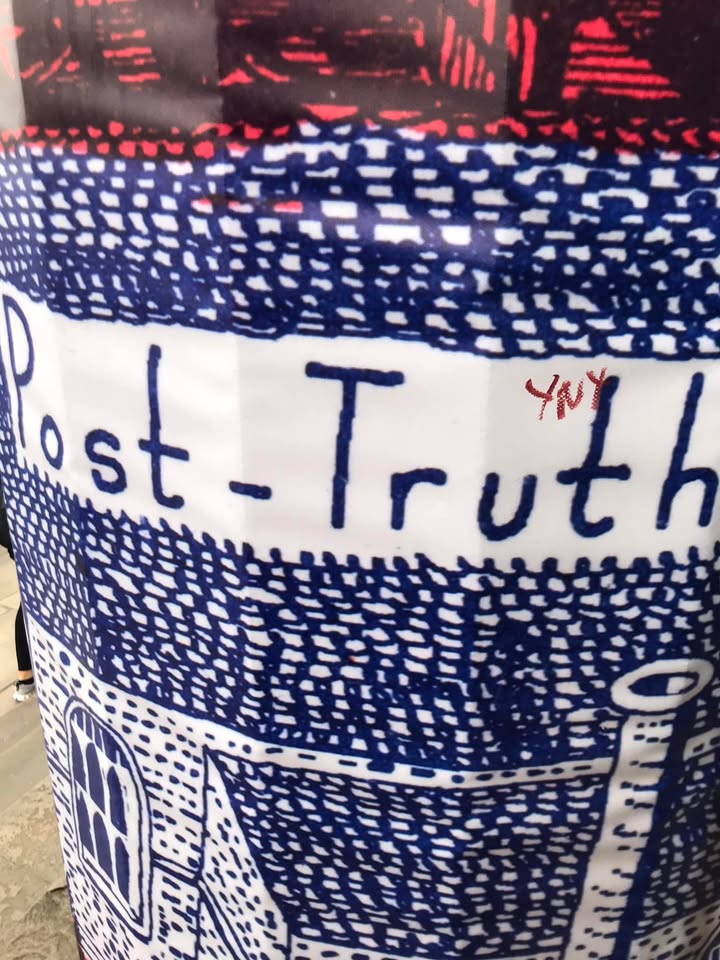
The dawning of the post-truth era is surprisingly precise. The Oxford Dictionary proclaimed ‘Post-Truth’ as its word of the year in 2016, defining it as the “circumstances in which objective facts are less influential in shaping public opinion than appeals to emotion and personal belief.”
Narrative and story, ‘framing’ and ’emotional resonance’ are far more powerful tools than ‘facts’ or ‘truth’ it seems. Not that we didn’t know this already, but this ‘storytelling’ has been amplified and turbo-boosted by the new technologies that we, or others, wield.
Aaron Banks, the dodgy businessman who bankrolled the Leave campaign, analyzed the Brexit Referendum like this: “The Remain campaign featured fact, fact, fact. It just doesn’t work. You’ve got to connect people emotionally. It’s the Trump success.”
It was indeed the Trump success and it was replicated in the Brexit campaign. Dominic Cummings had the idea of concocting a weekly cost of EU membership as £350 million – and suggesting that such a sum would be diverted to the NHS on our departure. It didn’t matter that none of these things were true, it was a good story, and so it was slapped on the side of a bus.
This was tabloid heaven.
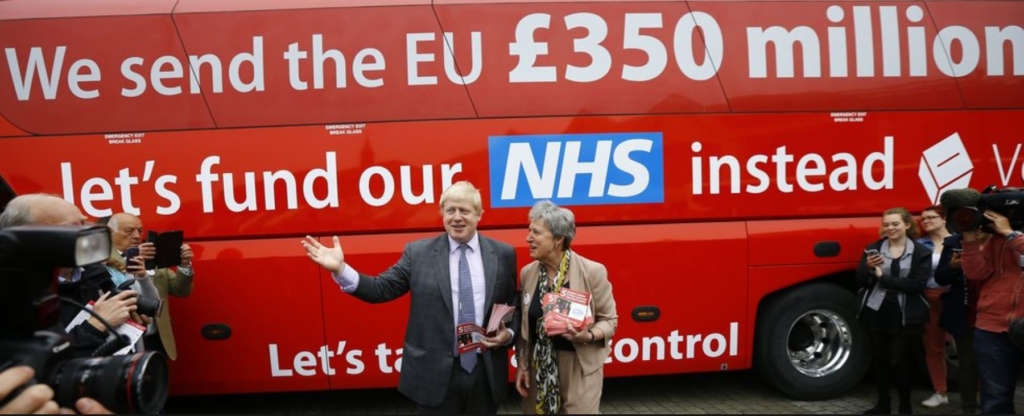
In Trump-Brexit post-truth politics narrative is key and arguments should be reduced to very simple very understandable slogans. For Trump it was ‘Make America Great Again’ and baseball caps, for Brexit it was ‘Take Back Control’.
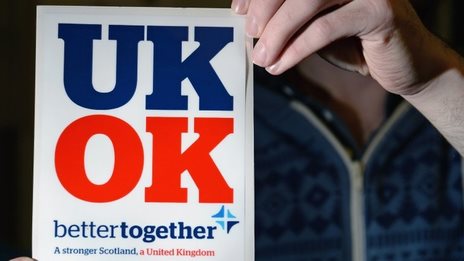
There is however, a strong argument for this post-truth politics to have originated two years earlier. ‘Better Together’ (2014) pre-dates ‘Take Back Control’ (2016) by two years and the distillation of political ideas was even more acute as laid out by Project Fear. ‘UK:OK’ was the micro slogan used by Rob Shorthouse and colleagues, a sort of desultory summation of constitutional affairs, belying the almost total lack of aspiration from the Unionist side.
However, while the Yes side produced gigantic tomes explaining everything about the future of an independent Scotland, Better Together turned up for photo shoots with a big chocolate coin, mocking the plans for a Scottish currency. While the Yes team immersed themselves in endless detail, the NO campaign, many who had experience as tabloid hacks could drown the media with negativity. As they knew well, bad news sells. Trump’s advisor Steve Bannon would later call this technique ‘Flooding the Zone’ (with shit).
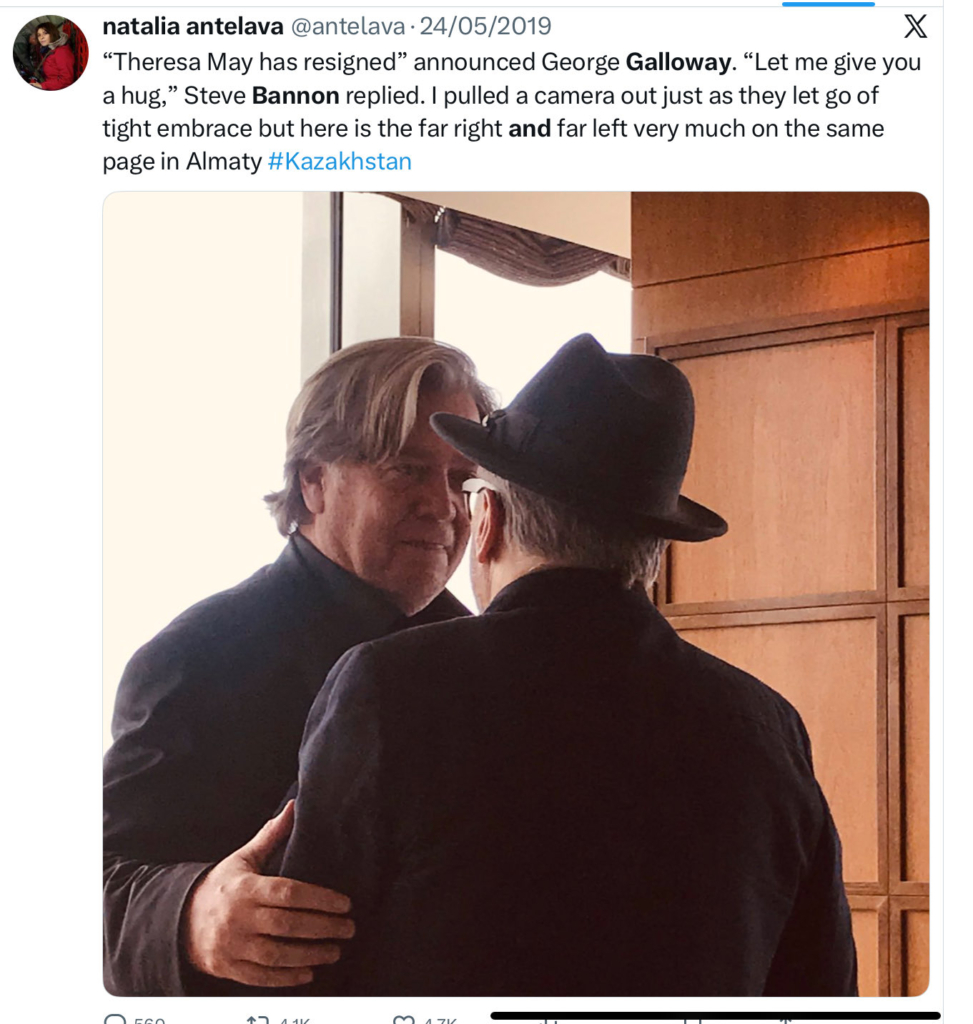
The litany of Better Together lies is too vast for this post, though as your energy bills soar and winter sets in, here’s one from the archives …
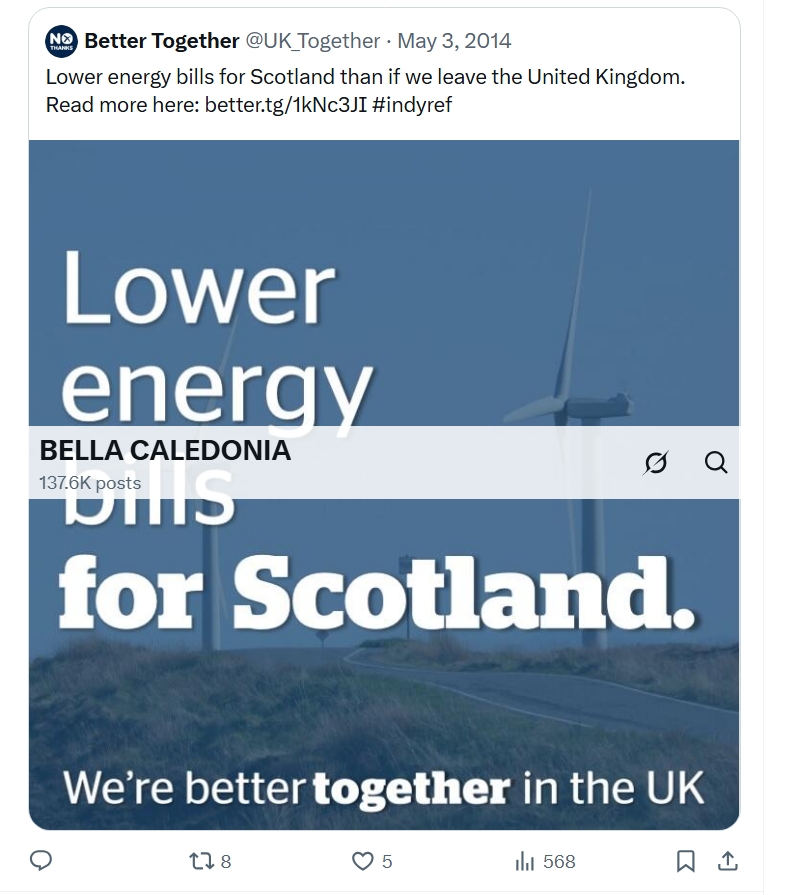
A key element to this process of decay has been the distrust of ‘experts’, the attack on education and the distrust, even banning of books (Lost Words) which the Trump administration has been obsessed with. In this environment science and rational argument is discarded and wild conspiracism runs riot. This phenomenon affects all sides of politics. Who will forget the moments which united the critics of Nicola Sturgeon – when conspiracy theories ran wild that she was pretending to read or be interested in books?
The Technology
“We’re living in a post-objective-truth society where billionaire-controlled social media algorithms and media force curated narratives upon you, and reinforce the messages and propaganda most beneficial to them.”
– Melanie D’Arrigo
The idea that ‘social media’ and the algorithms are responsible for our present predicament is only part of the story. These technologies amplify a tendency that is already in the air, as the collapse in belief in systems and institutions erodes trust and faith that previously upheld an established order. People have lost faith in not just politicians but political systems as the social contract has been broken, as has trust in legacy media. Why should you have faith in a political system that delivers abject social inequality or that makes Food Banks a permanent feature of our lives, and that makes ‘the cost of living’ a brutal unchanging reality?
The collapse of deference has a positive aspect to it, but only if people are organising around genuine alternatives and radical visions to get us out of this hellscape rather than obsessing about chemtrails and anti-vaxx fantasies.
This crisis of trust is compounded and exacerbated by the replacement of one party by another – from Tory to Labour – making no discernible difference. When politicians operate on the same wavelength, within the same ideological parameters, it is difficult to convince people that this is a system worth believing in.
As George Monbiot writes [Dark forces are preventing us fighting the climate crisis – by taking knowledge hostage] this is a crisis of truth, a crisis of epistemology:
“An epistemic crisis is a crisis in the production and delivery of knowledge. It’s about what we know and how we know it, what we agree to be true and what we identify as false. We face, alongside a global threat to our life-support systems, a global threat to our knowledge-support systems.”
At a deeper level we live in age where the truth about our climate crisis isn’t being told. We are told that we can survive the climate catastrophe either by ameliorative changes to our lifestyle (paper straws, endless recycling), or by offsetting emissions from one source to another. Pass the parcel. We are told that we can survive this crisis without fundamental changes to how we live or to our economic system. This is the fundamental lie that sits at the heart of our society and our politics. Lies and self-deceit cloud perception. Once one lie gets to settle at the heart of our political discourse, contamination is inevitable.
Vested interests and dark money distort much of what we see and do. Let’s just, amid the morass of lies, hold on to four simple facts, because facts do exist:
The BBC is not a left-wing broadcaster.
Donald Trump did incite rioters on January 6th.
Protesting against genocide is not a criminal act.
The BBC is not a pro-Palestine broadcaster.

We are supported only by our readers. We don't have corporate backers and we don't take advertising, so we rely entirely on your support.
Help to support independent Scottish journalism
and building more nuclear weapons is not going to reduce the liklihood of them being detonated
And building more nuclear weapons does not reduce the likelihood of a detonation.
And the Vow was a lie
A fine roundup by Mike of the history. For me, the big moment of indyref was the launch of “Vote No Borders”: https://bellacaledonia.org.uk/2014/05/02/astroturf-democracy/
VNB was created in London by an ad agency acting for Tory financier, with lots of London money. Yet the BBC News announced VNB as “grassroots” and “non-political”, giving it a big uncritical splash. These two blatant lies were easily disproven by other journalists, and the BBC has never had any plausible excuse for being fake news&. For me, that was the moment I realised that in ibdyref, the BBC role as propagandist was going to far exceed even it’s previous heights such as the Battle of Orgreave.
But now we’ve had eleven years of this post-truth politics. The BBC followed its indyref propaganda role with similar propagandist roles over Brexit, the war against trans people, Ukraine, snd the genocide in Gaza. The Daily Telegraph has gone from fruity conservatism to full Breitbart.
But isn’t it time now to be focusing on how to fight back?
Do progressives need to get our own attack machines, like the 2020 Lincoln Project? Thst was an anti-Trump advertising barrage, using big money to hit hard.
Or do we need to find and nurture fearsome young straight-talking soundbiters with authenticity, to follow the example of Mamdani and Polanski?
Or is there some path to build signifucant spaces for reasoned discourse and quest for truth?
Claire hits the nail on the head. I know that London will never allow Scotland to leave as long as there is a little oil left. Scotland has been systematically stripped of her wealth and industry for the benefit of others and we do not have a charismatic spokesman to rouse the people against this organised theft.
Alec Salmond was the best we had but was brought down in an organised campaign. Where is any real replacement? John Swinney appears to be a nice man doing his best but does not have the chutzpah to rouse the Nation; Alba is a busted flush and the Greens in Scotland are to attached to micromanaging small problems without looking up at the big picture.
I would agree about a certain element of bias against indyref, but it is in fact a classic case of post truth to say that the BBC followed ‘propagandist roles over Brexit, the war against trans people, Ukraine, and the genocide in Gaza’. If we really care about the truth then we have to start speaking it, not just doing our own version of ‘post truth’ that suits an apparent progressive agenda.
I find it interesting to watch how some people are reluctant to acknowledge the BBC’s propagandist roles. Even tho the BBC has extremist propagandist Robbue Gibb in a senior role in news, sone people remain in denial.
What are you actually suggesting? That the BBC took a ‘propagandist role’ as pro-Brexit, anti-trans, anti-Palestinian and, well Russia is less obvious, let’s say pro-Ukraine or anti-Putin / pro-NATO?
I do not find any of that tenable as I have followed all the news events you have highlighted quite closely for a lot of years and have detected no propagandist role that you suggest. And what is interesting is that many others have claimed, often loudly that the BBC was pro-Brexit, pro-trans (in the sense of censoring gender critical views), and anti-Israeli (notably almost every single Israeli spokesperson I have heard accuses the BBC of lying ‘pro-Hamas’ propaganda, shooting the messenger as soon as possible in any interview).
You don’t see a problem with Robbie Gibb. Let’s leave it at that.
You just made some stuff up, then say something about me for which you also have no evidence.
This view that we (whoever ‘we’ are) have abruptly entered a human post-truth world is dangerous cant. In politics, a useful rule of thumb is: it’s always older than you think. Where do you think Boris Johnson got his shtick from? The British Empire was founded on a sea of lies, many learnt from classical studies. Ancient Athenian co-emerged with theatre, the Greek city states did a lot of recorded politicking, and the Romans took this into their own rhetoric and practised disruptive cacophony. There’s so much precedent, but here are a few search terms.
Original sin. Noble lie. Equivocation. Jesuit casuistry. Divine right of kings. Terra nullius. Racial hierarchies. Witchcraft trials. Great men. Dulce et decorum est pro patria mori. Machiavelli. Hypocrisy and cant. Public virtue and private vice. Operation Legacy. The History Thieves. Creationism. The promised land. Manifest destiny. Political expediency. Money. White man speak with forked tongue. Fin de siècle. Yellow journalism. Peace for our time. Shakespeare’s character Rumor:
https://www.folger.edu/explore/shakespeares-works/henry-iv-part-2/read/IND/?q=rumor#line-IND.1
We don’t (AFAIK) teach ancient science or medicine or accountancy in our modern institutions of learning, but we do teach ancient political philosophy. For very sound reasons. Don’t fall into the ego trap of thinking that one’s own age is special for spurious reasons (see also: end of history) or that our superstitions are not like other peoples’. If we don’t learn from history…
Arguably, we live in a more truthful era now, or at least one with evidential material way more readily available. It’s just that the lies are more obvious because we know how to find that material.
What is interesting is that despite that, people still very much believe what they want to believe, including on the pages of Bella. We are all prone to it.
@Niemand, yes, I think your points are profoundly correct.
BTW, I meant to write “Ancient Athenian *democracy* co-emerged with theatre”.
I am interested in why people go along with things they must believe at some level to be untrue. What constitutes a tipping point in mental states (conversion or disillusionment) and outward behaviour? What are peer and context effects? Do people have different personas with different beliefs that manifest in different circumstances? Why do we tell children lies, and what long-term effects does this have? As well as social reasons, there are a number of cognitive biases, like sunk cost fallacies.
https://en.wikipedia.org/wiki/List_of_cognitive_biases
We are very seldom asked to put our ideas to some approximation of an ultimate test. Do we have a modern equivalent for those who decline to recant when being burnt alive for heresy? But it is often clear when people act inconsistently while claiming to be bound to some principle or other (free trade versus protectionism has a long history, for example).
I think education has a lot to do with it. I was always taught to question things, but importantly to question *yourself*. We can be very good at the former, but much, much less so at the latter.
Even there you get silos. In Higher education research, researchers, especially in the social sciences, often get the result they predicted, and wanted all along. Of course this may be reality but too often it is a result of finding what you are looking for and not what you are not. It is academic confirmation bias. Occasionally you do get counter results, and it is amazing how controversial this is if they dare publish. Even the hard sciences can suffer from this.
Otherwise, I think it might even be natural tendency. As a Libran, I do tend to weigh things up a lot 😉
Niemand – I agree that we are all prone to ‘have our own truth’ and need to constantly challenge that trait. The best way to do this is factual reporting rather than opinion. This is one area where BBC (& other media) are IMO sometimes guilty of attempting to be even handed and impartial in face of the factual evidence. As the old quote goes you if you want to find out if it is raining you don’t ask two different opinions you go outside and find out.
The other issue with the tv media which is supposed to be unbiased, as opposed to written media, is that it often takes its lead from the issues highlighted in written media.
@John, yes, there is a ‘many eyes’ hypothesis in collective animal behaviour:
https://en.wikipedia.org/wiki/Collective_animal_behavior#Protection_from_predators
which, if you note that humans prey on other humans, is a way that humans can defend themselves against bad actors, including those who deceive. The link onward to Wikipedia’s page on mass collaboration is worth following for its sketch of activity.
Naturally, the behaviours of deceitful human predators or social cheats tends to evolve, whilst the reliance on others to watch the watchmen can lead to apathy and freeloading.
And as primatologist Frans De Waal notes in Are We Smart Enough to Know How Smart Animals Are? (2016)
p101 “People lie all the time”.
People definitely lie about ‘the truth’. There’s a long and often rather boring western philosophical tradition regarding how can we know stuff, but one of the Big Lies is that: Ages Contain Values. Ages/epochs/eras/centuries do *not* contain values. This is an egregious category mistake. We are emphatically *not* in The Age of Lies.
I would suggest it is worth looking at the history of anti-clericalism and heresy that Silvia Federici discusses in Caliban and the Witch: Women, the Body and Primitive Accumulation.
John, the problem the BBC have is that the ‘ultra’ even handedness (which you are suggesting is too even, i.e. not even at all) is a response to accusations of bias or ignoring minority viewpoints (which may, possibly, become majority ones in time). It can be quite no-win.
Niemand – you are misinterpreting what I am saying. What I am saying is that BBC should follow its motto – educate, inform and entertain.
I am asking for impartiality in examining and reporting the factual evidence. If the BBC decide impartiality is the be all and end all then evidence is ignored or undervalued as opposed to opinion. This is especially important today where fake news is so prevalent and news spreads so quickly. Steve Bannon’s mantra , as frequently demonstrated by Trump, is flood the news media with shit to get your viewpoint prominence regardless of its truthfulness. Too many news media, including BBC, tend to acquiesce with this tactic rather than challenge it.
If a minority view is based on factual evidence then it should be highlighted but history shows that it is minority interests of those with influence that tend to get highlighted as opposed to the the viewpoint of minority group with little influence often with little regard for veracity of evidence.
Lastly, I previously referenced, with evidence, my view that the BBC is not reporting Gaza in a fair and open manner. It is worth noting that despite the mainstream media reporting and UK government policy the public are more sympathetic to Palestinians cause than media.
Niemand – you appear to have misunderstood my point. The BBC mission statement is to educate, inform and entertain. That is what I am asking them to do not to bend over backwards to be impartial to every viewpoint regardless of its veracity. This is actually more important now than ever with the speed news travels and the rise of fake (factually inaccurate) news.
I get it John, and generally agree, I was just saying why the BBC bend over backwards regarding impartiality regardless of veracity
Brilliant.
That the BBC is not officially-automatically trusted to follow its motto/royal charter is evident by its structure, complaints and regulatory system.
Obviously a royal-chartered organisation is not impartial; it serves the Crown, at least. Royal correspondent David Dimbleby has in the past commented on how the BBC jumps every time the Palace gets on the phone to them, and in future asks a very pertinent question:
What’s the Monarchy For? (coming December 2025)
https://www.bbc.co.uk/programmes/m002n21k
As I say, subtle shifts from time to time.
Anyone who has used the BBC complaints system will have drawn their own conclusions about its function. I complained about its environmental coverage back in the day, and was left with an impression that the BBC knew its biases and was determined to keep them, thanks very much.
Ofcom is often the dog that doesn’t bark, or even growl, but a low-pitched whine suggests it has been slowly compiling evidence for pretty extreme BBC bias from its (MI5-vetting inherited) recruitment and promotion practices. Scandals in these areas haven’t always had the public impact of other kinds, but they are deep-rooted and pernicious. The recent criticism of the BBC for its demographic skews has been potent, whilst the softer kind of Ofcom statistical probing has been equally damning. Independent bodies like the Sutton Trust have been noting the trends.