
Decolonising the Mind
Alan Riach, poet and professor of Scottish literature, Glasgow University, explores identity, language and power.
PART ONE
Culture, Politics, Language
Paul Kavanagh in The National (‘Trying to preserve Scotland’s distinct political culture is not hate speech’, October 15) sums things up neatly. Effortlessly and appropriately sending ridicule in the direction of Douglas Alexander for his patronizing words about Kate Forbes’s comments about Labour wanting to make Scotland more like England, Paul wrote as follows: ‘This is unquestionably true. It is a defining characteristic of opponents of Scottish independence to minimise, disparage or undermine all and any cultural and political differences between Scotland and England.
‘This is in order both to destroy any possible evidence that Scotland could do things better than Westminster – which is, of course, the parliament of England – and to deligitimise any claims that Scotland has a national culture and identity of its own which justify and underpin its right to self-determination. In her speech to the SNP conference on Monday [13 October], coincidentally the 100th anniversary of the birth of Margaret Thatcher, Forbes said that the Labour Government aimed “for our national parliament at Holyrood to mirror Westminster, Edinburgh to emulate London, and Glasgow to replicate Manchester.”
‘She also pointed to policies such as metro mayors – which Labour have said they would look to implement in Scotland – adding: “I hate to break it to Labour, but trying to be more like England would actually make Scotland poorer.”’
Those paragraphs contain a crucial elision between ‘politics’ and ‘culture’: together, they ‘justify and underpin’ Scotland’s ‘right to self-determination’. They are terms certain people want to keep very separate from each other. As in, ‘Enjoy your culture, just leave the politics to us. We’re the grown-ups.’ Of course, the terms are not separable. To quote, paraphrase and emphasise: The Unionists’ purpose is: ‘to destroy any possible evidence…and to deligitimise any claims that Scotland has a national culture and identity of its own which justify and underpin its right to self-determination.’
The political significance of that would apply even if the parliaments in Edinburgh and London did not exist at all. Indeed, the truth of it applied for three centuries, without the Scottish parliament.
I’d like to consider the significance of this truth with reference to language, partly to commemorate the 101st anniversary of John Buchan’s breakthrough anthology The Northern Muse (1924) and partly also to remember the work of the great Kenyan writer and activist Ngũgĩ wa Thiong’o, who insisted that erasing language was the most lasting weapon of oppression. Ngũgĩ died in 2025, on May 28, and his work has been with me since the 1970s, so it seems the right time to bring him into the discussion.
In an article quoting his work extensively in The Guardian (12 August), the Scottish and Sierra Leonean writer Aminatta Forna introduced him like this:
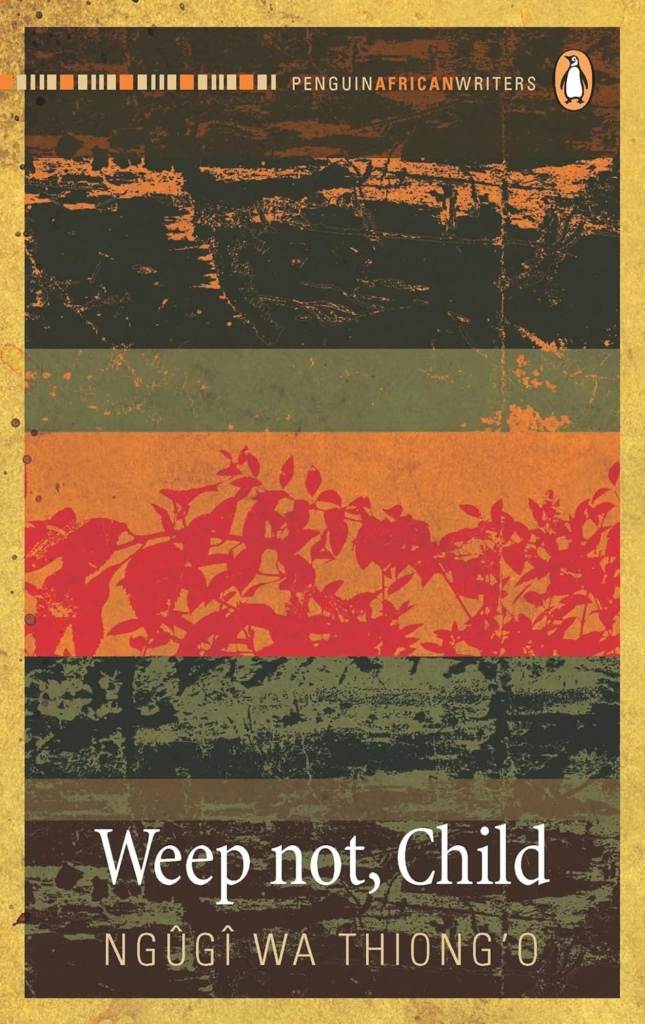
‘In the 1930s, it was common for British missionaries to change the names of African school pupils to biblical names. The change wasn’t “just for school” – it was intended to be for ever. So Ngũgĩ became James and my father, Mohamed, became Moses. While many students retained their new names throughout their lives, Ngũgĩ and my father changed theirs back, though you can still find early editions of Ngũgĩ’s first book, Weep Not, Child, under the name of ‘James Ngugi’.
With the novel, Ngũgĩ established himself as a writer and later, by reclaiming his Kikuyu identity as an activist, began a process of decolonisation that he would explore in one of his most famous nonfiction works, Decolonising the Mind (1986), which challenged the dominance of European languages in African education and literature. Ngũgĩ worked throughout his life to promote the decolonisation of language, writing and publishing his books in Kikuyu and only later translating them himself into English.’
She continues:
‘Ngũgĩ was a campaigner against the legacy of colonialism, but first and foremost a Marxist. Studying at the University of Leeds in the 1960s, he witnessed first-hand the brutality of the police towards striking white miners and realised that economic exploitation was a class issue and not a purely racial one. He endured exile, imprisonment, physical assault and harassment by the postcolonial Kenyan authorities and yet never stopped writing and publishing, even penning one of his works, Devil on the Cross (originally titled Caitaani mũtharaba-Inĩ), on prison toilet paper. Detained for his involvement with community theatre groups, Ngũgĩ noted that as long as he wrote in English, the authorities ignored him. Only when he began to write politically critical plays in Kikuyu, and ordinary working people could understand them, was he arrested.
‘Ngũgĩ was one of the grandfathers of African literature, and his courage made him beloved of a generation of writers.’ Aminatta Forna recounts some of her own encounters with him fondly, and ends: ‘In May this year, Ngũgĩ was apparently dancing with some of his students at the University of California, Irvine, to mark the end of the semester on the Friday before his death, at the age of 87.’ His work extended across the generations in a spirit of convivial and dedicated learning. We’ll be coming back to him and his writing on language. But now I want to bring some Scots into the context. David Bleiman’s recent book of poems, Tongue Stramash (Handsel Press), includes this poem, ‘Why Dae Ah Screive in Scots?’
Mebbe the smirr that aifter forty year
maun thirl this teuch auld Ashkenazi skin
fae empires o the Habsburgs an the Tsars
by way o Africa;
aiblins that this here Promished Laun
whaur ye cam hame
is whaur Ah chaised tae stey;
that wurds wull wander tae a mooth
whaurivver makars staun an blether;
that, gin it’s aye a yird-fast leid,
ilk ane appropriated by the dreich
maun sook it tae oor cultures, each to each;
that Oma Ethel spak three languages in ane;
that poesía makaronishe seeps in
an oot o me, like Weltschmerz;
so mebbe why Ah screive in Scots
is why Ah write at aa.
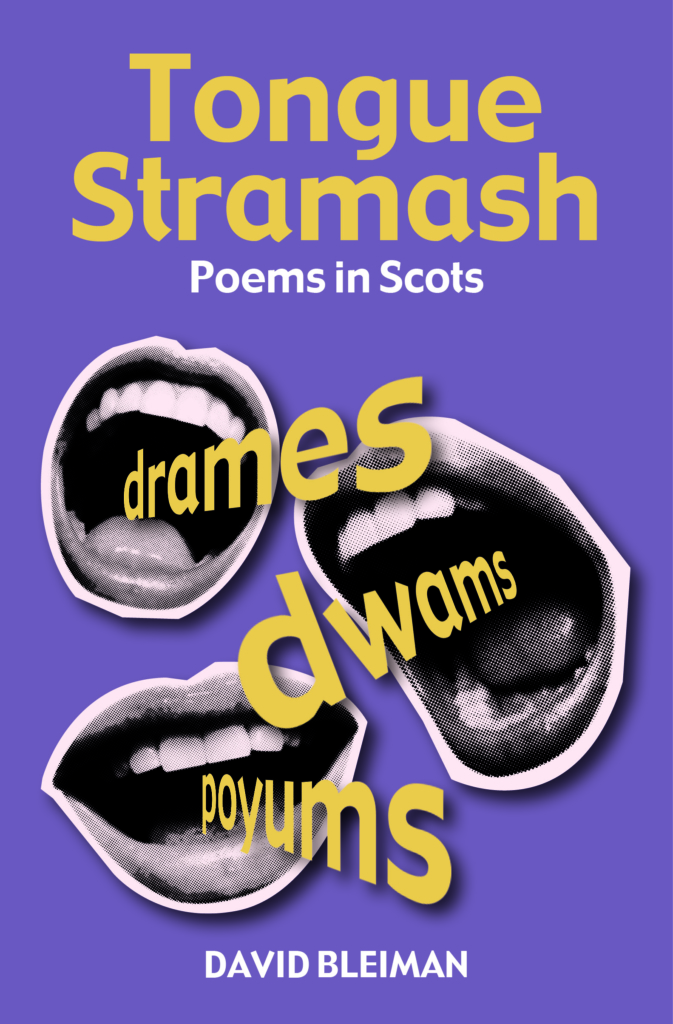
There are two glosses: ‘poesía makaronishe – macaronic poetry (Spanish/Scots/Yiddish neologism)’ and ‘Weltschmerz – sadness about the state of the world’. And the Scots is there for us all to decipher and comprehend. But it’s the conclusion that I’d like to draw attention to: ‘mebbe why Ah screive in Scots / is why Ah write at aa’.
David Bleiman’s poems are one instance of a flourishing of Scots-language work, in narrative prose and drama as well as verse, which has almost no representation in mainstream media. As the poem demonstrates, it’s a language that may be learned and adopted, as well as one that might come with one’s upbringing and family history. It might include other languages, but it has its own various idioms that are innate to its own music. The accomplishment of such work is remarkable in the face of such linguistic oppression enacted by Anglophone ascendancy, but the self-confidence that comes with it is a growing strength. It grows into a sense of acceptance, a fluency which might accommodate the imperial language but is not dominated by it.
Ngũgĩ draws our attention to this and it’s worth quoting his essay as cited by Aminatta Forna because it succinctly reminds us of just how globally extensive the story is. We might think Scotland is a particular case – and it is – but it is not an exceptional one. We have our own histories and experiences, but the basic story is repeated all over the world as a symptom of expanding colonial power and imperialist domination. This is a condition both cultural and political and it applies right now, present tense.
Since the foundation in Ireland of the Gaelic League (Conradh na Gaeilge), in 1893, it was, Ngũgĩ tells us, ‘dedicated to the revival of Gaelic, or Irish, which by then, in its own country, had become subordinate to the dominant English. Despite many efforts, including official government support for its revival, Irish is still subordinate to English.’
We can supply our own equivalents to this in Scotland but here I want to contextualise our own story internationally. Ngũgĩ continues: ‘London acted, and beginning with the 1366 Statutes of Kilkenny, it passed edicts aimed at protecting the English language against the subversive encroachment of Irish or Gaelic, reinforcing by law the use of English while literally criminalising Irish. Among other things, the Kilkenny statutes threatened to confiscate any lands of any English or any Irish living among them who would use “Irish among themselves, contrary to the ordnance”. These policies were given a literary and philosophical rationale by none other than the poet Edmund Spenser, author of The Faerie Queene and himself a settler in Munster. In his pamphlet A View of the Present State of Irelande, published in 1596, he argued that language and naming systems were the best means of bringing about the erasure of Irish memory: “It hath ever been the use of the conqueror to despise the language of the conquered, and to force him by all means to learn his.”
‘The marginal status of Irish in its own land did not come about by some kind of natural evolution. The decline of Irish in its own land was brought about through conscious political acts and educational policies.’
That’s one of those statements that still needs time to sink in properly. Let the realisation permeate and take deep hold. How badly it stains and taints the words of anyone who denigrates our languages in Scotland, Scots and Gaelic!
Further: ‘Linguistic suppression was not undertaken for the aesthetic joy of doing so. Spenser was clear that the colonisation of the Irish language and naming system would make the Irish forget who they were, weaken their resistance, and therefore make it easier for the English to conquer and subdue them. Language conquest, unlike the military form, is cheaper and more effective: the conqueror has only to invest in capturing the minds of the elite, who will then spread submission to the rest of the population. The elite become part of the linguistic army of the conqueror.’
Ngũgĩ then shows how the story applies in India, and in Africa, and in Wales. Then he makes this point: ‘A variation of the Irish situation, where even after independence, the intellectuals express themselves more fluently in the language of imperial conquest than in the languages from their own country, is present in every postcolonial situation. In the case of Africa, you even hear the identity of the continent being described in terms of Europhonity: anglophone, francophone and lusophone, mainly.’
He illustrates this with a brilliant exemplification of the absurdity it has given rise to: ‘Under normal circumstances, it would sound odd to hear that French literature can only be written in Japanese, or English literature in IsiZulu, so that when you meet a French writer who writes in French, you look at them in surprise: why on earth are you writing in French? Or an English writer writing in English: why are you not writing in Zulu? And yet this absurdity is expected of African writers and writers from those formerly colonised.
‘How did this absurdity come about? It is not that some languages are more “of language” than others. And under any circumstances, to know more languages can only empower the person. But this was not the case in colonial contexts or any context in which there is a dominating and dominated. It was never a case of adding a new language to what one already had. For the colonial conqueror, it was not enough to introduce an additional language to any community. Imperial languages had to be planted on the graveyard of the languages of the dominated.’
But let’s return to Scots, and the first poem from David Bleiman’s book noted above, Tongue Stramash. This is ‘The Carrying Stream’. It is an affirmation of what opposes linguistic imperialism, and demonstrates what it approves with happily contagious brio, verve and smeddum:
The hairst-blink, horizontal i the gloamin,
blins oor een oan the lang road hame,
bit doon thon dowie glen’s a warld o gowd an sheddas,
whaur straiks o sun bleeze yella-reid
an swanlicht sweems lik Lochiel’s lantern
alang the anerley burn ‒
dae ye mind the sangs o fowk we’ve loast?
Thon’s mair nor a haip o stanes ye stramp,
can ye no see the hairth at the hairt?
A larach’s a bourach wi a skirl o sang blawin throu,
throch-an-throu. Tak tent!
Dae ye hear the auld sang noo?
Dae ye feel the snell wind o yestreen i the hoose,
aye keenin throch-an-throu?
Blatter o the thrang toun hashes ma dwam,
the peep o muisic pous me tae a howff,
thon auld sang sings oot sae clair
i monie mixter-maxter vyces,
alang wi bonnie sangs fae fremmit airts ‒
Ah’m blithe tae get
sic hailsome corrieneuchin in a nation!
The skeelie stream o sang
rins oan aneath the rumbling brig,
Ah’ll ettle fir tae cairry aff a stoup
tae pairts whaur unweel fowk mak throu,
ma thrapple wyvin throch-an-throu the warp
o aa thae sindry threids
o common kinship comin yet.
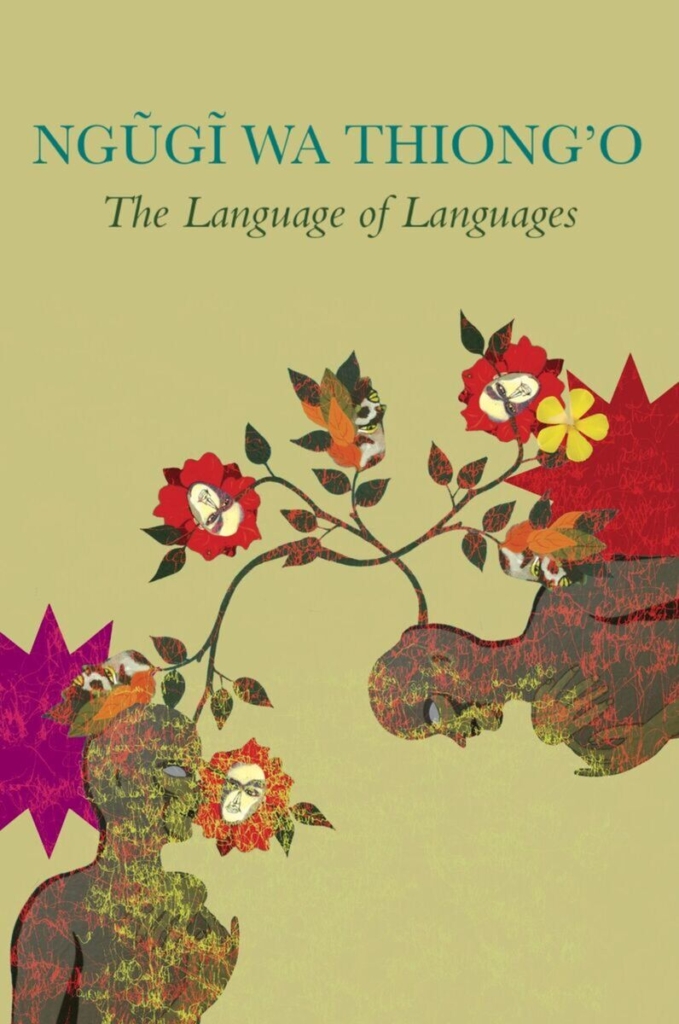
That question, ‘dae ye mind the sangs o fowk we’ve loast?’ is answered by the poem itself. The ‘carrying stream’ (Hamish Henderson’s great term for the deeper current) yields us strengths, even If we might have to translate them into another language for first access to them, before reclaiming them as our own, for current use. But I’d like to give the last word to Ngũgĩ, from his book, The Language of Languages: Reflections on Translation (2023): ‘If you know all the languages of the world and you don’t know your mother tongue or the language of your culture, that is enslavement. But if you know your mother tongue or the language of your culture, and add all the other languages to it, that is empowerment. In reality it is impossible for any person to know all the languages in their own country, let alone in the world. This is where the art of translation comes in.’
PART TWO
Decolonising the Mind
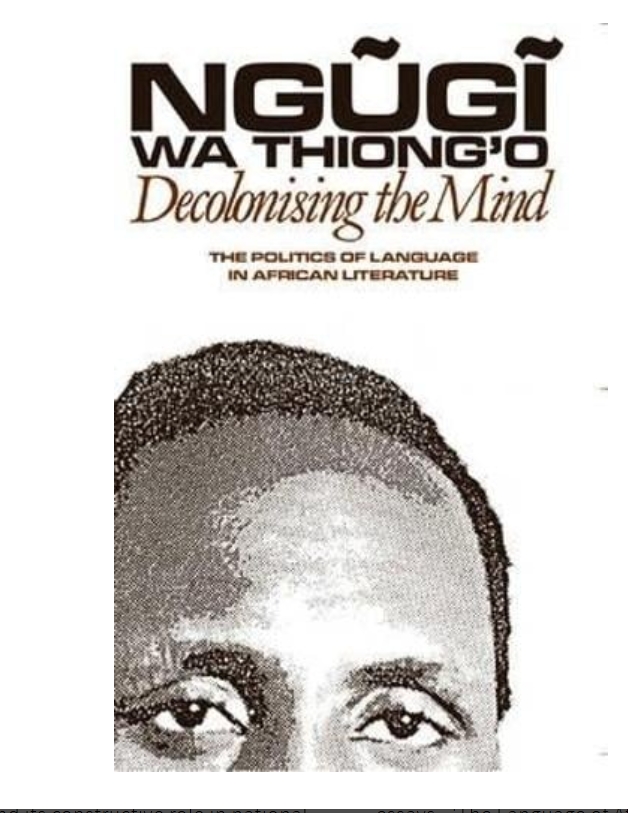
In his book, Decolonising the Mind, Ngũgĩ wa Thiong’o talked about the corporal punishment delivered to African children caught speaking an African language at school. These children had to carry a board around their necks, declaring their backwardness, their stupidity. In some cases, Ngũgĩ wrote, ‘the culprit was made to swallow filth, thus associating African languages with criminality, pain and filth.’
I want to follow Ngũgĩ’s insistence that the story has its parallels beyond Africa. ‘In his 2015 testimony to the Waitangi Tribunal about his experiences of school in New Zealand, Dover Samuels, a Māori politician, tells a similar story. Caught speaking Māori in the school, he said:
“You’d be hauled out in front of the rest of the class and told to bend over. You’d bend over and he’d stand back and give you, what they called it then, six of the best. On many occasions, not only did it leave bruises behind on my thighs but drew blood.”
‘The Sami people in Norway went through a similar experience in the period between 1870 and 1970 – what they call the brutal century – in an attempt to turn them into fluent Norwegian-language speakers. Violence against native languages is the running theme in the spread of English in Ireland, and in Scotland and Wales. In Wales, those who spoke Welsh in the school compound were made to stand in front of the class, with a placard reading WELSH NOT hanging from their neck. Violence was central in creating the psychological bond of language, culture and thought: colonies of the mind. You would think that after liberation and independence, the new nations, at the very least, would dismantle that unequal power relationship. But that is precisely the power of the colonies of the mind: negativity toward self has become internalised as a way of looking at reality.’
I want to emphasise how this story applies in so many very different parts of the world because if we do that, it gives us here in Scotland a solidarity, a context, a shared history we can draw strength from, while at the same time it insists that we pay attention to our own particularities, the singular ways in which this paradigm of colonialism has played out in our own country.
And the story continues. As Ngũgĩ says: ‘It is a classic case of conditioning you will find in manuals of behavioural psychology. Conditioning is a system of reward and punishment: punishment for undesired behaviour and reward for the desired behaviour. It is often used in various degrees of intensity in bringing up children or taming animals. The undesired behaviour becomes associated with punishment, and hence pain; the desired behaviour with reward, and hence pleasure. The object of conditioning, a child or an animal, comes to automatically avoid the space of pain, the forbidden behaviour, and gravitate toward the space of pleasure, the required behaviour. In the case of learning, one became the recipient of glory for excelling in the language of conquest, but the recipient of a gory mess for uttering even a single word in one’s mother tongue. One’s mother tongue became the space of pain, to be avoided, and the conquering language became the space of pleasure, to be desired.’
The polarised dichotomy described here carries a fundamental truth. Yet its extension over centuries has also meant an acquisition of the colonial language and its transformation into something singular in itself. This is what happens in some of the finest English-language writing of our Scottish writers, just as it does in Wales, Ireland, Africa, Australia, New Zealand. You can legislate for land but you cannot outlaw language – you can only use it or try to silence it.
I’m thinking of the English-language novels of Neil M. Gunn, where the depiction of Highlanders in the late 19th and early 20th centuries is so clearly nuanced, strong and subtle, and utterly distinctive. Or the poetry of Norman MacCaig, written almost entirely in English but in an English that could have come from nowhere other than Scotland.
This is not to excuse or endorse the imposition of the language but to observe how it has been reappropriated and turned to good use. Of course, at one time, there were puritans of a different kind, who would be merely disdainful of Gunn or MacCaig, advising them to learn Gaelic or Scots and write in indigenous languages as well, or even, exclusively. It’s another side of ‘The Puritan Dilemma’. The fact is, nothing is pure. The closer anything gets to ‘purity’, the duller, more neutralised, more sterile it becomes.
Which recollects a question that puzzled me greatly when I was a child: The boast, as it seemed to me, that ‘the inhabitants of Inverness speak the purest English in the country’. Well, I remember thinking, very good. That’s nice. But it’s a bit odd. Why be so proud about it? What happened to their Gaelic?
Here’s more Ngũgĩ:
‘The trauma experienced by the first generation of the conditioned can be passed on as normal behaviour that needs no explanation or justification; the later generations may not even understand why they associate pain with native languages and pleasure with foreign languages and cultures. The elite and educational planners of the formerly colonised societies assume that European (imperial) languages are inherently global and best able to carry intelligence and universality. That assumption may also explain why criminalising African languages continues to this day, now administered and enforced by African educationalists who don’t see the irony of what they are doing: an African punishing another African for speaking an African language, by order of an African government.’
And by order of an imperialist imperative. When we read of an American president attempting to control the priorities of education, broadcasting and publishing, and then trying to extend that control and influence into other parts of the world, as the USA has famously done more directly in past instances of ‘regime change’ (to use a polite term), we’re witnessing the same story spinning out across the world. Globalised power escalates the scale of the action.
And the temptation to oversimplify is too often, too easily, surrendered to. As I was revising this essay and showing a draft to Mike Small, Bella’s editor, Mike noted, a qualification: ‘I saw a post the other day by a Scottish nationalist using images from the Haka and aligning the colonisation of Scotland with the colonisation of the Maori people. But of course, Scots were absolutely central to the colonisation and displacement of indigenous people.’
Of course, that’s true.
But the point itself needs qualification. What I’m saying here is that there is a fundamental truth we can clearly state about imperialism, domination, exploitation and language, but it’s complicated everywhere by the ways in which human beings operate, and the liabilities are both subtle and crude.
There’s a difference between the wealth accruing particularly in some parts of the cities of unionist Scotland according to class through the centuries of slavery and industrialisation, and at the same time the impoverishment of the Highlands and Islands, and various towns and villages of post-industrial, post-war southern Scotland. The situation overall is complex, indeed, but not beyond comprehension.
And there’s something else.
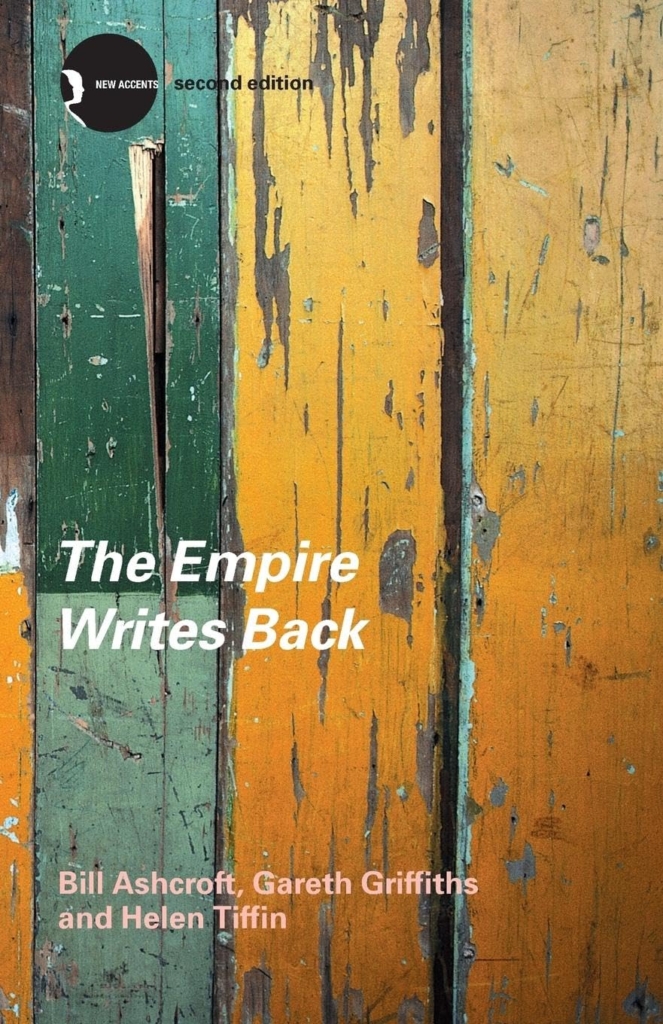
There’s a paragraph in The Empire Writes Back (London: Routledge, 1989), pp.32-33, by Bill Ashcroft, Gareth Griffiths and Helen Tiffin, a breakthrough critical study in its day, of what was then the emerging field of ‘postcolonial literatures’ (evolving from ‘Commonwealth Literature’).
Here, the authors discuss the work of Max Dorsinville with regard to the relation between dominated and dominating societies, hierarchies of oppression and the social politics of cultural change, both within and between societies. Dorsinville’s model accounts for productions of literary and cultural minorities within one country or area, such as the hierarchy of domination involved in the sequence Australian Aboriginal / white Australian / British and English literature, or the historical hierarchy of colonial and postcolonial literature in the United States, through the eighteenth, nineteenth and twentieth centuries.
To quote:
‘A model such as Dorsinville’s also makes less problematical the situation of Irish, Welsh and Scottish literatures in relation to the English “mainstream.” While it is possible to argue that these societies were the first victims of English expansion, their subsequent complicity in the British imperial enterprise makes it difficult for colonized peoples outside Britain to accept their identity as post-colonial. Dorsinville’s dominated-dominating model forcefully stresses linguistic and cultural imposition, and enables an interpretation of British literary history as a process of hierarchical interchange in internal and external group relationships.’
Unquote.
This begs a number of important questions. For whom does Dorsinville’s model make the situation become ‘less problematical’? In what sense is English to be understood as the ‘mainstream’ (even if that word comes with inverted commas)? And is the condition of Irish, Welsh and Scottish literatures really a problem ‘for colonized peoples outside Britain’? The crucial central sentence in the paragraph just quoted surely deserves to be rewritten in some way. Try this:
‘While it is necessary to argue that these societies were the first victims of (not so much “English expansion” as) the project of Empire, their subsequent complicity in that project – and their intimate relation to its dominating impetus – means that it is impossible to extricate their position fully from that project and that dominating impetus.’
End of revised sentence.
Yet without some attempt to fathom the autonomous energies at work in those societies, the monolith of English literature will continue to embrace or overshadow the literatures which have transgressed themselves and fallen prey to the project of Empire which ‘English literature’ was intended to serve.
I’m taking these last few paragraphs from an essay I wrote in 1991. The point I’d make more emphatically now is that Gaelic literature and the Highlands and Islands generally have a different language and cultural ethos that certainly would not consider English ‘mainstream’ or itself or themselves caught up comprehensively and committedly in the British Empire. Highland regiments in the British army are one thing, Highland communities in the geography of their spaces form another, but members of the same family inhabited and continue to inhabit both, and more than these two, worlds. Complex indeed, but comprehensible.
I’m remembering now the first year I was working in New Zealand, in 1986, being driven around the East Cape by the Head of the Maori Studies Department, and when we passed an under-construction building with the sign already in place for the first McDonalds in the town, he glanced at me wryly and said, ‘You see what your people are doing to my country?’
So to say, ‘Scots were absolutely central to the colonisation and displacement of indigenous people’ is correct. They (they is we – we) were both the perpetrators (some of us) and the victims (some of us) – different companies of us / them, clans, families, dynasties – and class, as much as nationality, and territory, and region – and the question of language – are all essential considerations throughout the whole story. We might know what motives propel certain kinds of behaviour but oversimplifying ‘blame’ is part of the problem.
Let’s get back to Ngũgĩ: ‘The trauma initially wrought by the colonial education system is thus passed on, inherited. Abnormality becomes normalised. The colony of the mind prevents meaningful, nationally empowering innovations in education. Control by the coloniser of the colonised is inherent in the inequality of the education system. Education may become a process of mystifying the cognitive process and even knowledge.’
And now he comes to the crucial point which any one of us involved in education in whatever capacity must be familiar with, and I’d like to emphasise it clearly: ‘Here we need to make a distinction between education and knowledge. Knowledge is a question of continuously adding to what we already know in a dialectical play of mutual impact and illumination. The normal cognitive process starts from the known and heads toward the unknown. Every new step makes more of the unknown known and therefore adds to what is already known. The new known enriches the already known, and so on, in a continuous journey of making dialectically related connections. Knowledge of the world begins where one is.
‘Education, on the other hand, is a mode of conditioning people to make them into, and function in, a given society. It may involve transference of knowledge, but it is conditioned knowledge, branded by the world outlook of the educator and the education system. A careful study of the colonial process, as a particular instance of the dominant and the dominated, the master and the servant, can be useful in thinking about balanced and inclusive education. Colonial education was never balanced or inclusive.’
But in social terms, it was – and is – understandable. I’m quoting Ngũgĩ so extensively here because the point I want to emphasise is that he offers us a theoretical understanding of a global history which, by necessity, simplifies particularities. As I said above, the fundamental truth is right there.
But there’s another truth, the human truth of how people behave and act in such circumstances, and this too is often overlooked. The puritans of any side insist we should ignore it. What I mean is that those wicked teachers, sadists, bullies, who inflicted corporal punishment and psychological abuse on pupils and students – let’s simply say, children – were human beings as well. Awful specimens of the genus, no doubt, but when my grandmother told me never to say ‘Aye’ (‘Don’t say “Aye” son. Who says “Aye”? Say “Yes”!’) that doesn’t mean she was a bad person. She was one of the best people I’ve ever known. You have to see the whole thing as a human story.
But having made that point, I need to go back to the truth of Ngũgĩ’s essay: ‘The colonial process was always a negation of the normal cognitive process. Imperial Europe – its names, its geography, its history, its knowledge – was always seen as the starting point of the educational journey of the colonised. In short, colonisation, in the area of education, was always predicated on the negation of the colonised space as the starting point of knowledge. In the area of language, it meant a negation of native languages as valid sources of knowledge or as means of intellectual and artistic inquiry. The lack of roots in our base creates a state of permanent uncertainty about our relationship to where we are, to our abilities, even to our achievements.’
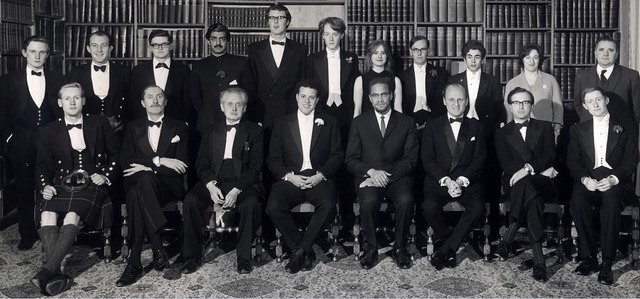
Malcolm X and Hugh Macdiarmid at the Oxford Union Debate 3 December 1963, Tariq Ali fourth from the left back row.
And that’s the long, long legacy we in Scotland still inherit. Many of us remain unaware of it. There’s always more to be said, and more to be learned from Ngũgĩ. But for now, let me bring this back home, or at least, offer a different illustration to make another connection that could be considered in this context. The Oxford Union Debate held at the University of Oxford, December 3, 1964, addressed the motion: ‘Extremism in the defence of liberty is no vice; moderation in the pursuit of justice is no virtue.’ To quote Corey Gibson:
‘This motion was adapted from Barry Goldwater’s speech at the Republican National Convention on July 16, 1964, in which he accepted the party’s presidential nomination. One month after Lyndon B. Johnson’s landslide victory over the firebrand conservative, the motion was debated in an altogether different, though no less performative context. Amongst those speaking for the motion at the Oxford Union were two unlikely bedfellows: the poet, Hugh MacDiarmid, an avant-gardist in the cultural sphere and vanguardist in the political, outspoken Scottish nationalist, and professed communist ideologue, and the political activist and cultural icon, Malcolm X, former Nation of Islam minister, revolutionary black nationalist, and, increasingly during this period, anti-colonial internationalist. Just a few minutes before midnight the motion they had supported was defeated 228 votes to 137. Nevertheless, in MacDiarmid’s thirteen minutes of diverse, emphatic aphorisms, and in Malcolm X’s thirty minutes of careful exposition on the depth and breadth of global injustice, the poet and the activist revealed a common cultural-political agenda.’
You can hear the debate online, on YouTube, if you search for ‘(FULL) OXFORD UNION DEBATE – Dec 3, 1964 – W/ Malcolm X’ [but we’ve included video beneath – Ed].
Let me quote from the speech Malcolm X gave there:
‘I live in America where there are only 22 million blacks against probably 160 million whites. One of the reasons that I am in no way reluctant or hesitant to do whatever is necessary to see that black people do something to protect themselves, I honestly believe that the day that they do, many whites on their side will have more respect for them, and that there’ll be more whites on their side than are now on their side with these little wishy-washy “love-thy-enemy” approach that they’ve been using up until now.’
Let’s see if that applies. How does this sound:
‘I live in the United Kingdom, where there are around 5 and a half million people living in Scotland, right next door to England, where there are over 55 million people living today. We’re all supposed to be living in a democracy, so that means the Scots have no say whatsoever in anything that the majority of the English vote for. (Such as government, nuclear weaponry and war policy, energy resources, the alleviation of drug abuse, the structures of the economy, mass media, broadcasting, almost all TV, radio and newspapers.) So I think the Scots should do everything necessary to protect themselves against the tyranny of the English government, and I believe that when they do, more English people and more people internationally will have some respect for them, and join in the struggle for independence, for England as well as Scotland, and we should get the powers of self-determination that are needed, and abandon the mealy-mouthed wishy-washy “wheesht-for-indy” approaches of persuasion and reconciliation that they’ve been advocating up till now. Call them out. If you’re out for independence, then get out and get going.’
This is not to equate Scotland’s situation with the oppression of African Americans but to call on the need for radical thought and action.
Show me a leader in Scotland able to make a statement like that. Malcolm X was assassinated on February 21, 1965, aged 39, only a few weeks after the Oxford Union debate.
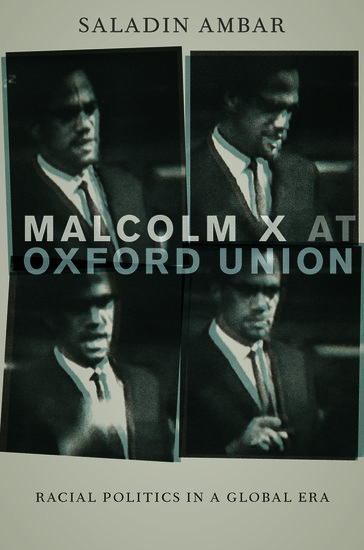
Saladin Ambar ends his book Malcolm X at Oxford Union: Racial Politics in a Global Era (Oxford, 2014) by recollecting an interview with Tariq Ali, the Pakistani-British political activist, writer, journalist, historian, filmmaker, and public intellectual. Saladin Ambar reported:
‘I talked to a friend who told me what Hugh MacDiarmid said about Malcolm X after having met him at Oxford,’ Ali told me. I paused, wondering what the one-time Scottish Nationalist thought of the one-time Black Nationalist. ‘Do you know the two words MacDiarmid used to describe Malcolm X?’ Ali asked, teasingly.
I let the question hang in the air for a few beats. ‘Tell me,’ I relented.
‘Authentic revolutionary.’
We could do with one or two here in Scotland.
[This essay was originally published in The National as two articles (3 and 17 November 2025) and is here revised and edited for Bella Caledonia.]

We are supported only by our readers. We don't have corporate backers and we don't take advertising, so we rely entirely on your support.
Help to support independent Scottish journalism
Brilliant
Thanks for that inspiring and informative article. It articulates so clearly what I feel and think about the conflicts and challenges of the Scots languages spoken and written.
I have a problem with the approach of this article, in that Alan Riach, a white university professor at an institution which has acknolwedged its links with the slave trade, says he is not comparing the struggle for Scottish independence with the struggle of Black people for equal rights, which continues to this day, when in fact, notwithstanding his disclaimer, that is exactly what he does in his anaylisis…
There are Black thinkers and writers like Kehindi Andrews who reject in its entirety the Western enlightenment project, which Marxism, nationalism and even the nation State itself would form part of, because they believe that the key dynamic behind modernity isn’t power relations or class, it’s skin colour, that, basically, white supremacy has been the motor of History.
You can accept Andrews’ argument or not as you prefer, but I think it is worth pointing out that this is the position of a lot of Black scholars who reject lock, stock and barrel, anything which has come out of the racist western tradition (Andrews cites racist passages in Kant, Hume, and Locke, in his book, “The New Age of Empire: How Racism and Colonialism Still Rule The World”, and, as is a well known fact, John Stuart Mill was a shareholder of the East India Company, the spearhead of the British colonial project in India, so even our most promonent liberals were only liberal when they were dealing with people with white skin…)
I don’t need to go as far as Andrews does, when he claims that Black and Brown people will be liberated by their own uprising, regardless of what anyone white does or doesn’t do, to have sympathy with the basic outline of his critique…
I can’t see how this isn’t problematic for such comparisons as Alan Riach makes here, and there is the further problem that, while writing poetry in Scots is valuable no doubt, the Scots leid has been almost totally abandoned by every other institution in the country, including the Scottish Parliament, so that, writing poetry in Scots is reasonably well considered in Scottish society, but speaking working class Scots still looked down on, if not abhorred, by the people who run our country…
Fawning to Englishness became a national trend back at the time of the Scottish Enlightenment (Hume’s “History of Great Britain” being a good example) and hs never really stopped, for all the heroics of McDiarmid and the other figures of the Scottish Renaissance…
You could say the same about Feminism as Black Critical Race Theory of course… which would include Kehende Andrew which is to say, people who try to understand the rise of modernity through the prism of race…
Well, you can say, “If I look at the history of modernity, it’s the history of men taking the fruits of women’s unpaid work to create the patriarchy”…
I think no one sensiblly can disagree that both Black people and women paid an inordinate for “progress”…
I think, also, that it shows that Scottish (and other country’s) university professors just don’t get it…
They still think they’re the font of power, when the fact is, they have been the mainstays of reaction and bigotry and prejudice for three centuries, a legacy a few apologies and a couple of scholarship funds can never undo…
A key statement in Alan’s piece is this:
“I want to emphasise how this story applies in so many very different parts of the world because if we do that, it gives us here in Scotland a solidarity, a context, a shared history we can draw strength from, while at the same time it insists that we pay attention to our own particularities, the singular ways in which this paradigm of colonialism has played out in our own country”.
It is a solidarity that takes us beyond our own struggle for Independence, and encourages us to learn from the creativity, resourcefulness and courage of people in other countries who have resisted colonialism. And stand alongside them.
Seriously?
You seriously think we have a shared history with the people of Africa who were kidnapped, put aboard slave ships in horrendous conditions, lying in their own filth for weeks on end, before being “seasoned” for slavery in concentration camps run by white people – among others almost certainly a few Scots – and then worked to death on slave camps / plantatiions until they died?
The history of one side of my family, my mother’s, is of fleeing Ireland for Scotland and the chane of a liveable life, but that, while bad, degrading, inhumane and wrong is nothing like the monstrous crime of chatel slavery surely?
Colonialism has been a global phenomenon, that played ouit in different ways in different places. No, people from Scotland were not transported on slave ships. Yes, people from Scotland, Africa, Australia, Canada and many many other places had their culture and language suppressed. From the early 1950s, there has been a massive worldwide postcolonial movement. We should be part of that. Within my own family history, some lost their homes, livelihoods and traditions in the legacy of colonialism in Scotland is complex.
Colonialism was not a global phenomenon, John, it was a European phenomenon, with Spain, Portugal, France, the UK, Belgium, the Netherlands, Germany and Italy all having extensive colonies right up to within living memory…
We have to acknowledge our part in it, I just can’t accept we do nothing to honour the memory of the slaves who were the biggest victims of it…
The people of Glasgow are known over the world for being generous, progressive and inclusive…
I can’t believe, if the history of slavery and Scotland were told to them, they would accept anything less than a monument to pay tribute to the victims of the slave trade which Glasgow as a city benefitted from, and can still be seen in so many street names today, like Jamaica Street…
Scotland is not, nor ever has been, a colony of England. But it was an arch British colonialist.
We need a slavery memorial in Glasgow, it is blindingly obvious…
We cannot go forward into the future as an indedependent country without acknowledging our role in the slave trade, which is only comparabale to Auschwitz and the Shoah as a historical event…
Go to Nantes, people, go and see what the French have done in Nantes, converting a former slave-trading centre into a vibrant, multi-racial society with a highly moving tribute to the slaves who were traded through that city…
“Won’t you help to sing
These songs of freedom?
Cause all I ever had
Redemption songs,
Redemption songs
These songs of freedom…”
I would have stayed in Nantes for much longer, I would have pitched my tent there and stayed for weeks. I like being in cities where there are lots of Black people, People of Colour, whatever the right term is these days… I much prefer that to being in a white city, like so many of Scotland’s cities still are…
Nantes is not a glamorous city, it’s a bit of a dump in fact, but I just loved it, I loved being there, and talking to people from there, and seeing how at ease everyone seemed to be with each other…
I went there, because I had read Tom Devine’s book “Scotland and Slavery” and quickly worked out Nantes was one of the big players in west European slavery and so decided to go there…
Here’s an online video which gives the flavour of what the French have done. Hats off to them. There’s never going to be justice, but there can be Memory and perhaps even atonement…
https://www.youtube.com/watch?v=dmFuf0Z4Klw
100% Douglas.