
A People Once Again? The Irish Questions
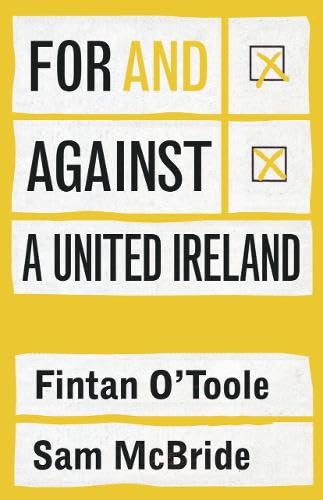
Fintan O’Toole and Sam McBride, For and Against a United Ireland, Royal Irish Academy, £18.
Reviewed by David McCrone
We have become used to the parade of prejudices masquerading as analysis in much writing and journalism. It is refreshing, therefore, that two of Ireland’s best journalists have set out the cases for and against a united Ireland, each writing two chapters so that we get each arguing each case. We can jalouse their own personal preferences, but that is not the point. They each take great care to spell out plainly and with sophistication the pros and cons of each. Their respective pedigrees are outstanding. Fintan O’Toole’s columns in The Irish Times are unmissable, and Sam McBride, Northern Irish editor of the Belfast Telegraph, has written the definitive study ‘Burned: The Inside Story of the Cash for Ash scandal and Northern Ireland’s new secretive elite’ (2019).
I guess that their own politics are broadly social democratic, but that is not the point. They provide a North and South analysis for and against reunification (or unification, if you take the view that at no point in history was there an all-Ireland independent state). The differences between them are those of degree rather than of kind in that they tell similar tales, whether in favour or against a united Ireland.
The key argument for both of them is that North and South are no longer the places they were back in 1921. Then, the North was much more industrialised and developed, around shipbuilding and textiles, while the South was agricultural and economically under-developed. Three key pillars have crumbled: there is no longer a Protestant majority in the North; the radical superiority of the Northern economy has gone; and the key political alliance between Ulster Unionism and British Conservatism is no more.
The Case for Unification
The case for unification on grounds of one island=one state is dismissed by both authors. This kind of geographical determinism falls foul of the state of the Other Island where no-one argues that England, Scotland and Wales are in a single British state because they share the landmass. Nor does either author have any truck with the view that Northern Ireland is British because it suits the British state to insist so. Neither in the long argument about the boundaries of Partition – obviously drawn in 1921 to ensure a comfortable Protestant majority – nor to enhance land of hope and glory has Great Britain clutched Northern Ireland to its imperial bosom. The best that can be said is that the Brits were indifferent (those dreary steeples of Fermanagh and Tyrone), which helps explain why successive governments hoped the statelet would somehow go away; a faraway place, and all that. And recall the statement by a British Tory government that it had no ‘selfish strategic or economic interest’ in keeping Northern Ireland in the British Union against the will of its people. Sinn Féin/IRA claims to the contrary never held much truth although it made good rhetoric.
Nor is there much truth in the case that North and South represented ‘fundamentally different ways of thinking’ (the words of a Stormont Minister in 1956). True, James Craig, prime minister of Northern Ireland in 1934 uttered the words ‘All I boast of is that we are a Protestant Parliament and a Protestant State’, but that was a reaction to claims that the South was a Catholic state. Also true was that Catholics in the North were formally and systematically excluded from a political route to power, and were banned from joining the Ulster Unionist Party. Such a route would, ironically enough, have done quite a lot to integrate Northern Ireland as a non-sectarian state, and made it more constitutionally secure. But that wasn’t to be; and the rest is history.
The case for reunification made by both O’Toole and McBride is that the political, economic and cultural conditions which created Northern Ireland with its curiously gerrymandered wiggly borders are no more. Partition in 1921 was a device to save the island from civil war, something the British were never good at preventing, witness India in 1948. And the Republic is no longer ‘a pathetic, sectarian, mono-ethnic, mono-cultural state’ in the words of David Trimble as recently as 2002. Nowadays, as Sam McBride points out, the Republic is ‘brimming with wealth’. So Irish unity would facilitate economic regeneration in the whole of island, bringing about necessary reforms in terms of inward investment, education, welfare, tourism and the arts. The North would have far more clout in the Dáil, and would represent 25% of the population of the Irish state rather than a mere 3% of the British one. The optimistic case for unity would be as a catalyst for necessary institutional change, to systems of health, education, social welfare, north and south of the border. That’s possibly as good as the case gets as seen by these authors. Old conditions which ran along religious and ethnic lines have disappeared; and the South is far more prosperous than the North, at least on paper.
The key point of this debate, though, is not whether reunification, but what kind. Southerners seem to favour integration into the Republic, so that Ulster becomes a Munster; annexation, if you like. Northerners, if at all in favour, are for devolution, with Ulster (Northern Ireland no longer) having a regional assembly in Ireland much like Wales in the UK. In passing, it is interesting that Sam McBride uses the Wales analogy, and not Scotland, presumably because the latter is farther out of the British Union. A regional Ulster, of course, is only half the story, because integrating institutions across the border is a huge task, and who can imagine An Garda Síochána policing the Shankill Road?
The threat of violence exercises both O’Toole and McBride, because it doesn’t take many terrorists to cause mayhem, although much would depend on how much cover the ‘Protestant community’ would afford protection to such people; think of Mao Zedong’s famous line about guerillas moving among the people as fish swim in the sea.
The case, then, for Irish Reunification as far as O’Toole and McBride are concerned is based on the removal of the economic, cultural and political conditions into which Partition was embedded. Furthermore, both North and South have far more people born elsewhere, respectively 15% and 20%, who would, presumably, be looking for something different than the same-old, same-old.
The Case Against
And what of the case against reunification? Let us count the ways. First of all, and basically, which people are we talking about? O’Toole comments that who makes up ‘the people’ of Ireland is shifty and blurred. Who counts (themselves) as ‘Irish’ and for what purpose, is a big question. The Irish sociologist Jennifer Todd has made the point that before The Troubles, Unionists in the North were happy to think of themselves as ‘Irish’, as well as other things, in terms of geography of the island. Post-1968 events saw them shrink back from that, to stress their ‘British’ identity, while ‘Northern Irish’ was a helpful cover for Catholics as well as Protestants in the North as it fore-fronted geography. Todd also made the vital point that over 100 years of The North had created new kinds of people there, regardless of religion or political proclivities. Most Southerners, she found, thought of Northerners of whatever suasion as morally different. They were considered loud, violent, aggressive, ‘guns-blazing, shouting us down’, while folk in the South were deemed ‘peaceable, quiet’. In O’Toole’s words: ‘The creation of Northern Ireland was less a case a people forging a state than of a statelet forging a people’. One can imagine, then, that trying to integrate into a new Ireland a people, Catholic or Protestant, Nationalist or Unionist, would be a job of work.
Then there is the aftermath of a border poll and its fall-out. Imagine a narrow majority in aggregate North and South in favour of Irish Unity, the classic 50% plus one. It would be hard enough to persuade the ‘minority’ that they had lost, and even harder if, say, unionists voted against, and nationalists in favour. After all, in the Brexit vote, that’s what happened. In that particular case, the British state chose to ignore it, as in Scotland, on the grounds that sovereignty resided in the UK as a whole, which meant that the vote was decided in England. Just how unionists could be shoehorned into a greater Republic is a big question; bigger than reunification in Germany in 1990 which came about because the East German state ran out of road. If Northern Ireland as a whole voted against (or even if the South did so), then the UK would have little option but to welcome the statelet back into its bosom, through gritted teeth, as a provincial basket-case.
In any case, the Union in The North has been ‘extraordinary resilient’, and ‘we cannot be held accountable for what our long-dead forefathers did’ (McBride). Consider that, since the Good Friday/Belfast Agreement, power-sharing has been accepted by unionists in Northern Ireland, as well as Sinn Féin becoming the biggest party and leading The Executive. The old Orange state has gone forever. There is the question of flags and anthems, never far away in The North. The Republic would be required to change both flag and anthem, while one wonders why the Tricolour with its Orange and Green (and White in between for none-of-the-above) isn’t the perfect device in a united Ireland.
McBride is surely correct to point to the Republic’s wealth being founded on its status as a global tax haven, and in a nice line observes: ‘James Connolly did not enter the GPO in 1916 to create a nation specialising in facilitating tax-dodging corporate behemoths’. More to the point, taxable wealth in the South rests on something of a shoogly nail.
There are all sorts of economic nitty-gritty to be resolved such as how the share of national debt post-unification is dealt with between Ireland and Britain (as the UK would become), and was a bone of contention when DeValera ruled the roost, only resolved by post-war compromise in 1948.
Where Are We?
So where do things stand? O’Toole is surely correct that ‘most people in the Republic want a united Ireland but only if it does not involve them making any real compromises on their own symbolic attachments’. A 26-county Republic on its own would not work, and new institutions and ways of thinking would have to evolve. There is little sign of that.
One key feature which neither author dwells on is the party political. In short, where is the political carrier for this transformative and tricky project? The civil war parties, Fianna Fáil and Fine Gael, are too comfortable in their socks to be that carrier. Sinn Féin is the only party with sufficient electoral strength north and south of the border, but is surely hobbled by its intimate association with the IRA to be a trusted vehicle of unification. You can’t bomb people into a united Ireland. The gist of the case, as read by these two outstanding journalists of both parts of Ireland is that reunification may be desirable in transforming the stale institutions of North and South, but remains highly unlikely in the short and medium terms. We won’t hold our breath.

We are supported only by our readers. We don't have corporate backers and we don't take advertising, so we rely entirely on your support.
Help to support independent Scottish journalism
All very solidly reasoned, David. There are multiple very solid reasons to regard unity as being a short-term impossibility and a medium-term stretch goal.
And yet, in 1905, a similarly rational and honestly-observed assessment would have been at least as dismissive of the possibility that within 17 years Ireland would be partitioned and an almost-independent state would cover 5/6ths of the island, and within 26 more years that it would have shed all ties with the Britannic Crown. The factors which propelled those shifts are visible in hindsight, but were at the time dismissed as fantasy. Even Padraig Pearse sold his vision as that of The Fool.
In addition to all the wise caution set out by O’Toole and McBride, there are a few big historical reasons to be wary of the durability of the status quo. In no particular order :
1/ Norniron no longer has majority positive support. It continues with the support of a unionist plurality, but not a unionist majority. That is unstable.
2/ Scottish Independence is a significant possibility. That would radically destabilise the union
3/ A ReformUK government in the UK now looks likely. That would radically destabilise the union
4/ the FFFG grip on power in the 26 counties continues to fade. Whoever succeeds them will bring a very different dynamic.
5/ the economic gap between north and south is growing. That puts big stress on the border
6/ migration pressures may make the open border unsustainable. That would make Norniron intolerable for many nationalists.
That’s before we get ointo the global economic destabilisation of trumpism, the political destabilisation caused by social media, let alone the non-trivial possibility of major war in Europe upending all expectations as happened after 1914.
So for me, the O’Toole/McBride analysis is a good reading of the cards on a very rickety outdoor table with storms likely. Don’t pay too much attention to the cards.
Whereas I jealoused, from the adulation for Fintan, from the hackneyed allusion to the’dreary steeples of Fermanagh and Tyrone,’ from the failure to allude anywhere in the introduction to the urban economic transformation of the Celtic Tiger, the rural tsunami of immigration or the political capture of FF-FG-SF by Woke that knowledge of Ireland (Six Counties or Twenty Six Counties) wasn’t apparently a strong point of this writer.
Then I read about Stormont PM ‘James Craig’…
Wow. “The political capture of FF-FG-SF by Woke”. Wow..
James Scott seems to have overdosed on GBNews. But the conflation of “FF-FG-SF” as a single group is, erŕ, novel.
Is James hankering for the glory days of the Catholic taliban selling babies, enslaving their mothers, covering up instuitional rape, and enying women bodily autonomy? Or is he more in line with the Musk-fuelled screamers who want to go back to kicking LGBT people about?
Is Ireland still run by a man who wears a Pharoe’s hat? Is it still run by people who are still going on about the Irish Civil War? Can you now buy a Durex without emigrating?
Are you genuinely fifty years out of date? Or just out and about in your lycra before dawn to indulge in some early morning trolling?
A country that was recently ruled by a guy in Italy wearing a Pharoe’s hat and proclaimiming himself to be a reincarnated version of St. John who got nailed to a boat and cast adrift.
Sorry St Paul. I guess his demise was equally brutal.
O’Tool and McBride, while excellent journalists, debating Irish unity would be akin to a Scottish Tory and English Tory (or Scottish Labour and English Labour, take your pick) discussing the merits and demerits of Scottish Independence. Mac Bride a unionist and O’Toole a partitionist both have skin in the game. Worth noting.
What do you mean by partitionist?
O’Toole supports a united Ireland. The video discussion between them about this book from an earlier post makes this clear, so it is not how you describe.
It’s fascinating, and instructive, how the very mention of Ireland, let alone the reunification of Ireland, in a positive light, still elicits such deeply hostile reactions, such disparaging comments, and such spectacular ignorance from some in the UK. This was on full display during the Brexit debates; and we seem to be getting a hint of it in some of the comments here.
OK, on reflection I can see that I did go over the top. I can see that I allowed what I perceived [wrongly] as an open goal in front of me to cloud my judgment. I played the man and not the ball, to mix my sporting metaphors.
As a result, I clearly posted as if the writer of this piece had somehow cornered the market in uninformed commentary about Ireland
I was wrong. I admit it. Mea culpa.
I was feeling chastened…until subsequent posts made clear that there remains a bull market for it here, in Scotland.
Trolls have been removed.