

A Cultural Evacuation: The Demarco Archive Leaves Scotland
“What the hell is Richard Demarco doing?”
Many have asked this question over the decades; now, he is asking it himself.
He is asking it now because, after years of trying, he has finally found a permanent, secure home for his archive. This vast Gesamtkunstwerk (‘total work of art’) of artworks, photographs, documents, posters, and ephemera has occupied 13 rooms at Summerhall for the last decade. However, the new home provokes very mixed feelings, as it is not in Scotland but at the Muzeum Sztuki in Łódź, Poland.
While he is deeply grateful to have found a place where the archive will be properly cared for, catalogued, and digitised, the fact that it is leaving Scotland causes him pain. It seems to confirm his long-held sense that he has never truly been accepted; the small boy bullied for his Italian background has never quite fitted in. Over the decades, he has fallen out with a number of significant figures and institutions in the Scottish art world. But then, he himself has never tried to fit in. There has, it would have to be admitted, always been a streak of self-sabotage in Demarco’s personality.
A European Identity
With the archive going to continental Europe, the move underscores his long-articulated belief that he is fundamentally European rather than Scottish. “Scotland is in Europe: Europe is in Scotland.”
Driven by the belief that art and culture should never be insular, he has consistently aimed to transcend borders, instead highlighting the deep connections between Scotland and Europe. He constantly urged artists to traverse boundaries and forge international connections. This outlook—a central feature of his work—is perhaps best manifested in the sheer range of countries he has been involved with. When sorting through his collection, his repeated, telling query was: “What language is this in?”
That the archive is going to Poland is, in Demarco’s view, entirely consistent with the deep cultural ties between the two nations. These are reflected, for example, in the number of Poles who stayed in Scotland after serving in World War II, and in the many who arrived following Poland’s accession to the European Union. As Demarco notes, Polish is, as a result, the “second language of Scotland”, not Scots or Gaelic. Through his many excursions beyond the Iron Curtain, connecting with artists “imprisoned” there, Demarco developed sustained cultural dialogues with Polish artists and institutions. He first visited Poland in 1968: “I’ve been working with the Poles for yonks.”
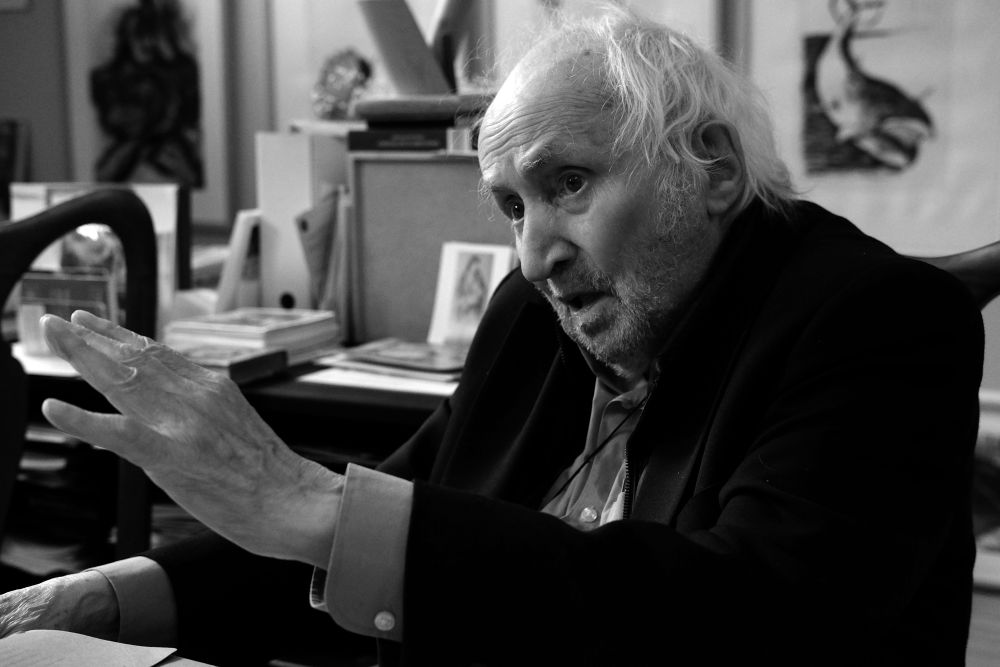
Therefore, as Demarco put it in a recent newsletter, “I am, therefore, now in my 96th year and most grateful to my experience of the Edinburgh Festival to be able to make the gift of my life’s work to Poland, representing the fact that the cultural legacy of Scotland is wedded to that of Europe and that legacy has a distinct Polish dimension”.
On the Cultural Frontline
Łódź lies not far (about 360 miles) from the Ukrainian border, nor from Russia and Belarus; it is, as Demarco describes it, “dangerous territory.” Yet this will “not deter” Demarco: he is content to be “on the frontline,” seeing this as emblematic of his lifelong desire to push artistic boundaries. Moreover, he believes the culture he has engaged with throughout his life is itself under threat from Russian aggression. In his view, Ukraine’s fight is also our own. The “brave soldiers” on the frontline are doing something we couldn’t (“Scotland has no army”).
Demarco has been assured that the Muzeum Sztuki would be able to protect his archive in the event of an invasion. Indeed, the rapid packaging and parcelling I witnessed at Summerhall had the atmosphere of the emergency relocation of cultural artefacts that so often occurs during wartime. During the Second World War, for instance, the UK’s major artworks—primarily from the National Gallery—were secretly evacuated and stored in the Manod Slate Quarry in North Wales.
The irony is stark: a city near a war zone currently offers more security than a cultural centre in peaceful Edinburgh. In this case, the urgency stems simply from the need to vacate the rooms at Summerhall. They are to be rented out as artists’ studios, and had Demarco wished to stay, he would have been required to pay substantial monthly fees. Summerhall, he says, “want me gone,” with “no trace of me left.” It feels a pity that they would not retain a few pieces—items that might have inspired the contemporary artists working there.
He does not wish to remain in the building, however, as its condition is no longer suitable for housing such material. Leaks have been regular occurrences and damp patches are clearly visible. In Poland, the collection will be safe. He is confident that its true value will only begin to emerge once it is properly accessible, rather than buried in drawers and boxes. “People will be studying this long after I’m dead.”
Given his health and that of his wife, he will lose physical contact with the collection. “I can’t go to Poland,” he admits. Instead, everything will be photographed, and he will provide as much information as possible remotely. In many cases, only he will be able to identify specific events or, especially, the people featured in the photographs. However, his memory is not what it once was, and recalling names and dates often takes time as he searches through his personal ‘hard drive.’ Yet, his recollection of particular events remains vivid and impassioned. For instance, on seeing a poster featuring Marina Abramović, one of the ‘big names’ he has worked with: “She was just 18 when I first introduced her to the art world; who else would have taken her seriously?”
Hidden Gems in Brown Paper
While I was present, several drawers of posters were being sorted and packed. As each one was revealed, Demarco responded with reminiscences and exhortations to “take this work seriously.”
What stood out most was the aesthetic quality of the posters; many were artworks in their own right. Although most in that drawer dated from the 1990s, there were also striking examples from the late 1960s whose visual language transported—and startled—everyone present. Demarco repeatedly delayed proceedings, compelling the packers to stop and truly look at the items they handled. “Oh my God, oh my God!” he exclaimed again and again, acutely aware that this might be the last time he would see these works. As each poster, document, or photo was packaged up, a flood of memories and recollections poured out, underscoring the profound sense of finality he felt about the collection.
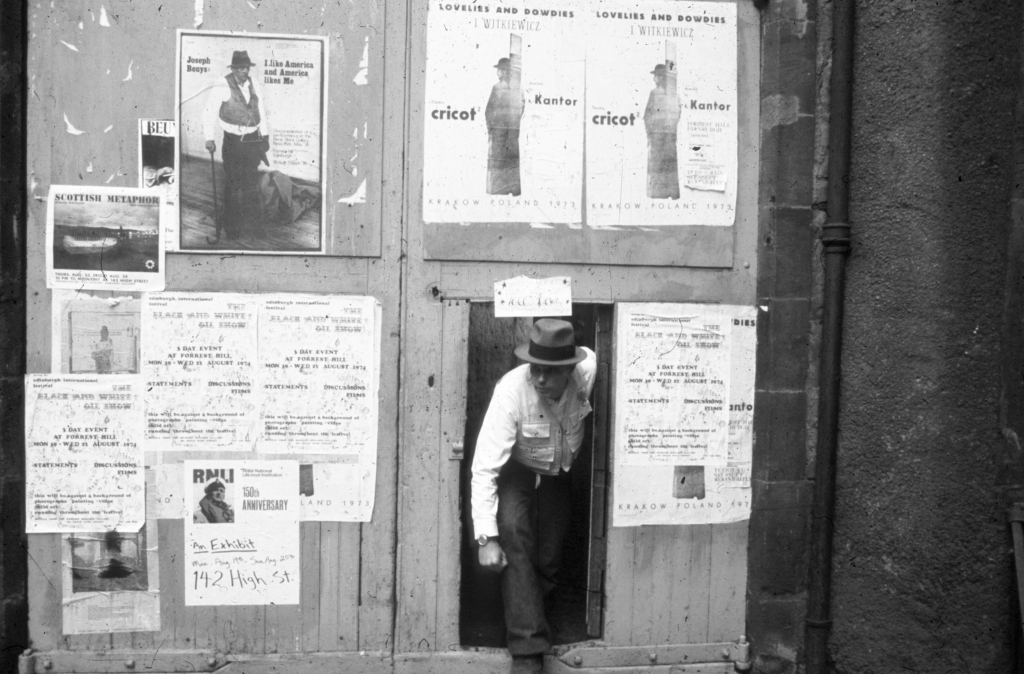
Joseph Beuys and the Poorhouse, 1974. Photo and © Demarco Digital Archive, University of Dundee.
The contents of the drawer appeared largely random, underscoring the monumental task of organizing the entire archive. Indeed, while sorting through the posters, we made a striking discovery: an unmarked brown paper bag contained a work by Joseph Beuys—likely worth several thousand pounds—a clear indication of the numerous significant gems scattered throughout the collection. The archive also features posters from Demarco’s early life, including a beautifully hand-illustrated one he created for the Edinburgh College of Art’s Sketch Club in 1952. Though a comprehensive record of his collaborations, Demarco’s distinctive personal imprint is evident throughout.
“Nobody Cares”
Although the visual richness of the archive is obvious, Demarco has never wanted to be “limited to the visual arts.” A deeply “serious person,” he has engaged with multiple artistic forms, especially theatre, as well as broader cultural and political ideas. He has always been interested in “ideas and history, not just art.”
He believes much contemporary art education lacks this wider context, leaving too many artists operating within a narrow frame of reference. This, he feels, explains why the university turned its back on him. “Nobody cares!” he exclaims angrily, grasping and prodding the small group of helpers in the room. In truth, many people do care, as evidenced by the numerous books, articles, and films devoted to his life and work.
As he has grown older, however, the range of his reminiscences has narrowed, and perhaps that “streak of self-sabotage” has contributed to the distance. He often repeats the story of being accused of “bringing dishonour” to the art world. Increasingly, he became detached, losing connection with key cultural institutions. The prolonged struggle to find a home for the archive has been deeply hurtful: “I feel completely humiliated.”
To survive, he estimates he has had to auction off around 80% of his collection. He feels he only truly “exists for three weeks a year” during the Festival, yet must somehow endure the rest of the year. There is a deep sense of rejection in his words. “I should have been the director of the Edinburgh Festival,” he says, rather than being pushed to the margins. Now struggling physically, his complaint upon being asked to pose for a photograph—“I can’t lift my head up”—felt like a powerfully fitting metaphor for his exhaustion and the burden of the moment.
A Loss for Scotland
While the hurt is personal, Demarco repeatedly emphasises that the archive’s significance extends far beyond his own life. It documents thousands of artistic collaborations. As he puts it, he is taking to Poland “all the galleries and artists I’ve been involved with—it’s not about me.”
In examining uncatalogued sections of the archive a few months ago, I became acutely aware of how much of the Festival and Fringe’s rich history is preserved here—much of it seemingly nowhere else. As Edward Schneider of the Demarco Archive Trust notes, there remains “no obvious place” to take a visitor who wants to understand the evolution of the Edinburgh Festival and Fringe. Given the wealth of material it holds, Demarco’s archive would have been the ideal site, even if much of it was previously inaccessible. Once organised in Poland, it will be accessible—but at a distance of 1,347 miles. This feels deeply symbolic: something of immense cultural value to the city will no longer reside within it.
This sentiment symbolises Demarco’s belief that the authentic spirit of the Festival belongs to an earlier, more radical era—one that existed before the dominance of TV-ready stand-up comedy and the Fringe’s subsequent devolution into a profit-driven ‘circus’. For Demarco, the Festival was meant to be a site of high-stakes cultural exchange, not a trade fair for light entertainment. Time and again, he denounces the “bitter darkness of the marketplace,” arguing that the commodification of the Fringe has choked off the oxygen required for the kind of serious, difficult, and avant-garde work that originally put Edinburgh on the cultural map. Though gloomy, Demarco has not given up hope that the original notion of the Festival might be resurrected. He sees signs of hope in Nicola Benedetti, the present Director of the Edinburgh International Festival, “whose thought-provoking programmes relate to her concept of education on all…levels”.
It also speaks to his core identity: that of an educator. As he often notes, the only profession for which he holds formal qualifications is that of a schoolteacher—an art teacher, which he was at Scotus Academy. This remains central to his character, evident in the gently bossy way he instructs his assistants. More broadly, he attempts to educate everyone he encounters, sometimes making clear that he believes his “pupils” have serious gaps in their knowledge. In my case, he sought to instil an awareness of the deep significance of “event photography”, the systematic documentation of exhibitions and activities; something he has practised for decades, camera seemingly permanently around his neck.
He generally feels he has failed in this mission. “I’ve been trying to educate the Scots about the true significance of the Festival,” he says, yet believes he has ultimately been unsuccessful. The lack of institutional will to retain his archive symbolises this failure. “Why is Scotland the only country that doesn’t want my archive?” Ultimately, he concludes, “we are not serious about art.” This belief brings a degree of relief in the move to Poland. He feels he is finally “freeing myself from the Scottish art world.” He has simply been, he believes, “too much for Edinburgh to deal with.”
A Final Lifebelt
At 95, time was running out. He describes himself as “facing a penalty shootout.”
The intervention of the Muzeum Sztuki was a profound relief, saving him from the slightly paranoid fear that his archive might be discarded after his death. Demarco’s project always carried a dual nature: the archive was both a physical object to be preserved and a significant psychological burden. Hence the sense of relief in recent months, as the Muzeum Sztuki shifted from a mere possibility to a concrete reality. Daniel Muzyczuk, the museum’s director, simply asked, “Can I help?” For Demarco, this was “a lifebelt to a drowning human being who was giving up hope.
As the talking and packing continued, his long-time assistant, Terry Ann Newman, received an email from Muzeum Sztuki staff confirming that the first consignment had arrived safely in Łódź. The relief in the room was palpable, energising everyone involved. The new home for the archive, long discussed, was becoming a reality.
Demarco and his small team have worked extraordinarily long hours, and the process has been emotionally draining. Further trucks were scheduled in the following week to collect the remaining materials. Once completed, only personal items—such as early-life materials and diary transcriptions—will remain at his home and at Terry’s studio in Midlothian. In time, these too will make their way to Poland.
A Poignant Irony
The departure of the Demarco Archive presents a profound paradox. It is a triumph of preservation, ensuring that his life’s work survives the “penalty shootout” of his final years, yet it stands as a stark indictment of the Scottish institutions that allowed it to leave. As the trucks head toward the “dangerous territory” of Eastern Europe, they carry with them a unique record of the Edinburgh Festival—one that Edinburgh itself refused to house.
In the end, the archive’s migration confirms Demarco’s oldest conviction: art knows no borders. He has found sanctuary, but the outcome is a poignant irony: to realise his vision of a truly European Scotland, his legacy had to leave it behind. Some traces of the collection will remain behind through George Mackintosh’s project Papple Steading, which will manifest Demarco’s view that “you cannot separate the world of culture from the world of agriculture.”
The journey to Poland places Łódź on the intellectual map of his life, turning it into a crucial location on the semi-mystical ‘The Road to Meikle Seggie’. Though rooted in a real farm on an ancient drovers’ road in Fife, this ‘road’ is Demarco’s core philosophy. It represents a route defined by history and mythology, one that deliberately turns its back on the easy, obvious avenues of the commercial art world and instead leads toward the essential destinations of adventure, risk-taking, and self-discovery.
While climate change destroys archives across the Caribbean, the new field of glacial archaeology is booming:
https://en.wikipedia.org/wiki/Glacial_archaeology
So it goes.
Sad to see the archive going away like that. Reminds me of encountering Demarco several years ago at the Summerhall installation. He welcomed me and a friend as though we’d arrived on his personal invitation and kindly showed us around his treasures. Its tempting to think of how we could have used an energy fund like that in Norway – for the Festival to have owned spaces to hold on to this kind of archive. I hope we dont disappoint him further and that the Festival can take a clearer international emphasis.
A partnership of built heritage organisations was created to save the Bernat Klein Studio in Galashiels. It is deeply disappointing that something similar wasn’t done to keep the Demarco archive in Scotland. Are Scottish Ministers, Creative Scotland, and the people in senior positions in our cultural institutions and universities asleep at the wheel?
Very sad but happy the Archive has found a suitable home I have followed Demarco and his Art since the 60s from the time of the start up of the Traverse theatre in the Grass market to its conclusion as is now. What a work Rici has achieved its beyond understanding that Edinburgh should turn its back on his need to house his Archive.