
2025, the Blur
A review of the year, sort of.
2025: a quarter into the 21C. Here we are.
Even the work of remembering, reflecting, or reviewing feels like an odd thing to do. Not subversive but somehow meaningful in a world where the torrent of crisis, ‘news’, violence, and corruption becomes a daily blur. In this tumult, to take a pause has a purpose. We are over-exposed to just about everything, but in particular, information, or more precisely, ‘information’.
It’s not all disinformation or misinformation. It’s more that it’s of low-grade quality. The word of the year for 2025 should probably be ‘slop’.
The problem is that such is the frantic state we live in, actually remembering anything at all is difficult. So, apologies in advance for all that I’ve missed out and all that I can’t remember.
Now we’ve had Tommy Robinson’s Carol Concert and Doug Barrowman and Michelle Mone have put PPE Medpro into liquidation owing the government £148 million, it’s time to hang the stockings, dress the tree and look back at 2025.
The year started as it ended with Donald Trump threatening to invade other countries. In January it was Greenland, Mexico and Canada, by December it was Venezuela. To what extent these were pantomime threats to distract us from whatever terrible activities he was trying to bury we may never know. Certainly, the threat to Greenland still exists but they haven’t been invaded yet, though economic and diplomatic relations with Canada – America’s closest ally – have been destroyed for no discernible reason.
February saw the 50th anniversary of Thatcher’s ascendancy to become the leader of the Conservative Party and the cataclysmic events that ensued. As the year wore on people would look back to that era and reflect on all that we had inherited from it, from the ongoing housing crisis, to brutal social inequality and the rise of a dark authoritarianism that was foreshadowed under her regime.
Late Britain and Gen Z
In March, Cabinet Office Minister Pat McFadden was interviewed by Trevor Phillips about the prospect of conscription, an idea that has been floating about all year. But only a month before a poll for The Times that found that “Half of Generation Z think that Britain is a racist country and only a tenth would risk their lives to defend it in a war” had sent a section of the commentariat into a tailspin.
Shocked, The Times winced: “An authoritative study into the views and beliefs of Generation Z adults — those aged 18-27 — carried out with YouGov and Public First has revealed a deep erosion of faith in Britain.”
This had come as a deep shock to many who assumed that after decades of Tory-Labour rule, young people would be, somehow, miraculously, eager to die for King and Country.
I don’t think these people have been paying attention.
The survey revealed that:
- Only 41 per cent of young people today were proud to be British and just 15 per cent believed the country was united
- Almost half (48 per cent) of those aged 18 to 27 thought that Britain was a racist country, far more than the proportion who thought it was not
- 50 per cent believed that the UK was stuck in the past
- Only 11 per cent would fight for Britain — and 41 per cent said there were no circumstances at all in which they would take up arms for their country
In Scotland, none of this comes as a surprise.
The 2024 Scottish Census gave the political/cultural context to The Times “shock poll”. The 2024 Scottish Census revealed that 66.5% of people identify themselves as Scottish and only 8.2% identify as British.

This isn’t hugely surprising. For the past forty years there’s been a quiet revolution in cultural renewal with emergent institutions and structures to represent Scottish cultural life. It’s a process that is hugely flawed, incomplete and inadequate – especially in terms of broadcast and media devolution; support for indigenous languages; investment in film and tv and theatre; and Scottish-based publishing and literature. However, despite all these failings, that are in part the result of not achieving sovereignty and in part the result of a failure of nerve and ambition within devolution, we have still seen a huge renewal of cultural confidence. People are far less ashamed of their own culture, feel it has worth and are able to both value it and critique it. We are minus key institutions to reinforce this huge change, but we are miles away from the sort of cultural cringe that used to dominate and undermine our cultural lives.
All that aside, 66.5% isn’t going anywhere and the trajectory is only going North, so to speak.
In this sense, 2025 marked the beginning of the era we can call ‘Late Britain’.
This is characterised not just by the collapse in belief in the idea itself witnessed by the Times poll (and others), but also the collapse of the two-party system that has dominated British politics for the post-war era.
The idea of conscription for a war is undermined not just by the collapse of belief in Britain itself but by the relationship between subjects and government, and the development of increasingly authoritarian legislation and policing. As the journalist Adam Ramsay has noted:
“Without a proper framework of constitutional rights, the government has been able to proscribe a non-violent activist network, Palestine Action, as a terrorist organisation. 1,630 people have been arrested under this ludicrous decision, most of them simply for holding up placards saying they support the group: a grotesque infringement of freedom of speech. Eight Palestine Action activists have been remanded in custody, while they await their trial, despite posing no threat to their fellow citizens. They expect to spend more than a year in prison before it’s decided whether or not they are guilty of any crime. Saying they have had their communications with family and friends censored, and documents relevant to their defence withheld from their lawyers’, they have launched the largest hunger strike in the UK since the one led by Bobby Sands in Northern Ireland in 1981. It’s perfectly possible some of them may die over Christmas.”
This was the year that priests and disabled people, old women and octogenarians got arrested for holding up placards saying they oppose genocide. The spectacle was so farcical it was almost funny. But rather than relent and admit the absurdity of where they had ended up, the government doubled-down. Now, this month, it’s just been announced that people can be arrested for just saying the words ‘intifada.’
2025 was the year of the Word Police.
Making Things Great Again
Elsewhere, politicians were busy making things great again.
In the U.S., the health secretary RFK Jr. suggested sending people who use ADHD meds to labour camps and, in some wild variant of the Culture Wars – ‘overdiagnosis’ became a buzzword on both sides of the Atlantic. In September, the chaotic and psychotic Trump administration announced a link between women taking Tylenol (what we call paracetamol) in pregnancy and autism.
The claims were quickly and decisively denounced and debunked by medical experts and, er, rational people, but the damage had already been done.
Prof Dimitrios Siassakos, an honorary consultant in obstetrics at University College London, was one of the medical experts around the world to intervene after Donald Trump’s comments. She said:
“Paracetamol is the safest medication to use in pregnancy, and has been used by the majority of pregnant women globally for several decades without any impact on autism and ADHD,” Siassakos said. “It is also the safest to use if there is maternal fever, whereas untreated high temperature is a risk factor for poor pregnancy outcomes, including adverse foetal outcomes. High temperature and inflammation have a negative impact on foetal and neonatal brains and untreated inflammation can cross the placenta.”
The comments were not just wildly irresponsible, they followed a pattern of trying to control women while simultaneously rejecting research and, to some extent, just rational thought itself.
But there’s another thing going on with the far-right’s obsession with neurodivergence. There’s both an eugenics element to their antagonism towards people on the autistic spectrum and a reveal about their wider worldview. They are obsessed with the singularity (white, straight, male) and fail to cope with any sense of complexity, which also means any sense of diversity.
In a speech earlier this month, which reached a new low even for Trump, he announced a uniform ban on immigration from ‘third-world countries’. He said: “Why is it we only take people from shithole countries, right? Why can’t we have some people from Norway, Sweden, Denmark… But we always take people from Somalia… places that are a filthy, dirty, disgusting.”
Racism had always been at the heart of the MAGA movement, but at times in the past, it had been at least partially muzzled, still knowing that it had to somehow put some filter on in polite society. In Trump’s second term in office, there are no such pleasantries. As Trump’s mental and physical state deteriorates, so too does the calibre of his already vile language and conduct.
There is an explicit connection between this hatred of the ‘other’ and the attacks on the neurodivergent community and his/their extreme racism. This isn’t just about a failure to comprehend complex systems, or have a basic curiosity about the world, it’s also about displaying your cruelty. Trump and JFK Jrs appalling statements and policies about autistic people are now being aped by Richard Tice and various outliers to Reform UK.
The performative cruelty could be described as what the Herald journalist Neil Mackay termed ‘Vice-Signalling’ (the opposite of Virtue-Signalling) whereby you display how bad and edgy you are by making awful statements about the world. It’s a performative punching-down often displayed by the very worst journalists in support of the very worst politicians throughout 2025. It probably reached its peak when the flotilla of boats attempted to reach Gaza and bring aid and support to a people under perpetual and indiscriminate bombardment.
Zohran, Zack and Zultana
In case, at this point dear reader, you are thinking that you are reading the scribblings of the Grinch, there were some highlights to the year behind us, which we should maybe cling onto for dear life.
In June, in New York, an unthinkable thing happened, which defied all of the gloom and doom, which I am narrating of the inexorable rise of the far-right.
Zohran Mamdani, a 33-year-old from Queens, ran a relentlessly disciplined campaign built around cost-of-living issues, focusing on essentials such as housing, transport, childcare and groceries. The predictable attempts by his opponents to smear Mamdani as a “Communist” or to force divisive identity politics to the fore, or to make the election a referendum on Israel, completely failed. Mamdani, who had created a huge base of on-the-ground activists, won by a large margin, defeating the former governor Andrew Cuomo.
Cuomo had been backed by millions of dollars of corporate interests, super PACs, and billionaire donors such as Michael Bloomberg and Bill Ackman. But Mamdani’s victory was not just a victory of ideas, it was a victory of campaigning tactics, of style and of grassroots organising over top-down endorsements.

As Bhaskar Sunkara the editor of Jacobin magazine put it: “Mamdani’s platform, which couples a supply-side focused “abundance agenda” with demands for equitable redistribution and expansive public-sector investment, offers precisely the kind of social-democratic governance model New York desperately needs. There’s nothing fundamentally radical about these demands; rather, what’s genuinely radical is the excitement they have inspired among voters, including many who previously disengaged from local politics altogether.”
Here was inspiration in spades. Have a candidate with some charisma, but marry that with an agenda that deals with people’s material reality, hone a campaign around a few simple ideas, and create positivity around the project through clever media.
Crucial to the success of all of this was attracting young voters, first-time voters and people who were completely disaffected from politics. As Billy Bragg wrote:
“The largest percentage of voters that elected Zohran Mamdani last week were under 30 – 78%. And polling of Reform UK supporters recently published by the Guardian showed that, of the groups identified in the poll, the lowest percentage were what the pollsters called ‘contrarian youth’, which correlates with the groyper demographic. While half of Reform voters were over 55 years old, only 9% were under 35.”
“Young people are by their nature drawn to radicalism but with Labour floundering and the Democrats failing to rein in Tяump’s authoritarian tendencies, new options are emerging to offer hope to progressives. Zohran Mamdani’s election in New York is mirrored by a rise in popularity of the Green Party in the UK under new leader Zack Polanski and echoed by the foundation of Your Party, led by Zarah Sultana and Jeremy Corbyn. The emergence of these viable political forces offer young people a genuine alternative to the rise of the populist right.”
Of course, the comparison stretches a bit thin. If Mamdani’s campaign was a lesson in how to rebuild and project the Left, Your Party and Zarah Sultana’s project was not. At times, it was like watching a tv drama based on all of the worst cliches about left activism and culture, the backbiting, the infighting, the factionalism, the powerplays, and the ideologies being played out as if totally divorced from reality. And yet, despite all of the shambolic organising and the terrible media management, Your Party survives. It may have shot itself in the foot, the back and the head, but it still exists. The hunger for change, the desperation at a broken politics on which the vultures of Faragism feed off, needs to be addressed, and if 2025 showed us anything, it is that ‘Populism’ is not the sole proviso of the right.
This unremarkable insight has been jumped on by Zack Polanski, the new leader of the Green Party in England and Wales, who has had astonishing success in polling (predicted to overtake Labour) and in attracting new members (more than doubled membership to 150,000).
When Polanski became leader of the Green Party in September, one of his first ideas was to launch a podcast. His tactic was simple: the Greens were going to succeed where Labour hasn’t and use social media to challenge Reform UK. I mean, hardly earth-shattering, but such is the moribund nature of British politics this was genius.
“Nigel Farage has more TikTok followers than the rest of the MPs put together. If that’s not a sign that this Labour government does not have a grip on media strategy, I don’t know what is,” he said.
So what? You might ask, bored of the superficial and increasingly toxic social media space. ‘Followers’ don’t translate into ‘Voters’ it’s true. But as the Mamdani phenomenon showed, if you are trying to connect with younger people then that’s not going to happen through legacy media. I mean, everyone knew this years ago didn’t they?
But Polanski’s success is not just about clever use of media or messaging, it is partly out of the fact that he has tilted the Green Party to the left and is talking directly about inequality and class and power in a way that few previous Green Party leaders ever did. The environmental movement, and society, is tired of the old messaging that we will create change through lifestyle and behaviour change, and the climate catastrophe is so interlinked with social breakdown that the old stories have run dry.
As these twins of eco and socialist populism have emerged in the past year, it seems that the Greens are in front by a margin, both in numbers, in credibility and in momentum. The defection of former Labour Mayor and Your Party founder Jamie Driscoll to the Greens only a week ago is testimony to that. He is widely regarded as a credible, serious person. Announcing his defection he said: “British politics is a mess. Food, energy, housing are all too expensive. Major parties are all flogging the dead horse of trickle-down. So I’m joining the Green Party. There’s serious work to do, but Britain needs an economy that works for workers, for small businesses, and future generations. That starts with getting a progressive council elected in Newcastle in May.”
Collapse and Churn
In 2025 we have lived through a slow-motion constitutional crisis largely unremarked on by the mainstream media.
Nothing exemplified that more than a moment after the announcement of the result of the Caerphilly by-election Wales when Lindsay Whittle won for Plaid Cymru. A moment after the declaration was caught on video in which the entire London media swarmed around the Reform UK candidate and ignored the victor.
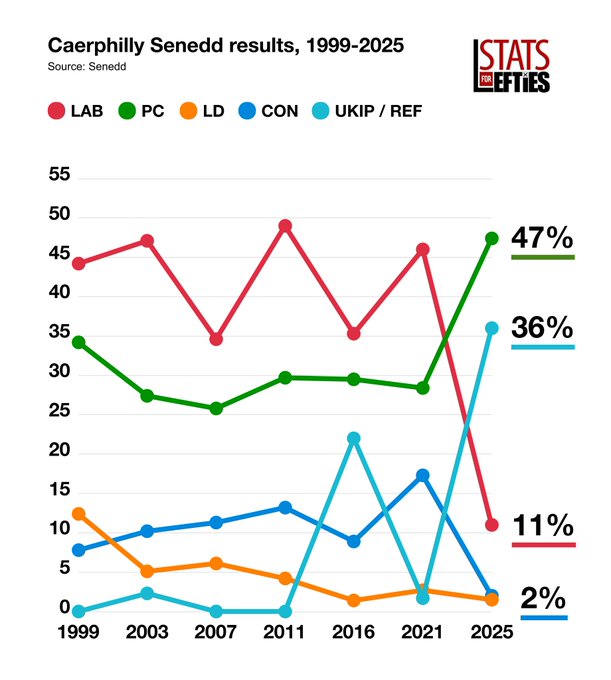
The Caerphilly by-election broke several Welsh records:
– First time Labour has lost in 115 years
– Worst-ever Labour result
– Best-ever Plaid Cymru result
– Worst-ever Tory result
In the most plaintive of tweets, Andy McIver, former Head of Communications for the Scottish Conservatives posted: “By 2030, if polls are correct: Scottish nationalists will run Holyrood, Welsh nationalists will run the Senedd, Irish nationalists will run Stormont, English nationalists will run Westminster. People who believe in the UK need to reimagine it.”
You could almost hear the penny drop.
The problem for Andy & Co is that Britain is now unimaginable.
Over at the New Statesman, Andrew Marr was also in pensive mood. “The postwar British political establishment is collapsing” he mused [I thought Labour would fix everything. I was wrong. Britain has become ungovernable.]
As I write the Epstein Files have, eventually, been released. In comically Orwellian terms they have been released almost entirely redacted. My feed is full of screeds of black blanked files. But we should not think for a moment, that the delirium and the censorship is restricted to the US of A. There’s no better tale of the descent of Britain than the story of Rutger Bregman, the brilliant Dutch writer and commentator who came to prominence after the Davos World Economic Forum in 2019 for pointing out the simple fact that those present just needed to pay taxes.
Bregman had been asked to give the prestigious BBC Reith Lectures for 2025. ‘Nation Shall Speak Unto Nation’. Except they won’t. In the first of four 2025 BBC Reith Lectures titled ‘A Time of Monsters’, the Dutch historian Rutger Bregman asks what can be done to counter the moral decay of today’s un-serious elites.
“Immorality and Unseriousness. These are the two defining traits of today’s leaders. Today it’s not the most capable who rise but the least scrupulous…” he says. Yet Bregman has accused the BBC of cowardice after it decided to remove a line from the first of his Reith lectures, which he was invited to give by the corporation. The line was one in which the Dutch writer accused Donald Trump of being “the most openly corrupt president in American history”.
As you’re reading this on Winter Solstice it seems appropriate to end with “The night is darkest just before the dawn.”

We are supported only by our readers. We don't have corporate backers and we don't take advertising, so we rely entirely on your support.
Help to support independent Scottish journalism
Let us hope so ! Thanks for this and all you do to inform us of what is going on around Scotland on all sorts of issues.