

Brecht, Brillo and Scotland’s Engrained Voting Habits
The Scottish Daily Express (and others) are spitting blood at recent opinion polls. “Andrew Neil says ‘Scotland has a death wish’ after poll shows SNP on course to retain power” the paper thunders.
“Earlier on Thursday, a poll from Survation suggested the SNP under John Swinney are on course to return 57 MSPs in the Scottish Parliament election on May 7, ahead of Labour on 21 and Reform with 18. Clearly flabbergasted, veteran broadcaster and journalist Neil, 76 – who was born and bred in Paisley – declared on X: “Scotland has a death wish. Continued decline inevitable with these engrained voting habits. Nobody to blame but themselves.”
“The piece is penned by the Scottish Daily Express’s Editor, Ben Borland who explains: “As well as the three leading parties, Election Maps UK put the Tories on 13 MSPs and the Lib Dems and the Greens on 10 each.”
“However, a deal with the Greens or the Lib Dems would ensure Mr Swinney was returned to the First Minister’s office for another five years – or however long he decides to stick it out, before handing over power to Stephen Flynn or another successor.”
“Under this scenario, even an anti-independence alliance involving Labour, Reform, the Tories and the Lib Dems would fall short of the numbers required. And in any case, the political reality is that they could never do a deal due to their ties to the Westminster parties.”
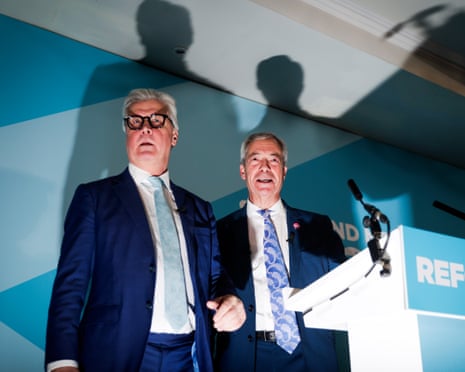
The dawning reality that neither Anas Sarwar nor the oleaginous Malcolm Offord are going to defeat the pro-independence parties is sending the Unionist media class into another tailspin.
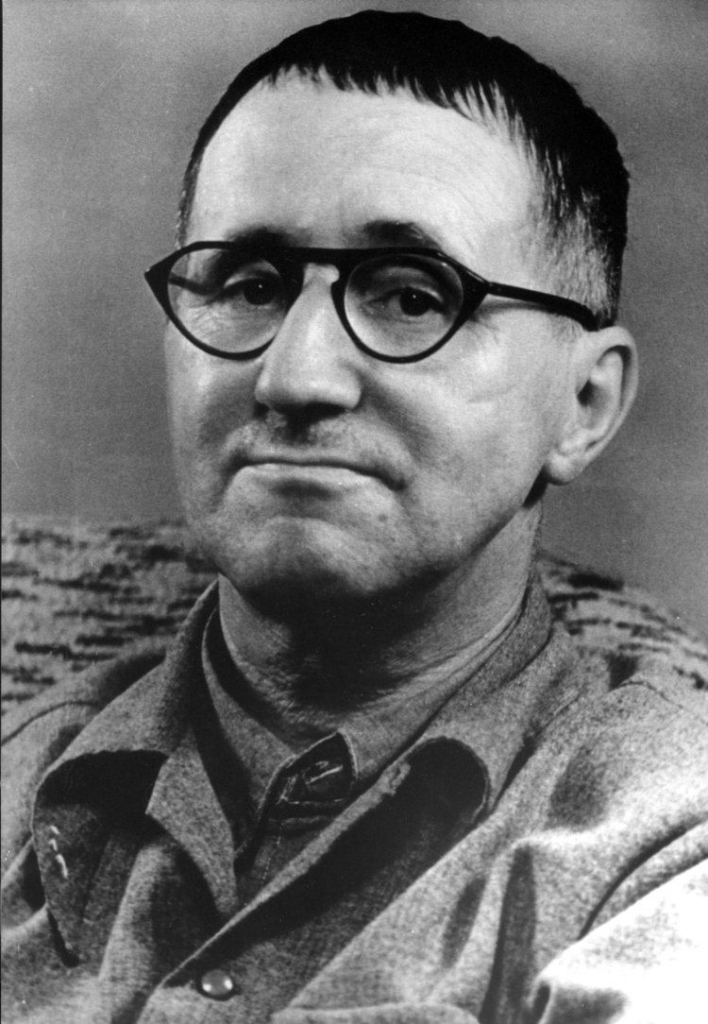
Andrew Neil’s crying-out in rage at the Scottish people is redolent of Bertold Brecht’s famous solution that the government could simply dissolve the people and elect another? Damn these recalcitrant Scots and their ‘engrained voting habits!’
Neil was been joined in his grief by luminaries such as The Telegraph columnist Tom Harris and the Mail’s Stephen Daisley. Poor Tom tweets: “Devolution was the Blair government’s biggest mistake by a country mile” and George Foulkes chimes up with “The Scot Gov is funding adverts on STV called “Together – We are Scotland” which are clearly political, supporting the party currently in power, so I have submitted a complaint to OfCom.”
The solution, according to Daisley is simple: “A problem that could have been avoided by simply not setting up a rival parliament to Westminster, losing control of it to the SNP, yet still carping for it to be given more powers.”
What’s happening here, and you can watch it in real time over the coming months, is something akin to panic, as realisation sets in that the return of Labour to Bute House – isn’t going to happen. Instead of changing policy, or campaigning, the Unionists are just going to undermine devolution itself.

Yesterday’s car-crash interview with Malcolm Offord, just after he was unveiled by his glorious leader, was widely predicted, certainly by us. Offord, presented by the desperate Unionist Press as a ‘safe pair of hands’ and a great business guru, would, we said, struggle to distance himself from Reform’s rancid politics. And so it came to pass. Here, Peter Adam Smith from ITV News, one of the best journalists in Scotland tried to ask Offord the most basic questions about their immigration policies. Smith was grabbed by a Reform UK staffer after being told to move on from his line of questioning while interviewing the party’s new Scottish leader, see here:
— BELLA CALEDONIA (@bellacaledonia) January 16, 2026
Reform in Scotland have to make up policies on the hoof, and try and distance themselves from the pantomime of the Farage/Jenrick Show. They also have to deal with the fact that people are watching a doom scroll of their proposed plans for mass detention centres and rounding people up off the streets on the streets of America.
Not only that, but polling suggests that both Wales and Scotland will have pro-independence majorities in the Senedd and at Holyrood by May.
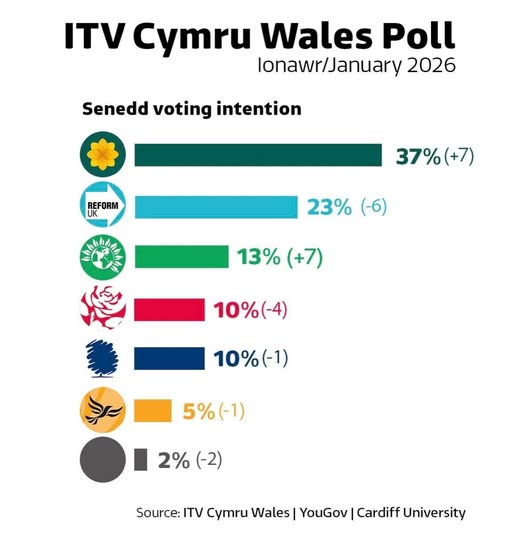 In addition, as Adam Ramsay has noted [Polls suggest Wales and Scotland on course for pro-independence majorities ]:
“Meanwhile, Sinn Féin, the pro-Irish unification party which is currently the biggest party in the Northern Irish Assembly, continues to lead polling for the 2027 Northern Irish elections. The last poll on support for Irish unification in Northern Ireland was in February last year, and saw 41% in favour and 48% against, a drastic change since 2013, when a poll put support for unification at 17%.”
Ramsay adds: “While Scotland has elected pro-independence majorities in every election since 2011, these results, if they played out, would be the first time that a Labour government had had to respond to a Scottish first minister with a clear mandate for an independence referendum, and that they would have to do so in a context where Wales also had a pro-independence majority and first minister, and Northern Ireland, a pro-Irish unity first minister.”
The Unionists claim now that they will consider a pro-independence majority of seats, rather than of one single party (SNP or Plaid) as an inadequate mandate for a referendum. But the hysteria we are seeing from the media class as the reality of polling sets in may lead to more and more extreme rhetoric about dismantling Devolution, which will surely backfire. And secondly, any result coming through on the current numbers would be a seismic constitutional shockwave, akin to the arrival of the SNP twenty years ago. This would be an unsurvivable event for an already beleaguered Keir Starmer, never mind Sarwar. In this situation they could continue the failed constitutional position of the past twenty years, but it would be ridiculous to do so.
It’s long been my belief that Scotland, Wales or Northern Ireland will have to fight to cut the bonds that bind.
It is also my belief that a fair referendum in Scotland is impossible due to the partisan nature of the media that operates here. And even if a referendum was held ( and won), how on earth could an independence Bill pass through Westminster intact and in a reasonable time?
Any politely party serious about independence should declare that polling of 60% + will empower Scotland to negotiate the end of the Union (though that has been overtaken by the terms of the Scotland Act).
A non-violent act of rebellion is required to prevent an actual political insurrection.
gavinochiltree
Scotlands right to dissolve the Union has not been prejudiced by the Scotland Act. This act only created a devolved parliament. Scotland or England can dissolve the Union provided that a majority of the electorate votes for it in an election .
In three simple sentences, Graeme McCormick encapsulates the essential truth of the matter, which is not affected by current political developments or discourse. As national parties to the Union, England and Scotland are each free to leave it if they so wish. The Union holds no legal or constitutional barrier to such a course, and the devolved Scottish Parliament has nothing to do with it. A wish for Scotland to leave can be expressed by a democratic majority of Scottish votes for a party or parties standing on the appropriate manifesto in any general election to the Union Parliament, and may be effected by fiat of the Scottish members so elected (though that would probably not be necessary, since following on a Yes victory and the resultant swamping of Scottish seats with resolute indy members, London would likely negotiate the exit with Edinburgh). The problem for Scottish independence is not what the UK establishment does or does not do, but what our own independence establishment, in the shape of the present-day SNP, fails to do, which is to give the people of Scotland that actual vote. That encumbrance will continue into the foreseeable future so long as the SNP declines to do the business.
“A wish for Scotland to leave can be expressed by a democratic majority of Scottish votes for a party or parties standing on the appropriate manifesto in any general election to the Union Parliament,”
Expressing a wish is not the same as exercising a right. Why would a Scottish parliament election not also be an expression of such a wish? And an “appropriate manifesto” would have to exclude all other policies that might sway voters to demonstrate the point. The precedent for such decisions is by way of a referendum on the principle of self-government or sovereignty.
“Expressing a wish is not the same as exercising a right.”
The right in question is the right of Scotland as a country to leave the Union. That can only happen if a democratic majority of its people so choose. Since a referendum is out of the question without London’s grant, which will not be forthcoming, the only way of making the choice is the one which has always been there, a general election.
“Why would a Scottish parliament election not also be an expression of such a wish?”
Such an election emplaces MSPs, whose powers are restricted, while leaving in place Scotland’s unrestricted MPs. It would be perfectly possible for the UK, and indeed the rest of the world if interested, as well as Scottish unionists, to disregard the result of a Scottish Parliament election entirely insofar as purporting to affect the Union.
“And an “appropriate manifesto” would have to exclude all other policies that might sway voters to demonstrate the point.”
Not sure what you mean. A party can put whatever it likes in its manifesto, and the SNP could certainly turn any UK general election into a proper Scottish plebiscite on independence with no bother at all.
“The precedent for such decisions is by way of a referendum on the principle of self-government or sovereignty.”
Not so. There has been one such referendum in Scotland, and that did not form what could be called a precedent by any stretch.
Alan – a referendum is a precedent in that the majority of voters in Scotland, regardless of whether they support independence or not, now see a referendum as the most democratic way of deciding whether Scotland should become an independent country or not.
The problem is that Westminster is running scared of having another independence referendum as they are not confident that the No side would win as they were when Edinburgh Agreement was signed in 2012.
If Westminster continues to refuse Holyrood requests for another independence referendum another route to independence will require to be found. It is imperative that any alternative route has the backing of a majority of electorate via the ballot box to not only gain international recognition but most importantly to ensure it reflects the wishes of Scottish citizens. Much as I support independence I couldn’t support it happening if the majority of my fellow countrymen did not also support it.
This is a reply to John.
Your assertion of the majority of voters’ view of a referendum may be correct – I don’t know. If it is, that is a mindset which has been sown by the SNP itself, and one which may be fatal to the cause since it gives London a veto. In any event, it is not a precedent, and is no more democratic than a plebiscitary election (and perhaps less so, since without prior agreement that the result will be executed, it is no more than the expression of a view, unlike an election).
You correctly minimise the chance of another referendum. I would rate it at virtually zero. That leaves only the electoral route, which has the virtue of being fully democratic, clear, formal, legal, constitutional, peaceful, self-executing via those elected, and entirely in Scotland’s hand. The great mystery of the independence movement in recent years, which remains completely unexplained, is why the SNP have continued to shun it. That utter folly is our own creation. It does not come from the Union.
Alan – thanks for your reply.
If Westminster was going to agree to another referendum it would have done post 2021 Holyrood election as this was the primary issue it was fought on. The SNP leadership must know that the current strategy of gaining an SNP majority as a means of gaining a referendum is a last throw of the dice for a referendum. Polling would indicate that it is not being believed by a substantial section of independence minded voters.
The potential problems in using a General Election as a means to gain independence are:
1)General Elections are fought primarily on UK issues and it would be difficult IMO to get the media bandwidth to make independence the critical issue for voters at a Westminster election.
2)I don’t believe sufficient voters in Scotland would buy into independence declaration as the overarching factor in election.
3)The impact and practicality of independence supporting MP’s withdrawing from Westminster to form an independent Scotland is questionable.
In saying that if a Westminster election returned a large number of independence supporting MP’s and this was followed by a Holyrood election where the Declaration of Independence was the main issue this would carry far more impact with voters. Holyrood could then vote for Scotland to dissolve Union and withdraw MP’s from Westminster unless Westminster starts negotiations on independence.
The big question that hangs over this strategy is the criteria for declaring independence being the will of Scottish electorate. Is it majority of seats or/and majority of votes?
The problem with all these approaches is that without another referendum the fact that 2 million people voted No in 2014 is not going away unless there is a clear majority of electorate in favour of withdrawal from Union.
And yet still none of the nationalist movements in Scotland, Wales or Northern Ireland can claim a majority of the electorate. In Scotland the latest polls show the biggest change is in the number of “don’t knows”. We’ll wait and see how successful a likely minority government is in Wales.
Although the long anticipated demographic changes in Northern Ireland are finally having a political impact there remains a gap between votes for nationalist parties and votes for reunification.
There’s a lot of work to be done in crafting a plan for post-independence that people believe in and that is not simply wishful thinking. The last effort was utopian rather than realistic. I don’t believe the SNP and Greens are any better prepared for independence than Labour have proven to be for government.
I tend to agree with you Ian on all of the above, however I’d say that the direction of travel is clear and the demographic timebomb of attitudes to ‘Britain’ and adherence to ‘British values’ is also very clear. But you are right that political parties, and wider movements need to be way further ahead on their game
Mike, I think iit’s interesting and perceptive that you mention ‘Britain’ and ‘British values’ in inverted commas. The term United Kingdom has all-but disppeared from the vocabulary of Westminster, and the Media; and has been replaced by Britain
In reality, there’s no country called Britain. Traditionally, it has been used as an informal term to collectively describe Scotland, Wales and England, but not Northern Ireland. (Aditionally, the term British Isles is unacceptable a majority of the inhabitants of the island of Ireland).
It appears to be a conscious attempt to create the impression of a unitary state where none actually exists. It might work with a segment of the English electorate (and they might be the target audience), especially given the long-standing tendency to conflate United Kingdom, Britain, and England.
There is also the wide spread tendency in the media to use “Britain” for issues pertaining mostly south of the border. It’s as if it were all still living in Roman Britain.
You can blame James VI and I for the use of “Britain” he was the person who most wanted his two kingdoms to be one and insisted on the use of “Great Britain” which preceded the.”United Kingdom” by over 100 years.
It is technically inaccurate to use it for the United Kingdom of Great Britain and Ireland (later Northern Ireland) but no one has ever come up with an equally concise alternative.
The English have always struggled ( and on occasions in the past Scots too) with “English” and “British” getting in wrong both ways just as many people abroad do. How often do we ourselves use “Holland” to mean “The Netherlands”?
In a way it hasn’t changed as Britain is an ambiguous term and always has been. What it means was disputed even before the Norman Conquest. Historians use the term ‘British’ to mean all those people who lived on these islands who were not the Romans or later Angles, Saxons and Vikings, also somewhat vaguely known as the Celts. The later idea that Britain equals England makes zero sense in that context, but it does make sense to talk about Ireland being part of the British Isles.
The problem is that the word has a political meaning which has evolved and latterly heavily associated with the British Empire, and one relating to ethnicity, a people, a simple geography in which they live, but those two things do not align properly, never have and still don’t. Hence, some people of Scotland, Ireland and Scotland using the word with ‘Brit’ in a derogatory and hostile sense, yet arguably, the claim to be truly British is more likely to apply to those of ethnic origins in those countries! Many ‘British’ in England fled to Wales with the Anglo-Saxon invasion to be with their British / Celtic brethren, the last of whom held out as the last Celtic Kingdom in West Yorkshire.
Ian – I agree with a lot of what you have written but I would add that incumbent governments are tending to become very unpopular much quicker these days. This rapid disillusionment with Labour both at Cardiff and Westminster has benefited Plaid as has been seen as main opposition to Reform. In addition Plaid benefit from having no record in power and are probably in a similar position to SNP in 2007. The fact that SNP look like they will win an unprecedented 5th successive election is probably due to a combination of independence support and disillusionment with Tories & Labour Westminster governments. It is this factor which I suspect is driving the Andrew Neil’s of this world to distraction!
While I also agree that independence movement has not adequately addressed the concerns of electorate from 2014 referendum I would make a couple of additional points:
1)The Yes manifesto of 2014 ran to 500 pages and carried far more detail than any Brexit manifesto which was vague to say the least. Which campaign was successful?
2)Gaining independence is about convincing voters that change is preferable to status quo. The status quo is now nothing like it was in 2014.
I would therefore sum up by saying that while more detailed plans are preferable to gaining independence they may not be such a crucial factor in a rapidly changing world.
My problem with the 2014 Manifesto was that it was a very optimistic plan for after independence was achieved it was not a route map for the complexities of disentangling Scotland from the Union and putting in place the institutions we would require as an independent state, a Central Bank, Treasury, Defence Ministry and Armed Forces, a Foreign. Ministry and embassies, Customs and Excise, Border controls etc. Most importantly treaties governing our trading relationship with rUK and the EU.
This would not be as simple as the dissolution of Czechoslovakia and their membership of the EU.
We would need to agree on whether the legislature should be unicameral, and perhaps if we wish to continue as a parliamentary democracy or adopt some fomr of executive presidency, and perhaps become a Republic. What mechanisms need to be put in place for approving filling offices in our new institutions too. Legal continuity would also be. an issue especially as we still haven’t fully completed repatriation of EU legislation.
Ian – some of the issues you list cannot be decided by Scottish government alone and are bound to be subject to negotiation with rUK, EU etc. By their very nature they therefore cannot be negotiated and resolved before a vote on independence.
I would also argue that issues such as being a republic, membership of EU should be in the gift of Scottish electorate to decide post independence – that is surely the whole point of being an independent nation?
The point I was making about Brexit, which campaigners for Brexit may have picked up from Scottish referendum, is that the more prescriptive you are the more ammunition you give your opponents to target you with. I would suggest that the 2014 referendum did highlight issues where a significant number of the electorate were not convinced about independence (ie currency, security of pensions) which opponents exploited. It is disappointing that more work and clarity doesn’t appear to have been provided by SNP on these issues which were obviously a priority for electorate. I also think that campaigners of independence could give a greater vision of what an independent Scotland could look like with regard to land, energy etc as opposed to more detail. This which would help build support and inspire supporters of independence.
The level of detail you seem to require would almost certainly require a confirmatory vote post independence negotiations. A second confirmatory referendum would IMO have little public support and in reality be just be used as a stalling tactic by opponents of independence.
Thank you John. I would point to our experience of going forward without a pretty good idea of the consequences. Something as basic as incorporation of the ECHR into Scottish law had been debated and widely agreed for a very long time and yet when it came to implementation we were unprepared for the consequences leading to several legal judgements against the Administration.
I really don’t think we should vote for independence and then debate what it should look like. We need an agreed plan that can be put to a foundational referendum fairly soon after the decision, and entrenching popular sovereignty. A constitutional convention would be a necessary preparation. Founding Fathers, and Mothers, required.
Hopefully once Scottish opinion is firmly set on independence the UK government would begin “conversations” about future relationships and not wait until afterwards. We made that mistake with Brexit
Ian – thanks for your reply.
I would emphasise that dissatisfaction with the status quo is also a big driver and respectable reason for supporting independence. The UK has no written constitution and is vulnerable to disreputable politicians eg Johnson proroguing parliament. This leads to virtually everything (eg EU membership, EHRC membership) being at the whim of a government that can be elected with only 30% support. It is also worth repeating that under this decaying system voters in Scotland have, in reality, no say at all and need to do what voters outside Scotland dictate. We are also experiencing increasing interference by Westminster in devolved issues and increasing hostility from Westminster to devolution. If Plaid and SNP win this years elections this hostility will only increase.
I appreciate your desire for as much detail as possible prior to any independence referendum but I would say that you are in danger of demanding perfection when it is not possible or even necessarily desirable. Apologies for descending to a cliche but your approach has a danger of making perfection the enemy of the good.
Having lived in earlier years in different parts of England as well as Scotland I can say with confidence that believing Westminster doesn’t listen or reflect local issues is widespread and not confined to Scotland, Wales or Northern Ireland. Even Londoners feel their interests are ignored. Sadiq Khan and Keir Starmer are not friends. Brummies feel everyone ignores them including the BBC. In the Home Counties huge wealth sits alongside crumbling 1970s GLC overflow housing estates and the hospitals are often of
much poorer quality than in the North.
Of course there are also parts of Scotland which think Holyrood ignores them. Orkney and Shetland once muttered about leaving an independent Scotland looking at the Faroes example.
I’m not looking for perfection simply realism. The UK unwritten constitution is a ridiculous anomaly so where’s the independent Scotland response? At present we are heading towards a unitary state where local Councils are simply agents of Government in Scotland. Is that what we want embedded in our Constitution, for example. It could be what we get by default without making decisions at the start.
Isn’t- I have also previously lived in North West of England, Wales and abroad so am aware about discontent with Westminster.
I am also aware that a Westminster Parliament may try and play hard ball in negotiations with a newly independent Scotland. You are overlooking the fact that Scotland is not helpless and has a lot more power than you seem to think eg energy sources, nuclear weapons sited in Scotland etc to negotiate with if Westminster cuts up rough. I do think that, regardless, Scotland will require to develop close relationships with European countries to also help counter any attempts at bullying by any future Westminster government. This is one reason I argue that we need a clear majority of voters either via a referendum or election before declaring independence.
While I agree that an independent Scotland requires governance to be devolved as locally as democratically and economically possible this is a red herring when you compare with current system of centralised Westminster government.
Ian, first time i’ve commented on BC.
I felt the need to do so in response to your comments on a post Indy manifesto a la 2014 in which pretty much all the details of a new Independent Scotland needed to determined prior to any referendum or vote.
I’ve always believed self determination to be a state of mind. By that i mean populations wanting to be in control of the decisions that affect them. I’m not talking about blood and soil nationalism by the way. To insist on a drill down on detail of how an Indy Scotland would, for example, access the BBC simply plays into the Unionist MO.
The main reason that Independence support is on the rise in Scotland and Wales is frustration with the overall UK ” offer “. It’s not specific policies.
Let’s put it this way. If your buying a house you don’t choose the colour of the kitchen plates before you’ve concluded the missives.
Scotland needs to be asked whether it wants to be able to choose it’s own way. It’s that simple. The negotiations as to currency etc. follow on from that. A vote for Independence is a vote to be able to make our own choices. The rest is just padding.
The 2014 referendum required detail from the YES campaign as it was percieved that an Independent Scotland would be leaving the certainty and comfort zone of the UK.
The UK is no longer a safe or certain place to belong to.
To ask that specific detail be pre-baked into any post Indy agreements is unrealistic in a very fluid world and, i think, not something that increasing numbers of Scots would demand from YES campaign
Heads and hearts. Few people in the UK are happy about our current political, social and economic situation, the English nationalism of Reform is just as much a response to this as Scottish Nationalism, but to take a decision on the substantive issue without any idea about the nature of the polity we are choosing seems to me like buying a pig in a poke.
How long could Scotland hang in limbo after the vote while we sort out what we mean by it? Five years would be optimistic given the time it has taken to transfer Social Security. Unless there is substantial agreement beforehand we could end up with a massive constitutional row that would not necessarily split on current party lines.
A hostile rUK government such as one headed by Farage could make the economic settlement very difficult. England is Scotland’s largest trading partner. The division of assets and debts is not going to be simple. The SNP may believe the UK’s National Debt is England’s but I doubt if the English agree, many already think the other nations owe them. An early decision to end the Barnet formula might be one response.
Iain -SNP are a Scottish nationalist party in so far as they represent Scottish interests and support an independent Scotland leaving rUK to rule themselves. Reform are , as you correctly point out, essentially an English nationalist party who want England to rule all the other nations in UK. This is a very significant difference in democratic outlook.
Reform are also a racist, far right party while the SNP are now basically a social Democratic Party.
They may both attract some votes from disaffected voters but it is also pretty clear that Labour won a lot of votes at last election due to widespread dissatisfaction with Tory government. Your linking of Reform and SNP is an unjustified, lazy trope pedalled by Labour and Tory parties in Scotland.
“…these results, if they played out, would be the first time that a Labour government had had to respond to a Scottish first minister with a clear mandate for an independence referendum”.
This would be the first stress-test of a Tory devolution strategy Labour has followed since 2020. According to this strategy, devolution in NI is to be strengthened to prevent a referendum and undermined in Scotland for the same reason. Never say you’ll deny Scotland a referendum because it creates more pressure. But never concede it either. Hold the line. Evade, dissemble, obfuscate, and kick the can down the road for ever.
Helped along by Sturgeon’s Supreme Court fiasco, this has been working effectively and so the likelihood is that Starmer will indeed just hold the line for London even as Sarwar’s power and influence are squelched in Holyrood.
Given both factors, and following the expected Starmer refusal, there will be momentum with any tactic of dissolving Parliament and using the re-run as an independence plebiscite to take to London (if it wins) with real political bite. The independence majority would have to agree this between themselves prior to the election, campaign for it, and then follow through afterwards, thus also facing down the Unionist threat against a pro-independence majority. But it seems safe to assume this is not going to happen. In which case the Scottish media will switch instantly to the metropolitan melodrama of Labour, Tory and Reform.
“Never say you’ll deny Scotland a referendum because it creates more pressure. But never concede it either. Hold the line. Evade, dissemble, obfuscate, and kick the can down the road for ever.” Agree this has been the tactic but I think Britain is extremely unstable and in flux. The establishment is incapable of keeping up with the rapid rate of the collapse (economic, social, demographic, ecological).
As one small snapshot of how rapidly British politics has changed here’s this from Peter Kellner: “In 1997, voters were as keen to install Blair as to remove John Major. In 2024, hatred of the Conservatives far outweighed love for Labour. In 1997, the Greens and James Goldmsith’s Referendum Party won fewer than 900,000 votes between them. In 2024, the Greens and Reform UK attracted more than six million votes. After the 1997 election, the two-party hegemony at Westminster seemed secure; now its future is anything but.”
What once seemed a clever (if completely undemocratic) way to ‘respond’ to the constitutional crisis may now, soon, seem ridiculous and indefensible.
I think you underestimate just how great a concession agreeing to a referendum was in the first place. No other European state appears willing to concede a referendum to break up their state even though several of them are younger than the UK. The German Constitutional Court has said there is no way it can be done. Spain demands a majority of the regions must agree.
The UK with it’s experience of the Irish independence struggle is willing to have Scotland and Northern Ireland secede if the majority wish it. What they are not prepared to concede is a continual revisiting of the question with some compelling evidence that that opinion has decisively changed. It hasn’t. We remain teetering between the two options. Of course we might also come to the point where the UK government of the day wants a referendum to kill the debate for the foreseeable future if opinion swings their way.
There will be even less chance of undoing the division of the UK than there is of re-entry into the EU, so we had better be sure it really is the “settled opinion” of the people of Scotland not just their choice on the day to be regretted some time in the future as we usually do when merely electing a government.
A very interesting debate! However, there are assumptions made throughout the debate which are just assumptions.
Do you think that the majority of the electorate would be more or less likely to vote for Independence to be delivered if the process and early years are portrayed as complex and daunting?
It needn’t be complex or daunting. we just dissolve the Union if the Scottish people vote by majority for Independence supporting parties at the next General Election. who treat the vote as an instruction to dissolve the union.
Most of the institutions have been created and the rest can be created very quickly.
We shall not create perfection on Dissolution Day, but the Union will be dissolved and the former partners will require to cooperate in both their interests.
The greatest issue is the practical one of our independent parliament having the funds to pay for services, etc. If the SG used its existing powers it could raise all the funds required through a land Tax which would bf paid to Revenue Scotland and not HMRC.
Rather than fretting about perfection can we not just lay our cards on the table and trust the electorate? That was the point of the amendment 6A to the SNP conference
Ian – I am not going to critique your knowledge of European and British constitutional history as it would take several pages and bore the pants of everybody! Suffice to say the UK has its origins in a union between Scotland and England and is we are always told a voluntary union. The United Kingdom is not made up of states it is a union of individual countries to make up a voluntary nation state.
The Edinburgh Agreement of 2012 was the correct Westminster response from a democratic standpoint to 2011 Holyrood election. I don’t think I am being overly cynical when I state that Conservative government saw a lot of advantages from agreeing to a referendum:
1)Support for independence was polling in low 30% at time and government assumed that No would win decisively They were not alone in thinking this Alex Salmond had so little confidence he wanted Devolution Max as a 3rd option on referendum (refused by Westminster). They ultimately won referendum but came close to losing referendum which spooked them.
2)Tory government thought that a heavy defeat in referendum would severely hurt support for SNP. They got this wrong as support for SNP increased at 2015 GE and they have remained the most popular party in Scotland and in power at Holyrood since 2014.
3)Tory government thought that the independence issue would be highly problematic for Labour in Scotland. They were correct in this assumption and Labour support fell precipitously in 2015 and has never really recovered in following decade.
We are always being told that we are in a voluntary union but the actions of Westminster appear to indicate otherwise. If it were a voluntary union it would be up to each member of Union to decide whether to leave or not. If an English independence party got a majority in Westminster there would be a referendum regardless of whether Scots, Welsh and Northern Irish MP’s agreed or not. The only democratic way to identify whether the electorate in Scotland want an independence referendum is via Holyrood elections. I would add that Westminster and Holyrood could agree on timeframes – I would suggest a period of every 10 years (2 parliamentary periods of Holyrood). This would be in line with GFA which states a 7 year period between referendum on unification.
The current Westminster strategy of either complete intransigence of Tories & Reform or just trying to ignore issue like Labour is detrimental to Scotland. It maybe that with Scottish electorate split on independence that DevoMax with full fiscal control is best way out of current impasse. If Westminster continues to refuse Holyrood requests for independence referendum then it is incumbent on them to sit down and talk about alternative routes out of impasse such as DevoMax. I am not holding my breath though!
@Bella Caledonia Editor
“The establishment is incapable of keeping up with the rapid rate of the collapse (economic, social, demographic, ecological)…What once seemed a clever (if completely undemocratic) way to ‘respond’ to the constitutional crisis may now, soon, seem ridiculous and indefensible.
The Tory method in lying, clowning, and exhibitionism was only ever available to Reform as a way of hypnotising the mainstream media, of course. But even so, ridiculousness is surely the UK norm, not an exception requiring reflection on its merits. Currently, the weird career of Rachel Reeves is an example. Starmer’s owl-swivel on any given point is another. Sarwar is so aware of his own ridiculousness he struggles not to laugh out loud even in grave debates.
Facetiousness will continue in the treatment of Wales and Scotland, but not with NI. As with the 2020 strategy, only NI merits any priority for serious political attention. They can expect more of the charm offensive until the situation gradually becomes concerning, at which point the stalling tactic will emerge there too. Even the GFA can be gamed with strategic inertia, semantic hairsplitting , bureaucratic revision, ministerial footdragging, clever-dodging, and miscommunication, all the while waiting for Black Swans and other events that require a pause on processes, a pause that always requires increased NI effort to overcome the inertia and recover the momentum again, and again.
Devolution in 1997 happened to Blair through force. The GFA is a threat of superior force. Nothing that happens inside Holyrood can carry commensurable force. But the tactic of dissolving parliament for a re-run on Independence does carry some realistic force. So it’s unfortunate that it will be left in reserve until at least 2031, when the Reform-Tory coalition will again be riding their clown-cars and looting the rickety UK state with abandon, as ever.
Reform’s polling is a bit of a black box, people could be ‘shy’ in reporting their intent to vote for them, though some of the polled reform voters might not turn out.
But being behind the curve on populist right movements we still have time to avoid the polarisation that other countries have seen. Ostracising people who consider voting for them, or anyone present at asylum hotel demonstrations hardens their positions.
Go for the leaders sure, though I think the winning strategy is talking to people on a human level and offering a narrative which explains the mess we’re in and offers a way out.
Make your new year’s resolution to talk to a reform voter!
Polls are just polls. The only way to further deepen Andrew Neil’s despair is to ensure the SNP do get back into government on May 7th.
“Instead of changing policy, or campaigning, the Unionists are just going to undermine devolution itself.”
This has been well underway and intensified under Ross.
The tories (& now labour) undermined the Scottish Government, Scottish Political System, Scotland’s institutions and the confidence by of the Scottish people. Not forgetting the press and bbc’s role.
At the same time they systematically tried to drag the Scottish Government down to their level, fortunately they failed to provide the Scottish electorate the impression they are all as and as each other.
It would have been someone from labour who gave rise to “never trust a tory”, in 2026, that should be updated to “never trust a unionist”, there is no difference between a labour and tory politician in 2026!