
Changing Scotland
A review of David McCrone: Changing Scotland: society, politics and identity. Edinburgh University Press, 2025. Paperback £19.99, hardback £90.00
By Dennis Smith
David McCrone, Emeritus Professor of Sociology at Edinburgh University, might be described as the godfather of Scottish sociology (as in sociology applied to modern Scotland). His pioneering work Understanding Scotland: the sociology of a stateless nation has dominated the field since it first appeared in 1992. Along with his late colleague Frank Bechhofer he played a key role in developing the Scottish Social Attitudes Survey.
His new book Changing Scotland may represent the summation of his career (though he warns against predicting the future). Its title encapsulates its message, with its neat equivocation between active and passive. We (who inhabit the land) change Scotland more or less consciously and intentionally; but Scotland is also changed by external forces of which we have little understanding and even less control.
As a sociologist, his work is heavily data-driven: his book contains lots of tables and graphs. But it also theoretically informed and cautious. Data can be understood in different ways and our understandings (which are rarely unanimous) change over time. His methodology is structuralist in the sense proposed by the linguistic theorist Ferdinand de Saussure, working on two axes – synchronic (looking at the totality of structures operating at a given time) and diachronic (looking at historical changes in individual structures). But societies are more complex than languages. Though individual languages evolve continually, core linguistic structures have barely changed in thousands of years. Social structures, in contrast, have changed rapidly in recent centuries and the rate of change is accelerating. The number of potentially relevant factors expands exponentially.
Into this mix McCrone presents a radical thesis: ‘modern Scotland has been transformed since the 1970s’ (p.1), which he sets out to explain. Given the rate of change, sociology must be flexible in its methodology and tentative in its conclusions. He claims that ‘Scotland sits at the nexus of three key concepts: civil society, nation and state’ (p.13), which, between them mediate society, culture and politics. This approach rules out one-way causalities (not least economic determinism): factors interact over time and are changed by these interactions. Most importantly, people can – and do – change their interpretations: meanings are never static. These conclusions will annoy dogmatists of many colours.
This commitment to following empirical data leads several sacred cows to the slaughter. While willing to use the concept of social class, McCrone emphasises that it operates in three dimensions – structure, consciousness and action – and ‘it is uncommon to find all three in alignment’ (p.127). Similarly, ‘“politics” is neither the cause nor effect of social change; rather, it is the medium through which social change is read and expressed’ (p.199). And – of course – different people read and express themselves in different ways, diachronically and synchronically.
McCrone follows the historian Dauvit Broun in tracing the development of Scottish consciousness to the late 13th century, crystallised in the nuanced conception of sovereignty expressed in the 1320 Declaration of Arbroath. He interprets this national identity as intentional and forward-looking, more concerned with routes than roots: it might also be pictured as a precarious balancing act that somehow never quite toppled over.
All identities are unique, but Scotland’s historical trajectory has been more unique than most. After centuries of suspension between the poles of England and France, the Reformation (1560) and dual Unions (1603 and 1707) brought Scotland firmly into the ambit of the British Empire. Its economy became thoroughly globalised and imperialist: ‘by 1913 Scotland probably had the most globalised economy in the world’ (p.264, quoting Jim Tomlinson), and it was exceptionally hard-hit by the inter-war recession. This led to high levels of emigration (much higher than Ireland’s in the decades after 1945) and deindustrialisation proceeded apace despite government attempts at attracting inward investment. In the 1980s, the Conservatives abandoned economic dirigisme in favour of market forces: Mrs Thatcher did not intend to deindustrialise the UK or to transfer much ownership and control overseas, but that was the unintended consequence of her policies.
This sets the background for McCrone’s radical claims about the transformation of Scotland, in economics, society, politics and culture. Demographically, slowing emigration and increasing immigration outweighed a fall in the birthrate to produce a modest increase in population after 2000. Better education, greater equality for women and the growth of the service sector transformed the structure of the workforce. But Scotland’s distinctive institutions generated social understandings notably different from those in England. The actual structure of the workforce is broadly similar in both countries, but many more Scots identify as working-class. Alongside this, there has been a marked shift in how people prioritise their multiple social identities: on average Scots now place more importance on national identity and less on class.
McCrone is at his most interesting, but also elusive, in the closing chapters where attention switches to politics, culture and prospects for the future. This is where tensions between data and rhetoric become visible. As a social scientist, he knows that data are fuzzy, incomplete and sometimes conflicting (just like human beings themselves). Trying to track social change, sociologists ask batteries of questions, regularly repeated. Trends are detectable but rarely clear-cut (and impossible to summarise in a short review). Meanwhile, an author must produce quotable conclusions.
A few examples will have to suffice. The proportion of people identifying as Scottish has not changed greatly (partly because it was always high), but the meaning of Scottishness has clearly changed. The correlation between Scottish identification and constitutional preference (specifically on independence) has strengthened. Attitudes and identities in Scotland and England continue to diverge, related to the changing valences of Scottishness, Britishness, Englishness and Europeanness, where new and unpredictable alignments appear. McCrone argues strongly against traditional perceptions of Scotland as deviant, abnormal and even pathological (Tom Nairn takes some stick here): on the contrary, it is England and the UK that are exceptional by the standards of modern European democracy. ‘The task … is … to account for the “abnormalities” of the British state’ (p.255).
One reason for this divergence is differing national mythologies, where myths are understood as ‘truths held to be self-evident’ (p.235). The idea of Scotland as more egalitarian, e.g. in education (the lad o pairts), may be ‘mythical’ but it has real effects in shaping Scots’ sense of themselves. In a country where the mass media are overwhelmingly owned and controlled elsewhere, and thus project ‘alien’ stereotypes, Scots may be unusually conscious of the mythical aspect of identities (including their own). Such self-knowledge may induce a sense of precarity but may also have advantages.
Another cause of divergence lies in the unswerving commitment of Westminster to an absolutist (Diceyan) conception of sovereignty (famously queried by Lord Cooper in 1953). Here McCrone makes his most significant political statement. His closing chapter, ‘Where to now?’, starts with an epigraph from Neal Ascherson: ‘For most people, devolution and independence are little more than different uniforms that can be buttoned over the single reality of self-government’. Sovereignty is not the same as independence: there is a crucial difference between having a right and choosing to exercise that right. Voters are evenly split on the issue of independence but survey data shows substantial agreement that sovereignty belongs with the Scottish people, not with Westminster. It is for Scots to decide how their sovereignty should be expressed: external interference may not be welcome.
McCrone is open-minded on the form that future socio-political structures may take: ‘genuine nation-states hardly exist’ (p.241) and we can ‘think in terms of degrees of state-ness’ (p.31). The European question looms ever larger: ‘“Being European” has entered the politics of Scotland and England, and relations with the British state are changed utterly’ (p.262).
McCrone concludes that ‘the past has become a poor predictor of Scotland’s future’ (p.268). This is surely right. Changing Scotland depends on choices made by voters; but it also depends on natural, technological and geopolitical factors (climate change, AI, etc.) far beyond Scottish (and possibly human) control. Something of McCrone’s own position may be guessed from his Preface, which is dated St Andrew’s Day 2024 and (channelling Michael Marra) figures himself as apprentice to the late Neil MacCormick. For me, sociology can’t quite fill the philosophical gap left by MacCormick. But it’s a good start.

We are supported only by our readers. We don't have corporate backers and we don't take advertising, so we rely entirely on your support.
Help to support independent Scottish journalism
The notion of ‘degrees of state-ness’ is interesting. However, it only applies to domestic policy areas: when it comes to foreign policy, it would surely be impossible to reconcile competing choices within the same political entity.
The issue has suddenly become critical for Scotland: are Scotland’s interests best served by remaining bound up with the UK-US special relationship, and all the subservience to US interests it implies, or by returning into the fold of the EU and asserting its independence vis-a-vis the US? Arguably, the case for independence has now acquired a whole new global dimension which hitherto seldom (never?) featured in the debate.
Thanks, Paddy. I don’t think he actually uses the phrase “degrees of state-ness” but this is in line with Neil MacCormick’s ideas in his classic book ‘Questioning sovereignty’ (1999). MacCormick argues on several fronts against the notion of absolute and unitary sovereignty, distinguishing between legal and political sovereignty and also between internal and external sovereignty. In general, MacCormick wanted to promote new legal orders favouring subsidiarity and post-sovereignty, with power and authority widely shared and dispersed. Going beyond MacCormick, I would argue that all forms of absolutist thinking are suspect. Apart from anything else, they can’t easily avoid the well-known logical paradoxes of infinity.
MacCormick’s book now looks both obsolete and ominously prescient. It was written on the assumption that either the UK or an independent Scotland and England would continue to work within a developing EU framework. We now know how that worked out. As we see on a daily basis, multiple state sovereignties competing with each other outside any recognised legal order do not make for comfortable coexistence.
good summary
A fascinating review of a book sitting I have bought but only skimmed as yet. The final three paragraphs reminded me of something the writer John Herdman wrote in the run-up to the 2014 independence referendum, in issue 20 of Walter Perrie’s occasional journal Fras:
‘A country’s right to independence goes beyond the mere right of its people to choose. It is an inherent right, which one either accepts or one doesn’t, and it continues to exist even if the people choose, at a particular moment in history, not to exercise it.… In September 2014 the Scottish people will be given an opportunity to choose whether or not they wish to exercise their right to freedom. But there is nothing absolute about that moment, the “when” is a mere matter of historical contingency. The will of the people is something that is always shifting, as that of the Scottish electorate did between the failure of the Devolution Bill in 1979 and the acceptance of its much enhanced successor two decades later.’
That’s as clear a rebuttal of the ‘once in a lifetime’ argument against another referendum as I’ve come across. It seems to sit very well with what Dennis Smith says when he writes, ‘Sovereignty is not the same as independence: there is a crucial difference between having a right and choosing to exercise that right. Voters are evenly split on the issue of independence but survey data shows substantial agreement that sovereignty belongs with the Scottish people, not with Westminster. It is for Scots to decide how their sovereignty should be expressed: external interference may not be welcome.’
I look forward to reading David McCrone’s book at a slower pace.
Thanks, James. Ascherson and McCrone argue (and for what it’s worth I agree) that the issue of sovereignty is more fundamental than the issue of independence. The question is: who has the right to decide the future of Scotland? For democrats there is a straightforward argument here: sovereignty (whatever we mean by that) belongs to the people (the demos), not as in Westminster theory to an elusive entity called the Crown in Parliament. And the survey evidence that McCrone quotes is generally favourable to this position.
The devil is in the detail. There is no simple way of relating this to political action. The option of devolution, as expressed in the 1997 referendum, can itself seen as an expression of Scottish sovereignty (though many unionists or unitarists nowadays would be reluctant to accept this). On this interpretation, Scotland has the right to independence but – so far – has chosen not to exercise that right. There’s a real philosophical question here: does having a right not necessarily imply a matching right not to exercise that right?
At the level of practical politics, this leads to the question: if the Scottish people exercised sovereignty in 1997 by asserting their right to devolution, does the UK parliament have the right to abolish or limit that devolution settlement without another referendum? Standard Westminster doctrine would certainly say it does. Scottish voters may think otherwise. This is where politics could get interesting.
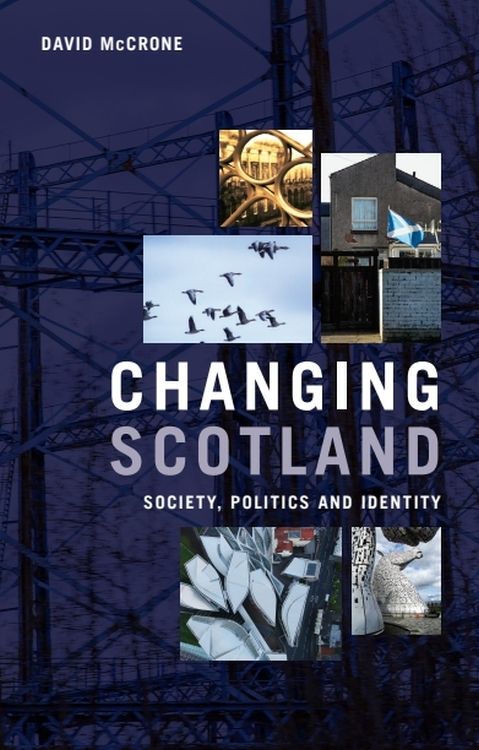
One of the (many) problems of sociology is its inherent speciesism. What about the interests and agencies of non-humans who may live in and around or pass through Scotland? Are they just harvestable resources, shortbread-tin decorations or vermin-to-be-destroyed? What is the significance of the flight of birds versus the drone, the Kelpie statue and what looks like leafy architecture pictures on the front cover? Are those references to ideas expressed in the book? Is there an overarching concept of Health (as opposed to the Will, illustrated in the Declaration of Arbroath onwards ad nauseum)?
I’m not a sociologist. I’m just saying that – within the scope of his own discipline – David McCrone makes a good job of marshalling a lot of relevant evidence.
As it happens, I have a lot of sympathy with your position. If you want to search it out, I published an essay last year ‘On democratic intelligence’ as part of a Festschrift for Tom Hubbard entitled ‘Crossing oceans to be home’ (Perth: Rymour Books). The core of the essay is an abstract philosophical argument that democracy and truth-seeking are necessarily interconnected. One part of truth-seeking involves recognising the true identity of others, which includes identity claims they make for themselves. In principle (though it’s not easy) this can be extended to include non-human species and things like ecosystems.
AI is a factor for independence? How come?
You might expect, with all this hype about AI, that the house robot would be a feature of the life of the wealthy by now. You know, cleaning, ironing, tidying up, maybe washing the car on a Sunday, (before heading to the pub to watch the fitba….)
Things which could be fairly easily programmed… But not even that exists. For starters, the dexterity of the human hand is well nigh impossible to replicate…
John Lancaster tells us, via the NLR, that 9 out of 10 of the world’s highest valued companies have links to AI. All but one of them are American. Together their value is worth half the US economy…
It’s the biggest bubble of them all, and the needs of AI, data centres, water supply, the microchips /rare earth requirements are destabilizing world peace… It’s partly why Trump wants Greenland…
But I really can’t see what it has to do with Scottish independence…?
As for the sovereignty question, a seat at the UN is a seat at the UN, and likewise, all.other international bodies…
I can’t help but read something of the Scottish Professional Class’ long-standing tepid attitude to independence in all of this…
They’re hedgers, the SPC, when it comes to indie, kinda like, “well, if it happens, I’m fine with that, and if it doesn’t, well, I can live with that too…” …I think they are more like home-rulers / Devo maxers than indies…
Either way, they’ll .be there, at the front of the queue… LOL…
Thanks, Douglas. A very brief reply to your question. This was a throw-away comment. I’m not actually opposed to all uses of AI but I am very dubious about the use of Large Language Models to drive things like chatbots. LLMs work by ingesting huge quantities of data (often stolen from other people) which they then digest and regurgitate on the basis of inaccessible algorithms. They have rightly been described as stochastic parrots. And the old adage applies: garbage in, garbage out. LLMs make no attempt to distinguish true information from false information.
I suspect this is not a bug but a feature. LLMs are intrinsically incapable of distinguishing truth from falsehood. Short reason: truth is necessarily perspectival and LLMs, not being embodied, can never have an authentic perspective. For a slightly longer version, see the essay quoted in my reply to SleepingDog above.
The ability of chatbots to pollute political discourse is pretty obvious
I couldn’t agree more, Denis, and it’s a good point you make about humans reading the world with a mixture of emotion, reason, knowledge/ experience (and also, repression, what we have repressed when infants tho arguably that would file under emotion) none of which Chat can do… but it cant do much at all..
To what extent it works or not is hardly a side issue, but the wider point is, what can it / could it actually do for business? Maybe some administrative level jobs will be lost, in fact, are being lost, but the fact is the USA has bet the house and billions of dollars on AI and no one can point to how it actually pays for all that investment…
As for the environment influencing indie, I saw on the BBC (I think) that a huge chunk of east Africa, in what is Ethiopia, is breaking away from the rest of the continent and in x number of years will be an island off the coast of Africa…
Here’s hoping that happens to us too!!!
Dennis, not Denis, apologies for that…
‘The idea of Scots as more egalitarian . . . may be ‘mythical’ but it has real effects in shaping Scots’ sense of themselves.’
These effects may well be negative. Jack McConnell branded Scotland as ‘The Best Small Country in the World’. The most worrying thing about that exercise was that nobody appeared to object to it. If you buy into that ‘myth’ – I would prefer fiction – you are likely to be happy with the status quo. Looking at the history of Scotland in the 21st century, this appears to be what happened.
Indeed. If myths are interpreted as truths taken to be self-evident, there are many questions to be asked, including: Is there any empirical evidence showing whether the myth is true or false? And are the consequences of that myth negative or positive (an issue on which views may differ)?
On the issue of equality, a lot depends on which field you look at. In parliamentary politics there are good reasons for thinking that England was for a long time more democratic than Scotland: before 1832 Scotland had a notoriously limited franchise and corrupt politics. But in areas like religion, education and everyday life Scotland arguably had the advantage. In principle if not always in practice Presbyterianism is more egalitarian and democratic than Anglicanism and Roman Catholicism. In education the lad o pairts myth was undoubtedly exaggerated for patriotic purposes, but it was not wholly false. Lindsay Paterson provides a lot of statistical data on this in ‘Scottish education and society since 1945: democracy and intellect’: the evidence is complex but by no means unfavourable to Scotland.
On the idea that Scots in the 21st century are generally happy with the status quo, there is a lot of data in McCrone’s book to suggest otherwise, not to mention on forums like Bella Caledonia.
The data that convinces me that most Scots are content with the status quo come from elections over the past 40 years.
During that time, Scottish politics has been dominated by Labour till 20O7 and SNP since.
Both parties have been largely wedded to the status quo. Even the main obvious difference, the latter’s support for independence, has involved telling the voters that the future would simply be a more prosperous version of the present.
For both parties avoiding upsetting vested interests has been more of a priority than tackling Scotland’s chronic social problems.
The notion that Scotland is more egalitarian than England comes from several sources.
One is that the Highland clans were, for centuries, semi-communist societies…
Another is the radical presbetyrian tradition in the shape of the Covenanters and the like – see Scott’s “Old Mortality” – who would recognize no absolute earthly authority, neither popes nor kings, over the individual’s own relationship with Jesus through reading of the Bible a flavour of which can be found in Burns’ “A Man’s A Man For Aa That…”
A third reason is that the Labour Party was founded in Scotland, its first MPS were Scottish…
A fourth source, would be the radical 20th century tradition coming from that, from John MacLean through to Jimmy Reid and the salient fact that more internstional brigadeers went to fight in Spain per capita than any other nation barring Serbia…
All of the above are more reliable than opinion polls which, as we know, vary drastically depending in how the question is asked, so that, for example, when people are asked for views on welfare they are generally less enthusiastic than when asked whether poor people should be helped…
And a fifth reason to think there is something more egalitarian in Scottish culture than down south is the fact we vote ad such, ans have done so for a long time…
Before the SNP, Scotland largely voted Labour, and before Labour, Liberal, though it was Gladstone’s support for Irish Home Rule which lex to the creation of the Conservative and Unionist Party…
Burns himself would be a sixth reason to believe most Scots have a strong egalitarian streak running through them,…
“Gie fools their silks snd knaves their wine / the man’s the gowd (gold) for aa that”
As Edwin Muir put it, “no other nation is as in tune with its national poet as the Scots with Burns…”
Anyway, comparisons with England are hardly the point. There is a strong enough radical and egalitarian tradition in Scotland to build a better society upon and half-way houses with imperial, colonial England just wont do…..
Read, please, Thomas Piketty’s “A Brief History of Equality”… there is hope there in abundance, a whole blueprint for a brighter tomorrow…
Thanks, Douglas. Two quick comments
“All of the above are more reliable than opinion polls which, as we know, vary drastically depending in how the question is asked, so that, for example, when people are asked for views on welfare they are generally less enthusiastic than when asked whether poor people should be helped….” McCrone and his colleagues at the Scottish Social Attitudes Survey are well aware of this problem and try to mitigate it as best they can, e.g. by repeatedly asking a battery of similar but not identical questions. There is a lot of detail in his book about how this does (or doesn’t) work in practice.
Second and more important, his book is about *change*. McCrone argues that there have been massive changes since the 1970s and these have accelerated in the past ten years. He quotes Yeats: “all changed, changed utterly”. If he is right, history is decreasingly relevant.
Thanks, Dennis, tho I was thinking of that great slayer of Scottish myths, Gerry Hassan, rather than David McCrone’s new book which I haven’t read as yet…
I am sure he is right too about history mattering less and less. That’s because we no longer live in a literary culture but a mass media / audiovusual one, and the powers that be in Edinburgh have never taken cognisance of that fact or paid much attention to indigenous film and tv… they see us as a venue…or a location…
It’s a great mistake and only adds to the cultural amnesia which has been descending on Scottish society since the 90s I would say…
I wouldn’t disagree. One of my pet grouses with our current predominantly visual culture is that it is *necessarily* post-truth. You can only make true (or false) statements if you use language. Images can only aspire to truth if they have a linguistic assertion attached, to say ‘This image represents this reality (under such-and-such conditions)’. And that’s a test that much current media fails.
Agreed, the book is usually better than the film, and concentrated, deep reading changes the structure of your brain, as does foreign language learning, say ( possibly other gentle activities like gardening or even walking, who knows)…
But we are where we are, what can we do? There’s no going back.. Film is dying too, it’s a tragedy… young Scots probably dont know who Truffaut or Godard or Bergman or Dryer or Rossellini or Eisenstein or Griffith or Hawks or John Ford even were…
Incredibly, just the other day, Raeburn’s long lost portrait of Burns turned up in a jumble sale or equivalent….
What was the headlne in The National? John Swinney’s spat with Douglas Akexander…
If they gave half the oxygen to culture they give to machine politics, maybe Scotland would be transformed…???
Hm, well except that written language is visual culture too. Some put the growth of a visual culture down to the printing press and the spread of reading, prior to which it was more of an oral / aural culture.
Is that pedantic? Perhaps but when you think about it, though somewhat impoverished in content and style,, the written word has increased in terms of importance via the medium of social media – ordinary people are probably writing more than they ever did, outside of work anyway.
Btw I thought your critique of LLMs inability to be able to tell the difference between truth and lies’ above really telling
Have you read this?
https://open.substack.com/pub/jmarriott/p/the-dawn-of-the-post-literate-society-aa1?utm_campaign=post-expanded-share&utm_medium=post%20viewer
@Editor, I agree with the Neil Postman on text freezing speech (you could add ease of quotation and digital search). But ‘post-truth’ sounds like Postmodernist slop, the simple egoist bias of ‘End of History’, and Lord Parakeet the Cacophonist ranting about ‘God is Dead!’.
I can think of various cases where visual media are held to standards of truth, such as in BBC nature documentaries (criticism over faked scenes), sporting events and any coverage of crowds (behaviour, size, existence). The BBC’s chronological reversal of the events at the Battle of Orgreave still cast a shadow. https://en.wikipedia.org/wiki/Battle_of_Orgreave#Media_coverage
Possibly there is a dilution effect. So many books, which to choose? What is a ‘must-read’ today? I would argue that a good book might save you reading a dozen decent books, and a thousand crappy ones, but which is which? Maybe bad experiences (celebrity author Christmas gifts?) turn some kids off. The USA has a notoriously poor educational system, so I would treat statistics from there accordingly.
There are mixed media of course. Graphic novels and comics. Many computer games feature extensive writing (I’m playing the medieval-manuscript-mode Pentiment at the moment, which I can recommend so far, with an interesting socio-political plot and characters, and books). People continue to read newspapers and even e-books on their phones.
“Our culture is being transformed into a smartphone wasteland.” Is it, though? Aside from philosophical concerns, perhaps there are advantages in the kinds of literacy (recognition of fallacies, for example), and possibly greater scepticism of received authority (who wants to return to an age of organised superstition, historical silences and manufactured ignorance?).
I’ve reread some books recently, like Mary Shelley’s Frankenstein (not the worst offender), and I find many old books horribly overwritten. I always found that about most philosophy works (I’ve just boiled down David Hume’s Dialogues Concerning Natural Religion into about a page of notes). Thankfully Thucydides’ Peloponnesian War borders on terse.
I disagree that “democracy and print are virtually inseparable”. In ancient Athens, their (partial but participatory) version of democracy was essentially theatrical (albeit city-scale, but then so is Swiss). For (theoretical) representative democracy on national scales, yes, we are accustomed to print mediation, but then it took a while for Hansard to be established, while the Yellow Press dogged its heels and likely long predated the official texts. I think Edmund Burke MP would have given those USAmerican windbags a run for their money, though.
Constraint is often proportionate to meaning, which is why successful writers under censorship regimes seem often more skilful and deeper. Naturally, I expect the Trumpist regime to remote-censor e-books in a digital purge if left in office.
But with nuclear armageddon hanging over us, the chances of finishing a TikTok video are appealing higher than War and Peace. Of course, if the Wifi goes off…
Marriott’s article is fascinating but I think he gets some key facts wrong and also muddles up distinct issues.
He says ‘The world of print is orderly, logical and rational’. This is wrong: the crucial word here is not *print* but *writing*. The key distinction is between literacy and orality. In principle, manuscripts and even carved inscriptions can do everything that print can do: it’s just that print makes writing available much faster and to many more people. The key thing is to have a fixed text that different people can discuss and refer back to whenever they need.
This brings up the medium of writing, in particular hard-copy versus online versions. Texts printed on paper can be falsified and forged, but it’s not easy and there’s a high chance of being caught. Virtually ever teenager now living knows how to hack an online text and create a deepfake image. Online discourse puts a premium on novelty and fluidity. If you repeat an online search you rarely get the same results twice. Without stable points of reference informed debate becomes almost impossible.
When I retired as a librarian the big drive was to get everything online, often in the name of democratisation, and there was a parallel move to discard hard-copy books. The disastrous hack of the British Library’s systems in 2023 shows how short-sighted this was: much of their online content is now virtually inaccessible. Hopefully some lessons have now been learned.
Attention overload and the decline in young people’s attention spans are serious problems, but the more basic issue is that you can’t talk about truth at all without reference points that are stable across time.
But a PS to my last sentence. I should have said that all reference points, even stable ones, are relative. I’m not sure the idea of an absolute reference point makes sense.
@Dennis Smith, although digital archives should include read-only durable media storing document open formats that don’t require quirky or proprietary reading methods. I’ve used M-DISCs myself without problem, although obviously not checked back 1000 years later.
https://en.wikipedia.org/wiki/M-DISC#Durability_claims
These are hack-proof (assuming your writing and validating software aren’t compromised). But vulnerable in other ways. Do we have salt mines in Scotland, or did we just get that mineral from salt pans?
Watching the documentary series Life After People (on Sky History; if ever a series might be sponsored by trade unions and custodial professions, this is it) is pretty fascinating from a ‘what happens to material artefacts once maintenance stops’ perspective. National Records of Scotland aims for ‘perpetuity’. Well, I guess the librarians of Alexandria did too.
Re the BL tangent, not just inaccessible, but totally wiped. This was confirmed in an email exchange I had with the BL recently who finally conceded to me that much of the digital archive collections were in fact lost for good. One assume the originals still exist (e.g. the audio archive) but re-digitising everything is not likely to happen, at least not for a long time. The amazing audio archive which I accessed regularly has no timescale for being brought back and my impression from their evasive communication with me about it, is that it won’t be restored.
When it comes to their PhD archive service (mostly gone), the only way to get them back is for individual institutions to rescan everything.
Digital resources are so ephemeral even when you think they are not.
[There was a superb audio mapping of London website done by a man called Sid Rawles, The London Sound Survey, which represented at least twenty years of work documenting London locations in sound with accompanying notes. I bought a book from him about his work and the site was a unique, fascinating and special archive that got praised in The Guardian, Wire and other major outlets. He died suddenly from a quick illness a couple of years again. His lovingly created site is now gone, someone (family?) didn’t pay the rent as it were and despite my own enquiries I hit a blank – no-one seems to know anything, or sadly, care. It is gone forever and all that praise and attention counted for nothing.]
All this should be a total wake-up call to anyone saying everything should go digital. It won’t be though because the digital zealots cannot be appealed to with reason. They see only ‘progress’, money and storage saving. There is something soulless about them, like the big tech bros foot soldiers.
@Niemand, with respect, I think you are missing the point. Websites are commonly semi-automatically copied and stored in other archives, like this one:
“This collection is of sound recordings forming part of the London Sound Survey website, which went online at the end of May, 2009.”
https://archive.org/details/LondonSoundSurvey?sort=creator
And anyway, there seems to be a site at http://www.soundsurvey.org.uk which may or may not be the original.
A lot of the web is not-for-profit (indeed, all the commercial efforts to create a WWW with walled gardens failed). Despite their propaganda, the ‘tech bros’ produce very little tech themselves, capitalist parasites over the commons.
Any time you fear a website has been ‘lost’, check the WayBackWhen Machine of the Internet Archive.
Sleeping Dog, no offence intended, but I have real difficulties following your train of thought…
Your reply to Bella’s post in response to the decline of literary rates, a rebuttal of Niemand’s equally bizarre notion that social media is some kind of aid to serious reading and writing, leaves me more or less speechless…What are you talking about?
Are we all mad who post on here?Quite possibly. But yourself, Sleeping, I fear outdo the rest of us by some measure…
SD – the sound survey link goes to a betting page which has done now for ages. The site re-appeard briefly a few months ago but with hardly any audio working, then went again
The internet archive is newish but without the actual map and website, the audio recordings are pretty meaningless, plus there appears to be only a fraction of them archived. You cannot understand the survey and all its detail and extent without the original site
The point I am making is valid – purely digital archives are less robust than hard copy for all sorts of reasons, and this has been obvious for years. In the farish future I reckon anything digital only will be long gone, inaccessible, whereas hard copies of stuff will still be around..
Douglas, please read what I wrote. I said ‘though somewhat impoverished in content and style,, the written word has increased in terms of importance via the medium of social media’. See the bit about being impoverished in content and style? How does that relate to you saying I apparently claimed ‘social media is some kind of aid to serious reading and writing’? You could avoid speechlessness and madness by paying better attention and not making false claims about what people said. The point I was making that your average person is probably writing more now on a daily basis than in the past by making social media posts and comments.
@Niemand, but that wasn’t the link I visited and tested (@Editor). Here is the site I actually visited and intended referenced (sorry, the limit of one hyperlink per comment means I should have posted two comments, rectifying now):
https://www.soundsurvey.org.uk/index_php/survey
Note that all websites should really have the secure https (not http) protocol, while the Internet Archive for the web domain indicates a series of redirects and URL not found errors, which may be why they set up a different archive for it. Possibly configuration errors are involved.
The sections appear to be: THE LONDON LOOP, STREET CRIES OF THE WORLD, LONDON UNSEEN, ANDRE’S LONDON, THE HACKNEY YEAR, 12 TONES OF LONDON, RADIO ACTUALITY, WATERWAYS SOUND MAP, RICHARD BEARD’S HACKNEY WILDLIFE, SOUND MAP RECORDINGS, THAMES ESTUARY RECORDINGS, SOUND ACTION RECORDINGS, and HISTORICAL SOUNDS AND MAPS. I drilled through the links and was able to play the sound of the Common Tern.
It’s a lot harder to ‘lose’ websites than you might imagine, though link rot is a real problem. As I said, digital archives can be printed on modern equivalents of artificial stone and metal, much more durable and compact than typical hard-copy media.
I think you place too much stock on hard copies. The Taliban destroyed much of Afghan recorded music by targeting audio cassette archives. It’s not an either/or. Many physical stores are prone to destroy their own contents through accident, lack of maintenance and foul play. Many physical archives are anything but accessible (Windsor Castle, Hanslope Park, anything in another country), despite being on paper (and paper files can and do go missing without anyone noticing because you have to physically open their file/box and read through them to check).
Yes that is the version of the site that I have seen before – it doesn’t work and most of the links get blocked with a ‘Sorry but your access to this area is restricted’ after a couple of seconds (e.g. the crucial Soundmaps link at the top)’. Only the few sound clips on the landing page play and a random few others.
If you had seen the original site which I visited many times you would know this version is broken and useless. What does interest me is how it was totally gone for about two years, then re-appeared in this broken form to no real purpose.
Digital is ephemeral – of course this website relied on the web as part of its architecture and structure but it requires constant human upkeep as has been seen that since the guy died, the site is like a house fallen into ruinous dis-repair, mainly because no-one paid the host, another huge factor – money is king with the survival of anything digital – an old hard drive would require money and expertise to revive two hundred years hence. How many dead links are there out there? Look at any forum and posts made say 5 or ten years ago – how many of the links still work? 10%, 5%, almost none? A box of documents needs little but a dry, sealed place to survive indefinitely. Yes it could have been deliberately destroyed, but anything can – a memory stick can be destroyed in seconds and if you don’t pay for your content on a server, eventually it gets deleted.
@Niemand, the web has been a bit of a wild west, but your solution smacks of ‘pirate treasure maps’. How would you store sound? I think my old cassettes are demagnetised by now. And what if your family just decided to burn your papers after your death, as apparently happens quite frequently throughout history?
It took a long time before the standards body(bodies) implemented the audio control in HTML5. You shouldn’t ever rely on scripting for essential basic content like audio files (although there was a ‘blind’ version of that site). The London Sound Survey site is running a geotarget script which checks for location (UK, Scotland etc) and I don’t know what values if any it will accept, or why that script is running, and what the idea for blocking visitors is. It’s a bit like BBC iPlayer content not being accessible to anyone outside the UK (in theory, always VPNs and proxies of course). In the old days, we just used to run sites through online accessibility and validation tools to check they worked from afar.
So there’s good web archiving practice and less good. And your chalk-and-cheese forum and buried manuscript examples are simply not a fair comparison to a media archive. There are appropriate measures to counter link rot, such as permanent links:
https://en.wikipedia.org/wiki/Permalink
I set some up for my College website, so that when the underlying tech changed, the course page addresses (with their important search engine rankings) would remain exactly the same. Needless to say, my replacements broke it anyway.
Mirror sites have been used since the start of the web. Pretty much anything in plain, conformant HTML will still work. It is also common to provide fallbacks (in one old site of mine I used now-deprecated Flash navigation just as an experiment but backed it up with a simple HTML alternative).
Just because there are bad examples doesn’t mean there aren’t good examples. I agree that legacy web content is a challenge, but then so much more of people’s expressions outlast their lives today, compared with the past, when most were lost to history. With automatic cloud copying, less family photo albums have been destroyed, for one. I’m sure many a refugee will be grateful for that. And digital archives can be verified in various ways (see checksums and so forth) that are impossible with paper archives, which might have been chewed up by mice, mould or mischief, with you none the wiser.
I’ve checked the WayBackWhen Machine and the last ‘good’ snapshots are a bit inconsistent (and always slower) in what audio files play (sadly I couldn’t get the dog barks), but with “Saved 474 times between June 6, 2009 and December 6, 2025” I guess you could return to your happy time and try again. I think if you search the web you will find this London Sound Survey collection has been copied again and again and again, and made available in different ways.