
The Nature Crisis
In a reminder that ecocide and fascism are tightly bound together, the Trump administration has lifted the conservation protection of Bison in Montana.
A sad day for the great Montana Bison.
Interior Secretary Doug Bergum, at the request of Little Greg Gianforte and the corporate zombie Montana Senators/Reps, has ended conservation grazing permits for Bison on the great American Prairie, a huge section of restored Bison land… pic.twitter.com/w3o4w7Q31t
— PROTECT ALL WILDLIFE (@Protect_Wldlife) January 25, 2026
In 1800, the Bison population of North America was 60 million; by 1889, a few hundred survived. Then and now it is an attack on the ecosystem of the prairie and then and now it is an attack on indigenous people. Colonel Dodge gave orders to “Kill every Buffalo you can! Every Buffalo dead is an Indian gone,” to starve Native Americans into submission. It is also the inevitable result of the beef industry. As Spencer from Unpop Science puts it: “Understand this as the work of the ranching industry. The price of USA/grass-fed/“regenerative” beef is the displacement and starvation of the last wild bison. If not the Great Plains, it’s the Amazon, the Pantanal, the Australian bush… This is an industry that devours land.”
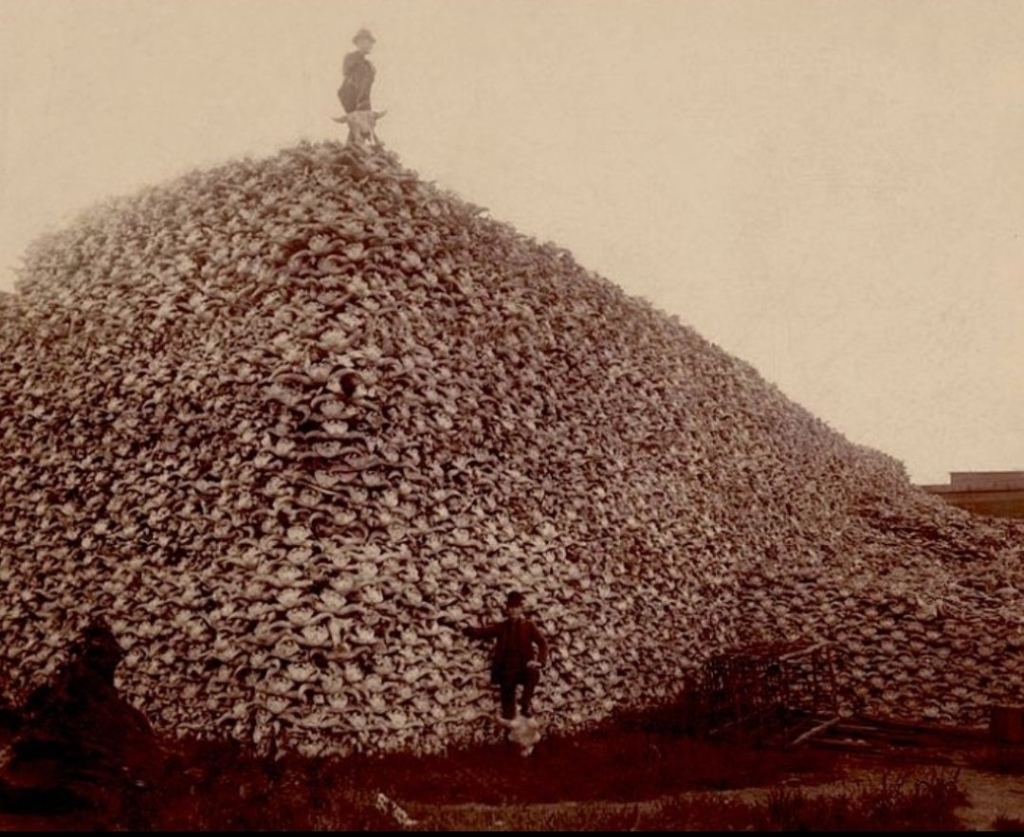
A mountain of bison skulls
Such relentless extractivism and exploitation are everywhere, and the corresponding biodiversity loss is inevitable.
Last week the UK government quietly published its own (delayed) report on ‘Global Diversity Loss, Ecosystem Collapse and National Security’.
The contents are so shocking the government tried to bury it.
George Monbiot has written [The UK government didn’t want you to see this report on ecosystem collapse. I’m not surprised]:
“The most important document published by the UK government since the general election emerged last week only through a freedom of information request. The national security assessment on biodiversity loss and ecosystem collapse was supposed to have been published in October 2025, but the apparatchiks in Downing Street sought to make it disappear. Apparently there were two reasons: because its conclusions were “too negative”, and because it would draw attention to the government’s failure to act.”
It’s conclusions are devastating: “If current rates of biodiversity loss continue, every critical ecosystem is on a pathway to collapse.” In any sane world would be front-page news everywhere and the moment for decisive, unprecedented action. Instead, we’ve been listening to nutters rave about efforts to green urban spaces, or swivel-eyed loons rant against Net Zero.
The report was compiled by the joint intelligence committee – which includes the heads of MI5, MI6 and GCHQ. This isn’t FOE.
Monbiot lays out some of the consequences revealed by the report:
“It tells us that “ecosystem degradation is occurring across all regions. Every critical ecosystem is on a pathway to collapse (irreversible loss of function beyond repair).” This presents a threat to “UK national security and prosperity”. It says “the world is already experiencing impacts including crop failures, intensified natural disasters and infectious disease outbreaks. Threats will increase with degradation and intensify with collapse.” The results will include geopolitical and economic instability, increased conflict and competition for resources. “It is unlikely the UK would be able to maintain food security if ecosystem collapse drives geopolitical competition for food.” It also warns that “conflict and military escalation will become more likely, both within and between states, as groups compete for arable land and food and water resources”.
Scotland’s Natural Environment Bill
It’s in this context that this week’s passing of Scotland’s Natural Environment Bill, which will require the Scottish government to set legally binding targets to restore Scotland’s nature, and to meet those targets, took place.
Currently, Scotland ranks in the lowest 15% of countries globally for the overall health of its biodiversity, and since the 1970s almost half of its species have decreased in number. One in nine species are at risk of extinction in Scotland today.
The bill is the work of Scottish Environment LINK, a coalition of 50 environment charities, which launched the Scotland Loves Nature campaign in 2024 to call for legal nature targets through a Natural Environment Bill.
Deborah Long, chief executive of Scottish Environment LINK, said:
“Scotland’s nature is vital to all of our lives. We depend on it for everything from clean air and water to the food we eat. Not least, insects pollinate many of our essential food crops. Nature is also our first line of defence against climate change – healthy ecosystems make us much more resilient against extreme weather like flooding and drought.
“And the Scottish government’s own figures show that nature contributes more than £40 billion to our economy and supports around 260,000 jobs.
“But Scotland’s nature is in serious trouble. Our seabirds, for instance, have halved in number since the 1980s.”
“The Scottish government knows that nature is in crisis, and over the last two decades it has produced a series of plans aimed at restoring it. But these have failed to stop the loss and destruction, because nature has never really made it onto the priority list.”
“That’s why it’s so important that the new nature targets stemming from this bill are to be legally binding. The legal force behind the targets, along with the public scrutiny of their progress, must compel those in power to act. The task of restoring Scotland’s nature is urgent and existential.”
Open Seas, the sustainable seafood campaign and research group said:
“The Natural Environment (Scotland) Bill offers an important opportunity to highlight and address the decline in Scotland’s biodiversity, especially in the marine environment. Targets must be backed up by concrete measurable actions; setting the targets themselves will not deliver the change that is needed to protect the natural environment.”
A Brick in the Wall
The bill was passing in the same week as the Greens Mark Ruskell introduced the Swift Bricks legislation that will require building regulations to be improved so that new buildings have to include nesting bricks for swifts and other small birds, embedding nature recovery directly into the way Scotland builds homes, schools and workplaces.
Hannah Bourne-Taylor, who has campaigned on the topic [The Feather Speech campaign for swifts] told us:
“I’m delighted by Scotland’s swift action led by Mark Ruskell MSP, proving how easy it is for England, Wales and Northern Ireland to mandate swift bricks.”
“What a landmark victory! Thank you Scotland for showing England how it’s done, taking six weeks to do what successive governments in England have failed to do in four years, proving how easy it would be for the Labour government to secure cavity nesting habitat by mandating swift bricks instead of offering a toothless policy that has no statutory weight. Scotland joins Gibraltar and The Netherlands in this critical, urgent action.”
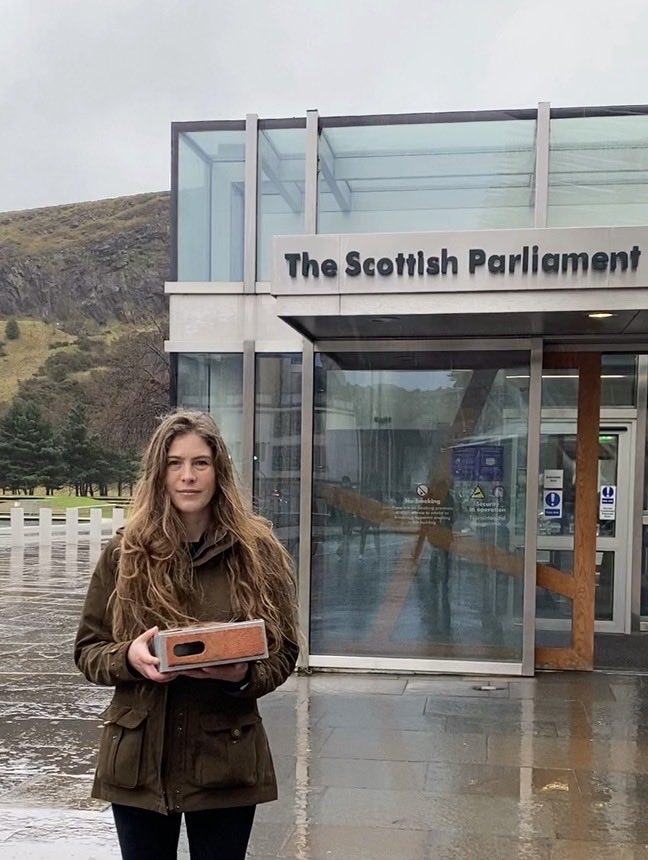
Swift bricks are small, purpose-designed nesting spaces for birds built directly into the fabric of a building, providing safe, permanent homes for swift birds in modern developments. Common Swifts are migratory birds in serious decline, and are reliant on buildings for breeding and were added to the UK Red List for conservation status in 2021.
It’s a really simple low-cost practical piece of legislation. Scotland has just become the first country in the UK to make Swift nesting bricks mandatory in law.
Next Steps
Small beer perhaps, but the trajectory is right and the legislation is a major win for the environmental movement in Scotland. Of course, you can’t just legislate against ecocide; the drivers and forces of perpetual growth and extractivism are relentless. But it’s a foothold in the battle to protect ecosystems and biodiversity.
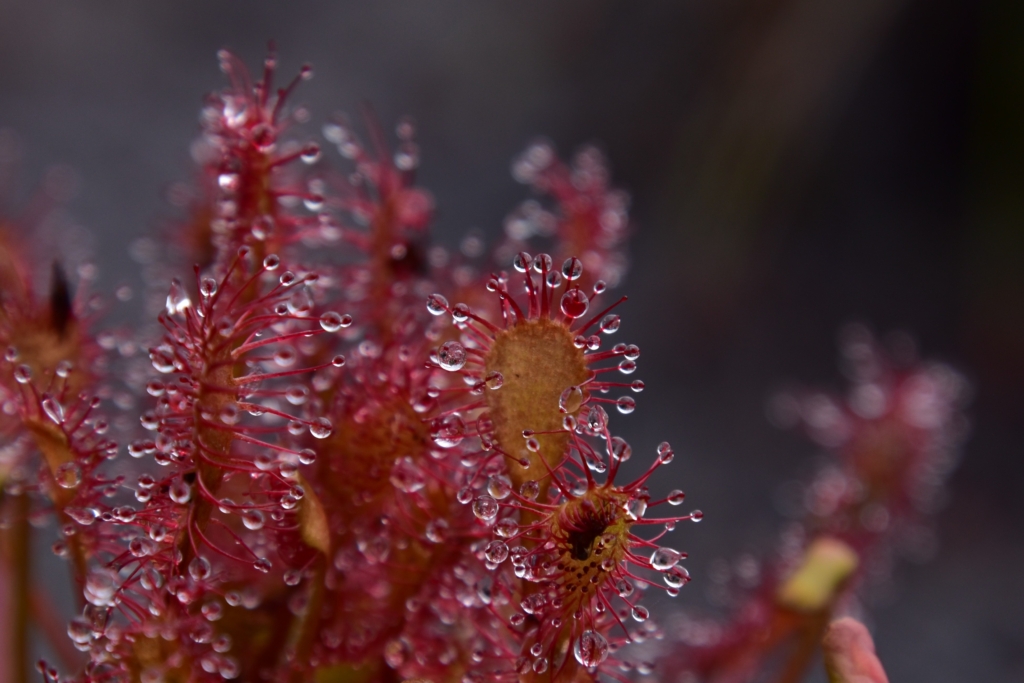
Image credit: Calum McLennan
The next steps would be to enforce that legislation, but also to bring into place the much promised large-scale reform of land-ownership that has been so conspicuous by its absence throughout the devolution era. Allied to this would have to be a wholesale re-imagination of our food and farming policies. Both of these essential moves would require us to challenge and face down enormous vested interests and landed-power. Further action would require the proper prosecution of raptor persecution; the creation of large Marine Protected Areas; the dismantling of the salmon industry and the enactment of Revive’s Land Reform Manifesto:
REVIVE-2025-Manifesto-for-Real-Land-Reform.pdf
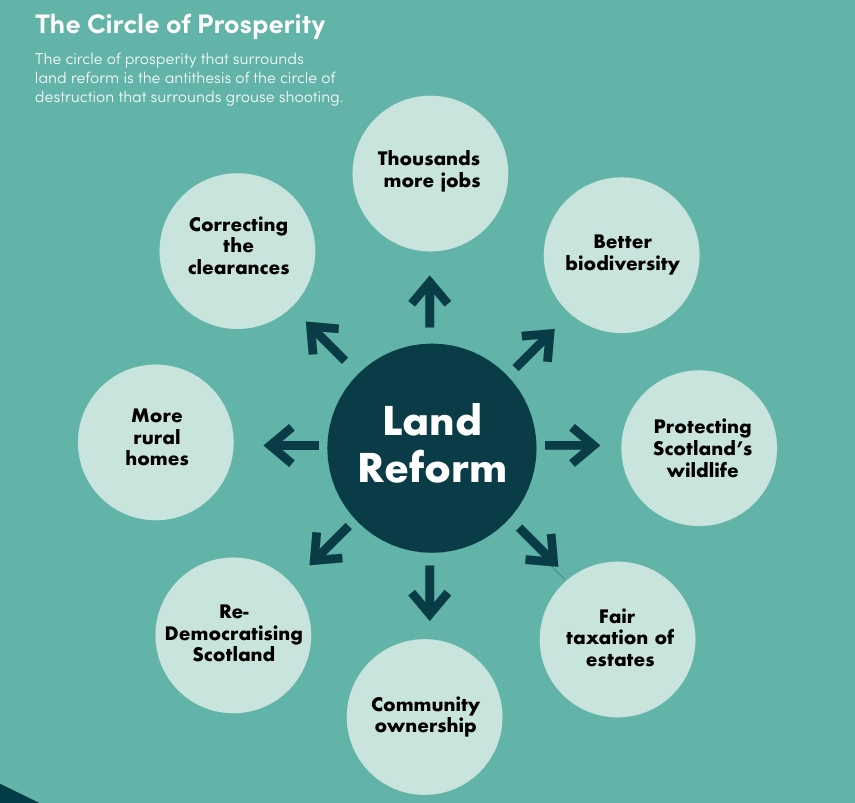
Their manifesto includes demands to:
- Utilise Compulsory Purchase orders (CPO) and Compulsory Sales Orders (CSO) to break-up concentrated land ownership in the public interest
- Limit new large land purchases to Scottish/UK taxpayers- Limit the amount of land a single person, family or company can own
- Mobilise the Scottish National Investment Bank to finance land reform in the public interest
- Create 10,000 crofts and common spaces across Scotland
- Increase the Scottish Land Fund for community buyouts to £25 million per year by the end of the next parliamentary term
- Ensure more rural homes are designated for permanent residents
- A policy to resettle previously inhabited areas and create sustainable new communities
- Designate, and start rewilding and reforesting, at least 30% of our land and seas for people, wildlife and the environment by 2030
- Transition away from driven grouse shooting and other intensively managed sport shooting estates to enhance biodiversity and protect our wildlife
- Drastically expand peatland restoration and protection
Too radical?
Not nearly.
The crisis of the natural world frequently gets overlooked in the wider debate about climate breakdown. Of course, the two are inseparable, but if we want to begin to reverse hundreds of years of extraction, pollution and contamination of our soil and land and air, we will need all of the above and more. Restoration and recovery will take a long time and will require disparate parts of Scottish society to come together to fight landed power.
We also need to be aware of the problem of shifting baseline syndrome – whereby you end of ‘defending’ something that is already degraded beyond measure. That’s why the idea of ‘restoration’ is essential.
Yesterday, Malcolm Offord outlined his plans to strip £9 billion out of the Scottish economy, much of it from slashing ‘ideological green nonsense’. The fight against the far-right is a fight for our survival.

We are supported only by our readers. We don't have corporate backers and we don't take advertising, so we rely entirely on your support.
Help to support independent Scottish journalism
Swifts migrate. Is there evidence to suggest that their situation in their winter homes attracts similar concern ?
Roger – you are well named as your surname very aptly describes your comment!
Swifts are perfectly capable of building their own nests on a vertical brick wall.
good in principle but could just be a more equitable form of a white settler land grab, that’s been happening for years, it can’t work on a civic basis as it will like the movement and society at large is geared towards colonialism. Just getting hit from both ends, look at the offshore renewable’s licencing sale by the SG or the land grab financed by the SG by Gresham House. land rights are about ethnicity and culture, also reintegrating the diaspora as a way of decolonising other communities we had a hand in colonising; that can’t be dealt with within civic movements.
land rights are about environmental integration and social health and well being but also ethnicity and culture, etc. not location location. its an issue not just restricted to here, but also colonial states through out Africa, the Americas, and Europe, etc, as much in England or Cornwall or the languedoc or Brittany etc
‘White settlers’? And who might they be?
You?
There are some relatively simple steps that could be taken immediately by such as Forest and Land Scotland. They own huge areas of environmentally depleted land. One good example is the area of Galloway/Carrick between the headwaters of the Doon and Dee, formerly part of the medieval ‘Forest of Buchan’ and more recently home huge sheep farms of up to 10,000 acres, prior to FC’s blanket Sitka plantations.
Despite the Sitka, large areas were not planted but (despite the sterling efforts of such as Rob Soutar (former FCS District Manager) to re-establishe some patches of montane woodland) most of it remains an overgrazed (sheep, deer and goats) wet desert. FLS has it in its power to radically improve this area yet it languishes, while reports like the one featured here are churned out. What is stopping us?
I should have said that of course FLS merely manage the land on behalf of our somnolent Scottish Ministers.
“Designate, and start rewilding and reforesting, at least 30% of our land and seas for people, wildlife and the environment by 2030” !!
This is the UN / WEF agenda 30:30 and it is a horrific disaster for people and planet. It is an absolute betrayal of Scotland’s people, communities and environment. You cannot save the planet by depopulating the highlands and islands and moving the population into ‘smart cities’. Reforesting depends entirely on how and why it’s done. And whether it builds local economies and communities or destroys them. Rewilding is a nonsense. There is not and has not been in Scotland any ‘wild’ land for thousands of years. This policy is just an excuse to shovel Scotland’s land into the arms of billionaires., drive out its inhabitants and exploit it mercilessly any way you can.. You can’t save the planet by destroying it. We don’t want or need the highlands to be destroyed for England’s data centres’ energy needs, electromagnetic pollution, destruction of habitats and species and communities. If the Natural Environment Scotland Bill is just full of this globalist colonisation, it should be torn up and all those responsible should be sacked forthwith.
If the Scottish government had any interest in the future of the people it is supposed to represent and their land and resources, it would start by rejecting fake ‘wilderness’ and building genuinely sustainable, empowered local communities with real democracy. But it just destroys democracy and accountability and sells us all out to to the techno-fascists.
Why not read something about “rewilding” by someone who knows something about it – George Monbiot is an obvious example. You seem to be constructing a serious false dichotomy, that “rewilding” (and there are a number of different management principles here) is inimical to population, communal land ownership or social advance. I know of no ecologist or activist looking to nature’s restoration suggesting that such areas should become data centres for instance as you seem to claim, that’s happening anyway because of political and economic ineptitude and nothing to do with nature restoration. . Scotland has a small population of 5.5 million, I’d strongly suggest no sustainable “plan for nature” can be considered without a population policy – perhaps Scotland has more than enough people already? Most ecologists see huge benefits from human interaction with nature, not the ideology of depopulation as you claim, that has already happened. A richer natural environment is a fundamental underpinning of a richer society. Much of the land is seriously nature depleted, as noted, the “shifting baseline syndrome” sees the sombre beauty of Scotland’s landscape, but doesn’t see the appalling level of natural ecological loss, on land or in the sea. . . It should be corrected as a matter of urgency, and humanity’s survival. Tens of thousands of Scots will be part of this process and contrary to your claim nature restoration will be a major boost to population and wealth in presently depopulated areas. Land ownership laws changes will be an important part of this, of course. I believe your critique of rewilding is seriously exaggerated, actually it is fighting the wrong opponent. Here is an article that discusses this very matter which should relieve you of some of your anxieties https://www.sciencedirect.com/science/article/abs/pii/S0264837721004002 This beaver project is in the middle of London, Not a single human being was displaced to allow beavers to live alongside a population in a densely populated urban area. https://theealingbeaverproject.com Storks are returning to London https://nz.news.yahoo.com/white-storks-return-london-centuries-081102589.html Peregrine falcons now nest in several British urban areas. Foxes are common in London .Rewilding isn’t just for nature itself, but considers human beings as both the problem, but with change, wisdom, foresight, humility, also the solution. Cheers. JKM
Meanwhile, back in the real world, companies have to report on the sustainability of their activities, a shareholders are concerned about reputational risk (cynically) and maintenance of long-term economic value (being dependant on extractive industries and agriculture).
The Soviet Union, on the other hand, had a poor record on the environment, as you can see with the disappearance of the Aral Sea and general pollution levels, including the Chernobyl disaster. This was despite not being subject to the dictates of the market. China and India are also major polluters, the former still having a socialist ideology.
But why bother with reality when you can just feel sorry for the Bison…
Hi Stephen
I’ve re-read your comment but I can’t make any sense of it. What on earth are you talking about?
Editor – you have to realise that in the bizarre view of the Stephen Cowley’s of this world anyone with an interest in nature, ecology and social progress is a dangerous radical in league with communists. Rather than discuss the issue of ecology or social justice their default position is to make those with an interest in these issues somehow answerable for the state sponsored atrocities of USSR and China. It is their only response because they are wilfully ignorant about the subjects and blind to the benefits to society of nature and social justice.
It is a ridiculous comment to make which only goes to make Stephen Cowley look like a ludicrous character.
I was buffaloed – so to speak – by the opening of the article that introduces the ideas of “fascism”, “ecocide” (which are “tightly bound together”) and “extractivism” (commonly known as mining, presumably) as a destructive force. The fundamental idea seemed to be that the political Right is an instrument of capital, which destroys the environment by externalising its costs and endless self-expansion.
Hence I made the reasonable points that shareholder-owned enterprises sometimes show concern for the environment (“sustainability”) and state socialism sometimes neglects it.
Having read the article more closely, I now see that after your opening blast you draw attention to a lot of reasonable proposals for improving Scotland’s natural environment. Well done you for that.
It’s an interesting question what ‘extractivism’ means – surely much wider than mining. Logically it could mean any process that extracts value from a resource, including human ‘resources’. On that interpretation, it could be equated with capitalism itself, meaning much the same as ‘exploitation’. And capitalism might be defined as any process that aims to maximise value extraction.
But this is only part of it. Can there be such a thing as mutual exploitation? Many natural processes take the form of symbiosis, where two or more organisms ‘live off’ one another, exchanging energy, nutrients, information, etc. Symbiosis in nature is often thought to be a good thing because it maximises the survival chances of all involved – not unlike cooperation among humans. Some human relationships – sometimes described as ‘transactional’ – seem to fit the same pattern.
We need to find more nuanced terminology here.
Extractivism is a term used in post-growth economics to reflect the reality that exploiting resources endlessly on a planet of finite resources is inevitably catastrophic. Extractivism is an essential element of capitalist economics.
This is OK as far as it goes but it may not go far enough. It’s certainly true that the *material* resources of our planet and our universe are finite. But it’s not clear that our *immaterial* resources (including many intellectual and cultural resources) are finite. Infinity gets very tricky when you try to pin it down. (Jelly, nails and wall barely begin to picture the problem.)
Particularly because there is the infinity of an endless straight line and the infinity of a circle that never ends (see Hegel’s logic).
Nature operates in cycles (hopefully).
Ecocide dovetails with humanism, capitalism and various theisms. Both democratic Athens and oligarchic Sparta ravaged the land (for denial of crops etc) during the Peloponnesian War, though paying lip service to the same gods. Fascism is not exceptional in this respect, though today’s fossil-fuelled forces do exponential damage in imperialist/fascist forever wars. Abrahamic monotheism is another poison for the planet. Constrast with biocracy, where ecocide would inherently be worse than high treason.
While individuals and species sometimes have competing or conflicting needs, they all depend on a healthy environment to thrive. The special abilities of humans should accord them special responsibilities, not degenerating perks. This is the pyramid we need to invert.
Shakespeare imagined deer to be citizens of the forest, one killed and the other invaded by humans, a case study in obvious injustice; and asked whether the Earth might be better governed without humans. Why do our governments only represent the violent passions and vicious follies of humans? JK Galbraith noted the British and USAmerican tendency always to look up towards leaders (in contrast with more participatory Swiss, apparently), a tendency also noted by Aditya Chakrabortty in the Guardian today:
https://www.theguardian.com/commentisfree/2026/jan/29/minneapolis-revolt-donald-trump-america-people-power
Will our political system reliably support the interests and health of other living organisms, ecosystems and the Earth systems we rely on? Of course not. Any proposal that does not address this looming, dooming death-flaw is nowhere near radical enough.
#biocracynow
The various political tribes are full of contradictions- the red/greens want to protect the environment, but refuse to spell out the genuine material consequences for ordinary voters of doing so. They are often cool with more government spending and borrowing, but that inevitably is a claim on future resources. Calls for degrowth ring hollow for many people who have had stagnant living standards for two decades.
The blue/brown coalition irrationally deride Net Zero while weaponising the obvious reality that a fast growing population puts pressure on local environments and makes life more expensive for large sections of the existing local population, while scapegoating the new arrivals.
Governments have a very difficult balancing act, pretending that we are going to be richer while we burn through our natural capital and hope that something will turn up.
The whole point of wanting to be in power is to make decisions that have an impact on (hopefully improve people’s lives. There are usually competing priorities when it comes to making a political decision.
Nobody pretends it is always easy but there again nobody forced politicians to try and gain power.
The biggest concerns that many of us have with regards to politicians is the process of how they make the decisions:
1)How well informed are politicians when they make a decision?
2)How widely do they consult to become informed?
3)How do they balance competing concerns?
4)How much do lobby groups and outside financial interests influence these decisions?
” the red/greens want to protect the environment, but refuse to spell out the genuine material consequences for ordinary voters of doing so.”
What do you mean? What’s unclear?
Has a Holyrood goverment ever achieved a legally binding target? Has the legally binding bit ever been anything other than the words ‘legally binding’?
BTW there are plenty Marine Protected Areas and things like seabed dredge trawling are allowed within them.
What? Where are these Marine Protected Areas with dredging?
Oh dear. They nearly cover half the seas around Scotland.
https://www.gov.scot/policies/marine-environment/marine-protected-areas/