

BBC Cuts – data show collapse for Scottish new music support
The questions about who and what BBC Scotland is actually for goes on (and on). Whether you’re discussing the pitiful representation of Scottish workers and production staff on flagship shows like Traitors [The Traitors, another Ofcom and BBC Failure for Scotland – Bella Caledonia], now, hilariously re-cast as a Tourism opportunity [How The Traitors is driving a tourist boom in Scotland – from Highland tours to immersive Traitors-style experiences], rather than as an essential part of a media industry for which the public broadcaster should be a key part, or trying to defend essential music programming, the results are in.
The broadcaster could and should be a showcase for the best of Scottish musical and artistic talent, documentary film-making, news and current affairs, and joining the dots between Scotland’s rich writing, film and theatre makers and the wider public. It’s NOT just about the cuts to the music programming, but here are the stats on the recent cuts.
As Stephen McAll, from Constant Follower, points out:
“Everything that we had warned about prior to the changes has come true and worse. The BBC’s own published playlists for the first 2 weeks of the new schedule show that every key marker for Scottish music is down considerably.”
“This isn’t taste or individual presenters. It’s about the future health of Scottish music. Scotland punches far above its weight for a small country, and that doesn’t happen by accident. It happens because there has been a visible pathway where new artists can be heard, trusted, and slowly introduced to a wider public. Late-night BBC Radio Scotland has been a crucial part of that ecology. How will things look in 5, 10, 15 years from now – when far fewer Scottish artists are coming through at all. I think the damage to the music pipeline will echo down the creative ecosystem that thrives around new music in Scotland, and the UK as a whole.”
“The BBC’s playlists show that this is already in motion. In the first two full weeks of the new late-night schedule, Scottish music and new releases fell sharply, while catalogue music from the 1980s and 1990s increased. That shift may feel safe, but it displaces the artists late night exists to support. Public service radio should be distinctive, human, and rooted in Scotland. When it becomes interchangeable with formatted radio found anywhere else, something essential is lost.”
Key findings for late-night output (1-15 January) include:
New music plays down 69%
New Scottish music by independent artists down 67%
Overall, Scottish music representation down 26%
A sharp rise in 1980s and 1990s catalogue while music released in the 2020s falls significantly
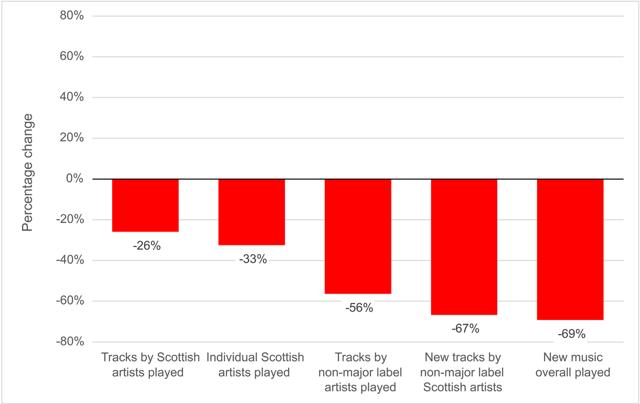
The truly depressing thing is it could easily be far better, and there is a richness of cultural talent out there – and a hungry audience – that are being given a disservice by an organisation that we pay for.
Jings, crivvens, help ma boab, who would have thought……
Indeed
Sadly for some the purpose of music is just background noise while they drive. Anytime I’ve clicked on to see what the late night presenter Lynne Hoggan is playing it’s totally bland. Most music from last century. Scottish artists (if any) are the likes Wet, Wet, Wet, Primal Scream and stuff from decades ago. What about this decades music – Valtos, Blue Rose Code etc. These are bands that actually tour in Scotland and sing & speak naturally and not obsessed with celebrity and Americana. The BBC wants the show to sound like pre 2014 radio. Like Smooth FM or Heart of any of the other sound alike station s where you could be anywhere but Scotland.
Remaining we have Vic Galloway, Roddy Hart and Anna Maddie – all presenters that know their stuff and share their love for music. You always discover new artist with them too. I’m very bored of the ageing rockers thing. We also have no Jazz show. Colin Steele and Paul Harrison have just recorded two brilliant albums but despite having them and award winning Fergus McReadie Trio we have little to zero coverage.
Fostering creativity is vital for a country and the BBC has ignored our young(er) voices of the future. We are not a region but are treated like one. Check BBC Sounds and count how much Scottish originated content is there.
Anna Massie I meant! Typed on a Kindle so excuse the errors!
You can hear the likes of Fergus McCreadie, Harbin Kay and Mat Kilner on Radio 3, especially on the Kinch show if you are concerned about where musicians were born.
According tothe Herald: “BBC Scotland director Hayley Valentine has revealed the number of Scots crew working on the show has only increased by around 10 in the last year. She insisted she does not know the total number of crew members involved in the production , which the BBC counts as Scottish despite not meeting key guidelines set by the broadcasting industry regulator.”
Isn’t knowing the number of people in Scotland employed literally her job?
You are confusing place of birth and number of employees you ethnocentric you! Do you hanker after positive discrimination for Scots?
No, I’m explicitly not. If there’s someone from Newcastle – or anywhere – working in tv production and living in Scotland – I’d argue they should be able to get a job in a tv/film industry. I’m arguing for a viable cultural sector in Scotland. Its not very difficult.
Can you imagine if there was a huge TV show based in England, and nobody from England was employed in it, but the argument was “well its boosting tourism in the Costsolds” (or whatever) – nobody would take that seriously, but we are supposed to?
Good article which describes what’s been done. The long term effects on the Scottish culture “industry” are a matter of conjecture but one cannot imagine are good. Could it be that we’re simply looking at mediocre or useless BBC managers?