
The Scottish Government Agrees With Artists. Now What?
BBC Radio Scotland recently made changes to its late-night schedule that are damaging Scotland’s music ecosystem by narrowing one of the few consistent national routes for new Scottish work to be heard.
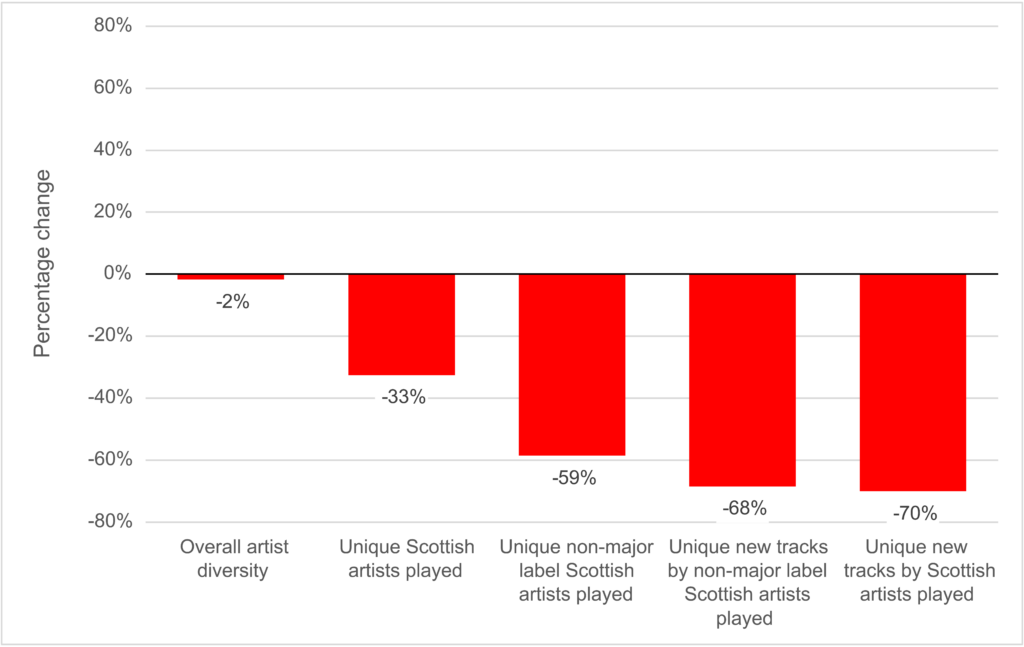
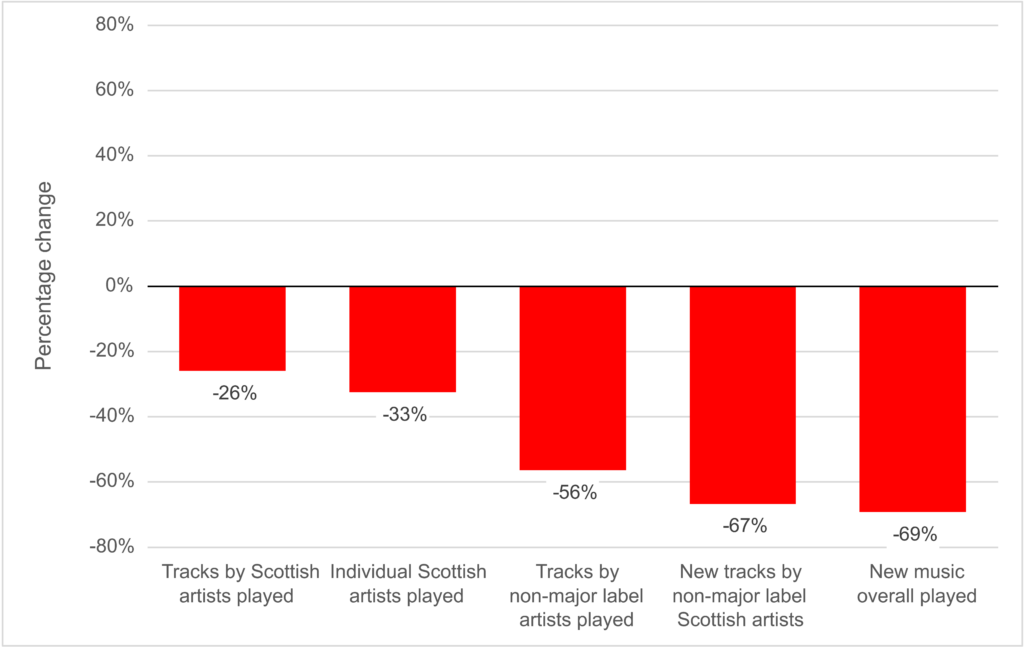
I’ve been tracking the change using a like-for-like comparison of the BBC’s late-night playlists, initially from 1st-15th January 2026 against the same period in 2025 (see charts below). Result: plays of independent Scottish artists down 67%, plays of new music down 69%, and plays of Scottish music overall down 26%.
That’s why the outcry has been so broad. This isn’t a private exchange or a single artist’s complaint. Industry organisations, artists, labels, venues and listeners have all been voicing concerns about this for months.
On 5 February 2026, Angus Robertson MSP, the Cabinet Secretary for Constitution, External Affairs and Culture, wrote to me in response to the open letter that over 300 leading artists and industry organisations sent, highlighting their concerns about the late-night schedule changes.
Robertson’s reply states the Scottish Government’s position in terms that are unusually direct for this kind of correspondence.
The Scottish Government, he writes, recognises “the role that showcasing new and emerging artists plays in nurturing the talent pipeline and allowing tomorrow’s success stories to gain a foothold at the beginning of their careers”.
He adds that it is “essential that any changes to BBC Radio Scotland’s schedule continue to support opportunities for artists, and do not diminish Scotland’s cultural capacity or the long-term health of the sector.”
The Scottish Government is stating, on the record, that the route from first play to long-term career is part of Scotland’s cultural health, and that late-night output is part of that system.
This validates the core argument that the industry has been making from the start. That the removal of curator-led late-night programmes is not a marginal scheduling tweak. It is a structural shift within the Scottish music ecosystem.
Robertson says that he has written to BBC Scotland to “impress upon them that the Scottish Government echoes the concerns” set out in the artists’ letter, and has requested a meeting at their earliest convenience to “clarify how they intend to ensure that emerging Scottish talent, especially those without established mainstream reach, continues to have a prominent and meaningful platform on BBC Radio Scotland”.
He closes by saying that it is his “clear view that the BBC must fulfil its public service obligations and listen to the views of audiences and artists across Scotland, and ensure that changes such as these are made only after proper engagement and consultation with the sector.”
All good words. It’s certainly a strong letter, and I’m glad it exists. But it does not, by itself, change a BBC schedule.
So the next question is practical: what can Government influence, and what might happen next.
The Scottish Government cannot direct the BBC’s editorial decisions or order a schedule reversal. Broadcasting is reserved and the BBC is set up to be editorially independent.
But “can’t instruct” does not mean “can’t influence”.
Government influence here is mostly about pressure and accountability. It can ask for meetings at senior level, and keep asking until the BBC gives clear answers rather than reassurances. It can also frame this as a question of public service delivery in Scotland, which changes the stakes. Once the question is about whether a public service broadcaster is meeting its obligations, it stops being an internal programming preference and becomes a matter of public interest.
It can also widen the audience for the issue. Ministers can put this in front of committees, sector bodies, and the wider cultural policy world, making it harder for the BBC to treat it as noise that will pass. It’s influence over time, through scrutiny, not control.
What might actually happen from here?
There are a few realistic routes.
The BBC rides it out. We get soothing statements about supporting Scottish music, while the practical damage continues. If that happens, the argument isn’t about intent. It’s about what the schedule shows. Where does discovery actually happen. Who is choosing the music. How do artists without existing reach get in the door. Is there still a regular, recognisable pathway for emerging Scottish work to be heard by listeners who are not already following it.
Or they rebrand the loss with a shiny compromise. A ‘new music’ strand, a named slot, something positive sounding. But the sector will know quickly whether it replaces what has been lost: sustained human curation, continuity, local knowledge, and trust built with listeners over time. If a compromise removes that engine, it won’t function as a proper route in for new artists.
Or they sit down with a broad cross-section of Scotland’s music community and they listen, properly. Then publish a clear plan for the schedule that has real hours, real curation, and a well-defined way in for artists without mainstream reach.
Trust is clearly damaged, and the BBC will need to earn it back. A commitment to building a clear, reliable way for emerging Scottish artists to be introduced and championed on our national radio would go some way towards a repair.
For now, the wider music community has to decide what a meaningful way forward might look like for us, and what we should be asking for next.

We are supported only by our readers. We don't have corporate backers and we don't take advertising, so we rely entirely on your support.
Help to support independent Scottish journalism
There may be more point in writting a letter to Radio Fitba instead of getting an MSP to forward it for you. Does anyone actually listen to it to deliberately hear music they haven’t heard before?
You have more work to do on your writting.
A very good article. The late evening music programmes on Radio Scotland were a joy, exactly fitting the definition of entertaining, informing and educating. Really knowledgeable presenters gave us the benefit of decades of deep research and study in a friendly, warm manner, always respectful, never condescending. Iain, Natasha, Roddy, Billy we miss you badly. I turned off the replacement after trying to endure the inane drivel for a week. I’ll not go back until the programme designers come to their senses and return adults to a vital source of information.
Were they a joy?
For me and others yes. We recently attended Celtic Connections which, as elderly folk, has become our annual holiday. Discussions among friends and fellow attendees always included our regret at losing the eclectic mix of music, much of it Scottish, which we could depend upon from 10pm to midnight each evening. It was indeed a joy which, in spite of searching, I have not been able to find on any other radio channel.
I would say that if ‘they’ generated 70% more plays than now of emerging Scottish talent they were ( are / will be) certainly a joy!
I would say Scotgov rather then trying to influence BBC should take the initiative to support a new national broadcasting collective .
Formed by bringing together the excellent local radio stations who already support local talent ( e.g Sunny Govan , Camglen) giving them a national platform to feed into and share selections of their great work, ,: together with Independent music venues ( offering a platform to showcase forthcoming events / exclusive performances and broadcasts) and material from the independent rehearsal and recording venues that give birth to and nurture our music scene.
It could be great…and ours!
I am sure some of the aforementioned experinced broadcasters would happily contribute with their experiences whilst bringing an initial audience with them !
I agree with your suggestion per cent. Let’s hope someone at Holyrood takes it up and makes it happen.
I had similar thoughts Alex, but basically you have to abandon a public broadcaster (which we resource) because its not for for purpose. I think Stephen McCall’s intent (and he’s doing this all on his own) is to try and make BBC Scotland better
Like many I am extremely disappointed in the way BBC Scotland has handled this re-scheduling exercise. It appears to me, a long time listener of the likes of Iain Anderson etc, that very little interaction with the listener has been entered into, it’s been a take it or leave it approach.
Not good enough, and having read Robertsons letter, and the subsequent incisive observations made, I sincerely hope the BBC is big enough to admit mistakes have been made and begin to rectify its ‘oversight’
I just got a reply to my complaint to BBC Radio Scotland about this and it does appear that they’re going down the route of the shiny compromise, ‘new music strand’ as mentioned by Steven in his article here. The reply from them continues to repeat what they’ve said already about there being no significant schedule changes and how they provide so many different ways for emerging artists to be discovered on BBC Radio Scotland. It’s really so easy to disprove that, as I’ve done by checking the listings for the replacement shows over the last couple of weeks. These show that there is a massive lack of new Scottish music, way down on what it was before the changes. Not only that but it’s almost all big hits that they play, rather than album tracks or less well known recordings by established artists. Frankly, it’s generic and could be found anywhere. We’re paying our licence fee for this?
They are either deliberately missing the point or are just not listening and don’t appreciate what they’re throwing away with these changes.
What I want is a Scottish ethnocentric radio in Gaza.
Donald Sturgeon is coming out with yet another book about how he stopped mayhem in Gaza and care homes and the Glasgow Deathstar and didn’t notice that his spouse had dumped a motorhome outside her mum’s and rocked up with a brand new jag.
now websites such as bc refuse to display the the ordinary punter’s opinion, so much fur the radical tradition eh
Let us all join hands, gather round the BBC casting couch, watch The Apprentice (now with Scottish Gaelic subtitles) followed by a double dose of The Traitors