
High Court Case Vindicates Palestine Solidarity
The legal case in favour of Palestine Action is a historic landmark. But what comes next, for the movement, and for the British government is more important than anything.
In a huge victory for peace activists, anti-genocide campaigners, and those fighting for civil liberties and human decency, the High Court in London has ruled that the proscription of Palestine Action is unlawful.
Huda Ammori, a co-founder of Palestine Action, issued a statement simply saying:
“We won! The High Court ruled the Palestine Action ban is unlawful as it is disproportionate to free speech and the Home Secretary breached her own policy. The court ordered the ban be quashed.”
“This has been a huge political mistake from the very beginning.”
This is a momentous victory, and marks a moment in which the madness of the past year has at least been put on pause.
Since last summer, being a member of – or even showing any support for – the group became an offence punishable by up to 14 years in prison. This led to the farcical spectacle of elderly and disabled people and the mildest, meekest clergy being hauled off the streets for holding up cardboard signs resisting genocide.
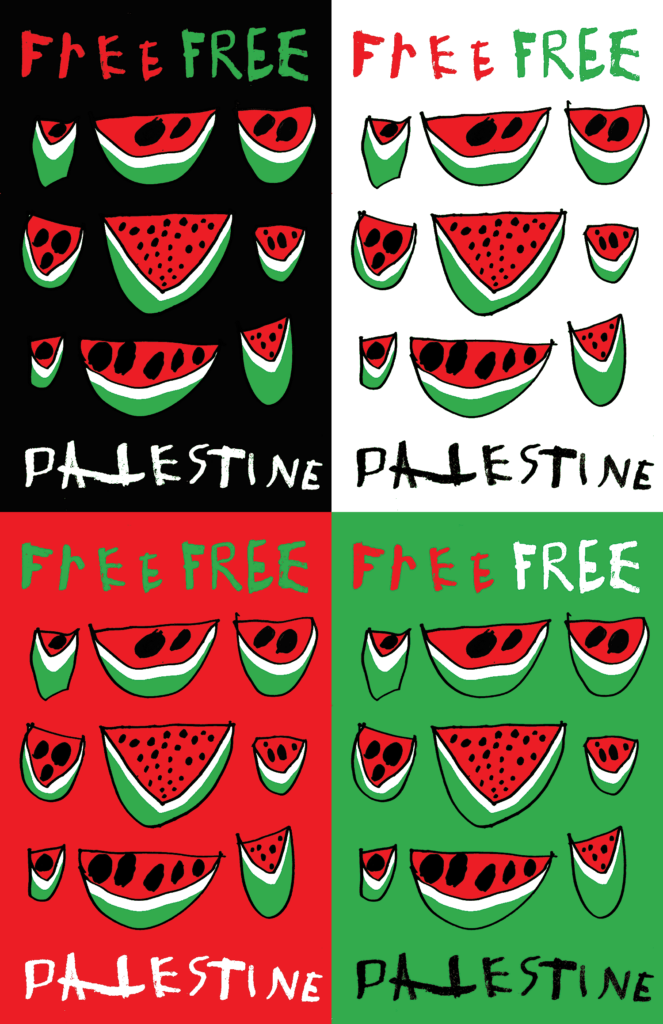
According to Defend Our Juries, more than 2,700 people have been arrested since proscription took effect – most of them for holding placards saying “I oppose genocide, I support Palestine Action” – accused of offences under section 13 of the Terrorism Act, which carries a maximum sentence of six months in prison. More than 500 of those arrested, who include vicars, pensioners and military veterans, have been charged.
Huda Ammori had challenged the ban at a trial in the High Court in London, part of which was held in secret and which concluded in December. On Friday, three judges ruled the decision to proscribe the group was unlawful, but the ban on the group would remain to give the government time to appeal.
This is a massive victory for the Palestinian Solidarity movement and for civil liberties, but it has also completely exposed the British government, and it is impossible to see how Yvette Cooper’s position is tenable.
Cooper’s case, when she was Home Secretary, was based on a fabrication that she had inside information based on security reports that proved that Palestine Action were intent on violence. This verdict, and crucially the trial of the Filton 6, destroyed that notion. Cooper hinted with a nod and a wink and asked the public to trust her. Today, that trust is destroyed.
Last August, following the mass arrest of more than 500 people, Yvette Cooper said that some supporters of Palestine Action “Don’t know the full nature” of the group. Defending the organisation’s proscription, she stressed it was “not a non-violent organisation”.
Last summer, the home secretary stood by her decision to proscribe Palestine Action, which she said had been “involved in violent attacks” and “major criminal damage against national security infrastructure”.
She told the BBC: “There may be people who are objecting to proscription who don’t know the full nature of this organisation, because of court restrictions on reporting while serious prosecutions are underway.
“But it’s really important that no-one is in any doubt that this is not a non-violent organisation.”
Cooper added there had been “clear security assessments and advice” ahead of the ban.
This week that deception was completely exposed.
Dame Victoria Sharp, who led the three judges in the court, described Palestine Action as an organisation “that promotes its political cause through criminality and encouragement of criminality”, but added: “The court considered that the proscription of Palestine Action was disproportionate. A very small number of Palestine Action’s activities amounted to acts of terrorism within the definition of section 1 of the 2000 Act.”
“For these, and for Palestine Action’s other criminal activities, the general criminal law remains available. The nature and scale of Palestine Action’s activities falling within the definition of terrorism had not yet reached the level, scale and persistence to warrant proscription.”
In other words, if someone commits an act of vandalism, disturbing the peace, theft or some other crime in the process of NVDA, they can be prosecuted under existing legislation. But to convict people of being ‘terrorists’ for opposing genocide is patently absurd.
What happens next is vital.
In the sense that this is a major reputational, moral and legal blow to the British government, it could, if it recognised this, take a moment to reflect and change course, as part of a wider attempt to repair its broken political standing.
But there are no real indications that this Labour has the moral compass, or integrity, never mind the strategic nous to make the right call. The extent to which it has been captured by forces outwith our democratic control will determine their response.
The Consequences and Responses
The damage done to relations between the police and the public is as serious as the damage done to people’s respect for the rule of law and the politician’s that rule over us.
Matt Shea, a freelance journalist who works for Vice and Channel 4 said:
“I have spoken to the lead organiser of the protests in support of Palestine Action. Because this ruling means the ban was unlawful from the outset, they say that not only are the 2700 arrests and 500 charges they have faced now void, but that they are entitled to financial damages from the govt. Some of them lost jobs as a result of the arrests. They now plan to demand a meeting with Shabana Mahmood to discuss what they call reparations, truth and reconciliation.”
“Today, the court found that the proscription of Palestine Action unlawfully interfered with fundamental rights to free speech and freedom of assembly. And crucially, this wasn’t a standard statutory de-proscription, where a proscribed group applies to be deproscribed and if granted is taken off the terrorism list *going forward* (like what happened with the official IRA). Judicial review rewinds the clock. It means the ban was never lawful in the first place. It can still be appealed, but if this stands it has enormous consequences and raises serious questions for Yvette Cooper.”
Ben Saul, the UN’s special rapporteur on human rights and counter-terrorism, has called for the home secretary to set aside the proscription and said authorities should apologise to peaceful protesters who were caught up in the ban.
A spokesperson for Saul said: “As an intervener in the case, the special rapporteur argued that proscription violated the UK’s international human rights obligations, because it was not a necessary and proportionate restriction on the human rights to freedoms of association, peaceful assembly and expression. The special rapporteur therefore notes and welcomes the court’s finding that proscription was indeed disproportionate.”
The spokesperson said Saul “Invites the home secretary to reflect on this judgment and accept the court’s conclusion to set aside proscription of Palestine Action”.
I think it’s safe to say this is unlikely.
The Scottish Response
Secure Scotland released a statement saying: “Around 40 people gathered outside the Crown Office in Edinburgh to await the announcement of the High Court’s decision, and many of them held placards in support of Palestine Action. No arrests were made. It was notable that the small number of police present appeared to share the protesters’ pleasure at the news – they may now be able to get on with their real work!”
“Given the compromised character of the current UK government it is highly unlikely that they will give up their aim to crack down on dissent without a further struggle.”
“Scotland can play a key part in the push back. We have an election in a couple of months and we should only be electing MSPs who are will to tackle this head-on. So never let us forget that the brutal oppression of Palestinians continues in Gaza and the West Bank. In all the hooha that is where our focus and that of any Scottish Government that we elect ought to be.”
There’s a dark irony here that the bodycam footage that helped reveal the truth to the jury at the Filton Six trial undoubtedly helped them see the truth of the matter, and, the phone footage of the murders of Renee Good and Alex Pretty has spread to expose the truth about ICE violence. So we are caught in a double-bind in which the ‘surveillance society’ is both saviour and prosecutor benefitting both civilians and the state.
*
*The Eyes of the State: Panopticism
While this is a momentous victory to be celebrated, it’s worth striking a cautionary note in the wider context of authoritarianism that the actions of the Israeli state have evoked around the world. This week we saw the contagion spread to Sydney Australia, where brutal state violence erupted in defence of the presence of Israeli President Isaac Herzog.
But the evidence for this being a moment of sea change against a repressive British government is tentative. Only last month, the UK’s home secretary, Shabana Mahmood, was criticised after naming ‘the panopticon’ as her model for the British criminal justice system.
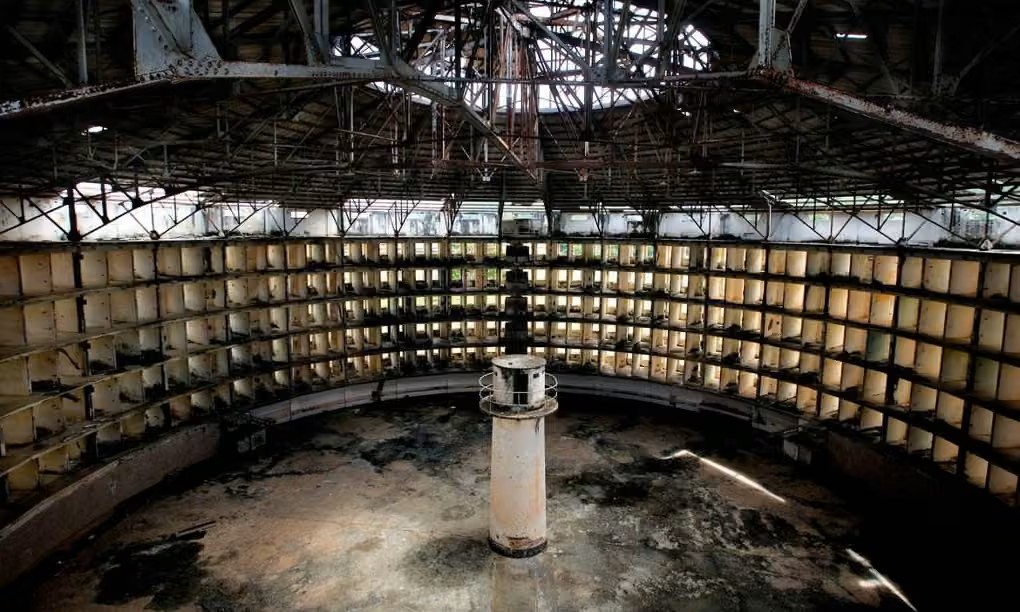
In an interview with ex PM Tony Blair, Mahmood — who was the UK’s justice secretary from 2024 to 2025 — said her vision in that role was to “achieve, by means of AI and technology, what Jeremy Bentham tried to do with his panopticon”.
Such a statement, in the context of the questions about the rise of the Palantirisation of the UK military the fears about the surveillance state and the looming transatlantic alliance of the far-right, seems a strange and chilling thing to say.
The panopticon was proposed in the 18th century as a more effective prison, designed in a circular layout allowing guards to observe every prisoner at all times. Ms Mahmood has appeared to suggest that the concept could be extended to society writ large. Her vision was “that the eyes of the state can be on you at all times”.
She also spoke of ways to integrate AI into policing beyond live facial recognition technology.
“I think there’s big space here for being able to harness the power of AI and tech to get ahead of the criminals, frankly, which is what we’re trying to do,” she said.
Last year, the UK government announced plans for a pilot scheme which will use AI to “detect, track and predict where devastating knife crime is likely to occur” which drew comparisons to the dystopian sci-fi film Minority Report.
Shami Chakrabarti, a Labour peer and former director of Liberty, last night said in the Lords that she assumed the quotes from Ms Mahmood were “fake news” when she saw them circulating on social media. “I cannot believe that from a Labour cabinet minister, even from a home secretary,” she said.
This is where we are.
But if the idea of a Labour Home Secretary aspiring to a AI-fuelled Panopticon should send shivers down everyone, the actual difference between a physical Panopticon and a digital one is worth exploring.
The journalist Thomas McMullan has looked at the differences between Bentham’s Panopticon and the emerging surveillance state:
“An important difference is the relative intangibility of data surveillance. With Bentham’s panopticon, and to some extent CCTV, there is a physical sense of exposure in the face of authority.”
“In the private space of my personal browsing I do not feel exposed – I do not feel that my body of data is under surveillance because I do not know where that body begins or ends. We live so much of our lives online, share so much data, but feel nowhere near as much attachment for our data as we do for our bodies. Without physical ownership and without an explicit sense of exposure I do not normalise my actions. If anything, the supposed anonymity of the internet means I do the opposite.”
“My data, however, is under surveillance, not only by my government but also by corporations that make enormous amounts of money capitalising on it. Not only that, but the amount of data on offer to governments and corporations is about to go through the roof, and as it does the panopticon may emerge as a model once more. Why? Because our bodies are about to be brought back into the mix.”
This was brought into sharp focus this week with the disastrous Super Bowl advert for ‘Ring’ a front-door webcam that its company promoted as a way of finding lost dogs. But in bringing the feature to national (global) consciousness they inadvertently destroyed their own product. Immediately the sinister implications of a ‘doorstop cam’ that acted as a camera without your consent became apparent, and a massive consumer backlash ensued.
Again, the ironies are crashing. We live in a digital panopticon but also have the ability to virally share resistance and insight. Much of the support for resistance to the repressive anti-Palestine Action was built on social media. But also, to what extent is sharing the images of police and army brutality sharing their message and spreading fear?
Myths of Change
This week saw a series of disbelieving columns and editorials struggling with just WHY Starmer is so unpopular [see also Why is Labour so unpopular? – New Statesman]. The above quotes from Mahmood give some insights.
In 2024, Britain voted to oust the Tories, hoping against reason that a Labour government would be a change moment. As always, it’s the hope that kills you. Lingering like a faint folk memory, people believed that Labour would be, could be, different. The crashing disappointment, fuelled by regressive punitive social policy and Labour’s extraordinary support for a genocidal Israeli regime is the main reason for the visceral hatred of Keir Starmer’s government.
This is a generational moment arguably bigger than the Blair Iraq war moment. Whether Labour have any sense of any of this, or the internal political clout to do anything about it, is the question.
Not only did the entirety of the political class play along with Yvette Cooper’s subterfuge, but so did much of the legacy media. The National’s coverage has been a beacon of clarity and honesty amid a media littered with complicity and self-censorship.
Hope and Challenge
This is a moment of hope. A historic victory that needs to be cherished. But that hope needs to be set alongside some deeper patterns at play.
Just why did a Labour government enact such dreadful legislation?
The journalist Harron Sidique writes that: “Never before had a direct action group been banned, fuelling perceptions, despite government denials, that suppressing pro-Palestinian voices was more important to ministers than stopping the slaughter of tens of thousands of people trapped in Gaza.”
She writes: “The advocacy organisations We Believe in Israel and the Campaign Against Antisemitism had pressed the government to proscribe Palestine Action, and the Guardian had previously revealed meetings, under the Conservative government, with Elbit representatives and Israeli embassy officials, that were apparently concerned with cracking down on the group.”
“Cynicism only increased in the run-up to the parliamentary vote on the ban as the Home Office briefed the Times that it was investigating whether Palestine Action was funded by Iran – a claim the Home Office later distanced itself from and which the independent reviewer on terrorism legislation, Jonathan Hall KC, who supported the ban, told Channel 4’s Dispatches was “nudge-nudge, wink-wink” insinuation without foundation.”
Coming to terms with the forces that have infiltrated the entire Labour government, and the wider political establishment, is vital in assessing how we came to this disgraceful situation. But so too is assessing what tactics have worked to oppose it. Many believe that the legal route has been key, particularly the democratic impulse of juries. While this is undoubtedly true, these victories wouldn’t have been made without a non-violent direct action movement on the streets, and on your screens to evoke massive public support.
One account satirised the High Court ruling as ‘High Court rules that you can’t pretend retired vicars and disabled people are terrorists’ – and struck a nerve.
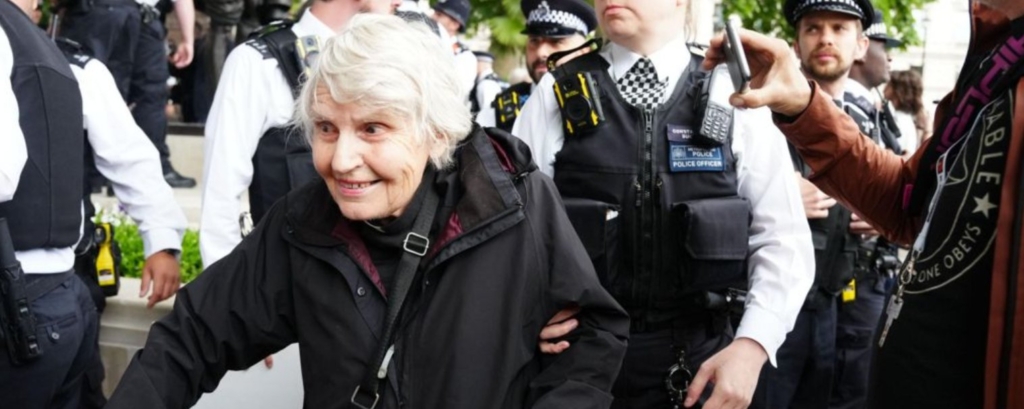
But this is still a defensive posture, ridiculing the authoritarian absurdity of the state we inhabit. What’s needed is not just the legal challenge, and alongside it the direct action and protest movement, but the opportunity to dismantle the infrastructure of propaganda and dark money that surrounds the support for war crimes and genocide. That is the next challenge.
You can peacefully oppose genocide now. That’s a victory, but that it has to be is a travesty for our time.
This week, human rights won. This week, we all won. But it’s not over.
Image credit: Asa Michigan & Josh MacPhee

We are supported only by our readers. We don't have corporate backers and we don't take advertising, so we rely entirely on your support.
Help to support independent Scottish journalism
Some good questions here.
It suits the British Establishment to pretend devotion to the Rule of Law, a concept to which they more recently tacked on human rights and obligations in international law (those would have been even more inconvenient during days of expanding Empire, no doubt):
https://en.wikipedia.org/wiki/Rule_of_law
Tom Bingham’s being the latest version quoted in the recent House of Lords ‘In Focus’ review.
So, if proscription of Palestine Action was unlawful, who has broken the law, what offences have they committed, and what suitable redress including a proportionate punishment of the offender(s) can we expect? Or, just wave the magic wand of sovereign immunity for Crown ministers’ actions in office once again?
Why should anyone who trusts a politician be trusted with a vote? That isn’t how politics works. There must be appropriate consequences for bad actions. And that *does* entail respect for the rule of law, which is quite reasonable if it means that.
There may come a point where a mass public movement to hand over indicted personnel now or recently occupying some of the highest offices in the land to the authority and custody of a properly-constituted international court becomes irresistible. For our rulers, this would seem to be like the incarcerated class taking over the prison. As historian of British history Mark Curtis has noted, in secret cabinet documents (for example, re Suez) the British public are the designated enemy who must be constantly baffled, gulled and hoodwinked.
Indeed. As I have said here before several times, the existence of crown immunity drives a royal coach and horses through the rule of law. And it is applied in all sorts of situations, to a lot of people and organisations. As I have experienced myself, here in Scotland, over the last five years.
It is almost impossible to hold any authority to public account at all. Democracy itself is an Orwellian sham.
This is a very serious situation.
If the government had any sense of propriety and democratic accountability they should immediately rescind the proscription of PA and Yvette Cooper should resign or be sacked from cabinet.
100%
The problem, of course, is that “sense of propriety and democratic accountability” is not just absent from the Starmer/McSweeney regime. It is the precise opposite of what the regime is founded on.
Starmer won in 2020 by his abd McSweeney’s systematically impropriety: hiding £700k of corporate donations, and running on a wholly false platform of promises which were rapidly discarded. Far from being democratically accountable to Labour members, the members were held accountable to a mendacious purge structure.
This same mentality drives the LINO goverment. It’s about holding the people accountable to the government. Given a chance, they’d act out that Brechtian parody, and dissolve the people to elect a new one.
Claire – Starmer only survived last week because there is not another Labour MP who currently appears to want the job. He blocked a potential successor from even standing as an MP.
Starmer is not capable of effective change and his lack of action following High Court ruling on PA just demonstrates this. In the last few days instead of change we have also seen him embroiled in scandals involving sending Matthew Doyle to HoL and now Labour Together (who chose him as leader) being involved in investigating a journalist. Starmer’s response to all these scandals is the ‘I know nothing’ trying to distance himself when he is supposedly the leader.
Labour under Starmer only won last election because of Johnson & Truss making such a mess, Reform splitting normal Tory vote and the vagaries of the FPTP system in a multiparty system. Under Starmer they appear to be planning go into next election with th ‘a vote for anyone other than Labour is a vote for Reform’ mantra. This is a cynical, negative strategy which is also dangerous to Labour if they don’t change policy and leader. The strategy is simply not applicable in Scotland and also probably in Wales now, but in large parts of England where on current trends the Lib Dem’s or Greens may well be the main contenders to Reform at next election.
If you are interested in this topic and thinking about who to votye for in May, you might be interested in this:
https://www.parliament.scot/get-involved/cross-party-groups/current-cross-party-groups/2021/building-bridges-with-israel
For me, I cannot vote for any of these people, or their parties.