It looks like Alba have disintegrated in exactly the same manner in which they have carried on for the last few years, in shambolic communication, internal feuding and bitter factionalism.
Earlier today the party leader Kenny MacAskill sent an email to all Alba members announcing the effective dissolution of the party: “…we face a financial situation where we simply cannot provide the further accounts which they (the Electoral Commission) require, along with meeting staff wages and covering other costs which we are either tied into or are required to meet. In these circumstances fighting an election is simply beyond our resources.”
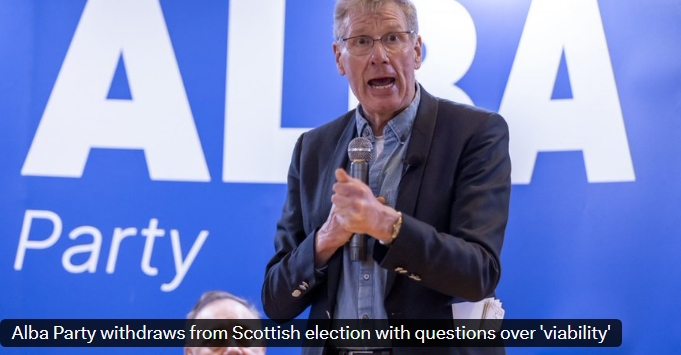
He continued: “I have to advise that it looks likely that we will not be able to register and therefore even to contest the election. That brings also into question the viability of a Party which neither has financial resource nor the ability to contest elections” before ending, bizarrely, “The dream shall never die.”
But by the early evening, key Alba figures were contradicting their leader’s message.
Angus B MacNeil wrote: “Despite temporary blips, Alba candidates will standing at the Holyrood Elections in May.”
Christina Hendry, the niece of Former First Minister
Alex Salmond, the party’s founder, responded attacking the plans. She said: “I am frustrated by the announcement made by the party leadership today. The decision to de-register the party should not rest with a handful of members in the leadership team, some of whom have no electoral mandate. It belongs to you, the entire ALBA Party membership.”
Tommy Sheridan claimed that no such decision – to withdraw from the elections – had even been made.
Complete chaos.
Whatever the truth of the matter, it looks like it’s the end of the road for Alba, and the dream has indeed died.
The short history of the party is one of complete chaos. As Paul Kavanagh has written:
“Founded with considerable publicity, boasting two Westminster MPs among its ranks and led by a former First Minister of considerable political talent, there was a brief time in which it seemed that Alba was about to become a major player in the Scottish independence movement. However, the party failed to make any headway in the May 2021 Scottish elections or the local elections the following year. Despite gaining an MSP when Ash Regan defected to Alba, and receiving the defections of a couple of former SNP councillors, Alba never came anywhere close to winning an election in its own right.”
“It soon became apparent that Alba lacked internal democracy, most shockingly illustrated by Alex Salmond’s unilateral decision to rip up the results of Alba’s internal NEC elections in 2023. Founding members of the party were expelled, and Alba soon became mired in rancour and internal fighting.”
Rancour and internal fighting there certainly was, but there were other deeper problems. The first was that the party never had a united leadership, with Ash Regan and Kenny MacAskill clearly hating each other, and the Chris McEleny issue rumbling on. But the internal feuding and scrambling for power weren’t the only problems the party faced.
They never seemed to be able to understand their relationship with the SNP (which they even blame in their final letter). They would simultaneously attack the SNP for being useless sellouts and ‘traitors’ and demand that they cooperate with them. Their idea of a ‘de facto’ referendum made no sense for a party that barely registered above 1% in polling. Nor did their sense of time. Independence must be demanded Now! But the tiny party might take thirty years to establish itself. It was all a bit crazy. Neither did Alba ever have a coherent political philosophy. They were a vehicle for a handful of ostensibly ‘left-wing’ figures which gathered together around a number of right-wing talking points. The overall impression was a group of people who had never moved beyond the 1970s.
Now what?
Some senior Alba figures are saying they’ll still stand, which would be a brave but incredibly stupid thing to do. Presumably, the shards of micro-parties will continue – ISP / Sovereignty / Liberate / Liberation Scotland – as will the recriminations. Already, some are suggesting that ALBA members determined to stand should join forces with the ‘Alliance to Liberate Scotland’, whatever that is.
But the sad thing about today’s announcement is how little difference it will make to anything at all.


If the party elections officer withdraws the Alba candidates from the election then no one will be able to stand as a Alba candidate.
Now we’re left to the tender mercies of those inept charlatans in the SNP.
Truly a pretendy wee ‘country’ without hope.
You can always emigrate.
‘Alliance to Liberate Scotland’, whatever that is.
That statement is one of the main reasons that Scotland will not be independent in my lifetime, whether you genuinely don’t know who they are or it’s just a sarcastic comment, it shows the complete lack of unity within Scotland.
I despair!
You’re right to despair with the field clear for the incompetent SNP. That ‘party’ has done nothing since the 2014 referendum to prepare the case for indy. Instead we have gross incompetence, corruption and willful negligence. This place is a hopeless case.
The field was always ‘clear’ for the SNP. Alba barely registered above 1%. What planet are you on?
And, as for ‘gross incompetence, corruption and willful negligence’ – have you been following Alba’s progress?
My point was not whitabootery but to despair at being left with the corrupt and incompetent SNP – an entity now clearly disinterested in independence and utterly content with this pathetic wee ‘parliament’
You’re not really on a vert steep learning curve are you? Do you really think that putting yourselves forward under the Alliance to Liberate Scotland is going to make progress? Do you really think that. Pause and think before repying.
To be fair, the “Alliance To Liberate Scotland” is a fine label for continuing Alba’s only significant achienent: collating all the bams under one label.
Are you happy with the SNP as torch bearers for indy?
The SNP is far too cautious.
But a pile of bams is no help. That’s why Alba never won any seat in any election, and polls at about 1%
The unsurprising demise of Alba is sad news for fans of political comedy.
Akba was a combo of a cult of personality around a sexually predatory leader, and torrent of unhinged, vitriolic transphobia fuelled on a rhetoric of “protecting women”. Really. YCMTSU.
Sleepy Cuddles And zthe Transphobes was a toxic mix fir a politicalmparty, but high political comedy. The hilarity was ramped up further by the arrival of Ash “Voter Empowerment Mechanism” Regan as ‘leader’ of a Parliamentary group of one. Pure Spinal Tap.
Other deluded fringe parties will continue to exist. But they lack even has-been personnel, and their never-been personalities are ignored by the media … so their comedy will go unnoticed.
Exactly
No party can exist without compromise but unfortunately the further Left opinion gets the less it appears to be able to compromise, like those tiny religious sects that split and split again in search of “pure” Christianity. If you cannot find common ground with your closest allies how can you find it with the electorate?
As Alba dies, we have Your Party adopt independence and how the UK party reacts will be interesting.
The Scottish Socialist Party already offers radical Left policies and a pro-independence agenda but hasn’t drawn many votes although it actually offers a manifesto closer to what most on the Left want. What makes them so unattractive? It can’t just be Colin Fox.
Perhaps Scotland just isn’t as leftwing as we like to kid ourselves.
Category error, Ian.
Alba is not in any sense a left party.
Your comment only demonstrates to me the problem that exists on the Left, always looking to exclude someone as not radical enough on the latest scale. In time you too will be a heretic.
I don’t think this argument will make any progress unless people are willing to specify what they mean by left vs right. Below is list of seven oppositions. Each of them can be (and often has been) expressed as Right vs Left. I’m open to argument on this, but I don’t think any opposition on the list is isomorphic with any other. Right vs Left is a pretty useless tool for debate.
• Conservatism vs radicalism
• Reaction vs progress (a temporal dimension)
• Hierarchy vs equality
• Authoritarianism vs libertarianism
• Collectivism vs individualism
• Determinism vs voluntarism
• Nature/biology/genetics vs culture
I’m not sure what you mean by determinism v voluntarism Dennis?
But on all other counts I’d have thought it was really clear?
Apart from historical examples of authoritarianism such as the Soviet Union and Eastern bloc countries, such as Romania, I’d have thought the following would be true:
• Conservatism (Right) vs radicalism (Left)
• Reaction (Right) vs progress (a temporal dimension) (Left)
• Hierarchy (Right) vs equality (Left)
• Collectivism (Left) vs individualism (Right)
• Nature/biology/genetics (Right) vs culture (Left)
Thanks, Mike. I was trying to make a more abstract point – hence my use of the weasel word ‘isomorphic’. It is certainly possible to rank each of these oppositions as Right vs Left on the lines you suggest (though it is not always straightforward – see my counterexamples below). But my argument is that each of these oppositions produces a slightly different *understanding* of Right vs Left. So if people just the terms Right and Left, without specifying which opposition they are actually using, the argument is likely to collapse into mutual misunderstanding.
Determinism vs voluntarism is a real crux here, because it introduces the concept of free will and also determines the place of liberalism. The word ‘liberal’ is notoriously slippery and hard to locate on the Right-Left spectrum. The one clear point is that it has something to do with freedom (Latin ‘liber’ = ‘free’). This is not the place to argue the point but I think a version of minimal liberalism is demonstrably true: unless humans have some form of free will, neither our ordinary moral concepts nor our use of language to make true assertions can even get off the ground. So there is a (minimal) sense in which we must all be liberals. The interesting question is where (on a very complex spectrum) people take their political stance.
Two quick comments on your classifications:
Conservatism (Right) vs radicalism (Left) – often, but always? Some supposedly Left regimes can be intensely conservative in key areas – think of the USSR under Brezhnev or China today. More importantly, if a progressive Left regime starts to approach its utopia (if only!), can it (logically) avoid becoming conservative as it tries to consolidate gains made? Equally, conservatives can be radical in attacking an existing welfare state.
Collectivism (Left) vs individualism (Right) – difficult: there are many different types of collective (community, class, race, etc.) and questions arise about voluntary vs ascribed membership. Both Italian fascism and German Nazism were distinctly collectivist (in rather different ways), which is why they are sometimes classed on the Left (Nazi = National Socialist, after all). On the personal level, Maggie T is a fascinating case: she was intensely individualist in her economic views but pretty collectivist in her moral and social views. By comparison, Ruth Davidson is more consistent in her individualism (or even liberalism).
@Dennis Smith, the policies and practices of German National Socialism changed dramatically over time, from their thuggish street-fighting origins through contending democratic elections to becoming a party of government, a totalitarian rulership in an expanded nation overlording a short-lived empire. You can see the changes of direction also marked by the several purges (notably the Night of the Long Knives of 1934) in the Party. By the time they were consolidated in power, the Nazis had come to accommodation with capitalists and had effectively purged their labour wing.
Where they were consistent is in support for the Führerprinzip:
https://en.wikipedia.org/wiki/Führerprinzip
Essentially all ideologies that support a Great Man (Occasionally Woman) View of History are right-wing, although originally right-wing may have chiefly meant royalist (similar but not the same). The Nazis also professed a belief in racial hierarchy, which did not however distinguish themselves from other allied and axis powers, nor even from some of the people they persecuted.
Will (human or divine) is not the only candidate for a guiding principle of governance. Nor are all political ideologies based on humanist (or theist) principles. This is why Green parties cannot simply be placed on a Left-Right spectrum.
Dennis – if Ruth Davidson believed in anything other than being opposed to Scottish independence it was herself and being in thrall to the British state. The evidence for this is how she bailed out of Scottish Parliament once she realised she wasn’t going to become First Minister, jumped at the chance to join the House of Lords and seems to have become a talking head willing to give her opinion on anything at every opportunity.
‘Couthie Ruthie’ came from the media class into politics, where she was lauded by the very media class she came from, before returning back into the self same media class. She typifies the unhealthy relationship between media and politics in 21st century.
She achieved very little of substance, in a relatively short political career and yet she was shoehorned into the House of Lords which only goes to demonstrate how undemocratic an institution the House of Lords is in 21st century.
Ruth Davidson was a media creation who was promoted as the bright new face of Tory Party and anti independence movement by media in Scotland and UK. In reality She stood for very little of any substance and looking at the Scottish Tory Party today she has left little discernible legacy apart from possibly stalling its long term decline in Scotland for a few years and sitting on a tank.
@John I’m not defending Ruth Davidson either as a person or a politician. I am saying that – compared with Maggie T – she occupied a relatively coherent ideological position – individualist and voluntarist on moral and social issues as well as economic ones. She held liberal views on LGBT issues and (if I remember right) abortion as well.
Dennis – Ruth Davidson did hold socially liberal views on LGBT issues but was that not more reflective of her own personal sexuality than any coherent philosophy?
I note that Jamie Greene, who was like Ruth Davidson openly gay and supportive of LGBT issues, but has now switched to Liberal Democrat’s due to Tories in Scotland becoming less supportive on LGBT issues. This provides evidence that Ruth Davidson, for all her high media profile, has had little lasting legacy on the Tories in Scotland or UK.
@John – Thanks. I’m not sure that being self-interested on the LGBT issue really counts against her: most people are self-interested much of the time. She was at least consistent in supporting LGBT rights for all, not just for herself and her cronies. In that respect she rates higher than Maggie T.
I agree that – as we can now see – she had little influence on mainstream Scottish Toryism. She now seems to be dabbling in some kind of ‘left-wing’ breakaway group.
Ruth Davidson is in a left wing group? Huge if true.
Dennis – fair comment about being supportive of something because it affects you personally. Many people, myself included, become engaged with issues either through being directly affected or by observing at first hand how issues affect others.
Ian – Restore are now competing against Reform for hard right wing vote with UKIP still kicking around. The far right has any number of small political parties. Factional ism is an inherent part of politics and becomes more prevalent the further left and right you go on political spectrum. The more extreme you become the more dogmatic you become and the less like you are to compromise hence the proliferation of smaller parties on the extremes.
Yes, I know the Right has it’s factionalism too. I’ve been around quite along time and seen them come and go, and we’ve all seen the remarkable, historic, division of the Tories. On this forum it is not their divisions that concern most people, it is those among groups with which we might share some common ground.
We are often informed that the UK, and especially Scotland, is basically a Left leaning country if only we could unite over a few big issues, but apparently fighting those closest to our own views is more important than fighting those radically in opposition. You can hold to your long-term vision while pragmatically agreeing on immediate achievable goals.
The descent of Holyrood into the stale partisanship.of Westminster is a betrayal of what we were promised. Attempts to force policies through rather than early consultation and negotiation has wasted time and credibility. Candidates could all stand as independents if they wished but not much would be achieved.
8an, you could have responded by explaining what definition of left you use, and why you think Alba meets that definition.
But instead you just resort to a pes8hal attack.
I would think that the political history of the members of Alba alone gives them a claim to be on the Left. Salmond led the group in the SNP which overcame expulsion to drag a conservative, narrowly Nationalist Party, at least one wing of which believed in “blood and soil” Nationalsm.and had flirted with Fascism, into a Social Democratic inclusive direction. Macaskill was art of the anti-poll tax 79 Group with Jim Silllars and Alex Neil who had founded Scottish Labour before joining the SNP. Ash Regan worked for Common Weal before joining the SNP.
Their stance on Gender Rights doesn’t align with some on the Left but there’s more than a little vanguard politics on these issues rather in advance of public opinion.
You didn’t offer any evidence for your accusation of “category error” as though you get to define the categories. I’m not going to attempt an essay on the definition of the Left from Babeuf to Chavez, or Tom Paine to Jeremy Corbyn but it is wider than you think.
Ian, I am still waiting for your definition of left. That’s your third reply about a characteristic which you applied but won’t define.
And no, “some of the people were labelled as ‘left’ 47 years ago” is not a definition.
.
Reconstructing Alex Salmond as some figure of the Left is extraordinary. He was an oil economist. The fact that he was to the ‘left’ of Siol nan Gaidheal doesn’t really mean very much.
Where is the journalism in this piece of personal opinion? Littered with liberal smatterings of hyperbolic phlegm, we now know what the situation within Alba and its dealings with the Electoral Commission are, the facts are evident but this spouting of personal anathema purporting to be an impartial reporting of the circumstances is truly worthy of the Daily Mail.
This is an opinion piece about the shambolic crisis in the Alba Party David, feel free to respond to any of the substantive points raised.
The facts are indeed evident. But what’s interesting is why Alba came to this, and for this some analysis is called for, beyond simply rehearsing the facts. A party build around grudges borne by a fallen leader, lacking in any clear ideological stance or clear purpose other than to attack the SNP, was never going to capture the imagination of anyone other than a select few malcontents. I can’t think of one positive thing that Alba contributed in the 5 years of its existence. But I can think of several negatives. One is the Alex Salmond cult. Another is that it sustained the illusion that the route to independence can somehow bypass democratic processes and the need to convince our fellow Scots.
David – it is an opinion piece. One that self evidently doesn’t align with your personal opinion.
Does the demise of Alba clear the way for the SNP to adopt these two Alba policies that make most urgent political sense (as it seems to me): opposition to NATO membership, and abolition of the monarchy? Now Alba (maybe) can no longer claim the SNP are stealing their clothes. Republicanism is on the rise for multiple reasons, and NATO is increasingly exposed as the World Evil it is, and not even membership will save any nation from its genocidal and ecocidal imperial pyromaniac-plutocratic overlords.
I personally support both those policies. But that’s a very diferent matter to whether a political party should adopt those policies.
Salmond himself pushed the SNP to make its 2011 decision to stay in NATO. He did so because he reckoned that the oath to independence would be harder if leaving BATO was part of the independence package. Same with the monarchy.
The calculations now seem to have changed wrt the monarchy. The 2024 poll put republicanusm as a vote-winner in a new imdyref.
But MATO is sadly a different matter. And a party with serious aspirations to power or leading an indyref campaign has to make very different calculations to a party dreaming f nsybe saving its first election deposit.
Opting out of NATO can only be a valid option if a pan-European defence pact takes its place. Traditionally neutral Sweden and Finland joined because of the Ukraine war and the constant low-level harassment of the Baltic Republics. Russia regrets the loss of its empire and refuses to admit that the expansion of NATO to the former Warsaw Pact countries was a reaction to it’s own behaviour. An Austrian solution was always possible. Some kind of apology might have helped. Imagine a Europe where no country feared it’s neighbour.
The EU is hampered in it’s ambitions to create a common defence zone by the two remaining neutrals and the ambiguous political stances of NATO members Hungary, Slovakia, and Czechia who stay members while leaning towards Putin, but most importantly because no one thinks they can exclude the UK, of which Scotland is a geopolitically crucial part.
Europe has relied on the US for too long and often against it’s own interests.
I deplore the concept of a “calid option” in politics.
It’s a part of the establishment discoure to narrow the Overton Window and rule out changes which depart from that very narrow frame. Options wuch as district heating, community energy, republicanism, Scottish independence, military neutrality and gender self-id are suppressed by this sort of labelling.
So I’ll leave you too it.