

The AI Backlash Is Real. And It’s Winning
Ewan Morrison writes books and coined the viral meme “You slop, you flop”. It describes the inevitable failure of low-quality, AI-generated creative content, or “slop”, in the entertainment industry. It functions as a warning that audiences reject formulaic, soulless AI work, predicting that creators who rely on it will see their projects “flop”. Here, he explores the contradictions and threats posed by AI and the massive backlash that is going on in Scotland, and around the world.

The AI backlash is growing fast and gaining victories. In the last few weeks three important pieces of news have appeared and overlapped and they show that something big has shifted in the battle against AI companies.
1 – In early February permission for a data centre in the jurisdiction of Edinburgh was not granted after a vote in the local council, due to well-informed locals, ecological and anti-AI activists, armed with facts and studies about water usage and local damage caused by data centres. The City of Edinburgh Council unanimously rejected a proposal for a 213MW hyperscale data centre at the former Royal Bank of Scotland site in South Gyle, despite planning officers recommending approval. As one witness put it, ‘the Americans didn’t know what hit them…they were sent packing.’
2 – On Feb 19th, local authorities in New Brunswick, New Jersey, voted against allowing the construction of a data centre on a 27,000-square foot site. Climate Revolution NJ, an environmental organization, helped coordinate the public response to the proposal, which then went viral with 30,000 supporters. Hundreds of local people packed into the city hall meeting to voice concerns that the proposed data center would send their electricity and water bills skyrocketing, and that the facility would harm the environment . At the celebratory event outside, local organizer Ben Dziobek shouted, “We say a big ‘fuck you’ to Big Tech!” to the crowd. “We say a big ‘fuck you’ to private equity! And it’s time to build communities, not data centers.” The local authorities not only rejected the proposal but then committed to building a new public park where the data centre facility would have gone.
These first two points should have been big news stories but so many newspapers have contractual ‘incentives’ for being pro-AI these days.
3 – At a time when many newspapers and media outlets have done deals with companies like Open AI, and as a result we are subjected to endless pro-AI propaganda ‘news stories’, an unusual event happened. TIME magazine ran a front cover on The People v AI: behind the growing backlash, stating: “In a deeply divided nation, a new coalition is forming around one belief: AI is moving too fast. Inside the stories of nine Americans, across ideologies and professions, determined to slow down the technology reshaping daily life.” The article cites evidence from activist website Data Centre Watch that shows “From Virginia to Indiana to Arizona, activists stalled $98 billion in data-center projects in the second quarter of 2025 alone.” The cover story claims that “a growing cross section of the public, from MAGA loyalists to Democratic socialists, pastors to policymakers, nurses to filmmakers” are now part of a non-partisan movement to stop or slow down AI data centres, and they are standing together to oppose politicians who are pushing for data centre expansion. The article says that “Strategists on the left and right alike warn that a backlash is coming.” “Politicians who choose to do the bidding of Big Tech at the expense of hardworking Americans will pay a huge political price,” says Brendan Steinhauser, a GOP strategist and the CEO of the Alliance for Secure AI.
MAGA are against AI because they fear it will bring about the apocalypse and destroy American jobs.
These damages are starting to mount up and include communities facing rising power prices and environmental harm where data centres have been built, to artists, designers, musicians and now even coders who are losing income and jobs as clients choose to replace them with cost cutting AI slop; to those deeply concerned by the pushing of AI into mental healthcare and healthcare; to those who see that with AI comes smart tech, smart cities, facial recognition and the growth of a surveillance state.
There are also those who have had AI forced into their workplaces, and who have witnessed first hand how this hastily developed tech, forced into even hastier adoption, is damaging systems, introducing errors that hurt people. See the medical revelations exposed by Reuters from the week of February 9th, which show that the American FDA has received unconfirmed reports of at least 100 malfunctions and adverse events in surgeries using AI.
“At least 10 people were injured between late 2021 and November 2025, according to the reports. Most allegedly involved errors in which the TruDi Navigation System misinformed surgeons about the location of their instruments while they were using them inside patients’ heads during operations.” The article cites one patient, Ralph, who suffered a brain clot, then a stroke after botched AI guided surgery.
The introduction of the systemic errors inherent in ‘AI’ are now entering law with slop legal papers being thrown out of court; AI is now contaminating education with over 90% of students ‘cheating by using it for essays; In medical research fake data and quotations are being AI generated 18-55% of the time; AI generative error by a coding bot was responsible for shutting down Amazon Web Services for 13 hours this month when an AI decided to erase and rewrite all the code. It’s taken a year of Ai being forced into everything for us to realise that people’s lives are being negatively affected in medicine, education, law, the arts coding. Even freelancers are finding their lives negatively impacted as one study shows that agentic AI assisted ‘real life work tasks’ fail at the rate of 97-98%. No doubt the military will be next as the UK has invested £1.5 billion in Palantir military tech.
So, we have a large coalition of the affected, the disillusioned and the harmed – at least here in the UK and in the USA – and those who can clearly see that further harms are on the way with the rollout of AI infrastructure development promised by and pushed by Trump and his Big Tech handlers.
Local protest works, and have an even bigger impact than we may at first realise. This is not a local mosquito biting the leg of a vast global elephant; the local efforts to stop data centres, when added together are rather more like 100 small cuts in the oil pipe of a huge engine, which eventually causes the engine to seize, and to grind to a halt.
Let me explain why I think this is much more important than the NIMBY politics of old, which we saw with communities fighting nuclear power stations, motorways and sewage works to limited success. Today, the accumulated effects of many community councils and local authorities declaring ‘not in our back yard’ means that these data centres cannot find a home, and so will not be built at all, within the timeframe in which AI systems will have to be built if ‘scaling’ is to be credible. Without going into too much detail, these data centres only have two years to get built before the resulting lack of AI compute bursts the speculative venture capital market in AI futures that we call the AI bubble. Fifty local actions that stop data centres being built could actually, to mix metaphors yet again, be the straw that breaks the camel’s back.
I’m getting ahead of myself, as there is rather too much to unpack here, so let me explain why local activism by bi-partisan gatherings of concerned people has unprecedented power against the US tech monolith.
The biggest weakness that AI companies (Open AI, Anthropic, XAi) and tech companies who have committed to AI (Google, Microsoft) have, is their dependence on the vast expansion of data centres so as to prove the foundational belief that the AI explosion has been built on. I say ‘belief’ because it possesses qualities of faith, of blind faith.
This belief is that these AI systems, which are really just ‘Large Language Models’ (LLMs) or ‘pattern and next token predictors’, can through a rapid expansion of capabilities be ‘scaled up’ to achieve a level of intelligence that has not been achieved before in the faltering history of AI development since the 1950s. These LLMs, the tech CEOs believe – or claim to believe – will achieve ‘Human Level Intelligence’ also known as Artificial General Intelligence or AGI. And it will happen very soon, or it has to or the investors will pull out and run, like they did twice before in the 70 year history of AI research.

AI meets Astroturf
Two AI Winters
Since the 1950s, there have been two major attempts to reach AGI, each using a different “intelligence architecture.” Both failed spectacularly. In each case, the failure was driven by hype and over-promising, as researchers failed to deliver on what they had pledged. These letdowns led to two “AI winters”—periods lasting up to a decade when funding dried up and AI research was viewed as bogus and embarrassing due to the massive waste of money chasing an impossible goal.
The first winter (1974–1980) came from the collapse of Symbolic AI and expert systems. The second (1987–2000) followed the failure of classical machine learning and support vector machines. In both, researchers over-promised, and when those grandiose goals weren’t met, major backers like DARPA and the UK government pulled the plug.
Consider this quotation by MIT professor, and a co-founder of the AI field of research, Marvin Minsky: “In from three to eight years we will have a machine with the general intelligence of an average human being.”
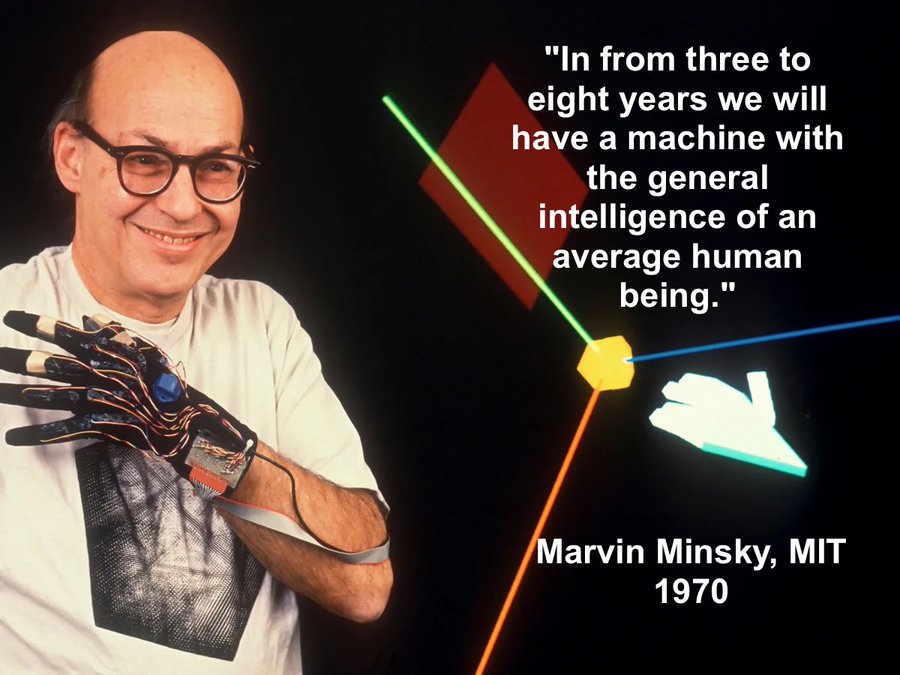
This sounds exactly like the things we’ve been hearing from Elon Musk and Sam Altman since 2022, but it dates from 1970. Minsky shows that the hype and devout faith surrounding Large Language Models (LLMs) is not new and that the industry has been promising, and failing to deliver, human-level AI for over four generations.
This should also throw into perspective the claims from Open AI, XAI and Anthropic that “AGI is close”. In fact, over the last month, we’ve seen ingenious marketing strategies from the AI companies to keep alive this fabulous fiction from the 50s that has been recycled as a ruse to play the venture capital game once more for one more spin of the speculation wheel.
So Anthropic claimed that “We don’t know if the models are conscious.” They imply that their tech is so advanced, they do not know for certain whether their AI models, specifically Claude, are conscious or sentient. It’s a clever trick that bypasses legal parameters on outright lying and accountability. For folks on this side of the pond, they’ll know this strategy of evading truth in advertising law as the Carlsberg Trick: in which through the cunning use of one word, the lager company evaded prosecution for making false claims and still added to hype about its product. This is the famous line “Probably the best Lager in the world”. So Anthropic have effectively said Claude is probably the most sentient AI in the world – with the cunning “we don’t know”. Anthropic it should be mentioned pulled this stunt in the weeks before their last funding round and their vague allusion to the possible or probable sentience of their LLM managed to raise them $30 billion on this yet again rekindled faith in the impossible goal of AGI.
Human Level Intelligence
The truth is that Large Language Models are not the correct pathway to Human Level Intelligence, they are the third wrong turn in the history of AI research. However, the frenzy of speculation in the AI market that has occurred in the last three years, and which has grown the value of AI companies to 1000 times their actual value, is dependent on this one belief becoming manifest – Large Language Models must be the pathway to AGI, because when AGI is achieved this amazing intelligence will then auto-programme itself to become “Superintelligence”(ASI) and then all investment returns will become exponential as the entire economy is revolutionised and taken out of flawed, limited human hands. When you write it out like this, it seems ludicrous, some nerdy tech-bubble-boy’s fantasy, but this is THE ONE STORY that has fuelled the American AI bubble. Exponential financial returns will come from massive investment in AI infrastructure now, which will grow LLMs to become AGI.
Anything short of this, say incremental improvements in chatbots and generative AI, does not fit that vast investment story. It’s AGI or nothing. This is why Trump initiated his pie in the sky drive to have a Public Private Partnership massive build-out of data centres and power stations. Trump has been made to believe in the LLM pathway to AGI belief system. This is the belief system behind the $500 billion Stargate project, which is supposed to fuse together the computer, the software and the financialisation capabilities of OpenAI, Oracle, SoftBank, the AI-focused Emirati investment fund MGX (Abu Dhabi), Microsoft, Nvidia and Arm.
And when you follow this belief system the only way to reach AGI, and the dreamed of economy of exponential returns, is SCALING – the only way is to build thousands of new data centres to meet the ‘exponential demand’ of an AI that they believe will grow exponentially and give exponential financial returns – and of course the nuclear and coal fired power plants to fuel them.
Maybe you’re seeing the irony and the huge blindspot that has occurred here. The belief that scaling up LLMs will achieve AGI is vulnerable to two things. The first is that if it takes too long to build all those data centres, then the AGI project will fail because investors will pull their cash, the BELIEF will collapse. The second is even bigger and it is that scaling LLMs to achieve AGI is a mistake in the first place and so the goal cannot be reached no matter if we cover every square foot of land in every nation in the world with data centres.
This last point is contentious; it is what I believe from studying LLMs and listening to specialists who say openly that LLMs are the wrong pathway. Yann LeCun, who served as Chief AI Scientist at Meta Platforms, has stated that current AI systems lack the ability to model the real world, a limitation he believes cannot be solved by simply making large language models bigger. Gary Marcus, the American psychologist, cognitive scientist, and author, known for his research on the intersection of cognitive psychology, neuroscience, and artificial intelligence; François Chollet, AI researcher at Google DeepMind and creator of Keras; Andrew Ng, the founder of DeepLearning AI and co-founder of Google Brain, asserts that while LLMs are powerful, they are “overhyped” and not a route to AGI on their own. Turing Award winner Judea Pearl argues that LLMs cannot reach AGI without causal reasoning; while Ilya Sutskever, a co-founder of OpenAI, has recently said that the benefits of scaling LLM pre-training have plateaued.
In fact, a 2025 survey by the Association for the Advancement of Artificial Intelligence (AAAI) found that 76% of AI researchers believe scaling current approaches is “unlikely” and “very unlikely” to yield AGI. While a mid 2025 paper by Apple, The Illusion of Thinking, argues that LLMs and LRMs, no matter how brilliant they may seem, don’t solve problems or even understand the problem. They are unable to reason and merely generate text, word by word, trying to sound coherent, creating an illusion, an imitation of intelligence.
And if you go back to 2024, you will even find Sam Altman of Open AI admitting this: “We need another breakthrough. We can still push on large language models quite a lot, and we will do that. But, within reason, I don’t think that doing that will get us to AGI.” It’s something he has perhaps forgotten or wishes we will have all forgotten, since he has yet again started declaring that “AGI feels pretty close” and on ASI (superintelligence) he said, “we are a few years away” in 2026 . How convenient, since this is the year that he wants to take Open AI to IPO. And how convenient to be able to pull the Carlsberg ‘probably’ trick with a ‘pretty’.
We are all wising up to these prediction tricks too since Elon Musk has discredited this strategy for all other players by making so many predictions that failed to come true: fully autonomous taxis in every city in the US by 2025, the first Mars mission by 2025, AGI by 2025, this was after previous predictions to land on Mars in 2018, 2021, 2022 and 2024. Musk more than any other company has committed to reaching AGI by scaling-up LLMs – building data centres.
There are those true believers who say that the wished for Altman’s breakthrough will happen without the massive overhead of scaling. While tweaks that focus on making Large Language Models (LLMs) smarter or faster like Mixture of Experts (MoE) and Long-Range Memory (LRM) might sound like new pathways, these architectural shifts often represent a tiny fraction of the model’s total operational logic, typically impacting only around one per cent of the active parameter selection or memory management. These things are still 99 per cent LLM.
So, when we look at the promise of AGI being delivered by LLMs we realise that this is a false promise, and one that has functioned like a fraudulent lie that has grown a vast speculative bubble. Perhaps we could call it best intentions, or tech optimism gone astray, but the fact is that hundreds of billions have been spent and are going to be spent on building a vast infrastructure for a pathway to AGI that will not and cannot work. Data centres are not just a waste of resources; they are a vast folly, a disaster waiting to happen.
This adds insult to injury for all of our communities, because those huge data centres the companies want to build on our local land are not going to deliver on what the overhyped sector needs to make a return on its investment. We can and should get angry about the fact that a data centre built in our country will push the prices of electricity up and contaminate fresh water supplies, and it will all be for nothing. Or rather it will all be for the mass delusion that America has spawned, that it could create a universal superintelligence by boosting chatbots through a speculative venture capital investment race into the trillions.
In truth there is no AI industry, there is no such thing as AGI or ASI research or ASI safety, there is only the recurrence here of something that American capitalism can’t stop itself from doing again and again in history – creating thin air money out of simplistic, hyped ideas and greed fuelled optimism, creating another economic bubble of vast proportions, bigger than the dot com bubble, maybe bigger than the 2008 crash.
And this bubble too, when it bursts, will bring down banks who invested in it and pension funds that got dragged into it. It will bankrupt governments like our own, in Scotland and the UK with their vast investments in AI infrastructure. The UK has the AI Research Resource (AIRR) through which the government is investing over £2 billion into the “AI ecosystem”, “including £1 billion to boost sovereign compute capacity, aiming for a twenty-fold expansion by 2030.” Then there is Scotland with its government plans for 17 new hyperscale data centres. This included the £15 billion “Stoics network”, which aims to build three of the largest global data centre clusters, although it refers to them as part of a Green data network in a fine example of greenwashing what is becoming the most anti-ecological industry in the world. Proposed sites for Scotland’s new data centres include four in North Lanarkshire (including a major AI growth zone at Ravenscraig), two in the Borders, two in Edinburgh, and two in East Ayrshire.
Why, so we can fuel a race within the American speculative capital markets, and fuel a bubble that has led to one AI company – the chip provider NVIDIA – having a valuation higher than the GDP of every country except the US and China.
The AI bubble rests on one belief: that scaling Large Language Models will lead to Artificial General Intelligence. That belief is false. It has always been false. The only thing keeping it alive is the relentless, breakneck construction of data centres to feed the illusion of progress so that the speculative financing keeps flooding in. Without the data centres, the story collapses. Without them, the venture capital stops and the whole edifice grinds to a halt.
This is why local opposition matters far beyond the familiar politics of NIMBYism. Every data centre that gets rejected, whether in Edinburgh, New Brunswick, or anywhere else, is a small cut in the pipeline. Every community that says no buys time. Fifty victories like the ones we have seen in recent weeks could be the difference between a managed decline and a catastrophic bubble explosion..
And these companies are on borrowed time (and borrowed 100s of billions). The promises made to investors, AGI by 2027, superintelligence by 2030, cannot even begin to be kept if the promise of the data centres aren’t there. And they cannot be kept anyway, because the technology doesn’t work the way the salesmen claim.
If we let them build everything they want, the bubble bursts all at once, taking down banks, pension funds, and governments with it. If we slow them down, starve them of sites, force them to confront reality piece by piece, the bubble deflates more slowly. The damage is still real, but it is contained.
This is the choice in front of us. Not whether to accept AI or reject it in its entirety. Not whether or not to stand outside a corporate building yelling END AI. Not whether to be techno-optimists or Luddites. But whether we let the biggest speculative bubble of our lifetimes explode in all our faces, or whether we take the small, practical, local steps that let the air out before the blast.
The people in Edinburgh and New Brunswick have shown us what can be done. They turned up and organised, they told the truth about the damage that was planned for their locations, and they won. Yes, the Americans didn’t know what hit them, and they will keep not knowing, every time another community does the same thing.
We have more power than we realise. We are not just protesting a technology we dislike. We are standing across multiple political divides, against a financial scam that threatens all our livelihoods. The good news is that we don’t need to bring down the whole edifice at once. We just need to keep saying no. What’s needed isn’t heroism, it’s just turning up at council planning permission meetings armed with facts. We only need to stop them, again and again, location after location, until the clock runs out. Keep blocking. Keep organising. Until the thing collapses under the weight of its own impossibility.
Scottish writers Ewan Morrison and Chris Kelso have just published a short book together – SHADOWSPHERES. It’s a hybrid collection of essays and stories by both writers, exploring the psychological and cultural fallout of a world accelerating beyond human control. From the rise of AI and the erosion of purpose to the collapse of empathy in a digitally saturated age. It’s available most places online.
Image credit: Michael Dziedzic from Unsplash.
Superb article. At last, something putting a proper perspective on glorified predictive text. Thank you
Make no mistake, the Edinburgh decision has rattled the Tech Lords and AI speculators. The ‘Edinburgh Inquirer’ has reported on Sandy Begbie, Chief Executive of Scottish Financial Enterprise and one of Scotland’s leading AI Bubblers, having a hissy fit. They will, of course, fight back, and have a lot of corporate money to throw at this, although many potential investors have already got the jitters. Scotland’s politicians, civil servants and planners need to up their game to get on top of things.
Guess what? Pace the Microsoft ads, we don’t actually need AI to visit a museum or distinguish a book from a roof tile. All that is being offered is disempowerment and infantilisation. Think of the tulip, South Sea and Mississippi bubbles, and you have a fair idea of what is going on here!
The ‘wicked problem’ that we should have been solving is web provenance, a way to provide a chain (or more likely web) of connections between a physical-world phenomenon and online digital representations (or shadows). In an important respect, we have moved further away from the goal of training AI on real-world data, since the production of ‘slop’ and generation of ‘hallucinations’ has accelerated the proportion of false representations. It’s like filling the Cave of Shadows with more fires and more shadow-casters.
However, there may be progress in AI systems which identify (but not necessarily resolve) problems of inconsistency within large phenomenal datasets, assuming we develop large- and fine-enough models (which is a goal of endeavours like climate science, for example).
The essential problem, however, is that these models themselves would need to be recursively modelled; the old difficulty of a mind trying to understand itself. But if all you are after is return-on-investment, your projects are going to veer towards exploits and cheats, illusions over substance. Work Without the Worker: labour in the age of platform capitalism, by Phil Jones (Verso, 2021) makes an interesting case about how much cheap labour goes into systems which are sold as automated (the Mechanical Turk etc).
An interesting experiment to try on enthusiasts for Large Language Models – ask them for their response to Godel’s theorem. This is perhaps the most important theorem in modern logic. Proved by Kurt Godel in 1931, it demonstrates – very roughly – that no formal language of sufficient strength can be both complete and consistent. Even more roughly, it shows that any AI system must accept incompleteness or inconsistency – or both. As far as I know, no serious logician has disproved Godel.
I’m no expert here but any time I pick up a book on AI I go straight to the index and look for Godel’s name. I very rarely find it. Odd.
“I’m no expert here but any time I pick up a book on AI I go straight to the index and look for Godel’s name. I very rarely find it. Odd.”
========
Gödel Incompleteness Theorem(s): the Achilles heel of AGI hype.
What is even odder is no mention of it in the otherwise fine article above.
I passed this article to some people deeply involved in AI. To summarise their responses and I’ve removed the contemptuous language:
1. The article is factually inaccurate
2. The development of AI within society cannot be stopped.
3. A country that does not harness AI will have a terrible economic future
4. The UK Gov has no effective AI strategy
I love the idea that someone ‘deeply involved in AI’ would be objective here.
What fun!
I love the fact that you don’t tell us what the factual inaccuracies are either!
@Edwinwine1 – Out of curiosity, have you (and/or your AI-involved friends), read ‘How to think about AI : a guide for the perplexed’ by Richard Susskind, President of the Society for Computers and the Law? It ends on a distinctly cautious note about the potential advantages and disadvantages of AI.
It is not easy to reconcile the idea that ‘the development of AI within society cannot be stopped’ with any recognisable theory of democracy, or indeed of human agency.
@Dennis Smith, I think the more pressing question would be: how would we know that the development of AI in human society was stopped? Surely there’s potentially a lot of dark AI research and criminal utilisation already. Possibly the best toolset for detecting such activity would include AI applications anyway (set a thief…). I believe there’s significant interest in anomaly detection. Although perhaps omission (lacuna) detection is the harder problem. And one of the current uses of AI is to create cacophony, which makes it harder to find signal in noise. One of the simplest ways for AI to hide (be hidden) is behind human components or artificial structures with their own operating logic (like corporations, see science fiction writer William Gibson on this, and predecessors).
https://en.wikipedia.org/wiki/The_Green_Death
This reads like an AI generated summary. You might be more persuasive if you did your own work, deployed arguments and quoted authoritative sources.
Their response reads like it was written by AI.