
Sailm nan Daoine, a Gaelic Road Trip
One of the standout films featured in this year’s Glasgow Film Festival is Sailm nan Daoine (Psalms of the People), a documentary directed by Jack Archer from Hopscotch Films. The film explores the rich tradition of Gaelic psalm singing as Rob MacNeacail undergoes a musical journey from his Carlops singing group in the Borders across Scotland and Ireland.
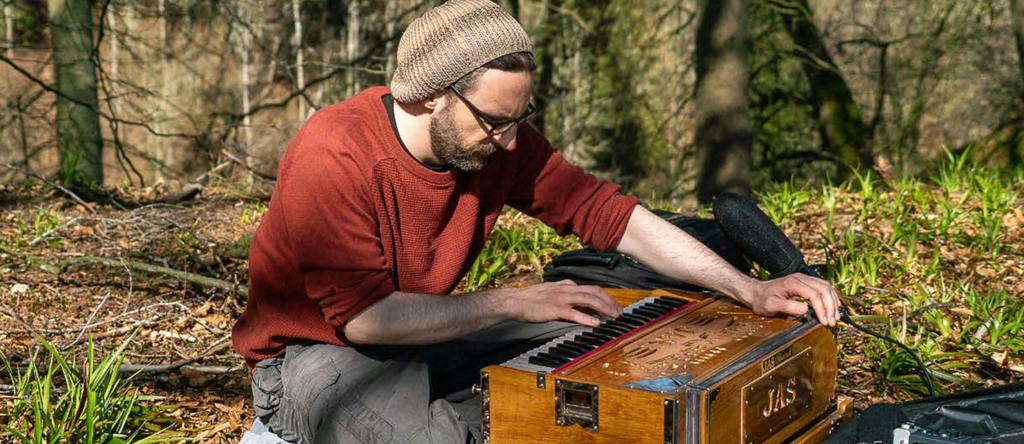
Rob uses the woods and fields around the village to try out new musical ideas and listens to the natural world using his portable sound recorder. He records the interior sound of trees and hangs out with his neighbour, who has a vast collection of ancient instruments to play with.
The film is quirky and uplifting, but has a background which is poignant and full of grief, both for Rob’s father – the acclaimed poet Aongas MacNeacail – and for the gaelic language. Aongas passed away at the end of 2022 and Rob realises he is not speaking gaelic as much as he did when his dad was alive.
On the anniversary of his father’s death, the village meets to sing the Psalms of his childhood and it proved a, perhaps unlikely hit. They began to meet every week.
Rob’s enthusiasm for psalm singing is infectious, and his weekly sessions become an
opportunity to not only sing but to speak Gaelic and learn from each other. But Rob started to question his authority to teach the psalms, he only learned how to precent relatively recently and didn’t grow up in the church (to ‘precent’ is to lead the call and response of the psalms0.
As summer comes, Rob goes on a journey to reconnect with his Gaelic roots and hear how psalms are sung by Gaels in the communities that have nurtured the tradition.
He travels across the Gàidhealtachd to Ireland and the Western Isles. On the Isle of Lewis, he visits Back Free Church, the heartland of the psalms, where he precents to hundreds of people.
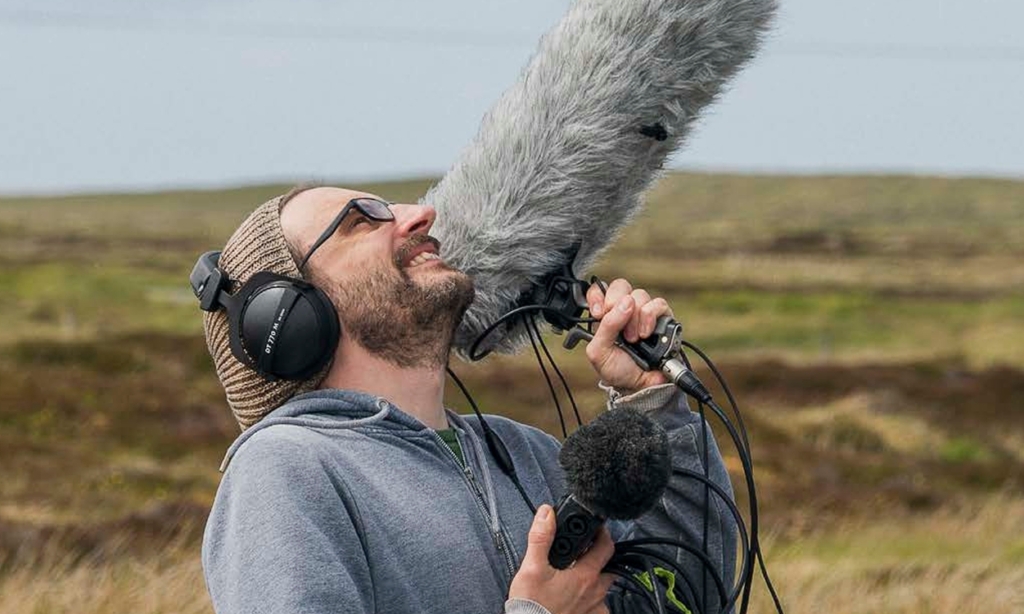
Appropriately, music is the core of the film. Rob composes the sound track as he goes, incorporating melodies, field recordings and the music he encounters along the way. The combination of harmonium, whistle, guitar and synthesised drones give the music a futuristic tone, whilst being steeped in tradition. A recording of a supermarket freezer in Broadford becomes the soundscape for a re-imagined rendition of the Ossianic ballad, Duan na Ceàrdaich. He reworks the melody for the psalm tune ‘Walsall’ for guitar, demonstrating its powerful versatility. His rendition of the old song ‘O Craobh nan Ubhal’ at a waterfall becomes a repeated refrain throughout the film.
Director Jack Archer says: “Gaelic psalm singing is a sacred tradition that is admired all over the world but it is also in a fragile condition, church numbers are declining and Gaelic is a minority language. Rob’s enthusiasm for getting people speaking and singing in Gaelic is inspiring, as is his philosophy towards life. The people he surrounds himself with, and the situations he finds himself, in are quietly radical. He rejects ‘external validation’ and believes that culture should be practiced for the benefit of the people involved, not prestige.”
“This film is a collaboration. Gaelic psalm singing is at the heart of it but we follow lines that connect the entire breadth of the Gaelic world, ignoring the artificial constructs and rigid identities imposed by colonialism and national boundaries. It has a spontaneous serendipity at its heart. This film is a collaboration. Gaelic psalm singing is at the heart of it. The story is a road trip inspired by musical sessions and poems. It’s about legacy, and within the film there is the repeated metaphor of an apple tree from the old song ‘O Craobh nan Ubhal’. Rob’s father gave him the gift of Gaelic and this opened up a world of opportunities for him. We see him taking this gift and passing it on in his own way.”
This is a profoundly moving film of redemption and loss, grief and nurture. It is both intensely personal and acutely political. If this is a road trip, it is a trip through memory and identity, community and language.
The sense of being held by both a tradition and also a live ‘choir’ or congregation is vivid, and perhaps speaks to our world of online disconnect and alienation. As Rob MacNeacail attempts to transcend his own grief, we are left with an uplifting story of finding solace in the most unexpected places. The film also speaks sensitively to how you step out of the shadow of your father, while respecting and honouring the traditions you have inherited, and learn how to re-make them in your own day. It is a lament, but ultimately a real joy.
“For me there is nothing like a community coming together and sharing their feelings through song.”
The film will launch in the Spring, and the team are aiming for a combination of cinemas and community screenings, some of which will have psalm workshops with Rob.
See also Sam Gonçalves interview with director Jack Archer here: Jack Archer on Sailm nan Daoine. Go here to see the full programme of the Glasgow Film Festival: GFF Home | Glasgow Film Festival

We are supported only by our readers. We don't have corporate backers and we don't take advertising, so we rely entirely on your support.
Help to support independent Scottish journalism
Nice article Mike thanks.
I kent his faither!
The late Aongas used to come in to the Centre for Human Ecology from time to time when it at 15 Buccleuch Place in Edinburgh University in the 1990s. He used to encourage our students to understand the poetry of people and place, the deeper levels of human ecology as the study and practice of human community, the integration of the social and the natural environments.
Just as Latin became a sacred language of the Catholic Church, and Sanskrit of Hinduism, so Gaelic Psalmody needs to be recognised as a sacred language and manner of song from our part of the world.
The timbre of such communal song is much more than a translation from the English or original Hebrew as some would relegate it to be. The tunes may, on their surface, be relatively “modern” in the historical sense, but the manner of intonation has an ancient quality to it that nobody I’ve encountered can adequately explain.
I say this, speaking as the great great grandson of Murdo Maclennan the precentor of Contin, Strathconnon (d. 1899) and at the 1845 FC Assembly, whose old style manner of precenting (leading in song) was documented by the German ethnomusicologist Joseph Mainzer (via an intermediary), and is still used each year at the Mod.
Mind you, Morag Macleod of Scalpay (ex of SoSS) told me that Mainzer didn’t get right what would have been old Murdo’s grace notes, described by Dr Beith in his book on Candlish as “magnificent and overwhelming … as one wave after another of fast harmonious sound rolled upon the ears … so sweet, so touching sweet.”
Aongas would have been proud of his son doing work like this film, as reported by Mike Snall. Indeed, from the sounds of it, the son Rob MacNeacail here is taking matters a whole stratum deeper than his father could do 30+ years ago.
That’s a very interesting and heartening sign of the times.
This is great thanks Rob Mike and Alastairs comments Quote “For me there is nothing like a community coming together and sharing their feelings through song.” “Yes the only way forward is through words music and community
Caught this beautiful moving film at GFF yesterday and blubbed my way through a lot of it – hit me really emotionally. A dod of hankies for Gaels on the door please ! So much baggage to unpack . And Rob is the perfect conduit to do that – open, curious, gracious, geeky, humorous and compassionate. Bhiodh d’athair moiteil asad gun teagamh sam bith, Rob. Hope that we can get a Gaelic Psalm Singing Workshop on the go in Glasgow when the doc does a wider tour. I’m sure An Lòchran could help with that . Or Ceòl is Craic.
The film reminded me of the late Donald Macaulay’s poem Soisgeul 1955, which I alway cherish, having been brought up with the psalms, both metrical (english) and gaelic. Thankyou so much for making this vital regenerative piece of work ! Mon the psalms and less pontificating fae the preacherman.
Soisgeul 1955
Bha mi a raoir anns a’ choinneamh;
bha an taigh làn chun an dorais,
cha robh àite suidhe ann
ach geimhil chumhang air an staighre.
Dh’éisd mi ris an t-sailm: am fonn
a’ falbh leinn air seòl mara
cho dìomhair ri Maol Dùn:
dh’éisd mi ris an ùrnaigh
seirm shaorsinneil, shruthach –
iuchair-dàin mo dhaoine.
An uair sin thàinig an searmon
– teintean ifrinn a th’ anns an fhasan –
bagairt neimheil, fhuadan
a lìon an taigh le uamhann is coimeasg.
Is thàinig an cadal-deilgeanach na mo chasan…
Domhnall MacAmhlaigh
Thanks Babs, yeah I found it moving too.
Only two showings at the GFT! By the time your read about you’ve lost your chance. Sorry.
Same with Kenmure Street film. I helped to fund it but I cannae get to see it in the town where it was filmed. Sold out by the time I got my GFT email. Great.
How about cutting back on some of the other films and giving home-grown stuff a longer run at the Glasgow Film Festival?
Anyway, rant over. Thanks for highlighting this film. Hope to see it sometime (probably on effing You Tube).
Good rant Wul, good rant. Too much artsy fartsy stuff gets given space and funding at the expense of what nourishes the roots of life in and from Scotland.