
The Making of Modern Scotland
The making of modern Scotland: Politics, Society and the sociology of a stateless nation
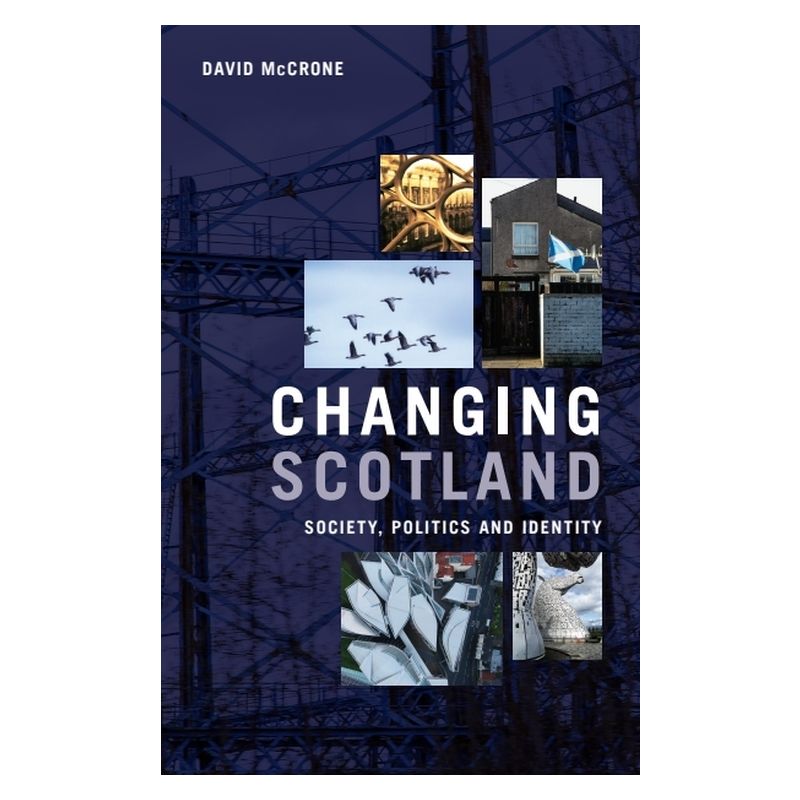
David McCrone, Changing Scotland: Society, Politics and Identity, Edinburgh University Press, £19.99.
Review by Alex Law
A clear head is needed for these turbulent times. Long assumed to be immune to the upheavals and misrule reigning elsewhere Scotland may not be so different after all. A sense of historical perspective is needed to address the well-founded illusions of Scottish exceptionalism. It is David McCrone’s contention in Changing Scotland that the nation was changed irrevocably in the final three decades of the twentieth century. This is grounded by McCrone in what the radical American sociologist C. Wright Mills famously called ‘the sociological imagination’. For Mills the biography of individuals can only be grasped in relation to wider historical changes in social structure which may or may not be readily apparent to people going about their everyday lives.
 McCrone has long interrogated the changing structure, politics and culture of Scotland. He has been an advocate of the sociological imagination since he first stumbled across the fledgling subject as an undergraduate student at Edinburgh university in the late 1960s. Better known as a sociologist of nationalism and Scotland, McCrone first of all made significant contributions as an urban sociologist inspired by Max Weber through studies of property and domination in Edinburgh, co-authored with Brian Elliot (1982, 1989), a subject to which his recent critical study Who Runs Edinburgh? (2022) returned.
The sociology of modern Scotland
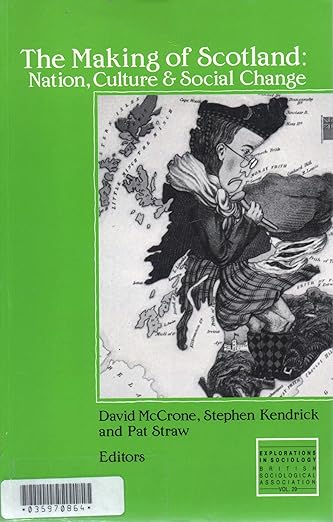
By the late 1980s a growing sense that Scotland was politically, culturally and socially distinctive in ways that were not well understood, even by sociologists in Scotland, produced the grounds for the emergence of sociology of Scotland. While there had been sociologically-informed studies of Scotland beforehand, most notably Tom Nairn’s celebrated The Break-up of Britain (1977), the 1989 collection that McCrone co-edited, The Making of Scotland: Nation, Culture and Social Change, represented the first devoted to a more concerted, if rather heterogenous, historical sociology of Scotland. McCrone’s own contribution took the form of a critique of what he (and others) considered to be a wholly misguided search for ‘authentic’ cultural representations of industrial Scotland at the very moment of its eclipse. By no longer conflating ‘society’ with the state or by subsuming Scotland to ‘Britain’ as a sociological unit of analysis The Making of Scotland was also the making of the sociology of Scotland.
A few years later McCrone’s influential study Understanding Scotland (1992) constructed Scotland as a legitimate object for a less state-centred sociological imagination. This appeared at an opportune time in Scotland of rising popular discontent with the ‘democratic deficit’ of the archaic British state. Diverging voting patterns between England and Scotland put into sharp relief collective self-images of national distinctiveness. Over the next three decades McCrone and his colleagues interrogated national identity in Scotland and England through a long-running series of social attitudes and election studies that enabled data to be produced and analysed under scientific controls beyond the impressionistic immediacy of journalistic commentary and political rhetoric. A key venue for this has been the Edinburgh-based journal Scottish Affairs that McCrone helped to found in 1992 as a collaborative endeavour to refuse the false coin of Scotland’s dreams about itself while attempting to understand its sociological bases. Even if this did not quite amount to a distinctive Edinburgh school of sociology it nevertheless imparted to public discourse about Scotland greater empirical rigour, conceptual precision and argumentative coherence.
Understanding present day Scotland
Changing Scotland (2025) is a fitting testament to McCrone’s long-running interrogation of the sociology of Scotland. It is eminently readable, intellectually engaging and instructive, replete with carefully marshalled facts in support of his overarching thesis about the post-war trajectory of Scottish society, culture and politics. Each chapter takes the reader through the argument step by step without losing sight of what are always deeply interdependent social processes. He begins by outlining the broad pattern of social change in Scotland from 1945 to 1975 before proceeding to account for the social conditions that made Scotland, for better or worse, what it is today. Chapter 2 argues that we have to understand how the meanings and institutions of Scotland were refracted by the three interrelated categories of civil society, state and nation. Chapter 3 addresses how the society-state-nation coordinates were transformed practically and ideologically by the caesura of the 1970s.
The rest of the book details the nature of these processes over the past half century or so. A chapter on demographic changes addresses the pattern of emigration and immigration and changing household size and styles. The following chapter on the restructuring of the economy and social class forms the materialist hinge for social, cultural and political change. Class is understood by McCrone as cultural, in the everyday sense, as much as by material conditions such as occupational structure. The book subsequently explores the complex relations of Scottish and British national identity (chapter 6), political attitudes and values (chapter 7), cultural representations (chapter 8), before concluding with some reflections on the future possibilities for sovereignty in light of twenty-five years of devolved government (chapter 9).
The main thesis of Changing Scotland is a materialist one: socio-economic and demographic changes since the 1970s have utterly transformed Scotland. It is no longer the country that it once was or thought that it was. All western societies passed through similar processes of deindustrialisation, the rise of services, demand for higher educational credentials, and the feminisation of the workforce, with populations reconfigured by smaller, privatised households living in new towns and peripheral suburbs.
Scotland and the imperial state of Ukania
For McCrone this process was given distinctive expression in Scotland where it was mediated by the institutional and ideological relations of a ‘stateless nation’ within a multi-national state. And, it goes without saying, the United Kingdom is no ordinary nation-state. The formation of the England-Scotland imperial state in the seventeenth century represented a pragmatic attempt to resolve dynastic and religious problems of the Protestant line of succession while the Treaty of Union in 1707 was premised on realpolitik calculations about the territorial integrity of the centralised state. By evacuating political society to London civil society emerged as an intermediate site for the institutional autonomy of Scotland, as early as 1767 viewed by Adam Ferguson as a bulwark against political despotism in his pioneering ‘historical sociology’ on the history of civil society.
For Marxist critics like Tom Nairn the archaic Ukanian state did not evolve as a modern ruling institution in the exemplary manner of the bourgeois revolution in France. For Nairn, Scottish politics, identity and culture were severely ‘deformed’ by the absence of a nationalist intellectual class capable of constructing a hegemonic alternative to the compromised British state form. With its lingering great power pretensions, flattering self-images of parliamentary democracy, and the mystifications enacted by the majesty of monarchy, as excoriated by Nairn in The Enchanted Glass (1988), the British state habitually represses the fact that it is a ‘union-state’ not a unitary state, where the people are ‘subjects’ not citizens. When the repressed returns, as it must, it finds expression in morbid symptoms of decline, decay and decadence.
Following Nairn what McCrone views as the ‘abnormalities’ of the British state is also the ‘normality’ of an eminently pragmatic Scottish nation. While national identity is inherited or ‘ascribed’ not freely chosen or ‘achieved’, in Scotland it has proven sufficiently pliable to adapt and make sense of radically different circumstances. As such, cultural representations of Scotland have travelled quite a bit from Nairn’s cultural pathology of ‘the Scottish cringe’ to what McCrone characterises as more optimistic, plural and open representations of the nation. The relationship between culture, nation and politics is always complex, as Nairn knew only too well from his close acquaintance with analyses of Antonio Gramsci, even if his evocative essays on Scotland often smoothed over deeply uneven and contested socio-political processes.
In the (mis)managed socio-economic transformation of the ‘long’ 1970s’, the ‘warfare-welfare’ corporatist state began to be consigned to the scrapheap by the neoliberal project of ‘modernisation’. Three decades of the warfare-welfare nexus cemented a taken for granted hybrid form of Britishness in Scotland. But the traditional bases of British nationalism in militarism, empire and Protestantism were already in secular decline by the 1970s, as were the large-scale, male-dominated industries that, from father to son, ensured privileged access to skilled jobs to the exclusion of outsiders. A social order that was largely taken for granted by generations of Scots was transformed at both the level of material practices and structures and the level of collective symbols and ideologies. Britishness was simply assumed by Scots to be a symbolic container that could be negotiated so long as the British state felt meaningful to enough people.
Beyond the Singularity of Scotland
McCrone cautions that the past ought not to be treated as a foreign country. Although it came to be defined by large-scale industry, urban deprivation and class consciousness, Scotland was never a singular homogenous society. He argues that, despite Protestant domination in the modern period the Scots were always a diverse people – ‘a mongrel people’ as he puts it – whose rulers developed a relatively elastic form of civic identity that incorporated the plural groups spread across its territory. As ‘one of Europe’s oldest nations’ the ‘foundation myth’ of the sovereignty of ‘the people’ was purportedly established by fourteenth-century noble elites in the Declaration of Arbroath. The magical-mythical symbols of nationalism fits rather snuggly with contemporary left-liberal self-images of Scottish identity that reproduce the collective charisma enjoyed by all of ‘us’ who feel completely at home in this imagined community. Widely-held myths about an inherently egalitarian Scotland help sustain such forms of symbolic democratisation – ‘we’re all Jock Tamson’s bairns’, etc – despite deep and enduring social divisions. While nationalism in Scotland does tend to take a left-liberal form in contrast to right-authoritarian nationalism in England it is advisable not to essentialise civic nationalism and ethno-nationalism as antipodes. By dispelling well-founded illusions while trying to account for them sociologists often seem like spoilsports.
Scotland is a far stranger country than it appears to be at first glance. For instance, for a want of job opportunities, post-war Scotland became a land of outward migration. Around 15 percent of its population emigrated between 1946 and 1971, and between 1968 and 1988 the rate of out-migration was three times that of Ireland, the classic emigrant state, creating a far-flung Scottish diaspora. In recent decades the shift has gone in the other direction, from mass emigration to empire to one of immigration, not least from England, to meet labour shortages. Scotland experienced a lengthy process of deindustrialisation well before Thatcherism finished the job. Post-war Scotland was exposed to external decision-making as a multinational branch plant economy. Some hoped that the decline of a specifically Scottish capitalism might be alleviated by the exploitation of North Sea oil in the 1970s as a possible material basis for home rule or national independence and dreams of economic autarchy.
It is a widespread myth that Britishness is no longer significant in Scotland. Scots do feel much more Scottish than British but many nevertheless cleave to some form of British state-identity. As a forced binary choice the referendums of 2014 and 2016 do not reflect the more complex relations of national identity. Referendums demand that people take sides – Yes or No, Leave or Remain – ideological positions that tend to harden in the process. So at least half of all Scots generally favour an independent Scottish state and a sizeable majority membership of the European Union; significant support exists for unionism and British ‘independence’. There is no neat relationship of the democratic self-images of Scots to party politics, with Labour supporters particularly split between sovereigntists and unionists.
Surveys of social attitudes over the past two decades demonstrate that Scots generally apply a positive lens to the legitimacy of the Scottish Parliament as more open and trustworthy than Westminster, admittedly not a very high bar as McCrone sardonically notes. Scotland’s fabled ‘civil society’ is valorised as the primary transmitter of these liberal-democratic cultural and political values. Yet civic nationalism may be more problematic than McCrone allows. For one thing, as Tom Nairn once argued, it is often speciously elided with democratisation processes. Here McCrone may have surfaced the changes in the reproduction of what C. Wright Mills called ‘the power elite’ in Scotland, as he has done elsewhere. Many civic institutions and organisations are dependent on state largesse and circulate the same faces that front ‘independent’ third sector bodies and pressure groups, never mind the opaque lobbying of politicians on behalf of vested interests. Worryingly, a revanchist form of exclusionary ethno-nationalism has surfaced in Scotland to parade some of the same symbols and mythologies as mainstream civic nationalism making them available for entirely reactionary ends.
By addressing the seismic transformation of society, state and nation Changing Scotland forces us to critically reappraise the conundrums and passions that it has thrown up. In mapping the social and symbolic revolution of the past five decades, McCrone remains faithful to the fundamental question that the sociological imagination demands that we ask: how have the social conditions of possibility in the present been formed historically?

We are supported only by our readers. We don't have corporate backers and we don't take advertising, so we rely entirely on your support.
Help to support independent Scottish journalism
I am not clear whether Mr Law is reviewing Mr McCrone’s most recent publication or is using it as a springboard to present his own opinions.
In particular, I found myself bristling at things like the reification of ‘Scotland’ as a conscious entity and the generalisation of views held by some groups within Scotland to a majority of Scots (i.e. the people who live within the borders of Scotland) or perhaps all.
I accept that in reviewing a book (or other imaginative creation) the reviewer will express her or his personal opinions. Indeed, challenging assertions or accepting them or proposing alternatives is part of a review. However, I think it is incumbent upon the reviewer to report accurately on what the author is arguing or reporting and then passing comment.
In reading this review, which has many interesting points to make, I was disappointed that I was not clear which were Mr McCrone’s views and which were Mr Law’s
It’s usually a bit of both with book reviews. The basic deal is that you get to read a summary of the book – which we get in the “Understanding present day Scotland” section – the price being that the reviewer gets to present his own conclusions, draw comparisons, etc.
‘Long assumed to be immune to the upheavals and misrule reigning elsewhere’
Is that really modern Scotland ?
‘for want of job opportunities, post-war Scotland became a land of outward migration’
This is an over-simplification. Post war Scotland was a land of full employment, looked back at nostalgically in the 1980s. Two particular factors were in play. Ambitious working class men could see that the industrial economy was rotting from a lack of investment and a few countries – Australia and Canada, in particular – were enticing them with the offer of a more secure and prosperous future.
‘Class is understood by McCrone as cultural’
The problem here is that class can – and in many cases did – become a matter of self-identification. Prosperous middle class public service workers, with a large amount of pension and property wealth, convinced themselves that they were still working class; voting Labour till the early 21st century served as a badge of their class identity.
Judged by Alex Law’s description, David McCrone’s book fails to appreciate the chasm that emerged between the winners and losers in post-industrial Scotland.