

Scotland Faces a Crisis of Loyalist Violence
There’s a lot going on in the aftermath of the unfortunate events at Ibrox on Sunday. This was a high-stakes game in which either side, if defeated, might face a trophyless season. Both clubs have been disastrously mismanaged despite having vastly greater resources than any other club in the Scottish league. This reality was the backdrop to Sunday’s fiasco.
This was the first time that an Old Firm game at Ibrox had a full stand of away supporters in attendance since 2018. But, in the aftermath of what happened, the idea that full allocations will continue is ridiculous. So too is the idea – discussed recently – that clubs should be permitted to serve alcohol in the grounds again.
But the idea that the Ibrox club, or the police were prepared for this match seems highly questionable. Police Scotland’s Greater Glasgow Chief Superintendent Emma Croft said on post-match scenes at Ibrox after Celtic beat Rangers: “I am satisfied with the policing operation” and “There were enough police officers.”
Neither statement seems true.
*
The scenes prior to the game with fans funnelled into a narrow cordon up to the stadium and kettled, did not bode well, and in the aftermath police and stewards were neither able to protect players and staff from assault, nor contain a pitch-invasion with intent, nor seemingly make arrests. The situation looked dangerously out of control and it’s a surprise there wasn’t more serious violence.
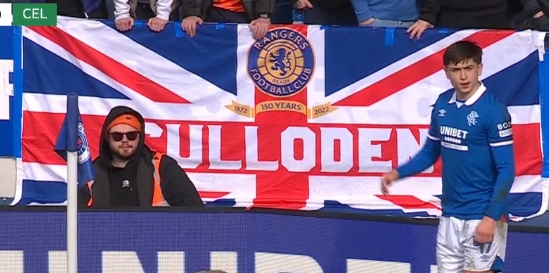
The default reaction in much of the media and online is a lazy one. It goes something like this: both sides of the Old Firm are the same and something called ‘sectarianism’ is to blame, a crime of which both are guilty in equal measures.
Such simplistic tropes are repeated ad nauseam in the Scottish press, and have been for so long as to have become truisms. These are what John Kelly calls ‘Sincere Fictions’ in his thesis ‘Sectarianism’ and Scottish football: Critical reflections on dominant discourse and press commentary.’ [_Sectarianism_and_Scottish_football.pdf]
Sincere Fictions
Kelly explores this in two examples from the Sunday Herald and the Scotsman.
“The following sincere fictions created by the press reveals more about the dysconscious sectarianism of the press than it does about the sectarianism of either Rangers or Celtic (clubs and fans). For example, the following two press illustrations, which, ironically, were intended to appear as critical challenges to sectarianism, merely expose not only the sectarianised misconception of the journalists but, given the prominence of the publications and/or journalists, also the culture of acceptance pervading the society in which the prejudiced comments are made. Both examples refer to the press-created sincere fiction surrounding Celtic’s ex-manager Gordon Strachan. This sincere fiction frames Celtic fans as disliking Strachan because he is (allegedly) not a Catholic, has not played for Celtic and did not support the club.”
*
“The Sunday Herald’s Hodgart (13th April, 2008) criticises Celtic fans, and trivialising Catholic rosary beads, exclaims, “some [Celtic] fans would probably rather have a bead-rattling Hoopy Hound in the dugout” (p.14). Aiden Smith (31st May, 2009), in the Scotsman, criticises Celtic’s search for a new manager in the aftermath of Strachan’s departure, by caricaturing an ex-Celtic player pleading for the job. Smith speaks the imaginary words of this ‘candidate’, mocking, “but unlike Gordon Strachan I played for Celtic … the fish on a Friday after training? You couldnae
whack it”.
*
These examples are highly revealing on two counts. First, the determination to promote the preferred ideological position results in the press overstating its (often speculative) supporting evidence whilst overlooking the (factual) evidence that contradicts the sincere fiction being produced. For example, in the aforementioned articles, Hodgart’s unequivocal insinuation is that Celtic fans are so determined to have only a Catholic manager, even a cartoon-like dog-hound would do. Correspondingly, Smith’s criticism of Celtic fans for being “Celtic-minded” – a
term which when used by the media, is a sincere fiction itself, euphemistically and pejoratively meaning Irish-Catholic – implies that Celtic fans have a fear of non-Irish Catholic managers.
*
Although Smith acknowledges that there are some “who insist that Celtic-minded has nothing to do with religion”, his one page article referred to religion four times, and when considered in the context of the article and the wider press sincere fictions around Celtic-minded, it clearly implies intimate (and negative) connection between Celtic-minded and Catholicism. Smith attempts to placate this fear of non-Catholic managers by informing the reader that with regard to the club’s “romantic history”, “any new manager would have no difficulty acknowledging [it], whether or not he was Scottish or Irish or Catholic”. Smith then re-introduces religion, informing the reader that Strachan is “the wee, red-haired, Presbyterian” before wondering whether some Celtic fans did not welcome him “from day one”.
*
“Additionally, in juxtaposing Celtic with its major rivals, Rangers, Smith adds the significant claim, “you never hear the phrase Rangers-minded”. The consideration that this latter reality is itself a reflection of press discourse is seemingly overlooked, along with the factual reality of the situation. Celtic’s previous non-Catholic managers number approximately six out of fifteen from those employed after 1965.”
*
“Celtic’s most successful manager, Jock Stein, a Scottish Protestant, employed as manager from 1965 to 1978, was voted ‘the greatest ever Celt’ by Celtic fans in 2002. Meanwhile, Rangers employed its first and only Catholic manager in 2006 and Paul Le Guen’s six month managerial reign remains the club’s shortest in one hundred and thirty eight years of existence (now replaced by Russell Martin – Ed). It is far from obvious that anti-Catholicism figured in Rangers’ (club and fans) increasing antipathy towards Le Guen. However, the media’s duplicity is merely compounded by the fact that it is comparably doubtful that Celtic’s (fans and/or club) antipathy towards Gordon Strachan was connected to his religious background or lack of it. These facts are absented from the mediated sincere fictions.”
*
“The second revealing aspect to these examples is the press’s open denigrating references to Catholicism, referring to “bead-rattlers” and “fish on a Friday”. This exposes aspects of the press’s supposed anti-sectarian view, revealing that in some discourse around Catholicism in Scotland, it is unremarkable to use potentially offensive and derogatory language and to trivialise practical elements of that faith. Moreover, by constructing a picture of a cartoon-like cuddly dog-hound reciting the rosary, one need not be a semiotician to read the message being produced to depict
Catholic rosary bead users.”
*
So we have an embedded unconscious and totally normalised problem within Scottish media about how these games and the toxicity around them are reported, then you have a situation in which both clubs are in crisis, and facing the prospect of winning nothing, and you have the vicious-circle of authoritarian policing and fan interaction amplified by bigotry.
The 49ers and the SPFL
What comes next after the mayhem at Ibrox?
The reality is that until Scottish football stamps out the racism and sectarianism of the Ibrox club culture nothing will change, and it’s not credible that a masked gang can run riot with impunity in a Scottish city in 2026.
The Scottish football authorities have been notoriously unable to commit to any meaningful action over decades. Clubs don’t want Strict Liability (arguably the best solution), and political efforts such as the Offensive Behaviour at Football Act were repealed in 2018. There is no real religious authority here, as the Ibrox faithful’s commitment is to Loyalism is not the Church of Scotland, and even if this was otherwise the church is so diminished as to be irrelevant.
One option, given the hopeless lack of leadership from anyone within Scottish football, is, paradoxically, Rangers American owner, Andrew Cavenagh. This is where late capitalist realism collides with 17th-century folklore.
When The Times published a gushing piece about Cavenagh’s injection of 20 million pounds into Rangers last summer, he said:
“There are many things about this club that are attractive,” he said, cutting a relaxed and enthusiastic figure inside the stadium he now owned. “But the big three are [firstly] the supporters — the breadth and depth of the fanbase is incredible. We’ve not seen many other clubs in Europe with this sort of scope and passion. [Secondly] Ibrox is an incredibly magical place to attend as a supporter.”
I mean, sure.
Apparently, he was at the game on Sunday. I’m not sure how magical he found it.
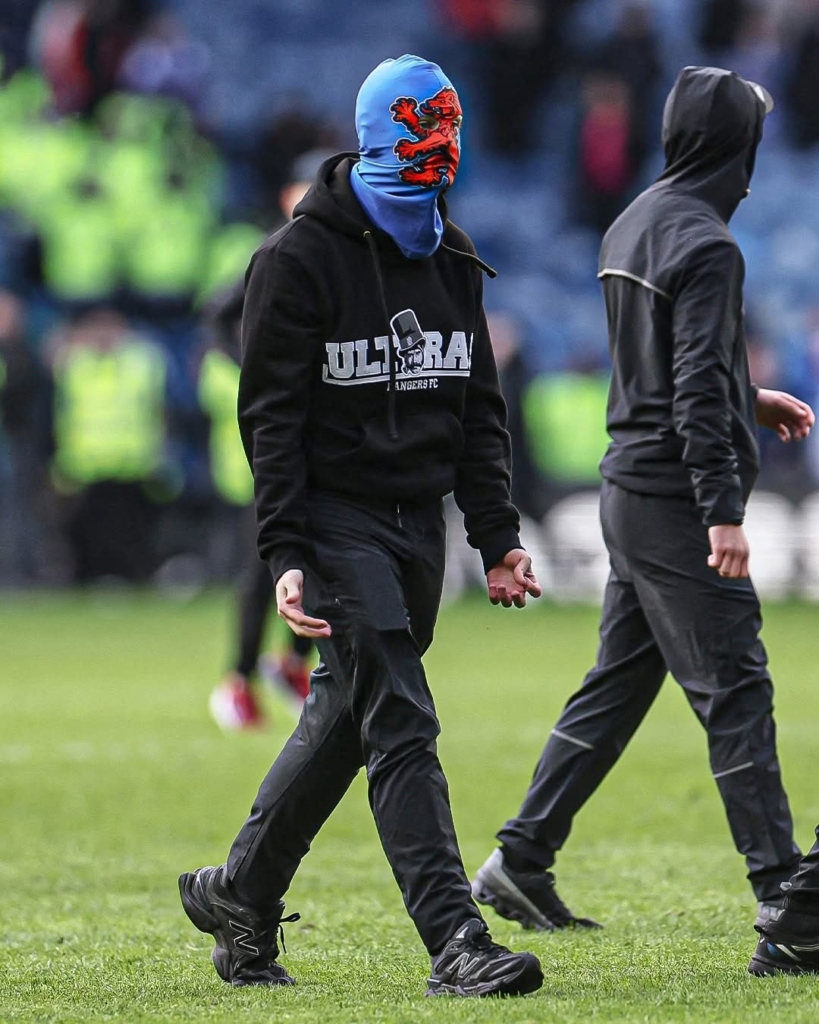
Scotland faces a societal problem about far-right Loyalist gang culture that isn’t captured by often pathetic ‘both sides’ media coverage. This is a societal and political problem that can’t and won’t be addressed by football pundits who are locked into normative violence.
This is a turning point as much as 1980 was.
Celtic fans aren’t without blame in all of this, but without serious intervention from political, legal and football authorities, then Ian Archer’s famous qoute from 1976 remains true:
“This has to be said about Rangers, as a Scottish Football club they are a permanent embarrassment and an occasional disgrace. This country would be a better place if Rangers did not exist.”
Time to get tough on that disgrace of a club formerly known as Rangers and it’s disgusting support.
The beautiful game sure does create some ugliness. I can’t believe that this is still going on as have been far away from my home town for more than sixty years. The terror and misery sectarianism causes must be addressed one day in Bonnie Scotland. Where are the Brave Hearts?
If only somewhere in the multiverse we could find an example of a third successful football club in Glasgow that could offer a non-sectarian alternative for trophy-loving supporters, and see how that dynamic plays out. Oh, wait.
https://glasgowcityfc.co.uk/pages/our-story
No Brave Hearts in the Scottish football authorities who tacitly support the sectarian approach to Scottish football.
Evidence on what might seem a relatively minor issue to some. Examine how tickets are allocated for club matches at Hampden? Are they allocated to a home team and away team dependent on draw as at Wembley?
No – one end of the ground prioritises- 1)Rangers, 2)Hearts 3)Dundee. The other end of the ground prioritises – 1)Celtic, 2)Hibs, 3)Dundee United. Other teams are expected to fit in with this system of allocating tickets.
What is the basis for allocating tickets in this manner? You don’t need to be a brain surgeon to work it out!
Tickets are all sold in advance of matches these days so there is no excuse for the SFA, SPFL perpetuating this historical tradition based on nothing more than perceived religious background of clubs. It also says everything about which teams the football authorities prioritise in Scotland.
Until the anti Catholic mindset disappears, nothing much will change in Scotland
They certainly are the people.
No mention in the media about 2 hours of anti-Catholic abuse.
So Mike Small is a Celtic supporter. Whatever. Every single brainless idiot that invated the pitch should be prosecuted, and both Rangers and Celtic should play their next 5 games in an empty stadium. The acceptance of this violent riot is wierd. Welcome to Scotland.
I’m not.
Celtic/Hibs whatever, Mike. Your entire article could have been lifted from the pages of Kerrydale Street. I have never seen a mask slip so quickly in your penned article. It’s well composed but worthless as a serious piece of balanced journalism because clearly you have either at worst, a conscious or at best, a sub-conscious bias towards one side or other. Always a problem from anyone reporting from within Scotland and exemplified by your good self.
Or maybe, I just disagree with you?
Mike’s a Hibby…
Hadn’t heard that Ian Archer quote before – he was right.
I agree with your view that the trope that ‘one side is as bad as the other’ deployed regularly by the bulk of the Scottish media is an act of moral cowardice which precludes them having to examine objectively the cultures and histories of each club and recognising that there are significant differences and that there are differences in the attitudes and behaviors of those who are supporters of the clubs.
I have played and watched football enthusiastically during my almost 80 years. It is reasonable to assert that most of those who play the game and watch it are generally good people who can, after the game get along with each other and not bear lasting malice. But, it is also true to admit that there are those who behave thuggishly on the field of play and on the sidelines of public pitches and stadia. Some teams and clubs have a higher proportions than others. The reasons why people associate themselves with teams and clubs are varied and, for some, the team or club is an ulterior motive for enabling them to express nastier, baleful, antisocial behaviours.
In the case of Rangers FC, for a large proportion of its existence (I am granting that the post liquidation Rangers is a continuation of the historic Rangers) was institutionally anti-Roman Catholic and particularly anti Irish Roman Catholic. It has also been for most of its existence jingoistically British, monarchist, and Conservative in politics. It was formed 16 years before Celtic FC.
It was founded by five brothers from Argyll who wanted to play football. Its beginnings were benign as were those of other clubs. But, as is the case with some clubs, whether bowling clubs, tennis clubs, sewing clubs, some become exclusive, often for social class reasons, and Rangers evolved from a football club open to any players into one which identified itself in opposition to clubs like Hibernian and, later, Celtic (and others of the time) which were formed by immigrants from Ireland, who had often experienced the social, economic, political and religious discrimination which was widespread in Scotland at the time and had been in decades long before there were football clubs.
The early success of Celtic FC angered many non-Irish, non-RC people in the population and groups of them associated themselves with Rangers FC and saw Rangers as a vehicle for keeping Irish Catholic immigrants in their place. In this they were reflecting the views and fears of a substantial section of the population. It was always more than just about football.
Celtic was formed as a social and athletic club for poor people in the east end of Glasgow, who were, in the main, Irish immigrants or of Irish descent and, in the main, Roman Catholic. It had an aim of raising funds to support local people who were suffering poverty. It is significant that a few years after its founding that the club rejected a proposal that only people of Irish descent and Roman Catholic could play for the team. It said that it was open to players no matter their background or religious belief.
Thus, from their early years both clubs and different cultures and underlying principles. These continued and evolved into the 20th and 21st centuries. Both were and are, in the phrase used about Barcelona FC, ‘more than a club’. And it is the ‘more than’ aspect which has led to significant differences between sections of the supporters of either club.
As I said I enjoy football, but I support neither club. I was raised as a Presbyterian, but for all my adult life I have been an atheist. I have attended matches at both stadia, both to see my own team and also, because it gave me the opportunity to see teams from Europe (since my own team’s lack of success meant I saw only Coleraine, Spartak Brno and Honved).
I found the experience of being part of crowds of up to 90000 people electrifying at times. There is undoubtedly a mass psychology associated with such experiences and it can, as often, be a happy communal experience as a malign one.
Unfortunately, it is this malign aspect which I think is more dominant at Rangers than at Celtic. Compare the pre match ‘choreography’, ‘Tifos’ and singing before matches. I feel on edge, out of place at Ibrox, even in the company of Rangers supporter friends, but not at Celtic Park. I feel safer at Celtic Park, but, even in the company of Celtic-minded friends, I am happy, but not part of it.
It is analyses of these differences that the Scottish media balks at.
Alasdair, I think you are a bit confused by the origins of Celtic Football Club, here are the words of the original statement :
CELTIC FOOTBALL AND ATHLETIC CLUB
CELTIC PARK, PARKHEAD
(Corner of Dalmarnock and Janefield Streets)
Patrons
His Grace the Archbishop of Glasgow and the Clergy of St. Mary’s, Sacred Heart and St. Michael’s Missions, and the principle Catholic laymen of the East End
The above club was formed in November 1887 by a number of the Catholics of the East End of the City.
The main objective of the club is to supply the East End conferences of the St. Vincent De Paul Society with funds for the maintenance of the “Dinner Tables” of our needy children in the Missions of St Mary’s, Sacred Heart, and St. Michael’s. Many cases of sheer poverty are left unaided through lack of means. It is therefore with this principle object that we have set afloat the “Celtic”, and we invite you as one of our ever-ready friends to assist in putting our new Park in proper working order for the coming football season.
We have already several of the leading Catholic football players of the West of Scotland on our membership list. They have most thoughtfully offered to assist in the good work.
We are fully aware that the “elite” of football players belong to this City and suburbs, and we know that from there we can select a team which will be able to do credit to the Catholics of the West of Scotland as the Hibernians have been doing in the East.
Again, there is also the desire to have a large recreation ground where our Catholic young men will be able to enjoy the various sports which will build them up physically, and we feel sure we will have many supporters with us in this laudable object.
See how different it is to the watered down version that is accepted now, where’s the mention of the unemployed in the original? Celtic was set up:
“to supply the East End conferences of the St. Vincent De Paul Society with funds for the maintenance of the “Dinner Tables” of our needy children in the Missions of St Mary’s, Sacred Heart, and St. Michael’s. ”
So where you got this twaddle I have absolutely no idea:
“for poor people in the east end of Glasgow, who were, in the main, Irish immigrants or of Irish descent and, in the main, Roman Catholic. It had an aim of raising funds to support local people who were suffering poverty.”
Maybe in future best keep quiet about things you don’t know about, Alisdair.
Ed007 (Mark) what I wrote was a précis and broadly accurate. Since Roman Catholics were excluded from much of the limited social provisions of the period, the Archdiocese had funds and organizational ability to assist its parishioners and in its documents it has emphasized its pastoral role in enabling Roman Catholic children to be fed and to get the physical exercise necessary for good health. Although the minute mentions Roman Catholic footballers, at a meeting in the early 1890s the club rejected a motion that only Roman Catholics would play for Celtic.
My point was to endorse Mr Small’s argument against the ‘they are both as bad’ paradigm adopted by much of the media. I think that both clubs and the actions of their supporters should be examined separately because the clubs’ founders and subsequent supporters had different cultures, beliefs and economic experiences.
I am not arguing that Celtic FC and its supporters should be exempted from examination. What I am arguing is that studies of both clubs and their supporters should not start from a cowardly false premise that ‘they are both the same’ and to procrusteanly distort the narrative to fit that false premise.
Of course the existence of the other impacted on the clubs and their supporters, but there were other factors involved, too, and that any analyses to be useful has to look at these other factors.
Alasdair – the origins and roots of Hibernian were similar to Celtic. Hibernian have managed to honour their past (witness their 150th celebrations) without being prisoners to it as Celtic appear to be at times.
In fairness Celtic’s greatest manager Jock Stein and one of their greatest players Kenny Dalglish were not Catholics and were raised as Rangers supporters. Not sure a similar comparison can be made for Rangers.
This article again illustrates the main means by which the working class in Glasgow and Scotland is kept divided.
It also reflects how deep fried nationalism has neutered any means to overcome that class divide.
Only a genuine injection of socialist politics offers any such hope but there’s little sign of that right now.
Hi Tam, can you say a bit more about what you mean?
At the risk of sounding somewhat unkind, perhaps Tam shouldn’t be projecting his own lack of Socialism onto the wider populace.
No mention of the bigoted and hateful bile espouse by the green brigade at celtic matches?This is in no way a balanced article,both teams have sets of supporters who are responsible for creating “Scotlands shame”
I agree, broadly about the nature of Rangers Loyalist gang culture support and the skewed nature of the analysis of this problem but the quotation, ‘the pitch invasion by hundreds of Celtic fans after Cvancara had clinched victory was inexcusable but perhaps understandable in the circumstances. It was, too, good-natured’ is a contradiction in terms – if it is inexcusable it can never be ‘understandable’, nor ‘good-natured’ which could never, ever be so when invading the pitch of your arch-rival’s stadium having just won a penalty shoot-out in a massive game (Matthew Lindsay is talking nonsense). If that is not a provocation what on Earth is? The Loyalist thugs were triggered by the pitch invasion. Would the thugs have kicked off anyway? We do not know as they had the perfect pretext for their ‘inexcusable’, but ‘understandable’ reaction (my deliberate inversion).
As a supporter of neither club, I would modify the statement at the end to: ‘This country would be a better place if Rangers and Celtic did not exist’. This sounds like another ‘they are all the same reaction’, but it is not. Why? Because you cannot remove only Rangers, which has probably hundreds of thousand of perfectly decent supporters, as it would be grossly unjust, whatever the Loyalist thugs do. You do not punish the innocent majority ins such drastic terms for what a small minority of the guilty does, as a point of principle. The banning of away fans was one thing, destroying the whole club quite another.
Of course getting rid of both clubs is also ridiculous: the deeper problem is not Loyalist thugs but irreconcilable division, a problem that is growing across society, not lessening. In football it is a structural problem and the best thing that could happen is that both clubs stop being so dominant, permanently, so the stakes stop being so high and a more democratic league results – concentrated power of the two has utterly gone to their heads.
Many Celtic supporters (some who I have spoken to about this) would seemingly be quite happy if Rangers was dissolved and confined to the dustbin of football history for good and that Celtic went on winning everything, forever. When asked whether that did not make the ‘competition’ worthless and hundreds of thousands of fellow Scots Rangers’ supporters distraught and angry, the response is a shrug. I am sure you would get a similar reaction from many Rangers’ fans, and definitely from the Loyalist hooligans. That is the underlying problem.
Thanks Niemand. I think what Matthew Lindsay (a quite conservative-minded journalist) and the Greater Glasgow Chief Superintendent Emma Croft both meant was that there is clealry a difference between going onto the pitch in celebration with no intent to cause physical harm to anyone, and entering the pitch armed with an iron bar and masked, and then physically assaulting people. This doesn’t seem controversial.
I accept your point about the idea of getting rid of either club. The problem is we are left with nothing at all. Nothing ever happens. So you are left with a situation where a small section of people can intimidate people with violence across a city, and repeatedly in city centres with impunity.
Niemand – from 2012-2016 Rangers were not in top league and weren’t competitive with top teams. Many commentators predicted financial Armageddon with Rangers out of top flight but other clubs not only survived but some prospered. Celtic did win the league in each season but several other teams won Cup & League Cup which was a real boost for them and the game in general.
The Celtic boardroom missed Rangers more than anyone else. Financially the two teams need each other. It appears that for Celtic & Rangers the sectarian rivalry pays from a financial point of view. It is no coincidence other fans refer to the Old Firm as ‘two cheeks of the same a**e’.
If Rangers or Celtic (or both) went out of business (again) and ceased to exist Scottish football would adapt and in the eyes of many non Old Firm supporters it would potentially thrive without the toxic, suffocating presence of what they commonly refer to as ‘the bigot brothers’.
It would certainly be a benefit to Scottish society, many wives and demand on A&E in Glasgow hospitals if one or both of the clubs didn’t exist.
That’s a good point.
In the business of so-called sport, the owners and sponsors stand to gain much more when rivalry, ‘tribalism’, pride and aggression are stoked.
The ‘sectarian pound’ is lucrative and part of the ‘Old Firm’ business model.
Whatever the ins and outs of it, us non-football people are heartily sick of these morons: their infantile tribe/gang culture, their pathetic reliance on alcohol, their cowardice (hiding faces and always travelling in packs), their pantomime machismo, their willful ignorance, their thugery, their repellant presence on our streets and public transport networks, their infantile, babyish need for constant supervision and policing, the ugliness of having them amognst us.
They are a drain on society. They live in the sump of an abandoned imperial cess-pit.
If you abandon approximately 35% of the population to social exclusion, these things are likely to happen surely?
Possil, Easterhouse, Drumchapel, these housing estates have some of the worst poverty rates in Europe, with life expectancy for men as low as 66… whole communities of Glasgow especially are more or less written off… I also know lots of successful people have come out of these areas…but the statistics are bleak…
If we lived in an average European country in terms of poverty rates and life expectancy, we might have a normal fitba scene…
Jose Luis Guerin just released “Historias del Buen Valle” a film he made after going to live in a marginalised community in Barcelona, following in the footsteps of Pedro Costa, who did the same in Lisbon to film those betrayed by the Revolution of the Carnations (his words)…
Where is the reaction in the arts to the anomalous and unjust situation so many of our fellow citizens live in?
I think just condemning aint going to change anything…
We need policies…
It’s also worth pointing out that Orangeism was something specifically cultivated and furthered by the British State in response to the United Irishmen’s rebellion of 1798…
…imagine if some of those coming onto the pitch from the Rangers end the other day knew that Irish nationalism was invented by the Protestants of Ireland, because that is absolutely the way it was when it first emerged, its first major expression, of 1798..
The British State in response annexed Ireland and called it Union, and then went into full overdrive boosting with Orangesim and the Lodges and all that…
Wolf Tone, let no one forget it, was a Protestant, as were most of his fellow conspirators…
Are these things the Rangers fan the other day know or not? Probably not.
Anyway, it’s a legacy of the British State, both the decades long conflict in N Ireland and its echo in Scotland…
Answer? End the British State…
Very well said. ‘Great Britain’ was set up as a Protestant, that is, anti- Catholic, state from the outset because it claimed a right to rule with absolute authority in both spiritual and temporal matters. Anyone who did not accept the absolute power of the state to decree your religion would find themselves at least unable to pursue a career and at worst, executed.
In reality, religion was used by the powerful as a means to an end (= more power) rather than as a matter of genuine belief. William of Orange had Catholics in his army. They were welcome so long as they followed his orders.
Every possible way to divide and rule people has been exploited by the ‘British’ state to divide and rule ever since it started. This includes religion and sectarianism. Because the state insists that it is all-powerful, psychologically as well as physically, and that its subjects must accept that authority without question. Anyine who questions it is ‘othered’ and attacked. Thus since ‘Gret Britain’ started in the early 17th c any dissent in England, Scotland, Ireland, Wales, has had a religious aspect. Protestatnts could be managed; the real threat was seen as from the Pope, and from non – Christians. Throughout the empire – in India / Pakistan, in ‘Israel’ / Palestine, and still in attacks on Mislim immigrants, this continues. It goes much deeper than the Orange Order and thugs masquerading as Rangers supporters.
Football is just one example of the way the ‘British’ have divided and rule pwople and encouraged us all to fight each other instead of them. This is not confined to Rangers / Celtic, or to Scotland or to sectarianism: In Manchester, Liverpool, London and elsewhere rival clubs developed to set people against each other.
Sunday served once again to highlight why an Independent Scotland is currently unattainable.
Lack of proper policing and journalism compounds the matter, but someone, somewhere is going to have to address Civic Scotland’s grubby little past time of anti catholic and anti Irish sentiment. It’s embedded in all fabrics of Scottish establishment and walks of life. It is not a ‘ West Coast issue’. such terms only serve to diminish the country wide problem.
Generally when I hear of a violent pitch invasion or confrontation at Scottish football I ask one question- did Rangers lose? I’m usually advised- yes they did. Nothing changes.
This really has little to do with football or religion, and everything to do with the ‘British’ state. It could have been predicted. It is simply a form of state terrorism; of an Orange Order style fascist entitlement to bully and intimidate in the name of the Union.
Surely this was set up to cause trouble in the run up to the Holyrood election. The behaviour of the press, and the police (who answer to Westminster). Is a disgrace., pushing a narrative that Scotland is a sectarian country too divided and bigoted to rule itself. It is a lie.
The real problem is that we meekly permit this to continue at all. . Thugs who create violence, need to be arrested and charged; and jouranlists who use disgraceful sectarian language are encouraging violent disorder. Those who permit and even encourage this do not represent Scotland or our culture at all.
Who or what are our authorities all so afraid of? We need a police force, media, and a Scottish Government that will stand up for Scots, regardless of the football team they support. That must mean independence, not only from London, but from all those who fail to secure the rule of law, equally for all..
Often wonder how the players feel about the bigotry and violence of so many if the fans. Looks like most of the players are of foreign origin and likely to have little or no knowledge of it concern about the sectarian issues.
Standing back, the whole thing looks farcical, and dangerous.
– It’s not sport – it’s business.
– Team members, mostly, have no connection to the bigotry of the fans.
– fans get ripped-off for the privilege of supporting…supporting what?!
– the media coverage, whether pundits are intelligent or not, reflects little better than schoolboy ideas
I mean…21st century
Is this as good as it gets?
“I mean…21st century
Is this as good as it gets?”
Pretty much. Expect hand-wringing, banning a few individuals, strongly worded statements, that kind of thing.
Mike said “But, in the aftermath of what happened, the idea that full allocations will continue is ridiculous. So too is the idea – discussed recently – that clubs should be permitted to serve alcohol in the grounds again.”
To the contrary I think reintroducing alcohol in the grounds could be the answer. Why do all the other clubs suffer because of the actions of sore losers (1980 as well as Sunday). It would rectify that injustice as well as give the SFA a stick to beat clubs with. Any misbehaving fans and the club is banned from serving alcohol in their ground for some period. Also alcohol wouldn’t be available in the away end for that club’s away games.
Celtic fans were by no means the innocent party on Sunday. There was no excuse for Celtic fans to invade park after match on Sunday and there was also. an issue of ticketless fans breaking into Broomloan Stand and the damage the away fans caused in that stand. No pitch invasions are acceptable even from Hibs fans though as it followed a last minute winner and 100 year wait for Cup win it was perhaps more understandable. I would also add that Celtic fans disrupted a game at Dundee earlier in season for a protest against the board. This was tantamount to being invited to a neighbours. house and having a domestic dispute- ie completely disrespectful.
Having said all that I fully agree with the sentiments of this article about the historical behaviour and arrogance of Rangers supporters and its underlying causes. I and am constantly disgusted by tv pundits praising atmosphere at Okd Firm matches when chanting (primarily from, often the majority, of Rangers fans) is sectarian and racist. Why can someone just not say the atmosphere is loud but hateful?
The desire to reintroduce alcohol to football stadiums is delusional. Football, unlike rugby, is far more tribal in nature which is one of its attractions to many supporters. The Old Firm matches add a layer of toxicity to the tribalism.
Supporters of other clubs are voting with their feet when it comes to Celtic & Rangers and many other clubs in SPFL now have a lower number of home supporters attending a match when playing Celtic or Rangers than for other matches. These games tend to be televised, at odd times with a high expectation of defeat (until this season) but the main reason given for non attendance is the obnoxious behaviour of the away supporters which leads many supporters to question whether it is worth attending especially if they have children. We are constantly being told that every other club in Scotland needs the old Firm support but if you drill down and examine attendances these days this mantra doesn’t stand up to scrutiny.
Never read so much drivel in my puff.
As a Jambo, I’m enjoying them both go up the shiter, but Mikes right about some of the loyalists , there pretty much the backbone for the reform crowd at the anti asylum protests, I know, I got decked by one of them in Perth last year, then ended up getting cuffed myself even though I didn’t hit anyone. Funny though I had a good conversation with the polis about Scottish independence and de-colonisation, and the claim of right, they sort of got it, must of been the start name quality of mentioning professor Black as supporting Salvo’s case.
I don’t know if it just a coincidence but the 1980 Hampden riot happened a week after Aberdeen won the league after 15 years of Old Firm domination and this years riot occurs when Hearts are threatening to win the league after 40 years of Old Firm dominance?
@John, perhaps historical precedents go even further back?
https://en.wikipedia.org/wiki/Nika_riots
Not sure about the direct relevance to Scotland but I would advise anyone interested in Scottish football history to read up about the riots at 1909 Scottish Cup Final between Celtic & Rangers.
I think SD is alluding to is the ancient rivalry in the Roman Empire between the Greens and the Blues.
Across many decades I recall, as a schoolboy, my Classics teacher making a similar reference .
On Sunday, at the end of the Rangers v Celtic game, some Celtic supporters came on to the park to celebrate. Rangers supporters responded by coming from the other end and approaching the Celtic players and supporters in a manner that understandably caused alarm.
These Rangers supporters crossed the half way line and then retreated. There was no mass confrontation as at the Rangers v Hibs final a decade ago and after various Rangers v Celtic games, most notoriously the 1980 cup final.
This should be a cause for cautious optimism, with common sense – belatedly – prevailing.
Instead, Mike Small comes up with the headline ‘Scotland Faces a Crisis of Loyalist Violence’. His article, as often in Bella Caledonia, is much concerned with the the Scottish press. Much of it is based on an academic article by John Kelly which, having read it, I find unconvincing.
Predictably, the Scottish press on Monday was awash with articles and leadlines featuring the word ‘shame’. By Tuesday, most of it was forgotten.
Scotland faces many far, far more pressing social problems.
FA – you appear to have sent your job application for a post with either of the Old Firm clubs to the wrong address!
Perhaps they can use this as their response to Sunday’s events as they have said SFA so far.
Yeah, everything’s fine.
Nothing will happen, nothing will change, nothing will be done. For 2 reasons:
1. Sectarianism is Scottish domestic football’s only selling point. It’s the thing the rest of the world knows us for. All publicity is good publicity
2. It suits the political/media establishments to portray Scotland as reactionary and immature, an implacably and irredeemably divided country
The thing about these games is that there is rarely any trouble at them, the events of last Sunday were the exception not the rule. The trouble that did occur was largely the result of inept policing, one police officer who was was on duty apparently described the policing operation as “a shambles.” Supporters, presumably ticketless, should not have been allowed to break through turnstiles and security doors into the Broomloan stand, whether the police could have prevented the vandalism that subsequently occurred in that stand without provoking a riot is another matter. At the end of the game police should have formed cordons across the front across the front of the Broomloan and Copland Road stands, stopping any incursion and preventing a reaction from the other end. It is not the norm for winning away supporters to run onto the pitch to celebrate at the end of OF games, nor should it be allowed to become the norm.. There’s apparently going to be an independent inquiry into what happened, it shouldn’t take too long to determine that a few elementary crowd-control measures could have prevented the trouble that occurred.
William – the Dundee derby is on Sunday afternoon at Dens Park. United have the normal full away ticket allocation equivalent to ~40% of attendance.
It is very unlikely there will be:
1)Sectarian chanting throughout game.
2)Fans without tickets breaking in to stadium.
3)A pitch invasion by winning team fans at end of game in celebration.
4)A counter invasion by losing team fans.
5)Violent attacks by fans on other fans, stewards, police officers or players.
Yes there may have been faults in Glasgow police response at Ibrox but that doesn’t deflect from the toxic atmosphere at Old Firm games, who was actually causing the trouble and the hatred that is the root cause of the associated problems that Old Firm games cause. A primary reason for the hatred is addressed in this article.
You seem to have adopted the default mentality to deflect blame onto everyone else which was demonstrated by both clubs in their pathetic too little, too late responses to the disgraceful events at Ibrox last Sunday.
Excellent piece, totally agree and these fascist s hiding in their masks and knuckleduster gloves are being allowed to enter the stadium unopposed ,why is this allowed to happen by rangers security and the police, also why is the constant sectarian singing never addressed by rangers or the SFA ,if it were antisemitic or islamophobic chants the stadium would be closed but anti catholic/Irish singing appears to be acceptable and condoned, Scotland’s shame .
BBC Scotland has a somewhat different take in its new series on Scottish Ultras:
https://www.bbc.co.uk/programmes/m002st57
In the first, sympathetic episode, the psychologist (more research needed, obs) claims not to know what the ultras are getting out of it, but it seems fairly evident. Perhaps more will be uncovered in the final two episodes. The makers do make the fair point that Celtic and Rangers Ultras are both very different from each other and from other groups (the latter was where the focus was), some of which appeared to be social-media-inspired copycats, maybe cultured during COVID-19.
On an even more divided city, the BBC’s Europe on the Edge with Katya Adler (S1e1) features the Palio in Siena. Although sadly we didn’t get to hear the thoughts of the horses.
great tae see the meadja attempting tae stoke up sectarianism in the hopes ae a wee bit drama, journalism by far the lowest profession of all