
Edinburgh International Festival faces public boycott
The campaign group Art Workers for Palestine Scotland (AW4PS) are calling for a public boycott of the Edinburgh International Festival (EIF) by artists and audiences. This, the group says, is after more than two and a half years of sustained engagement, dialogue, and attempted accountability. The boycotts raises issues of artwashing and ethics in the arts in Scotland.
The group claim that for over two years, they have repeatedly raised concerns with EIF about its ongoing relationship with Baillie Gifford, an investment firm whose portfolio includes arms, weapons, fossil fuels, and companies directly implicated in the occupation of Palestine and the ongoing genocide in Gaza.
A statement from the group said:
“We have reached a point where further engagement will not lead to change. This boycott is not symbolic. It is a necessary act of refusal – a refusal to allow cultural prestige to obscure complicity, and a refusal to accept the silencing of artists in service of unethical funding.”
“We are calling on artists to refuse participation in the Edinburgh International Festival, on audiences to withhold their attendance, and on cultural workers and institutions to publicly support this boycott. It will remain in place until EIF ends its relationship with Baillie Gifford.”
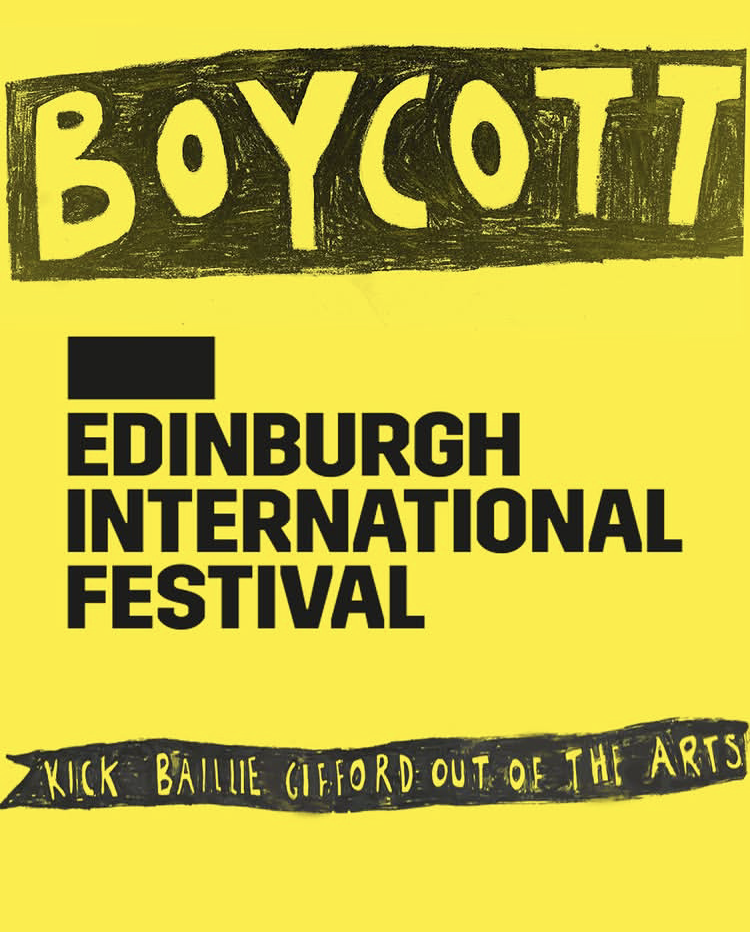
The 2026 EIF programme lists Baillie Gifford as the festival’s main “supporting partner,” alongside its public funders, Edinburgh City Council and Creative Scotland. The threat of a boycott comes two years after the Edinburgh Book Festival ended its partnership with Baillie Gifford.
Art Workers for Palestine Scotland released a statement saying:
“Despite Scotland’s cultural sector seeing widespread refusal of Baillie Gifford funding, including by organisations such as the Edinburgh International Book Festival, Fruitmarket, Collective, and Stills, EIF has refused to meaningfully engage with calls for change. Art Workers for Palestine Scotland repeatedly asked EIF to use its significant cultural influence to enter into direct conversations with Baillie Gifford, a long-term partner, about its investments in companies linked to Israel and the arms trade, and the urgent need for divestment. EIF refused.”
“This refusal has persisted even as over 700 artists, arts workers, and audience members signed an open letter demanding EIF cut ties with Baillie Gifford, including multiple artists programmed for 2025 and many who have performed at EIF over previous years.”
The Truth We Seek
In 2024–25, AW4PS worked closely with artists involved in the festival. Several shared that their EIF contracts contained gagging clauses that restricted artists from publicly criticising EIF or its funders, including Baillie Gifford. These clauses include:
4.1 (l) – The engagement will not contain any element that “may be damaging to the reputation of EIF and/or the Venue(s)”.
8.9 – “Neither party will be derogatory about the other party or do anything which may damage the reputation of the other party including in social media posts by the Visiting Company Personnel.”
16.1 (e) – EIF reserves the right to terminate contracts if any conduct by the company or personnel “materially prejudices or is likely to materially prejudice the reputation of EIFS or the Festival or any of EIFS’ sponsors or supporters.
EIF claimed these clauses were “standard.” Arts Workers for Palestine Scotland reject this claim outright. As artists, producers, and commissioners who sign contracts daily, we know these clauses are not standard practice. They represent an abuse of power designed to silence ethical dissent. These clauses clearly infringe on freedom of expression, especially as they appear to target artists who may wish to make ethical or political statements, particularly those critical of funders like Baillie Gifford, who profit from arms investments linked to the genocide in Gaza.
The hypocrisy is particularly stark given that the theme of last year’s festival was “The Truth We Seek: Artistic Freedom.” EIF has publicly positioned itself as a defender of free expression, yet these contractual terms do the opposite. Meanwhile, Palestinian artists were being asked to perform work about their lives and histories on EIF stages. This is not solidarity, it is weaponisation of Palestinian stories for institutional legitimacy.
At the same time as local community arts organisations in Edinburgh face potential closure due to a £3 million shortfall in council funding, the public posture of the EIF compounds this harm. Grassroots, community-led organisations, many providing essential cultural, youth, and access-focused work, are being pushed to the brink, with cuts threatening the survival of spaces that form the backbone of the city’s cultural life. Against this backdrop, EIF continues to frame itself as financially precarious while receiving more Creative Scotland multi-year funding than any other organisation in Scotland (£11,750,000 spread over three years). While the festival claims to approach political issues with “calm” and “clarity,” it has used the press to disparage and delegitimise Arts Workers for Palestine Scotland and others raising ethical concerns. The result is a stark imbalance: as community arts organisations struggle for survival, one of Scotland’s most well-funded cultural institutions asserts neutrality and restraint in ways that obscure structural inequality and deepen harm within the wider cultural ecosystem.
EIF have a long history of prioritising themselves over the local Edinburgh community: In 2023, Festivals Edinburgh co-signed and submitted evidence opposing aspects of short-term lets regulation, warning of severe economic damage to the city’s festivals and workforce. That intervention relied heavily on inflated economic impact claims, arguing losses of jobs and cultural value, while downplaying the reality that much of the financial “benefit” of short-term lets flows to private landlords rather than local communities. By lobbying to delay or dilute regulation, the letter risked irreparable harm to housing policy reform in a city facing acute housing pressure, disproportionately affecting renters, low-income residents, and those already most vulnerable to displacement, while prioritising festival-led economic narratives over residents’ right to stable, affordable housing. Housing is a human right.
The Edinburgh International Festival continues to benefit from public funding and cultural prestige while remaining financially and structurally intertwined with actors whose wealth has been accumulated through systems that harm Palestinian lives and other oppressed communities.
The embedding of Baillie Gifford and other bad actors within Scotland’s cultural infrastructure must end. This is urgent, not only for moral accountability, but because the continued normalisation of these relationships corrodes the cultural sector as a whole, making genuine ethical practice increasingly impossible for those without institutional power or protection.
Arts Workers for Palestine Scotland are therefore calling on:
- Artists to refuse participation in the Edinburgh International Festival
- Audiences to withhold ticket purchases and engagement
- Cultural institutions and workers to publicly support the boycott
Art cannot be funded by genocide. Cultural prestige does not absolve complicity.
This boycott will remain in place until the Edinburgh International Festival ends its relationship with Baillie Gifford.

We are supported only by our readers. We don't have corporate backers and we don't take advertising, so we rely entirely on your support.
Help to support independent Scottish journalism
Well done organizing this. i do hope it will work
Before calling for boycotts protesters should be offering alternaive sources of sponsorship. I strongly suspect they cannot find many who are totally free of all taint.
Unless one is a pacifist (not many of them in Palestine ) then one has to accept that arms have to be manufactured, and preferably close to home. Edinburgh is the home of important arms companies. Arms bans decisions are made at Westminster not Crewe Toll. A very small amount of Baillie Gifford’s investment is in arms companies, indeed without the EIF connection I doubt if they would be attracting attention. Your pension fund is probably as guilty. The Book Festival has not replaced all the missing sponsorship, £300,000 of Scottish Government money helped cover some community work. They still have Edinburgh University and the Royal Bank of Scotland as sponsors neither entirely free from taint.
An international festival has to be heavily funded, compared with rivals around the world the EIF is not extravagant. The Avignon Festival gets 16-17 million euros of State, Region, Department and City funding making about 55% of the total.
Local arts are a bit like local football teams, they are important but won’t draw the same audiencs as the big names, and the stars from Scotland often move on early in their careers. I love to see international audiences attend Scottish productions but the EUF was also founded to bring the world to Edinburgh and we don’t see the big names year round.
“Before calling for boycotts protesters should be offering alternative sources of sponsorship.”
I don’t think this is true. Many of the critiques of the arts call for a less corporate less expensive structures to these events. Secondly, the argument that Baillie Gifford are the ONLY company that would sponsor these marquee events is just absurd.
“Unless one is a pacifist then one has to accept that arms have to be manufactured, and preferably close to home. Edinburgh is the home of important arms companies.”
What a bizarre argument. It would be good if you could address the reality that these arms manufacturers are involved in arming a genocidal regime?
“Arms bans decisions are made at Westminster not Crewe Toll.”
Well, no, that’s precisely the point of cultural boycotts.
It’s about the Edinburgh International Festival. That involves paying 80-piece professional orchestras. There isn’t a cheapo alternative to paying them, including their accomodation and travel, and squeezing them onto a really big stage.
Brilliant.
Well said! The hypocrisy of EIF is beyond belief. Well done Art Workers for Palestine, and Bella Caledonia for reporting on the situation.
Thanks Leslie!
I’m definitely going now to show my support for Israel
Art Workers for Palestine Scotland re-working of the EIF programme cover, so much better than the inspid meaningless original.
No-one boycotting Baillie Gifford? The Art Wokers Comintern are certainy providing them with a lot of free advertising. No idea what they do, but now I know their name.
Does Baillie Gifford ‘support’ the Edin Book Festival? Does the Book Festival continue? It’s a very long time since I paid for an exorbitant price for an EIF ticket, and won’t be, this year…again. In the past, I did email them to say I wouldn’t buy due to the price range, and no concessions for seniors..so maybe this year I’ll email them regarding my support of this boycott
Hi Selma – not the Book Festival pulled their deal with Baillie Gifford after a wave of complaints about it from writers and the general public. Thanks, Mike