
Glasgow after the Fire: What should we do about Scotland’s First City?
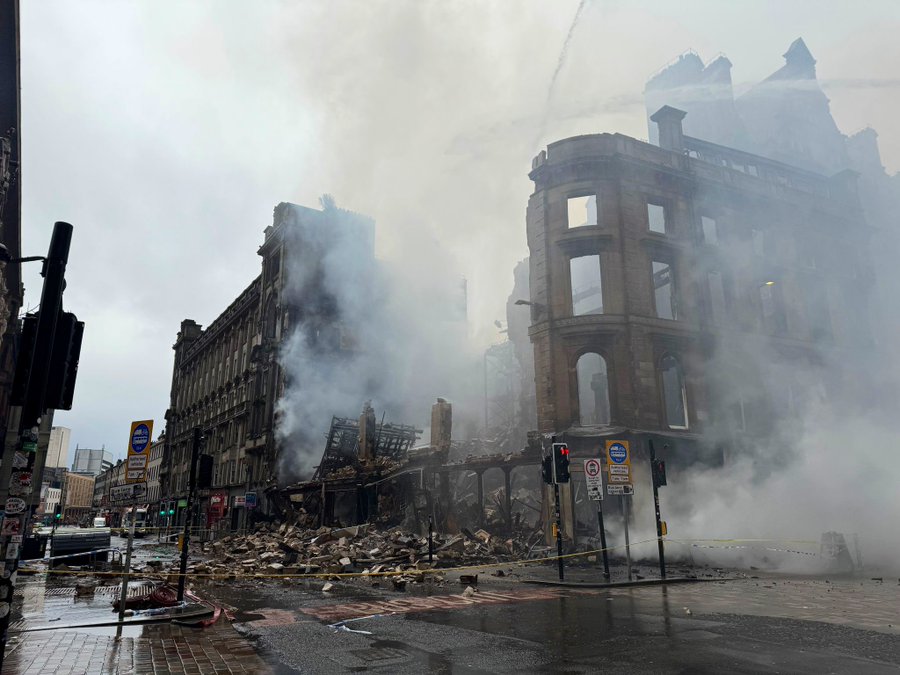
Glasgow has recently been much in the headlines. In the last few days, the Union Corner building by Central Station burnt down, destroying many businesses and an iconic part of the city centre, and on the same day, Celtic and Rangers fans engaged in their ritual loathing and hatred in an Old Firm derby with a pitch invasion at the game’s conclusion.
Both were met by immediate responses and a welter of commentary. In the former, emergency services responded with professionalism and bravery, limiting the damage and helping to save Glasgow Central Station – much loved by Glaswegians and arguably the beating heart of the city. Sadly, the city has a track record of excelling in how it springs into action in the face of such disasters, but these events need to be considered in terms of the bigger picture and the historic roots that shaped them.
The Story of Official Glasgow
Context matters in the above. The ongoing fiscal constraints affecting Glasgow City Council are the product of the atrophying and marginalisation of local government, accelerated by the arrival of the Scottish Parliament. Pre-devolution, the abolition of Strathclyde Region by Michael Forsyth in 1996 hurt Glasgow – taking away the redistributive effect of such a large region and how it aided the city. Add to that, in recent times, the legacy and cost of the equal pay dispute for low-paid women workers which landed the council with a bill of £770 million.
All this is well-kent. But less so are the mostly unintended consequences of 25 years of devolution. Edinburgh has become the political centre of Scotland in a way it was not pre-devolution. Put bluntly, Glasgow has become one of the losers of the devolution era.
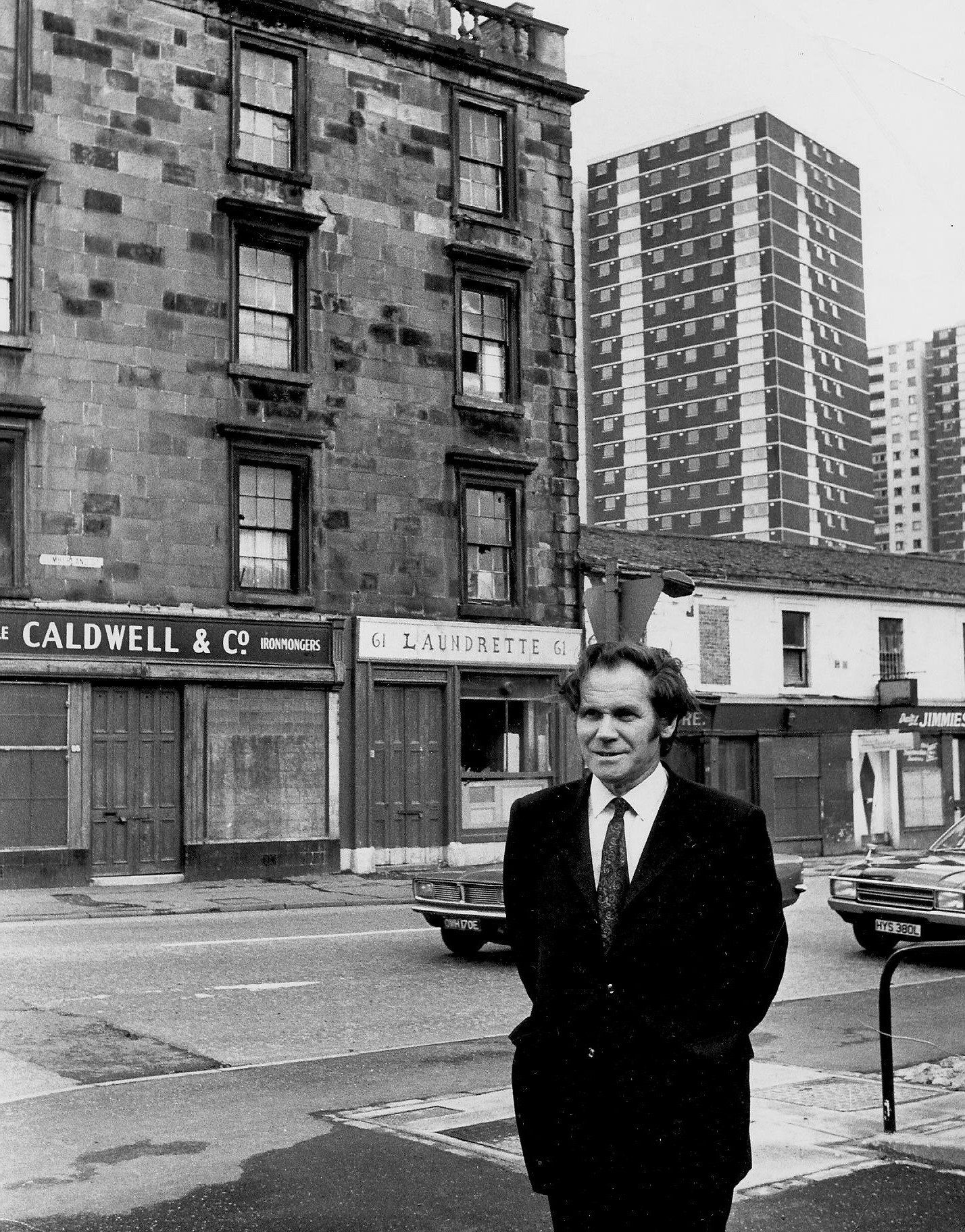
Glasgow City Council pre-devolution had an impressive track record of producing big hitters and leaders with national influence. People such as Michael Kelly, instigator of the ‘Glasgow’s Miles Better’ marketing campaign; Pat Lally and Jean McFadden – all in different ways were successful political operators whatever your opinion on their politics. Strathclyde Region, which existed from 1975-96, produced pioneering Labour leaders such as Geoff Shaw who championed community change and Charlie Gray who in the Thatcher era gave the region a powerful European profile, which contributed to its abolition by the Tories.
Geoff Shaw
Post-devolution, the picture is very different. The abolition of the regional tier removed a layer of local government which could plan and think strategically, while the 32 single-tier authorities have less financial and political muscle. When the Scottish Parliament came along in 1999, it sucked up power and attention, diminished the role of local government and impacted on Glasgow, which has been hit since then by the lack of any Labour or SNP vision for the city when each respectively have been running the council.
The SNP will have been in office in Glasgow for ten years when they come up for election next year. That is a decent time in which to make a judgement on their effectiveness, and over the course it has been a patchy record in difficult circumstances. There have been some achievements, but there has been over-reach – such as when SNP council leader Susan Aitken declared that the council would be renamed ‘Glasgow Government’, which seems to have fallen by the wayside – as well as missteps such as Aitken blaming a ‘rat epidemic’ on the legacy of Thatcherism.
Perhaps the biggest issue of late has been the unwillingness of the SNP city leadership to openly make the case for the city to the Scottish Government. This was particularly acute when Nicola Sturgeon was First Minister and Glasgow MSP. The ground of a Glasgow pitch is obvious: the city is a unique, special case and its success vital to the success of Scotland. This requires a bespoke deal for the city which addresses its financial constraints and its truncated boundaries whereby a straitjacket surrounds the inner core while the wealthy suburbs of the city-region sit outside the city council.
There is a void where there should be vision and championing the city. Why did the SNP have an electoral project for capturing Glasgow at council level and not a commensurate political project to change and transform the city? Detailed plans were made for the SNP to address its ‘Glasgow problem’ electorally but there were no detailed policies that could have potentially turned the city into a model of SNP governance and a showcase for the Nationalist Scotland of the future.
Much of the above politics goes above the head of most of the city’s citizens and is discussed and conducted by tiny insider groups without public knowledge or engagement. In so doing for decades the city’s politics, the way political parties operate and its governance, have contributed to a growing democratic deficit and disconnection in the city: a tragic paradox in a place where so many of its inhabitants feel such pride about where they live.
Glasgow Visions and the Future of Hope
Glasgow and its people are filled with ambition. The Glasgow 2020 project I led nearly 20 years ago involved over 5,000 people – a representative cross-sample of the city. It conveyed the energy, dynamism, and hope of the population, with many of these characteristics most pronounced in women campaigners and community figures who often did not describe themselves as ‘activists’ but lived a life of doing things.
The project drew on the vibrancy and adaptability of the self-organising, self-governing organisations and initiatives in neighbourhoods and areas, some widely known such as Galgael and Govanhill Baths and others that were small-scale, local and less permanent such as numerous DIY and pop-up activities.
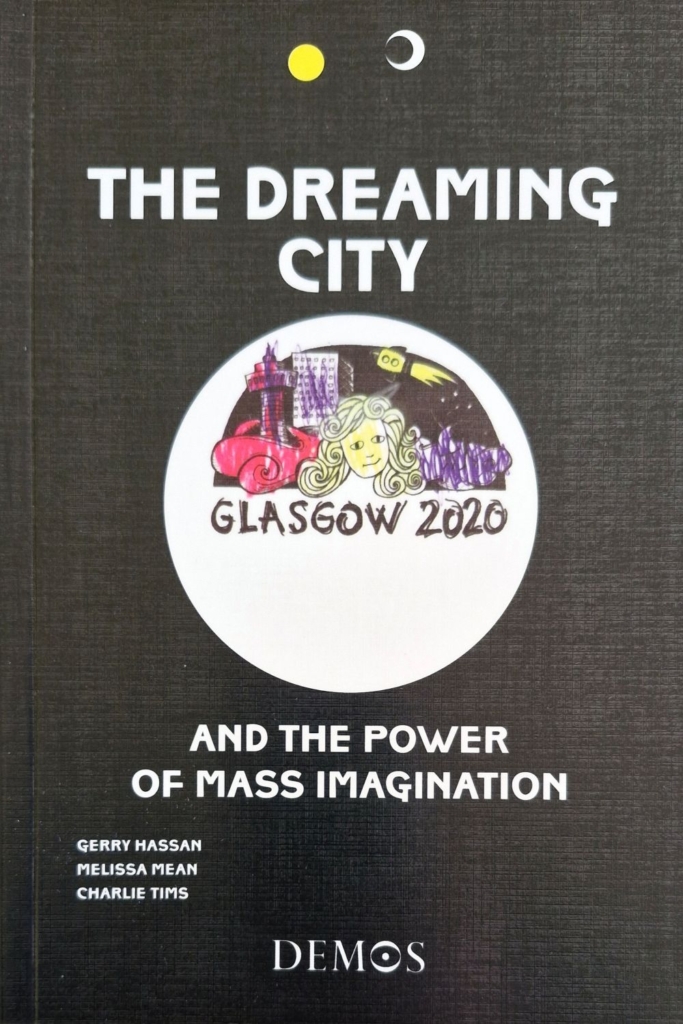
One of the starting points of Glasgow 2020 was challenging the grip of damaging, selective stories. These included the Panglossian stories of optimism told by numerous public bodies that the city needed to be sold, marketed and branded in a certain way; another dwelt on the miserabilist mindset stressing crime, violence, anti-social behaviour, and strengthened learned helplessness and passivity.
The Glasgow project critiqued the official stories of the city – from the council, public bodies and business organisations – seeing these as part of the problematic account of the city which predicated everything on a consumer version of the economy, of Glasgow as a shopping destination, mass tourism, and culture reduced to an instrumental extension of economic policy. Glasgow’s official story was its version of the political and economic orthodoxies of the world pre-banking crash; unfortunately, no new city vision, official or unofficial, has come along since to supplant it.
Glasgow’s Successive Big Bangs and the Cumulative Cost
Glasgow’s current state has been magnified by a culture of top-down, and sometimes brutal, dehumanising change which has entrenched powerlessness and a lack of agency. In the rapid industrialisation and population explosion in the 19th century, the city’s population rose from 77,000 in 1801 to 1.1 million in 1901, making it the fourth biggest city in Europe behind London, Berlin and Paris. This was followed by dramatic depopulation post-1945, followed by deindustrialisation from the 1960s onwards.
Much of the depopulation was planned; the debate a controversial one between different planning visions and ideas of cities, city-regions and the West of Scotland and entailed the two-track policy of ‘growing out’ (overspill, creation of New Towns) and ‘growing up’ (the building of 230 tower blocks many of which have been subsequently demolished). At one point Glasgow had more tower blocks than any city in Europe.
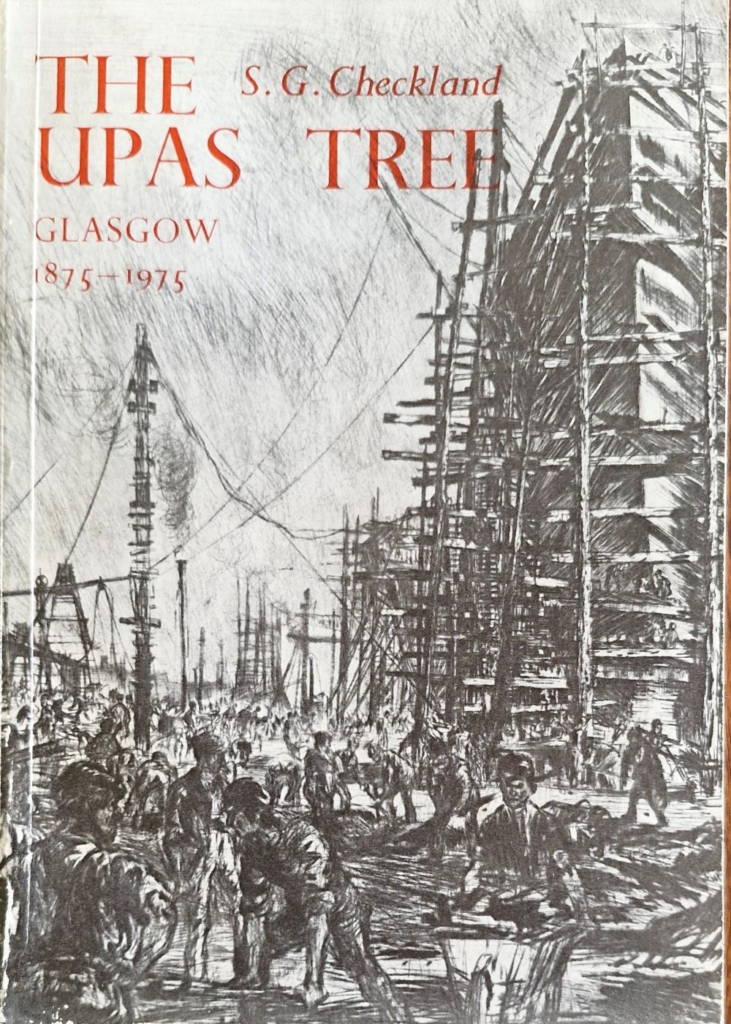
The human cost is laid out in S.G. Checkland’s brilliant account of the dramatic changes the city experienced from 1875 to 1975 in The Upas Tree where he assessed the scale of transformation imposed on people and communities writing:
The bulldozer has been used in Glasgow on working-class areas with a minimum of consultation and almost no resistance. Communities have been disrupted and destroyed by decisions taken from above, bringing great changes in the social fabric of working-class life.
The writer and theologian Alastair McIntosh has talked over the years of ‘the cumulative psychic damage’ done to people and the city and states:
Glasgow is a battered city with a beautiful soul. It’s not just the past, refugees from the Highland Clearances or Irish Famine coming to labour in the industries made possible by a deep river and nearby coalfields. It’s also in modern times, with the tide going out on the British Empire, and those industries never having been replaced and it has been ground low by intergenerational poverty.
Sue Laughlin of the People’s Plan for Glasgow noted about the present day:
The city is financially stretched because of previous decisions on private loans leading to public debt. That said the continued reliance on private developers is distorting the economic, social and cultural life of the city against public interest.
Alan Sinclair has worked to advance early years support for many years, and observed that young children bear a disproportionate price for the city’s failures:
There is a much larger fire, with much bigger consequences than the one in Union Street. One in four children in Glasgow aged between 27 and 30 months are failing to meet at least one out of five child development measures. Child development is cumulative and sequential. Physically – crawl, walk, run – but that same applies to sound and language or as an older child sight and comprehension.
Glasgow’s Built Environment and the Importance of Culture
This is the backdrop which, in recent year,s has seen growing concern about decline, decay and drift in the city, from the well-being and health of its citizens to the fabric and sustainability of its built environment and Victorian legacy. Niall Murphy, head of Glasgow City Heritage Trust reflects on this:
Glasgow’s problem is to do with construction techniques and how these changed and evolved as the city, which was one of key centres of the Industrial Revolution, surfed the technological zeitgeist during its golden age from the start of the 19th century to the outbreak of World War One.
Commenting on the recent Union Corner fire, he notes:
The building which has just been destroyed was traditionally constructed. Therefore, it had a load bearing stone exterior and a timber lined interior as that is how Scottish buildings were traditionally built until Glasgow’s building standards became more sophisticated in the 1890s when municipalisation led to it having some of the strictest building regulations in the world.
Glasgow has also suffered the twin shocks of the Glasgow School of Art fires in 2014 and 2018 which twice destroyed the precious Mackintosh Building with the aftermath of the second closing a host of businesses on Sauchiehall Street. Eight years since the last fire there is no agreed rebuild plan for the Mackintosh Building which is a public indictment of the city and national authorities. Meanwhile, no one has been held accountable for the GSA’s scandalous mismanagement.
Alongside this has been the hollowing out of parts of the city’s once dynamic arts and cultural environment – which had been incorporated in the city’s official story (one version profiling the city’s visual arts as ‘the Glasgow Miracle’). There was the closure of independent pioneers such as The Arches under the Labour council in 2015, with the Centre for Contemporary Arts (CCA) finally shutting its doors in January 2026. Add to this the ongoing closure of the legendary People’s Palace, and the current insecurities affecting the cultural activities within Trongate 103.
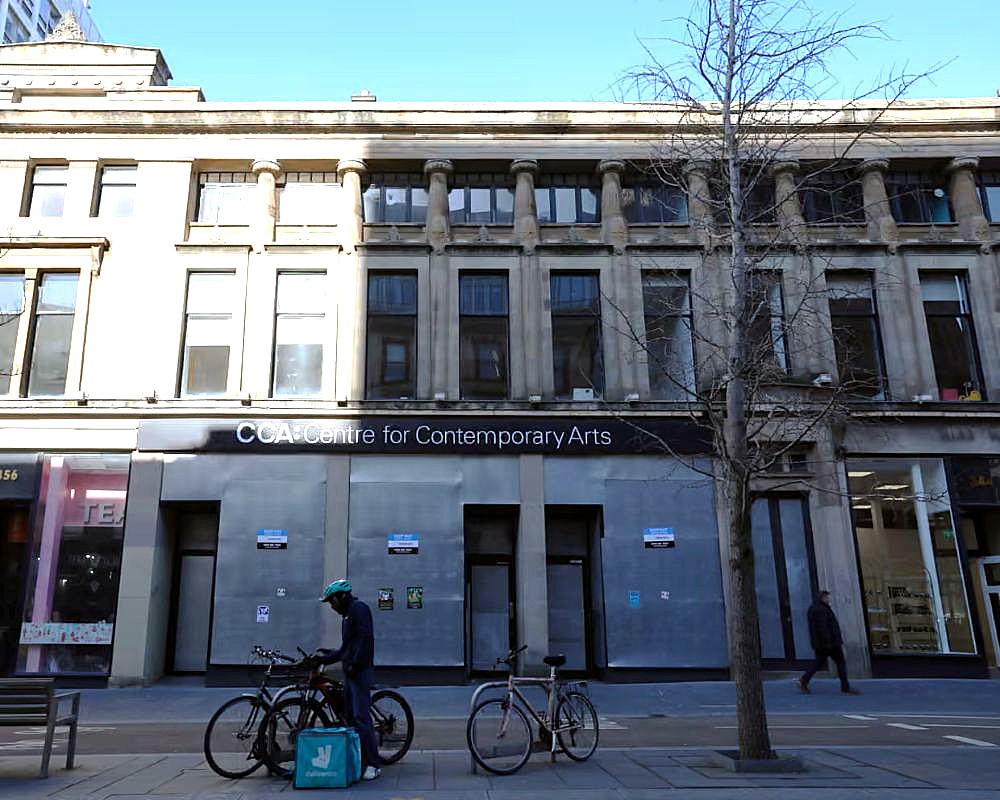
Glasgow still has many innovative artists, creatives and settings but things are getting much harder, reinforced by a cash-strapped council, a national funding formula which benefits Edinburgh over Glasgow (Edinburgh galleries and museums getting direct national funding from the Scottish Government unlike Glasgow), and the perception that Culture minister Angus Robertson prefers funding middle-class well-connected Edinburgh art and culture.
Author Denise Mina describes the emotional condition of the city after Sunday: ‘the sadness is, I think that these buildings – the ABC, art school and the new fire, are not being rebuilt. Private developers turn everything into “student flats” i.e. not for us.’
Mina reflects on the general malaise afflicting large parts of the city:
Walking down Sauchiehall Street is like walking through a carcass because there are so many empty or burned-out buildings. There are years-long projects that feel as if they’ll never be done: the repaving of George Square, cycle routes being carved out. Roads are shut apparently at random with no warning. There are sectarian flags and tags everywhere, by the motorways, on bridges, covering up road signs, and it feels as if we’re all hostage to ball-cupping men.
Glasgow needs radical change. It needs leadership from within – political, cultural, civic and community. And it needs Scottish political leadership and championing from every part of the political spectrum. This will require major structural and fiscal change; taking on vested and entrenched interests; creating winners and losers. This is the path deliberately not taken by the SNP and Scottish Government. Without fundamental, bold change challenging the current status quo Glasgow’s future will continue to be of decline and decay, while public agencies pretend otherwise in showy brochures and official prospectuses.
Glasgow and the Power of Collective Action and Stories
Glasgow is complex, filled with paradoxes and contrasts. It cannot be reduced to a single story or monocultural tale. In its recent past, and parts of the city to this day, there can be found the lessons, spirit and resilience needed for a different future. It can be seen in the self-organisation of the women who organised the successful rent strikes in the early 20th century which changed UK housing law and the community activists who stopped the decimation of the city through bulldozers ripping up once vibrant neighbourhoods in the late 1960s and 1970s.
There were the citizens who said enough is enough when their lives were blighted by gang and knife violence and organised, challenged and massively reduced its prevalence in the early 21st century; and the young wave of activists in the present who want a more sustainable, local, humane city: one with less motorways cutting a swathe through communities. All of these and more offer glimpses of collective agency and assemblies of hope, of people coming together and affecting bottom-up change and a glimpse of the future.
An additional dimension in this is renewing the generous, open, engaged aspect of the city’s civic tradition which even at the height of ‘the Second City of Empire’ was not just an oppressive leviathan. Rather alternative perspectives existed, even at peak Glasgow, such as the Glasgow: Our City publication discussed in schools and evening classes. This was supplemented by the prolific film output of Glasgow Corporation from 1922-74 when short information films were made about public health, housing, culture and the importance of public spaces. They showcased the collective power of people and government and contained besides a seriousness of purpose a sense of joy, liberation and possibility. In today’s cynical, questioning world the tone of such films would jar, but the example of showcasing such local and collective stories in film form is part of the city’s history which should not be forgotten.
Glasgow is unique and this needs to be recognised and cherished. As Denise Mina says:
The city is in transition but gallusness burns off at a low temperature and the civic faith that we’re going anywhere good is exhausted. People are just sad.
There is a cumulative wear and tear on many of the people of Glasgow who have gone through the full gamut of emotions: anger, rage, resignation, and now, sadness and even trauma. Somehow, the emotional connections people feel for the city and its future must be creatively harnessed. But that will not come from traditional party politics, top-down processes or the official story.
A different Glasgow and future exists and yearns to blossom. But the forces of conservatism cling to what they know and have to be challenged. Glasgow holds a special place in the heart not just of its own citizens, but across the city-region, Scotland and the wider world. Difficult questions need to be asked – whose Glasgow is it; what should its values be and how do we define success; and how do we address issues of economy, enterprise, sustainability and supporting the people of the city to live happy and fulfilled lives?
Its current malaise is a warning of the void, lack of vision and absence of ambition, which characterises too much of political and public life in present-day Scotland. Glasgow has risen to major challenges in the past and can do so again. But the current unsatisfactory state of affairs cannot be allowed to go unchallenged with its resultant cost for the people of Glasgow and Scotland and for future generations.

We are supported only by our readers. We don't have corporate backers and we don't take advertising, so we rely entirely on your support.
Help to support independent Scottish journalism
Perhaps there’s an underlying issue: that Scotland is a country of regions that have historic and cultural identities, and instead of cel rating that diversity and coming together through what might unite all, there has been a divisive sense of competition between them and a wish to centralise and dominate. The old Regional Councils were no doubt designed to counter a sense of ‘Scottishness’ by the UK government – a similar approach was tried in Wales – but they couln’t stop the rise of nationalism, and while power devolved to Holyrood was power retained by London, Holyrood could and did draw power to itself from below. So there has been a tremendous centralisation of power, and an assertion by Edinburgh of its status as capital.
The cultural differences between east and west, and also north and south, need to be recognised, accepted and seen as a source of potentioal stregth rather than weakness. When we gain independence from London and I hooe Washington and the international criminals too, it is really important for Scotland to create regional and local structures and decentralise. No more nonsense about Gaelic or Scots or Doric or Shetlandic riadsigns etc.
One thing that Strathclyde did that we can all be grateful for was their refusal to acceot tge orivatistion of Scottish Water. I’d like to see regional authorities with that sort of clout back. But please, not ‘city regions’ that end up depopulating rural areas. In the age of the internet the ‘city’ is surely a concept past its sell-by date. As is the whole idea of commuting from suburbs. City and country both need rethinking for the 21st c. But let that be done by the communities in them. We’ve all had more than enough top-down planning and authoritarianism.
I haven’t “known” Glasgow since I was a medical student – based in the Western Infirmary I qualified in 1970. I last visited when I made my way through the town on a walk from Canterbury to Iona in 2014 ( had been living 30 years in NZ)- I called my walk “Stepping on the Heel of Ghosts”, there was the sort of relationship that I came to feel with my past, and Glasgow was full of ghosts. .My grandfather was a professor of Medicine in that school a long time ago, and my father was born in Glasgow, They lived in a rather nice private terrace house in Sauchiehall St, Somerset Place it was. . I assume Glasgow is still the amazingly interesting and varied place it was during my student days., though they did plough a bloody motorway right through your town, are you going to blow it up yet? There again, I walked from Edinburgh to my alma mata along the Union and the Forth Clyde canals, what an admirable job your city fathers and the Scottish people have done in re-instating this waterway, what a boon.
But goodness too I do remember a whole ward of men, all being treated with gastric feeds of milk and alkalis for their rampant duodenal ulcers, and the surgeons kept busy dealing with DU perforations. I trust the diet and life-style habits might have improved? Cigarettes/alcohol as bad as it was? Or are drugs now the bigger problem?.
Basically, I can’t make any realistic comment on what is going on in the city now or on Mike’s splendid contribution to the debate you’re having, but I do have a very fond and vivid memory of the town, and all I wanted to do really is to wish all of you living there, or anywhere elsewhere in Scotland for that matter, good luck. Glasgow’s problems may be mighty enough, but it seems to me they’re just a tiny microcosm of the existential problems we’re all experiencing world wide, including here in NZ,, in our fascistic neo-liberal and ruinously covetous societies. If you can do better, then perhaps we here can do so too. Not much time left though.
Strathclyde Region was disproportionately large, it seems no one knew where to stop. In contrast Lothian Region did not extend down to the border. As planning areas the Regions were far superior to the current arrangements, especially as the Central Belt gets closer to continuous urbanisation from east to west. but the article in it’s concentration on Glasgow overlooks the other once proud cities that were incorporated Into the Region and often neglected. The suburbs effect exists worldwide and Glasgow has fared better than Liverpool with the flight to Cheshire and North Wales.
The built environment in Glasgow has several advantages over Edinburgh whose councillors always thought small. Glasgow was a true imperial city. The contrast between the Glasgow city owned museums and galleries and Edinburgh’s is instructive. Scottish Government money does go to Kelvingrove but most of the collection belongs to the City. Most of Edinburgh’s small collection came from a single donation.
When rebuilding I suggest the city is as bold today as those who created the 18th and 19th century city. Avoid historical re-creations, they will inevitably be criticised a few generations on for inauthenticity. Whether creating something sympathetic to the other buildings or boldly in contrast to them, avoid mediocrity, grab the attention of the passerby, and build for a century at least.
The West has the MSPs to assert their interests but often lack a common vision of what they aim to achieve. Local Government needs to push back at the Scottish Government but to be successful they need to cooperate especially in procurement. The centralisation of Police and Fire Services highlighted the wastefulness of local decision-making and the potential for dodgy deals.
“The West has the MSPs to assert their interests but often lack a common vision of what they aim to achieve. Local Government needs to push back at the Scottish Government but to be successful they need to cooperate especially in procurement. The centralisation of Police and Fire Services highlighted the wastefulness of local decision-making and the potential for dodgy deals.” Hmm.
The West’s lack of a common vision is a product of centuries of colonialism. There are those who seek protection from the colonial power and offer it their support (Loyalists) and those who oppose the colonial power and suffer mightily for it (everyone else). Unfortunately it is the Loyalists and the so-called ‘small c conservatives’ who have tended to be the more advantageously connected and better off whose ‘entitled’ vision of themselves has dominated political and economic life. That is now fast disappearing, thank goodness, under the attack of the mega corporations who couldn’t care about them ir anyone. In fact the small ponds that the Warmington on Sea shopkeepers and bank managers once swam in have been swallowed up by the flood of modern international organised crime. These days they do as they are told.
Local Government does need to co-operate and they can and have done so – through joint committees and so on. But procurement needs to be local as far as possible. Globalism has completely failed us.
The centralisation of Police and Fire Services has been an utter disaster, especially for those of us in rural areas where the managers and call centre staff have no idea at all about local conditions. Local knowledge and local interaction and local participation are key – and they have all been lost.
We do need a regional tier but the basis of local government needs to be much more local than at present. It is the only way it can be representative. And actually this is our best protection against dodgy deals. Small is beautiful, and knowing who’s who, putting names to faces, it is much easier to hold people to account. Local decision making is not ‘wasteful’ – it is democracy. Centralisation just makes the dodgy deals bigger and more difficult to stop. Our centralised country is run almost entirely for the private profit of American robber barons at public expense. And they seem to be completely above the law. The poor still have no lawyers.
Glasgow was an ‘Imperial’ city indeed, but like all imperial things its magnificence was built on slavery and misery and the Glasgow slums were notorious. If we are to reimagine Glasgow for the 21st c, that is surely the last thing we want to re-create. Maybe keep some treasured landmarks that people relate to, and decide which ones to choose by public debate and consensus. We certainly don’t want to hand it all over to vainglorious architects either to put up monuments to themselves. We have had far too much of that egotistic disastrousness over the last 150 years.
What Glasgow represents above all is paternalistic philanthropic capitalism and the days for that are (I hope) over. William Morris offered us a possible alternative vision in his ‘News from Nowhere’ (1890). Instead of megacities, Marvel comic style, which are (a) fascist (b) polluted (c) dependent of a rural hinterland for everything so completely unsustainable and (d) places to escape from, surrounded by miles of soulless mind-numbing suburbia, we need to open up a network of empowered communities of various sizes, with interconnected circular economies , like an ecosystem. The planet cannot be run centrally like a computer.
You’re absolutely right, John, about the legacy of Colonialism in Scotland…
It’s everywhere, the colonial, top-down, imposition of policy on everyday citizens, like we’re these natives who can’t think for ourselves (when did we vote for Creative Scotland, a Labour idea, or a full blown diversity model designed in the USA for 300 million people?)
In our case, it’s much more acute, because Scotland has never been a republic.
Almost every single European country has at one time or other been a republic…
And the birth of the republic was one of the most exciting, empowering and democratizing times for State institutions and the arts in countries all over Europe, in Portugal, in Spain, and in France, but also Mexico… albeit not all of those republics survived. In France, they are on their Fifth Republic, remember…
But the memory of the republic, that context, the changes in the way things are done in office, not to mention the art movements those arose at the same time as the Republic, are still so important and, even when they failed or were overthrown, had transformed these country and ithe nation’s aesthetics…
There are definitely two things I would build in Glasgow.
One is a slavery museum on the Clyde,
The other is a state-of-the-art modern art museum, like they have all over Europe in big cities…
You need some big and bold ideas and some kind of vision which is so rare in Britain…
You know, they build sh*t like the Millenium Dome… And we’re going the same way with the Disneyfication of Edinburgh
I thought Dundee was the First City in Scotland historically speaking?
A good article, Gerry, I suddenly get it about devolution and how it has been structured benefitting Edinburgh at the expense of Glasgow particularly, something which hadn’t ocurred to me.
You have to add to that, that lots of people in Edinburgh are fed up of its excesses: too expensive, too much traffic, too many tourists, too much in general of everything, especially in the summer…
All I can say is that the arts spend in Scotland as a percentage of GDP is way below the European average, and you have to ask yourself why that is so. I mean, what is the justification for the citizens of Scotland being shortchanged like this? Aren’t we all so pro-European? The SNP on culture have been just awful. Creative Scotland, another problem which never gets addressed.
As a result of that, we have the highest football attendence figures in Europe. I mean, that can’t be a coincidence. I used to think that was great, but now I think it speaks of a country which has never had its culture taken seriously by the people who run Scotland, a few exceptions to the rule notwithstanding… people go to the fitba every Saturday, that’s probably the main weekend cultural activity…
Glasgow’s problems must have a lot to do with that. I’m not talking about just the arts, I’m talking about culture in the widest sense, ceramics workshops, puppet shows, painting classes on every second street corner, dancing and singing groups, specialized shops selling weird stuff you’d never thought existed… these are all things which are subsidized by local government, in Spain at least, so you get neighbourhoods which are buzzing with life and transmit well-being and a sense of community…
There’s nothing like that in Scotland as far as I’m aware, so our highstreets are like deserts wae windaes…
As for the Mac, they’re obviously not going to rebuild it I’d say. They are letting it fade from the memory… And as you say, zero accountability…
Brave man, naming it about the football. I cannot understand why the SNP does not pump more funding into the vernacular culture. I understand the severe fiscal constraints, but if you don’t feed the soul the body dies; the body politic.
Gerry Hassan paints a fairly bleak picture of Glasgow. Yet, if anything, he understates the depth and gravity of Glasgow’s problems.
It is a mistake to think that pre-devolution Glasgow had good – let alone great – leadership. He mentions ‘big hitters’ but omits their achievements. Michael Kelly’s ‘Miles Better’ slogan is the exception. His track record on the board of Celtic FC tells a grim story.
What are Glasgow’s core problems. I would suggest they are, first, economic and, second, political. The economic problem is the failure to create a successful economy to replace the industrial one which collapsed in the early 1980s; nearly half a century ago. This failure is clear in the dereliction of the city centre. Perhaps even more from the huge number of Glaswegians not working and existing on a variety of benefits.
The political failure is that the absence of a vibrant economy is due in part to the political consensus which views entrepreneurialism with suspicion. Glasgow’s political culture has been one which looks to the state – local and national – for solutions. This has been tested to death but remains strong, not least among the activists Gerry Hassan praises.
Glasgow includes a large prosperous area in the much enlarged West End. However, this important section of the population has opted out of local politics, seeing it – with justification – as a grubby business. If this group actively involved itself in local politics it might be Glasgow’s best shot at reviving itself.
Gerry Hassan, as before, writes of the need to take on ‘vested interests’ and creating ‘winners and losers’. Sadly, all the available evidence suggests that the vested interests have the protection of the most important political parties, SNP and Labour.
As far as I understand it, Glasgow was credited with largely transforming its former industrial economy into a service economy fairly successfully…
That was what the Glasgow’s Miles Better campaign was all about surely? (Bitterly criticized by Kelman and others at the time, and no doubt with good reason, as a way of brushing too many problems under the carpet).
I don’t know enough about Glasgow these days, except that when I visit once or twice a year, I feel the same way as Denise Mina, it clearly looks shabby and run down, with Sauchiehall Street in particular a sad version of its former self.
What is Glasgow? A truly vibrant, European city in fabulous natural surroundings which has been neglected for too long by the Scottish Anglo elite, a kind of dumping ground for the dispossessed of voracious 19th century capitalism, that is, Irish immigrants, both protestant and catholics, and the tens of thousands cleared from the Highlands…
After being forced to flee hunger and mass eviction, they were subsequent dumped in housing schemes in the outskirts of Glasgow with no thought for either culture or well-being…
As Piketty says, access to culture is one of the key indexes to measure equality by and in Scotland not nearly enough is being spent at the grassroots level…
And then there are great traditions which are neglected and forgotten. For example, in 1930, Glasgow along with Chicago, was the most cinema going city in the world!! There were 129 cinemas in Glasgow alone back then!!!
Surely there is a legacy to build on there? As there is too with the Glasgow Kino Group, Helen Biggar,, who died tragically young, and Norman McLaren, who was later described by Truffaut as “one of the greatest film-maker in the world” (in “The Films of My Life”).
Film production should be centred on Glasgow, and yet Screen Scotland is based in Edinburgh…
I could go on. Glaswegians are clearly right when pointing to Edinburgh getting preferential.treatment…
The last 2 (at the time of writing) economic comments can’t possibly both be right. It would be interesting to hear much more factual information on this vital issue.
However, the evidence of my own eyes on increasingly infrequent trips to the city where I was born but which I left as Strathclyde folded, just before ‘Miles Better,’ is definitely with ‘fa.’
Two fairly random observations:
At Easter 74, I visited Amsterdam and saw an integrated transport card allowing transfers on buses/ trains within 2 hours. Yet I recall that in July 25, access to the subway was not allowed with my ‘integrated’ ticket.
Does the situation, dating from the demise of Strathclyde I consider, to effectively allow inhabitants of many rich peripheral towns gain access to the city’s infrastructure without any payment in the form of regional taxes still pertain, or did the Blair/ Brown administrations, under Scottish PM’s, in any way rectify this anomaly?
Glasgow is the biggest city economy in Scotland according to wikipedia, though the figure is from 2017. It’s not the powerhouse it once was, but it’s still the city fundamental to the well being of the nation.
You would have expected a national government – which seemed like a pipedream back in the 80s, as did Holyrood itself – to have made it a priority to tackle some of the big national problems like alcohol and drug deaths, the centuries long neglect of Scottish culture, and a life expectancy rate as many as 10 or 15 years off our European neighbours in some of the most deprived parts of Scotland, many of which are to be found in Glasgow… These things are absolutely inter-related in my view.
Yet, I can’t point to a single thing the SNP have done that the Labour Party wouldn’t have done.
The betrayal of the most disadvantaged and vulnerable in our society carries on as before, and arguably in terms of culture, things are significantly worse now than they were in the late eighties…
‘You would have expected a [Scottish] government….. to have made it a priority to tackle some of the big national problems … in some of the most deprived parts of Scotland, many of which are to be found in Glasgow… Yet, I can’t point to a single thing the SNP have done that the Labour Party wouldn’t have done.’
So many issues:
My strongest contrasting memory of the Scottish independence debate and of its near contemperaneous Catalan cousin (the latter more immediate for me) was of the contrast between the roles of Glasgow and of Barcelona. The former consistently starred as the darling city of the EU if not of the whole planet(*). The latter manifested an obvious pariah status; quite simply ignored by all and sundry.
In terms of being ignored, I intended in my previous post to highlight the fact that it is not only the Scottish government which has ignored Glasgow. How many times did Tony Blair, whether in office or not, ever visit the city where his own father grew up?
Mention of Blair inevitably leads to the issue of political parties and democratic structures. Is the current Labour Party, moulded as it is not in any historic economic theory but rather in the image of people like Blair, Mandelson, McSweeney any more deserving of the adjective ‘democratic’ than Meta, JP Morgan, the DDR or the CCP?
Never has the electorate been better informed; never has it been more easily fooled, is my exceedingly sad conclusion.
(*) A double-edged sword obviously, both at the time and, even more so, since then.
The British Labour Party, James Scott, is in my opinion an absolute disgrace…
It is the entity above any other which has betrayed the most disadvantaged and vulernable in our society. It was and still is a thoroughly colonial party of the liberal unionist establishment, which, far from supporting decolonization in the former colonies, resisted it tooth and nail… so that, Blair’s invasion of Irak was absolutely in line with the party’s history. It just as bad as the Tories.
As for Mandelson, it was he and his prodigy Morgan McSweeney of Labour Together – funded by the zionist Trevor Chinn – who picked out Starmer to lead the party, not the other way around, so that all this media nonsense about what Starmer knew about Mandelson / Epstein – everything, or almost everything – is just a smokescreen…
As for the SNP’s absurd culture policy, this is what Jean Renoir, perhaps the greatest film-maker in the history of cinema wrote about finding his voice as a director:
“Naively and laboriously, I did my best to imitate my American teachers (ie, American directors); I had not understood that a Frenchman living in France drinking red wine and eating Brie cheese in front of a grisaille of Paris, could only create works of quality by following the traditions of people like himself… Now I am beginning to be aware of how I must work. I know that I am French and that I must work in an absolutely national sense. I know also that, by doing this, and only by doing this, I can reach the people of other countries and create works of international standing….”
There are artists who needn’t necessarily go through the national to reach the univeral (like Buñuel), but they are few and far between…
Woudn’t it be an idea if Renoir’s reflection were inscribed above the door of Screen Scotland / CS?
If you want an example of Screen Scotland’s misguided film policy, then check out HARVEST, released last autumn and selected, goodness knows how, for the Venice Film Festival (probably for reasons of gender parity).
Directed by the Greek Athina Rachel Tsangari, and adapted from the Jim Crace novel of the same name by Tsangari and the American producer / writer Joslyn Barnes, the film received 500,000 pounds from Screen Scotland.
The novel by Jim Crace, he of the Guardian (a pretty likeable guy I always thought) was longlisted for the Booker Prize, and tells the story of a small English rural village after the Inclosure Act, the Act which, for Marx, was so vital for the primitive accumulation of capital, and which saw England’s peasants dispossessed of all communal land….
But that’s the book. For reasons unknown, Screen Scotland got involved and, presumably for this reason, the film takes place in Scotland. Or at least, the actors are all Scottish and speak in contemporary working class Scots.
Unfortunately, they don’t wear the kind of clothes you would expect in pre capitalist Scotland at all. It’s all just weird.
The whole tenor of the film is a kind of folk horroresque which, if properly situated in Scotland by a good production designer, could possibly work (though not my kind of film) in terms of visuals, though that isn’t the case here because the film-makers literally don’t know where they are.
The dialogues are a bizarre hodgepodge of folkish medieval English speak delivered in contemporary urban Scots… A total disaster.
A film like that – based on a novel in England, flippantly transferred to Scotland without any accomodation – written by a Greek and an American, simply cannot possibly work because it cannot cohere…
I can only point out that the Head of Screen Scotland is English.
She doesn’t know Scotland. She probably thinks it’s more or less like England in so many questions which would be jarring to a native Scot…
The film is a total mess and virtually unwatchable…
500,000 on such a film is an outrage….
Apologies for going off topic…
Andrew’s Sq in Glasgow looks a bit different to it’s Edinburgh equivalent. Housing emergency and an entire square of elegantly uninhabited buildings. Intrigingly post-apocalyptic and ideal for Gotham City. Not nearly as visually threatening as the QETH Deathstar Hospital though, but at least that’s unlikely to busts into flames as it is so damp.
If the the Glasgow 2020 project hadn’t been a cultural whitewash, Glasgow City would hardly have had to start a conversation on Glasgow’s Slavery Legacy in 2019, would it? Oh look, Susan Aitken taking responsibility:
https://glasgow.gov.uk/article/6530/Glasgow-s-Slavery-Legacy
So what conversations between the likes of Graham Campbell, Stephen Mullen and Gerry Hassan happened in public or private? Why did this take so long? Why hasn’t Scotland’s role in Empire been properly addressed yet either? Waiting for it to finally fall?
Many thanks for all the comments and reflections in what is such a rich, layered topic and one which touches on so many issues about power, agency and past, present and future – and different interpretations of it.
On the point of the legacy of Empire and slavery. The long journey of addressing this, coming to terms with it, and uncovering the suppressed histories and voices related to Empire and slavery are core to any interventions on the city which have integrity. This was true of Glasgow 2020 where this was a consistent strand throughout the two year project; this led into other projects and discussions; and in recent times through a host of activities initiated by Glasgow City Council, black history groups, research on Empire and the pathbreaking work of Stephen Mullen, it has evolved.
Glasgow has always been a city of paradoxes and multiple stories; the suppression, exclusion and marginalisation of so many voices and stories has to be recognised, a process of reclamation initiated and the narrow official story challenged. None of this is easy. But in the city’s current crisis there is hope, anger, potential and the possibility of change.
The marginalization of Scottish voices in film, Gerry, is of such scale that it makes my blood boil… I despair, I truly do.
Roughly half of the films shot with money from Screen Scotland over the last 6 or 7 years were done so by directors born outwith Scotland…
It’s hard enough, the film industry in the best of corcumstances, very precarious, very complicated, but when your own government agency is, stacking the deck against native Scottish voices, what chance is there for film in Scotland? And working class voices even more so….
Even when it works, it doesn’t work. Laura Carreiera, the Portuguese director resident in Scotland who shot the very impressive ON FALLING, her debut feature, was nominated for Goya a Award (the Spanish BAFTAS) this year in the category of Best European Film.
What came up beside her name in brackets in the Spanish press and during the award ceremenony a couple of weeks ago?
No, not the word Scotland, but the word Portugal….
There are days I wish I had been born in a normal European country…
I mean, what are the origins of the British State investing in film?
There are dozens of books on the protracted, controversial and ultimately futile attempt by British film-makers to convince the British State to support a vibrant British film industry…
But it started in the 1920’s, when the then Tory government (Stanley Baldwin) expressed concern that Britain was being swamped by US films, and that those films didn’t just tell stories, they expressed a way of life, moral values, and also SOLD things to people unconsciously (for which reason the Americans have always been ruthlessly protective of their worldwide domination of the box office, to the tune of around 80% market share). In short, that films are highly powerful ideological artefcats…
This was the same conclusion reached by countries all over Europe, some earlier than Britain. We must have a presence on the film scene, we must reflect our native culture on film so that our presence in the world isn’t diminished, film is a kind of soft power we simply can’t afford to be without… etc…
Of course, there were also voices hailing film as the great 20th century art form, but those voices were the minority… native film production was and still is a question of national interest almost everywhere in Europe expect the UK and it had little to do with art until at least the 60s..
Britain has always been a bizarre country in that so many of the people who have contributed to British films are foreign, whether Jospeh Losey or Emeric Pressburger or Alexander Korda or, more recently, Merchant Ivory… It has never had a strong native film culture, and Scotland even less so…
But the rationale for the Scottish tax payer putting money into films is that Scotland is represented on the big screen, that our nation becomes visible and that the prestige attached to film festivals like Cannes, Berlin and Venice accrue to the benefit of Scotland through our film-makers’ works being screened there in competitition (films which often don’t do well at the box office more often than not)
This seems to be almost entirely absent in the thinking of the people who have been running film in Scotland for the last 10 years since the strictures of the diversity agenda landed on these shores (and there must be some diversity guidelines, but tailored to Scotland, ie, Gaelic and Scots films, two minority communities, should not be left out as is the case today).
In short, no one is making art films in Scotland, and that can only be because the people who are running Screen Scotland haven’t bothered to read anything about the reasons their jobs even exist…
They’re not meant to score great B.O hits, they are supposed to project an image of Scotland to the world which will benefit the nation…
How on earth a Greek director like Asthina Tsangari shooting a novel by Jim Crace adapated by herself and an American writer / producer fits into this is a mystery… but it’s a mystery that has cost us all 500,000 pounds…
Laura Carreira is a different case altogether. She lives in Scotland and has shot a film about her experience living and working in Scotland… That qualifies for me as a Scottish film, whereas HARVEST does not…
And just think, Gerry, just think, let your imagination run wild in a flight of fancy, what we could have done with that 500,000 sterling they put into HARVEST.
We could have gone out to Easterhouses or Drumchapel or any of Scotland’s deprived communities and tried to make a wee film about the community, either a documentary, or fiction. magine how empowering that would be for people.
Imagine talking to community leaders and setting up through them, and finding some young working class Scots who have an interest in film, either as technicians or actors or directors and writers, or just to observe the process….
That’s the kind of project we should be spending the tiny pot of tax payers money on. Not this metroopolitan bullshit also known as the “international film”…
Whilst I understand the human desire to highlight one’s own past efforts, and whilst I was not only outside Glasgow/Scotland but also outside the UK at the time of its genesis, I have considerable doubts as to whether the ‘Glasgow 2020 project’ mentioned both in the main article and in this reply merit the promince attributed to it.
As I said previously regarding the degree of success which the city has (or hasn’t) had in renewing its economic base after the collapse of many many essential industries such as shipbuilding, steam locomotives, steel making, mining and sewing machine manufacture [not all within the city boundaries obviously] I would be interested to receive factual input as to what real world impact the ‘Glasgow 2020 project’ may have had.
Thanks for your comments James. If we start with an honest assessment no one project or initiative changes a city single-handed.
What can be said of G2020 was that it was a bottom-up project based on futures literacy and people creating their own collective futures unique in Glasgow and beyond. G2020 is an exception in the city as a futures literacy project about popular engagement not institutions. Second, it has been cited around the world over the past 20 years.
What impact did it have? Locally I would not want to overclaim. What it did do was provide community leaders and activists who created change with wider resources and networks to build on what they did. It also provided a series of tools for key institutions in the city beyond their formal mandates including health services, police and council arts and culture. Internationally it is still used as a rare example of a non-institutional version of a city future.
There were numerous lessons and shortcomings in the project; its time-limit nature; the fact it could not address the lack of agency; and that various vested interests clung to the same version of the city. Hope this answers your above points. Glasgow and Scotland need creative conversations and addressing agency, hope and power which moves beyond traditional politics and public life.
Thanks for your comments James. If we start with an honest assessment no one project or initiative changes a city single-handed.
What can be said of G2020 was that it was a bottom-up project based on futures literacy and people creating their own collective futures unique in Glasgow and beyond. G2020 is an exception in the city as a futures literacy project about popular engagement not institutions. Second, it has been cited around the world over the past 20 years.
What impact did it have? Locally I would not want to overclaim. What it did do was provide community leaders and activists who created change with wider resources and networks to build on what they did. It also provided a series of tools for key institutions in the city beyond their formal mandates including health services, police and council arts and culture. Internationally it is still used as a rare example of a non-institutional version of a city future.
There were numerous lessons and shortcomings in the project; its time-limit nature; the fact it could not address the lack of agency; and that various vested interests clung to the same version of the city. Hope this answers your above points. Glasgow and Scotland need creative conversations and addressing agency, hope and power which moves beyond traditional politics and public life.