
When a Community Comes Together: People Power and the Lessons of Kenmure Street
Reviewing and reflecting on Everybody to Kenmure Street
Gerry Hassan
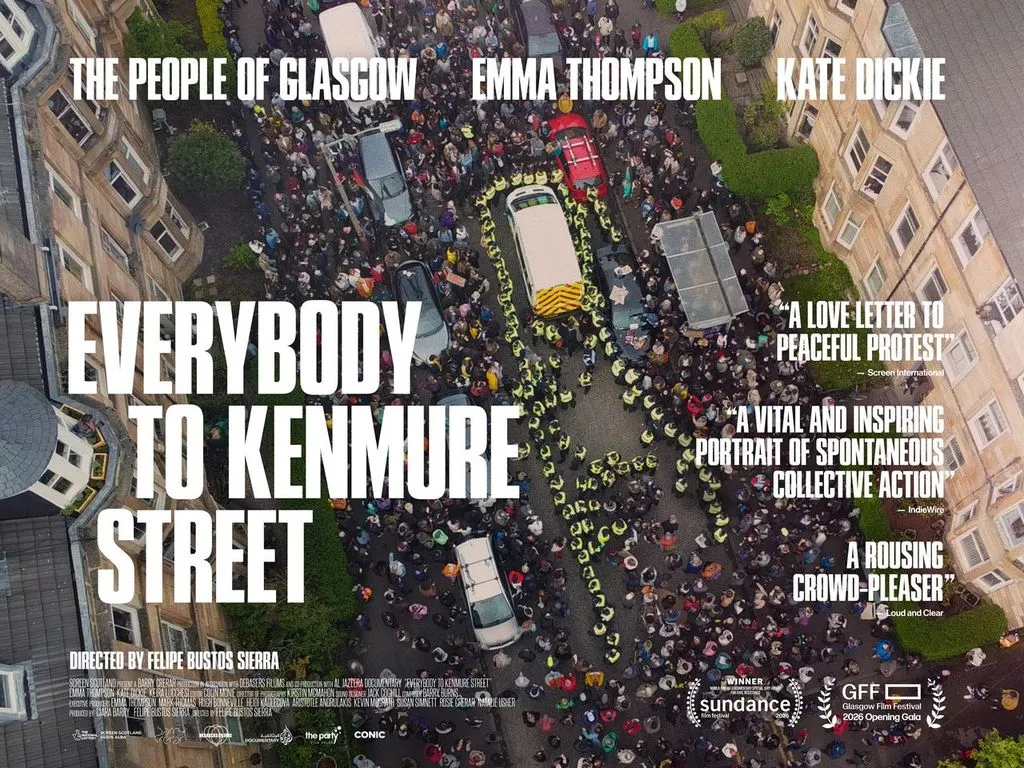
Kenmure Street in Pollokshields on Glasgow’s Southside is a long north-south running street of Victorian era tenements who have witnessed many decades of shifting demographic and population movements.
On 13 May 2021 Kenmure Street not only witnessed but created history, an important moment in the city’s many stories and a precious victory – for a community, against racism and xenophobia, and a notable humiliation for the Home Office and its controversial dawn raids.
This is the context of Everybody to Kenmure Street directed and produced by Felipe Bustos Sierra, Glasgow-based Chilean filmmaker, who previously made Nae Pasaran about the Scottish workers who refused to work on aircraft parts being supplied to the Pinochet dictatorship. The new film is a testimony and document, that celebrates the community togetherness of this day, without ignoring its wider implications. It is an important film, worthy of serious overview, wider dissemination and audiences – with continued relevance five years after the event it portrays. This essay reviews the film while attempting to offer some pointers to those wider lessons and where we are now.
Felipe told me:
With this film, I wanted to connect a few dots. The dots were fragments of footage, echoes of anecdotes witnessed and captured by neighbours and activists to both expose what was happening and urge more people to turn, as well as memories of previous acts of civil disobedience in Scotland.
He expanded on the style, pace and tone of the film:
The scenes with the actors allowed us to slow down time and add a level of intimacy. This combination of urgency and intimacy reminded me of the type of solidarity I’d grown up with, as the son of a Chilean exile, and, I felt, it would create an immersive experience for any audience, tell a story that might stand the test of time and hopefully, bring more people to join future protests.
It takes a Community
Numerous Kenmure Street voices take us through a timeline of that day in May: a community waking up and reacting to the Home Office dawn road on the first day of Eid attempting to snatch and deport two members of the community. Pollokshields is mobilised, aided by the actions of ‘Van Man’ – a still unknown local activist and neighbour who when roused by the actions and noise created by the Home Office personnel managed to squeeze underneath their van, attach himself to it and to stop it from moving out of the area.
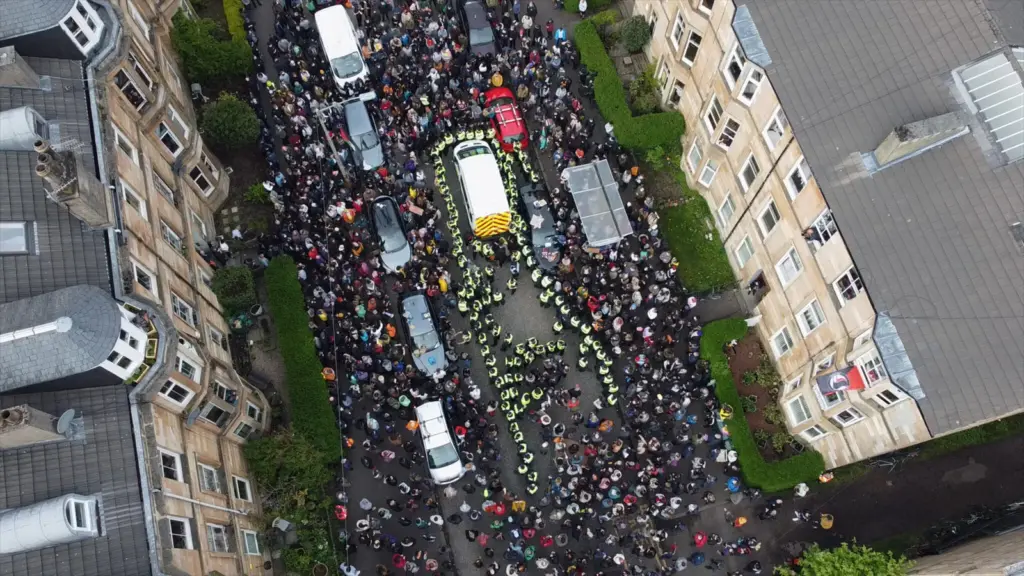
In the film his words are spoken by actress Emma Thompson dramatising his many hours under the van while an off-duty nurse on the scene who offers support is played by Kate Dickie. ‘Van Man’s’ quick thinking and bravery gave people time to get out and surround the Home Office vehicle. It allowed a community of friends and neighbours to be mobilised in that first wave of local activism. Living nearby my own notification that something afoot happened at 10.00am that morning and I arrived at 10.30am, first thinking I would be arriving at a scene which had long since passed only to find the exact opposite.
This was the beginning of a long day and a unique one for Pollokshields and the people who live there, and in adjacent streets. Pollokshields East is home to a whole host of communities and identities who rub along in its narrow streets. It is an immigrant neighbourhood, from Pakistani families to people of Irish descent, Gaelic speaking Scots, Scots, English, Welsh, European migrants and a Jewish community. It has a rich mosaic of young families, artists, creatives and folk engaged in a plethora of community initiatives. Pollokshields, like the nearby Govanhill, is a multi-cultural area and a real, living community of people connected to each other.
The film takes us through the day; the stand-offs; the trapped Home Office van with the words Immigration Detention emblazoned on it declaring its purpose unambiguously; the actions of the police (many dozens of whom arrived in the narrow streets) answerable to Scottish politicians; the role of political leaders in Scotland; and the silence over the day of the UK Government and then Home Secretary Priti Patel as events unfolded and began to fill Scottish and UK-wide media.
Legal representation was provided for the two men who were held in the Home Office van sitting in the middle of Kenmure Street. This came from Aamer Anwar, a celebrated human rights lawyer who has successfully challenged the Scottish establishment and earned a reputation for opposing injustice. Anwar, asked to attend the scene by an Afghan refugee activist, addressed the crowd passionately and then reached agreement with the authorities to release the two men unconditionally. It was a rare victory against racist, xenophobic and stigmatising policies and for people power and the views of the local community.
Glasgow and the ‘legacy’ of Empire
We are taken mid-story through the history of Glasgow, Empire and slavery including the origins of the name of Kenmure Street. Like many streets in the city it has its origins in Empire. Kenmure Street’s name comes from Kenmure House in Bishopbriggs, just outside Glasgow, built in 1806 for Charles Stirling, a partner in the West Indies mercantile firm Stirling, Gordon and Co. using profits from his slave-run plantations.
This particularly powerful section of the film contains testimony from an array of experts and scholars in Glasgow, slavery and Empire. These include Stephen Mullen from Glasgow University who has undertaken pioneering research on slavery’s role in underpinning the wealth of Glasgow’s elites historically, along with Zandra Yeaman of the Hunterian Museum and Art Gallery and writer and educator Saskia McCracken.
All three make powerful observations. Zandra told me about the city, its history and the film:
Glasgow is a city of paradox. Everybody to Kenmure Street captures a defining moment when our modern identity that actively resists racism becomes visible in real time. The community wasn’t just reacting to a single incident, they were expressing a shared humanity grounded in community solidarity. The film works as a counter-narrative, a city once shaped by Empire and racial exploitation now generating grassroots resistance from within. That tension is the point. Glasgow can stand for justice today, but while anti-racism demands moments of defiance it also requires confronting the racial injustice embedded in both its history and its present.
Glasgow’s pivotal role in Empire and slavery is underlined – and its continued relevance. This is brought home by the brutal fact that the UK government paid £20 million compensation to slave owners for the loss of their property – slaves – between 1835-43 which represented a staggering 40% of the UK state’s annual national budget and was only fully paid off in 2015.
State Power, Self-Organisation and Mythologies
The film raises profound questions some local and city-wide, some universal. It addresses issues of power and asks who has power over such controversial subjects, who should have power, and who has power in communities such as Pollokshields? It questions what, in such a context, is the reality of ‘community policing’ when the Home Office suddenly sweeps into an area; what is the role of community leadership, of alliances across the generations and between people from different backgrounds and cultures, and how can a community self-organise and mobilise at short notice?
These are big questions. The film rightly draws from the rich well of mythologies and evocative stories about radical Glasgow. Its opening scenes are a short history of Glasgow and the turbulent changes it has seen: the rise and fall of industry, rebuilding and then clearing of the city through various waves of regeneration, changing patterns of work and life, and the different phases and types of radical protest from rent strikes to community resistance, trade union action, and of course, Upper Clyde Shipbuilders (UCS) work-in in 1971-72.
Local resident and writer Henry Bell told me that the myths and stories of Glasgow can be used to underpin radical action:
One key factor [in the day] was myths. The myths of the Glasgow Girls, of the UCS workers, of Red Clydeside, of the Rent Strike, of the Merrylee housing scandal, of the Polaris eskimos. These are all Glasgow myths about taking and space and holding each other. I hope that Kenmure Street adds to those myths and helps make the next victory real too.
An explicit connection is made between Kenmure Street and UCS and the charismatic leadership of Jimmy Reid whose oratory and politics were pivotal to its success. This is made real by Jimmy’s oldest daughter, Eileen Reid, being present on the day living as she does at the south end of Kenmure Street yards from the Home Office van. She was a witness to the events of the day and filmed much of it from her flat, footage of which is used in the film.
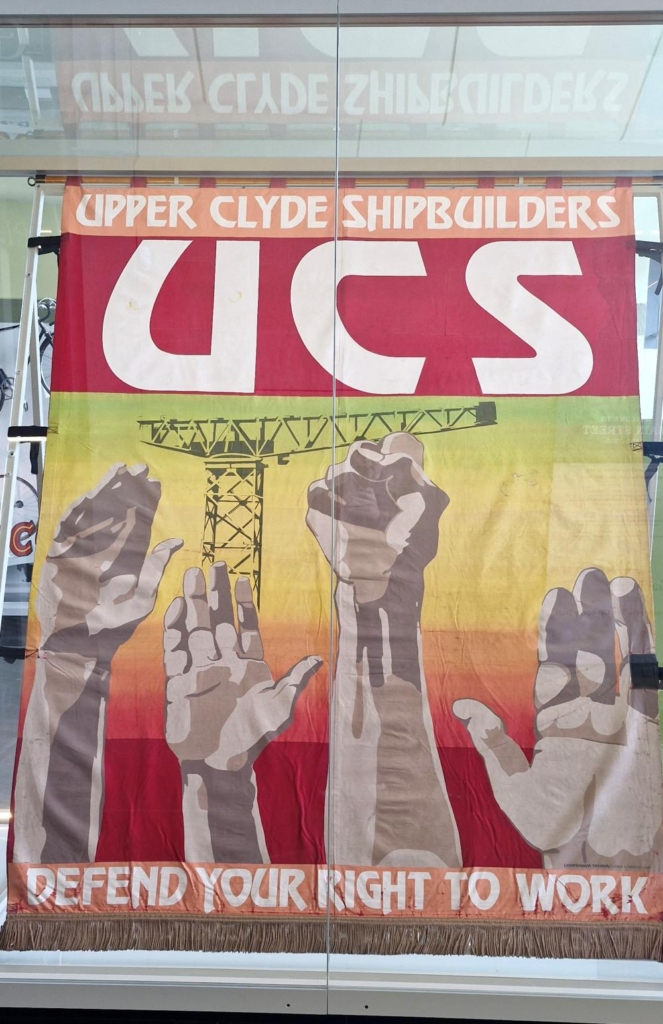
This is a potent strand well-told. Another radical example not fully explored is the community organisation which sprang up against the poll tax in Scotland in 1989-90. This is an antecedent to Kenmure Street, of self-organisation and mobilisation emerging in a political vacuum in communities abandoned by traditional top-down party politics.
This self-organisation and culture of ad hoc, creative resistance draws from a rich, anti-state, localised tradition of Scottish radicalism beyond Labour, SNP and mainstream parties. This was not only seen in the poll tax non-payment campaign and ultimate victory, but the grass roots DIY activism which flourished in the independence referendum, and nearby to Kenmure Street the inspiring campaign to keep open and refurbish Govanhill Baths. This saw police on mounted horses charging protestors in 2001, cited in the film, leading to a twenty-year campaign which has taken over and run the baths as a community-owned resource in another victory for local activists.
Historian and organiser Katherine Mackinnon observed telling me:
Kenmure Street didn’t come out of nowhere, it sits within a lineage of struggles over contested space in the city of Glasgow. I think it was a really astute and important choice by the filmmakers to put in that focus on Glasgow history, because it demonstrates how the events of May 2021 could only happen because of longstanding traditions of organising and direct action in the city.
Henry Bell reflects on this tradition in Pollokshields and Glasgow:
Kenmure Street was the result of so many factors. The hard graft of decades of community organising and migrant solidarity. The brutal lessons of racism on the Southside and how to fight it. The victories of UCS, Kinning Park and Govanhill Baths. The history of lock-ins at Faslane and Brand Street. The mutual aid groups from COVID.
The Kenmure Street protest was supported by many on the day, but was also condemned by a host of right-wingers. Tory MSP Murdo Fraser denounced the actions of protestors as that of ‘a mob’ whilst at the same time as a Rangers fan publicly refused to condemn the actions of a sizeable section of Rangers fans wantonly destroying part of Glasgow city centre to mark their winning of the Scottish Premiership title.
The Relevance of Kenmure Street Today
The events at Kenmure Street took place five years ago. Their impact is even more important today in a world where reactionaries and self-declared populists openly embrace repugnant, racist policies, and as Reform politicians invoke a base ethno-nationalism rooted in a politics of colour and division drawing from the Powellite poison of mass deportations of British citizens on race and ethnicity.
Aamer Anwar makes this explicit telling me:
We no longer have the luxury of waiting: asylum seekers, refugees, the poor are not only demonised but ‘negated’ as human beings. Since 2021 pessimism has been the prevailing mood, but Kenmure Street showed what is possible when we come together.
The Kenmure Street triumph is a clarion call not just for Pollokshields, Glasgow and Scotland, but internationally. It is an example of people power, organisation and mobilisation reaching out beyond the narrow cadre of activists and politicos of many protests. This was a community acting as a community, with friends and neighbours looking out for each other and standing against the brutal face of the British state. It drew together creative activism with DIY signs and banners being made on the day; and produced a plethora of songs and art to commemorate the day and victory – including a painting of the street protest by local artist Craig Smillie.
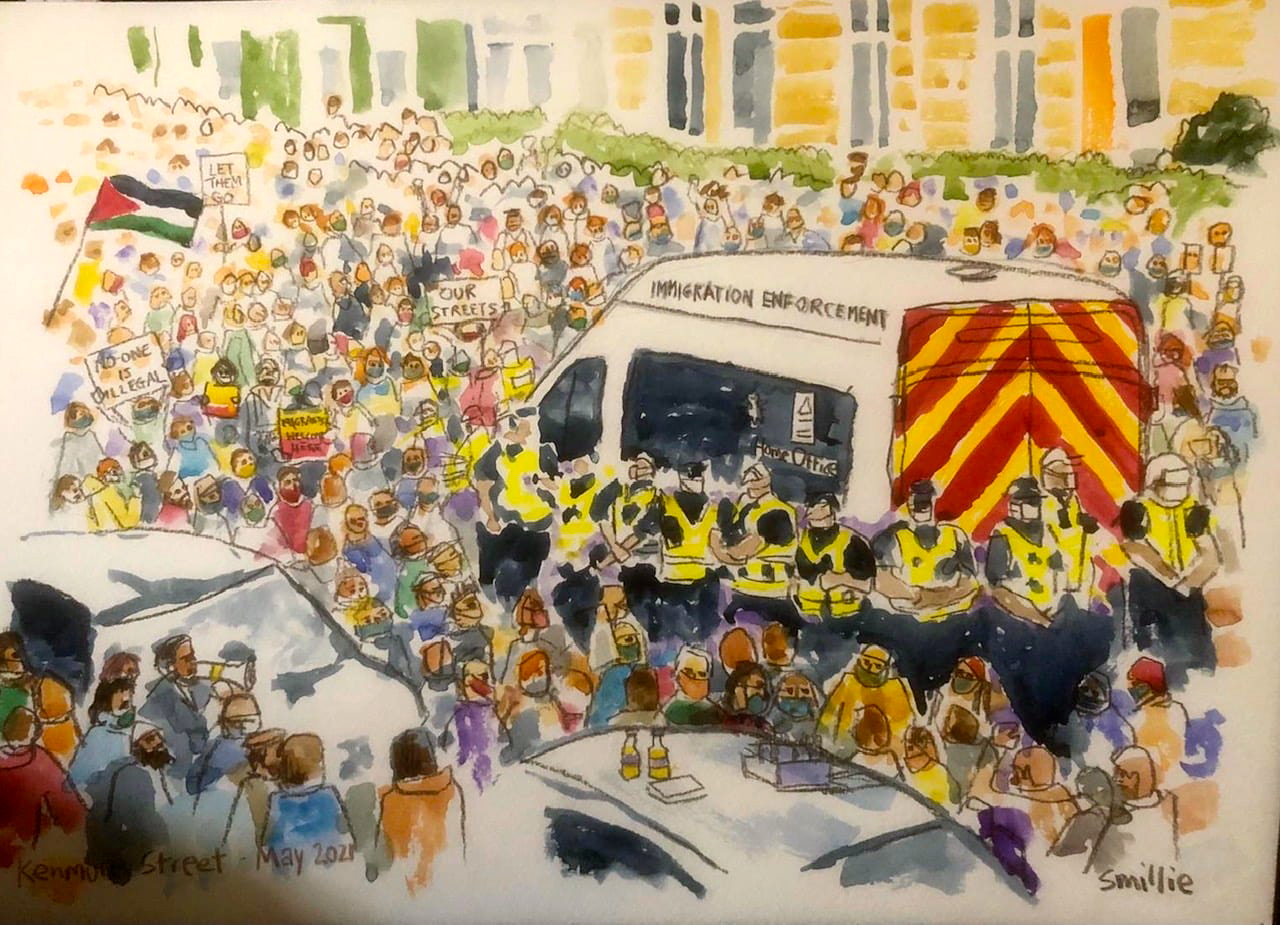
Original painting by Craig Smillie.
Katherine Mackinnon notes the lessons of moments such as Kenmure Street:
Kenmure Street is also important as a reminder to everyone involved in ongoing struggles against fascism, the rise of the far right, in solidarity with the people of Palestine. Although sometimes things feel pointless or doomed to failure, in fact we do not and cannot know the impact of our actions, or the cumulative effects that all these individual efforts to build connections and solidarity might one day have.
She continues drawing on Glasgow’s long-term campaign against the South African consulate in the city:
I think a lot about this comment of lifelong activist Isabella Porte talking about how she didn’t regret all the days standing on the anti-apartheid picket outside the South African consulate in the rain, because “if people ask you, did it dae ony good, I said everything you do makes a difference.” And Kenmure Street is the perfect example of that. It reminds us that the things we do can make a difference.
The Kenmure Street film arrives when the Trump administration is using violence and the power of the US state and Immigration and Customs Enforcement (ICE) to engage in mass detentions lifting people from the street and places of work as well as battering their way into people’s homes. This indiscriminate and deliberate state-sanctioned violence saw the killing of Renee Good and Alex Pretti in Minneapolis, Minnesota, in January 2026: people who were witnesses and non-violent protestors as in Kenmure Street.
Alongside this Kenmure Street throws a light on the meaning and importance of the Scottish dimension and self-government. The attempted Home Office dawn raid happened a mere week after the Scottish Parliament elections in which the SNP had just won an emphatic electoral victory under Nicola Sturgeon’s leadership, who was then the sitting MSP for Glasgow Southside which includes Pollokshields.
Ultimately Everybody to Kenmure Street is a breath of fresh air as a film. It is about a protest which not only won but drew protestors from every walk of life and different backgrounds. No one there on the day expected that it would conclude with an unambiguous defeat for the Home Office and British state, and that makes the emotion and drama of the film even more sweet.
It illustrates people acting on their own initiative against the raw nature of state power and showing how it can be opposed, resisted and defeated. This is a film which is moving, inspirational and full of lessons for all of us now and for the future. We can successfully oppose racists; stand for a joyful, non-violent anti-racism, and defeat the long arm of the Home Office and their reactionary advocates and apologists.
Film Screenings:
At the Edinburgh Filmhouse Everybody to Kenmure Street
At the Odeon: Everybody to Kenmure St. | Showtimes & Tickets
At the Cameo: Everybody to Kenmure St. | Showtimes and Tickets
Or stream online: Everybody to Kenmure Street – stream online

We are supported only by our readers. We don't have corporate backers and we don't take advertising, so we rely entirely on your support.
Help to support independent Scottish journalism
I absolutely loved this film and the events it shows. I can’t help thinking that the only reason the police didn’t wade in as usual was they were not given permission by the Sturgeon Government. If it had been under Westminster heads would have been cracked. I don’t think it’s too much of a stretch to say that the political theatre provided by Police Scotland when arresting Sturgeon and Murrel was their response to the humiliation of not being allowed to run riot in Kenmure St.
I am not in agreement with your speculation regarding Ms Sturgeon and Police Scotland.
The initial action was being carried out by the Home Office, which, usually, deals only with matters in England, because the law in Scotland is different. However, immigration is an issue which is not devolved to Scotland and so in the case of Kenmure St it was the Home Office which was the lead agency. But, when the demonstration began it was the responsibility of Police Scotland to manage it.
That they played a non aggressive roll, I.e. they made no attempts at tactics like ‘kettling’, they did not draw batons, or use tasers. They stood around the van and, apart from ‘Van Man’ there was no aggressive action by the demonstrators. Police and demonstrators simply stood facing each other.
It is the Chief Constable and senior officers who have operational responsibility and it would have been their instructions to the officers on the ground to conduct themselves as they did. They could have deployed reinforcements but they did not.
Contrast that with the actions of the Metropolitan Police facing similar actions in London. It is usually much more ready to use force, in terms of actions like ‘kettling’ and forcing demonstrators back.
There was clearly no physical threat to Home Office officials or to Police Scotland officers. The senior police officers allowed Aamer Anwar to negotiate with the Home Office officers to reach the resolution they did.
It is almost certain that there would have been political discussions between the Home Secretary and the Scottish Government. Not only was Nicola Sturgeon the head of the Scottish Government, she was also the local constituency MSP. She has always been an MSP who is approachable and proactive active in engaging with her constituents. She had a degree of affinity with the people on the street and an understanding of their concerns. She is also a Scottish lawyer who worked for a time with Govan Law Centre, and since the management of the demonstration was governed by Scots Law, I think she was satisfied with the approach Police Scotland was adopting.
The approach was successful in preventing unrest and allowed time for negotiation.
So, it is arguable that Police Scotland managed the situation successfully and deserve credit.
I suspect that Ms Patel and the Conservative Government were angry at the outcome and, probably did bear a grudge as perfidious Albion has done for centuries.
As to the circus surrounding the searching of Ms Sturgeon’s home and the arrest and subsequent charging of her husband, it is difficult to know if the UK Government were the instigators. It is possible that it was a decision made by some senior officers for other reasons. For example someone in the Fiscal’s Office might have alerted the media in advance.
There are many people in senior positions in Scotland who are staunchly unionist – Scotland is fairly evenly divided on the question of independence – and they saw this as an opportunity to harm the cause of independence.
There is a Home Office office in Glasgow. It’s where people go to apply for unlimited leave to remain visas and such. I presume the seats are still chained and bolted to the floor.
I am selling the Forth Rail Bridge. Would you be interested?
If the author of the article chose to live illegally in Pakistan and the authorities deported him would they be accused of anti-white rascism or just upholding their countries law?
You either have the rule of law or mob rule, the author has sided with the mob.
So next time a bunch of drunken Rangers fans go rampaging thru Glasgow centre they should be left alone to express their own ‘unique cultural identity’ otherwise the police could be accused of ‘fascism’.
There’s old John Learmonth throughout history:
Standing nodding along whilst sufferagettes are coshed by the police. Relieved to see peasants jailed, killed or transported for trying to stop their common-grazing lands being stolen. Approving of picket-line strikers having their skulls smashed by mounted police, tutting from behind his newspaper as as he reads about same-sex marriage.
All of them ‘law breakers’ at one time. Back in the good old days.
Wul,
I suspect if ‘law breakers’ took to the streets to advocate policies you didn’t agree with you’d be the first to call for a heavy handed police response.
As I say you either have the rule of law (however imperfect) or you have the rule of the mob. You can’t pick and choose.
We will need to disagree John. I think human life is nuanced, not black and white or simple. Be nice if it was, but it ain’t.
Some laws are unjust, immoral and detrimental to progress. Humans are flawed, and so are some of the laws that we make. I shall continue to pick and choose the laws that I support and those that I don’t.
If you can’t tell the difference between a neighbour’s love and protection for a fellow human being and a pissed football hooligan acting out a triumphalist sectarian fantasy…..nae luck pal.
We will need to disagree John. I think human life is nuanced, not black and white or simple. Be nice if it was, but it ain’t.
Some laws are unjust, immoral and detrimental to progress. Humans are flawed and so are some of the laws that we make. I shall continue to pick and choose the laws that I support and those that I don’t.
If you can’t tell the difference between a neighbour’s love and protection for a fellow human being and a pissed football hooligan acting out a triumphalist sectarian fantasy…..nae luck.
Felipe, unless I am mistaken, is a child of the great Chilean diaspora who fled torture and death after Pinochet’s CIA backed coup against the democratic government of Salvador Allende in 1973, so he is being faithful to his roots with this film, which, let’s not forget it, won a prize at Sundance… No mean feat…
It’s a great connection, the Scotland – Chile link, because both Scotland and Chile are relatively small countries and both are relatively left leaning (notwithstanding the victory of the far right Korch(?) the other day in Chile, son of a former German Nazi)…
But Chile is an amazing land of poets and writers: from Neruda, to Nicanor Parra, from Roberto Bolano to Alejandro Zambra whose novel “Chilean Poet” which I recently read struck me as just the update we needed on the idea of paternity… A terrific novel…
It is a Chilean too who made the greatest documentary ever made in.my opinion: Patricio Guzman’s THE BATTLE FOR CHILE…
Guzman is a spell-binding artist, and I am really looking forward to seeing Felipe’s film. It sounds bri!liiant.
But maybe, after all, there is something happening in Scottish film, thanks to people like Felipe.
If we can get Laura Carreira to stay and make another film, that would be good, and Ben Sharrock’s partner is, I think, a Basque lady, and then Paul Laverty’s wife Iciar Bollain, isn’t just another film director, Iciar in Spain is a major film director, almost a star, she is also an actress who is famous for starring in Victor Erice’s The South, one of the greatest Spanish films ever made.
Most probably nobody knows that in Scotland, Iciar knows film inside out as does Paul of course and she has won all the prizes you can win in Spain. She’s as major a figure as Paul is here.
But we seriously need an entire!y different set up to corporate Screen Scotland. A hub, a centre, where people can drop in for a cup of tea and a biscuit and talk about films, where the ethos is to make small, cheap film with lots of personality…
The other thing we need to do / ought to be done is to bring together the Scottish film canon from when the first Scottish film fund was set up in 1982 – about 50 years later than the rest of Europe – to date.
A Scottish film festival in Scotland screening the back catalogue of Scottish films, films by people like Timothy Neat, with the eventual idea of a DVD issue of Scottish Classics would be an idea…
I, personally, would also build a statue to Bill Forsyth, a true hero and legend and pathfinder, unaccountably forgotten these days…
His contribution to Scottish culture is astonishing…
Anyway, that’s what I am going to try and do when I move back to Scotland, be a figure for Scottish film with my 30 years of experience in the European film industry, during which I did basically anything and everything you can do in Spain on a picture except act..
.(including personally travelling from Madrid to Cinecitta in Rome with 2 suitcases full of the film internegative reels of a Spanish film which the Italian distributor had bought and had to accept the delivery of so we could get paid a million dollars, tho they kept !mee waiting hours…)…
I can’t see Felipe’s film right now, cause I just had a hernia operation here in Madrid and an lying papped out on the couch, with the words of the surgeon still ringing in my ears about quitting the fags…
But I know the Scots are mad for film, and if we can get a family-friendly film agency anything is possible…
It’s possible. It’s doable.
We could really put Scotland on the map for film if they would only free is from the corporate structure and mentality…
Not a family-friendly film agency, as the idiot spell check amended me above, a film friendly film agency…
A screen agency where the execs are really into film. Just think!
Not that I am a film buff compared to the real film buffs, those freaks of nature who watch 4 or 5 per day. I can’t watch more than a film a day, maybe now and again two, but in general, I can’t do it, whereas I could read all day. Don’t ask me why.
Mark Cousins, I tremble at the name. When Mark made “Women Make Films”a feeling of dread descended on me. Oh no, I said to.myself, who are all these directors whose films I haven’t seen and whose names I don’t even know?
Mark, to give him credit, says somewhere that he hadn’t heard of most of them either before embarking on that admirable project…To have Mark in Edinburgh is also a real asset…he’s a legend…
As for The South / El Sur, Victor Erice was suckered by the legendary film producer Elias Querejeta to put together a rough cut of the film to present to Cannes while he was still shooting, before the part in the South of Spain to which the title alludes had been shot, and after screening it, Querejeta declared it to be a masterpiece and shut the production down to Erice’s consternation…
It is a masterpiece, albeit an unfinished one, and Victor Erice still complains about it to this day…But The dance scene, when estranged father and his daughter dance an impromptu tango is one of the great scenes of world cinema… What a film! What a director! And what a producer too!
Actually, it wasn’t a tango they danced to in El Sur, it’s a pasodoble..
.
La, la la,
La la la, la la la!
La la la
La la la la la la!
Terrific.
It’s the south Europeans who should run Europe, not the north Europeans…
The Spanish and the Italians, and the Greeks and the Portuguese…
They’re still alive…
The Scots and the Irish, of course, still have a bit of it…
But Europe was invented in the south of Europe… it’s a south European idea…
The Spanish are amazing people…
Just think of Nunez de Balboa, who having slashed his way through virgin jungle for months on end, finally reached that mountain top in Panama where he became the first European ever to see the Pacific Ocean…
The story of the Conquest of America, there is no other story like it in human history…
Magallanes (Portuguese) the first person ever to sail around the world…
They are just astonishing people… The bravery and spirit of adventure is just incredible….
Nunez de Balboa came to a sticky end, executed by a jealous superior.. Magallanes underestimated some natives in roughly the Philippines and was killed in battle…
But still, his ship.made it back.to Spain…
The famous spice islands had been discovered after all.
What a feat…
Douglas,
You rightly condemn British imperialism but laud Spanish and Portugese for doing the same thing?
Do you know how many indigenous people’s of the Americas died as a direct result of Spanish colonialism, not to mention the transatlantic slave trade set up by both countries prior to the British.
Slavery wasn’t abolished in Brazil until 1880 and far more slaves were transported to South america than the Caribbean or the USA.
Hi John
You’re right about all empires being bad, the Spanish too, but some of the individual stories are astonishing…
So, I’m not really disagreeing with you.
But that human drive to discover and keep advancing is pretty remarkable…Nunez de Balboa for example, with just a few men…
There are no original native peoples left in Santo Domingo or Cuba, the first sites of the Spanish in America, they all died out, mainly from contact with European diseases, but also from slavery, sadness and violence…
It’s a sad story from the native’s point of view, unquestionably…
I love ‘stop people getting arrested for breaking the law’ flash mob identity politics. This achieved nothing for the two Indians involved – they were arrested anyway. They don’t even get a mention in Gerry’s entire article, but of course none of this is about a couple of people with expired visas, and it never was. But the flashmob got on internet and TV. In Indonesia flashmobs are for rent and get paid. Is that the next step?
Factual corrections. The protestors were not a ‘flashmob’; we were friends and neighbours there for the duration of the day until the Home Office backed down. As for the two men detained by the Home Office they were released unconditionally on the day and remained legally in the country after the May protest.
Gerry Hassan quotes Henry Bell as saying; ‘One key factor was myths’ including ‘UCS workers.’ When it comes to Jimmy Reid and the UCS workers, myths need not come into it. The historical record is clear. Given a choice between myths and historical record, relying on the former will not end well.
It was not much of a ‘victory’ – unless a pyrrhic one. It was more of a stay of execution. A decade later much of industrial Scotland collapsed. Vastly more jobs were lost than had been at stake on the Upper Clyde. There is no shipyard in Clydebank where the UCS sit-in started.
Reid himself ended up as a columnist for The Sun and a fierce critic of the NUM during the miners’ strike of the mid 1980s.
Gerry Hassan regards what happened at Kenmure Street as a ‘precious victory.’ I am more skeptical. It was an example of street politics overwhelming the police, for me, a worrying precedent.
A few days before the events at Kenmure Street, there had been an election for the Holyrood Parliament. In the Hamilton, Larkhall and Stonehouse constituency, Reform UK got 58 votes. In the most recent important test of Scottish public opinion, there was a by election in the same seat. This time Reform UK got 7,088 votes. (26% of all votes cast.)
Such a figure was unthinkable in 2021. Gerry Hassan himself wrote that Reform UK could have won that by election.
Reform UK is an essentially English party, whose signature policy is opposition to immigration.
Across Scotland street demonstrations, particularly against the use of local hotels to house asylum seekers, have become routine.
Street politics are mainstream, though not in a way that Gerry Hassan is likely to applaud.
But the history of western civilization is all about how the law must be broken from time to time.
Jesus broke the law of the Sabbath by restoring sight to the blind on that holy day, and then submitted himself to the unjust law of fascist Rome to reveal his doctrine and philosophy which he and his followers believed would save mankind from barbarism through his own davrifice…
No doubt there are cases in which you, Florian, would also agree the law must be broken, say, in Nazi Germany or the British in India?
G Steiner has an excellent essay on the two most important deaths in western culture, that of Jesus and that of Socrates…
The list of freedoms we enjoy today which were won for us by protestors ‘breaking the law’ is a long one. We should remember this.
The Ramblers were a law-breaking, land reform pressure group. Next time you see a group of water-proof-jacket wearing retirees ambling across a field, remember that this is what ‘law breakers’ look like.
A threat to society? A worrying example of ‘street politics’ and ‘flash mobbery’? Just like women who vote eh?
Exactly, Wul, it’s about gradual the birth of the universal human subject, and the end of all these unjust hierarchies which were enshrined in law…such as some men getting the vote back in 1900 but no women… Or colonizers and colonized…
It’s activism which won all those victories…
And the big one still to be won is the victory of ordinary people over unlimited private wealth. What moral law can justify Elon Musk being on the way to becoming a trillionaire while something like 40% of humankind lives on a dollar a day?
No moral law can justify that, but the laws of Britain uphold that injustice…
Almost every Sunday, I try and go to the flea market here in Madrid, the famous Rastro de Madrid…
There’s a wee bar, a tiny bar, you have to squash up all the time as people squeeze by you, run by Jesus and María… a couple in their sixties, covered in Palestina Libre! badges…
It’s an amazing… they play flamenco all day full blast and the vibe is just amazing…
That’s what I love about Spain.
No one judges anyone… No capitalism here…
And Flamenco is the music of the excluded ones, the gypsies, one of the peoples with the most amazing musical talent in all of Europe…
You leave the bar, the bar of Jesus and María and you just feel so happy…
Full blast Flamenco, so you can’t hear yourself speak, for a couple of hours…
It’s what we need…
Y no te quedan lágrimas!
Y no te quedan lágrimas!
Y no te quedan lágrimas
Para ablandar a mi corazón!
Scotland is too serious, we’re far too serious…
I went out to watch the Madrid derby tonight in my local pub, which ended Real Madrid 3 – Atlético 2
Atlético were pretty unlucky to leave the Bearnabeau without a point I thought, they are a great team, but the point is, there were fans from both teams in the pub, in their colours, and there were no problems at all…
There was a bit of ribbing and piss taking, but nothing like tension much less violence…
There was a guy just beside me in the full Atlético strip going on about Futre, their legendary Portuguese player from the 90s…
Madrid won, nothing happened, everyone had a last drink and went home.
How can we not have that in Scotland?
And let’s not kid ourselves, it’s not just Celtic – Rangers, it’s Hibs-Hearts for sure, and probably even Dundee – Dundee Utd…