
A Laird for our Times: Questions of Philanthropy and Community in the Scottish Highlands
My first encounter with Coigach was in May 1977. With a small gang of friends, we rented a single-story cottage on the shore at Reiff for a week. It was raining, the cottage was damp, the open fire smoked and when we drove to the Summer Isles Hotel bar for a drink the front wheel sheared off my friend’s Morris Traveller. The next morning the sun came up and shone gloriously for 6 days. We swam in the Minch, climbed energetically up Stac Pollaidh and Ben Mòr Coigach, pottered on white sand beaches and left with sun tans. We were young. The wheel was repaired. I have returned to Coigach many times over the last 50 years.
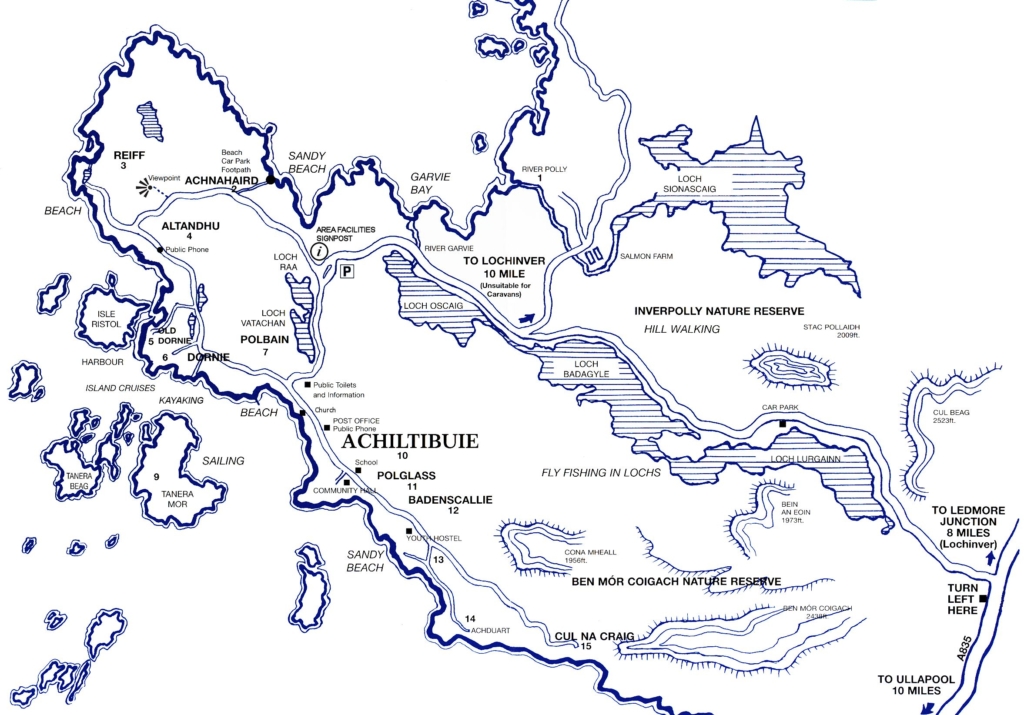
Coigach Peninsula & Summer Isles
Why and how am I writing this?
I am an outsider to Coigach. I do not live or work there, but I love this place, care about it, have friends there and have been endlessly captivated by the warp and weft of its topographical, cultural and human landscapes. This is a curious story about 21st century land acquisition and ownership in the Scottish Highlands, a project led and controlled by one of the world’s wealthiest Hedge Fund managers, Ian Wace. It is also a case study about contemporary philanthropy and the claims and conditions often associated with it. It is an account of how one man bought a Scottish island – Tanera Mòr (hereafter Tanera) – in 2017 without any clear purpose, but who then on the back of extraordinary expenditure, turned it into a retreat for the super-rich and, through the charities he supports, a place of respite for public service workers and members of the armed forces suffering stress and exhaustion. Tanera is the largest island in the Summer Isles archipelago, about a mile off the Coigach coast, but it is still small – 466 acres with its highest point at 407 feet. Later, as the Tanera project unfolded, Wace also bought (through the legal vehicle of Summer Isles Enterprises [SIE]) the Badentarbat estate and a range of properties on the abutting mainland peninsula, Coigach. It is this second phase which has particularly generated disquiet from some of Coigach’s residents. It is a complex and unusual story which so far has largely been told by the press in an uncritical and credulous manner.
Philanthropy and community.
This writing is framed through two lenses – philanthropy and the invocation of ‘community’- as I believe these provide context and nuance to the account which follows. I offer brief observations here, but throughout the text anchor these comments in the material reality I describe.
In his analysis of finance capital, Hedge Funds and Wall Street trading – ‘For Every Winner a Looser’ – in the LRB (26/06/2025) John Lanchester reflects astutely on the importance of philanthropy for the financial billionaire class:
“The problem is that finance is useless. The solution is to try and do something useful with the only thing it produces: the money it makes for the winners … Meaning has to be found in what they subsequently do with the money they have made. For many of them, the most valuable thing they can do with their riches is establish a reputation outside the world of finance which matches the image they have in their own heads. It is for this reason that so many people in finance, after achieving their fortune, become obsessed with wanting to be the thing they know themselves to be: a philosopher king.”
The myriad practices of philanthropy have been the subject of considerable analysis and critique in the fields of anthropology, development and business studies in recent decades. Appraisals of philanthropy might be assembled around the following themes: the dominance of the giver; issues of control, accountability and legitimacy; conditions attached to the giving; the self-aggrandisement of the donor; actual as opposed to asserted or imagined impact; the ethical foundations upon which the philanthropist’s wealth was built; and the more subtle – but no less powerfully insidious – feelings or obligations of indebtedness and being beholden to the source of the gift. Arguably, there is no such thing as a ‘pure gift’ as all such transactions create power relationships between the donor and the recipient. It is the nature of this relationship that increasingly troubles many of the people living in Coigach.
In Keywords, (1988) cultural theorist, Raymond Williams describes community as ‘a warmly persuasive word to describe an existing set of relationships … and that unlike all other terms of social organization (state, nation, society, etc.) it seems never to be used unfavourably’. As many commentators have observed, the problem with the term is that it often masks and disguises as much as it reveals about the extent and nature of (apparently) shared goals, feelings and interests of those who constitute the ‘community’ in question. In short, it is all too often a lazy and unhelpful word which tells us very little about the actual relational dynamics within and between the key players or groupings which make up the claimed community. How ideas of ‘community’ are evoked and experienced in Coigach is a key issue throughout this account.
What follows offers a profile of Wace and the sources of his wealth; a brief overview of the topography and employment patterns across Coigach; a review of his project for Tanera; an account of the purchase of the Badentarbat estate, the Manse and the Summer Isles Hotel; reflections on the 2025 Tanera Impact Report and some concluding thoughts on philanthropy and community.
Whilst I feel I know Coigach well through many encounters down the years, I have no first-hand knowledge or experience of Tanera the island, and any descriptions which follow are based on stories told to me, existing newspaper articles and from SIE publications such as the Impact Report 2025 and the July 2025 newsletter entitled TANERA – News and opportunities from our Communities. I attempt to pose questions about Wace’s projects which have regularly been expressed privately but rarely in a more public arena. Throughout the essay I have drawn upon research undertaken by anthropologist, Roderick Stirrat, and the conversations we have had together in recent years, and with key players in this whole story. Stirrat is currently engaged on a research project entitled ‘Coigach: past and present’ which traces how post Second World War Coigach has been made through its people, its work, its culture and its landscape. For reasons of confidentiality and protection all references to individuals we have spoken with will be anonymised.
Who is Ian Wace?
Ian Wace was born in 1963, but details of his education are hard to discover, or at best, puzzling. One source (https://tradersunion.com/persons/ian-wace/ ) claims that he studied economics at Bristol University, although did not complete his degree. Another (https://wikifinance.info/ian-wace ) that he attended the London School of Economics, where he earned a bachelor’s degree in economics. Between 1984 and 1997 he worked at the Warburg and Deutsche Morgan Grenfell banks, but in 1997 with Paul Marshall set up Marshall Wace Asset Management whose website (https://www.mwam.com/about-us/ ) currently brands itself as ‘a leading provider of alternative investment solutions’ with 700 employees and assets worth ‘$70 billion +’. This is the company which generates the fluctuating but continuing wealth of both men. Apart from London, Marshall Wace has offices in New York, Singapore, Shanghai, Abu Dhabi and Hong Kong. The Sunday Times ‘Rich List’ for 2025, the annual survey of the wealthiest people resident in the United Kingdom, interestingly places both Wace and Marshall at 188th equal in the ranking order, each with a net worth of £850 million. Marshall Wace Asset Management is in the business of Hedge Funds, a form of finance capital management which ‘bets’ on the swings, the highs, the lows and the turmoil of the financial markets. There has been a huge growth in these operations over the last two decades and Hedge Fund outfits stand to make massive profits if shares in the companies they have targeted collapse after using the controversial trading tactic known as short selling. In these situations, Hedge Funds ‘borrow’ shares, sell them and then try to buy them back at a lower price and hence make potentially enormous profits when they return the shares back to the original owner. Essentially, Hedge Fund managers are gamblers, but gamblers whose profits depend on the misfortunes of others. As one example, Marshall Wace was one of the biggest winners in the collapse of Carillion plc. Carillion was a British multinational construction and facilities management services company which went into liquidation in January 2018 after its debt and financial difficulties surfaced in 2015. Reuters reported on 12 July 2018 that ‘Marshall Wace was the biggest winner in one of the most popular recent trades among Hedge Funds, with its bet on Carillion landing it a profit on paper of 19.1 million pounds in just three days’. In short, Hedge Funds are the epitome of neoliberal capitalism.
Almost all of Wace’s projects and acquisitions on Tanera and Coigach are through SIE and there is no evidence of any direct involvement by Marshall in Wace’s Scottish ventures. The detailed and revealing London Review of Books (LRB) profile of Paul Marshall (Vol 6, No 4, 6 March 2025) tells us much about the man’s emergence as an evangelical right wing media tycoon – he owns, for example The Spectator and the news and opinion website, Unherd – and has donated lavishly to right wing causes and institutions over the last 10 years. Whilst there is nothing covert about Marshall’s political alignments, Wace is a more shadowy figure whose ideological positions are less explicit and perhaps harder to discern behind his charitable and philanthropic projects. Both Wace and Marshall have shared a joint role in charitable giving largely through Ark (Absolute Return for Kids), a foundation they established in 2002. Marshall stepped down as chair and trustee of Ark schools in 2024 after his endorsement of homophobic and Islamophobic tweets was revealed in public. Wace, as far as we know, continues to provide substantial support for Ark activities and there is little reason to question his integrity in this regard. However, what Ark has also enabled is his access to celebrities and members of the royal family. Wace gave money to the Remain Brexit campaign, whilst Marshall explicitly supported leaving the EU. Perhaps a cannily strategic bet on both horses for the Wace Marshall partnership. In broader terms, however, Wace’s political allegiances are clear as indicated by his £300,000 contribution to the Tory Party in 2019.
Wace also has a country estate in England and a property on the Caribbean island of Canouan where he has recently made donations to reconstruction after the devastation of Hurricane Beryl. On Canouan he has become very involved in local and political affairs. In terms of his personal domain some significant experiences can be found in the public arena. These appear to have marked and driven his ensuing life and work. In 1994 his first wife and their two children were killed in a car crash. He was driving ahead and saw the calamity in his rear-view mirror. Wace has since defined the accident as ‘the motivating force in his life … But a positive force did emerge in Ark and I’m happy to be part of that’ (The Standard, 10th April 2012). He has subsequently had two further marriages. Wace also ascribes his motivation and charitable activities to an encounter he had with Mother Theresa at an orphanage in Kolkata in the 1990s. In The Scotsman (19/05/24) he recounts how Mother Theresa asked what he had done today before adding ‘that mattered’. He recalled ‘those are the important words. Tanera is built with those two words in mind’.
Very rich men – and most occasionally, women – have long arrived in the Highlands with the rhetoric of improving the lives of the natives, even when, as it often did, this meant banishing them from where they lived and worked to Scotland’s Central Belt or further afield across the Empire. Claims to have ‘improved’ the Highlands are, of course, debatable and contestable. In his introduction to West Highland Survey: An Essay in Human Ecology in 1955 Frank Fraser Darling wrote that: ‘the bald unpalatable fact is that the Highlands and Islands are largely a devastated terrain’. This ‘devastation’, Darling concluded, was the ‘inevitable outcome of bad land use’. The Highlands had first been ‘denuded of their natural forest cover, then subjected to repeated burning, to intensive grazing, to overstocking and to other forms of maltreatment which had drained their soils of fertility and made them increasingly unproductive’.
Wace’s Tanera project and more recently his ventures on Coigach (both through SIE) are suffused with claims and aspirations of ‘improvement’ but diverge significantly from more conventional models of land acquisition in how such ‘improvements’ are imagined, articulated, and in the scale of their ambition and missionary rhetoric. Wace’s story deserves telling because it is not just another narrative of a rich and powerful landlord controlling the lives of those who work for him, or who live on his land, but because of the claims and the philanthropic assertions made to underpin and justify his projects. It has become a story about the disjunction between some of those who are experiencing Wace’s schemes and his aspirations to improve the lives of others.
Where, who and what is Coigach?
Coigach is a rocky peninsula running about 25 miles Northwest of the town of Ullapool in Wester Ross, and 90 or so miles south of Cape Wrath on Scotland’s northern coastline. Most of Coigach’s 40,000 acres are wet peat moor and stony ground punctuated by variously sized freshwater lochs. It is a beautifully bleak landscape but inhospitable to intensive agriculture and almost entirely lacking in trees. The peninsula is flanked to the east and the north by a range of dramatic peaks, the most prominent of these are Stac Pollaidh, Ben Mor Coigach and with the startling Suilven, outwith Coigach but clearly within its sights. Much of the area is relatively flat and only accessed by a 15-mile single-track road leading off the A835, a section of Route North Coast 500, the popular but controversial tourist trail around the far north of Scotland.
Historically, Coigach was under the ownership of the Cromarty Estate until 1957 when the whole area was sold in two lots (with two small exceptions) which subsequently became the separate estates of Badentarbat and Ben Mor. The former covering the outlying northwest of the peninsula and the latter, the southeast. It is important here to remind readers that when we refer to highland estates such as Badentarbat and Ben Mor land usage and legal rights within such assets are hugely different from ‘estates’ in, for example, the Home Counties of Surrey, Kent or Sussex. Nonetheless, as chronicler of Scottish land ownership, Andy Wightman, writes, ‘land is about power’ (https://andywightman.scot/2022/ ). Tanera itself had already been sold in the 19th Century. Coigach’s eight main settlements straddle both estates and lie largely along the southwest coast with Culnacraig at the most easterly point and Reiff at the far northwest. The foremost ‘township’ is Achiltibuie with a shop, fire and petrol stations, , church, manse and the now closed (until 2027) Summer Isles Hotel. Directly adjoining Achiltibuie in Polglass are a community centre and primary school. Further west, a gift and art shop at Polbain, and at Altandhu a campsite, small grocery store and the popular Am Fuaran bar and restaurant.
Like most areas of the Scottish Highlands, and particularly the Western Highlands, the population of Coigach has declined dramatically since the late nineteenth century after the end of the major clearances. Census statistics rarely offer an uncomplicated or complete demographic picture, but between 1921 and 2011 (the last date for available official figures) the overall population of the peninsula had dropped from 605 to 264. Today, the 2011 figure remains roughly the same. Currently 90% (7,900 acres) of the Badentarbat Estate is given over to crofted land and the Register of Crofts claims there are 88 crofting units on the Estate. However, there are less than ten which are ‘active’ agriculturally. Crofting as a means of income generation has steadily declined over the last 100 years. In terms of livestock, a small number of crofters raise sheep on common grazing lands but have other sources of income. There is virtually no arable farming. For many decades crofting seems largely to have had symbolic rather than economic importance, although, the existence of croft lands in Coigach remains complex but crucial in terms of land distribution, usage, rents, inheritance and in determining what can and cannot be permitted on such domains.
In terms of employment distribution on Coigach one might still identify agriculture, fishing and tourism as the main ’industries’, but this tells us little of the shifting and unstable nature of how people actually earn their livings in 2026. Modes of fishing have changed significantly over 100 years. Today fishing employs less than 10 people and the salmon farm off Tanera (not owned by Wace) another 8. Herring fishing has almost completely died out and fishing for crustaceans is now confined largely to langoustines, rather than lobsters. Tourism in the Scottish Highlands has a shape-shifting history which can be traced back to the mid/late nineteenth century when shooting and fishing holidays were popular with the upper classes. In 2026 the ecology of tourism is built around short-term holiday lets, a hostel at Achduart, camping, camper vans, the Summer Isles Hotel (when it reopens in 2027) and a handful of pods and chalets. The hotel – the only one on Coigach – has always been important as a source of local, regional and – until Brexit – European employment. Although it has long been an upmarket destination, but with a restaurant and bar open to the public, it has maintained an iconic locus for hospitality on the peninsula. The future shape and character of the hotel remain of critical concern to all those who live and work on Coigach. In addition to the hotel, the Am Fuaran restaurant and bar in Altandhu is the only other site where tourists or locals can eat out, although a chef employed at the Summer Isles Hotel until its closure in 2024, has recently opened a restaurant in the Old Village Hall in Polglass. Bed and Breakfast facilities have declined significantly here – as they have across the Highlands – to the extent that, at time of writing, there was only one B&B left on Coigach.
For a significant number of people who regard the peninsula as their home, there is a pluralism of part- and full-time employment. Some travel regularly to Ullapool, working, for example, in education or for the council, whilst others have employment in the Scottish Central Belt, returning at weekends, or more sporadically to their Coigach homes. All this makes the Coigach employment demographic a complex one and thus renders any claims about a ‘community’ of interests fragile and questionable indeed.
Wace’s arrival on Tanera.
In 2017 Wace bought the island of Tanera Mor for £1.7m from the Wilder family who had owned the island since 1995. The island was sold to Wace under the title of Summer Isles Enterprises (SIE), a company originally established by the Wilder’s in 2010, and he has kept this title and legal structure for most of his subsequent purchases and other activities. Currently Companies House lists SIE as having three officers – Adam Blaker, Robin Irvine and Rachel Rose – with Wace himself having stood down in January 2023. Blaker is Chief Executive Officer of the SIE and divides his time between Sussex and Tanera.
Tanera had been repeatedly advertised for sale in the Country Life magazine since 2013 with an asking price of £2.5m and apparently Wace had noticed it then but thought little more about it. In The Scotsman 2024 interview it was reported that Tanera was ‘something he had to save’ and later he was quoted as saying:
“I certainly had no interest in buying an island but I sort of felt sorry for it …I believe Tanera will be a catalyst for people to reappraise what is possible if you get yourself into a different mind-set, where you find that calmness, to find restoration in the real meaning of the word and restoration of the soul.”
To help achieve these ambitious aspirations, Wace, according to Harriet Agnew in the Financial Times (16/06/25), has already spent over £100m. Not small change, even for a very wealthy Hedge Fund manager.
If we are to try to understand some of Wace’s motives for buying the island – and later the Badentarbat estate – the whole messianic notion of ‘saving’ the place and its people begins to surface two or three years after the purchase. However, as one of Coigach’s long-time inhabitants wryly remarked to me, ‘I wasn’t aware that we needed saving’. The language of restoration and spiritual renewal is hard to find in the early years of his ownership of Tanera, although at some point Wace remarked that he saw Tanera as a catalyst for reappraisal of what might be possible. However, it is not until 2022 that the articles of SIE were recalibrated and rebranded in the name of philanthropy. Although Wace had long been involved in charitable activities (Ark etc.) it remains uncertain what his motives were for buying the island in 2017, beyond feeling ‘sorry for it’. However, in The Herald (18/07/21), a profile of Wace and Tanera alludes to ‘creating an idyllic retreat for paying guests’ and a plan to ‘restore and regenerate the physical ruins and structure that was inherited when the project started in April 2017. Key to this endeavour is the creation of a vibrant community … creating substantial opportunities for local community regeneration’. It is unclear what kind of ‘community’ Wace imagined and wanted to generate on this tiny island, but it is important to note that he regularly invokes ‘community’ as both aspiration and rationale during the purchase in 2024 of a considerable portion of Coigach, and properties within it. 2022 marks a major shift in both the expressed purpose of Wace’s Tanera project and its formal ownership and governance. By this point in time SIE is owned by the Jagclif Charitable Trust which was established by Ian Wace with himself as chair and four others (including his daughter, Claudia) as trustees. Interestingly, Jagclif has the same postal address as Marshall Wace Asset Management and states that ‘The Trust will donate funds for the benefit of a range of charitable purposes as the trustees see fit’. (https://www.fundraiso.com/en/organisations/the-jagclif-charitable-trust ) The funding – income and expenditure – is opaque. The Charity Commission reports an income for the year ending 30 June 2024 of £22,770,000 with an expenditure of £11,465,602. However, under ‘Charitable activities’ only £1.75m is spent with ‘Other’ at £9.72m. It is difficult, if not impossible, to discover how exactly the £1.75m of ‘Charitable activities’ was used, and, equally, how the £9.72m ‘Other’ was spent. It is clear from these records that Jagclif does not seek charitable donations, and we must assume therefore that almost all its income comes from Wace himself.
How to capture the material and cultural world of Tanera in 2025?
A complex task, because it is difficult to convey the spirit, the mood and the aesthetic of the place which Wace – and his many highly skilled employees – have created there. Not least of these difficulties is that all staff and visitors have had to sign non-disclosure agreements (NDAs), thus preventing or inhibiting the communication of their experiences to the outside world. When asked about the reasons for the NDAs Wace, or his spokespeople, resort to saying ‘Tanera may seem like a mysterious place sometimes, but this is largely to keep the mystique and magic for those who visit’ (Tanera newsletter, July 2025). Between 130 and 150 people have regularly worked on the island at the height of its transformation and at least 30 of these have been from Romania. During this period a small number of craft-based apprenticeships were also offered.
Over 40 ruined or derelict buildings have been artfully restored as living or communal spaces and five kilometres of road over and around the island built. A gushing but incurious eulogy to Wace and his Tanera project was published in the Financial Times (13/06/2025) and whilst this piece by Harriet Agnew – like most journalistic accounts in, for example, The Scotsman and The Mail – reads like a PR press release by the SIE or the Jagclif Trust, it does provide a useful description of the extraordinary scale and ambition of the Tanera project. The quality of the craftsmanship in all the restoration work is beyond dispute, but one is left with a visual impression or sense of a film or theatre set, a Disneyfied fantasy world of Flintstone or Brigadoon cottages (but with underfloor heating). A flavour of Agnew’s panegyric is captured by these lines:
“A stone cottage with a thatched roof sits at the end of a winding path lined with daisies and evening light. Repurposed materials are used to restore homes, including local stone, reclaimed Ballachulish slate and wood from the Union Canal … A freestanding bathtub with brass taps sits beneath a window framed by a patterned curtains in a tiled alcove … creating a colourful patchwork of history.”
Agnew, it is interesting to note, is the Financial Times ‘Asset Manager Editor’ and therefore one might assume well acquainted with Wace’s work in the business of Hedge Funds.
A guiding principle of the reconstruction of Tanera, we are told, is to use both local materials and, from (much) further afield, resources repurposed from other sites and locations. Alongside the carefully reconstructed indigenous ruins, Wace has ‘imported’ an extraordinary patchwork of buildings, furniture, fittings and artefacts from far and wide: a giant World War Two Avro Lancaster aircraft hangar from Cheshire, disassembled and tastefully reconstructed and repurposed as a communal place for eating and other social gatherings; marble from the men’s toilets at the Savoy hotel; freestanding Victorian bathtubs, a commercial cargo ship (the SS Davenham), now a cinema; floorboards salvaged from Churchill’s War Office in Whitehall … and so it goes on. On the landward side of the island, close to cottages, other accommodation and communal spaces (the Mess, for example) there are greenhouses and neatly constructed raised beds for growing vegetables. By the jetty, where people arrive from the mainland, a sauna and tidal plunge pool. Abutting the converted hangar, a well-equipped gym and work-out space. Wace has his own private house at the eastern end of the island, some distance away from the residential cottages and social spaces. Whilst all this may – arguably – be environmentally laudable it perhaps sits uneasily alongside Wace’s claims and aspirations towards authenticity – ‘the project is a model for sympathetic, authentic and ambitious restoration’ (Tanera press release or statement at 31/07/24). There is no doubt that the building and reconstruction work has been undertaken with considerable skill and care, but the whole project raises intriguing questions as to what constitutes ‘authenticity’. One might surmise that the architectural aesthetic is based upon what London based Englishman Wace thinks the Scottish past was like, or how he would have liked the Scottish past to have been.
How to make sense of this?
Wace has stated that he did not apparently buy Tanera in 2017 with the philanthropic purpose and objectives he began to articulate publicly five years later in 2022. At one level the island remains a place for the wealthy, the rich and famous to be invited for short restorative stays. Who these people continues to be a well-kept secret but, of course, rumours abound about celebrities and members of the royal family being spotted boarding the speedboat from the Badentarbat jetty to the island. I return to the publicised charitable aims of the project below, but it needs reiterating that Tanera has been developed as a location to please the business elites and the wealthy of the world. This is made clear by the SIE ‘Operations and Guest Coordination lead’ who, in a Linked In post (June 2024) described the work of the team thus: ‘From wellness retreats and escapes for UHNWIs to offsite gatherings for global finance leaders our team creates space for unique transformative experiences in one of the worlds (sic) most remote and stunning locations’. I had to look up what the acronym UHNWI meant. I read that ‘an ultra-high-net-worth individual (UHNWI) is a person with a net worth of at least $30 million, one of a small but growing segment of the wealthiest individuals globally’ (https://www.investopedia.com/terms/u/ultra-high-net-worth-individuals-uhnwi.asp). ‘Unique transformative experiences’ – there’s a phrase which deserves a bit of unpacking!
Beyond wide-ranging and vague aims around rural regeneration, sustainability and environmental protection, there is a split in Tanera’s function and purpose between offering escapes for UHNWIs and global finance leaders and respite for armed services personnel suffering Post-Traumatic Stress Disorders (PTSD) and for front-line workers in the health and education sectors. Today it is claimed that since 2018 over 1000 individuals have benefitted from such philanthropic invitations, but it is very difficult to discover hard – or even hearsay – evidence about these experiences and who and how some of the guests are invited. Apparently, since 2017, half of those who enjoyed restitution on Tanera have come through the Taigh Mor Foundation, a charity set up to provide mental health support for public service professionals, including predominantly, those already in the armed forces or who have served in them. In particular, Taigh Mor provides places to stay for personnel in need of pre- or post-deployment mental resilience and fitness. That a degree of privacy around how these transactions take place and who benefits from them is understandable given sensitivities and confidentiality around mental health. However, if the figure of about 50% coming through the Taigh Mor route is correct one wonders who the other 50% have been and how they have been invited. At present this aspect of Wace’s philanthropy is opaque with only brief references to these experiences on Tanera in press coverage. Moreover, of course, because all those employed on Tanera have had to sign NDAs there is little public discourse or conversation around what may or may not be happening in this regard. Beyond this, apart from glowing and hugely affirmative comments quoted, for example, in the 2025 Impact Report there is little publicly available evidence of the efficacy of these experiences for those fortunate enough to be invited on to the island to help restore their mental wellbeing and resilience. Given that public money has been spent via, for example, philanthropic tax management (allowances) to Wace and the Jagclif Trust, or in the financing of the Taigh Mor Foundation, one might have hoped to see greater transparency and accountability in these operations. Like many powerful and rich men, Wace attempts to control this public narrative, and has thus far been successful in doing so. The publication, and curiously limited availability of the Tanera Impact Report epitomises how Wace tells his story and I explore this below.
Buying Badentarbat and the ‘gift’ of crofted land.
By the end of 2024, Wace’s operations in Coigach had taken a radical step in a new – and apparently unplanned – direction with the purchase of the Badentarbat Estate and other properties on the mainland. The previous owner of the Estate, Mrs Rex, had expressed her intention to sell and details were already in the hands of an estate agent when Wace through SIE made his successful offer. When a Scottish estate comes on the market it is – in principle – the opportunity for a ‘community buy-out’ (Eigg, Knoydart, Glendale and North Assynt are four cases out of nearly 30), and this possibility had been discussed in some circles over the years on Coigach. With Rex’s intention to sell the estate this could have been the moment to launch a buy-out proposal. However, to assemble detailed plans and finance for a serious community buy-out scheme is a lengthy business, and it also seems clear that there was little groundswell of opinion about the desirability of such a step. However, it appears that the Coigach Community Development Company (CCDC) had embarked on the early stages of the process but had not constructed a robust and detailed enough case when Wace expressed his (urgent) intentions to buy the Estate. With Rex committed to sell and Wace issuing ultimatums and eager to expand his property portfolio on the peninsula, there was little chance that a buy-out proposal could be put together in time.
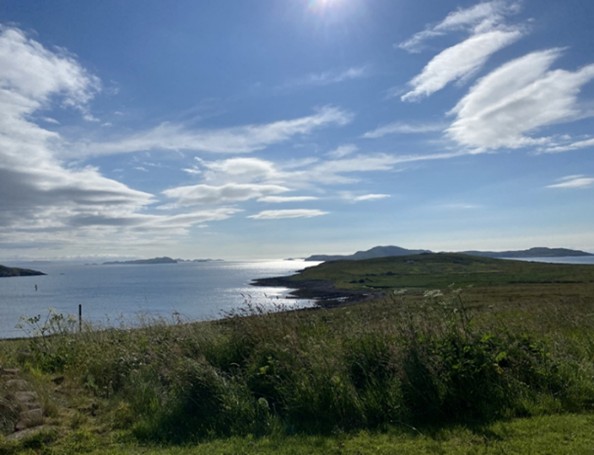
Tanera Mòr behind the Broch at Achiltibuie (Image: Simon Murray)
Wace’s incursions on to the mainland moved his relationship with the inhabitants of Coigach into an altogether more complex and uneasy realm. Here, the power of his wealth, and the decision-making which arises from that authority, have clearly unsettled some inhabitants of Coigach. Some of the peninsula’s residents have worked (and a few continue to do so) on the Tanera project as electricians, joiners, builders, drivers, hauliers, stonemasons, plumbers, cooks and in hospitality. Hitherto, most people living on the Coigach mainland could only (covertly) hear the stories, imagine what was happening across the narrow strip of water towards Tanera and feel any combination of wonder, incredulity, perplexity, scepticism or even dismay and consternation. Now, Wace’s apparently philanthropic aspirations and practices impact socially, culturally, economically and psychologically on the quality and material texture of their daily lives. By 2025 these conditions have given rise to a culture whereby a number of residents feel reticent to speak openly of their concerns regarding Wace’s current and possible future activities on the peninsula.
At the time he was in the process of buying the Badentarbat estate, Wace made a financial offer to the CCDC on the condition that it purchased all the crofted land on the estate. This was trumpeted as a great ’gift to the community’ and I elaborate on this saga below. The CCDC was set up in 2010 and is a (free) membership organisation for those resident in Coigach. On its website (https://coigachcommunity.com/) its mission is stated thus:
“… to work in an open and transparent manner with a view to enabling and delivering projects that support community development, aid population growth and contribute towards making Coigach a great place in which to live and work.”
The CCDC receives income from grants and from green energy production – a 500kW wind turbine and from a profit-share in the 500kW Achvraie Burn hydro-electric scheme. The profits from these two schemes are gift aided to CCDC and this income goes to supporting a number of smaller projects. At the time of writing the wind turbine is out of action and being replaced or repaired. CCDC has hitherto employed part-time staff with different specialist responsibilities but in 2024 appointed a full-time chief executive.
On 27 June 2024, at very short notice, the CCDC called a public meeting during which any ‘resident’ of Coigach could ‘vote’ to consider Wace’s offer and make a collective decision as to whether it should be accepted. Retrospectively – and indeed at the time – this event was to become a crucial marking point with concerns about Wace’s future intentions for Coigach. The meeting was chaired by a ‘neutral’ figure, Topher Dawson, Chair of Loch Broom Community Council from Ullapool, and about 100 people were present. Wace’s representative at the meeting was Adam Blaker, CEO of SIE, who spoke glowingly of his employer as a ‘humble man, an artist, and an innovator who does good things’. Blaker also emphasised that a decision had to be made that night, otherwise Wace was likely to withdraw his offer. From various accounts, many in the hall were uneasy about being pressured so rapidly into such a choice, how the debate was conducted and the rather chaotic manner in which voting was organised. Those who could legitimately vote were asked to make their choices by passing through different doors in the building and hence making their voting choice very visible to friends and neighbours. A large majority voted for the Wace/CCDC proposition but many clearly only did so with a degree of reluctance. The meeting reflected and brought to the surface differing currents of opinion, not simply about Wace and his offer, but about the role of diverse ‘institutions’ on Coigach, how various constituencies of interest viewed their current lives and how these lives might be performed into the future. He is no longer simply creating a rich man’s playground on an island. Beyond these issues the 27 June encounter raised important questions of how the story is told and reported in the press. In the Daily Mail of 31 October 2024, Claire Elliot tells us that ‘The Mail reported earlier this year that he bought the estate to gift it to the community group ‘in an extraordinary act of generosity’. The uncritically gushing tone aside, Elliot is unclear of her facts since the whole estate was not to be given to “the community”, rather that the price of the croft lands – admittedly a sizeable portion of the estate – had been gifted to the CCDC so that it should become its new landlord. It appears that Elliot is uninterested in possible tensions and debates around the ‘gift’, only that it is unproblematically and incontestably ‘an extraordinary act of generosity’.
Wace’s offer to the CCDC was made with considerable fanfare whilst some remained sceptical about his motives and wondered whether this gift might become a ‘poisoned chalice’ for the CCDC. It was emphasized that any change of ownership of crofting land on Badentarbat would not affect the rights of crofters which are governed by the Crofting Commission. In a statement the CCDC maintained that:
If the buyout proceeds, CCDC will be acquiring the ‘landlord’s interest’ in croft land tenanted by crofters. The crofters’ security of tenure, individual crofters’ right to buy, and all the other protections and responsibilities conferred upon crofters by crofting legislation will continue as before.
By the end of October 2024, the legal and contractual protocols of transferring the crofting land to the CCDC were completed. With the crofts dispatched to a new landlord, Wace – through the vehicle of SIE – purchased the remaining 1,100 acres of land not under crofting tenure on Badentarbat Estate, including Badentarbat House, the area around Achnahaird beach and the islands of Eilean a’Char, Eilean Chonaid, Eilean Fada Beag & Eilean a’Ehuic. At this time SIE also bought the Old Manse and the Summer Isles Hotel in Achiltibuie. Before the purchase of the Estate, he had already bought Achnahaird Farmhouse and two other houses on the mainland – Mellon Udrigle in Badenscallie and the old postman’s cottage in Altandhu. These latter to accommodate workers employed on Tanera. Uncertainty exists around how Achnahaird Farm and the Old Manse will function, but rumours suggest that they will become ‘inns’ accommodating paying guests (8 at the farm and 12 in the Manse). However, it remains unclear how these ‘inns’ will configure as sources of hospitality with the reconstructed hotel to be re-opened in 2027. The Manse has already been accommodating some workers from Tanera and here an adjoining building – stone built with the same Tanera architectural and design aesthetic – houses a communal eating and social area, an art gallery and studio space for a practicing artist. It is understood that these three properties will in the future operate commercially with the hope of drawing in tourists who would hitherto have passed by on Route North Coast 500. Whether the Manse and Achnahaird farm will offer dining and bar facilities, or act as a kind of conduit for the hotel when it eventually opens remains uncertain.
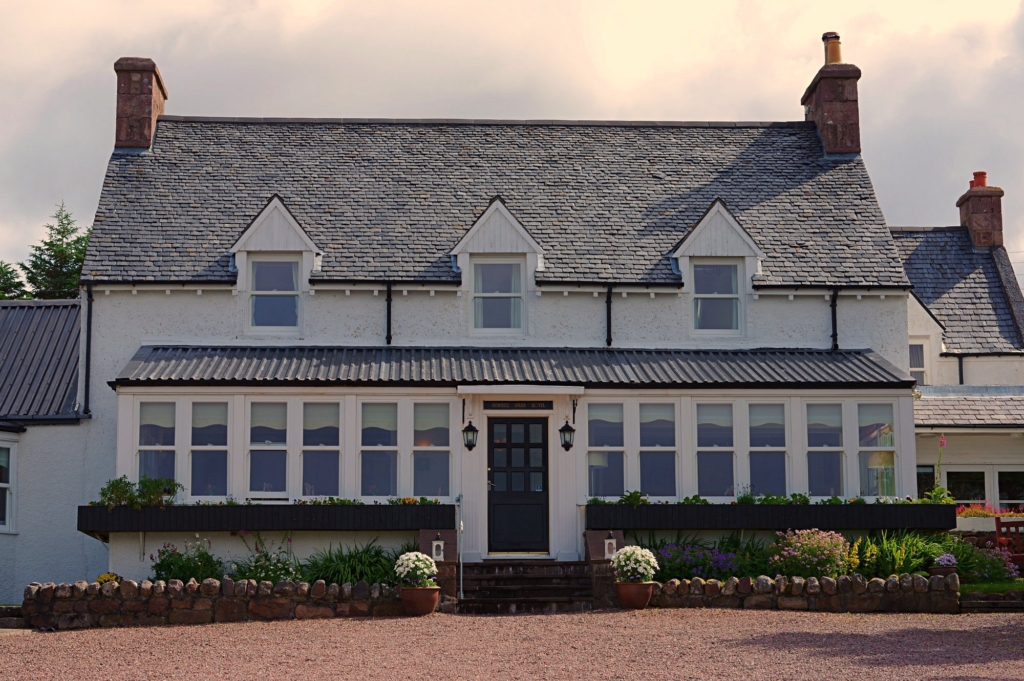
Summer Isles Hotel 2022, photo Simon Murray
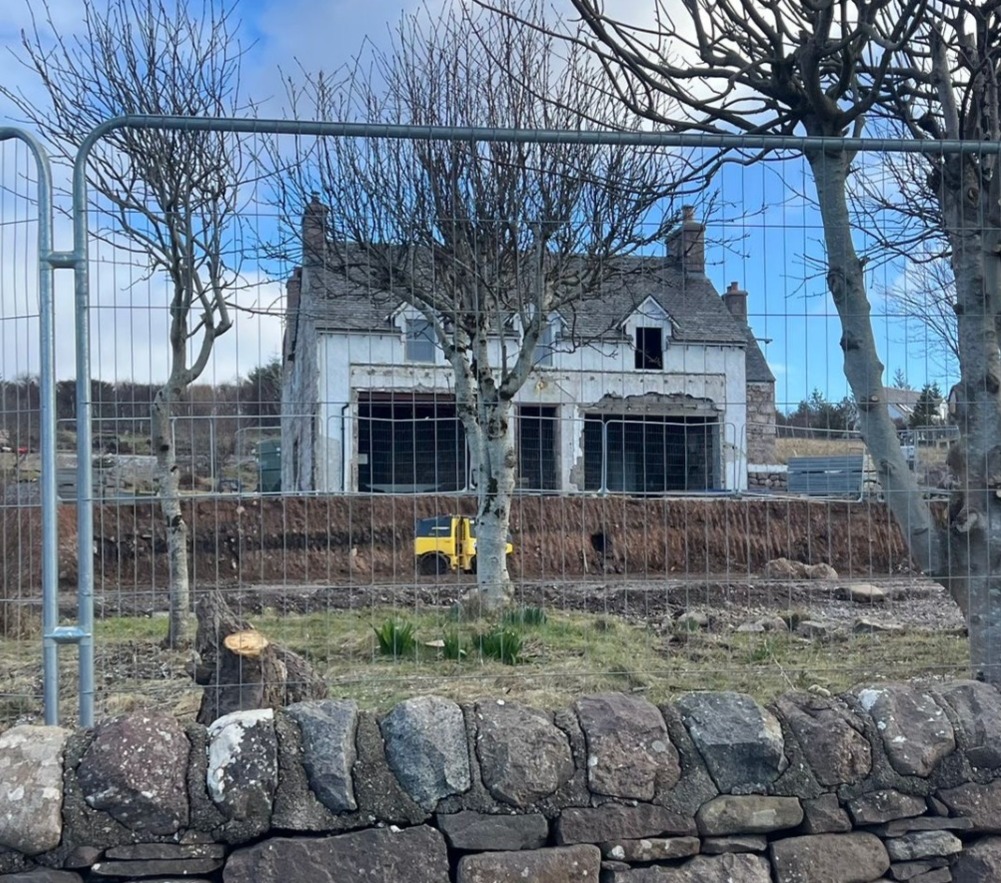
Summer Isles Hotel 2026, photo Simon Murray
One of the key features of this story up to 2025 is that, for better or worse, all these developments, land and property acquisitions and other projects have not been the consequence of a grand ‘master plan’ but, it would seem, the result of a series of impulses or rapid decisions made when opportunities presented themselves. Consultation, or participation, whatever they might mean in practice, have never been part of the vocabulary or intention of Wace and SIE’s endeavours. There’s no pretence about this rather, whether on Tanera or in Coigach, the claim is that these are projects run by people whose rhetoric is around caring for the place and working from the inside. What might constitute ‘caring’ is not up for debate and consultation with Coigach inhabitants has played no part in shaping decisions which will directly affect their future(s). They have not been invited to articulate their priorities in terms of the economic, cultural and social wellbeing of the peninsula. From our conversations, comments like these were not untypical: ‘I am increasingly feeling displaced or unplaced since Wace bought the Badentarbat estate’, ‘I think a lot of us were taken in by him to begin with. He was different when he first came, but he has changed quite a bit and is now showing his true self’. The complexity here is that this control is – at best – nuanced, inflected and complicated by the language of philanthropy and of ‘doing good’. I sense that it is this dimension of how Wace operates which unnerves and irks people the most. The question of control extends beyond the powers that accompany ownership but also to matters around publicity, who tells the story and how that story is told. Those who might be able to ‘tell the story’ from their own experience of actually working on Tanera are forbidden to do so by virtue of having to sign an NDA.
The Tanera Impact Report.
This document is in many ways an impeccable statement which captures how Wace understands his project and the missionary vision he has for the land and the people who are affected by it. Equally, the claims, assertions and the whole ethos of this beautifully produced document speak eloquently to the disquiet which many of Coigach’s inhabitants have for Wace’s philanthropy and ambitions. It is not too fanciful to suggest – an irony and paradox perhaps – that the Impact Report may well have created precisely the opposite effect from the one imagined by his Impact Team when they constructed and wrote the document. Only in the narrowest sense does this publication constitute an ‘impact’ report. Certainly, it tells us what Wace, through SIE and the Jagclif Trust, has done – jobs created, respite for stressed and tired public service workers, land and properties bought, buildings rebuilt or converted and donations or support in kind to groups and organisations on Coigach – but it does not investigate or record any sense of a deeper impact on the lives and feelings of those on the receiving end of all these activities. The only exceptions here are a page of glowing statements from some of those in the public services who spent recuperative time on Tanera through the Taigh Mor Foundation, and a summary ‘Quantitive Impact Measurement’ which suggests that the wellbeing scores of these guests rose on average by 46%. Honest and robust impact reports have several qualities: i/ identification and recording of a range of voices from those on the receiving end of any particular project; ii/ consideration of unintended consequences of the actions and behaviours of the main protagonists; iii/ quantification and evaluation of the changes which have been ushered in though the developments in question; and iv/ critical reflection on the original aims of the work carried out and whether these have been fulfilled or not. Sadly, the Tanera Impact Report achieves few of these conditions, rather is replete with self-affirmatory claims, declarations and aspirations expressed in an unsettling blend of corporate (‘maximising catalytic potential’, ‘enabler of connections’, ‘cascading impact’, ‘catalytic philanthropic investment’, ‘multi stakeholder collaborations’, ‘transformative outcomes’) and new age (‘immersive experiences’, ‘holistic interplay’, ‘sustainability as a pillar of wholeness’) jargon.
The Report runs to 172 pages, is stylishly produced and lavish with carefully framed images depicting an impression of life on Tanera. Short paragraphs describe both the welter of activities and buildings on the island and burgeoning deeds and plans on the mainland itself. Punctuating these accounts are images, flow charts and mind maps. In a curious way it reads and often looks like an annual corporate report to shareholders, but without any hard financial information. Wace’s aspirational spirit and goals are habitually articulated with terms like sustainability, stakeholders, wholeness, community life, shared purpose, restoration, self-discovery, care and wellbeing all making claims for themselves across this substantial publication. Towards the end of the Report, Wace’s activities on the mainland are signposted and what is significant here is that these are framed as the ‘Tanera project’. The acquisition of the Achnahaird farm (with its 1022 acres), the Old Manse and the Summer Isles Hotel, for example, are absolutely seen as an extension of the ‘Tanera project’. The virtues (or otherwise) of the culture and spirit of Tanera are exactly those to be infused and nurtured on the mainland and into its inhabitants.
The question of control extends beyond the powers that accompany ownership but also to matters around publicity, who tells the story and how that story is told. Those who might be able to ‘tell the story’ from their own experience of working on Tanera are forbidden to do so by virtue of having to sign an NDA. It is significant here that in both the Tanera Impact Report and a publicity pamphlet entitled ‘Tanera – News and opportunities from our Communities’ (July 2025), Tanera has now ‘exceeded’ the geographical boundaries of the island and become a collective term for Wace’s ambitions and practices on the Coigach mainland. But it is now more than just a noun, more a kind of conceptual or cultural construct which – to Wace at least – tries to capture the spirit and the practice of his philanthropy. In a Scotsman article by Alison Campsie (19/05/2024) Wace is quoted thus: ‘Tanera the verb is a work in progress, but I do believe you can say “that is not very Tanera” or “we Tanera’d it”’. It remains to be seen and experienced how, for example, the farm, the manse and the hotel (when it reopens) have been ‘Tanera’d’. Are Wace’s Badentarbat and Coigach projects an extension and redefinition of Tanera?
It seems that Wace believes he is engendering ‘community’ with his determined (though often changing) plans and projects, whilst the inhabitants of Coigach may use ‘community’ to describe fluctuating, overlapping and often unstable identities and allegiances in different contexts across the peninsula. What seems clear is that to ascribe ‘community’ to the whole of that geographical space called ‘Coigach’ – its land, its multifaceted relationships and its people – in an uncomplicated way is to oversimplify the warp and weft of how people feel and live their lives. In this respect at least, Coigach and Tanera are little different from any other gathering of people whose lives are at least partially circumscribed by geography. As in so many usages of the term, Wace’s treatment is unreflective and shapeshifting. Sometimes Tanera the island and all that happens there is invoked as a community; sometimes – as we have noted above – Tanera the community is extended beyond the island to embrace the whole of Coigach and all those who live and work there. When the offer of croft lands to the CCDC was being debated, it was regularly described by supporters of Wace at the meeting – and later in the press – as a ‘gift to the community’. Leaving aside who and what community might mean in these circumstances, it is an inaccurate statement since the proposition was to the CCDC which – regardless of its virtues – has no constitutional remit to represent the ‘community’ of Coigach. Indeed, less than 50% of the population belong to the CCDC. These observations are not to suggest that Coigach is riven with factionalism and warring tribes, rather that there are a variety of often differing and conflicting views about Wace and the future that he promises. Some, especially those connected to the CCDC, are very affirmatory and supportive. Others are questioning, uncertain, worried and a few, hostile to the man and his projects. Moreover, beyond the porosity and elasticity of the actual practice of community, Wace’s missionary invocation of the term provokes serious and intriguing questions as to whether the experience of community can be imposed or constructed from the outside, by a wealthy individual who believes that he knows what a state of ‘community’ looks and feels like.
So, how much does this all matter?
Is it a story worth telling, or merely an eccentric spasm in the history of land ownership, power and control in the Scottish Highlands? In some ways it is straightforwardly another case study of Scottish lairdism, but in others it makes for a compelling 21st century case study. A study of the contradictions between philanthropic ideals and practices and the actual experiences and feelings of those on the receiving end of apparently benevolent intentions. A study of control and power – both ‘soft’ and ‘hard’ – and the disempowerment, and precarity that comes with such relationships. A study, too, of how contemporary cultural mantras of care, wellbeing, healing, restitution, spirituality and holism provide a cover for unchallenged actions and behaviours. A kind of human ‘rewilding’ with all the contradictions and duplicities that often accompany such projects. This is not to say that for Wace these are merely cynical games in the exercise of supremacy, or that any of these aspirations are ignoble or wicked in their own right; rather it is to question how these relate to, how they function within an overall framework of unequal power and great wealth. More materially, this account attempts to identify, describe and understand the disquiet and sometimes anger expressed quietly and amongst residents living on the mainland. The issue is a complicated one since many people acknowledge that Wace has brought relatively well-paid employment to the area, has enabled very high quality craftsmanship to be learned and practised in all the restoration and building work and that the respite and recuperation he offers to military and public service workers on the island are praiseworthy and well-received. Today, and as the months roll by, my sources suggest that increasing numbers of Coigach residents are learning – reluctantly or otherwise – to live with Wace. They are ‘getting on with their lives’ and it is not as if the control exercised by a laird is new to them. However, where apprehension and anxiety remain, these are both existential and material. Existential, in a sense of powerlessness embedded in the more nebulous and uneasy sense of beholdenness and dependency – both economically and in more nuanced and complex ways – of lives determined by force fields outwith their control. At a material and practical level, for example, the future direction and functioning of the three pillars of hospitality – the Manse, Achnahaird Farm and the hotel – remain uncertain and of considerable concern. Apart from the employment opportunities these may offer for people living locally they are central to Coigach’s tourist industry and its ability to attract and look after visitors. It is not too fanciful to suggest that over the next five years or more, most employment in Coigach will be in the hands of Wace and SIE. The Impact Report identifies the many ways in which Tanera is forging a network of relationships in and beyond the peninsula. The July newsletter lists a range of ‘upcoming impact events’, listings, news items, projects and educational visits. Some of these are directly organised by Tanera, whilst others have received financial or in-kind support. The newsletter announces under the heading of ‘Impact Events Coming Up’ a ‘sharing’ of the Impact Report in Ullapool and Lochinver, both towns outwith Coigach. Is this ‘sharing’ (note the term) a gesture towards good neighbourly communications, another gentle exercise of soft power, or a signal of further ambitions to come? Through one lens these all may seem benign and well-meaning interventions into the world of Coigach. Through another, however, they illustrate the kind of influence which Wace is increasingly exercising over various dimensions of social, cultural and economic life there.
At root, Wace’s philanthropy, through every aspect of the Tanera project, has become an issue of legitimacy, power and control. The Tanera rhetoric invites community involvement but with unequivocally clear boundaries between a regulated ‘participation’ and actual decision making. Unsurprisingly, these matters are of concern for those who live and work on the Coigach mainland. Of course, such power relations play out on all of Scotland’s landed estates under private ownership, but few of these perform and ‘justify’ their ownership and control through the language of community, of wellbeing, self-discovery, care, of wholeness and of healing. These qualities are not ignoble (or wrong) in their own right, but this essay has tried to raise questions about the context and cultural framework in which they are exhorted and practiced. In many troubling ways this is the ideology, language and culture of the coloniser and missionary who know what is ‘right’ and how people should behave and act. Wace is certainly a passionate secular missionary whose wealth gives him great power to imagine, plan and deliver the present and future shape of the world on Coigach. Perversely, Tanera has colonised the peninsula, a performance of neoliberalism in the ‘wilderness’, a manipulation, perhaps, of local human realities on Coigach. Tenses are important here: has Coigach already become Tanara’d, in the process of becoming Tanara’d or will be Tanara’d over the months and years to come?
Postscript
As I finally completed this essay, I learned – hot off the press – about a new SIE/Wace development: the ‘Tanera Project – a pioneering Scottish charity launching in 2026’. This organisation is currently advertising six full-time and permanent jobs to work ‘across our island and mainland properties’. Salaries are various but fall between £40,000 and £58,000. These are the job titles: Land and Estates – Team Lead; IT and Communications – Deputy Lead; HSEQ Deputy Lead; Procurement and Logistics Mainland Coordinator; Island Procurement and Logistics Coordinator; Procurement and Logistics Lead.

We are supported only by our readers. We don't have corporate backers and we don't take advertising, so we rely entirely on your support.
Help to support independent Scottish journalism
Excellent. Independence 1st, followed by a reckoning. If I was living in a “community” I would be deeply unhappy with an outsider coming along, buying large lumps of land and telling everybody that he has their best interests at heart. Bollocks. He has his interests.
An excellent essay – like a modern interpretation of a Shakespeare play – showing how a laird controls the lives and livelihoods of people in the vicinity of a privately owned estate in 2026. The village fete, secure jobs for servants, knock on economic effects of investment; the updated equivalents are all there to show that nothing has changed except the terms used to describe the scenario and the industry that produced the enormous personal wealth. Its never all bad, but its never democracy either. This would be a good focus for debate about the Scotland people want to live in.
Thank you for such a carefully written, informative, and thought-provoking essay. It raises so many big questions. To mention just one: I found the the systematic use of non-disclosure agreements to stop employees from talking about Tanera deeply disturbing. It conveys such sinister overtones, and seems to me to be completely at variance with notions of community, transparency, and engagement.
Excellent and timely article. Thank you.
Rural Scots, living in the rich-man’s playground, are always the audience. Never the author. Or even the actor.
In many ways the infantilisation of rural people living within the rich man’s gravitational field is presaging what is happening to us all. Our role is to stand and watch the obscenely wealthy strong-man heroes act our their fantasies of environmental destruction and commodification of everything. The whole of life and nature turned into a grubby business. Something the money-man can finally understand.
Whatever Mr Wace’s intentions, I fear that the final ‘impact’ of all he creates will be ugliness. It can’t become anything else because the source of the wealth is ugly and un-human. No harm to him, but people who aquire those levels of wealth have become maddened and disconnected from the rest of humanity and nature. I wouldn’t trust them with anything as important as land.
Spot on!
It’s always some guy who had a life-changing epiphany after a personal tragedy isn’t it. Wounded rich men will fill the void by buying up huge swathes of land as a stage for their ego fantasies before they’ll ever consider therapy
Having just returned from several days in Ullapool and visiting the Coigach area, it was uncanny to come across this article by Simon Murray. I’ve
been familiar with the Coigach peninsula from the early eighties and new of the sale of Tanera Mor, but wasn’t aware who the new owner was or
what the future plans for it were. The article and story behind are certainly an eye opener.
Back in the 70’s, 80’s and 90’s, pleasure cruises from Ullapool were popular and included going ashore on Tanera Mor where there was a shop
selling souvenirs, and the island had it’s own stamp!
Yet another part of our country sold as a rich man’s playground.
An aside: When I was last in Coigach, near Achnahaird Bay, I noticed that the grounds of a humble timber holiday-hut were providing a lush tree-sanctuary. An oasis of life and bio-diversity in the otherwise empty wet-dessert.
The owner of this simple hut and deer fence was doing far more to bring life back to the landscape than whoever owned the thousands of acres surrounding the hut. From the air, it is a tiny green square of woodland-in-the-making surrounded by bare muir.
Maybe we don’t need millionaires/billionaires to “feel sorry for the place”. Maybe we just need them to leave, take their deer and sheep with them and return the land (the good bits, not just the shitey wee bits) to the people who live there?
Yer man has planted 7000 trees near that hut. The locals aren’t happy with it. To describe the landscape as a wet desert doesn’t exactly correspond with its inherent beauty!
As a resident of just about half a century, I can state with some certainty that Coigach has to quite a large extent be “Tanara’d” already. The Highlands exist here as a mere visual landscape, but not any longer as a human and cultural landscape. Those who don’t submit to this new reality are marginalised and excluded from what is supposed to be “the community”. In that sense, this modern form of landlordism is far harsher than the landlordism of old, which has lost its power long ago, but is still be taken by all too many people as a point of reference.
A very interesting debate – but a shame the article is so biased as to make it almost worthless.I have rarely seen such perjorative language. almost every statement qualified by a negative. What I was left with was the perennial question – whither the Highlands (and an increasing number of marginalised rural areas across Europe) ? After a lifetime involved in these places I don’t have the answer – but solutions put forward generally involve large sums of public money.
Thanks for your essay, Simon.
I interviewed for a job on the island a few years ago, during which I spent a couple of days there, and for some time afterwards was left feeling bewildered and unsettled by the whole experience.
Every now and then I would look up the project, only to come across the sanitised marketing pieces that you mention.
The whole time I was reminded that I was to sign an NDA, and not to forget to do so. I did, however, manage to leave without signing one.
Aside from NDA, the term that was most used on the island was ‘authenticity’; true authenticity is endogenous and speaks for itself; its attempt which is imposed from the outside can only be a counterfeit. Likewise with community.