
People Power can shake Establishments: The potential of by-elections through the years
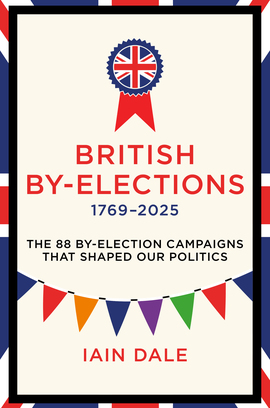
British By-Elections 1769-2025: The 88 By-Election Campaigns that shaped our Politics, edited by Iain Dale, Biteback Press £30.
Review by Douglas Chalmers
This is a fascinating book, covering by-elections from 1769 till 2025 (the Gorton and Denton by-election narrowly missed out), it should be of interest to any follower of Scottish (and generally British) politics. It is large – coming in at almost 800 pages, with eighty-seven contributors.
The only significant by-election that seems to have been missed, is that of Bernadette Devlin who entered Parliament as the then youngest MP in the 1969 Mid Ulster by-election and chose to attend Westminster (unlike other MPs in the republican tradition) – who does not warrant a chapter, but is mentioned in the editor’s introduction. With that exception, however by-elections in Northern Ireland, Wales and Scotland are given suitable prominence together with contests seen as of political import in England.
There’s such a mine of information and decent commentary here – almost all non-partisan – that it would surprise me if many readers, no matter how well versed politically were able to finish the book without discovering something they had been unaware of.
The preface states ‘There’s rarely a dull by-election as these pages will testify’. I think the contents do justify this claim. To pick two examples at random. I was certainly unaware that one of the features of the contentious and racist by-election in Leyton in 1965 was the (then) Labour Defence Secretary Denis Healey being captured live on TV punching the neo-Nazi leader Colin Jordan right off the platform at a rowdy campaign rally. He later proudly recalled: ‘I knocked him off the platform and he fell on a journalist in the front row of the hall breaking his spectacles.’
I was too young to have watched that in person. However, I do remember the count for the Crosby by-election in 1981. This was, of course important in seeing victory for Shirley Williams for the SDP, something The Times heralded as ‘the biggest upheaval in any by-election in recent history with The Observer also declaring we ‘had entered the era of the three-party system.’
For many others watching on the night however (and I do recall this), the biggest pleasure was perhaps the distaste on the face of the returning officer, forced to announce the votes of the Cambridge University student standing for the Monster Raving Loony Party. He had changed his name by deed poll to Tarquin-tim-lin-bin-whim-bim-lim-bus-stop-F’tang-F’tang-Olé-Biscuitbarrel in homage to the Monty Python election night sketch. It didn’t win him a seat, but it brought a smile to the face of anyone who did not appreciate the importance of Shirley Williams’s election.
Dirty Tricks and Other Tactics by the British Establishment
Overall, there is a myriad of detail within this book including some fascinating facts in the statistics section. However, there are many themes that come through the book, which are of more importance than trivia or statistics. As someone who contested elections on many occasions for the Communist Party in the 1980s and early 90s – and indeed in the Govan by-election of 1988, a theme that I took from the book was the level of dirty tricks and undemocratic tactics used by the British establishment or the main establishment parties to fend off any outsider or radical voice that seeks to challenge privilege.
There are countless examples of this – from the earliest by-elections to the most recent. The radical John Wilkes – elected eventually in 1769 had to campaign on the theme of liberty from his prison cell. The Catholic Daniel O’Donnell elected in 1828 in County Clare was unable to take his seat in the House of Commons due to his refusal to declare his loyalty – only succeeding after a further election in 1829 and the granting of Catholic emancipation. In 1830 in Preston, the Radical Henry Hunt was finally elected, unseating the Chief Secretary for Ireland, after being arrested during the events leading up to the Peterloo Massacre of 1819.
The election in 1867 saw Liberal Jacob Bright win who was in favour of women’s suffrage. Introducing a bill to remove the electoral disabilities of women – he was defeated more than once with William Gladstone the Liberal PM arguing that to give women the vote in parliamentary elections would be ‘a practical evil of an intolerable character’. In 1884 in Northampton, Charles Bradlaugh was elected in a by-election which was significant in finally allowing him as an atheist ‘to affirm’ rather than state a religious oath of allegiance.
Many famous radical (or notorious) figures also make their first appearances in by-elections.1899 saw the first election of the Labour Representation Committee in the person of Arthur Henderson. The East Clare by-election in July 1917 saw the overwhelming success of Eamon de Valera for Sinn Fein over the Irish Parliamentary party. A sign of change to come. Less propitious in 1926 was the election of Sir Oswald Mosley as a Labour MP – later to launch the British Union of Fascists in 1932.
Scotland’s and other famous contests
Some by-elections were notable for those who were defeated. In December 1938 the Duchess of Atholl – Scotland‘s first female MP had resigned from the government and her seat wishing to fight the by-election as an opponent of appeasement. She was defeated in a very dirty contest where the Conservatives and pro-war forces mounted a campaign against her using all possible means including a fake supportive telegram ostensibly from Stalin!
The Motherwell and Wishaw by-election in April 1945 however was to see a historic moment in its returning of the first ever SNP member of Parliament, Dr Robert McIntyre. In his short period in the Commons he managed to annoy Winston Churchill by asking ‘if he will arrange for a referendum in Scotland on the question of the establishing of a democratic legislature in that country through which the Scottish people would be able to control effectively the affairs of their own country?’ ‘No sir’ was the curt response.
The Roxburgh, Selkirk and Peebles by-election in March 1965 was a Liberal gain from the Conservatives and so for the first time saw David Steel elected to the Commons. A similar breakthrough for Plaid Cymru in July 1966 in Carmarthen saw Gwynfor Evans elected as the first Plaid MP – something that helped transform Plaid’s fortunes in a very positive manner.
The Hamilton by election on 2 November 1967 was referred to by Professor James Mitchell as ‘the by-election that transformed Scotland’ and in the view of Michael Russell was the beginning of modern distinctive multi-party Scottish politics. According to Russell the SNP had been hitherto seen by some as ‘largely an irrelevant party of monomaniacs and poets for much of its 33-year existence’. Glasgow Garscadden in April 1978 saw Donald Dewar elected, reviving his political career which was later to be entwined with the creation of Scotland’s Parliament.
Fermanagh South Tyrone in 1981 was to see the election of hunger striker Bobby Sands despite the ferocious opposition of Mrs Thatcher. His subsequent death and the re-election of further Sinn Féin-linked candidates, helped move Sinn Fein itself towards the renunciation of the armed struggle and further involvement in the peace process.
Glasgow Hillhead in March 1982 was again to see the apparent rise of the SDP – Roy Jenkins beating the Tories into second place. West of Scotland readers might be interested in one of the unsuccessful fringe candidates however, who received 388 votes – a certain Pastor Jack Glass who stood as the ‘Protestant Crusade against the Pope’s visit’.
The Bermondsey by election in February 1983 saw Simon Hughes the Liberal candidate beat Peter Tatchell for Labour with the biggest swing in party support ever recorded. Space precludes outlining the dirty tricks played against Tatchell but John Curtice covers this well.
Gerry Hassan offers a very fair coverage of the Glasgow Govan by-election of November 1988 which saw Jim Sillars of the SNP beat Bob Gillespie of Labour by a majority of 3554 votes. The second Govan election had taken place 15 years and two days after the first one – which Hassan also covers admirably. One point indicative of Labour’s complacency in 1988 was that Neil Kinnock’s keynote address at the Scottish Labour conference in March made not one mention of the Scottish Parliament. When questioned afterwards about this in a TV interview he commented that he had not mentioned the weather in the Himalayas either. Interestingly Scottish Labour very soon after the by-election formalised its support for a Claim of Right and a cross-party Convention.
Nigel Farage gets his first mention in the Newbury by election of May 1993 where he served as chauffeur for the well-known racist politician Enoch Powell – supporting the Tories. It was, said Farage the thing that got him involved in politics.
Rutherglen and Hamilton West 2023 saw a Labour victory over the SNP, following the recall of Margaret Ferrier for breaking Covid restrictions. I found this a surprisingly unsatisfactory chapter however, with the commentator’s rather partisan approach and its general dismissal of the SNP and praise of a much broader resurgence for Labour in Scotland. Well perhaps.
Finally, Rochdale in February 2024 saw George Galloway under the Workers Party banner succeed with a majority of 5,962 pushing Labour into fourth place, and establishing a swing of 41.8 percent from Labour to the Workers Party. He became the only MP since party politics began to win in three different constituencies from outside the governing, or official opposition party – a result which Tory Prime Minister Rishi Sunak described as ‘beyond shocking’.

We are supported only by our readers. We don't have corporate backers and we don't take advertising, so we rely entirely on your support.
Help to support independent Scottish journalism
Great review, thanks. It had me pining for the days of Denis Healey…