
A New Deal and Vision for Glasgow
As the ongoing cultural crisis rumbles on, the debate about creating a new vision for Glasgow intensifies. Gerry Hassan speaks to a range of people and suggests some starter-ideas to take things forward.
Glasgow has been in the news of late – the aftermath of another fire with talk of decay, decline and malaise. Arguably, this is a Glasgow industry itself – talking about the fortunes of the city going wrong – is this time any different?
Glasgow is a city of paradoxes, of competing – even contradictory – stories. There is the official story, that working smarter and more strategically will deliver the goods and the Panglossian hope of serial local leaderships that things will somehow turn alright.
There are a host of opposing accounts – of resistance and opposition; of local initiatives and self-organisation; another more miserablist about long-term challenges, alongside the pathologising public health narrative of “the Glasgow effect” and “a sick city in a sick country.” And that is just for starters!
All these stories have some element of truth but are also partial and selective and not the entire picture. What is uncontested is that Glasgow should be put centre-stage in public debate and priority, not just within the city but across Scotland, and that the status quo is failing people and no longer defensible.
Glasgow has positives. The city region is a powerhouse of the Scottish economy contributing one-third of Scotland’s total economic output. It is a centre of enterprise, innovation and ideas. A senior SNP policy adviser makes the case:
Glasgow’s economic performance has been reasonably strong in comparison with other large UK city regions for some time. Scotland’s GVA per capita is the best outside the wider South-East so Glasgow is in a different context to all the other large post-industrial conurbations. Especially in that it has Edinburgh 45 miles down the road (which if you believe the latest figures is now richer than Greater London per head).
Glasgow is often compared to Liverpool and Manchester – economically, in ambition, their public realms and civic leadership. “The Manchester boosterist narrative” can be overdone, but what is obvious is that the partnership working of different levels of government, city-region leadership and public agencies is central to its success, and similarly that of Liverpool.
James Mitchell of Edinburgh University states that:
Glasgow has huge potential but that has not been harnessed as it requires real, meaningful joint working across UK, Scottish and local governments including the range of public bodies within the jurisdiction of each. Building a consensus, avoiding blame games and making sure that respectful and open discussion are important.
Film-maker and academic Eleanor Yule from Glasgow observes:
I’ve lived in Liverpool now for eight years and it has all the best bits of Glasgow but also feels like there is investment and promise – not the feeling I get when I visit my hometown which seems to get more and more neglected each time I go – no Glasgow School of Art, no Rogano , no Centre for Contemporary Art, and now the building which had the Iru Bru clock, which I delighted in as a child, has gone.
Glasgow needs change, a new deal and a new vision. Here are ten thoughts on beginning such an approach breaking from the current complacency and inadequate approaches.
1. Rejecting the Official Story
The official story of Glasgow presents a version of an urban template told the world over. This advocates consumption, shopping and tourism alongside a view of the economy driven by inward investment and a branch-line economy with power and decisions elsewhere.
The main public bodies have sung from this sheet – which until the 2008 banking crash posed globalisation as the way to Glasgow prosperity and well-being. Post-2008 this official story has appeared increasingly threadbare and inflexible, but an alternative set of stories has yet to emerge. With the official story of recent decades discredited new stories of change and the future need to be encouraged.
2. Making the values of the city explicit and what people want
One conceit of the official story is that it is never fully open about the values underpinning it. It is an instrumental view of humans and relationships subservient to economic logic. Instead, a more human-centred set of values based on local needs, unique character of the city, building trust and relationships, and sustainability, needs championing. This should come from local people not institutions and from the different kinds of storytellers who make the city.
Sue Laughlin of the People’s Plan for Glasgow observes that there is a need for “a different imagination to the status quo” centred on “how we travel around, how we warm our homes, how we source our food, how we design our public realm, how we care for each other. Yet, public policy makers are indifferent to these alternative ideas.”
3. Glasgow City Council needs transformation
The city council faces huge challenges, not all of its own making. It has faced significant cuts to its funding from the Scottish Government over the past decade while having to pay the bill of the equality case for low-paid women workers. Yet, over the post-devolution era the council has failed to adapt and fundamentally change enough in how it works.
It has outsourced many of its delivery agents, creating a complex maze of outsourced bodies delivering key council services, weakening accountability and destroying public ownership. A different city council would for starters bring some of these agencies back into council control – beginning with Glasgow Life and City Properties.
4. A new regional strategic authority
Liverpool and Manchester have been aided by city-region leadership. Glasgow has lacked this since the abolition of Strathclyde Region in 1996. Successive Scottish administrations, Labour and then SNP, have failed to address this because it involves taking on local council fiefdoms who do not want to have to give up their patch. But if several English cities can do this, surely Scotland can for Glasgow?
The writer Alastair McIntosh notes that Glasgow has been undermined over decades:
There must be urgent recognition at the UK level that industrial policy, for which Scotland never voted, has pulled the rug on Glasgow’s fiscal base. This has left the city poor and with a reduced status.
5. What kind of economy, growth and prosperity should Glasgow champion?
Glasgow’s economy has positives but is hampered by structural barriers in its labour force including severe inequality and generational worklessness: an accentuated version of the UK economy. This raises the question of what kind of economy Glasgow should advance post-globalisation, where are the jobs of the future arising from AI, and how can issues of ownership, control and growing local businesses be advanced?
6. Glasgow’s Waterfront
The city needs a new vision for the Clyde and its waterfront. The Clyde is one of the great rivers of the world, cutting through the heart of the city. Where once it thrived with work and energy, in the words of one observer it now feels like “a dead river” which “a large part of the city has turned its back on or forgotten about.”
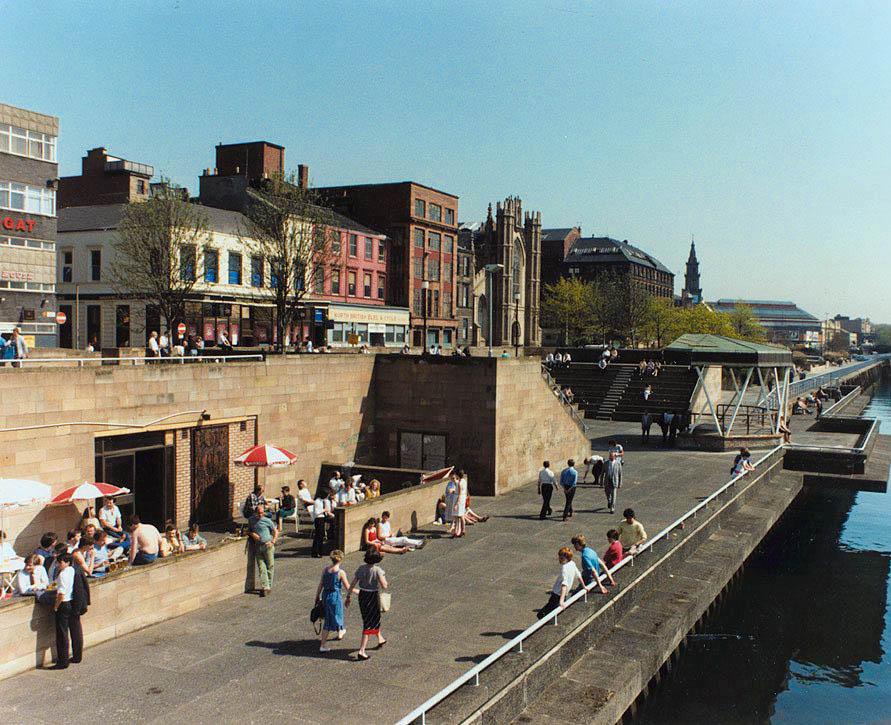
Glasgow Riverfront 1990
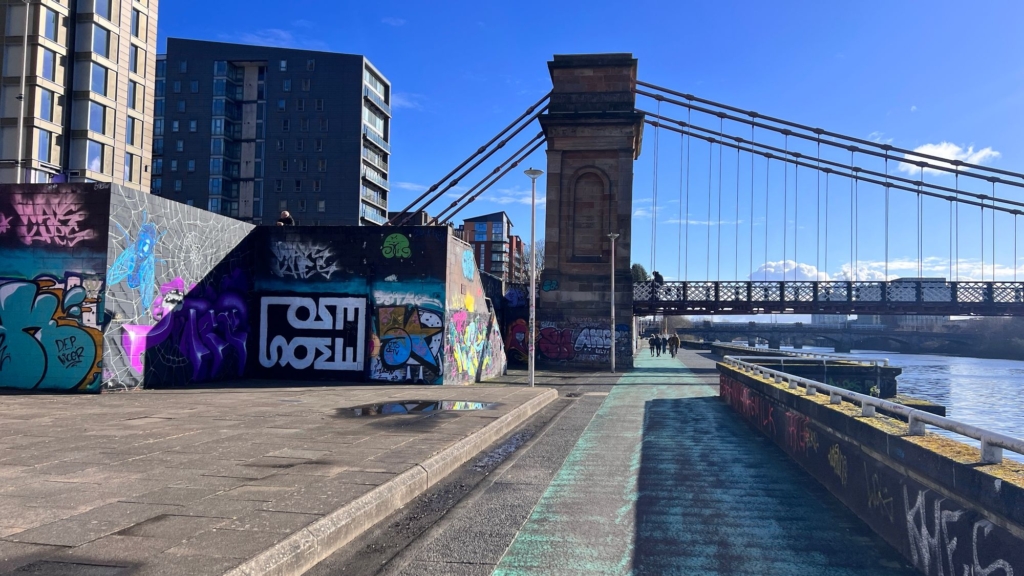
Glasgow Riverfront 2025
Decades of talk and public regeneration have focused on the Clyde, but with no coherent plan linked to action ever emerging. Last weekend I was in Liverpool and visited the Mersey riverfront with a host of museums and attractions including the Museum of Liverpool alongside the Tate and forthcoming International Museum of Slavery. The entire riverfront is visually impressive, planned coherently, and connects the new to the city’s Victorian heritage. Glasgow does not even have a proper Maritime Museum.
7. Public realm and infrastructure
Glasgow’s Victorian heritage and public infrastructure needs attention. The crumbling nature and fragility of too much of the built environment can be seen in the serial fires of too many totemic buildings. Connected to this the city needs to have a coherent plan for the public services and goods which are essential to its citizens. One of the most critical is developing an integrated transport system which is publicly owned.
Ellie Harrison, author of The Glasgow Effect observes:
We need the Scottish Government to support our transport authority, Strathclyde Partnership for Transport (SPT), to bring the bus network back into public control, so they can deliver a fully-integrated, accessible and affordable public transport network across the region like Greater Manchester’s new ‘Bee Network’, or the recently released plans for South Yorkshire’s ‘People’s Network’.
8. Whose Culture City?
Glasgow’s cultural strategy has taken a huge hit in recent years. There has been a cultural vandalism at a local level along with cultural neglect and aloofness from the Scottish Government. The litany is grim: the Arches’ closure in 2015, Glasgow School of Art fires in 2014 and 2018 with no agreed plan for the Mackintosh Building eight years after the second fire; Centre for Contemporary Arts (CCA) closure in January 2026; the delays to the refurbishment of the People’s Palace; and the ongoing crisis at the multi-venue Trongate 103.

This latter example is another tragic case of the city’s authorities undermining and destablising independent, acclaimed cultural enterprises – in this case, the Glasgow Media Access Centre, Sharmanka Kinetic Gallery, Glasgow Print Studio, Street Level Photoworks and Project Ability.
As Clare Henry, former Art and Culture Editor at The Herald, puts it:
The lack of support from Glasgow City Council (GCC) for the arts in general is indicative of their short-term blinkered approach and ignorance. Not long ago Glasgow Life and GCC were using the visual arts and Glasgow School of Art’s numerous Tate-Turner winners as PR for the city.
Janie Nicoll, freelance visual artist, comments:
Like many people the thriving cultural scene in Glasgow was the reason I moved here in the first place. Sadly, it feels like the arts in Glasgow have been taken for granted, like much of the Victorian architecture that makes Glasgow the special place that it is – hollowed out, neglected, sold off to developers.
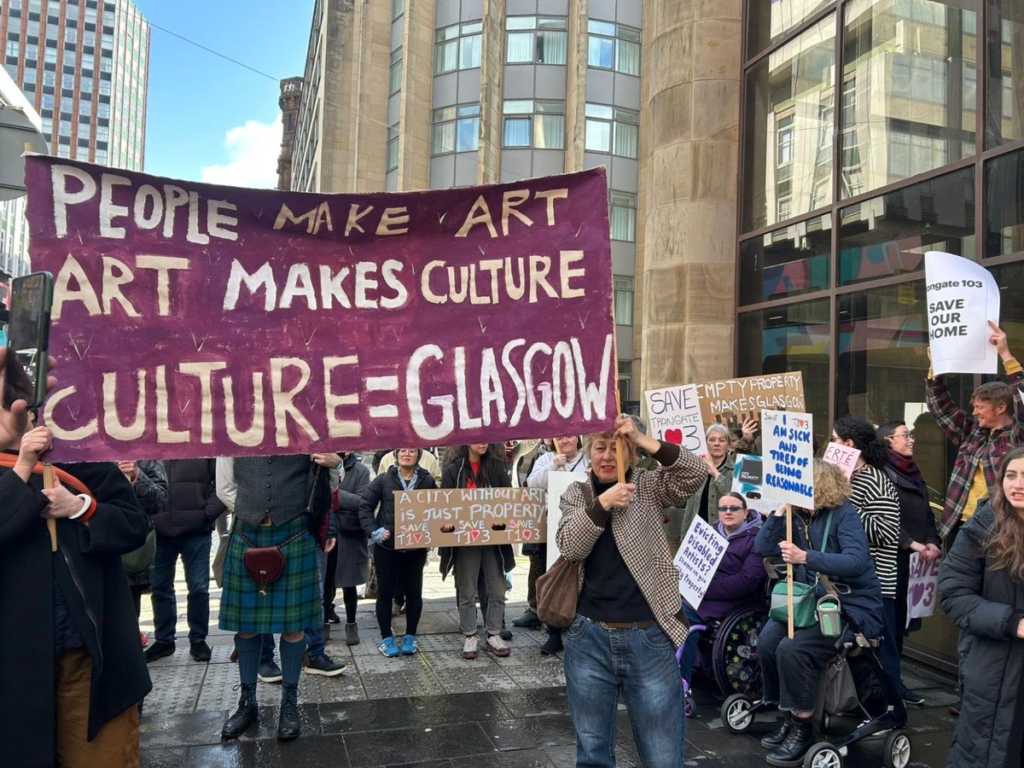
She continued:
As ever the art sector is expected to somehow muddle through, an elastic band continually stretched. It currently feels like this is the final straw. To say that I am scunnered and angry at the current situation is an understatement. Glasgow City Council needs to take a long hard look at the way they support the arts in this city before there is nothing left.
9. Nurturing human relationships in the city
Glasgow is scarred by inequality and poverty. This is still entrenched and on numerous indicators going backwards despite many positive initiatives. Early years child development is now showing regressive trends which have until recently caught politicians and policy-makers unaware.
Alan Sinclair has championed this issue for decades and notes that:
If Glasgow was a book, you would note its shabby cover. More important than the cover is what is inside the book. Health visitors carry out an assessment at 27-30 months of every child in Glasgow. They report that 1 in 4 children are failing to meet one or more of their key development milestones.
10. Glasgow needs to be a national priority in the way it has not for the past 25 years
A vibrant Scotland needs a dynamic Glasgow at its heart. This is not currently the case. A city-wide and city-region leadership which speaks up nationally which is ambitious and takes on vested interests is missing. A national understanding of the importance of the city is absent from Scottish leaders – witness John Swinney’s dismissive comments at First Minister’s Questions last week on Trongate 103. It is missing a vision which unites city, city-region, and national institutions – and costing the city dear.
The wider context of Glasgow matters and has harmed the city. The abolition of Strathclyde Region and the entire regional tier of local government by the Tories in 1996 took away a strategic authority across the West of Scotland which redistributed monies from more prosperous areas to Glasgow and other parts.
The arrival of the Scottish Parliament in 1999 – initiated and first run by Labour with the Lib Dems – displaced the pre-devolution era in which Glasgow had major political clout. Its leaders mattered and had political muscle via COSLA; it was also the heartland of the Labour Party electorally – meaning that its views and interests mattered in the corridors of the party’s hierarchies. The era of devolution has undermined Glasgow’s role as it has that of local government whose leaders are no longer significant national figures as attention, powers and finances have been swept up and concentrated in the Scottish Parliament.
This has been added to by the SNP taking control of Glasgow City Council in 2017 and their failure under Susan Aitken’s leadership to address the major challenges. It can be argued that they inherited a tough legacy and landscape, but the cumulative decisions of the SNP in office have added to the city’s problems.
This latest story has several layers. First, the SNP internally prioritised winning Glasgow electorally at a council level to build a base at national level, recognising they had a historic “Glasgow problem” by-elections apart. However, what this did not entail was creating a political programme or vision of what to do with Glasgow once they captured the city. No plans were devised to make Glasgow a shining beacon of Nationalist success and a model for the future of Scotland. Rather as SNP documents made clear winning at council level was seen as building a base for national success: relegating Glasgow to a sub-story.
Secondly, since they won Glasgow the SNP have never publicly made the case for the city’s unique status and importance at a Scottish level. The city and the city-region need special recognition and a national agreement on its critical role nationwide – with funding and big projects to follow. Such arguments have not been openly made by Susan Aitken and others, and an opportunity was missed in the eight years Nicola Sturgeon was a Glasgow MSP and First Minister. An SNP ex-minister told me: “The SNP in government let Glasgow down. We just did not prioritise it or understand its needs and that failure can be seen in the state of the city today.”
Thirdly, the national political picture has negatively affected Glasgow – both under Labour and then the SNP. Both have been wary of making major structural changes which could have the effect of upsetting powerful vested interests and institutional forces. Moreover, they have slowly sucked up powers and monies from local government hoarding them at the political centre. And both have refused to confront the prejudices at senior levels in the Scottish Office and now Scottish Government which the policy analyst David Webster described as “an anti-Glasgow bias.”
It is not an accident that Nicola Sturgeon’s 460-page autobiography contains not one mention of Glasgow City Council despite her representing the city for a quarter century as an MSP. It is a revealing omission, saying much about her political priorities, and a damning one which reflects a political view of the world which has hurt and held back Glasgow.
Some will baulk at the above, wanting to ignore the mixture of mediocrity and mendacity towards Glasgow and thinking that all that matters is defending the SNP and independence. But such an attitude is apologising for the indefensible status quo, slow attrition and undermining of Glasgow, its fabric and citizens.
All political parties must shoulder some of the blame – the Tories for abolishing Strathclyde, Labour for its vision of devolution centralising power, and the SNP for its lack of ambition at a local level and failure to champion the city. The first step in challenging this is raising these concerns in public and addressing them. The recent catastrophic city centre fire and the forthcoming elections this and next May provide a catalyst and a vehicle respectively to start the process.
Glasgow could continue as it is. Thinking and remembering better days. Drawing on nostalgia. Noting that in places it still has successes economically and culturally. But isn’t Scotland’s first city worth more to all? Glasgow desperately needs a New Deal and a new vision before things get even worse for its citizens and for the rest of Scotland.
Glasgow matters to all of us and urgently needs a fresh start and new settlement. The question then arises: who will speak for Glasgow, challenge the current unsatisfactory state of affairs and present a new set of stories about the future?

We are supported only by our readers. We don't have corporate backers and we don't take advertising, so we rely entirely on your support.
Help to support independent Scottish journalism
Fantastic article Gerry. Another area worth teasing out and developing is the virtual absence of the 3 Glasgow universities – or 4 if you were to include UWS under a greater Glasgow/ Strathclyde region concept – in developing any real focus on being an intellectual network for the City with a focus wider than just recruiting international students to help their bottom line. Even Glasgow Caledonian University – which promotes itself as a university ‘for the Common Good’, never grasped the concept of being a truly ‘Civic University’ in the years that I served on its Court, despite myself and other colleagues in the unions pushing for this. And indeed the willingness of the new GCU principal to promote compulsory redundancies within 3 weeks of being in place, doesn’t bode well. Would it be too much to hope for the widening of the Gramscian concept of progressive individuals becoming ‘organic intellectuals’, into a new concept of the City’s universities working together with local government, city-wide unions and others to realise the potential of the new vision your article seems to be crying out for.
Totally agree with author. Glasgow deserves leadership as bold as its reputation.
i think that the failure of the Scottish government to reform local government and finance is now coming home to roost.
Instead of considering metro provost there should have been devolution to local communities with executive powers while the city had responsibility for strategic planning
A land and property tax could raise far more funds than all current devolved taxes. However bearing in mind that 60% of all vacant and dilapidated land and property in urban Scotland is in the public sector, the stewardship of how it is used is crucial to the development of the city.
Just remember who’s ultimately responsible for that. When the SNP first properly mooted scrapping Council Tax and Gordon Brown’s government said fine, but we’ll take all council tax related funds off the block grant.
Independence is the key!
With regard to reform of local government, I think we need both a restoration of a strategic city region along the lines of Strathclyde Regional Council and a greater devolution of powers to local communities within the city of Glasgow and within the smaller towns and areas which comprise the rest of the wider region.
These layers of government must have clearly defined powers including the power to raise funding and to borrow. Since there can be a tendency of overarching bodies, such as the regional council, to centralise powers and become dirigiste, the more local bodies should be the ones with the strongest powers, and they would grant to the overarching body powers to enable it to set and, to some degree require, strategic policies to be implemented. Within the city and the larger towns, different areas have different needs and community councils within these should have powers and funding to implement programmes particular to their own agreed priorities, provided these are consistent with the strategic principles, and do not affect adversely the adjoining communities.
These things require ‘checks and balances’ and procedures to resolve disagreements. They also require people to adopt an attitude that is prepared to compromise. Since these arrangements would involve far more people than at present in elected positions more people would be aware of the nuances of issues and the fact that they have powers, responsibilities and accountability would make it more likely that solutions would be found, because a principle of ‘the common good’ would emerge.
I know it’s coming from a good place but disagree.
Scotland’s four major cities all need greater autonomy and bigger financial firepower…
But that’s just not possible within the UK. Independence first, then free from HM Treasury we can properly set a new way of city government.
We need to get Glasgow back…
When I went to study in Glasgow in 87, I felt like a total hick who was among the trendy and sophisticated… We were in the crest of a wave…
Right enough, I was from Portobello which, no matter how many times they say it, is not Edinburgh… It doesn’t have that Edinburgh class thing… More like a wee prosperous market town in East Lothian…without the market…
When I moved to Madrid in 1992, Cameron de la Isla had just died. Everyone was wearing Camaron de la Isla T-shirts…
I had no idea who he was. And then someone takes you under their wing. Gill Hall frae Harthill, a few years in Madrid.
Oscar, Ernesto and Mari Angeles, who had a stall in the Rastro flea market selling T-shirts, radical anarchists, who invite you to lunch, and give you a copy of Legend of Time by Camaron de la Isla.
Then, you begin to understand… Paco de Lucia, Camaron…
They’re buying you lunch, because they believe in international solidarity,just like Glaswegians…
Neither Glasgow nor Madrid can compete with the more “beautiful”cities in the world.
They are two cities you live more than go to see…
They are maybe the two best cities in the world for me..
I still think I’m a hick in Glasgow…
Yesterday, I was reading El Pais newspaper, which has a much better culture section than any paper in the UK, and they have this feature which is the music writer rounds up the best 10 albums of the first quarter of the year…
…and he always adds one album, a kind of blast from the past…
Yesterday, it was Bandwagonesque by Teenage Fanclub…
I knew who T.F were, but I’d never heard that album…
Yet another example of Glasgow’s truly legendary musical status, which absolutely is known and recognized in Spain…
Glasgow does still have a brilliant, vIbrant, diverse music scene – as well as a diverse cultural scene despite Glasgow City Councll and the Scottish Government.
But Teenage Fanclub are NOT a Glasgow band and would never want to be seen as such. They are from Bellshill, just outside Glasgow.
Thanks, Gerry, I had no idea of that album – very highly praised – cause it was like that black out period when the internet didn’t exist and you could call yer maa maybe once every two weeks from Spain, because of the cost…
The internet didn’t exist so you really couldn’t follow anything in Scotland except what was in the Spanish press… or maybe you’d spend a fiver on The Guardian now and again and try and catch up, but that idea you were “abroad” then was real… and it was also kinda good in a way… because you could actually check out of everything and go abroad…
I rememeber the day Federico Fellini died, in my flat then in calle Toledo in Madrid, in 1994. Felipe Gonzalez had just won a fourth term! And like I say, it’s an old joke of mine to say I moved to Spain cause I thought Felipe was a Socialist! It never fails to produce a round of laughs and a beer…
But Fellini….
You know, there’s only one truly cinematic city in Scotland and it’s very obviously Glasgow…
Of course. It should be a powerhouse in the north for film.making and we need a filmotecheque… a centre…
There have been two stages in my life.
First, when I hadn’t seen the films of Federico Fellini, second when I had seen them…
The kids in Glasgow deserve to have the great cinema of the world available to them…
But, I think it’s an age thing…
You understand, to the extent possible, how great Fellini was…as a director but also as a human being…
I saw LA STRADA when I was about 16 or 17 on the BBC…
And NIGHTS OF CABIRIA not much later…
I loved them then, I think I actually left Scotland because I was so captivated by the film-makers of Spain and Italy…
But I never planned to stay (I just got lucky)….
But I watch those two films now, and I cry. Just amazing pictures about the poor, the vulernable and the dispossesed…
I just think they are among the greatest artworks ever produced in our time…
Maybe I’m wrong. But I’m damned if working class Glasgow doesn’t get to see them and tell us so..
My mum was from Penilee… I know working class Glasgow very well..
Give people a fckn chance.
Build a Filmotec in Glasgow…!!!
Wouldn’t a proposed Greater Glasgow Region open up Glasgow status for bands like TFC? There’s quite a lot of Glasgow bands who don’t come from Glasgow !
But to have lived in Madrid… I can’t express how much I love Madrid and the people of Madrid and how they opened my eyes to the world and the arts… It’s just an amazing, fantastic, open, warm and friendly city… I don’t have words to describe Madrid, it’s the best city in the world for me…
Spain in the 80’s and to a lesser extent 90’s was still coming out of Francoism, and so it was still really, beyond the law so to speak… Franco’s laws had been abolished, but they hadn’t replaced them…
So you’d get things like the goat on the ladder. I haven’t seen that for decades at the Rastro flea market, but it was normal in the 90s. The gypsy, el gitano, and his wife would turn up at the flea market with a goat and a ladder and a sound system and a trumpet.
And they would put the goat on the top of the step ladder, and then start up the sound system… the percussion…
Boom deree boom deree boom deree boom…
And then he’d start on the trumpet…. Ba ba ba baaaaa / Ba ba baaaa!!!
A pasodoble…
I just love the trumpet, we need more trumpets in Scotland…
And the goat is on the ladder looking down at you all and the wife collecting coins…
Paddy came out here on year with a big UK band in the 90s and I made sure to take him to that Hawai bar there used to be in the centre of Madrid which was full of budgies and parrots flying around the pub… a pub full of birds flying around the shop… ha ha ha… Paddy was freaking out…
That’s all gone in Spain now. It’s a serious country these days… for better or for worse, it was brilliant fun right through the nineties…
But there are days I am embarrassed to be Scottish, like today…
My neighbour, Fran, is a Madrileño who is a massive Scottish rugby fan. Every year he goes to see Scotland play during the Six Nations…
This year he went with his 12 year old son to see Scotland – France, and he was in raptures about the game itself…
And so after the game he wants to go and have a pint with his son, but they won’t let his son into the pub…
You hang your head in shame at the Scottish mentality…
He’s probably spent 3000 euros to go and see Scotland and he can’t have a drink after the game with his son because the Scots still think pubs are places people go to get pissed up, which is not the case at all in Spain…
It’s like we’re in the 19th century or something…
You blush, you cringe, you hang your head in shame…
We really need a popular song about how we burnt down our art school…..Twice! Wha’s like us?
The author is correct to highlight our neglect of The Clyde.
You could visit Glasgow as a tourist and leave almost unaware that the city is built on a river. Other cities seem to have their founding rivers as a central artery. Full of life, excitement and beauty. Ours is like a forgotten drain out the back court. Its a huge wasted potential.
I agree with you.
For the two centuries of Glasgow’s industrial dominance the citizens were largely denied access to the river. Except for relatively short stretches in Glasgow Green and Richmond Park the only sight most of us had of the river was when we crossed bridges or took one of the ferries. Do, the social aspects of the city developed with their backs to the Clyde.
From the 70s onward the industrial riverfront infrastructure was becoming increasingly derelict. Gap sites lay empty for decades. The Garden Festival of 1989 was a valiant attempt to present a vision of what the waterfront might become, but, alas was a missed opportunity as the site itself mouldered for years.
The SECC could have provided a good waterfront campus, but it was largely used to provide car parking with an uneven path along the river. The BBC/STV/Science Centre also show possibilities, but Prince’s Dock is still a wasteland with an exclusive gated community.
Part of the problem was ownership of the land along the river. The Scottish Land Register had not been properly kept up to date, and the City Council found it difficult to know who owned large tracts of land. It does know now and is able to set up planning frameworks. But private land ownership sees benefit in keeping areas of land empty to create an artificial shortage and force up the price of the land they allow to become available. So, we need land reform and land taxes to force this land out of private hands for the common good.
The motorway and expressways are incubi in the body of Glasgow. They balkanised the city and created a bleak derelict wasteland between Argyle St/Stobcross St and the Clyde resulting in the dreary, sparsely populated area that has existed for decades. We need to close the Expressway and restore Stobcross St as the Anderston local street it was. We need to take the opportunity to remove the Woodside Viaducts and redirect M8 traffic.
We also need, as happened with Liverpool and Manchester, for example, significant government investment in urban regeneration.
There are developments along the river which are showing promise and which are brining homes close to the river, but we must end the excluding fences along the riverfront from the Clyde Arc eastwards towards the Kingston Bridge.
I read the above article shortly after I read an account of the early days of the ‘New’ Labour government elected in May 1997, ostensibly elected to correct the many excesses of the previous Thatcher-major governments. I was immediately reminded of a passage in the book ‘The Paymaster’ by the author Tom Bower which, despite the author’s propensity for quoting verbatim conversations he cannot possibly have listened in to, I have copied below but have chosen to split into 2 distinct parts, even although there is no separation whatsoever in the original book.
‘ His more serious advisors warned of a more cogent reason why his proposal aroused ridicule:
“The poor don’t buy PEPs, Paymaster General, because they’ve got no money. People without money don’t save. And for the same reason they won’t but your new ISAs at a Tesco checkout.”
The paymaster-general disliked contradiction. He was Gordon’s facilitator, his problem solver, not his hired dissenter. Although he had no understanding of or interest in savings, Robinson simply obeyed Gordon. In a government where Cabinet meetings had been reduced by the PM to 20 minutes of announcements and of mutual congratulation, Robinson had no inclination to break a long-term habit and consider contradictions.’
More recently, on Thursday morning this week on a local tv channel, the overnight decision by the Russian government to suppress the Telegram App in Russia was debated at considerable length. One lively, undeniably ‘progressive’, sensible, likeable, regularly-featured academic present in the panel discussion showed great delight in his contribution to the effect that this was but the latest step in what Putin’s Rasputin, named by him as Vladislav Surkov, had planned from some 3 decades ago, namely ‘controlled democracy.’
The academic defined this important concept invented by Surkov as ‘allowing apparent democratic institutions such as elections, political parties, parliament, press & media but where the real power controls and dictates the results so as better to guarantee the inviolability of the leadership cadres.’
Mention of leadership cadres reminds me of the only time I came close to seeing and hearing Tony Blair speak in person. It was one afternoon in autumn 1995 when he was still the very recently elected leader of the ‘New’ Labour but not yet PM and he addressed the TUC in Brighton. His speech was brought forward by an hour or two that afternoon and, since I had to work for my living, I arrived after he had departed. But I listened to him speak live on the radio as I drove to the conference. He made a comment in the speech which struck deeply and favourably within me when he said something to the effect that:
‘I have noticed that no matter what the result of any general election might be, it’s always the same people who are in charge and who are making the important decisions.’
Next day Mr Blair announced the crucial appointment of his new chef-de-cabinet. Straight out of the FO and the Washington Embassy, Jonathon Powell.
Brother of Charles Powell (pronounced Cholmondeley)., in turn chef-de-cabinet to a previous PM, Mrs Margaret Thatcher.
Great overview of the issues. Glasgow has been on a precarious slide since the break up of Strathclyde Region and the creation of a centralising Parliament in Edinburgh. These two institutional challenges were compounded by the economic tsunamis of 2008, austerity, Brexit and Covid. I’ve lived and loved Glasgow for nearly 60 years and it’s always been a fragile patient but prior to 2008 there were encouraging signs. Absence of a credible vision, innovative thinking / policy making and leadership means the patient’s prognosis is the worst in generations. Something radical needs to be done and quickly. I was working in Ireland recently and a colleague on returning from a long weekend in Glasgow summed it up as dirty and dangerous. People do make Glasgow but it desperately needs ambitious policy, institutional innovation and step change investment.
Thanks to folk for the informed commentary.
Real change in Glasgow and Scotland entails moving beyond hiding behind blind party loyalties or the belief in the abstract of independence coming to save folk in the near-future.
Firstly, the SNP are in part responsible for the current situation. And their present offer to the city locally and nationally is contributing to the malaise and drift which define Glasgow. Blind party loyalty wants to deny such truths rather than confront them.
Secondly, the idea all these big challenges have to wait the other side of independence beggars belief. For starters it is a defence of the current unsatisfactory status quo. An excuse for unimaginative policies. And if that were not enough it ties independence to such a minimal and problematic politics – fantasing that after defending this somehow post-independence a more bold, ambitious politics will emerge like magic.
Glasgow and Scotland have to begin addressing these big issues in the here and now; otherwise the current centrist stale failing politics of the mainstream including the SNP will remain entrenched.
‘Glasgow and Scotland have to begin addressing these big issues in the here and now.’
In Gerry Hassan’s articles and comments below there are few concrete proposals which would significantly improve Glasgow. The Council now, and for decades past, has been content with slogans and with spectacles. Neither of which have amounted to much. For the Situationists, ‘spectacles’ were to divert people’s attention. For the Council, there are to demonstrate the dynamism of those the voters have elected. Next up is a rerun of the 2016 Commonwealth Games. The Commonwealth has a population of 2.7 billion., yet only Glasgow wants to stage their Games.
Even if the Council could be side lined – in a democracy a dubious proposition – the next level up takes you to Holyrood and to the Scottish Government. Is there any more intellectual initiative and dynamism to be found there ? Not on the evidence of the past 12 years.
One area specific area might bear fruit; schooling. London appears to have made very real progress in improving an area which, for several decades, was a disaster zone. Success here would at least allow more young people to escape from the stagnation around them.
Thank you for your comments as always.
There are at least ten concrete proposals for action above.