
Holyrood 2026: Dogwhistles, Potholes and Polling
The Holyrood election grinds on with endless allegations of sleaze and misconduct, the grotesque debacle of Reform UK in Scotland, the late collapse of alternatives like Your Party and Alba and campaigns characterised by the hyper-banal.
Scottish Labour have created a campaign based almost solely around Anas Sarwar pretending to be Zohran Mamdani, forking out a vast digital spend in the process. If polling is anything to go by, it looks to have been a complete disaster, generating Labour’s worst-ever Scottish election result. Sarwar has posed in front of a giant saltire, grand-standed against his own party leader, been surrounded by cheerleaders in the press and faced an incumbent SNP government weighed down with policy failures (both real and imagined). If they cannot win in these circumstances, in fact, if they can lose historically, then what does it tell you about the state of the party that was swept to power at Westminster little over a year ago? This is all happening, despite a media class hallucinating about scenarios in which a minority Labour leader is elevated into Bute House, supported by the neo-fascist Reform Party.
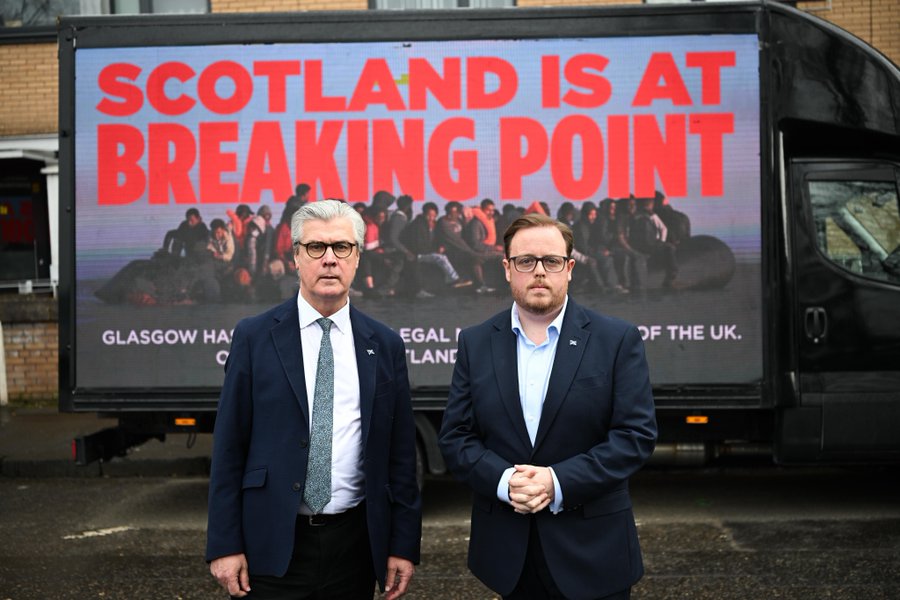
Reform’s racism adds a new tone to the Holyrood campaign
Even for a party mired in petty and negative politics, Labour’s 2026 campaign looks to be an echo of John Major’s Back to Basics which focused on tackling the scourge of potholes and traffic cones. If the Sarwar campaign looks to be from a party that has nothing to say about the substantial issues of the day, the same can be said across the parties.
As Coll McCail has written [The Forgettable Election]: “With this context in mind, it follows that the Scottish election campaign, characterised by a distinctly uninspired electorate and an outcome that feels pre-determined, should be remarkably well choreographed — or, to put it less kindly, dull as dishwater. The banality of Scottish Labour’s promise to “get the basics right” or the SNP’s “fresh start” belies something else: The composition of Scotland’s political economy is not up for democratic contest. If it were, one could have expected a more determined effort to politicise Alexander Dennis’ closure or Ming Yang’s ill-fated investment. Neither was forthcoming — from anywhere.”
This lack of policy substance – this absence – is added to by the complete lack of charisma or energy by so many. When was the last time you saw or heard a genuinely inspiring political speech by a Scottish politician? Figures like Alex-Cole Hamilton, Russell Findlay and Jackie Baillie seem to exist only in a negative sense, the relentless assaults on the idea of independence just descend into a desultory blur.
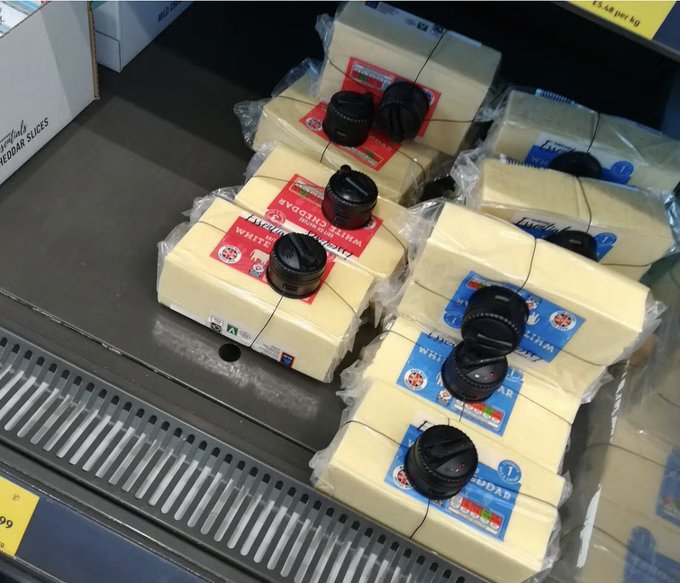
If Labour’s Potholes campaign represents a sort of Majoresque post-ideological nadir, the same accusation can be thrown at all the parties. As the cost of living continues to rise, and poverty and inequality continues to dominate people’s lives, what are the significant actions taken to address any of this? This image of cheese with security tags went viral earlier this week with the question hanging about the outbreak of shoplifting, rather than the more obvious question of ‘Why are people so poor they have to steal food?’
Added to this the sense in which Holyrood has become dominated by a professional political class, overseeing a bland managerialism, and you have an overwhelmingly bleak picture.
Majority Report
However, this relentless narrative of declinism and negativity has its limits. At its worst, it descends into a sort of anti-Panglossian mood-music, in which everything about Scotland is awful, everyone is corrupt and useless, and all politicians are ‘troughers’ or ‘traitors’.
This becomes a circular, self-fulfilling prophecy, distorting the need for real criticality.
The problem becomes that this outlook blends in with the messaging from the Unionist Right, which wants to portray everything about Scotland as useless and incompetent, and wants to undermine and destroy the devolution settlement itself actively.
Yet there is some dynamism at this moment, even if it is happening despite, rather than because of, the mainstream political parties.
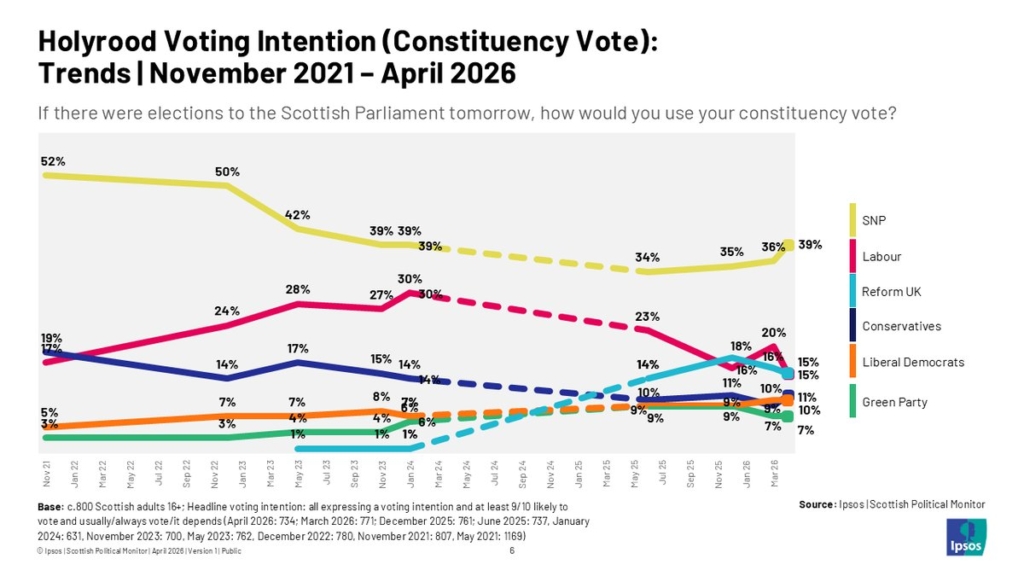
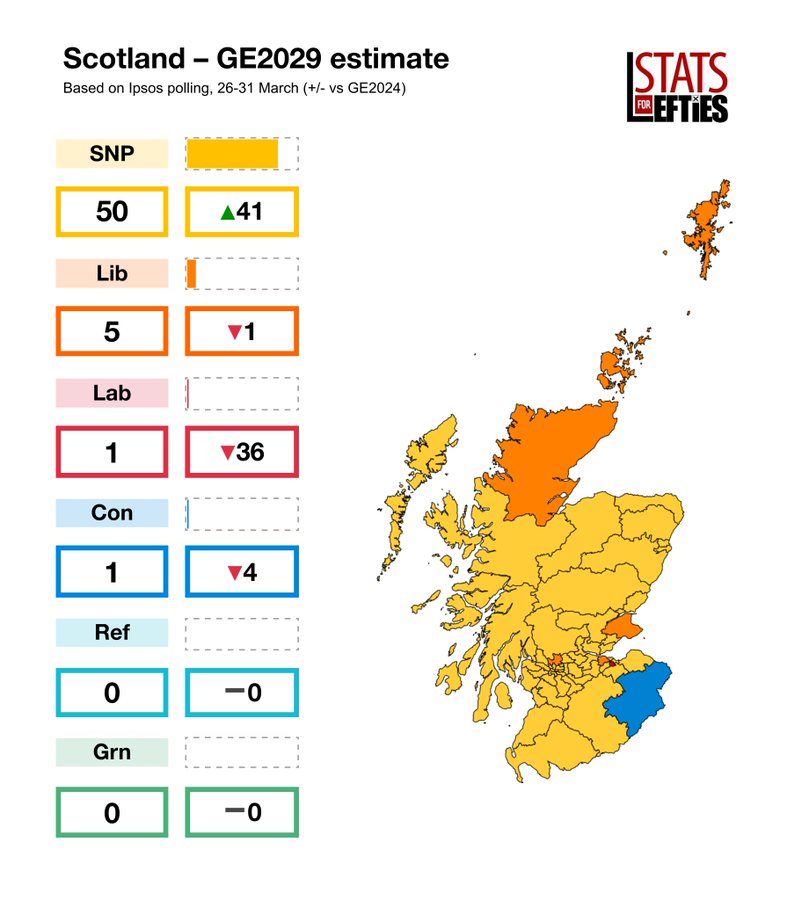
Polling suggests the SNP are looking at around 40% of the constituency vote, only a month out from the election:
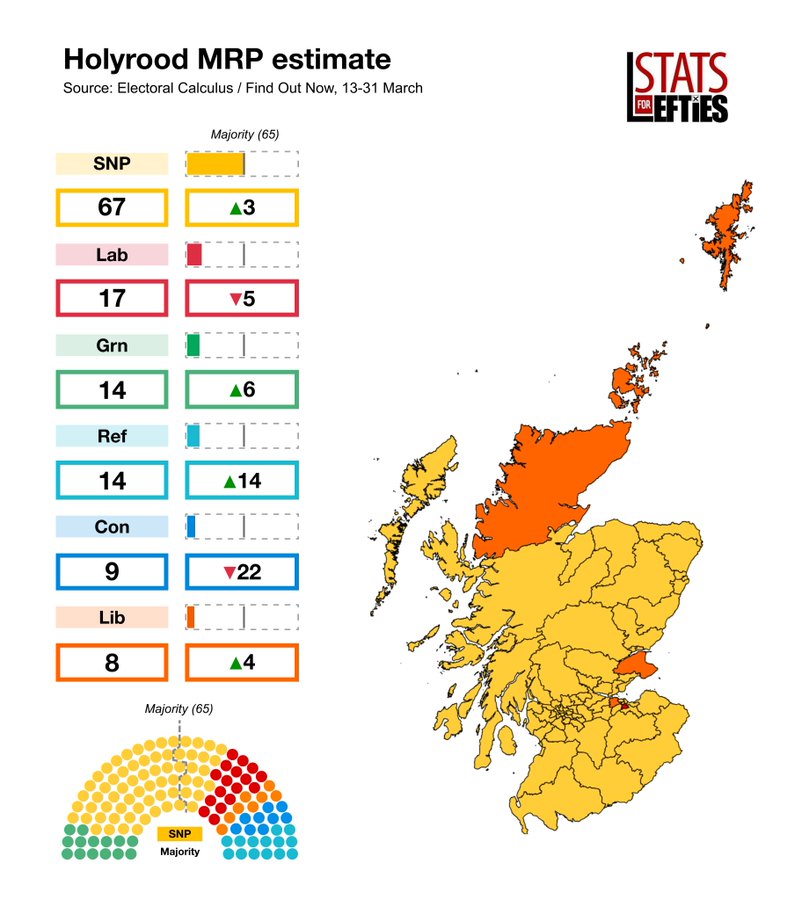
Others, such as this weeks MRP poll show the SNP with an outright majority, with the Greens adding considerably to the pro-indy vote. With an almost 2/3 Indy majority – the idea that this wouldn’t be significant or could be resisted is delusional.
In polling out today, the Scottish Greens were predicted to be the second biggest party [New Holyrood poll predicts Scottish Greens to be second biggest party]. The Scotland Political Pulse survey of 1038 adults, conducted in the first week of election campaigning, shows the SNP have also extended their lead on 39% of the constituency vote.
Now, of course, there will be some who are sceptical that any of this means anything at all. Objections vary from:
The SNP are not to be trusted, they ‘harvest’ support for independence for votes at elections, then do nothing.
The British State (Blue Party) has already declined a referendum; the British State (Red Party) will just say the same.
In this sense, to understand the growing constitutional crisis, you need to look beyond Scotland and see the cumulative impact of multiple fronts of crisis facing the Union. Even the normally uber-cautious and anglocentric Guardian has woken up to some of this. Severin Carrell and Bethan McKernan write [‘‘Seismic change’: how election wins for nationalists in Celtic nations could reshape UK’]:
“After decades of collaboration between Plaid Cymru and the SNP at Westminster, Scottish ministers have recently helped prepare Plaid for government in Cardiff, sharing a playbook of tactics and experience garnered after 19 years in control in Edinburgh.
Rhun ap Iorwerth, the Plaid Cymru leader who aspires to end 103 years of Labour domination in Wales, is preparing to demand that Starmer give Wales powers long enjoyed in Scotland, such as devolved policing and justice, control over its seabed and increases in funding.
“The Labour party became so preoccupied with holding on to power that it forgot where it came from and who it was there to serve,” ap Iorwerth told delegates at Plaid Cymru’s autumn conference. “We don’t have to believe Westminster when they tell Wales ‘this is your lot’ and that we should be ever grateful for what we’re given. We can do things differently. [We] are not here to repair Labour. We are here to replace them.”
“In a further sign of the UK’s shifting constitutional politics, Scotland’s first minister, John Swinney, has tentatively allied himself with Sinn Féin’s deputy leader, Michelle O’Neill, the first minister of Northern Ireland’s power-sharing government – an alignment that was previously politically unthinkable.”
“Pictured together last year at the funeral of Pope Francis at the Vatican, O’Neill backed calls from Swinney in mid-March for an emergency summit to discuss the energy crisis amid the Iran war, with the pair meeting at government summits. There are expectations too that Sinn Féin would use Plaid Cymru and SNP victories next month to boost its demands for a poll on Irish reunification by 2030, making that central to its Northern Irish election campaign in May 2027.”
Moving the Goalposts
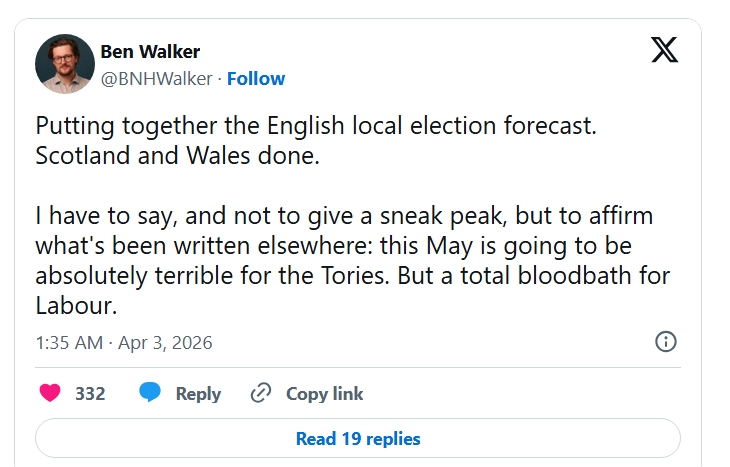
Nothing is certain, but if these polling results were to emerge in reality in a month, it is difficult to see how either Anas Sarwar or Keir Starmer could survive in post.
It is difficult to imagine, but efforts are already being made to re-frame a historic SNP victory, either as by far the largest party or with an outright majority (65 or more) as, somehow, a defeat. This absurdism stretches from efforts to gerrymander Holyrood and cobble together a Unionist Bloc, including Farage’s party, to arguing that an outright majority for one party, with a massive pro-indy majority with the Greens, somehow isn’t significant. The goalposts are being moved from ‘You’ll need a majority for one single party, which you’ll never get’ – to ‘Even if you get a majority for one single party, that doesn’t really count.’
This is desperate stuff.
The reality is that two-party politics, the defining characteristic of the post-war era, is collapsing, and we are in entirely new territory. The legitimate criticisms of the SNP – both in terms of failure of strategies for independence – and domestic policy failures – are valid, but are obviously not resonating with the electorate.
Starmer’s Labour project, which attracted large swathes of the Scottish electorate in 2024 under the mission of ‘getting rid of the Tories’ has crashed and burned. It was the last chance for the Union. As the writer Jamie Maxwell has observed: “There are some people in Scotland who will vote SNP not because they expect independence to be delivered next term but because they think only an SNP-dominated parliament can or will, at some point, deliver it. Nationalist strategists understand this. Their critics don’t.”
The SNP’s survival may seem unlikely or improbable, but it is a sign of deeper historical forces at work and a sign of a broken Union and the failure of it as a political force.

We are supported only by our readers. We don't have corporate backers and we don't take advertising, so we rely entirely on your support.
Help to support independent Scottish journalism
What I think we are witnessing at present, and have been witnessing for several years is the United Kingdom just falling apart. Increasing numbers of people, including many in England, simply see the United Kingdom as having no real meaning for them. I think the death of Queen Elizabeth symbolised this for a large number of people. She had been there for 70+ years and connected the post war generation to the present. She represented a continuity albeit one whose threads were fraying and unraveling.
Successive UK Governments – Con/LibDEM/Con/Lab have been insubstantial and unable to provide a vision and a ‘national’ story, and their members have been mired in corruption from the egregious Boris Johnson, the idiotic May, the upper class entitlement of Cameron, to the petty bungs received by Starmer and his cronies. The infamy of Brexit and the mendacious basis on which it was achieved cut the UK loose from a significant international economic bloc. Scotland was removed despite voting to remain, while Northern Ireland having voted to remain, is still to all intents and purposes a member despite the lie of it being out of the EU with the rest of Britain.
In Scotland, Labour has not had any constructive ideas since 2007 and has been sullenly oppositionist, incapable of producing positive proposals. It destroyed itself substantially in 2014 when it showed itself to be contemptuous of Scots and anything Scottish and embraced Tory gold in the risible ‘Better Together’.
The Tories are in terminal decline and its voters migrating to Reform for no great reason other than it is not pro independence and will provide some right wing MSPs. Reform is essentially racist, xenophobic, sectarian and sub-Trumpianly anti British. The self proclaimed British party that wants to subjugate its country to a thuggish, criminal crooked US President.
If the people of Scotland vote for an SNP majority or a pro independence majority either the Greens it will just be another chunk of masonry falling from the crumbling edifice of Britannia. In Wales, sweeping PC gains and large Green and Reform council gains in England, combined with a lessening of Ulster Unionist fears of a United Ireland will add to the sense that ‘things fall apart, the centre cannot hold, mere anarchy rules’.
Is a ‘terrible beauty’ about to be born?
I have been watching a few podcasts on Irish reunification and how Brexit has affected the discussion. The main points I observed were that Brexit has both :
1)opened up people in Northern Ireland to the idea of reunification due to the issue of Ireland being ignored during the Brexit vote and the contortions Westminster got into over border in negotiations with EU.
2)the lack of detail about what Brexit entailed in run up to vote has led to people on both sides of border wanting as much detail as possible on what reunification would entail before any vote.
The need for the government in Dublin to do as much work as possible in planning reunification including dialogue with unionist leaders in Northern Ireland was emphasised. The idea of a Constitutional Convention was discussed. Ideally this planning would include Westminster but it was understood that Westminster may well opt not to participate.
Although there are significant differences between Scottish independence and Irish reunification the issue of Brexit, the wish of electorate for as much information as possible and pre-planning (especially for transition period) were issues that seemed most relevant to Scottish independence.
There is a diminishing section of Scottish society that will not want to contemplate independence under any circumstances but there is also a substantial section who, although they may not currently support independence, are not ideologically opposed to it and will want to become involved in its planning as it seems more likely. The more sections of Scottish society involved in planning for independence the more effective it will be and the more support it will gather.
Perhaps if independence supporting parties hold power in Scotland and Wales after May this will help make independence seem more probable and encourage more people to become involved in planning for it?