
Scotland’s Strange Election and the Barbarians at the Gate
The seventh Scottish Parliament election campaign since 1999 has not exactly set the heather afire; missing energy, purpose, connection and relevance to voters.
‘The story of the election is that there is no story’ observed election guru John Curtice, but underneath this more is at work. In many respects this is a standstill election – a holding operation for the SNP incumbents against a weak and divided set of opponents – a contest waiting for something to happen here or elsewhere that will define and give it meaning.
The SNP will be returned with the largest vote share and number of seats but with a much-reduced vote compared to 2021. Potentially they will win with a constituency vote which was last lower in 2007, when they narrowly won and entered office for the first time – and their lowest regional list vote in the history of devolution.
‘No one realistically thinks a 34% constituency vote is a mandate for an independence referendum’ noted one pro-independence commentator. What it would amount to is a victory akin to the ‘loveless landslide’ which Starmer won in 2024 on the same share of the vote and the same lack of enthusiasm: all of which stored up problems to come for a Labour Party unsure of what to do with its victory.
We need to talk about Reform
The big takeaway of the election is the rise of Reform aided by the collapse of the Tories and retreat of Labour burdened by the setbacks and scandals of Starmer. There are a set of paradoxes about the march of Farage north of the border. Firstly, Farage has never been popular in Scotland and his toxic ratings have not improved. Secondly, Malcolm Offord, Farage’s choice to lead Reform in Scotland with no democratic mandate, has fought an election filled with missteps underlining his lack of political experience and instinct.
Reform have been able to counter these negatives to an extent such is the weakness of their opponents. Much media commentary has focused upon whether Reform or Labour will finish in second place in votes and seats. This misses a bigger point. ‘Whether Reform form the biggest opposition party or not, they’ll be treated as such either way. Scottish politics will revolve around “culture war” issues more than independence (which isn’t happening soon) and Swinney will get on with making cuts’ observes academic Ewan Gibbs.
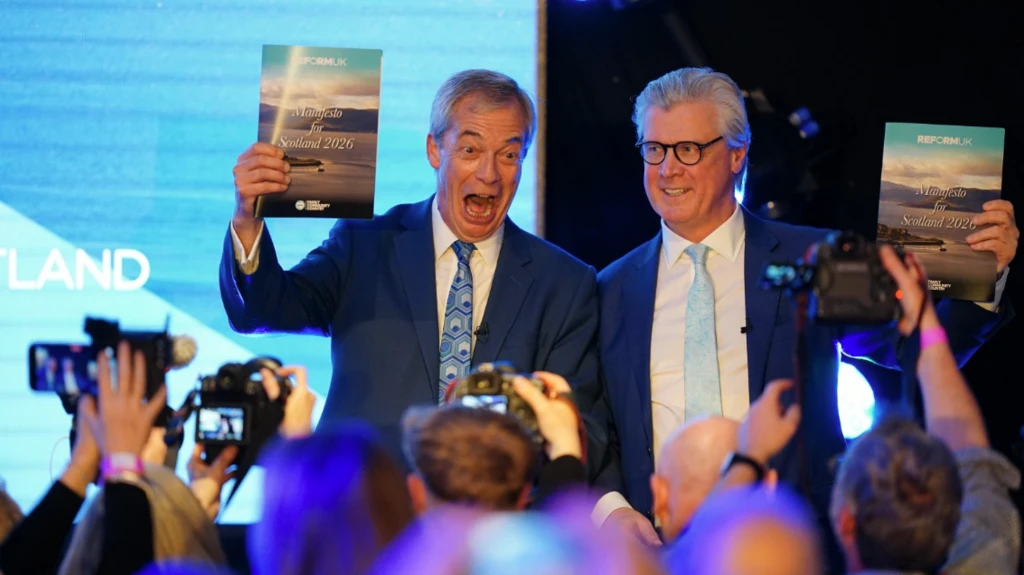
The Scottish Parliament does need disruptive politics – challenging the cosy consensus, managerialism and smug insiderism of Holyrood. But Reform will bring a performative politics of posturing, anti-virtue signalling, dehumanising and stigmatising minorities, normalising racism and endlessly searching for new enemies and dividing lines. None of which will help a politics which delivers change and supports those who need it most.
Labour and Tory Troubles
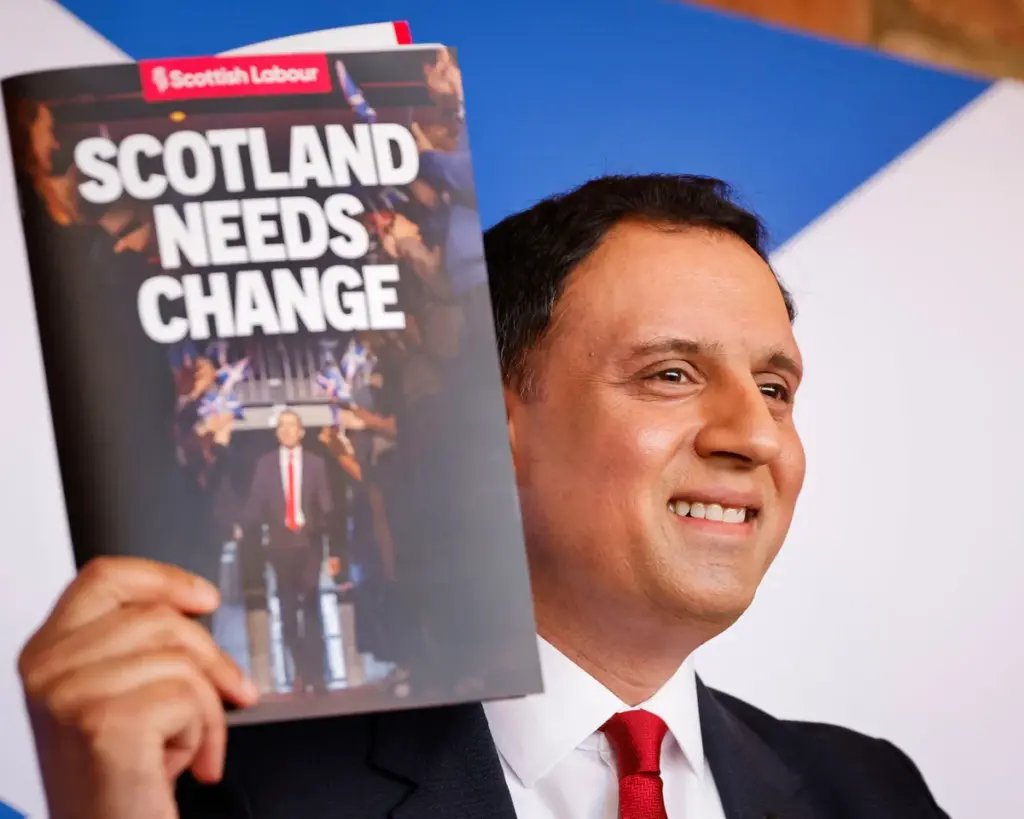
If Reform are on the march what of the other parties? In Scotland, Wales and England Labour have retreated to a point where no previous heartland is safe. Wales and London are under threat with the former set to go the way of Scotland. Anas Sarwar failed to take the opportunity post-2024 of Labour’s victory and SNP defeat to put forward a new rationale for Labour and critique of the Nationalist record. Then again, Labour have failed as an opposition force in Scotland for 20 years, hardly making much of an impact in the Scottish Parliament over their period in the wilderness and are close to becoming an irrelevant political force unless something drastic changes.
Similarly, the Scottish Tories have struggled over most of the 26 years of devolution to find a role and voice. The only exception was the much-hyped Ruth Davidson leadership where Tory fortunes briefly rose. But this brief hiatus to Tory discomfort and decline was all about Ruth and nothing to do with remaking and detoxifying the Tory brand. The Tory vote in 2024 was the lowest in the party’s history in Scotland (12.7%) and they could go even lower this week.
The Inner World of the SNP
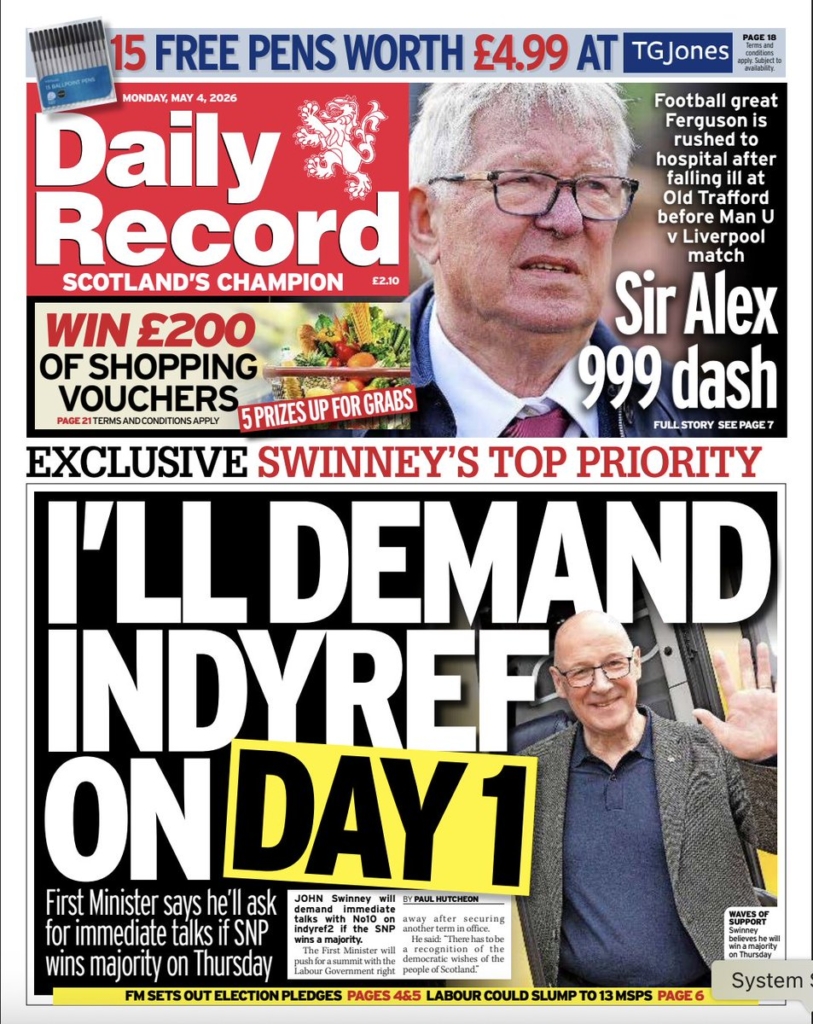
This brings us to the SNP. The interregnum of the John Swinney leadership has shown little of a new offer or vision, but he has as many have said ‘steadied the ship’. Yet is this achievement really enough of a rationale to give meaning to a fifth successive SNP victory, produce a popular mandate and governing agenda?
The SNP have not had an easy last few years. In fact, they have experienced all sorts of discomforts and problems from how the party was governed in the Sturgeon era, the centralising authoritarianism of Sturgeon, and governmental over-reach alongside policy exhaustion and failure. All of this has been well documented and debated but a deeper malaise less commented upon is a major factor.
A large section of SNP members, voters and supporters have not adapted or accepted the mixed picture of above and how to counter it. Instead, they have displayed a deep-seated cognitive dissonance manifested by a seismic gap between reality and the idealised, even fantasy version of the SNP which many seem to try to hold onto despite everything.
This disconnection has echoes of Scottish Labour’s inner world when it was the political establishment. Then too many party members denied to themselves even in private the reality of Labour in office – particularly in local government. I found this really acute many years ago when I moved from Dundee to Glasgow and found Labour activists who just did not want to recognise or deal with the machinations and machine politics of what Glasgow City Council was up to in their name. Instead, they projected an often vague, idealised and ultimately fantasy of Labour to keep motivated which had no connection to what Labour were doing in the city.
This Labour denialism had a rationale of keeping activists energised, but what it also did was stop them addressing the industrial-scale cronyism, corruption and contempt which went hand in hand with too much of Labour in power locally. Eventually voters had enough and called time on Labour, and their cognitive dissonance played a part in this. The SNP’s version of this phenomenon has had a disabling effect on the politics of the Nationalists and will not end well – as reality will eventually intrude and triumph over fantasy politics. The only question here is how and when?
This inner world of the SNP and similarities with Scottish Labour can be found across the wider political environment. The SNP’s long story of incumbency and government has seen the party morph in how it does politics, governs and accrues power. It has seen it adopt a version of politics with much in common with Scottish Labour when it was a formidable force and ran Scotland. Many SNP supporters will baulk at this comparison which only strengthens the convergence. One long-term observer of the SNP and sympathetic to the party puts it:
In a very short period of time the SNP has taken on the worst elements of Scottish Labour. Part of a broader development in the hollowing out of parties but gone are the days of robust debates at party conferences. The same arrogance we saw in sections of Scottish Labour are all too obvious in the SNP.
The Shape of Scottish Politics to Come
With the above factors, how will things play out in and after the election? First, pro-independence attempts to game the Holyrood electoral system will come to nothing. The various enterprises such as the Alliance to Liberate Scotland will poll a risible vote: a safe house for Alba survivors and various other delusionists. Second, there could easily be a pro-independence majority in the Scottish Parliament but this will carry little weight for now. The reason for this is not Westminster intransigence but the absence of any independence plan, progress or strategic thinking since 2014.
Third, the ruse of independence and a possible indyref by Swinney must be seen in the light of the above. Swinney is using independence to limit the number of questions asked about the SNP’s record in office. And at the same time utilising it as a vote maximalising strategy to gather independence supporters back into the SNP fold from which many have strayed. It is Sturgeon’s ‘Duke of York’ approach to independence as she frequently invoked but with an increasingly diminishing effect without a politics of substance and public demand for a vote.
Fourth, if an SNP overall majority appears unlikely this will produce a PR Parliament in which all parties are minorities and have influence and have to work with each other in at least some respect. This is the reality of the charge and counter-charge between SNP and Labour about whether the latter would be prepared to do a deal with Reform.
Reform will have influence in the next Scottish Parliament. With a sizeable Holyrood group of MSPs they will have representation on the Parliament Corporate Body and will be entitled to several chairs of parliamentary committees. In a PR Parliament with no party having a majority they will have even more influence and profile.
Fifth, the potential role of the Scottish Greens could be pivotal. They could provide a pro-independence majority in the Parliament. The party has been an ever-present force in the Parliament but it has so far failed to gain from the Zack Polanski effect which has seen the English and Welsh party galvinise the political scene. Despite this a host of mainstream media commentators continue to use the most hackneyed cliches and stereotypes about the Scottish Greens showing their indignation and reactionary nature: thus, vitriol regularly flies about calling them ‘extreme’, ‘cranky’, ‘totalitarian’ and ‘demented’ – sometimes in the same article.
Finally, in this election campaign and beyond, parts of Scotland’s media have taken a contemptuous attitude towards any politics north of the border which does not correspond to the increasingly shrill, intolerant illiberal authoritarianism which defines Westminster and its related media punditry. This newly charged partisan politics of an emboldened hard and ultra-right, scornful and dismissive of Scottish devolution, autonomy and our own distinctive politics, would seem set to grow and Scottish politics, politicians and civil society have to find a better response than so far.
Mainstream political and media discourse has a default position of blaming social media for the abrasive, divisive nature of much of public life. Yet the corrosive, hyper-partisan nature of much of the legacy media, print and broadcast, has played a role in this, fuelled by anti-Corbynism, Brexit, ‘culture wars’ and the ongoing wars in the Middle East. It is not just the overt Trumpian disinformation of GB News which has gone unchecked by the regulators. The Daily Mail and Telegraph are increasingly siren organs of the ideologically intolerant right. But so too are once liberal platforms with The Times showcasing Melanie Phillips and Trevor Philips (who also presents a show on Sky News): the former shamelessly articulating Israeli genocide denialism and the latter with a track record of denying the existence of Islamophobia while articulating it.
If this were not enough traditional broadcasters such as the BBC have long lost the confidence to stand up and ask difficult questions of those in power. Instead, fearful of the critique of a vengeful right, worried about the future of the licence fee, and losing audience in a fragmented, multi-platform environment, it has yet under successive Director Generals, to find a clear purpose. The same can be said for BBC Scotland with Radio Scotland’s relegation of arts and culture in the country as it dumbs down and embraces generic programming [Scottish musicians in open revolt against BBC Scotland – Bella Caledonia].
Underpinning this election campaign and its strange mood is a widespread sense of unease, dissatisfaction, anger and worry. There are domestic concerns and more general geopolitical and international challenges. There is a prevalent sense of angst and anxiety about mainstream politics and politicians across the board whatever their views, a frustration and fury about the status quo, and a want to try something radically different – hence the rise of Reform and continued strengthening of the Greens albeit nothing like down south.
Safety-First Politics whoever it comes from won’t hack it
‘Steady as she goes’ politics will not suffice in Scotland just as they don’t anywhere across the Western world. That goes for the SNP and John Swinney as it did for British Labour and Keir Starmer. This is an election marking time, which should have been about change but is instead waiting for other things to happen such as the ongoing crises of British government and the British state to boil over and become more acute. Such a passive politics – of Scotland as an onlooker and observer in its own fate – has only encouraged the disillusion and disconnection which is all too prevalent in this contest.
Scotland deserves and needs a politics better than that currently on offer. To rise to the numerous challenges the country faces economically, socially and in public services. To offer a vision of self-government and independence which dares to think big while also connecting reality and inconvenient truths to the idealism we all want to see in public life: a politics with responsibility, honesty and ambition at its heart.
Unless mainstream politics changes how it does things the current rising tide of Reform, racism, xenophobia and scapegoating and blaming minorities will become turbo-charged. Alongside this an intolerant and bitter English nationalism will continue to have a corrosive, damaging effect across the UK and spill over the border. Maybe the dominant forces of Scottish politics – an inclusive but self-congratulatory civic nationalism and vague and diluted social democracy – are inadequate to meet such a challenge.
Scotland’s centrist politics are not up to delivering on the noble aims at the heart of the best version of devolution or independence. They are not up to taking on and defeating the emboldened, radicalised right-wing. We need to be honest about this, recognise the storm clouds in the near-distance, and start organising and nurturing a different kind of politics to that practiced by Holyrood politicians over the past 26 years.
This is easier said than done but politics need to change course dramatically and recognise the high stakes in Scotland, UK and Western world. Mainstream, safety-first politics are bust; the forces of reaction, populism and bigotry are emboldened; public discourse has become more contested and a cacophony of noise and rancour.
Scottish radicals, progressives and democrats need to rise to the occasion, not cling to our comfort and echo chambers, and recognise that in these turbulent times of climate catastrophe, neverending wars and the rise of the extreme right, there are no easy answers. But change starts with recognising this, that safety-first politics will not suffice, and we have to create a new kind of politics of belonging and coming together to defeat the barbarians gathering at the gate.

We are supported only by our readers. We don't have corporate backers and we don't take advertising, so we rely entirely on your support.
Help to support independent Scottish journalism
I would say theres no great relevance to 2024 – Labour clearly received “borrowed votes” to kick the Tories out, but for many people in Scotland it was for a parliament (Westminster) we see as being voted out of existence, and that has a sell by date that you can number in months (not decades). 2024 wasn’t a Labour win & it was disappointing to see pro-European Scots described as “Nationalists”. In this decade the two broad cohorts are Brexit British Nationalists or Pro-European internationalists, who – living inside Scotland’s uniquely export led economy- appreciate we need reunification with our true Family of Nations . I for one am an internationalist. Let’s leave harmful Nationalism to the hardcore Brits.
I agree in general terms, but I think the rise of the far right, or Trumpism, may be over-hyped by those who support it.
‘Labour denialism had a rationale of keeping activists energised, but what it also did was stop them addressing the industrial-scale cronyism, corruption and contempt which went hand in hand with too much of Labour in power locally.’
The SNP has done exactly that same. The cronyism corruption etc has simply switched parties. The SNP went from Dennis the Menace to Cuthbert Cringeworthy, and it is never going to deliver any form of independence worth the name.
The tide is turning however against all this and the more outrageous the behaviour, the more it will prove self-defeating. I confidently predict that the SNP will face fury when it fails to deliver anything after the election, just as Labour did in London. But contrary to the Unionists claims that the only way to defeat the SNP is to vote for them I do not think they will benefit from this disillusionment. We are already heartily sick of the lot of them, the SNP included.
I think the independent and Alliance candidates might well do better than expected. I also think there’s a growing head of steam both sides of the border for a new radical agenda. This is what drove the ‘Your Party’ movement, the support for Zack Polanski in England, the election of Mamdani in New York. The old guard, across the board, cannot prop itself up with increasing violence and nastiness indefinitely. England is now a fascist country and every arrested peaceful demonstrator and opponent of the utter horror going on in the Middle East is another shot in the foot for the Establishment. As is its unquestioning support for Donald Trump and his genocidal friends. He is not going to survive much longer and the ‘British’ Establishment – including, I hope, the monarchy – will go down with him.
I fully expect a miserable result to a miserable election and a deep awareness of betrayal. Reform might have a brief moment in the spotlight as a ‘disruptive force’, but it is going nowhere. In fact it starts to collapse as soon as it wins any seats anywhere because it is obviously a fake ‘party’ , a PR company set up by organised crime. A vote for them is a vote for Trump. And who really wants that?
I think we have to go through this to kick start the energy to start dropping the Scottish cringe and reinvigorating the demand for independence. Real independence, not some feeble Vichy France version. Meanwhile I’ll vote for an independent candidate.
‘England is now a fascist country’
This is rubbish. Arresting some demonstrators due to specific sensitivities regarding the Middle East does not make it a fascist country. I cannot understand how people can write such stuff with a straight face.
Shame because a lot of what you say otherwise is perceptive especially regarding Reform and the SNP’s corruption and complacency.
The irony regarding where the SNP sit politically, which a very soft centre-left is that is very similar indeed to Labour (and the LibDems). The Greens (English/Scottish) are more left but not by that much when you really look at it though quite what the Scottish Greens are about these days is not very clear. Perhaps because of the question of independence these similarities get forgotten and the stark unionist/nationalist divisions are paramount.
I find this depressing as it all seems like dancing on the head of a pin outside attitudes to the Union. I feel this will be mirrored at the next GE, and the result? A Reform government. Then we will see what you say John Wood play out across the UK, but that ‘disruptive force’ will have considerable impact nationally.
Fascism.? The cap seems to fit pretty well as I see it. We could probably argue about definistions of ‘fascism’, and if course I am referring to modern, business- suited neo-fascism rather than the 1930s variety. I am talking about police arresting people for peacefully objecting to genocide, and leving them to rot on remand in prison until they go on hunger strike. I am talking about the weaponisation of victimhood and real antisemitism – the outrageous claim that all Jews support the horrific crimes of Israel and that the police can somehow justify shocking brutlity, repeatedly kicking a tasered, incapacitated man in the head. The attacks on Zack Polanski, a Jew, for not supporting genocide (and if he did support it, to attack him for that instead). I am talking about the blatant corruption, the performative cruelty, the utter destruction of civil liberties, democracy, the rule of law through ‘SMART’ ( Surveillance, Monitoring, Analysis and Recording ) technology, the Internet of Things and of Bodies ( and minds). The supposed ‘entitlement’ of the super-rich to be completely above the law and do as they please, bullying, harassing, extorting, blackmailing people. Because the rest of us ‘will own nothing and be happy’. The lies, the endless deception, Macchievellian manipulation, warmongering and militarisation,, Project Fear …. I could go on and on – it all has the hallmarks of fascism to me. Our family members who fought and died to save us from this will be spinning in their graves.
Here in the Highlands, human rights, democracy and the rule of law are a mirage. And this is becuse for centuries, the highlnds hve been Scotland’s colony. For the last 300 years, Scotland has been England’s colony, ruled by violence. And for the last 80 years England, or rather ‘Britain’ has been a US colony. But let nobody say a word about that.
So, who to vote for?
A vote for Reform is a vote for Trump and his friends, It isn’t even a real political party, just a commercial PR outfit funded by the friends of Epstein . Who really wanTs that?
A vote for Advance is a vote for Reform
A vote for the Labour / Tory party (effectively one) is now also a vote for Reform
A vote for the LibDems is just a vote for Starmer. They have nothing believable to offer, just their hatred of the SNP
A vote for the SNP? A self-defeating, controlled ‘opposition’ that tries to capture the Yes vote only to destroy it. Flower of Scotlnd? Hmm. ‘ Weeds of Scotland more like. Setting themselves up as targets. A cap-in-hand party of endless excuses.
A vote for the Scottish Greens is a vote for corporate Greenwash. There’s nothing really ‘green’ about them anymore.
Such a prcel of rogues in a nation. We need rid of them all. We need authorities that act by the genuine consent of the governed. Who are accountable to us’ no-one else. We need a real rule of law in which all are equal and to which all have equal access. No more private affluence and public squalor.
Anyway enough ranting, for now. I will vote for an independent, independence supporting candidate. Because sovereignty is the only possible future for us. We can argue about what that future looks like when we have the power to do it.
I confidently predict that after this electio;, whatever the outcome, there will be a similar tide of fury at the wholesale betrayal by all sides of the ‘British’ establishment ( in which I include the supposedly pro-independence parties) – we have seen it before and there’s a head of steam building that cannot be contained indefinitely. Donald Trump’s downfall has already started. So has the globalist world economy.
It’s going to be a rough ride, but I look forward to some genuinely radical politics ahead.
John,
You appear to have given up on democratic politics and want a ‘radical’ alternative.
Who’s going to vote for this?
If you’ve given up on democracy as a sham doesn’t this make you a fascist?
Reams of petulant self indulgent miseralbislim. The clear objective is independence, unless you want to be throttled by what’s coming in England. The SNP is the only material you have to work with, however ineffective they may currently appear and you paint an extreme and unsupported picture of them, just as the media do. You are even writing off the Greens. You have to work with what you have and see what positives there are. Abandoning the SNP is abandoning Holyrood, which together are an electoral and institutional base which will not be replaced.
It’s interesting how so much commentary on the current election chooses to depict it as uneventful and boring. This seems to me to be a profoundly parochial perspective. You won’t find many countries worldwide where the left has been in power for nearly twenty years and is likely to be returned to power once more. This in itself is quite remarkable in an international context which has seen the far right on the rise and social democratic governments desperately following in its tracks – as in Denmark – or the left losing the plot through endless internecine battles – as in France.
Another commentariat constant is the whole theme of policy failure. You’d think that the SNP were terminally corrupt, careerist, sold-out to vested interests, and incapable of delivering anything at all. Yet alongside the undoubted policy failures there are also clear policy successes, including, for example, the tangible effects of the Scottish Child Payment and the very different strategic direction taken by the Scottish NHS compared to its English counterpart, as argued recently by Allyson Pollock.
Perhaps a more nuanced analysis is required? Especially since the USP of this strangely resilient social democratic party that is the SNP is independence – which, let’s face it, involves an utterly revolutionary break-up of the British state.
You seem to think ‘the left’ have been in power in Scotland for the past 20 years. No serious analysis of the SNP in office could characterise them as this.
Similarly the state of what passes for Scottish social democracy is not really that social democratic. Not being very redistributive to those in need but on any analysis of the distributional consequences of public policy choices redistributing income and resources up the income scale to those who are more affluent: free tuition fees; free care for the elderly.
Yes there have been SNP successes in office which I have written about elsewhere in detail. But there have also been all the things you allude to not existing: scandals, careerism, insider politics. The point I am making is that 20 years on there needs to be an honest assessment of what is a very patchy record public policy wise rather than the denialism which exists in too many true believers.
Yes, I most definitely would characterise the SNP as on the left, perhaps more accurately on the centre-left. Its policies are not much different from those of many of the mainstream left or centre-left parties in Europe, for example. I think the problem lies with the ‘serious analysts’ you mention who reject this label. While I would agree that the SNP is not a Socialist party by any measure, its policies identify it clearly, in my view, as within the spectrum of what we once called the Broad Left.
This raises a wider issue though, namely the tribalism that characterises much of the left in Scotland (and probably not just in Scotland), whereby Scottish Labour castigate the SNP as ‘not left-wing’ and vice versa, each side throwing the insult ‘Green Tory’ and ‘Red Tory’ at the other. My own view is that the route to independence will only open up clearly once we have got over this kind of petty sectarianism. One hopeful sign in the STUC welcoming the leaders from Scotland’s three left parties: SNP, Scottish Labour and Scottish Greens. Another is grassroots initiatives such as the Scotland Demands Better campaign.
As for the question of policies like free tuition fees: I find it remarkable that some on the left reject universalist policies which help define a progressive social contract between government and people, a key example being the NHS. We need more of such policies, not fewer: free nursery care, perhaps free transport once day, and universal basic income. To be paid for, of course, by progressive taxation across the board. That is the way to entrench progressive ideas so that they become hegemonic (in a Gramscian sense) and are to some degree protected from the passing whims of electoralist politics.
I look forward to proper, grounded, non-sectarian analysis of the undoubted failures but also successes of the SNP’s 20 (hopefully 20+) years in government. Such an analysis might also seek to explore why it is that the Socialist left has so far utterly failed to get any lasting purchase in Scotland, an outcome I personally very much regret, but which I think might be bound up with some of the points I made above.
Paddy – I couldn’t agree more with your post. Gerry Hassan’s criticism of universalism is quite something when it has been a core principle of left of centre politics since 1945.
His article is basically no more than Gerry putting his own spin on the almost universal media line of the election being boring and pointless. He talks about the lack of radical ideas from parties without offering any suggestions himself . You shame him by putting forward an array of left of centre policy ideas in a much briefer comment.
I would turn the reporting on its head by stating that the media reporting of this election has been boring and shallow and I include this article. Where is the analysis of how Scottish politics has changed since 2014 independence referendum? Where is the analysis of how Brexit and Internal Market have affected Holyrood and its relationship with Westminster? Where is the analysis of how the refusal of Westminster to even countenance any possibility of another independence referendum has affected Scottish politics? This and various other issues – eg increasingly elderly population, the increasingly restrictive Westminster immigration policies are affecting Scottish economy and Holyrood’s scope for action- rarely examined in any detail if at all.
In short the politicians in Scotland may be disappointing and not serving Scots as well as they could be but the media are hopelessly lacking in any credibility and completely failing Scots.
Gerry Hassan is still a more interesting journalist than vast majority of media in Scotland but based on his recent output he appears to be in danger of falling into their bad habits.
Thanks for your comments John.
What are those bad habits out of curiosity that you refer too?
Two brief thoughts:
1. There is a right-wing problematic media agenda in Scotland as there is across the UK.
2. At the same time there is point in a politics of illusion about the SNP and state of independence.
There have been too many myths and fairy tales told in the decade plus since 2014. It does not aid anyone. Does not aid people needing radical change. And does not aid those wanting independence.
Gerry – I am not indulging in comforting myths that have arisen since 2014 independence referendum. I personally think the SNP and wider Yes movement need to properly concentrate on addressing concerns of No voters in 2014 eg currency, pensions etc. They also need to talk far more about how an independent country would benefit the citizens of Scotland and their children both economically and socially. They need to open up discussions with a process similar to Constitutional Convention post 1979 devolution referendum. They need to spend less time on the process of getting independence though forcing Westminster to accept Holyrood’s right to call an independence referendum is crucial.
Paddy’s comments highlighted some of radical solutions which many of us would like to see implemented in Scotland. I compared that to your column which repeatedly highlighted the need for radical reform without offering many suggestions- that is an easy cop out.
I have also identified how much more hostile and interfering Westminster government have become in Holyrood since 2014 (first ever use of Section 35), the effect of Internal Market on freedom of devolved governments in UK. I also gave specific examples Bottle Deposit Scheme, safe room injection scheme where Westminster opposition has been knee jerk. These are not comfortable myths, they show that devolution to some extent relies on a benign Westminster government approach. With the particular demographic challenges Scotland is facing how can any government address these without having more power over immigration? On top of all this the approach from Westminster to Holyrood has been far more confrontational post 2014. All of these developments leave big questions about the future of devolution but are rarely discussed.
Similarly most of the media are wringing their hands about a 5th successive SNP win in a Holyrood election especially as the last 5 years of government have been difficult and unimpressive. Where is the serious discussion about why the SNP will win again in spite of their well documented troubles and what does this tell us about Scotland in 21st century?
I would have expected someone with your academic background to actively engage with these deeper issues in an article about the Holyrood election in 2026.
Thanks
John
Thank you for your comments.
First, I have written endlessly on different creative approaches in Scottish and indy politics. I don’t think a pre-election or immediate post-election environment is the time for floating new ones.
Second, the SNP is winning despite losing lots of its support. It is being aided by the weaknesses of its opponents and is offering little. I think the SNP have ran an insipid campaign – lifeless and without purpose or energy- and this may come back to bite them.
Finally, my piece is trying to address the delusions and illusions about and confront the vacuums at the heart of our politics – from independence to the wider political spectrum..
Without addressing these and how to counter the far right we really will be floundering. Hope the above answers your main points.
The SNP are a social democrat party that borrow some ideas from the left(free education etc) but ultimately are a neoliberal project. Neoliberalism is RIGHT wing. Calling the SNP a left wing party is clearly incorrect. Labour are also not a left wing party and not left or centre. Why can we define both SNP and labour as neoliberal? They both espouse the ‘free’ market as the mantra to our politics. We are told by the snp that we must build our ferries abroad as the market says that’s the best option. Labour says we must pay ridiculous prices for our our energy because the market tells us so. SNP sold our renewables at ‘market’ prices and are now owned by overseas private and national companies. This is right wing folks and is the politics of old people. The good thing is there are now a lot of younger people coming into politics that are going to see this for what it is and reject it. Get behind them. We are heading for not only class division but also generational division. Poor and getting by versus the super rich and the old against the rest. The old think snp are left wing and reform is a protest party worthy of voting for. Time to get real.
Not denying the good things the SNP has done, but their ‘Both votes Yes’ and their failure to have any real vision for what indepoendence might look like seem like self-sabotage. It is no good trying to set themselves up as the only party of independence and so setting themselves – and independence itself – to be judged by their record. Their commitment to indepoendence lacks credibility. And Angus Riobertson, the coinstitution secretary, is part of a pro-Israel lobby gvroup. At a local level the politicking is much the same as we saw from iother parties and they seem to be ineffectual. Real democracy human rights and the rulke of law are hollow shams, at least here in the Highlands. So the Unionists go on the attack and present themselvces as the only alternative. It isn’t a binary choice – SNP or Unionism, despite what both of them claim. The SNP show no enthusiasm or vision for independence. The Uniuonists have nothing to offer to claim we might be ‘better together’ with corruot, fascist Westminster.
Independence is not about any political party’s record in government or promises to improve the NHS. It’s about picking ourselves up of our knees and believing in ourselves. Unlike Norway. Unlike Iceland. Unlike Ireland. Unlike even the Faeroes. Soon, maybe, even unlike Wales. We have a very authoritarian, even militaristic tradition that sees wealth and power as their own reward. It is the counterpart to everything radical. It’s colonialism, alive and well even if unacknowledged.
Well said Paddy…..
Scottish politics has been changed by 2014 independence referendum and we are still living with consequences of it.
The recent study by IPSOs on polling attitudes clearly shows that though independence may not be the top issue at this election is still a very important determinant on how people will vote on Thursday.
Your criticism of timidity of Holyrood is valid but needs to be seen against a background where any radical policies proposed by SNP government will be vehemently opposed by Westminster, opposition parties and media as an almost knee jerk reaction. I evidence the opposition to bottle deposit scheme and drug consumption trial (both policies that have been implemented successfully on continent ) as well as the hysterical response to modest suggestion of capping some essential food prices.
The SNP look like winning a 5th successive election on Thursday at a time when incumbent governments across Europe are lucky to get a second term and after an extremely mixed performance over last 5 years. There is obviously something else at play here and IMO it is a combination of unionist parties being in a trench concentrating on negative anti SNP and anti independence messaging without offering a positive prospectus or a positive case for the union. In addition there is a core constituency of voters who are willing to overlook policy shortcomings and vote SNP based almost solely on their support for independence.
The Scottish political landscape is pretty depressing at present and when you consider the demographics of support for independence, Westminster intransigence to another referendum and unionist opposition parties absolute opposition to even considering independence, not to mention a potentially hostile Reform/Tory Westminster government in 2029 things are unlikely to change for the better any time soon. I would also add that the SNP focus on process rather than strategy means that even if there is to be another independence referendum the pro-independence side could still lose it which would leave the country in an even more unsatisfactory position and a recipe of more of the same for the longer term.
Some of this reflects “truth”. Other parts are little different from the jibes from the right-wing critics.
How does a country which has been under a colonial cosh for centuries escape their cringe?
We now have virtually no indigenous media.
We are daily told we are useless and inferior—often by Scot hating Scots.
If the pro-independence people fail now, it’s hard to see any future resurgence.
Holyrood cannot defend us and may not survive whoever gets into No 10 next (not just Farage).
The same media which promotes Reform decided to be “bored and scunnered” with Scottish democracy.
I seem to remember when the SNP was threatening Labours hegemony, that the media then (led by the BBC) decided to be “bored”.
It’s a method to turn voters off, and diminish turnout.
We are in stasis. For the foreseeable future the SNP will be the largest party in Holyrood, put there by people who support independence. Those who don’t support/have yet to be convinced won’t vote for them, but as the non-indy vote is split no other party can wrest control.
The SNP seem unable or unwilling to put in the hard work to convince the waverers – every Finance Sec promises a GERS that will show Indy in a positive light, but the analysis never appears. Ditto a plan for creating the apparatus of state, etc….
So…..the SNP won’t lose too many voters as they have the indy vote, but they won’t gain many voters as they don’t know how to attract the waverers.
Normally a poor quality incumbent would end up being voted out, but I can’t see that happening for a few cycles.
“We are in stasis”. It depends who and what “we” refers to here. If it refers to Scottish electoral politics it is arguably true – though only if you take Reform and Tories to be largely interchangeable. If it refers to UK or world politics it is surely false. It would be more accurate to say that the world is entering a state of chaotic uncertainty, so there is something to be said for maintaining a steady course till the shape of the chaos becomes clearer.
In the past week I heard a Labour MSP use the word ‘socialism’ in a way which implied a belief in the concept!
Is this a ‘red’ crawling out from under the ‘new’ Labour bed or a careerist reading the runes and positioning for the fall of Starmer and a shift to more redistributive policies and investment in public services like integrating public transport?
Will Labour stop being dully oppositionist and actually engage in the creation of policies which is how a ‘proportionally elected ‘ parliament is supposed to operate?
Will all parties seek to collaborate for the common good and devolve real power and funds to local government and really empower local communities?
An independent Scotland has to be one where people have a true sense of agency.
I think the UK is just going to fall apart.
Agreed!
Very depressed by the election results coming in. Rather than ‘a new kind of politics of belonging and coming together to defeat the barbarians gathering at the gate.’ it seems the barbarians are already inside, and it’s just more of the same.
My vote was cast based on recent experience of hospital and ambulance services. It didn’t go to the party that has been ultimately responsible for them for 19 years, and it certainly wasn’t based on Scottish undependence. That said I found it near impossible to be inspired to vote for anyone. My depressing feeling is that the next 5 year of Holyrood will, unfortunately, be very like the last 5 years, a provincial accountant will be calling the shots, and whetheer the SNP have a ajority or not woun’t make much difference seeing as they have no plans to do much.
I’m afraid I agree with John and see England well on the way to a kind of Fascism…
If it’s not fascist now, it will quickly become so if they put their plans to deport 2 million people into action…
They will have to militarise the country and spend millions on vast detention centres… the courts, already logjammed, will be overwhelmed, the police, already undefunded, will be swamped with extra work, protests will erupt all over the country… the whole country will spiral into a kind of psychosis…
Reform is the worst thing I have ever seen in UK politics, of course, if you like, you can see it as merely the next stage of neoliberalism… Thatcher’s project come to fruition….
We know that the problem with public services is that they are underfunded, and that is so because the tax take in the UK is about 10 points lower than France and Denmark…
Neoliberalism, the mantra of the small State is the problem, a wretched, mean and selfish view of life which has gone from being a minority theory of a few cranks, to mainstream politics…
The Left, of course, have been nowhere for 3 decades now….
I mean, is this what the people of England want, to descend in a nightmare spiral of immigrant hunting, neighbours denouncing neighbours (delation and denounciation), the politics of fear and hate?
The country of Shakespeare, the country of Charles Dickens, the country of the most influential film-maker of all time, Alfred Hitchcock and the pure genious of Chaplin….???
What on earth is going on? How can such a rich and cultured nation be voting for a bunch of outright charlatans like Farage and Jenrick?
No doubt there were people who said much the same in Germany in the 1930s. How did the Nazis come to power? A quick questioin online produced the following AI resulty. Seems plusible to me.
“The Nazi Party did not win a single election that granted them absolute power; rather, they leveraged electoral victories combined with political maneuvering and state-sponsored terror to dismantle democracy from within.
Electoral Growth: The Nazis transitioned from a fringe group to the largest party in the Reichstag, winning 37% of the vote in July 1932 and 43.9% in the final multi-party election in March 1933.
Appointment to Power: Despite never securing an outright majority, their status as the largest party allowed Hitler to be appointed Chancellor in January 1933 through backroom deals with conservative elites who believed they could control him.
Elimination of Opposition: Following the Reichstag Fire in February 1933, Hitler used the Emergency Decree to suspend civil liberties, arrest Communist leaders, and intimidate voters, creating an atmosphere of terror that skewed the March 1933 election results.
Consolidation of Dictatorship: With a coalition majority secured in the March election, Hitler passed the Enabling Act in March 1933, which legally granted him the power to rule by decree, effectively ending parliamentary democracy and allowing the Nazi Party to ban all other political parties. ”
The present rise of neo-fascism is doing much the same. Project Fear, targettinganyone they can ‘other’, including ‘immigrants’, especially Muslims and Jews (yes, ‘antisemitism’ is being weaponised against Jews, who are all supposedly complicit in the crimes agaqiunst humanity being committed by the IUS and Israel. Reform is also funded by American roibber barons, as the Nazis were. The same poropaganda and psychological warfare techniques are being used. And the surveillance technoloigy available now would delight the Gestapo.
How many Germans voting ‘National Socialist’ had any iude of what they were doing or what it would lead to. But we have seen it all before. We have even seen Trump round up innocent Americans and kill them or send them off to concentration camps. We are already witnessing horrific genocide in Palestine, Lebanon, and blatant piracy on the seas. How many British people voting Reform are just burying their heads in the sand to register a protest vote against the incumbent party? There’s no excuses anyone can offer for what’s going on. It’s all haqpeeniung in plain sight. But no-one can face up to it.
In the 1930s, American companies funded the Nazis. Just as they are funding the modern fascists today. It’s good for business. Who cares abiout anything else?
Hugo Boss designed the Nazi uniform, John, countless companies like Volkswagon and Mercedes Benz made millions fromNazi slave camps and the workers who died from exhaustion there…
After it was all over, the Catholic Church set up the infamous Rat Line to get Nazis to S America or Franco’s Spain…
Some of the best Spanish films of the Franco era, and there were a few, were financed by Nazi gold stolen from European Jews….
The generation of the 60s, who read Marcuse, saw the links between Fascism and capitalism, particularly in Germany, France and Italy, and rose up against capitalism as a system which contained the chyrsalis of Fascism in its basic exploitative structure…
The culture mavens from Thatcher on backtracked and depoliticized the arts…
There is a famous scene of Fassbinder, the truly great German director, who died so young, talking naked on the phone to his mum on the phone, a fascist…
Fassbinder died thinking the revolution was just around the corner, and the old otder would be swept away…
I mean, I think we are seeing the final fruition of Thatcherism, a Hobbseian society of lives short, nasty and brutish… a perpetual.civil war…
You see it in England in their total indifference to culture.
Hitchcock was English, but you’d never know it. He left for America for that reason.
He couldnt stand being looked down on anymore by the toffs. He is one of the great figures of 20th century world culture, and the English just ignore him.
The same with Chaplin, a true Socialist, an absolute red, expelled from the USA by Macartheyism…
You might expect the English Left to claim Chaplin, but they also completely ignore him… How many people these days have seen CITY LIGHTS?
So, culture is vital, because it gives meaning to life beyond the basic life necessities which is what British politics are all about…
Helen Graham, in her short (and brilliant) book on the Spanish Civil War defined culture as “the means by which change in a society is mediated”…
That’s a great definition…
It is the key to positive change…
Douglas,
You don’t half talk some cobblers.
Both Chaplin and Hitchcock went to the US because they got paid loads more money than if they stayed in UK.
Chaplin also had a predilection for young girls which Hollywood turned a blind eye to.
The ‘socialist’ Chaplin spent his final years living in tax exile in Switzerland in a massive villa overlooking Lake Geneva with his extremely young wife.
Thankfully (for Chaplin) he lived in an age when the sexual predators in the film industry were in charge
What absolute garbage you spout, Learmonth…
Chaplin’s socialism is all too apparent in the films he made, and CITY LIGHTS is one of the great films of all time, continually voted by film-makers in polls as such… as for THE GREAT DICTATOR, Chaplin took a stance against fascism and war very explicity, something film-makers these days seem reluctant to do…
His relationship with women – young, but of legal age, like his last wife – wouldn’t have been so unusual for the time…
The wider point is you can watch every single minute of election coverage in the UK and no one, not a single politician or journalist or member of the public even ever mentions the word culture, or culture policy, or anything except growth, immigration and jobs…
No wonder the country is so miserable, given that culture is where the fun starts…
Spot on.
F**k!