
From Glory Days to Building a Better Future
“If you don’t like the changes we’ve made, the door is open, and you can leave”.
– Keir Starmer (2023)
And they did.
There is a sense of déjà vu in the air this weekend, as the defeated Unionist parties retreat to their default position of ‘everything’s fine’, ‘nothing has changed’. Facing a fifth election victory for the SNP, the collapse of Labour hegemony in Wales after nearly 100 years, and the ruling government’s massacre in local elections in England, the response is to shrug and pretend it’s all great. I’m not sure if you’d describe it as hubris or denial, but it’s a spectacle in itself.
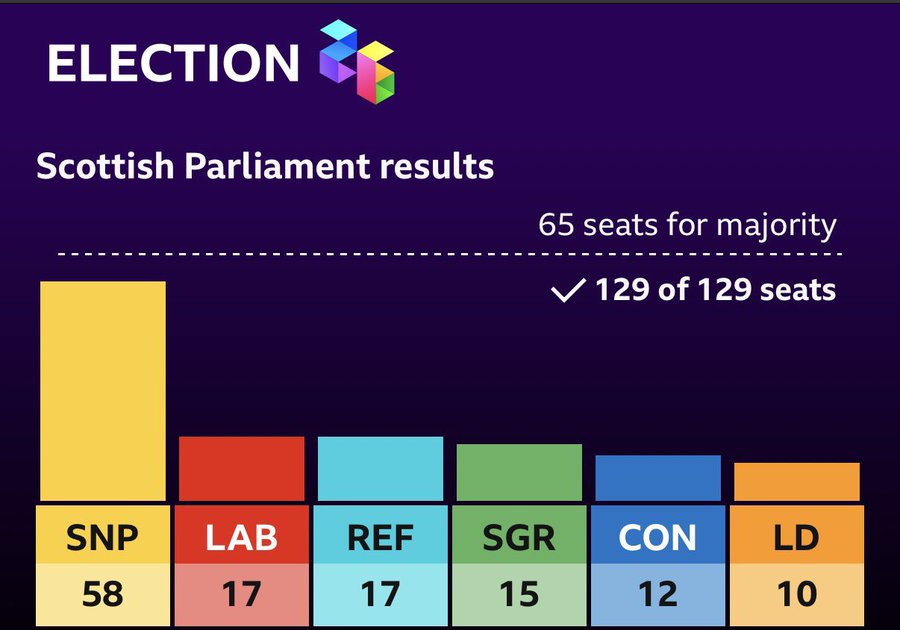
The final results of the Holyood election were a pro-independence majority of 73 – the largest number of pro-independence MSPs ever elected to the Scottish Parliament.
The Unionist response?
The Daily Mail: “Swinney’s hollow victory: Independence remains off the table and he’s lumbered with a crackpot manifesto – and a team of duds to enact it (or more likely botch it).”
The Sun: “Nats Fail: Down and Rout.”
The excuses range from ‘it was all Keir Starmer’s fault’ to the ‘Reform Party split the Unionist vote’, to ‘turnout was low’, or to pretend that the whole election was terrible, and therefore somehow not real.
As we begin to look over the consequences (or inconsequences) of the election, it’s worth considering three different aspects. The first is the state of the independence movement and parties; the second is the makeup of the new parliament; the third is the state of the Unionist parties and the established order.

The State of the Independence Movement
Laurie Macfarlane, Co-director of the Future Economy Scotland think-tank, wrote: “Ironically, the victory was greatly helped by Reform further splitting the unionist vote. As long as the unionist vote is split four ways, while the independence vote is split two ways, the arithmetic will always favour the pro-indy side.”
That’s not quite true. The independence vote was ‘split’ at least four ways: SNP, Scottish Green Party, the Alliance to Liberate Scotland, and the Workers Party of Scotland, headed by George Galloway. George Galloway’s Workers Party got 0.4% in Glasgow. The Alliance to Liberate Scotland’s lead candidate, Craig Murray, got 150 votes in Edinburgh. The Scottish Green Party won its best ever result, including defeating a sitting Cabinet Minister, Angus Robertson in Edinburgh Central and Holly Bruce winning in Nicola Sturgeon’s old constituency of Glasgow Southside. The Scottish Greens won more votes than Scottish Labour on the Glasgow List and now have an MSP in every region of Scotland for the first time.
So it’s not true that the independence vote was only ‘split’ two ways. It was split four ways but the forces of the remnants of what was once Alex Salmond’s Alba Party, and, whatever you would call George Galloway’s latest party, were completely humiliated.
This represents a significant moment for the independence movement, where these reactionary movements, sub-cultures and micro-parties will now disappear.
Despite the surround-sound of gloom and smear from the mainstream media, and the pervasive sense of doom that was put on the campaign, the Scottish and Welsh parliament elections show people are looking to “a future beyond the constraints of the Union”, Michelle O’Neill, the First Minister of Northern Ireland has said.
Tedium blends with history.
As the historian James Hawes put it [The twilight of the British Union]: “Is the UK finished? Of course, this seems unthinkable. But then, the idea that Britain might actually leave the EU was scarcely credible just a decade ago. Such things always seem unthinkable until they happen, at which point we immediately wonder how we didn’t see them coming.”
It’s difficult to see any glimmer of hope in such a gloomy landscape, but consider this. Despite conditions that could not be more favourable for the Union, the Uniparty has been roundly defeated. After 19 years in office, with an incumbent government reeling from internal factionalism and with the favourable wind of a ridiculously partisan media behind them, Labour, in particular, failed spectacularly. Consider the factors in favour of Anas Sarwar. As Jamie Maxwell points out in Tribune [How Devolution Destroyed Scottish Labour]:
“Scottish Labour’s crack-up is even more interesting considering the advantages its leader, Anas Sarwar, appeared to enjoy. Sarwar emerged from the depths of Scottish Labour in the late noughties, flush with institutional support and family money. (His father, Mohammed, was the MP for Glasgow Central; Anas inherited the seat in 2010.) When Richard Leonard tried to breathe fresh life into the party during the Corbyn period, Sarwar stepped in to stop him. Positioning himself as the golden boy of the Blairite right, he easily won the leadership contest in 2021, once his faction had reestablished their dominance.”
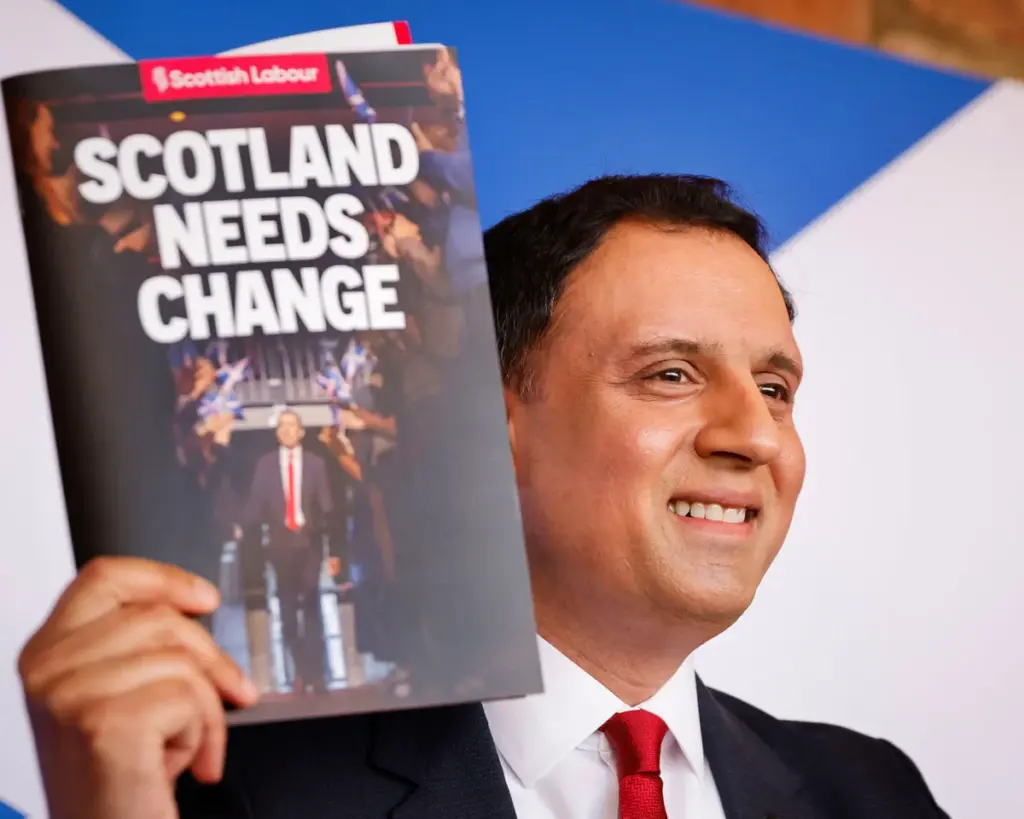
“The leader worked hard to ingratiate himself with the Westminster clique. He proclaimed his loyalty to Keir Starmer, endorsing the PM’s brutal welfare reforms, and indeed to Peter Mandelson, whom he publicly described as an ‘old friend’. Scottish Labour had considerable success in replicating their approach to private interests. In January, Sandy and James Easdale, billionaire owners of the McGill bus franchise, donated an undisclosed ‘six figure sum’ to the party. Sarwar, the brothers said, had ‘a better handle on business and how Scotland’s business sector works’ than Swinney.”
“Two months later, The Ferret revealed that Sarwar had received another sizeable donation. This time the cash came from Stonehaven, a London-based PR firm that counts among its clients the French energy company EDF, which happens to own Torness, Scotland’s last surviving nuclear power plant. During the campaign, Sarwar pledged to overturn the SNP’s ban on nuclear, no doubt to the delight of his patrons.”
“Yet despite his elevated political stock, his elite connections and his effective positioning as Scotland’s foremost representative of capital, Sarwar ranks as one of Scottish Labour’s worst ever leaders.”
My intel shows that Labour spent about half a million pounds on their digital campaign, almost all of it promoting Sarwar as a singular, Presidential candidate. They outspent the SNP 3:1.
This is not just to revel in the completely botched Labour campaign – though it partly is that – but also to show that this victory for pro-independence parties didn’t come easily.
You might ask if Stonehaven will ask for their money back. Their clients are going to be nowhere near power in Scotland for a very long time, if at all. There will be no new nuclear power here.
This is a major victory for the independence movement which now finds itself in the middle of a three-nation assault on the idea of the Union. It must find the tenacity and imagination to make the most of such a situationship. We must celebrate our common ground and our diversity, eschew culture-war politics, and avoid Yestalgia. We should embrace the new dynamics and personnel of the new parliament and see all of this as a fresh start with great potential.
“Is e duilgheadas Shasainn cothrom na h-Alba” to paraphrase the Irish.
The Makeup of the New Parliament
The Scottish Parliament had shed many high-profile names before a vote was cast, 42 in total. Among them: Nicola Sturgeon (Glasgow Southside); Humza Yousaf (Glasgow Pollok); Kate Forbes (Skye, Badenoch and Lochaber); Michael Matheson (Falkirk West); Shona Robison (Dundee City East); Fiona Hyslop (Linlithgow); Mairi Gougeon (Angus North and Mearns); Sarah Boyack (Lothian); Richard Leonard (Central Scotland); Douglas Ross (Highlands and Islands).
Also departing, though not by choice, are Ash Regan, Angus Robertson and Fergus Ewing.
That’s a generational shift, and a chance for a re-start.
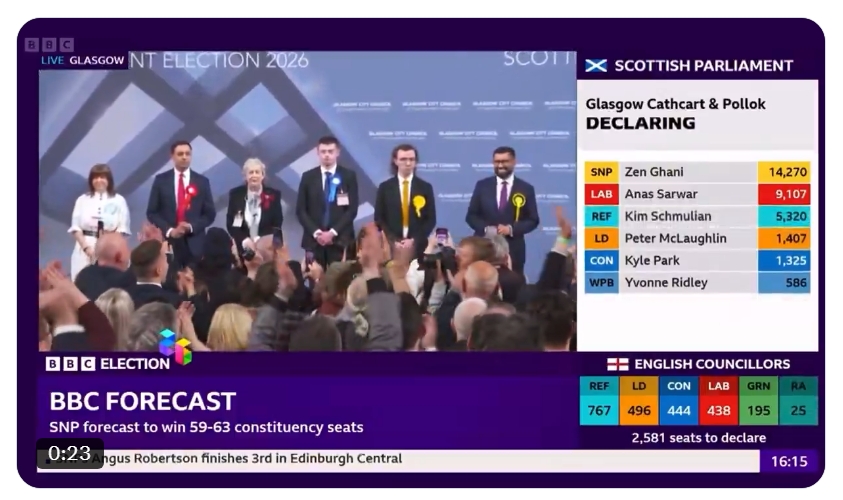
In Glasgow Cathcart and Pollok, Zen Ghani became the youngest MSP at only 24, defeating Anas Sarwar in a Mhairi Black moment:
Zen GHANI (SNP) 14,270 ELECTED
Peter Michael MCLAUGHLIN (LD) 1,407
Kyle PARK (CON) 1,325
Adnan Zafar RAFIQ (COMM) 163
Yvonne Anne RIDLEY (WPB) 586
Anas SARWAR (LAB) 9,107
Kim SCHMULIAN (REF) 5,320
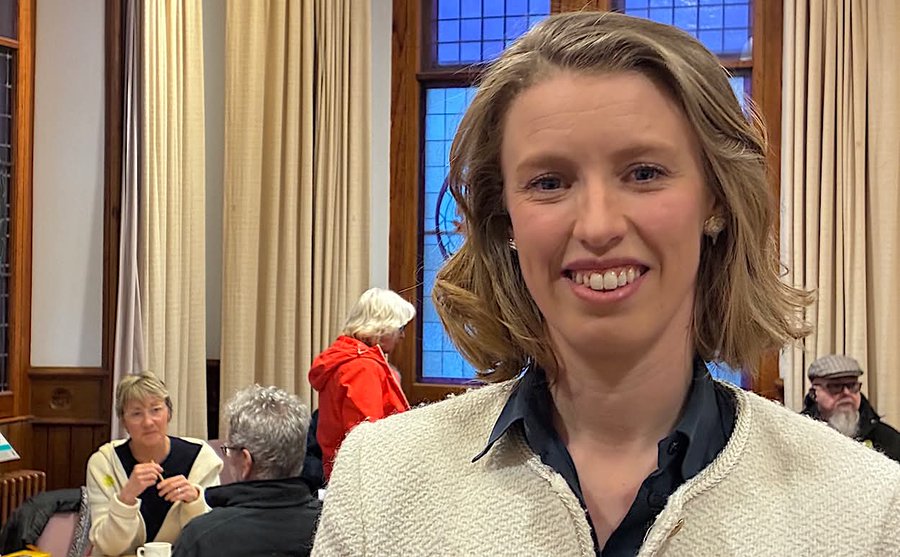
In the far north, the SNP’s Hannah Mary Goodlad won the Shetland Islands constituency with a majority of over 1500 votes. This is a part of the country where the Liberal Democrats have been dominant for decades.
Q Manivannan has become the first trans-identifying MSP in Scottish history. Manivannan, who described themself as a ‘trans, Tamil immigrant’, was elected on the Edinburgh and Lothians East list.
Speaking from the podium, Manivannan told the crowd: “I am, to some in this country, everything that the hateful despise, and I’m standing here as your MSP now with care. “They say politics is the art of the possible. A politics of care, I’d say, expands what’s possible for everyone left behind, pushed out, or never invited in. A scholar I love called Saidiya Hartman wrote that the holes that bind us are also the bonds that free. “Every barrier placed before me with the Greens was the reason also that we pushed further. And this is what diversity looks like in power.”
Holly Bruce won Glasgow Southside for the Scottish Greens by 4,000 votes. She said you should never “underestimate a quine fae the Broch”. Bruce defeated SNP candidate and minister for equalities, Kaukab Stewart, by over 3,000 votes. Bruce achieved 14,048 votes, representing 36.5 per cent of the overall votes cast, while Stewart received 10,947.
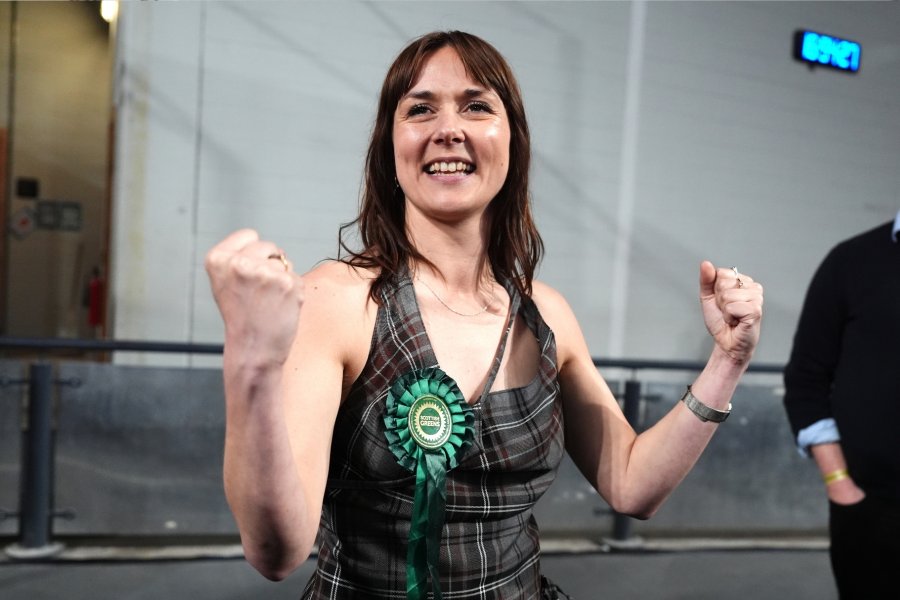
This was a breakthrough election for the Greens, who, remarkably, are even more despised by the mainstream media than the SNP.
With Stephen Flynn winning in Aberdeen Deeside and North Kincardine, the new parliament is going to have a raft of younger and more diverse MSPs. Full list here: Cumulative list of MSPs A-Z (Session 6)
This may come to nothing, it’s not ultimately about individuals, it’s about what politics they bring and what strategies they develop. But the sense that there is an ongoing generational war between younger people fighting for a future – motivated by demanding a better democracy and a survivable climate – and the reactionary forces of Reform and the Establishment is palpable.
The State of the Unionist Parties and the Established Order
We have just witnessed the worst results ever in a Holyrood election for Labour and the Conservatives. As Laurie MacFarlane writes: “The two-party system fragmented in Scotland a long time ago, but this election feels like its final funeral.” Yet their leaders hang on.
This looks like a Near Death Experience for Labour North, South and West, but if the Scottish parliament is heaving with new, younger MSPs, Labour’s response to the current crisis is to bring Gordon Brown back into government:
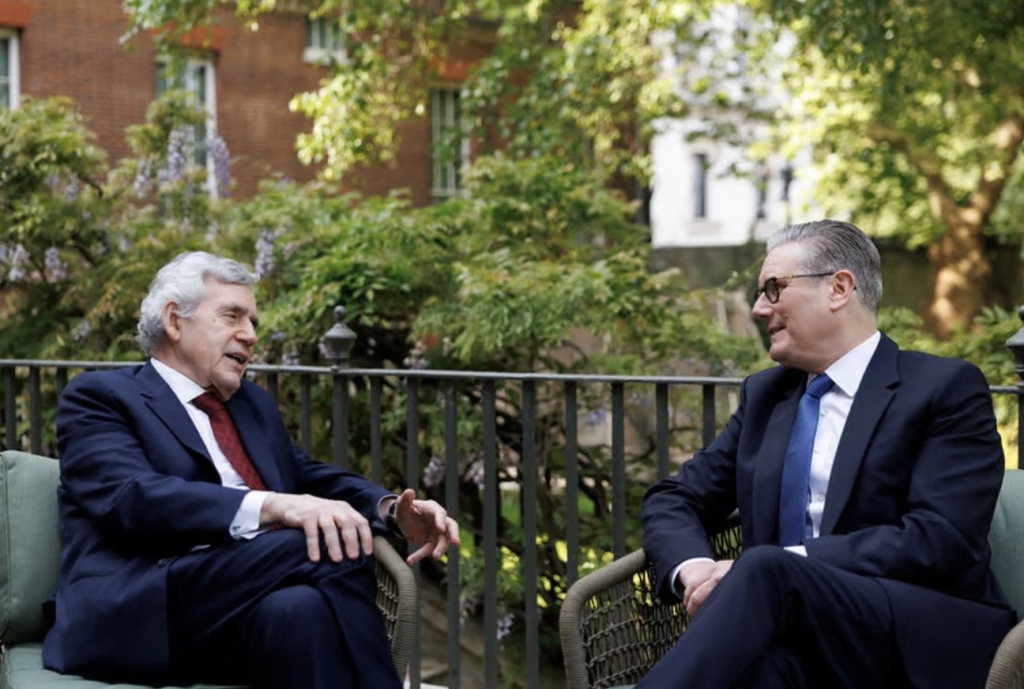
If that seems, well, not very forward-looking, they just had Douglas Alexander run an election campaign (again). The Times, which has specialised beautifully at leaks from Scottish Labour MPs (I think my friends there’s a tab running somewhere) has this:
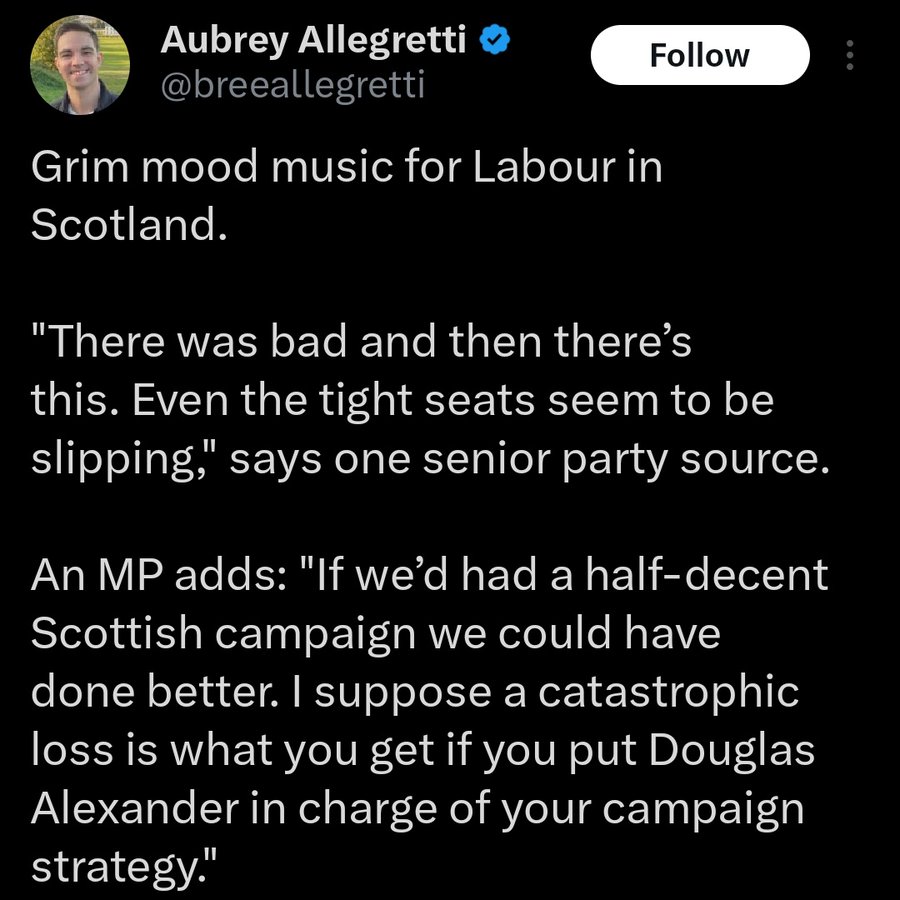
The problem for Scottish Labour is that all of this was very predictable. We’ve been predicting it for months, if not years, and we take no pleasure in being proved right [not strictly true, be honest Ed].
But where do they go from here? Having spent a small fortune promoting Sarwar they have been awarded with their worst result. They may try and convince themselves that they are, somehow, on track, that the result was the only thing imaginable given the terrible hand their London colleagues served them, but it seems a theory of (rapidly) diminishing returns.
And it’s not just us Terrible Nats at Bella that predicted all this.
Way back in 2020, the late great David Graeber laid it out:
“The Labour Party under Keir Starmer will abandon its core idealism and principles and won’t even gain tactical advantage. It will be a party which gives no one a reason to vote for it, and no one will, in fact, vote for it.”
How prosaic.
But the idea that Scottish Labour’s defeat was all down to Bad Starmer is also taken down by ex Labour MSP Neil Findlay, who wrote:
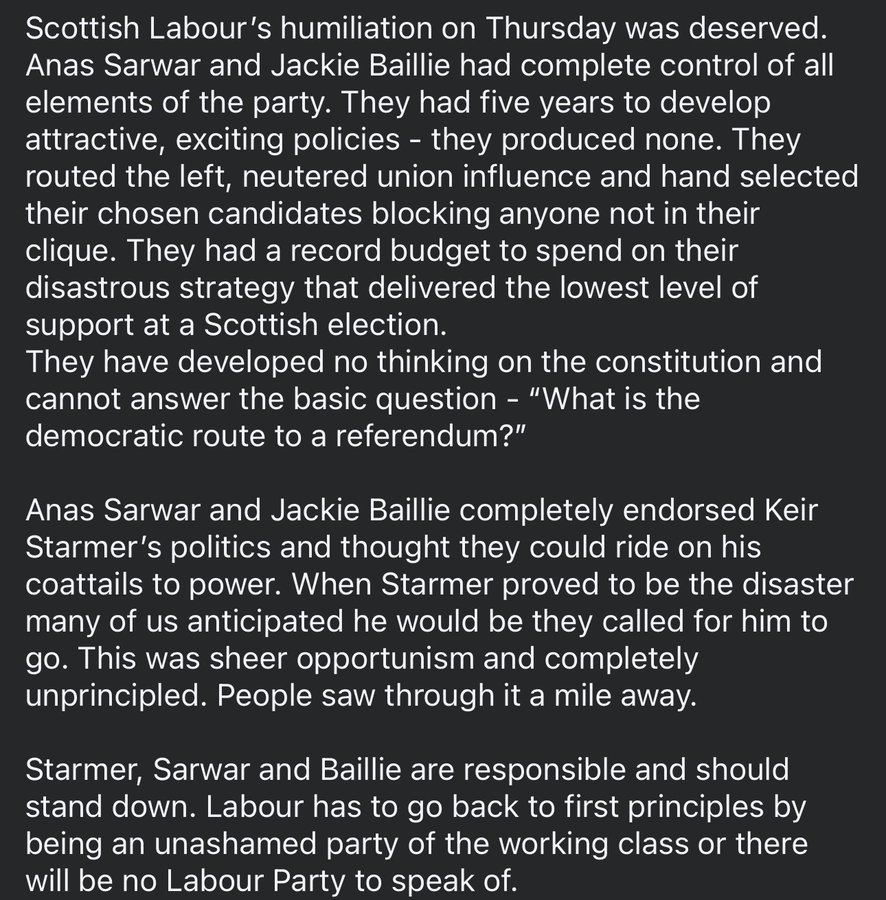
Such analysis chimes with many who think that the death of Labour in Scotland is as much about its abandonment of a discernible left agenda as it is its adherence to Unionism beyond anything else. The two actually come together because they are about the lack of moral/political compass that comes from just being un-anchored from any ideological guidelines.
The dark irony is that the Labour Party had previously pioneered constitutional change. It’s in its history, if not their DNA. It has just become obsessed with the idea of the Union, despite not really knowing why.
Miracles were not expected, though some principles were, mistakenly, assumed.
George Monbiot writes:
“No one expected Keir Starmer to solve our pressing problems overnight. But what we did expect – and had every right to expect – was that he would lay out a clear vision and roadmap for doing so. Instead, we’ve had drift, appeasement and a startling absence of ideas, values and ambition. The world is changing at great speed, as oligarchs grab powers that once belonged to the people. Starmer not only has no answer to this, but he doesn’t even register it as an issue. He promised “Change”, but the change is happening without us. And without him. He has prostrated himself before the far right in a futile attempt to attract its voters, as if the vast body of evidence which shows that this NEVER works – and only legitimises hate and racism – did not exist. In doing so he has lost his real voters, alienating his base in spectacular fashion.”
Less Angry
Tonight we are told that on Monday, Keir Starmer says he will set out his “values and convictions” that drive him as PM on Monday. Which sounds great, if familiar. This is all too late.
This is sad, but not really our problem.
My colleague & comrade Pat Kane noted that some of the most insightful commentary on election night came from Ailsa Henderson, Professor of Politics at Edinburgh University:
“I’m not talking about the rights and wrongs of holding a referendum or of independence, but just how people react to the issue. And we pick up in the data frustration about the way in which the constitutional issue has pushed other issues off the agenda. We absolutely see that in the data. But one thing we also see is that the Scottish electorate is much less nostalgic than the English electorate. And the same is true in Northern Ireland as well.”
“And the thinking is that by having these important debates about our constitutional future, yes, they may well crowd out debates about how to improve education or how to improve health. But they also do shift our temporal focus from thinking about the glory days that we used to have to thinking about how can we build a different future. And regardless of what side of the constitutional debate you’re on, that shift in temporal framing does change the mindset. As a result, the Scottish electorate is also much less angry than the English electorate…”
— BELLA CALEDONIA (@bellacaledonia) May 9, 2026
The key lines are “but they also do shift our temporal focus from thinking about the glory days that we used to have to thinking about how can we build a different future.”
But for all the chat, all the analysis, let’s leave it to the Welsh (and the dogs) who say it all better.
Rhun Ap Iorwerth was answering questions from the media about how he would lead the next government when he was cut off by an impromptu rendition of the Welsh National Anthem.
No more questions after that! pic.twitter.com/516QpnoT4j
— Rhys Williams﮷ (@RhysWilliamsTV) May 9, 2026
Sing up.

We are supported only by our readers. We don't have corporate backers and we don't take advertising, so we rely entirely on your support.
Help to support independent Scottish journalism
Thank you, as always, for excellent analysis and the ongoing quest that is at the heart of questioning. I do wish I knew what the Welsh were singing. Oh, well.
The Welsh were singing their national anthem. The translation into English is:
The old land of my fathers is dear to me,
Land of poets and singers, great names of renown.
Our brave warriors, mighty patriots,
For freedom they lost their blood.
Country, country, I’m a partisan of my country.
For as long as the sea is a wall around us,
Oh may the old language continue.
Thank you.
Good commentary. Just a small note – by my calculation Alasdair Allan would have won Na h-Eileanan an Iar by about 15 votes if the hundred or so people who voted for ‘Alliance for Independence’ had voted for AA instead.
I also think the vote share of the SNP dropped off quite a bit and if it happened again, and the British Nationalist parties got their act together the SNP will be back where it started in 1999.
The next SNP leader cannot afford to stand still on independence – we need to excite people and stop accepting that we are not allowed to get a vote. Swinney does not have the personality for this kind of political challenge.
So you’re saying that the group who wanted to boost pro-indy MSPs actually reduced the number of pro-indy MSPs?
Ironically yes for this consituency. Not sure if AfIndy share Alba’s strategy on the second vote probably not as they put up a candidate who got 160 odd votes.
Yes they share Alba’s strategy
They did, the whole point was to use the list not directly against pro independence the candidate’s. The greens also pulled a spoiler in the central belt for the SNP. But what’s more relevent is that the Highlands and islands have been badly dented by the managerial bad handling of renewables energy, the ferries, and the top down colonial altitude of protected marine areas, as for the poor result from alternative yes voices, there lightly support has become disillusioned with politics and like the SSP isn’t cutting through to there base, it was a lower turn out and both the greens and the SNP don’t reflect the total support for independence, list msp’s don’t reflect the electorate but there party internal politics, so though it’s a great result we have to stop glossing over the difficulties in the yes movement, there is a collapse of trust in the working class mike, you might want to heed your top fan bonnie prince bob, , what can you say, the revolution eats it’s children.
It is interesting to note that the SNP got 58/129 seats (45%) with 38% of votes whereas Plaid Cymru got 43/96 seats (45%) with 35% of votes.
Not sure what this proves but does raise questions about whether the new system in Wales is actually any more proportionate than the d’Hondt system in practice?
It can be said with absolute certainty that both systems are far more proportionate in a multiparty system than the FPTP system currently used by Westminster.
Well, for an election which, we were told by the commentariat of all stripes, was supposed to be lifeless and boring, this one ended being packed with spectacle. Particularly spectacular were the huge Scottish Green wins in Glasgow and Edinburgh. And these were not marginal successes: the victory margins were huge. Can if be true that Edinburgh Central, home to the New Town and the Grange, has 58% support for pro-indy parties? If so it is extraordinary. But perhaps the most telling, and welcome, result for me was the defenestration of Fergus Ewing by Emma Roddick – again by a very handsome margin – in a direct contest between two very different personifications of the future that independence has to offer.
And the total of 73 MSP for independence would have been 75, had it not been for the spoiler antics of Independent Green Voice in the Central Scotland region and of the so-called Alliance to Liberate Scotland in Na h-Eileanan an Iar.
You are assuming that the election was about nationalism rather than Angus Robertson, who thankfully came third and is now unemployed. Even Lorna Slater was seen as a better option, and she should have stuck to engineering.
Thank you for this article, I also enjoyed the schadenfreude of the “pumping” of Scottish Labour and Conservatives. Sarwar’s phrase, not mine.
The comment about holding onto the Union no matter what hit home, as it’s long been my theory that Scottish Labour would do much better if they split off, ooh, let’s say gained independence, from Westminster and formed a new Labour in Scotland that was at least open to the idea of Indy, if not its reason for existence. And it would put to bed the long held situation of their party leader being a branch manager.
But then again, don’t interrupt your enemy when they’re in the middle of courting the right wing.
I feel a huge excitement at the three Celtic nations now having leaders who are striving for self determination; I really really hope that they strategize so that they ask for a Section 30 together. It’s one thing for Westminster to turn down one country and then use that as the lever to say no again to the other two. They can’t possibly condone one or two S30s either, that wouldn’t make sense.
It’s entirely another thing to deny 3 countries in one go. The international community is watching. And my popcorn is ready.
Bad news for Alastair Allan but Maree Todd might only have been elected on the list because of his defeat.
Also, pretty sure Galloway’s Workers Party oppose independence like GG himself
No Galloway’s party support independence like he does, apparently, now.
….. sorry, Mike but if you believe that “shyster” Galloway believes in Independence …. I’ve got a bag of magic beans I can sell you … cheap !!
I don’t really believe that at all. This is Yvonne Ridley: “Where is Workers Party Scotland? This is our launch in Govan, Glasgow – ignore us at your peril: Our Workers Party Scotland launch made it clear in Govan on Friday night – we are pro self determination, our leader George Galloway spells out what he is standing for and I am pro-independence which is why I voted with my feet and came to Scotland back in 2011 and have worked for the indy movement ever since.”
The SNP lost a slightly bigger chunk of voters than the Tories. Stupendous result for Reform, good results for the Greens and Lib Dems, little change for Labour. 48% of the electorate couldn’t be bothered, and who can blame them. I think the main change will be that Reform will be the new Holyood bogyman, providing them with unending free publicity. Appart from that: More of the same.
One of the more succinct, honest and unbiased analyses that it is hard to argue with.
The only thing I would add is that Reform expected to do even better than they did.
Except that it ignores relevant context. That being the big Labour win in Scotland in 2024, now reversed, with the SNP regaining some (not all) the support they had lost.
True, many missing in action, and to gage from the chat in work, many are pro independence, mmmm answers on a self addressed postcard for that back in the day concern the awkward Scottish working class!
Large sections of the media try to tell the people of Scotland that:
1)the SNP government are hopeless and unpopular
2)the Scottish people are not interested in independence or holding another independence referendum.
If you agreed with media and agreed with both these statements you wouldn’t dream of voting SNP last week.
The SNP have just been returned to govern for 5th successive term (unprecedented in UK elections) with a higher percentage vote than Labour received in 2024 GE.
It is glaringly obvious that:
If you were impressed by SNP governance you would only vote SNP if you support independence and holding another referendum.
If you don’t support independence you would only vote SNP if you thought they were best party to govern at Holyrood.
The fact that large sections of media will not acknowledge this obvious truth just shows how contemptuous they are of the Scottish people.