
Cultural Vandalism and the Crisis of Public Broadcasting
BBC Radio Scotland is being rebuilt as commercial radio. With public money.
By Stephen McAll, Constant Follower
An internal BBC Scotland email sent on Monday confirmed what the station’s recent schedule changes have already made hard to ignore. BBC Radio Scotland is not simply refreshing programmes. It appears to be transferring power.
Victoria Easton-Riley, Head of BBC Radio Scotland Audio & Events, confirmed three senior editorial appointments. Michael MacRae will join in early August as Head of Content Production. Martyn Ewart becomes Content Editor for Edinburgh and Aberdeen. Julie Heekin becomes Content Editor for Glasgow while continuing as acting Exec Editor until MacRae arrives.
Taken with Easton-Riley’s own appointment last summer, the four most powerful creative and editorial roles at Scotland’s national radio station are now in place. Three of the four come from Bauer’s commercial music radio network.
Not from speech. Not from news. Not from arts. Not from cultural programming. They are all executives from commercial music radio.
Easton-Riley joined BBC Scotland in August 2025 from her previous role as Director of Content for Scotland and Northern Ireland at Bauer. MacRae is currently Head of Content for Forth 1. Ewart is Executive Producer of Forth 1’s Boogie in the Morning. The people who shaped output for Forth 1, Clyde 1 and Greatest Hits Radio Scotland are now being handed the levers of Scotland’s publicly funded national broadcaster.
Easton-Riley, MacRae and Ewart are the pattern. Heekin, from a news background, is the exception.
These appointments from the commercial sector are significant because they come at the exact moment BBC Radio Scotland is removing the output that made it, by design, different from commercial radio in the first place.
Image credit: Jim Barton
In January, the station axed its late-night specialist music shows: Iain Anderson, Roddy Hart, Billy Sloan and Natasha Raskin Sharp. Decades of specialist knowledge disappeared in one schedule change. Four programmes that gave Scottish music seriousness, cultural context and national attention were replaced by Up Late, a single five-night strand presented Monday to Thursday by Lynne Hoggan, who came directly from Bauer commercial radio.
This month, BBC Radio Scotland confirmed it is clearing out Afternoons too. Michelle McManus, Len Pennie and Nicola Meighan all “step down” on Friday 29 May. That means three more deeply rooted Scottish arts and culture broadcasters gone, including one of the leading voices in contemporary Scots and a music journalist of 20 years for The Herald, MOJO, Q, The Big Issue, The Quietus, BBC Radio 4 and BBC 6 Music. These are not generic presenters. They are people with knowledge, judgment, trust and a working relationship with Scottish culture.
Replacing them from 1 June are Grant Stott, who spent over 20 years in commercial radio before joining the BBC, and Arlene Stuart, currently still at Bauer’s Forth 1. Sources inside BBC Scotland have told me the in-house Edinburgh production team has been informed it will not be working on Stott’s incoming show.
Asset Stripping
Then look at what is forming around Forth 1’s Boogie in the Morning show. Arlene Stuart, Boogie’s longstanding on-air partner, is replacing Nicola Meighan. And Martyn Ewart, Boogie’s executive producer, is not merely arriving at the BBC; he is arriving as Content Editor for Edinburgh and Aberdeen. That puts the producer, the on-air partner, and the editorial authority in the same frame. With Kaye Adams already out of the morning schedule, the path is clear. If BBC Radio Scotland is preparing a space for a commercial breakfast format, the pieces are already on the board.
Inside the BBC, staff appear to know what is happening. The recent BBC Radio Scotland staff satisfaction survey reported confidence in the BBC executive team down at 33%. Excitement about the BBC’s future down at 34%. Belief in the BBC’s position to succeed over the next three years had dropped to 34%. The accompanying note from Hayley Valentine referred to “leadership changes and financial challenges”.
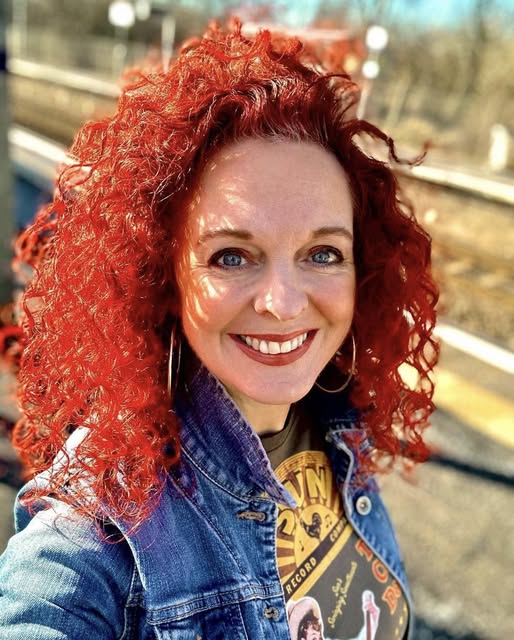
Nicola Meighan
Set those figures beside the changes at Radio Scotland. Staff who spent years developing specialist music, Scots language broadcasting, arts journalism and production craft around public-service radio are watching the editorial layer above them fill with executives from a commercial competitor. They did not spend their careers building the cultural output of a national broadcaster to be folded into “what did you have for breakfast?” chat and now time for some Duran Duran.
The latest audience figures make the decision stranger, not easier to justify. RAJAR’s Q1 2026 figures show commercial radio’s overall UK listening share falling quarter on quarter, while speech and current-affairs services including BBC Radio 4, LBC and Times Radio all added listeners.
BBC Radio Scotland itself rose too, from 835,000 weekly listeners in Q4 2025 to 921,000 in Q1 2026, though sources familiar with the figures say much of that station-wide gain was driven by an exceptional football season. According to an internal BBC Scotland RAJAR note, some of the biggest weekly-reach improvements inside the station were Drivetime, up 47,000, and Afternoons, up 37,000. Afternoons is the slot currently being cleared out. So even on the BBC’s own audience terms, this is not a rescue operation. It is a choice.
The BBC has spent months telling MSPs, the Scottish parliament’s culture committee, the music industry and the public that specialist music remains a cornerstone of its output. But a cornerstone is not something you keep mentioning while removing it brick by brick.
And this is not snobbery about pop songs. It is about purpose.
Commercial radio already exists to saturation point in Scotland. Nobody needs the BBC to spend public money recreating what the market already provides. Commercial radio does what commercial radio is built to do: familiar voices, familiar songs, audience retention, a saleable format. There is nothing wrong with that. But it is not public service broadcasting.
BBC Radio Scotland exists for the things that do not fit that format.
The first national play for a Scottish artist with no budget behind them. The long interview with a poet, playwright or musician who cannot be reduced to a format point. The Scots language voice treated not as heritage decoration but as part of the present tense of the country. The risky live session. The difficult record. The cultural argument that needs context and time to be explored. The work that requires a public platform before it can find an audience.
That is how my own career began. My career exists because those programmes existed. A short play from Roddy Hart and Vic Galloway. A few generous words on national radio. That was enough to secure funding, which paid for my record, which led to event bookings, a label and everything that followed. Routes like that are rare in Scotland. Once they are removed, they are not easily rebuilt.
That is not nostalgia. That is how culture works before it becomes profitable. Someone has to hear it early. Someone has to take it seriously before the numbers justify doing so. That was part of the BBC’s job – to support the development of Scottish culture.
Cultural Vandalism
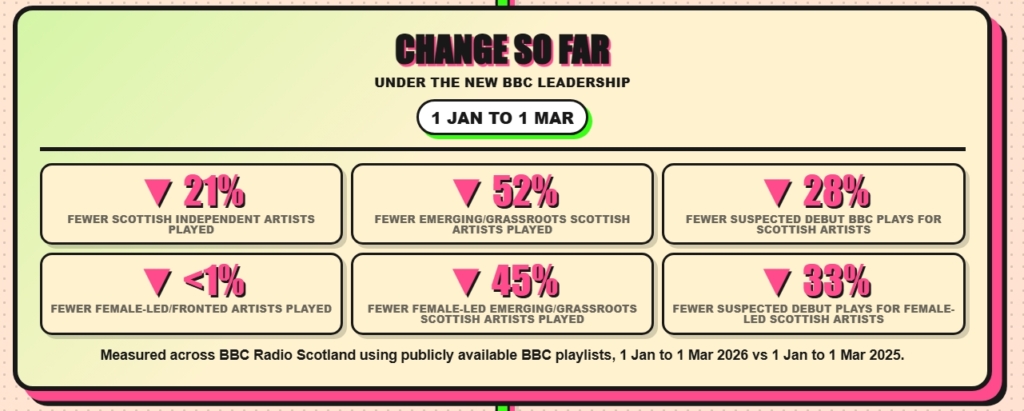
I spent the past months telling the Scottish parliament’s Culture Committee that the 67% drop in new Scottish independent releases on the late-night schedule between January 2025 and January 2026 was not an abstract programming choice. The BBC challenged the figures, saying that they didn’t recognise them and that they only looked at a tiny fraction (late-night, where most new music was played) of the station-wide “music offering”. Those two weeks were all we had at the time. But it’s now been almost six months since the new schedule took effect.
Today we released culturalvandalism.info, a project measuring the impact of the new schedule across BBC Radio Scotland’s full music output from 1 January to 1 May, compared with the same period last year. It found 23% fewer Scottish independent artists played; 56% fewer emerging or grassroots Scottish artists; 55% fewer female or female-led emerging Scottish artists; and a 4% drop in female or female-led Scottish artists overall. Every significant measure for a thriving Scottish music scene showed decline. This is not supporting our culture.
It is the breaking of a chain. At one end is an artist making something fragile, local, strange or new. At the other is a national audience. BBC Radio Scotland used to hold the middle.
A public broadcaster is not meant to behave like a commercial playlist with a Scottish accent. It is meant to take responsibility for what the market cannot see, cannot monetise or cannot be bothered to understand. It is meant to give a country more than the sound of what is already popular. It is meant to make the unknown audible.
Senior commercial radio executives do not usually move into public service broadcasting because it pays more. These appointments therefore deserve scrutiny. If licence-fee money is being used to match commercial salaries, that is a public matter. If the attraction is editorial power, and the chance to remake BBC Radio Scotland in the image of the stations these executives came from, that is a public matter too.
Because Scotland will not gain another commercial station from this. It will lose the publicly funded space where Scottish culture meets itself.
Once that space is removed, it does not simply reappear somewhere else. It migrates to platforms Scotland does not own, curated by algorithms it cannot interrogate, in service of revenues that leave the country entirely. The small label, the new writer, the Scots voice, the difficult record, the artist who needed one serious national play before anyone else would listen: they do not get a smoother version of the old system. They get silence.
The BBC’s Royal Charter and Ofcom’s Operating Licence describe this in administrative language: public purpose, market failure, content of particular relevance to Scottish audiences, support for the creative economy. The plain version is simpler. BBC Radio Scotland exists to do the work commercial radio has no reason to do, because that work is the culture itself.
If BBC Scotland’s leadership has decided that work is finished, it should say so plainly. It should put its name to the decision in public. What it should not do is dismantle a national cultural institution behind the language of cornerstones, commitments and evolution, while staffing the editorial floor with executives from the very commercial model the BBC was meant to stand apart from.
Scotland deserves to know what it is losing before it is gone. After it is gone, there may be no national radio platform left to ask.
To support our work, please donate here:
Bella Caledonia 20/20


We are supported only by our readers. We don't have corporate backers and we don't take advertising, so we rely entirely on your support.
Help to support independent Scottish journalism
I now avoid Radio Scotland much of the time, particularly the chattering and giggling that comprises the Breakfast Show. The almost nonstop football makes it very tedious.
Point taken Margaret, I am a boringly relentless critic of the BBC. But this is a defense of the idea of public broadcasting. I understand its difficult to separate these two things.
Bring back fish prices on the news.
The algorthim on Constant Follower’s live in Peebles u-tube next brings up a good Israeli band https://youtu.be/Y-_XAt1OFNI?list=RDZQqrO6_r_bg followed by an ad for Thales war manufacturing jobs. That is a far more normal route to recognition than Vic Hart late-o-clock radio.
You can tell that you are listening to Radio Scotland because there isn’t advertising at half-time.
Cheerio!
they have Canadian content laws in Canada, it works.
Unfortunately it now seems that Stephens attempt to ” make BBC Scotland better” is a losing battle….but let’s win the war!
Reiterating my previous comments it could be great fun to change tact to campaign as below….from 29th May there will be even more talent available to contribute and I am sure many more well kent faces would be buzxing like bees to come to the party !
5th February 2026 at 2:23 pm
I would say Scotgov rather then trying to influence BBC should take the initiative to support a new national broadcasting collective .
Formed by bringing together the excellent local radio stations who already support local talent ( e.g Sunny Govan , Camglen) giving them a national platform to feed into and share selections of their great work, ,: together with Independent music venues ( offering a platform to showcase forthcoming events / exclusive performances and broadcasts) and material from the independent rehearsal and recording venues that give birth to and nurture our music scene.
It could be great…and ours!
I am sure some of the aforementioned experinced broadcasters would happily contribute with their experiences whilst bringing an initial audience with them !
I found myself sitting next to BBC Scotland ‘Debate Night’ presenter Stephen Jardine in an Edinburgh café a few weeks ago. Then I realised that he was chatting to Hayley Valentine, who was sitting at an adjacent table! Stephen confessed to being bored by Scottish politics and intended to go off on holiday before election day. If I were the Director of BBC Scotland and the presenter of one of my flagship programmes volunteered that he was bored in his role, I think I would be looking to replace him. Instead, Hayley commiserated and asked anxiously whether the SNP would win a majority in the forthcoming Scottish Parliament election. Stephen reassured her that it would not.
NRK, the Norwegian public broadcaster has a 24 hour folk music radio station, which plays a mix of modern, innovative arrangements as well as old archive and fieldwork recordings, and everything in between. It has a 24 hour jazz station. It has a 24 hour classical station. These are in addition to its main dedicated music station.
BBC Scotland wouldn’t even keep Pipeline.
I couldn’t agree more with Margaret’s comments .
Radio Scotland’s so called flag ship breakfast news programme is awful. There’s far too much “ chit chat” on what is supposed to be a serious news programme ; it’s not .
There is also far too much football discussed too, especially when there is already considerable time devoted to football in the rest of the station’s schedules .
The loss of Iain Anderson was tragic and unforgivable .
So too was the loss of the excellent Saturday morning programme originally presented by Shereen Nanjiani . The person who replaced her ( apologies – can’t remember her name ) was also extremely good . For no apparent reason the programme gets axed and replaced with more football chit chat , giggling gossipy nonsense that is frankly , annoying .
The comments which have been attributed to Stephen Jardine are deeply concerning especially as he’s one of their flagship presenters on both radio & TV. If he finds Scottish politics boring then move on – plenty others don’t and could do a much better job .
I completely agree with everything you have said. The late show has lost all direction, even Ashley and Paul who used to have a very funny show, are being pushed in an entirely different direction. Dropping Billy Sloan is just total madness and now letting Nicola Meighan go is beyond all reasonable understanding. This is one listener who is off to pastures new.