

Language Matters
As the announcement of the Plaid Cymru Cabinet being all Welsh speakers, and the Scottish Government having no fluent Gaelic speakers, the issue has been catapulted into the public consciousness.
Cultural activist Antwn Owen-Hicks tweet reached 715k people. He wrote: “Every minister in the new Plaid Cymru Cabinet is a fluent Cymraeg speaker. For the first time in 622 years, since the parliament of Owain Glyndŵr, our government will hold its Cabinet meetings in Cymraeg, the mother-tongue of our nation.”
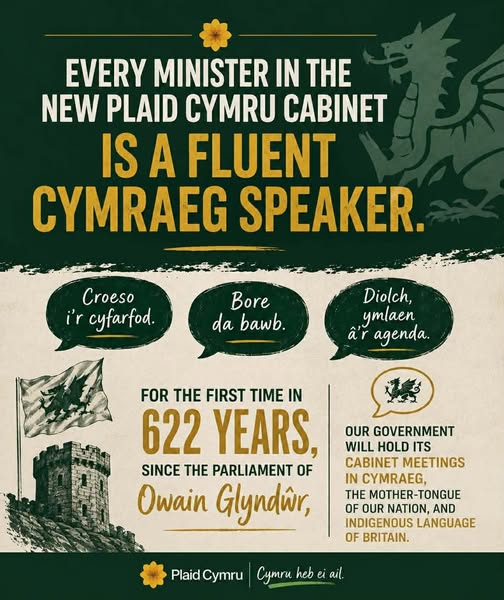
At the same time, The National noted:
While every minister in the new Plaid Cymru Cabinet is a fluent Welsh speaker, it appears that nobody in the Scottish Parliament is fluent in Gaelic. pic.twitter.com/vQtUIsO4IG
— The National (@ScotNational) May 20, 2026
Predictably, Owen-Hick’s tweet provoked some outrage from the monoglots and cultural imperialists, even if, as he reiterated, this would be about private Cabinet meetings, not public Senedd meetings.
Other responses were very strange, if well-meaning. Aaron Bastani, of Novara Media posted: “This is cool. Every kid in a British school should learn one of Welsh, Gaelige, Scottish Gaelic and Old English. Even if just for a term (I’d favour longer).”
But the furore raises interesting questions about Identity, Language and Power, and the different statuses of Welsh and Gaelic.
Nobody Notices the Silence Anymore
The first thing to note would be that the ‘crisis of Scottish Gaelic’ is not some new phenomenon that we, or the wider public have stumbled on just this week.
We covered this here, read Gille-chrìost MacGill-Eòin What next for Gaelic – new parliament, new start? and explored the potential and limitations of the planned policies here, read Wilson McLeod The Scottish Languages Act: opportunities and challenges. The crisis in Gaelic language was not ‘revealed’ this week by the dearth of Gaelic speakers in the parliament.
But this doesn’t mean that the moment is without consequence. As Rona Dhòmhnallach has said:
The second thing to note is that although language loss is multifaceted, it is cultural imperialism. Read Iain Mackinnon’s two-part essay series here:
Education and the colonisation of the Gàidhlig mind 1
Education and the colonisation of the Gàidhlig mind 2
The third thing to note is that Welsh and Gaelic are not – for historical, cultural and political reasons – the same. We are a three-voiced country – and there has been no equivalent – in terms of militancy – of the Sons of Glyndŵr. Welsh has had a totemic status in a way that Gaelic has not.
As Gerda Stevenson says: “Plaid Cymru’s official target is to reach one million Welsh speakers by 2050, which aligns with the Welsh Government’s overarching national strategy. While the party has a transformation vision for 2030, its specific target for that year is to ensure 50% of seven-year-olds are in Welsh-medium education.”
The Funding Chasm
That is a scale of ambition that is nowhere near being met in Scotland. Just look at the funding situation, where resources and commitment in Wales dwarf those in Scotland.
Public spending on the Welsh language in Wales ranges from between £150 million and £200 million annually across various public and broadcasting sectors. The exact total fluctuates, as it is divided between the Welsh Government, independent bodies, and UK-wide broadcasting organisations.
Major allocations include:
- Broadcasting (S4C): The Welsh language television channel receives the largest single share, typically costing around £75 million to £85 million per year, largely funded by the UK TV Licence fee and UK Government grants.
- Welsh Government Direct Funding: The Welsh Government directly allocates tens of millions of pounds specifically for Welsh language development, cultural initiatives, and the Cymraeg 2050 strategy (which includes Welsh-medium education grants and community language centers).
- Education and Training: Substantial amounts are embedded within the broader education budget for Welsh-medium schools, resources, and free adult Welsh courses.
- Welsh Language Commissioner
By contrast the Scottish Government allocates around £35 million annually for Gaelic projects and language promotion. This investment – which also covers Scots – is divided among broadcasting, education, and development bodies.
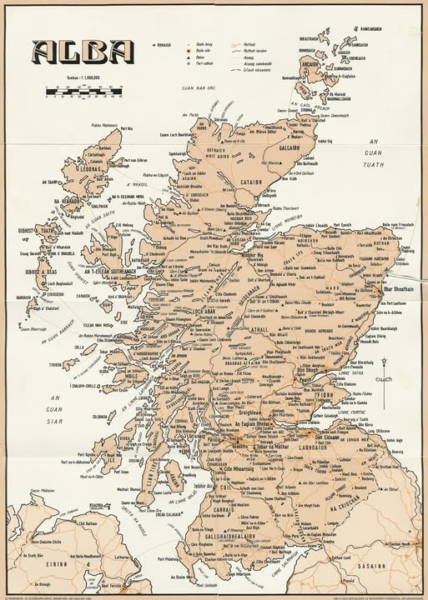
Funding is distributed across several core areas:
- Broadcasting: The majority of funding goes to MG ALBA for Gaelic television and media, accounting for more than £12 million of the annual spend.
- Education & Learning: Approximately £10 million is disbursed by the Scottish Government directly for Gaelic-medium education and learning programs.
- Bòrd na Gàidhlig: The principal Gaelic public body receives around £5.1 million annually to fund its operations and community development.
- Cultural Centers & Heritage: Additional capital is regularly earmarked for heritage, inclu
So, let’s not act all surprised that the Welsh language is ahead of Gaelic.
Part of the reason for this disconnect may be the mythology that Gaelic language funding is huge, when it is, in fact, pitiful.
As Jamie McIntyre has written: “This situation has inevitably led to some discussion on the state of Gaelic. Some say in Ireland Irish is compulsory, but (in their view) that’s counter-productive. But before we get to compulsory, how about just *available* in all schools in Scotland. Or even just in the Highlands and Islands.”
He continues: “There really isn’t enough discussion about how *little* Gaelic Medium Education provision there actually is, even in traditional Gaelic heartlands. For example, only around 17% of all primary schools in the Highlands and Islands offer GME.”
There is no secondary school in the nation’s capital offering Gaelic Medium Education.
An obvious place to start would be to make Gaelic available in all schools, and the default language in the Highlands and Islands.
We’ll be exploring these ideas in our Bella 2020 series later this year [Bella 20/20 | Scotland 2047 – Bella Caledonia].
DONATE TO OUR FUNDRAISER HERE:
As someone who, apart from my father, has an entirely Gaelic speaking ancestry, I certainly support actions which promote the use of the language, and ‘normalise’ it. As a toddler, I mainly spoke Gaelic because my mother was a native speaker, who was also fluent in English. She decided, with lasting regret, to stop speaking to me in Gaelic, because I was being bullied by some adults for speaking in Gaelic. (There was also a sectarian aspect to the bullying.) I suffered no bullying from my peers.
So, I grew up speaking Lowland Scots. However, like many of my peers, we were often humiliated by teachers at school for speaking it. Indeed, I recall a pal being corporally punished because, when a teacher spoke to him, he said, “Whit?” (He had not heard properly.) Thus I spoke standard English in class and Scots in the playground and at home.
There was an insidious aspect to this because the overt and tacit message was that Scots was ‘degenerate’ and was unsuitable for expressing nuanced ideas! It took me a number of years after two university degrees for me to accept that I was, indeed, capable of expressing nuanced concepts in Scots.
My wife whose family spoke Doric, was similarly bilingual – Standard English in school, Doric everywhere else. She also has a degree in modern languages and speaks French fluently, albeit with a noticeable Perthshire accent, and German fairly well.
As I said, I support the promotion of Gaelic, but I also support the greater use of Lowland Scots, Doric and the languages of the northern islands in schools, in broadcasting and in other forums.
In order to function as a country we do need to have some lingua franca, and, at the start, it will probably have to some form of Scots with a bit of anglicisation. But, in the longer term as Gaelic, Lowland Scots, Doric, Norn and Shetlandic become part of the curriculum of our schools and are used more often in the media, we will become more confident in engaging multilingually.
We have a significant population which derives from the Indian subcontinent and China and they have retained to some degree their ancestral languages. We need to make provision for that section of the population to access its historic cultures in these languages.
In parts of Glasgow, there are a number of primary schools and 3 or 4 secondary schools who make such provision within the overall curriculum.
What I do not want is campaigners who are performatively angry who speak only in hyperbole as the ‘go-to’ people by the media, because they are ‘good television’!
Thanks for the comment Alasdair. You write: “As I said, I support the promotion of Gaelic, but I also support the greater use of Lowland Scots, Doric and the languages of the northern islands in schools, in broadcasting and in other forums.”
Yes, agreed. It’s not a zero-sum game, and support for Gaelic is not an attack on Scots. A ‘rising tide lifts all boats’ and all that.
“There is no secondary school in the nation’s capital offering Gaelic Medium Education.”
This isn’t the case. James Gillespie’s High School has a GME stream.
Well, no, Gillespie’s has a gaelic unit within it but is not a Gaelic Secondary school. So the entire stream of pupils graduating from primary have no secondary provision.
Fresh from the Jamaican parliament:
‘It’s broken English’: MP’s attempt to speak Jamaican in parliament sparks language row
“Parliamentary rule that only English is allowed has reignited debate about language, legitimacy and postcolonial identity”
https://www.theguardian.com/news/2026/may/21/jamaica-parliament-language-english-patois
So what are the longest-term aims of these movements?
I’ve started watching a linguistics lecture series which decouples language from Empire (as in the case of Persians using Aramaic, and potentially the Chinese using English) and ease-of-use from popularity. What can Big History tell us? What tipping points? What political uses and agendas? Can human language represent significantly different worldviews, and what happens if they do?
As I’m quoted in this, a wee qualification to the “17%” figure – I excluded Orkney & Shetland from this as they’re not traditional Gaelic-speaking areas.
Also, that figure is heavily skewed by the fact that almost every primary in Na h-Eileanan Siar offers GME. If you do the calculation for the mainland H&I plus Argyll & Bute islands only, you find only 11% of primary schools there offer GME, a truly shocking number – effectively 1 in 10.
IMO this is partly due to a focus on pupil numbers (which have risen) at the expense of geographical coverage (which has not, in nearly 30 years, indeed almost all the geographical expansion of GME took place *pre devolution*).
Food for thought……
What do you expect from a country where everything is dispagared except the fitba, machine politics and crime?
Seriously? If the SNP wanted to revive Gaelic, that would be relatively easy. They’d have a Minister for Gaelic as a prioirity?
It’s been done in Norway, the Basque Lands, and Israel, and that’s off the top of my head… It’s “all the rage”!
Nothing was translated into Catalan for 3 centuries… seriously… now 8 million people speak it…!!!
The SNP govt are a bunch of deplorable squares and nerds, they don’t know anything which invlolves passion… or a way to make a buck…
They lie, friends, they lie…
It’s interesting how the algorithm works on Bella’s Facebook page this has over 300 comments – on here not many. Maybe its ragebait?
Yes odd isn’t it – over 400 comments now and the comment count on other FB posts is mostly single figures!
What comes across from a brief survey of the comments is the conflict between Gaelic, Scots and other languages (see also Alasdair’s comment above where he lists five languages, plus English and you might add Orcadian to that). It would be nice to believe in the idea none of these should be mutually exclusive, but the reality of opinion does not seem back up this view, which is a very significant problem, a problem not present in Wales (and thanks for the information about the new Welsh cabinet being all fluent Welsh speakers – why would they therefore not speak in Welsh?).
The cynic in me suggests this is a wider problem than language – these very bitter ‘internal’ disagreements, which reflects the diversity of Scotland, a nation made up of very different ‘tribes’, and though there are differences in Wales (e.g. between north and south Waleans), it is very different there, where there also seems more take-up of Welsh by incoming English and others.
Yeah I think you’re right Niemand, different ‘tribes’ – and this reflects an often under-noticed aspect of anti-Gaelic rhetoric that it regularly has a sectarian aspect to it.
It also is really challenging for people who want a forced or imagined unitary Britishness. This is deeply challenged by both Welsh and Gaelic (hence the really weird idea that people who all speak Welsh as their first language shouldn’t somehow speak it!)
Gaelic is really triggering for some members of the Scottish Loyalist fraternity. I remember sitting on the top deck of an Edinburgh bus some years ago close to two chubby middle-aged gentlemen en vacance from Lanarkshire. On spotting a car emblazoned with the word ‘Poileas’ coming towards us, their faces turned puce with rage, veins on their temples started throbbing, and they began swearing. 🙂
@Editor, I assume Facebook (I avoid the platform) gives you tools to understand where your visitors are coming from (engagement)? Internet ranking algorithms tend to have external inputs such as weighted incoming links (so some prestigious site may have linked to your FB article), which can increase rank, raise position in lists, resulting in positive feedback loops. There are evolving countermeasures to prevent gaming of such systems (like SEO, clickbait), while potentially dampening flocking behaviour and feedback loops (otherwise it would resemble those playground kickarounds where almost everyone chases the ball).
Usually the platform will give you some indication:
https://www.facebook.com/business/help/718033381901819
But aside from quantity, what about the quality?
The quality is mixed. Lots of people haven’t read the article so, literally, don’t know what they’re talking about. Lots of people just repeating the same points because they haven’t read the thread. Lots of people just expressing their disdain for Gaelic, and they’re complete ignorance of anything to do with language, or, er, culture, and lots of people just expressing their complete cultural self-hatred either for being Scottish, or against Scotland. Fun!
@Editor, interesting, if a little depressing.
The Cold War era began with various war crimes trials, where the victors were often accused of avoiding drawing attention to their own crimes. This led into propaganda exchanges of the tu quoque (you too!), alleged and proven hypocrisies. And despite the UN charter, violent and extremely hypocritical recolonising campaigns.
Sometimes the Internet re-enacts various post-Soviet, post-colonial, neo-colonial propaganda contests. For example, the Guardian today reports:
‘We will not survive’: jailing of Daria Egereva highlights plight of Russia’s Indigenous people
https://www.theguardian.com/world/2026/may/22/jailing-daria-egereva-plight-russia-indigenous-people
which feeds into wider campaigns for recognition, rights, environmental protection, indigenous knowledge, language, ecological living and culture. For people who assume many social comments are the spawn of Russian bot farms, attacks on Scottish Gaelic may seem like a poor profile fit.
Anyway, I remember the official Soviet position was pride in all these diverse cultures. What their lived experience was, I don’t know, but they seem to have at least survived, until now anyway.
that’s not the only thing they’re no fluent in
Scotland has become a backward country over the course of my.life…
The completely irrational hatred of Gaelic encapsulates it, but it’s much wider than that.
Foreign language learning in the Scottish education system is marginalised when not openly disparaged…
The result is, the Europeans are much smarter than us. Usually they speak reasonably good English, they are bi.cultural, they have to be so they have something to compare with…
We are stuck in a silo of anti Gaelic morons, and ignoramuses who in the swearing in ceremony the other day, were claiming to speak various languages which don’t really exist, Dundonian Scots for example, as if all languages don’t have different dialects…
We are a backward country in my opinion, dumbed down over the last few decades…
The Scots used to be among the most famous linguists in the world…
It is an elephant in the room this distinction between dialect and language. It seems to have reached a point where if you say that is a dialect of a language, not a distinct language then you are some kind of ignorant bigot.
If you look at some English dialects, in England, there is no serious push that I know of to change their status to languages proper, yet some of those dialects are as distinct from English as some dialects of Scots and, dare I say it, Scots itself, e.g. true Yorkshire dialect.
I am sure though that a technical definition of Scots makes it a distinct language and that is all well and good, but, written down, 90+% of it is understandable to an English-only speaker, whereas with Gaelic I would say 99% of it is incomprehensible. Does this matter? I don’t know, but the roots of these languages make the reasons for the similarities and dissimilarities obvious.
@Niemand, on a larger scale, see also the contested status of creole languages, which may contain significant influences from these isles.
https://en.wikipedia.org/wiki/Creole_language
I saw an interesting documentary segment on the Gullah Geechee culture recently, which is apparently part of a larger groups of African-American English (AAE) dialects.
A language is a dialect with an army and a navy, as the old saying goes…
…ie, it is political power and its formalization by the State that gives one dialect the status of language over another…
The SNP have been extremely disappointing on Gaelic, largely indistinguishable from what Labour would have done…
James Gillespie’s High School is the only secondary school in Edinburgh that offers Gaelic Medium Education (GME). The program, known locally as the Darach Community, allows pupils to study a broad range of subjects through the medium of Gaelic while also serving as a broader hub for the city’s Gaelic speakers.
The point is Stan that having a unit is not the same as GME. These are not the same things.