
Why Greenland matters to Scotland
As great powers scramble for influence in the North Atlantic, Scotland’s geography is quietly becoming one of NATO’s most valuable assets. The question is whether anyone in Edinburgh or London has noticed.
There is a particular kind of geopolitical shift that happens slowly and then all at once. For years the signals are there, visible to anyone paying attention. Then something breaks the surface and suddenly everyone is scrambling to catch up with a reality that has been building for a decade.
Greenland is one of those moments.
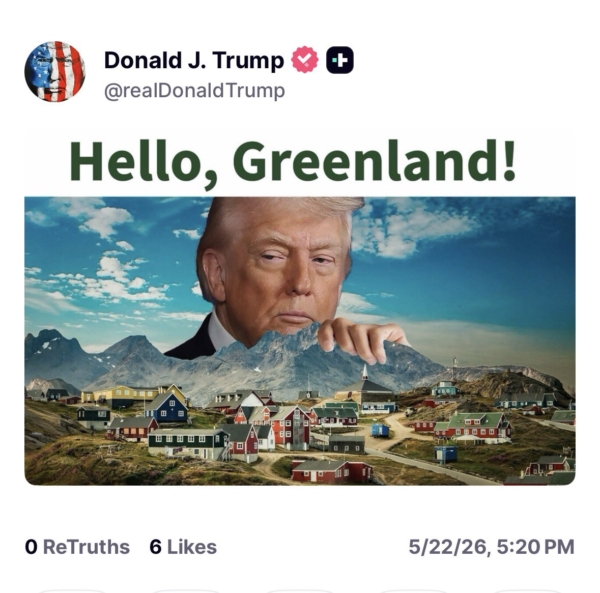
When Donald Trump announced, with characteristic bluntness, that the United States needed to acquire Greenland, the reaction in most European capitals was a mixture of irritation and embarrassment. The idea was treated as a distraction, the kind of provocation designed to dominate news cycles rather than advance serious policy. What it actually was, stripped of the theatre, was a public acknowledgement of something the intelligence and defence communities had understood for years. Greenland is no longer a vast, cold, thinly populated island on the edge of the map. It is a pivotal territory in an accelerating competition between the world’s major powers, and whoever shapes their relationship with it now will be better placed for what comes next.
That competition is about minerals, about shipping routes, about military positioning and about the deep-water corridor that connects the Arctic to the Atlantic. It is, in other words, about the same geography that nearly defined the outcome of the Cold War. And at the eastern end of that geography sits Scotland.
History Has a Way of Returning to the Same Water
In Moscow in the 1990s, when the Soviet collapse was still raw and Russian military power seemed permanently diminished, I used to hear senior officers talk about the North Atlantic with a mixture of nostalgia and unfinished intent. They had not forgotten what the GIUK Gap meant. They had not forgotten that controlling the approaches to the Atlantic had been, for decades, the central preoccupation of Soviet naval strategy.
What they lacked then was the capability to act on that memory. They do not lack it now.
The Greenland-Iceland-UK Gap is the deep-water passage between those three landmasses through which any submarine force moving from the Arctic into the open Atlantic must travel. During the Cold War NATO built an extraordinary surveillance architecture across it, hydrophone arrays on the seabed, maritime patrol aircraft flying constant patrols overhead, attack submarines trailing their Soviet counterparts through the darkness below. The Gap was the hinge on which Atlantic security turned. If it was closed, Soviet submarines could not threaten the supply lines keeping Western Europe alive. If it was open, they could.
For twenty years after the Cold War ended, the West behaved as though that question had been settled permanently. It had not been settled at all. It had merely been deferred.
Since 2014, Russian submarine activity in the North Atlantic has been climbing steadily. The Northern Fleet has been rebuilt and modernised. The submarines transiting the GIUK corridor are quieter and more capable than their Soviet predecessors. NATO has had to scramble to reconstruct the surveillance and response capabilities it spent a generation allowing to atrophy. The Gap is contested again, and the urgency in the alliance’s response reflects how seriously that is being taken at the highest levels.
Scotland sits at the eastern end of this corridor. It has always sat there. But for the first time in a generation, that position carries the weight it deserves.
The Ground Beneath the Strategy
What strikes me, is how often the human reality of a place is the last thing to be factored into the strategic calculations made about it.
Greenland is a case in point. The conversation about its rare earth deposits, its military positioning and its relationship with Washington, Copenhagen and Beijing tends to proceed as though the island is a piece of terrain rather than a place where people live, fish, raise families and try to make sense of a world that has suddenly decided they are important. The communities along Greenland’s coastline are facing pressures that would be recognised immediately in the Scottish Highlands and Islands. Young people leaving. Fishing industries under strain. The infrastructure of daily life becoming harder to sustain as the economics of remoteness bite harder. Climate change arriving not as an abstraction but as a direct disruption of the natural systems on which people depend.
Greenlanders rally against new US consulate in Nuuk
Greenlanders march against US President Donald Trump’s desire to control the vast Arctic island, after the inauguration of the US consulate’s new premises in the capital, Nuuk.
“We have always lived in Greenland. It has… pic.twitter.com/UFwKNfRSLE
— AFP News Agency (@AFP) May 22, 2026
Scotland is not Greenland. But Scotland knows this terrain. The crofting communities of the Western Isles, the fishing towns of Shetland, and the glens of Sutherland that have been emptying for a century and a half have all been living at the intersection of geographic isolation, economic fragility and political neglect for a very long time. That experience, and the policy learning it has produced, is not nothing. It is, in fact, exactly the kind of practical knowledge that Greenland will need as it navigates an opening to the world that it did not entirely choose and cannot entirely control.
Building a relationship on that basis, on shared experience rather than just strategic interest, is both more durable and more honest than the alternative.
The Energy Question
There is a harder-headed argument running alongside all of this.
Greenland’s rare earth deposits are among the most significant on the planet. The minerals in question are not exotic abstractions. They are the materials inside the electric vehicles Western governments are mandating, inside the wind turbines those same governments are building, inside the guidance systems of the weapons NATO is deploying. The Western world has a serious and acknowledged vulnerability in its dependence on Chinese rare earth supply chains. Greenland is the most credible alternative source of scale.
Developing that source requires offshore and remote-environment industrial capability of a kind that takes decades to build. Aberdeen and other areas of the north-east of Scotland have spent half a century doing exactly that. The North Sea oil industry created an engineering and logistics infrastructure specifically designed for cold-water, remote, hostile operating environments. That infrastructure does not need to be invented for the Arctic. It needs to be redirected toward it.
The window for Scotland to position itself within Arctic supply chains is open. It is not permanently open. Norway has been building these relationships for years. The United States is moving quickly. Other European actors are following. A deliberate industrial strategy, backed by serious diplomatic engagement, could give the north-east of Scotland a long-term economic future in Arctic energy and extraction. Without it, the expertise accumulated over fifty years will simply migrate to countries that made the decision sooner.
Brexit’s Quiet Legacy
There is one dimension of this story that tends to get lost in the noise of constitutional argument.
Brexit changed Scotland’s strategic orientation in ways that have not been fully absorbed. For forty years European Union membership had pulled Scotland’s institutional attention south and east, toward Brussels and the continental mainstream. The rupture of 2016 weakened those orientations without replacing them with anything coherent. Into that space the northward pull has quietly strengthened.
I have seen this kind of reorientation before in other countries, the moment when a shift in external relationships forces a reassessment of which direction a nation is actually facing. Scotland’s political class is still partly working through what that means. But the geographic and economic logic of a deeper northern orientation, toward Norway, Iceland, Denmark and increasingly Greenland itself, has become harder to argue against.
It is worth noting, without overstating the parallel, that Greenland made a version of this choice in 1985, leaving the European Economic Community and deciding that its interests were better served outside European structures. Scotland did not make that choice. But the effect of having it made on its behalf has been to reopen the same fundamental question about orientation, relationship and identity that Greenland answered four decades ago.
What History Suggests
I have learned, over many years of watching how these things unfold, that the countries and territories that position themselves ahead of strategic shifts tend to do better than those that react to them after the fact. The window during which Scotland can shape its role in the emerging North Atlantic order is not unlimited.
The GIUK Gap is contested again. Greenland is at the centre of a great power competition that will define the North Atlantic for decades. Scotland’s geography, its military infrastructure, its offshore energy expertise and its nascent Arctic relationships give it assets that most comparable territories would envy. What it lacks is a government, in Edinburgh or in London, that has articulated clearly what it intends to do with them.
That is not a permanent condition. But it is an urgent one. The North Atlantic is not waiting for British or Scottish policy to catch up with it. The submarines are already moving. The minerals are already being mapped. The shipping routes are already opening.
The map that matters now is not the one that puts London at the centre. It is the one that puts the water between Scotland and Greenland at the centre. On that map, Scotland is not peripheral at all.
It never was.
See also: Greenland’s Real Crisis: The Colonial Legacy We’re Not Discussing – Bella Caledonia
DONATE TO OUR FUNDRAISER HERE:
BELLA CALEDONIA 2020


We are supported only by our readers. We don't have corporate backers and we don't take advertising, so we rely entirely on your support.
Help to support independent Scottish journalism
Sadly, at present, the thinking and consultations that have to be done along the lines the author suggests are not within Scotland’s present powers. The power in these matters lies at Westminster and the ‘strategic’ position of Scotland vis-a-vis the North Atlantic, has always been one of the reasons ‘Britain/England’ has been reluctant to countenance independence for Scotland.
On the rare occasions when it is alluded to by unionist politicians and the unionist media, it is contextualised as a reason for Scotland to remain in the UK, because we are ‘incapable of doing it ourselves’ – the Scotland-is-too-wee-and-no-very-good paradigm.
The fact that legal power over this do not lie at Holyrood does not mean that we in Scotland must accept this quietly. There are civil political actions which people can take. Iceland is in this area and it is an independent country. It has political ties with, particularly, Denmark, as well as with NATO. Greenland, Faroe Islands, Denmark, Norway and, arguably, Ireland, its neutrality notwithstanding, are part of this, too, and all have far more powers than lie at Holyrood.
Scotland must continue to foster links with these states, as was begun when Nicola Styrgeon was FM.
This is a problem when there is a government in London determined to diminish and deindustrialise Scotland in order to make independence unviable. Any situation that might raise Scotland’s profile has to be sidelined and reduced in importance.
Thoughtful and timely piece.