
Eh? Aye? Resisting Scotland’s Hyperscale Data Centre Revolution
The AI revolution in Scotland is a product of Brexit and the spawning of the network of Special Economic Zones, Freeports, and now AI Growth Zones, which function as areas where normal planning rules, environmental standards, and democratic accountability magically disappear. Labour inherited this fever-dream of neoliberalism, technological liberation and exponential growth from the Tories. In January 2025 Keir Starmer announced that Britain would become an “AI superpower.”
Scotland is experiencing yet another revolution it didn’t ask for, as vast hyperscale data centres for AI are planned across the country. The phenomenon follows historical patterns of colonialism and extractivism that are well-worn, but with an entirely new dimension and in an entirely different historical context of: climate catastrophe, Late Capitalism and the Anthropocene.

Communities across Scotland, and the world, are organising to resist. The objections include ecological/climate issues, social and economic consequences around mass job losses and cultural questions around copyright, harvesting human creativity and slop. But there’s a fourth objection at play which is political: AI feeds-into all of the contemporary fears about the power of the Broligarchy and the surveillance state and how it interacts with the political elite.
Democracy for Sale has noted that Oracle founder Larry Ellison has donated and pledged at least £257 million ($330 million) to the Tony Blair Institute, fueling a massive expansion of the think tank into a global powerhouse with over 900 staff. The Tony Blair Institute frequently publishes policy papers championing the integration of AI, digital IDs, and unified electronic health records. Critics and investigations highlight that these recommendations heavily intersect with Oracle’s commercial objectives, with some insiders referring to TBI’s technology policy arm as being “inseparable” from Oracle.
See Blair and the Billionaire – Lighthouse Reports.
But, if a lot of the public focus is on companies like OpenAI, Anthropic, Palantir, SpaceX (which gobbled up AI startup xAI creating a combined entity worth $1.25 trillion) and Windsurf, the market for AI is actually much more diverse than the high-profile companies.
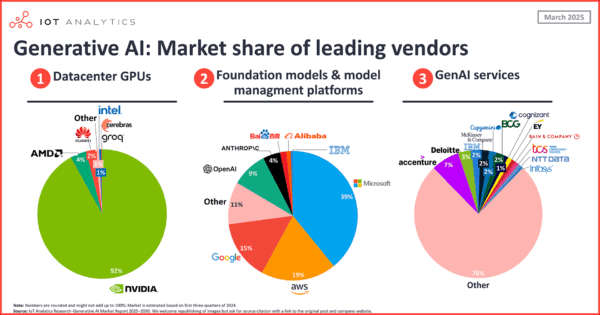
However, if the eye-watering sums of money being invested in AI and the terrifying existential questions it raises can be overwhelming, the backlash against the technology and its consequences is very real.
The People v AI
In February Time magazine ran a front cover on The People v AI: behind the growing backlash, stating: “In a deeply divided nation, a new coalition is forming around one belief: AI is moving too fast. Inside the stories of nine Americans, across ideologies and professions, determined to slow down the technology reshaping daily life.” The article cites evidence from activist website Data Centre Watch that shows “From Virginia to Indiana to Arizona, activists stalled $98 billion in data-center projects in the second quarter of 2025 alone.” The cover story claims that “a growing cross section of the public, from MAGA loyalists to Democratic socialists, pastors to policymakers, nurses to filmmakers” are now part of a non-partisan movement to stop or slow down AI data centres, and they are standing together to oppose politicians who are pushing for data centre expansion.

The resistance is interesting because, despite the appearance of a technological juggernaut that must not be resisted, which assumes a sort of inevitability, AI is actually quite vulnerable.
As the award-winning author Ewan Morrison has noted: “The biggest weakness that AI companies (Open AI, Anthropic, XAi) and tech companies who have committed to AI (Google, Microsoft) have, is their dependence on the vast expansion of data centres so as to prove the foundational belief that the AI explosion has been built on.”
Morrison wrote for Bella in February, arguing that the AI industry, or phenomenon, is a capitalist fantasy, one with terrible consequences but a fantasy nevertheless. He wrote:
“Data centres are not just a waste of resources; they are a vast folly, a disaster waiting to happen.”
“This adds insult to injury for all of our communities, because those huge data centres the companies want to build on our local land are not going to deliver on what the overhyped sector needs to make a return on its investment. We can and should get angry about the fact that a data centre built in our country will push the prices of electricity up and contaminate fresh water supplies, and it will all be for nothing. Or rather, it will all be for the mass delusion that America has spawned, that it could create a universal superintelligence by boosting chatbots through a speculative venture capital investment race into the trillions.
In truth there is no AI industry, there is no such thing as AGI or ASI research or ASI safety, there is only the recurrence here of something that American capitalism can’t stop itself from doing again and again in history – creating thin air money out of simplistic, hyped ideas and greed fuelled optimism, creating another economic bubble of vast proportions, bigger than the dot com bubble, maybe bigger than the 2008 crash.
“And this bubble too, when it bursts, will bring down banks who invested in it and pension funds that got dragged into it. It will bankrupt governments like our own, in Scotland and the UK with their vast investments in AI infrastructure. The UK has the AI Research Resource (AIRR) through which the government is investing over £2 billion into the “AI ecosystem”, “including £1 billion to boost sovereign compute capacity, aiming for a twenty-fold expansion by 2030.” Then there is Scotland with its government plans for 17 new hyperscale data centres. This included the £15 billion “Stoics network”, which aims to build three of the largest global data centre clusters, although it refers to them as part of a Green data network in a fine example of greenwashing what is becoming the most anti-ecological industry in the world. Proposed sites for Scotland’s new data centres include four in North Lanarkshire (including a major AI growth zone at Ravenscraig), two in the Borders, two in Edinburgh, and two in East Ayrshire.”
Morrison was prescient, but already this mapping is out of date. The impact is vast.
Scottish countryside charity APRS has published this interactive map showing the real scale of the process. From a 1000MW hyperscale data centre (scaling to 2000MW) at Killean on the Dunoon Peninsula, to Chapelcross in Dumfries, to 600MW data centre proposed on farmland by the village of Auchtertool, between Kircaldy and Cowdenbeath, to the proposal for a 220MW data centre on farmland and moorland near Duns in the Scottish Borders the map shows over twenty sites.
APRS say: “Click on the map to find out information on the capacity, stage of planning, developer. And each proposed site has a dedicated webpage with more information including maps and plans, links to planning documents, and contact details of local campaign groups.”
“Hyperscale data centres are some of the biggest buildings in the world and this is why we are seeing them being proposed mainly on greenbelt and greenfield sites,” said Kat Jones of APRS. “Their main requirements are large quantities of land and access to huge amounts of electricity and water. These buildings are huge but the amount of energy they use is absolutely off the scale.”
“This is an inconceivable amount of energy that Scotland is being asked to divert to the use of hyperscale AI data centres, which will enrich a few billionaires in Silicon valley at the expense of the Scottish consumer,” said Jones.
APRS has a petition to
Call on Scottish Government to demand Environmental Impact Assessments on Data Centres
They write: “Data centres use huge amounts of energy and water – a recent proposal for a data centre in Edinburgh is reported to require power equivalent to that used by more than half a million homes, the population of Glasgow and Edinburgh combined.”
“The developers of this data centre will not be required to draw up an Environmental Impact Assessment (EIA) as part of the planning process. This is because it has been screened out as unnecessary by the Local Authority. Environmental Impact Assessments are required of major infrastructure and lay out all the environmental impacts in one place so that decision makers can make an informed decision. However we are seeing applications for data centres and large battery storage installations being screened out of requiring EIAs. This is extremely concerning because the scale of energy requirements for data centres mean that they have a disproportionately high impact on the environment.”
You can sign the petition here: Call on Scottish Government to demand Environmental Impact Assessments on Data Centres
This is another industrial revolution that has arrived in our lives and our communities without any consultation or public discussion. As the green researcher David Powell has written:
“Across Wales, Scotland, and England, the largest peacetime infrastructure seizure of community land and energy in modern British history is accelerating, and the vast majority of people living in its path do not know it is happening.”
But we do know now, or we’re beginning to. And where communities realise the extent and consequences of the plans they are outraged, as in Auchtertool in Fife – Auchtertool villagers rally against 600MW Fife AI data centre plan | The Herald – and at Duns, between the villages of Longformacus and Westruther on the Lammermuir Hills – Locals bid to block ‘monster’ AI data centre in Borders | The National.

The problem, and the community-response, mirrors what we have seen as Scotland’s onshore renewables revolution has been rolled out across the Scottish Highlands and Islands. The model is communities vastly affected by technologies from which they derive little benefit and industries that they don’t own.
The Green Myth
Much of the support for AI in Scotland, and subsequent data centre development, is based on a couple of comforting myths. The first is that Scotland’s beautiful clean energy will fuel such centres, rather than bad grubby energy elsewhere. The second is that this is technology we NEED and will bring us huge benefits (often vaguely referred to).
Kat Jones from APRS has said: “Scotland’s “green data centre” policy framework is in open collapse. More than a dozen Scottish data centre projects in planning, including the £8.2 billion Lanarkshire AIGZ, would collectively draw roughly 6.2 gigawatts, equivalent to one-and-a-half times Scotland’s entire winter peak demand. Scotland’s National Planning Framework 4, the document theoretically governing these decisions, was last analysed in 2022 before ChatGPT existed. Its underlying modelling assumed data centre emissions would be offset by reduced commuting. AI-scale workloads were never modelled. The “green” designation being applied to these projects has no enforceable emissions standard. It is a label, not a standard.”
AI Data Centres are, despite the hype, greenwashing and ignorance, inherently anti-ecological. [The Data Centre Land Grab: How Britain Is Being Carved Up for Big Tech — Without Your Consent].
Kat Jones has stated:
“Data centres require power continuously, 24 hours a day, seven days a week. Renewable energy, wind and solar, is intermittent by nature. Data centres are not well-suited to being powered by renewables because they need constant power 24/7. Many data centres are building batteries on-site to provide backup, but these are generally designed to store energy for a maximum of four hours; most have just two hours of storage. That could bridge the times of day when prices peak, but it will not cover energy requirements for the hours and days when there is a lack of wind. That needs long-duration storage, pumped hydro, hydrogen and such like, which is expensive to build.”
This is the real reason why we’re told over and over again, Labour politicians told us: “Scotland needs Nuclear Power.”
A Nuclear Renaissance for Scotland? – Bella Caledonia
That AI data centres are an environmental disaster zone isn’t disputed. This report, Environmental Cost of Artificial Intelligence: Carbon, Water and Land Footprints, by the United Nations University Institute for Water, Environment and Health, examines one of the most underexplored consequences of AI’s rapid expansion: the environmental footprints of the energy required to power it. The new report – it was only issued on 3 June 2026 – explains the scale of the crisis:
“By 2030, the global data centres powering artificial intelligence are projected to consume 945 terawatt-hours of electricity. This is nearly triple the combined annual electricity use of Pakistan, Bangladesh, and Nigeria—countries collectively home to more than 650 million people. Their associated water footprint will equal the basic annual domestic water needs of all 1.3 billion people in Sub-Saharan Africa, and their land footprint will exceed 14,500 square kilometers, roughly twice the Jakarta metropolitan area, home to more than 32 million people.”
Read the press release here: ‘Rising Emissions, Depleting Water and Vanishing Land—UN Scientists: AI Is Threatening Natural Resources for Billions’, or the full report here.
Displacement and the Unnecessariat
If AI is profoundly anti-ecological and by its nature profoundly anti-democratic, it is also profoundly anti-human, or certainly this incarnation of it is. As Cory Doctorow has written [Hell is other people – so billionaires are using AI to replace them] Bezos and Zuckerberg and Musk and Sam Altman (Open AI) have a vision of the future, you’re not in it:
“Jeff Bezos built the world’s most advanced automated warehouses, and the workers in those warehouses are seriously injured at 300% of the national rate. The automation and the injuries aren’t unrelated facts. The inhumane treatment is caused by the automation, because when you commit hundreds of billions to automation capex, you need to work those assets to recoup the investment. In a human/machine collaboration, humans will always be the bottlenecks.”
“Mark Zuckerberg would like to replace your on-platform friends with chatbots. Sure, your friends are the reason you’re stuck on his platforms, but your friends are stubborn and thus suboptimal. They unreasonably refuse to leave Facebook with you and follow you to another platform (this is bad for you, but good for Zuck), but they also refuse to organise their social media lives to “maximise your engagement” and thus the number of ads you see (which is bad for Zuck). By replacing your friends with chatbots, Zuck hopes to reinvent social media without the socialising.”

The vision, according to Doctorow, is grim:
“For these politicians, AI offers a way out of their double-bind. If migrants can be replaced with AI, then you can satisfy the racist sadism of your most ardent voters without shutting down the country for lack of workers. In feeding the fantasy of a world without people, AI serves the fantasy of a world without migrants. Unlike gastarbeiter, bracero fruit-pickers or Saudi quasi-slaves, AI makes no demands, requires no moral consideration, and does not attempt to germinate a culture, a cuisine, or a language in your sacred soil.
The wealthy have always dreamed of transforming the proletariat into the precariat: desperate workers who do as they’re told. But in the automation story of which AI is the latest chapter (and purportedly the climax), the precariat becomes the unnecessariat: workers who are surplus to requirements and can be vaporised or liquidated or warehoused or simply ignored.
“In the fantasy world of total automation, the owners of AI can make the world go around without any of us, which means that we will exist solely at their sufferance, and will therefore have to act like the non-player characters they half-believe we are already, organising everything we do around their priorities.”
None of this speaks to the cultural impact of AI. Living in an era of AI Slop is profoundly unnerving and disturbing, but it is not the real problem. The problem is not just the displacement of writers, poets, musicians and artists with slop, in terms of jobs and status – which tells us ‘you are replaceable, you have no value’ – the problem is what that tells us about ourselves. The message is to demean and degrade human creativity and flourishing. It is anti-art and anti-culture.

There’s ethics in aesthetics, or at least there should be.
Now, resistance is taking many forms (the QuitGPT movement), but one is to declare websites, publishing houses, galleries, record labels, and whole cultural sectors ‘AI Free’ – and the battlelines are being drawn on creating strict cultural demarcation.
As Gary Marcus has written: “Outside of coding (where there is clear value), and a handful of other domains (e.g. brainstorming), Generative AI has been a net negative for society.
GenAI has been undermining secondary and college education, opening up mass surveillance, increasing disinformation, delusions, impersonation, phishing, and other forms of cybercrime, nonconsensual deep fake porn, bias in employment and other domains, and economic disparity, drowning the world in slop and unwanted, over-leveraged environment-damaging data centers that risk causing a recession.
Simultaneously, it has empowered a bunch of people who want to privatize almost all the gains while leave all the downsides to society, taking almost zero responsibility.”
End Games
Any technology for which the benefits are vague, untouchable and over-hyped and the downsides are huge, visible and clandestine is in deep trouble.
If much of the AI experience feels like a high-speed hallucination in an already deeply disorienting world, it may become a focal point for a culmination of disaffection. AI is fast becoming the lightning rod for decades of immiseration, anger at tech-elites and deep-seated hatred for the world we’ve been forced to inhabit. In this sense, the overwhelming power and wealth of the Tech Class is a mirror of the illusion that AI can create enough ‘growth’ to solve social crisis, or the fantasy that you can create massive power surges in a climate crisis.
As Ewan Morrison writes: “We have more power than we realise. We are not just protesting a technology we dislike. We are standing across multiple political divides, against a financial scam that threatens all our livelihoods. The good news is that we don’t need to bring down the whole edifice at once. We just need to keep saying no. What’s needed isn’t heroism, it’s just turning up at council planning permission meetings armed with facts. We only need to stop them, again and again, location after location, until the clock runs out. Keep blocking. Keep organising. Until the thing collapses under the weight of its own impossibility.”
Photo by Steve A Johnson on Unsplash

We are supported only by our readers. We don't have corporate backers and we don't take advertising, so we rely entirely on your support.
Help to support independent Scottish journalism
The new thneed?
https://en.wiktionary.org/wiki/thneed
The Cave of Shadows is hotter and stuffier, a electronic hum heard behind a rising cacophony, fires flicker with electric frenzy, and sidelined shapecasters are sitting sullen.
I’ve been looking at one line drawn between Cold War black propaganda to today, in Rory Cormac’s new book Fakers: a top-secret tale of phantoms and forgeries on the disinformation front line (2026). The WW2 SOE operations folded postwar into new organs like the IRD (which editorial section the book tracks from 1960). How much of our culture since WW2 has been essentially cultivated through spook-funded artistry? What arts were selected for promotion on the basis of their lack of revolutionary potential? How many creatives had suspicions they were working for fronts but turned a blind eye?
The USA has openly attempted capture of world copyright before. There is possibly more continuity than disruption here.
There’s nothing in these data centres for Scotland. Beyond the initial construction they have very few employees. So Scotland gets the extra 2% or whatever extra income tax they pay up here which will be balanced by the universal benefits they receive. The bulk of the income tax, all corporation and capital gains tax go to WM as does taxes on the energy they use.
There’s no place for them until maybe after independence when we’ve an abundance of energy that the UK’s decrepit grid can’t handle.
Thank you for this diamond sharp analysis. Your eloquence and integrity gives me hope.
Another World is Possible.
Thanks Craig!
Sat 13 Jun 10:45 AM – 4:00 PM: Scotland resists big tech power
https://www.tickettailor.com/events/globaljusticenow/2199587?ref=sb_twitter
By the way this the Scottish Government’s AI strategy:
https://www.gov.scot/publications/scotlands-ai-strategy-2026-2031/pages/3/
Hopelessly naive, sketchy, back of a fag-packet ‘strategy’ that is no more than a ‘Your-Data-Centre-Here’ placeholder. An invitation to recolonise Scotland with the population as passive subjects waiting to be milked for their attention.
Nein Danke!
Yeah. It wasn’t posted as a recommendation.
Do we even have AI yet?
All I see is large language models which are very quick at regurgitating select bits of already-written internet content. Usually stuff they have scraped for free from someone else’s (human) work.
I can’t help feel that that investing our national resources (land, water, energy production) at this stage would be like going all-in on funding the inventors who made feathered wing-suits and claimed they had discovered how to fly.
Definitions vary but as far as I am aware, no, we do not have AI as it was originally conceived. What we have, in the words of a scientist looking into real AI, is a very clever and sophisticated search engine.
correct, wikipedia on steroids might be one way to view it
I’d like to see a global resistance that uses switching off as a protest. A coordinated turning of our backs and averting our gaze for periods of time to remind those in power (and ourselves) that we have agency and that our consent cannot be taken for granted.
yip, & month off the tinternet for example
I’m not sure why this topic has got me so activated. It just feels deeply wrong and sinsiter on so many levels.
At a time when we should be drastically reducing our energy demands, heavily insulating our homes, de-escalating our consumerism and dependence on infinite growth. It goes against all that we should be doing to plan for a liveable future.
Computers that can’t work without water-cooling, electric fans and getting hot are really, really primitive tools.
Our hill-sides commodified as carbon-credit tokens, valleys full of pylons taking energy south and our lowlands filled with toxic computer warehouses. None of it offering a resilient, prosperous future for Scotland’s people. In fact, the very reverse.
Signed. But Holyrood has handed relevant committee chairs to … the Tories and Reform!! You couldn’t make it up. We never voted for that
The whole Scottish Government is a disgrace. Utterly incapable of standing up for us.
interesting article in The Ferret I read recently which was telling me how much money landowners are making thru renting the land upon which these windfarms have been built, as a non-voter I’m not even gona start on the Scottish Nato Party or Scottish Nato Parliament in case I blow another fuse, one fuse per week is all I can afford at the minute, fs cov
Link to article for anyone interested https://www.theferret.scot/landowners-making-millions-wind-farms-scotland/
Thanks Mark