
On the World Stage
Something strange is happening about Scottish identity and representation through our appearance at the World Cup.
First, the lack of an ‘official’ World Cup song has led to a surge of songs, some terrible, some great, some (very) amateur, some professional, some traditional (Skerryvore), some techno (2am Eternal, a KLF reference).
See World Cup Beats – Bella Caledonia

But while some people have moaned about the cliches (Irn-Bru, McTominay, and whisky feature heavily) I think it’s a great outpouring of a mixture of ‘dream’, self-expression and a heavy-dose of self-satire – “Hampden Park kinds sucks, but I will go there anyway” bleeps and croons JJ Bull. The tone is going for a laugh, living in public hope, while nursing private fears, and enjoying the ride. This is about excitement rather than expectation.
But if musicians try and give garbled expression to how we feel, there is resentment in some quarters. In an extraordinary segment on Good Morning Britain this happened:
Gavin Ramjaun, Susanna Reid and Ed Balls all agreed it was a terrible idea, and a waste of money. Afua Hagan tried to hold her corner.
Watch it. The use of ‘they’ and ‘we’ in it is hilarious.
Susanna polled viewers with the question: “We asked you is it unfair for Scotland to get a Bank Holiday for the Fifa World Cup while the rest of the UK would be hard a work?”
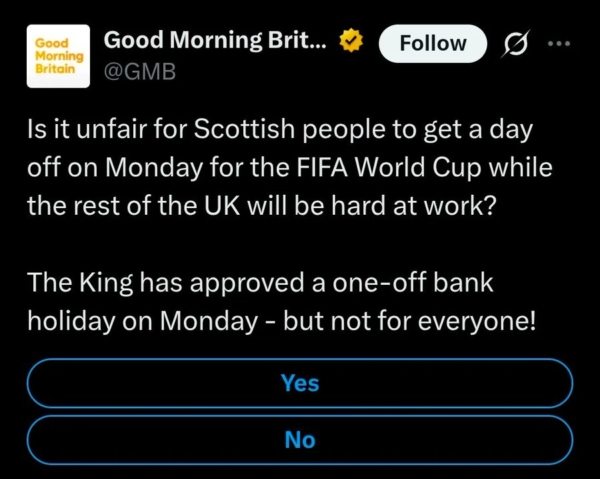
In another segment, the discussion just degenerated into cultural stereotypes and bigotry. At one point, Susanna Reid says, “It’s pretty outrageous, I mean how long does it take for Scots to get over the fact they’ve played their first match?”
— BELLA CALEDONIA (@bellacaledonia) June 9, 2026
Setting aside that this is a segment unimaginable if it were talking about England, it must be playing into some deeper resentments. First up is just resentment that Scotland does something (anything) different. This is intolerable. Second, there’s the racist tropes about alcohol and laziness. But third, there’s something else, a sort of resentment, which is about how different countries are relating to the event and their representation on the world stage.
Great Expectations
The weight of expectation lies heavily on England.
As Migeul Delaney writes [The meaning of 1966: Does England’s only World Cup still carry the same relevance? ]:
“England’s sole World Cup win has weighed on every tournament since, but carries an extra resonance for this summer now that it’s 60 years on. If ever there was a moment to emulate it…
But does it even carry the same relevance? The 4-2 win over West Germany is now closer to the sinking of the Titanic than to this 2026 World Cup.”
David Baddiel was commissioned to write another series on the strange concept of ‘Sixty Years of Hurt’.
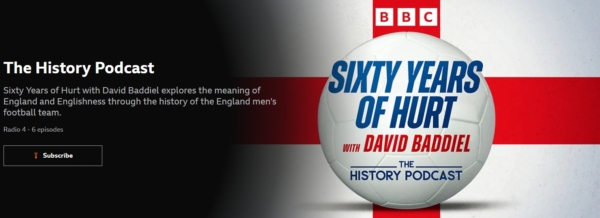
The level of self-entitlement even to frame history like this is astonishing and inevitably leads to a crushing sense of expectation.
Fractured Media
Finally, all of this plays out through the prism of ‘UK’ media institutions that are barely representative and completely partial. ‘Fans with typewriters’ as the old adage went. All of this gets heightened and amplified at a World Cup, which is one of the few sporting stages where Scotland and England have a genuinely global profile and compete against each other.
As faith in the public broadcaster (north and southern versions) collapses [Cultural Vandalism and the Crisis of Public Broadcasting] we can expect the media landscape to splinter further into thousands of micro-sites, YouTube channels and other platforms.

We are supported only by our readers. We don't have corporate backers and we don't take advertising, so we rely entirely on your support.
Help to support independent Scottish journalism
Scotland’s holidays are none of their business. They still seem to think we should be constrained by what England decides to do. Like the pandemic. So very far out of touch and so needing to be dumped in the the dustbin of history.
Afua Hagan (I’m not familiar with her work) did more than ‘try’ to hold her corner, whatever that means in this fluffy breakfast TV confection, but clearly distinguished the Scottish senior Men and Women teams (obviously the latter have qualified for the World Cup more recently than 1998), defended and honoured our first opponents Haiti from the denigrating blowhards, and effectively highlighted the joyless and borderline-sociopathic economind of her hosts.
What the role of the ‘king’ was in the matter of the bank holiday, was left unexamined.
The English national women’s team has meanwhile been extraordinary lucky (and cheated a lot in winning the Euros they hosted in 2022), but were roundly beaten 4–0 by World Champions Spain at home who clinched overall victory automatic qualification from their group. Their players and manager have been fêted and some turned into stars of advertising campaigns, becoming familiar faces. But their more individualistic style has drawn unflattering comparisons with Spanish teamwork (which can be glorious in full flow).
The uncomfortable reality for the SWNT is that the decisive factor in their recent success has largely been the outstanding performances of attacking midfielder and captain Caroline Weir, from Real Madrid and Fife. But perhaps the team is just coming out of a slump (associated in my mind with USAmerican soccer influence of the kind Hope Solo has criticised), and as the commentary teams have said, are poised between the A and B groups, and may become regular qualifiers again.
I have no interest in World Cup songs, tedious nostalgia and crass commercialism. I plan to watch as many matches as I can stay awake for, but most of the rest is just repetitive noise. There is a sense that the soul of football is being fought over. If anyone is interested in the links between radical politics and football, I would recommend Gabriel Kuhn’s Soccer vs. the State, but I haven’t read the newer 2nd edition.
But if you are looking for signs and portents, what to make of this card-carnage in a Brazil–USA ‘friendly’?
https://www.bbc.co.uk/sport/football/live/c9wewzvvrn5t
The grown-up answer of course is; “Scotland should have whatever public holidays the governemnt & people of Scotland want.
It would have been interesting for someone to have asked the question; “Was our King wrong to have approved this bank holidy?”
The GMB article is typical of the arrogance and ignorance relating to Scotland (&Wales & Ireland) displayed by many in media and society in England.
The question I cannot answer – is this arrogance borne out of ignorance or ignorance borne out of arrogance?
I write this as someone who has worked and lived in England, Scotland and Wales and had good personal friends in each country.
I think there may be two things at play. There’s the English (our friends, neighbours, spouses, family) and then there’s ‘English-ness’.
Or rather, a particular kind of Englishness that can be whistled up in certain situations.
Scots can exhibit it too because we were all, UK-wide and even in the Commonwealth, steeped in a kind of English-childhood experience; Commando comics, Ealing films, the BBC, Royal Family, racist TV comedy etc. And yes, as fully paid-up & enthusiastic participants in The Empire us Scots are not immune.
I love England and the English, but that particular strand of Englishness ( entitlement,i gnorance, superiority, exeptionalism, arrogance) gets on my wick.
Wul – I agree with your comments.
I would add that people in Scotland and Wales tend to have a better knowledge of what is happening in England and English history than vice versa. This is mainly down to the media in UK being overwhelmingly Anglocentric.
@Wul, there are objective differences.
“Joanna Barrett, the NSPCC’s associate head of policy, said: ‘This UCL research shows yet again that physical punishment does not improve children’s behaviour and in fact has an adverse impact on their wellbeing and links to poorer outcomes in the future.
“‘As is already the case in Scotland and Wales, children in England and Northern Ireland should be afforded the same protection from assault as adults. It’s time to change the law and remove the defence of reasonable punishment once and for all.'”
https://www.theguardian.com/education/2026/jun/11/children-hit-by-parents-more-likely-to-bully-others-research-finds
“UCL’s research found that physical punishment was still used by parents against more than 20% of 10-year-olds in 2020-21, and was likely to be more common against younger children in their preschool years.”
Is it surprising that these events in England and Northern Ireland are playing out this way?
Politics would be a lot easier if we stopped traumatising children.