
Cultural and Ecological Repair On the Other Side of Sorrow
This text has been adapted from a talk given at the conference Community, Resistance and Resilience: Celebrating 50 Years of The Making of the Crofting Community, which took place at UHI Centre for History in Dornoch on 11th and 12th June 2026. The conference gathered scholars, creative practitioners, and activists from around the world to commemorate this landmark book.
A fortnight ago, I was at a gathering in Dornoch celebrating fifty years since the publication of James Hunter’s seminal book, The Making of the Crofting Community (1976). There were so many rich conversations – about land, culture, history and futures. As part of a shared presentation with Raghnaid Sandilands at the end of the first day, I spoke about the influence of Hunter’s writing on my own work and our creative practice. A huge thank you to Jim MacPherson at the UHI Centre for History for the invitation.
Digging where I stand, I’ll begin with a song. In the hills above Loch Ness, there was once a local bàrd baile, the Abriachan Bard Thomas MacDonald – also known as Tòmas an Todhair (b.1822). Much of his poetry was lost, destroyed by his own hand. Some of his work appeared in John Murdoch’s radical newspaper The Highlander, the voice of the crofting movement in the 1870s-80s – the same newspaper that would later amplify figures such as Màiri Mhòr nan Òran and help shape the political awakening of the Highlands. Tucked away in volume 28 of the Transactions of the Gaelic Society of Inverness, there is a poem without translation titled Fhir Astair a dh’ Imich o Thìr nam Beann Àrd. It is addressed fondly to an unknown young man of Mackay connection, and speaks to the grief that the Clearances wrought on the land and people of Sutherland. The poem is long, in the bard’s own style, intended to be sung. Here are a few stanzas:
Fhir astair a dh’ imich o thìr nam beann àrd,
Beir soraidh gu dìleas gu filidh nan dàn;
‘S e giomhanaich éunaich is ciobaran Galld’,
A’ tearnadh ‘s a’ direadh ri aonach nam beann.
Tha an àite nan laoch a bha ‘saoradh nan gleann,
‘S na Gàidheil air faontradh, ‘s cha ‘n fhaod iad bhi ann.
‘S ann tha nis iad fo chis aig luchd mi-ruin, ‘s be ‘m béud,
‘S na glinn bh’ aig an sinnsreadh na frithean aig féidh.
O traveller who has departed from the land of the high mountains,
bid a faithful farewell to the poet of the poems, the maker of the songs…
There are men hunting grouse, and lowland shepherds,
descending and climbing the face of the mountains,
in the place of the heroes who once defended the glens,
the Gaels are scattered, they cannot stay.
Now they live under the power of those who wish them ill, and this is the loss:
The glens of their ancestors have become sporting forests for deer.
The bard goes on:
‘S gur truagh leam an càradh th’ air càirdean mo luaidh;
Ga ‘n sumadh le bàrlinn gun fhàbhar gun truas;
‘S na manasan àghmhor bha ‘g àrach an t-sluaigh,
‘S e ‘s fhéadar dhoibh ‘fàgail gu àilleas dhaon uaisl’.
It is a great sorrow to me, the condition that has befallen those dear to me
Served with eviction notices without favour or pity;
And the joyful home farms where the people were nurtured,
Must be abandoned for the pleasure of the gentry.
The poem continues its lament, following the journey from the Highland glens to the ships bound for Canada and Australia. What is mourned is the breaking apart of an entire web of relationships: homes turned into estates, families torn from one another, communities scattered across the seas.
More than a century later, The Making of the Crofting Community would tell that same story of dispossession and displacement, but with a crucial shift in perspective. Rather than treating crofters as passive victims of history, Hunter showed them as active historical agents, shaped and surviving through collective resistance: the land agitation of the 1880s forced the Napier Commission and ultimately helped secure crofters’ rights in law. The book was hugely influential, showing that the Ceist an Fhearainn – the land question – was not settled history, but a live and urgent demand for justice.
While I read The Making of the Crofting Community in my university days, it was another of Hunter’s books that had the most profound effect on me: On the Other Side of Sorrow: Nature and People in the Scottish Highlands (1995; 2014). Here Hunter asks a question that goes beyond land ownership: after generations of dispossession and disconnection, how might we begin to repair the relationship between people and place?
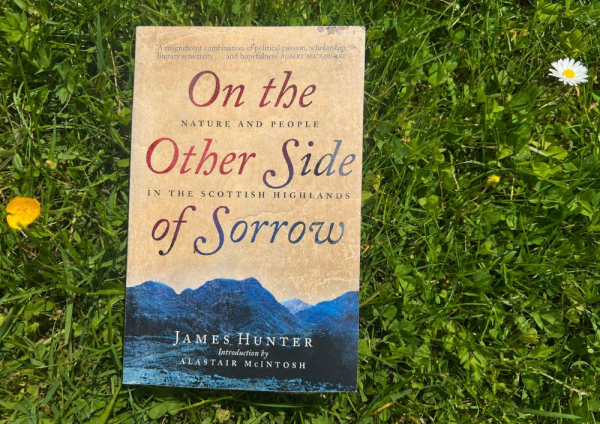
On the Other Side of Sorrow takes its name from Sorley MacLean’s unfinished long poem An Cuilithionn (The Cuillin, 1939). In it, MacLean surveys a landscape haunted by dispossession and absence, putting Gaelic language and Highland history at the centre of a conversation about the whole of Europe – of fascism, capitalism and human suffering. The final stanzas look towards how a people might recover dignity, agency and hope beyond grief and injustice, ag èirigh air taobh eile duilghe, rising on the other side of sorrow. Hunter shares that same conviction: that history is not a retreat into the past, but a resource for imagining more hopeful futures.
This book was first published in 1995, less than three years after the Rio Earth Summit, at a time when the world was only just beginning to articulate the language of a global biodiversity crisis. In the Highlands today, biodiversity is among the most depleted in the world, sitting in the lowest 15% globally. Hunter reflects on the dissonance between romantic imaginings of a wild, untainted, uninhabited landscape and the local lived realities of what Fraser Darling called a ‘devastated landscape.’
Hunter draws a direct line from political dispossession to ecological loss, showing how the erosion of culture, language, and memory is inextricably linked to the degradation of the land itself. He sensitively critiques conservationist approaches that separate nature from culture and human presence, outlining a future vision of the Highlands that involves both environmental restoration and the revival of local communities, ‘turning around those processes which have done so much damage both to this area’s people and to its natural environment.’
I first read this book in 2017, during a period of deep personal disillusionment. I was heartbroken, watching all my worst fears play out after the outcome of the independence referendum, and really deeply struggling with the dawning realisation of the true scale of the climate and ecological crisis, of our own historical moment. I had left my job, moved to the Highlands, and found the whole idea of pursuing a ‘career’ increasingly meaningless in the face of it all: biodiversity loss, mass extinction, burning forests, failing crops, rising seas, war, displacement, the resurgence of the far right. It felt as though the world was unravelling, that the future had been taken from us.
In a way, Hunter’s hopeful book gave me a framing for understanding my own work, and for seeing its deeper purpose. If our collective crisis is, at heart, one of severed relationships – a loss of meaning – then the long work that follows is that of repair and restoration, both cultural and ecological. In fact, the two are inseparable: that is to say, the task of nature recovery is as much about our human relationships with nature as it is about the practical work of restoration itself.
Archives, from this perspective, are more than records and relics of the past: they become a wellspring for rekindling cultural memory and inspiring creative practice as part of an ongoing process. Songs and stories are cultural expressions of living relationships with place and more-than-human life, carrying ecological knowledge shaped by centuries of attention to land, to sea and tide, to seasonal rhythms, to species. They are lifelines and songlines of love, grief, struggle and resilience, passed down through generations, offering ways of making meaning and navigating times of change. In an age of profound loss, the very act of remembering and giving new life to these cultural expressions becomes a quietly radical act.
Raghnaid and I have come to describe our creative practice as cultural darning and mending: finding disparate threads of memory, song, story, language and knowledge, and darning them carefully back into the ongoing story of a place. While we may feel powerless in the face of global crises, while we cannot mend the whole, we do have within our power the ability to make small, careful acts of repair that invite people into relationship with the land, its past, its people and its stories. This is not about a nostalgic return to a romantic, imagined past; it is active, political and future-oriented. As we pull at these threads of memory and story, we find ourselves deeply entangled with the world, connecting to wider struggles for justice as part of a global movement of resistance and possibility. It is a gift of a life’s work, hopeful and life-affirming, and for that, I am very grateful.
While preparing for the conference in Dornoch, I was in the middle of re-reading the book Abriachan: The Story of an Upland Community (2020), written by Katharine Stewart, edited by her daughter Hilda Hesling, with other contributions too. The introduction is written by Hunter himself: he describes a warm summer afternoon in 1999, strolling through Abriachan in the company of government ministers. The newly-established Scottish Executive had chosen to launch its proposals for land reform in Abriachan Village Hall. At the heart of those proposals was the notion that rural communities should be given greater opportunities to shape their own futures by acquiring the ownership of the natural assets on their doorstep. Rather than choosing Edinburgh, they chose this place, because Abriachan pioneers had recently taken an area of mixed forest and hill ground into community ownership.
Hunter writes, ‘the Abriachan folk I met and talked with had a very real sense of pride in, and attachment to, this little piece of territory on the shores of Loch Ness…irrespective of their origins, capable of collaborating closely for the benefit of the entire community to which they belong.’ He goes on, speaking to the value of the book: ‘all of us, no matter whence we came, are the better for knowing something of what has gone before, in the places where we’ve chosen to settle.’ This echoes Katharine Stewart herself, who, in her lovely book A Croft in the Hills (1960) – which preserves a picture of Highland community life, crofting, neighbourliness, and attachment to place – writes, ‘to hold on to one’s identity, one has to keep making one’s own discoveries…to hear the song, to find the gold.’
Today, Abriachan is the place I choose to call home: I am raising my family there, I volunteer with the Forest Trust, I host events and gigs in that same village hall. We benefit hugely from the legacy of care and restoration that has already taken root here. This year, I have been making discoveries of my own, through a project called Stories, Songs and Stewardship, offering what I find back to the community, and to a new generation.
Just a few weeks ago, at the threshold of summer, with help from Suzann at Abriachan Forest Trust, we held a community walk up to the reconstructed shieling hut on Càrn na Leitire, celebrating the tradition of the imrich chun na h-àirigh, the flit to the summer shieling. Over forty of us, in May sunshine, with a cuckoo calling, wandered up the forest track, noticing and naming plants and wildflowers on our way. Ryan Dziadowiec guided us through the history of summer life on the hill and the ways people once relied on the surrounding landscape, which would have been intimately familiar to those who spent each year on the hill from Beltane to harvest.
We were so lucky to have Ruairidh MacIlleathain with us too, who shared his deep knowledge of Gaelic plant lore – from whom so many of us have learned so much. The children now know their louseworts from their milkworts, and the magic of the lus an ìme, or mòthan, the butterwort. Among us that day were Gaelic speakers, young and old alike, and people hearing words like these for the very first time. We also tuned in to the birdsong around us: the ceileiriche, the willow warbler with its cascading song, a tiny crìonag-bhuidhe, the goldcrest, and the breacan-beithe, the chaffinch, the speckled one of the birch trees.
On our way back down the hill, we got to work making our own butter with bottles of cream, which our youngest participants enthusiastically shook until they became yellow – ready for oatcakes, pancakes and a pot of soup back at the village hall. We enjoyed art-making, plant printing and card-making with Katie. A display brought together placenames, local songs, traditional butter churns, spoons and paddles, and examples of local craft knowledge including fleece and wool dyed with natural lichen, all generously shared by community members. Gaelic song group Ealtainn sang beautiful traditional shieling songs for us, and local children sang Far am bi mi fhìn, a hopeful wee song from Gaelic tradition: ‘where I will be, is where my hope will be.’
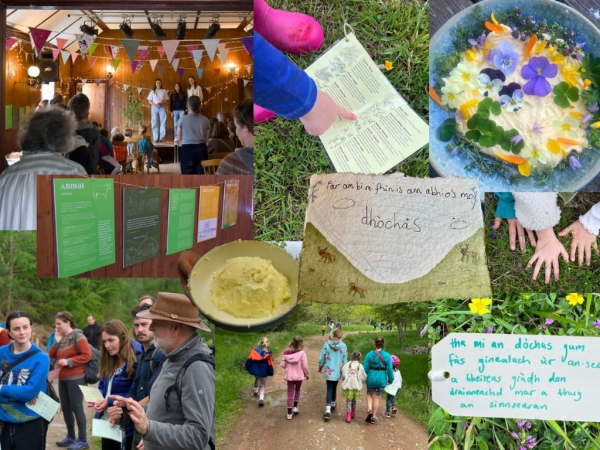
If this work feels hyper-local, well, it is. But deep attention to the local is not a retreat from the wider world; it is how we begin to understand our relationship to it.
Memory survives not only in books and archives, but in the living creative practices through which people make meaning for their own time. Repair takes root at the intimate scale of place, through the oldest and most convivial of human gestures: noticing, naming, remembering, singing, gathering, telling. It begins when someone learns the name of a bird, teaches a child a song, or asks an older neighbour how a place used to be. These acts may seem small, but they are all ways of coming to know a landscape deeply enough to love it, and to love it enough to look after it, to steward it into the future. Lasting community stewardship absolutely depends on a deep sense of place, rooted in cultural and emotional connection, and a belief in the future.
Many of today’s efforts to restore Highland ecosystems take place where the scars of clearance still shape the landscape, in areas once cleared of people, now home to deer: where land may be cared for, but not lived in; protected, but not always connected to community. As Hunter argues, ecological restoration at scale cannot be separated from the revival of community. It requires countless acts of local care, attention and ongoing responsibility.
Abriachan Forest is now a generation on from the 1990s community buy-out. In the words of my neighbour, Hilda Hesling,
‘In recent years, we have seen seasonal changes well beyond normal fluctuations, which bodes ill for the future. We must work hard to promote resilience, grow our own food, reduce reliance on fossil fuels, and nurture creativity and conviviality. In many ways, we must become more like the crofters of old!’
Every generation encounters ideas from the past in its own historical moment; the carrying stream is a constant flow of culture in which understanding is continually renewed and remade. Tòmas an Todhair was writing in the aftermath of clearance and dispossession. Hunter wrote a century later, at a moment when historians had begun to ask different questions of the past. His task in The Making of the Crofting Community was to give communities back their history and their agency, showing us that the past can be a source for imagining more hopeful futures.
We inherit these histories in a time of profound climate and ecological crisis. The task of our generation is different, but connected: it begins with communities reclaiming their histories, taking agency in a place, refusing to accept that loss is the end of the story, rebuilding relationships with the land and the more-than-human world, and imagining what futures might still be possible.
This article is dedicated to the memory of Hilda Hesling, whose support and gentle encouragement for my work, and whose commitment to the landscape and community of Abriachan, will continue to inspire us all into the future.
Stories, Songs and Stewardship is a project supported by Creative Scotland with funds from the Scottish Government. More information about Mairi’s work can be found on her personal website www.mairimcfadyen.scot and www.ichfornature.co.uk

We are supported only by our readers. We don't have corporate backers and we don't take advertising, so we rely entirely on your support.
Help to support independent Scottish journalism
A beautiful piece of writing Mairi, thank you. I too have been hugely influenced by ‘On the other side of sorrow’. It was given to me around 1991 and it framed my thinking and passions in all the years I have been living in Uist and all my work in the rural context.