
The Outrage Economy
THE OUTRAGE ECONOMY: From The Province Of The Cat by George Gunn
Ten years after Brexit, everybody is angry. The age of democracy has metamorphosised into the age of force. The concept of International Law as set out by the United Nations – peace, dignity and equality on a healthy planet – is as beautiful, moving and as distant as the ancient cave paintings made by the Denisovans and Neanderthals. The four core crimes under international law are genocide, crimes against humanity, war crimes, and the crime of aggression. These, since 2016, since the rise of Putin, Trump and Netanyahu, are now considered the standard and preferred strategies of foreign policy. To speak out against them is to be branded as a subversive. To protest in public, to hold up a placard condemning genocide, is to be arrested and charged with terrorism.
Furthermore the seven principles of International Law refer to the foundational tenets of the international legal order, universally codified in the landmark UN General Assembly Resolution 2625 (Friendly Relations Declaration) – they are:
- Prohibition of the Threat or Use of Force
- Peaceful Settlement of Disputes
- Non-Intervention in Domestic Affairs
- Sovereign Equality of States
- Equal Rights and Self-Determination of Peoples
- Duty to Cooperate
- Fulfilment of International Obligations in Good Faith
For a fuller understanding of these seven principles go to https://en.wikipedia.org/wiki/United_Nations_General_Assembly_Resolution_2625_(XXV)
There are many warlords who would like The United Nations to go the way of The League of Nations. It is obvious to see why. The fundamental purpose of The United Nations is in conflict resolution. This may seem, as viewed from the second decade of the twenty-first century, as the altruistic, optimistic, beautiful and calm choreography of a slow dancing animal. In the age of the algorithm anger travels quickly. Nuance does not. The algorithm-driven media allows people to forget or dismiss history, to curate their own reality, to reinforce their beliefs rather than challenge them. The result is not just disagreement, but distortion. Princeton professor and neuroscientist Molly Crockett has shown that moral outrage is amplified online because it is socially rewarded – through attention, validation, and visibility. What is created is a an outrage economy where disagreement no longer feels like a difference of opinion. It feels like a threat. The outrage economy is all about psychological self-protection. Those who invest in it tend to become more hostile towards their opponents, more likely to see them as extreme, and more likely to attribute negative motives to them – reinforcing the very distortions that drove the conflict and outrage in the first place.
For example if you were to point out that according to Scottish Government figures Brexit cost the Scottish economy £3 billion last year alone, that the £350 million promised to the NHS on the Brexit bus never materialised, that two million jobs have been lost across Ukania because of Brexit, that 15,000 students are lost per year because the Erasmus scheme no longer applies to Ukania, and so on. What you will get if you do is outrage from those who believe in Brexit. In the outrage economy belief is the currency. Empirical evidence is the very devil. There will be scores of anonymous comments informing you that you are a moron and that the opposite is, in fact, true. If even highly intelligent people are susceptible to the outrage economy and are calling you a moron, can people meaningfully improve? Motivated reasoning is deeply human but the outrage economy is a ghetto construction. The origin of the outrage is submerged beneath the outrage itself. No amount of personal storytelling and perspective-taking will convince a Brexit believer to change their mind and see the value in other information. As Sir Francis Bacon (1561-1626) put it, “Man prefers to believe what he prefers to be true.”
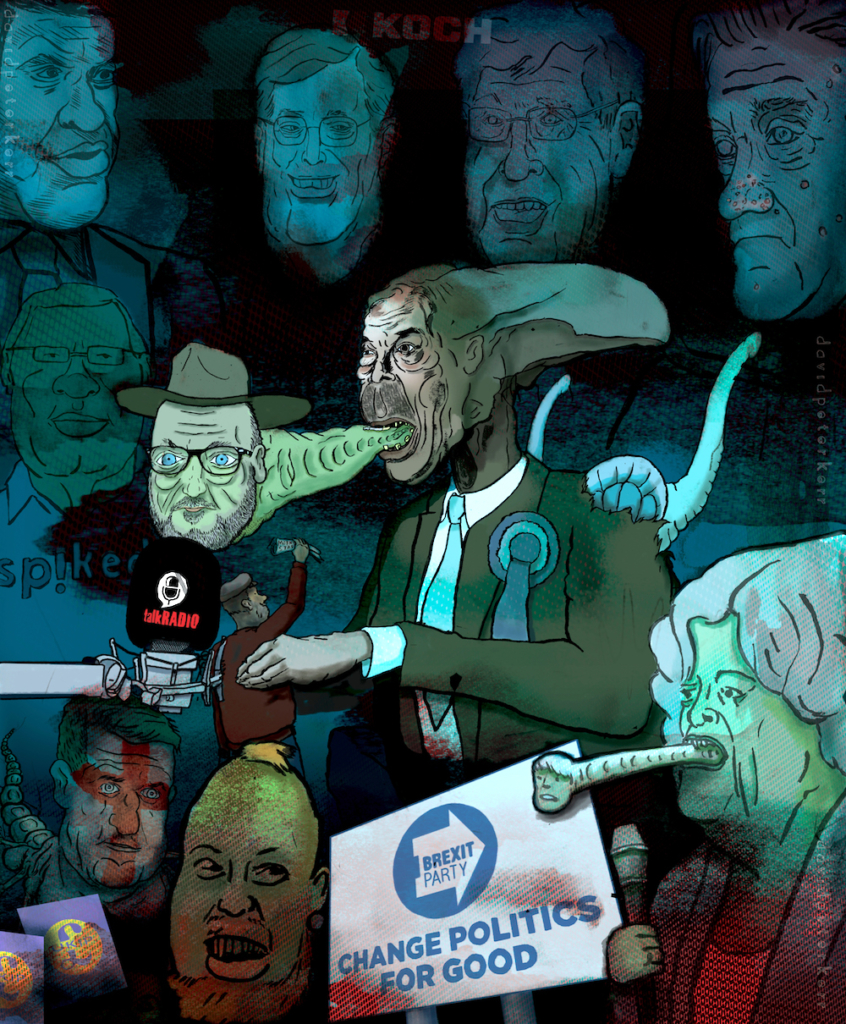
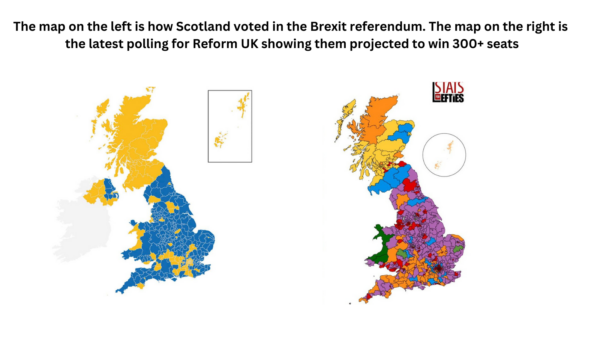
On June 23rd 2016, on BBC TV, David Dimbleby announced when the referendum results were known, “The British people have spoken and the answer is: we’re out!” As history shows, it was the English people, because of their greater number, who had “spoken”. That was the “we” of “we’re out!” 62% of Scots voted to Remain. But Scotland was dragged out of the European Union and we were back in the dark days of Thatcher and “the democratic deficit” which tied Scotland to Ukania like a sea-anchor. As long as Scotland returns MP’s to Westminster this sea-anchor will keep us attached and nothing will “meaningfully improve” and the outrage economy will thrive. Post 2014, post 2016 Scottish politics has had its good share of false hope and disappointment, and while the outrage economy has played its part in combining the fractions into a whole, the general sense in the body politic is not so much outrage as a lingering grief and as Longfellow put it in his poem “Snow-flakes”, “it is a troubled sky that reveals the grief it feels”. Few could argue that Brexit has not provided Scotland with a “troubled sky”.
Brexit, for Scotland, is our reluctant entry into the age of force. In this new, bloody, violent age there is only dichotomy: for or against – independence or the Union, Palestine or Israel; Ukraine or Russia; Trump or sanity. It is a tight domain where thinking is flattened, where there is no room for reflection and there is no space either for justice or farsightedness. In such a society of squeeze judgement comes easily. Knowledge is more difficult. And the truth is subjected to force.
In her essay on The Iliad the French philosopher Simone Weil (1909 – 1943) wrote,
“To define force – it is that x that turns anybody who is subjected to it into a thing. Force is as pitiless to the man who possesses it, or thinks he does, as to its victims: the second it crushes, the first it intoxicates. The truth is, nobody really possesses it. War as a shared institution effectively ‘enslaves’ everyone. Only he who has measured the dominion of force, and knows not to respect it, is capable of love and justice.”
In the age of force, with is economy of outrage, everyone is drunk. Those who advocated for Brexit did not have a plan. Ten years after the vote there is still no plan. But the vested interests who instigated it, bluffed their way through the campaign and danced with joy when David Dimbelby announced “We’re out!” know what they want. What they want is, in fact, everything. That is Farage’s mantra. The saving grace for the rest of us who desire love and justice is that the greed-warriors, like Farage, forget one detail – that everything is not within their power. History shows, as does The Iliad, that upon the fascist bed of insatiable erotic materialism greed has but a brief joy and that violence and deception will obliterate any sense of destiny the Brexiteers may cherish.
In the Old Testament Book Of Judges, the warrior-judge Samson ends up blinded by the Philistines, as John Milton superbly puts it, “eyeless in Gaza.” Samson is harnessed to a huge millstone, forced to drag himself around and around in circles, always moving but unable to go anywhere. Eventually, in the most spectacular of suicides, he gets his revenge by pulling down their temple on top of the Philistines, killing both them and himself. The Book Of Judges would have you believe that the story of Samson is one of heroism, but in truth it is a fable of vicious and cruel futility. If or when Nigel Farage becomes the next Prime Minister of Ukania and if he were to read the story of Samson, would he recognise it as a self-portrait? The lesson for Reform UK is that cruelty begets cruelty until there is nothing left but mutual destruction. For those who vote for Reform UK they will learn through their encounters with the economy of outrage that the force in their possession is only of a limited quantity and that, eventually, they will have to see their relations with other human beings as a kind of balance between unequal amounts of force. Who knows, then Reform UK voters might learn not to admire force so much, not to hate difference quite so wholeheartedly, nor to scorn the unfortunate with such seething and maybe not so keen to live in a constant state of algorithmic outrage against decency. How soon – or if ever? – this will happen is another question.
In a recent National (22.6.26) article the ever-excellent Richard Murphy, who is Professor Emeritus of Accounting Practice at University of Sheffield Management School, set out 52 questions for the incoming mak-a-dae King of Ukania, Andy Burnham, to answer “before anyone can sensibly judge whether he offers a genuine alternative to the present government, or merely a different personality pursuing much the same agenda.” The questions ranged from those on the economy; to wealth, tax and inequality; climate and the environment; public services and the state; work, income and social security; debt, money and finance; Britain and the world. Of course Andy Burnham won’t answer any of them, except question number 34 which asks “are you open to independence if Scotland, Wales and Northern Ireland wish for it?” The answer will be, predictably, “No!” The last question – and for Richard Murphy, the “biggest question” – is “What is your theory of society?” “That question maters” he says “because every successful political project ultimately rests on an answer to that question”
It is important to repeat: the Leave campaign in 2016, like the Westminster government of the time, had no plan for what happened if they were successful. The current Ukanian government has no plan for Europe and what kind of relationship it should have with the EU, so algorithmically shackled is it to the short term and the reactive economy of outrage. This is why Keir Starmer made so many wrong decisions, so many spectacular and comic U-turns and why there has been seven PM’s in ten years. The only theory in Westminster is one of survival and they have not worked that one out very well either. As for society – and Scotland – they are just resources to be extracted for immediate gain. Until the Scottish government win-at some smeddum and formulate a national policy for harnessing the wealth generated by land and energy Scotland will remain subject to this spiralling incompetence. We need to move beyond fantasy, force, anger, and outrage. And soon. In Scotland, it has proven politically and socially fatal to forget history. Ten years after Brexit this fact has never shone so clearly – and that peace, dignity and equality on a healthy planet is possible.
©George Gunn 2026

We are supported only by our readers. We don't have corporate backers and we don't take advertising, so we rely entirely on your support.
Help to support independent Scottish journalism
Writing like this is what MacDiarmid meant by:
A Scottish poet maun assume
The burden o’ his people’s doom,
And dee to brak’ their livin’ tomb.
Thanks George Gunn a light into the morbidity of nothing happens. Waiting for Nothing.
Such articulate writing and clear thinking keeps hope alive that our children might yet inherit a better future
Mmmm.
I suggest the author ditches his “Guardinista’ prejudices and looks at what’s going on in his beloved EU.
1. Germany. The AFD now the most popular party which make Reform look like the Bolshevicks.
2. France. Senior military officers have warned the govt that the country stands on the verge of inter-ethnic civil war and the economy is virtually bankrupt.
3. Italy/Spain/Portugal youth unemployment at around 25-30% and the average person having to live with their parents well into their 30’s due to spiralling housing costs.
Lots of problems in the UK but to pretend that the EU is the land of milk and honey is delusional.
Finally why does he single out Putin/ Trump and Netanhayu the latter 2 both been democratically elected
No mention of the dictatorships in China/Muslim countries which combined make up well over 50% of the worlds population living under communist/religious tyranny………but hey its all about Brexit/Trump.
Trump and Netanyahu were indeed democratically elected. That doesn’t say much for the American and Israeli voters.
John L
I am sure the civilians being killed by Israel in Gaza and Lebanon by Israeli military and the schoolchildren killed in Iran by US airstrikes are consoled by the fact that these countries are democracies.
In a democracy you can argue that the public of that country carry a much greater responsibility for the actions of the country than the public in a non democratic country do.
The AFD have less chance of forming government in Germany than Reform have in UK due to different electoral systems.
Military commanders are always worried about breakdown of law and order almost regardless of country. I have read of plans for a military coup in UK in mid 70’s.
The EU is and has never been perfect and each country is sovereign enough to elect its own government. Different countries within EU will have economic and political problems but being part of EU will usually provide some economic support to weather these crises. That being said no party within EU has got close to power proposing leaving EU since 2016 having observed the effect on UK. Indeed other countries, previously sceptical about EU eg Iceland, are reconsidering whether they should remain outside EU .
John,
Macron publicly stated that the reason he didn’t give the French the right to vote on EU membership is because they would have voted to leave.
Why is the EU so afraid of the people?
Or should we take Frank’s position and decide that if people vote for Trump/Nethanyu/Brexit they should be ignored?
John L – I can find no evidence for your claim about Macron could you please reference this claim rather than just baldly stating it.The reason Macron doesn’t campaign for an EU vote is that he believes France should be in EU.
Even Marie Le Penn is no longer campaigning on France leaving the EU. Her position on this changed from 2015 when she was advocating Frexit to change of EU from within in 2019. (multiple references on her wiki page). I wonder which event relating to EU occurred between 2015 & 2019?
Bizarrely, this piece does not apply its own standards to itself.
It claims to argue about the “outrage economy” but is one long angry diatribe. It suggests we need evidential arguments then presents none. It unironically dishes out the same treatment to Farage, Reform voters, and Brexiteers that he claims is a problem in the first place.
Everything you have written above is untrue. Did you actually read the article?
Would you like me to evidence that what you wrote is entirely false?