
Housing in Crisis: Film as the Critic
The Housing Film examines how a century of realities and possibilities in domestic living have been profiled and foregrounded through studies and representations of Housing in the medium of Film. The filmic investigations, analysis and exposés of homes and our way of occupying them, and their possible effect on behaviour, in documentaries like Housing Problems (1935) and Paul Sng’s Dispossession: The Great Council Housing Swindle (2017), propaganda films like Cumbernauld: Town for Tomorrow (1970), dramas like Cathy Come Home (1966) and features like High Rise (2017), to understand how closely – film and housing – have grown and developed together, each conditioning the understanding and the range of possibilities of the other.
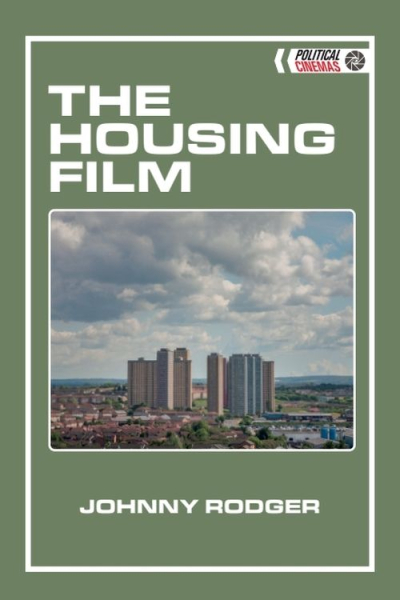
Johnny Rodger: The Housing Film, Edinburgh University Press, 2026
In the Spring of 2007, I recall visiting on at least three occasions an exhibition at the Lighthouse Centre in central Glasgow won the theme of the films made by Glasgow Corporation from 1920-1978. At least fifty films were sponsored or arranged by the Corporation (the forerunner of Glasgow District Council and now Glasgow City Council) over that period. Many of these were produced at the instigation of particular Corporation departments, for instance, the public health department and notably, the city’s education department.
The title of the exhibition – attendees could view a number of these films – Sadness and Gladness: The Films of Glasgow Corporation 1920-1978 – depicted a city that in living memory been widely portrayed as ‘the second city of the Empire’, but one in which living conditions for the majority of the population were in need of considerable overhaul. In the context of post-World War One reconstruction, which saw major inroads by the Scottish and UK state into the direct provision of urgently required housing and other social goods, there was also a spirit of hope that wide-ranging social reform would rid cities such as Glasgow of its slums while improving the general health and education of its citizens.
Glasgow was not the only local authority at the time to embark on an ambitious programme of social renewal. Municipal reform was to be seen across most areas in Scotland and in other parts of the UK. And it was not just Glasgow that utilised film to inform its residents of its project of civic renewal which would consolidate Glasgow’s standing as a great city, as without doubt the second city.
If one social problem dominated Glasgow it was the poor state of much of its housing stock. From the late nineteenth century to the late twentieth century at least, Glasgow’s housing problems were considered to be the worst in the UK. Severe overcrowding, a housing stock in which even the most basic amenities were absent and a general lack of houses to rent which would be within the financial reach of the majority of its people, were among the most pressing issues. It is perhaps not surprising therefore that housing (and matters related to housing provision) would be a topic that took up much of the Corporation’s film output over the 50-year period in question.
If we are able to grasp key aspects of Glasgow’s approach to housing provision through these films in their entirety, the same could be said for the wider history of housing policy in the UK. In his book, The Housing Film, Johnny Rodger rightly begins his exploration of the ways in which housing has been represented through film, by distinguishing between ‘the house’ and ‘housing’:
Housing is not simply the plural of house…. Housing is… something different: it designates the residential arrangements for the population in an era of mass society…. Housing as an arrangement of the residential thus designates not just actual buildings and how to design and construct them, but also a whole range of other issues and potential dilemmas to be resolved.
… housing involves a set of human needs in engagement with a plethora of interests, ideologies, policies and processes in wider society. (p14)
From this foundation, Rodger proceeds to offer an extensive story of the history of the housing film in the UK, a story in which a large number of films feature, some of them extensively so. This is the first book to focus in particular on housing in film and here Rodger is keen to establish the housing film as representing a distinctive genre. This is important not least that there has been important work done previously by Elizabeth Lebas, among others. Lebas played a significant role in the Glasgow Lighthouse exhibition highlighted above and in her published work, Forgotten Futures: British Municipal Cinema 1920-1980 (Black Dog, 2011), she explores a range of films which cover many areas of local state policy making, beyond a concern with housing.
There is another crucial dimension at work here however: in the housing film, one type of housing tenure is overwhelmingly present – what is now generally referred to as ‘social housing’ but in the not-too-distant past was labelled ‘council housing,’ and it is council housing which dominates the discussion throughout this book. Importantly though, this should not be seen as a static, fixed entity: what comes across in this book is the historical evolution of council housing is reflected in many of the municipal films and documentaries that Rodger refers to. In turn this evolution directly reflects important political and ideological shifts in the story of state housing provision itself.
A particular strength of this book for me is that from the outset, Rodger strives to explore the housing film in relation to questions and issues of class. Housing policy and provision has long reflected the unequal and class-divided nature of British society. One cannot offer an informed account of housing – or the housing film – in isolation from its wider class contexts.
Rodger’s book is comprehensive in its coverage and it offers a detailed analysis of a number of housing films, among these is Housing Problems (British Commercial Gas Company,1935), which is regarded as
… the earliest self-standing film made in Britain on the subject of housing alone, by professional filmmakers neither involved in housing as a municipal activity, nor as charities raising money for good works, and in principle, with no promotional aims other than raising the issues depicted in the film. (p.27)
The use of the word ‘problems’ – which has characterised much of the discussion of housing in different media and published formats over the past century – is here used to suggest that at a local level, here in the London Borough of Stepney, an issue requiring intervention or reform exists, while simultaneously implying that resolution of the problem, on other words, ‘reform’ is indeed possible.
As Rodger’s indicates the problem-solution structure shaped a number of housing films in this period and while that was to shift in the years to come, nonetheless the problem-solution structure has long been part and parcel of housing policy making – that is in relation to council housing – as well as other areas of social welfare intervention. How a social problem is constructed in the first place will shape how it is represented and portrayed, and from this which policy will be appropriate to address the problem. But there is something else at work here – and this is as true of housing as it is of other areas of social policy making: the articulation of a social problem mobilises a particular sense and understanding of class. In the history of UK housing, the classed politics of tenure have almost always been to the fore but within the arena of social housing itself, the stratified nature of much of state housing since 1919 also reflects a sense of a fragmented working class which also mobilises particular narratives about the ‘type’ of population, what category of people, are to be housed. This underpinned the allocation of housing in Glasgow and elsewhere during much of the inter-war period and did not completely disappear in the era of mass council housing development after the Second World War.
In considering the chronology and shifting character of the housing film, Rodger draws on Eric Hobsbawm’s The Age of Extremes: The Short Twentieth Century,1914-91 (Michael Joseph, 1994). Three periods in the historical evolution of the housing film are identified: 1918-1950, the 1950s to 1970s and the 1970s-1990s. In contrast to the films of the first era, which focused on exposing a range of housing related problems, not least the consequences of often unplanned rapid urbanisation in relation to slum housing, the second period is referred to as a ‘golden age’ wherein the construction of large council estates, new towns and in its later years the building of large numbers of rise-high blocks, reflected a political commitment to constructing the largest number of houses in the shortest possible time, as slum clearance was accelerated. The third period not surprisingly sees the rise of neoliberal-inspired market solutions to housing need, Thatcherism and right-to-buy’ and the decline of state housing as a political and policy priority.
The films explored here in relation to these periods betray different political projects and ideologies in relation to housing. Arguably, with the exception of a relatively brief period in the late 1940s and early 1950s, council housing was always regarded as a second class housing tenure – housing for those unable to afford owner occupation, which was always regarded – and supported by governments of different political outlook – as a better class of housing – and housing for a better class of people; housing to which we all should aspire. Films relating to big state housing projects such as the new towns, for instance, the 1970 production of Cumbernauld: Town for Tomorrow, were already becoming more of an exception by this time, with more harrowing exposes of the failures of state housing to meet the needs of some of the most disadvantaged populations in the country being echoed in probably the most famous housing film to date, Ken Loach’s Cathy Come Home, made for the BBC in 1966. Cathy Come Home is given considerable space in the relevant chapter, reflecting its canonical status in this genre and in British film documentaries more generally. It was being broadcast at a time when hard hitting TV documentaries such as Granada’s World in Action series, frequently focused on Britain’s housing problems.
In the wider economic, social, and political context of the time, however, state provision was already increasingly under attack as having failed to meet its objectives. The 1960s was supposedly when poverty ‘was rediscovered’, that the post-War welfare state was seen to have been unsuccessful in meeting the needs of many groups in the population and increasingly was under attack from both the left and the right.
In this context, I wondered if Rodger might have considered locating his discussion of the historical development of the housing film in the context of wider and more important shifts in the idea of state provision of social welfare. Rodger sees his work as bringing together two disciplines, film studies and housing history. In my view, those insights offered through housing history would have been greatly enhanced by seeing housing provision through the lens of a more critical social policy approach to the subject at hand. Through this, we can grasp more fully the ways in which the classed nature of state social welfare – including housing provision – is echoed in the history of the housing film.
There is so much to commend this book and I would like to have said more about the case study around the ways in which high rise housing was reflected in film, and over the past few decades how a media representation of ‘the council estate’, which some have argued has become little more than a form of ‘poverty porn’, has largely been informed by a view from above that represents working class life as essentially dysfunctional, problematic, deviant and disreputable.
This is a book I would liked to have written myself, which should not be taken to imply I could have offered something better than Johnny Rodger has done here. Far from it, but more that I have had a long-term interest in the ways in which territorial stigmatisation – not least of the council estate and its populations – has been channelled and reproduced in film and television. Having researched the historical development of Glasgow’s ‘peripheral’ estates in the distant past, I have also been long aware of some of Glasgow Corporation Housing Department’s films in the immediate post-1945 era – not least the two ‘Progress Reports’ from 1946 and 1948. It would have been good to have seen an additional ‘case study’ chapter in here devoted to Glasgow Corporation’s housing films, building on the work of Lebas but locating these within the wider framework utilised in this book.
Finally, are we now likely to see the demise of the housing film now that we live in a period where a political commitment to state housing appears to be largely off the table? Perhaps that may open-up other spaces for new forms of media to provide different ways of grasping Britain’s housing crisis which, like the century that has passed, has been a crisis for the most disadvantaged groups in society.

We are supported only by our readers. We don't have corporate backers and we don't take advertising, so we rely entirely on your support.
Help to support independent Scottish journalism
There is a short film on a Dumbarton/Scotland housing issue being shown at Offline 108 Niddrie Rd, Glasgow in September as part of
https://videoclub.org.uk/selected-16-uk-tour/ along with other short films. It’s about a tenants experience of a tenant ballot by a housing association, and how undemocratic it was. It also makes reference to the unequal way new build social housing is paid for today. A so called solution to a problem that creates more inequality than it solves.