
The Whole is Shattered and Wrecked
“The whole is shattered and wrecked”: human ecology, relationality and dùthchas in the testimonies of the Free Church ministers of the far north-west to the Napier Commission.
This is a script of a paper delivered by Dr. Gemma Smith at the ‘Interrogating the Napier Commission’ Conference held at Glasgow University on 24-25th July, organised by PhD candidates Grace Wright and Niall Ingham. The Napier Commission was a government enquiry that toured the village halls of the Highlands in 1883, responding to the growing land agitation movement among the crofting communities. The crofters’ complaints to the Commission about clearance and ‘Improvement’ resulted in the Crofters Holdings (Scotland) Act 1886, which among other things granted security of tenure, but also ensured the perpetuation of already unequal land divisions. The minutes of the Napier Commission are available in digitised form here.
The whole is shattered and wrecked.
It is a grave evil to put class against class, landlord against tenant, and tenant against landlord; but this must be the inevitable result of all laws relating to land being in favour of the monied few and adverse to the interests of the many, only because they are less fortunate in their lot—in other words, that they are poor.
We are all interdependent on each other. No man can say I have no need of thee. The rich are dependent on the poor, as they are called, as well as the poor being dependent on the rich. Every human being has necessary relations with some of his fellow-creatures which he can no more repudiate than he can deny his own existence or his debt to our mother earth.
It is time now these relations were understood. It must be the aim of all right-minded men to insist on this point; to preach the duties of property and now that its rights are beginning to be realised as wrongs, after having served for centuries as a catch-word to justify a thousand forms of oppression.
The great and ignorant cry is, I can do what I like with my own, No, we say there are scores of things in a man’s possession and which he calls his own, he dare not do with it what he likes. I dare not do what I like even with my own life, nor my children’s, nor even to that of the very horse I employ, much less with property in land which God intended for the benefit of all his creatures.
Let us not be considered wild or radical when we make these statements, we speak the words of truth and soberness, we are no agitators in the sense that word is generally used, but we must agitate until we receive redress.
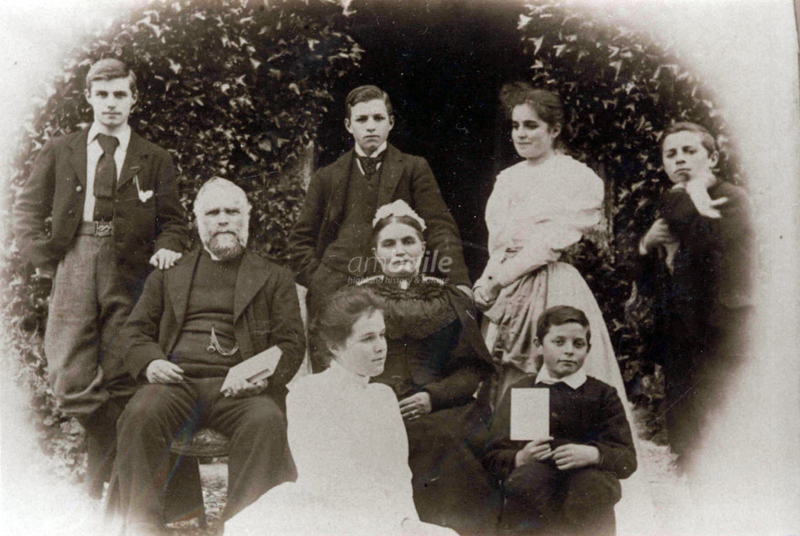
Rev John Macmillan and family. Photo:Ullapool Museum/Am Baile
Those were the words of the minister of the Free Church on Mill Street in Ullapool (now the Church of Scotland), the Reverend John Macmillan, to the Napier Commission on 30th July 1883.
Macmillan was born in Lochielside, Lochaber on 6th August 1838. After a teaching career in Lewis he trained at the Glasgow Free Church College, and was ordained at Lochbroom in October 1872. He became a notable Gaelic preacher – it’s said that John Stuart Blackie made visits to Ullapool to hear his Gaelic – and he was a prominent figure in the Land Agitation movement.
In 1880, after the notorious clearances at Leckmelm, when a young family was thrown out into the snow, the Rev. raised a public meeting in Inverness to highlight the injustices faced by people in his parish, as documented by Alexander Mackenzie in his 1883 book, The History of the Highland Clearances.
It’s striking how radical Macmillan’s ‘truthful and sober’ words sound to us now.
And what he is clearly talking about here is relationships: he talks about interdependence, necessary relations, our debt to our mother earth, the duties of property; he insists ‘It is time now these relations were understood.’
It could be said that what is being expressed here is in fact an indigenous feeling for relationality. This definition is taken from the Cree scholar Shawn Wilson’s wonderful Research is Ceremony. Wilson says:
Every individual thing that you see around you is really just a huge knot – a point where thousands and millions of relationships come together. These relationships come to you from the past, from the present and from your future. This is what surrounds us, and what forms us, our world, our cosmos and our reality. We could not be without being in relationship with everything that surrounds us and is within us. Our reality, our ontology is the relationships.
Wilson emphasises relationality as an ontological foundation, saying further that ‘reality is not an object but a process of relationships’ and that ‘relationships do not merely shape reality, they are reality.’
This to me seems very much related to the Gaelic concept of dùthchas. I like Michael Newton’s definition, of dùthchas as having ‘dimensionality as a putative total field of understanding embracing landscape, a sense of geography, a sense of history and a formal order of experience in which all these are merged.’ Other definitions are available. Certainly I think there is that sense in the minister’s statement of an awareness of how in dùthchas, belonging and responsibility go hand in hand.
Rev Macmillan is not the only minister of the far north-west whose testimony contains evidence of a relational worldview. My first contact with the Napier Commission was when I used the Assynt minutes as a case study for my undergrad dissertation, and I was blown away then by the words of the Free Church minister in Lochinver, Rev Norman Mackay.
He describes a relationship between landlord and tenant that has by this stage completely disintegrated. When asked if in his view the Highlanders have a rightful claim to the land, Rev. Mackay replies:
In the Highlands I consider that the peasantry have a far greater right than elsewhere. In the case of a chief or head of a clan, I think the head of that clan came very likely into the position in which he finds himself through the assistance of the crofters all round about him. He and they have grown up upon the land; they have made him chief, and he has always felt that it was his duty to protect them. I don’t say that either the chiefs or the tenants have now the same feeling.
He further provides us with a perceptive analysis of how that situation has come to be. As Rev Mackay says:
The despotism may be often paternal, but it is still a despotism. One man’s will (the factor’s) rules whole parishes in all their concerns without limit or check. I blame not the man, but the system and the circumstances. Factors find themselves placed in remote districts with enormous and almost absolute power over every person there, and the more they exercise this power, the more the love of power increases, and impatience of all opposition increases; these men in these circumstances would be more than human if they did not sometimes commit excesses in the exercise of this power, and do things which would be painful to bring to light, and which they can hardly see in their true colour unless set before the eyes of the public.
Right relationships have become imbalanced due to a system built on injustice. This sentiment is echoed by others: At Kinlochbervie, Rev James Ross of Durness Free Church says ‘I am not dissatisfied with the people generally. I mentioned some things in the system, and in the actings that have, in my opinion, a prejudicial effect upon the spirit of the people.’
At Bettyhill, the Rev Donald Mackenzie of the Free Church in Farr tells the Commission that it were as though the proprietor were ‘surrounded by a hedge’; he says that ‘all that we are allowed is to gaze with admiration on the retreating wheels of his carriage when he is going away.’
The statement of Mackay’s that I found most fascinating though, expresses a kind of ecological relationality. He tells the Commission:
“Well there is a curious idea which was mentioned to me – I don’t know whether I should mention it to the Commission – that the trout in the loch were much more numerous because the cattle were so numerous.”
We know now that without the correct biological input from animals, insects and protozoa, soil rapidly deteriorates into dirt, which has a knock-on effect on animals whose nutrients come from soil-filtered waters – like fish. This is supported by the testimony of Reay Clarke, in Reay Country: The Story of a Sutherland Farming Family, his account of the effects of his family’s sheep-farming on the Eriboll estate, where he describes how soil fertility built up through centuries of transhumant pastoralism was squandered in just a couple of generations. So what Rev Mackay was describing here was quite literally true.
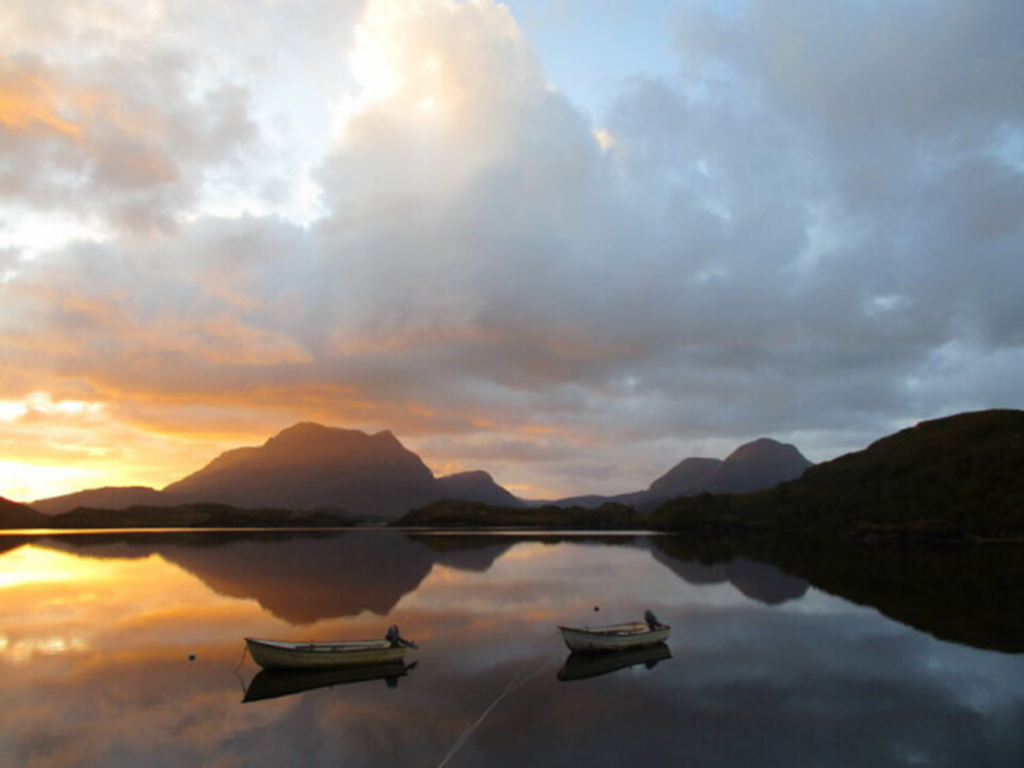
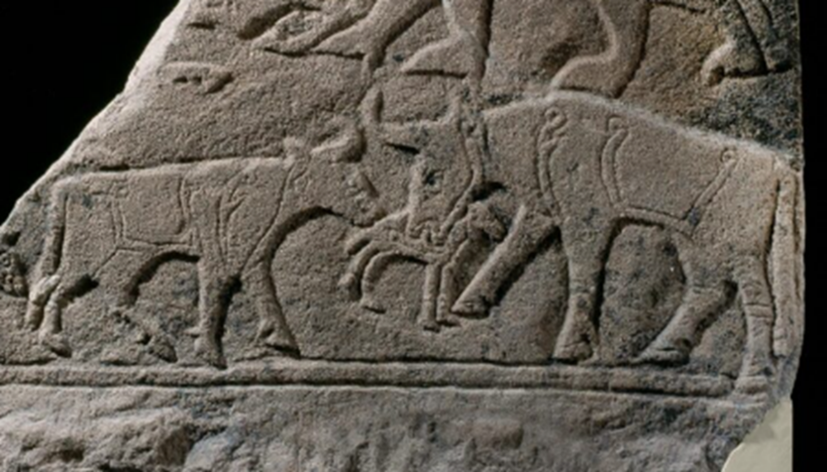
Calf Stone
Returning to the hills pictured on my title slide, this is Cùl Mòr, Cùl Beag, and An Laogh, in Coigach. Yous surely didn’t think you were getting out of here without hearing some place-names chat.
I’ve bothered various linguists about the supposed origins of this, and nobody seems to be able to confirm it, but according to onomastic scholar WJ Watson, the element that gives us the cùl of Cùl Mòr and Cùl Beag here is not ‘back’, as widely reported, but instead it comes from cuthaill, an Early Gaelic word that is apparently a loan word from the Old Norse kua-fjell, or ‘cow-fold mountain’.
Certainly by the time the surveyor Peter May made his 1758 survey of Coigach, it seems that these hills were understood by his informants as a family of cows – you can see here he’s written on the map, ‘Coul more and an logh, the meikle cow and calf’. An Laogh, as this wee hill in the middle is called, is Gaelic for ‘the calf’. Next to that we have a Pictish carved stone from Portmahomack on the east side of Ross-shire, depicting a trio of cows in a very similar formation. Now I’m not making an explicit connection between these two things, but the names and the carving originate from the same 200-year period, and give an indication of the kind of imaginal realm, I suppose, we’re dealing with.
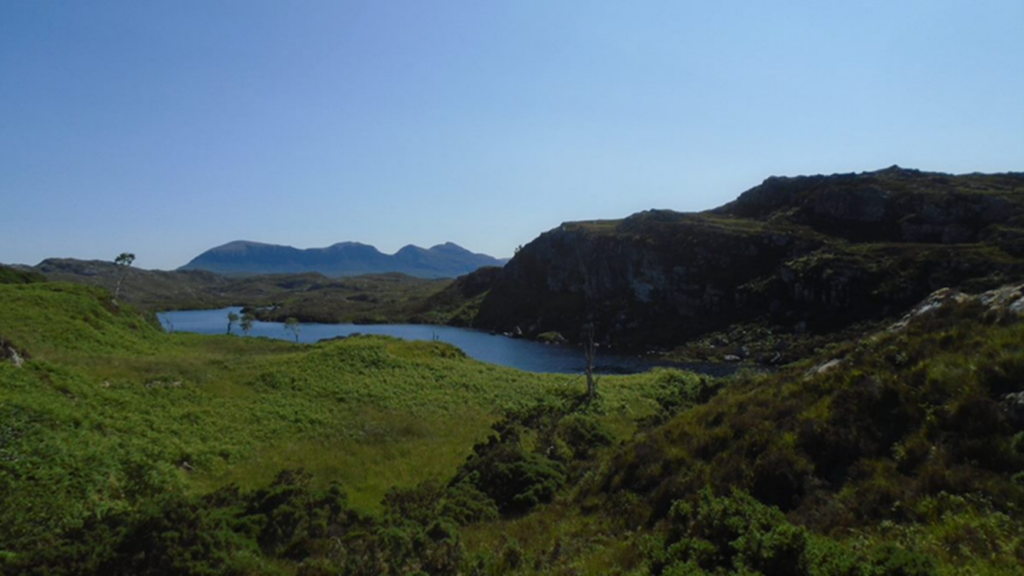
Quinag: Gaelic A’ chuinneag, ‘the milk pail’
Think also of Quinag: a’chuinneag, ‘the milk pail’, the backdrop to the Stoer shieling landscapes, the hill around which North Assynt life revolved, named because that was what it did – it was where the produce came from in the summer.
And then behind our Coigach shielings, we have our family of cows: relationships. So transhumance was absolutely woven into the landscape and lifeways of the Gaels of the far north-west, and the reorganisation of the land that the 19th-century landowners called ‘Improvement’ would have been an affront to how they viewed the world.
I think place-names are absolutely key to understanding relationality in Gaelic ontology – not only do the names tell us of settlement patterns that were flexible and dynamic, but also the labels people gave to their surroundings inform us of how they perceived the significance of these places themselves. Gaelic place-names suggest a landscape in which there was a place for all creatures; there’s a sense that these are the places in which these animals naturally belong, and a sense of permeable boundaries on the hill between shieling, hunting and ‘wild’ landscapes. They tell us of the relationships between the baile (township) and the shieling, between people and animals, and between people and the land.
In his speech at Inverness – although by this stage we are well out of the era of shieling practice – Rev Macmillan still emphasises the importance of hill pasture, I think very interestingly making a link between the effect of changed practices and land use, and the relationship between landowner and tenant. He says:
“As long as tenants have a hold of the hill pasture by sheep, and especially if it be what we term a commonage or club farm, it is impossible to lay it waste in part. But once you snap this tie asunder, you are henceforth at the mercy of the owner to do with you as he pleases.”
But once you snap this tie asunder – again, Macmillan is using the language of relationality.
Thinking about this for my PhD research also brought me back to Tim Ingold’s book Lines. Ingold defines life as ‘a manifold, woven from the countless threads spun by beings of all sorts, both human and non-human, as they find their ways through the tangle of relationships in which they are enmeshed.’ Furthermore, ‘the lines of the meshwork are the trails along which life is lived.’ Essentially, the world is comprised of relationships.
Ingold explains that originally, ‘thing’ meant a gathering of people, and a place where they would meet to resolve their affairs. He goes on to say that ‘As the derivation of the word suggests, every thing is a parliament of lines.’
In this sense, we could characterise the shieling as a ‘thing’, or place, in which people and animals gathered, and which over time, became the parliament of the lines of their lifetimes of gathering there. Place-names show us the lines indicated by bealaichean, cadhan and imrichean – these are all words that indicate a ‘pass’ or ‘way’ – by which people traversed the landscape, with the paths and haunts of animals also indicated, each spinning their own threads into the mesh. Transhumance, therefore, was integral to Gaelic ontology, and the imposition of ‘Improvement’ not just a change in agricultural practices, but an unravelling of the very fabric of life. Convivial relationships became dysfunctional, connections were severed – the whole was shattered and wrecked.
I was going to leave it somewhere around there, but then I rewatched Andrew Black’s excellent film Dan Fianais recently, with an indigenous friend who was very struck by the similarities between the Highlands and the situation in his native Mi’kmaqi – that’s part of what we still call Canada – and it made me think about these things in a broader context.
What really got me thinking was the part in which Iain Mackinnon says that some of the older generation on Skye still have that ‘sensitivity to cause and effect’, that same sensitivity that informed historical systems of local governance based on a deep sense of connectedness to others and to land.
We’re living in pretty dark and wild times just now. Times in which the brutal violence on which our system of property is founded has been exposed for all to see – even those who are so embroiled and invested in that system that they choose to turn the other way. I’m sure many of us are feeling pretty hopeless and impotent just now. Some of us may well be struggling with the relevance of our research – I know I have been.
But I suppose if there is even one tiny spark of hope, it comes from what Iain says, that there are still remnants of that ontology there. There are still remnants of that ontology in Rev Macmillan’s words to the Napier Commission, well over a hundred years after Coigach was forfeited. And there are still living cultures, mostly in what we insult by calling ‘the developing world’, where relationality is foregrounded.
I’ve spent the last two winters living in Morocco, a place that Westerners visit and often report feeling ‘harassed’. I think that’s a really sad misunderstanding.
In reality, what they’re experiencing is just a completely different set of cultural norms. Especially in the very Amazigh-identified areas in the mountains and in the desert, but also to a surprising-to-us extent in the modern urban centres, in Morocco, as with many other societies, everything revolves around connection. It’s a culture where it is perfectly normal to make eye contact with, to smile at, or to say hello to strangers in the street, where the standard mode of address is ‘hoya’ or ‘okti’ – my brother, my sister – and where the answer to pretty much any issue is: ‘don’t worry, I know a guy.’ But this all feels so alien to us, we experience this constant connection-seeking and these labyrinthine social relationships as invasive and overwhelming.
I’m obviously not trying to paint any time or place as perfect – but it seems that you still have to make that caveat. So often when you suggest we might have anything to learn from those past or living cultures – and belief systems – that we have historically othered and characterised as somehow less advanced than our own, you find yourself up against the hackneyed, thought-terminating cliché of the Noble Savage.
It sounds clever, doesn’t it? It sounds ‘critical’. Noble Savage.
I don’t have time to get into all its arguments today, but I can’t recommend this book enough – The Myth of the Noble Savage by Ter Ellingson. I know the UHI-educated among you are well acquainted with it already, but I never came across it on any reading lists, and essentially found the reference I’d been looking for for a decade literally the day after I passed my viva.
Essentially the book is about the myth of the myth of the Noble Savage – about how the Noble Savage trope was not as is the common but outdated consensus popularised by Rousseau and the Romantics – he never actually used the phrase and was actually often really quite insulting about the ‘savages’ he wrote of – but the Noble Savage as we know him was, rather, raised as a straw man to argue against indigenous rights, by the racist, 19th-century anthropologist John Crawfurd.
I always knew I hated that phrase.
It is easier to imagine the end of the world than it is to imagine the end of capitalism.
(Jameson/Žižek/Fisher/Einstein/whoever)
I think we all know this one by now – whoever it was who originally said it. And it seems we have as much trouble imagining a past before capitalism existed in its current form, before it completely took over our lives, and our souls. This is a profound failure.
Because we have to imagine it. The only hope we have of prizing ourselves from the jaws of this system, of this machine that feeds on human misery, is to imagine a world without capitalism, a world beyond what Rev Macmillan called ‘the cold malignity of a civilized law’, a world without Anglocentrism and Western cultural hegemony, and a world without white supremacy.
In a Gàidhealtachd context, this conference examining such an important and under-studied source is a step towards this, and I commend the organisers.
Thanks for listening.
Salam.

We are supported only by our readers. We don't have corporate backers and we don't take advertising, so we rely entirely on your support.
Help to support independent Scottish journalism
Yes! I opened my email inbox after a power cut to find a piece by Gemma! Love your writing. Also love that Ingold book Lines. Thankyou. x
Thanks for this – I found it riveting.
My mother, a native Gaelic speaker from South Uist often spoke of such interrelationships and, when I was at school studying Higher Grade geography often explained to me the meaning of Gaelic place names that appeared on Ordnance Survey maps. I had other relatives in Skye, who when taking me around the island would tell me the real names of places rather than the anglicised place names on signs.
With Kate Forbes’ decision to step down from Parliament at the next election there has been critical comment from many who assert their ‘progressiveness’ about her Free Kirk beliefs. There tends to be an arrogant dismissiveness about Free Kirkers because of their stance on matters of sexuality, which ignores the kind of rigorous intellectual thinking on other matters as demonstrated in this article in the evidence of the Reverend Macmillan on land and human relationships. My Skye ancestors were all Free Kirkers and a number of them had formidable academic and professional careers in a range of disciplines. My father, however, reacted strongly against the strictures on morality! My mother, strangely, for someone from South Uist, was an Auld Kirker and frequently made fun of Free Kirkers’ attitudes on a number of matters.
Life in the Hebrides was, and is, an interestingly diverse cultural paradigm.
You put that very well. And it is a great joy, and culturally important, to see a younger generation of scholars like Gemma (and there’s quite a raft of them now) brining this sort of sensitivity and depth to understanding Highlands & Islands communities. As for the Free Church of Scotland, several of the most committed land reformers and community enablers that I know are from that provenance, a provenance like all churches that can be criticised in some respects, but tends to be a lightning rod for mockery mostly by those who choose not to understand it or to love its people.
This is wonderful – thank you. It is a source of great hope to see how traces of older ways of relating still exist. Reading this piece reminded me of the other great articles you have published in BC. It was very useful to include reference sources to books and authors – this makes it possible to read more widely around the themes you explored. One request – do any BC readers know how to access the Dan Fianais film mentioned in this article?
Thanks John.
You can read Gemma’s previous articles here: https://bellacaledonia.org.uk/contributor/gemma-smith/
This is a great piece from Gemma, and her exploration that, “It could be said that what is being expressed here is in fact an indigenous feeling for relationality.”
I am very pleased to see the work of scholars who understand this such as Michael Newton and Iain MacKinnon being acknowledged. Also, to see the Free Chuch, the people’s church for all its now-softened Calvinism, being recognised and not pushed into a corner and pilloried. Calvin is a deeply problematic theologian, but on one of his good days (from memory, a commentary on the Psalms) he said “We are bound together as a holy knot”, and that is the ethos of community.
I am just back from Uig in Lewis with a box of over 20 kg of frozen fish and meat gifted to myself and for the GalGael from 3 of the crofters there.. As the bard Angus Peter Campbell remarked in an email, it shows that the sense of dùthchas is still alive. And here’s the crunch, and the delight: it will only remain alive if we pick up the baton and carry it on. The future is in our hands, and such as Gemma is carrying that. All strength!
Thanks, Gemma. Brilliant stuff. ‘Relationality as an ontological foundation’ is bang on.
Two tiny quibbles. First, ‘indigenous’. I know this can be defined in terms of relations to land and culture, but it can also have blood and soil associations. I hope, from reading Philip Ball’s recent book ‘How life works’, that biology is now moving on from its obsession with DNA determinism. But those ideas are still influential in some quarters and need careful handling.
Second, the end of ‘capitalism’. I recently laughed at the ghost of Adam Smith (voiced by Brian Cox) foaming at the mouth when hailed as the father of capitalism. ‘Capitalism’ is too vague to make a useful target – ‘financial capitalism’ gets a bit closer. Concepts like intellectual capital and cultural capital are problematic in various ways but they do have their uses. Indigenous knowledge as intellectual or cultural capital isn’t quite right, but there are issues here that need discussion.
A great piece, thank you.
The powerful words of Rev MacMillan certainly still resonate today. But it is striking that what he calls for is better landlords, rather than questioning landlordism. It is a worthy message, but hardly one of liberation.
Yes, this view is clearly what is missing from so many economics ideologies. Contrary to those, it is Nature who is the Great Scorekeeper. By its depletion, we can tell we are not doing so well in Scotland.
There is a very important concept discussed here, sometimes referred to as the jus abutendi, or imagined right of disposal, or right to destroy property:
https://en.wikipedia.org/wiki/Ius_abutendi
which in colonial ideologies often seems to be reinterpreted in the perverse sense of: “If I can destroy it, I own it.” Now scaled to much of the living planet.
One also thinks of the failure of that infamous Scot, Andrew Carnegie, to spend on the upkeep of his dam, which led to the Johnstown Flood.
The American Gaelic scholar Michael Newton has just published a blog piece “in homage to her article”. It is: https://gaelicmichael.substack.com/p/pilgrimage-and-sacred-landscape-in
Thank you Gemma, a great and fascinating read as always.
I wanted to ask about sheep. At one point you say in relation to Reay Clarke that, ‘the effects of his family’s sheep-farming on the Eriboll estate, where he describes how soil fertility built up through centuries of transhumant pastoralism was squandered in just a couple of generations’. But then later you quote Rev Macmillan: ‘As long as tenants have a hold of the hill pasture by sheep, and especially if it be what we term a commonage or club farm, it is impossible to lay it waste in part.’
I admit I think sheep very destructive of landscape, vegetation and just about everything really, but am I reading a contradiction here or is the MacMillan quotation a call for a better managed sort of sheep farming that is not destructive?
I remember talking to a crofter in Bettyhill years ago who told me that the coming of the sheep under the nee capitalist system meant that the shep now ranged free ovet the whole hills including the hill fields and shielings where soil fertility had been carefully built up over centuries, The sheep naturally went straight for these places and grazed them out.
The infield – outfield system made use of places in the hills – the shielings for th cattle and making butter and cheese, the hill fields for cropping and then grazing.
The huge industrial style sheep farms were like ranches and had no use for all that. Unfortunately the situation is very different now.
Wow, I absolutely loved that and will try it follow it up. I have been coming to very similar conclusions.
If you haven’t read it already, I recommend An Cearcall by Torcuil MacRath.
https://www.gaelicbooks.org/explore-the-shop/fiction/short-stories/an-cearcall?lang=en
Tapadh leibh for the recommendations! They all look very interesting and I have bought copies