
On Freedom Cities
The city as a human right, the city as a space of resistance, the city as a place of anonymity and citizenship have long been ideals of the Left. See “New municipalism” and Fearless Cities. But the city is increasingly a place that obsesses the far-right, no more manifest than Donald Trump’s seizure of Washington DC under the guise of establishing a network of ‘Freedom Cities’ (and under the excuse of rampant crime levels).
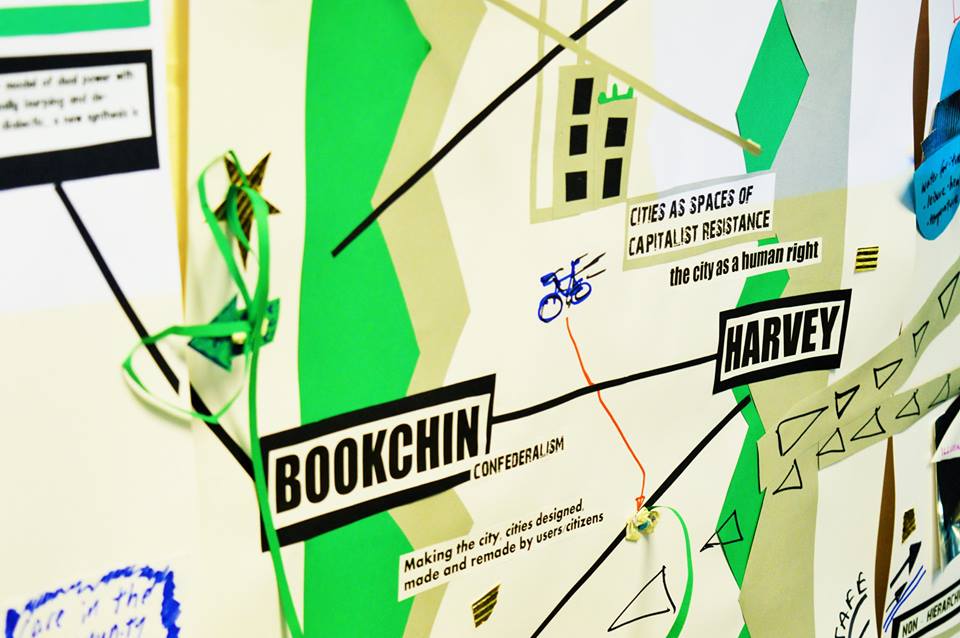
From the hysteria about the Fifteen Minute Cities to the attempt to smear London as a ‘No-Go area’ crippled by multiculturalism and crime, the city has become the right’s demon incarnate.
As Andy Becket writes From LA to Paris, the populist right hates cities – and it’s fuelled by a sense of bitter defeat:
“From Los Angeles to London, Istanbul to Warsaw, cities are making rightwing populists angry. Their liberal elites, immigrants, net zero policies, leftwing activists, globalised businesses, expensive transport infrastructure and outspoken municipal leaders – all are provocations to populist politicians whose support often comes from more conservative, less privileged places.
Three years ago the founders of national conservatism, the transatlantic ideology on which much of modern rightwing populism is based, published a statement of principles. One of these, surprisingly little noticed at the time, declared with some menace: “In those [places] in which law and justice have been manifestly corrupted, or in which lawlessness, immorality, and dissolution reign, national government must intervene energetically to restore order.”
“This month, Donald Trump’s administration identified the first American city – and almost certainly not the last – to meet these ominously broad criteria. “Los Angeles has been invaded and occupied by Illegal Aliens,” he said. It was “a city of criminals” and “socialists”, said his homeland security secretary, Kristi Noem. “Mob violence” was so disrupting the work of the federal government there, claimed his deputy chief of staff, Stephen Miller, that an “insurrection” was under way. Trump promised: “We will liberate Los Angeles and make it free, clean and safe again.”
‘Restoring order’. This is a key phrase from the fascist playbook. Cities have long been a totemic space in the imaginary of those worried about crime and national decay. Now. after much foreshadowing, Trump’s power-play is coming into being. No one is surprised.
What is at stake here is incredible. Trump is not only taking direct control of the country’s capital (which many claim is a prelude to Martial Law) he is literally handing the city to Peter Thiel. Becket: “That this “liberation” involved an ongoing, expanding and legally contentious military occupation – almost unprecedented in American history – is one indicator of how deep the populist animosity towards liberal cities and their leaders runs.”
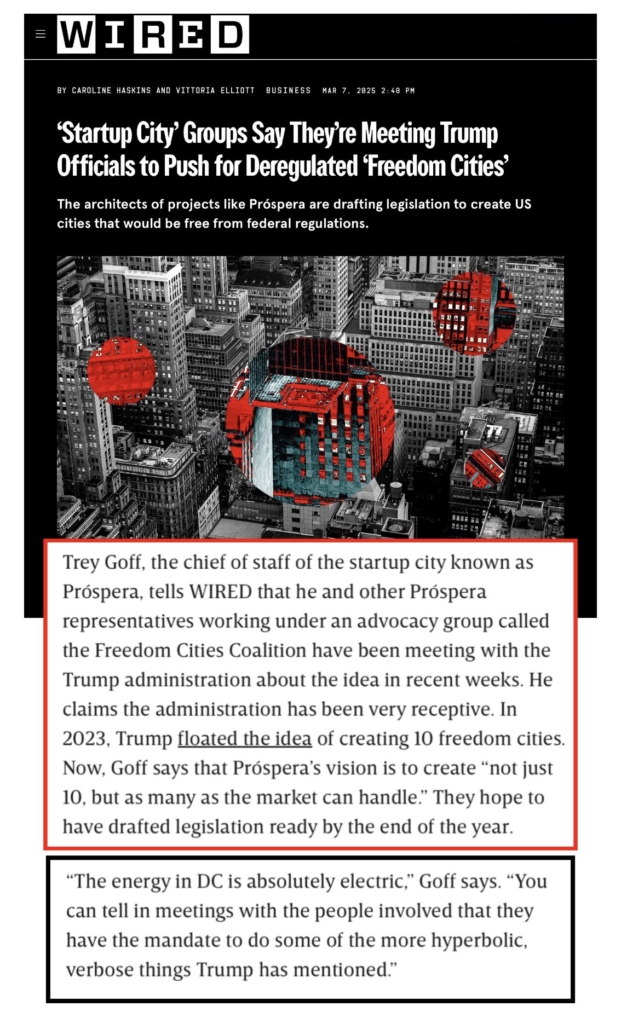
But Becket was writing way back in June, and now here we are in August. The speed at which the coup is taking place is matched only by its incompetence and collapse. What is being proposed is ‘corporate colonies’:
“Freedom City?” WTF? pic.twitter.com/5MtJS1bubZ
— ML Smith (@maria48308) August 4, 2025
This is breaking but not new. This is Forbes reporting on his dystopian vision back in 2023:
In a video released to social media yesterday, former President Trump pitches a plan to build ten new cities in the United States called “freedom cities,” “baby bonuses” to incentive more childbirths, a beautification campaign, and more in a quality of life improvement effort. pic.twitter.com/OR90pxBRNv
— Forbes (@Forbes) March 5, 2023
In March Newsweek reported [ What Are ‘Freedom Cities’? Billionaire CEOs’ Plan Could Reshape America ]: “The Freedom Cities Coalition, a think tank pushing for the creation of unregulated areas in every state, said that it had informed the White House about the use of interstate compacts to create the cities.
This would involve at least two states designating land along their borders to be allocated for the city, and agreeing on shared taxation and policy positions.
Another organization pushing for the concept is Próspera, which is supported by Pronomos Capital, a venture capital firm which is in turn backed by Thiel and Andreessen. Thiel already has close ties to the Trump administration and has supported Vice President JD Vance‘s political career since his run for Senator in Ohio.”
… and, exactly a year ago, the website the Nerd Reich reported on the specifics of the Network State Cult [Trump’s weird new ‘freedom cities’ and the Network State cult]:
“In another bow to Peter Thiel and the weird Network State tech cult, Donald Trump’s campaign platform has a plan to create new charter cities (so-called “Freedom Cities“) on federal land. It’s a clear indicator of his willingness to sell out the country to his far right Silicon Valley benefactors. In fact, Thiel and Marc Andreessen are funding an entire company – Pronomos Capital – dedicated to building such futuristic tech cities around the world.”
This is the fusion of anti-Net Zero hysteria, whipped up racialised messaging about ‘crime and criminals’ and hatred of local democracy, and the convergence of broligarch power and deregulation as we have seen in the idea of ‘Free Zones’. It is perhaps the greatest threat to (what’s left of) US democracy in our times.

We are supported only by our readers. We don't have corporate backers and we don't take advertising, so we rely entirely on your support.
Help to support independent Scottish journalism
Reducing lawlessness by… removing laws? Didn’t science fiction writer Robert Sheckley satirise this kind of utopia in the short story A Ticket to Tranai (Citizen in Space collection) in 1955?
https://en.wikipedia.org/wiki/Robert_Sheckley#Short_story_collections
It’s “martial law,” Michael–but all the rest is spot on.
Oh no. Thanks, fixed.
Why do this?
Why remove the veneer of democracy from a system where everyone in public office is bought and paid for?
Surely it’s much better for the billionaires to have puppets who they can disown when convenient?
What is a ‘city’?
It is not really a place of ‘freedom’ but a centre of wealth and power. A place where wealth and power are concentrated, stored and exercised. The city is the seat of power – the place of the royal palace, the parliament, the head offices of banks and trading companies, and it is populated by the powerful and the powerless who depend on them. It is therefore a fortress that holds and protects wealth and power. That wealth includes resources such as slave labour – whether that slavery is directly enforced by violence or more subtly through debt. It divides the ‘tamed’ from the ‘wild’ outside the walls but it actually depends for its existence on everything that is not ‘city’ – in other words a rural hinterland. It is therefore the very basis for colonisation and exploitation; but at the same time vulnerable to siege. Cities and wars and empires go together.
It is also a place of manufacturing and technology. The Industrial Revolution with its ideas of mass production created factories surrounded by workers housing and an ‘urban proletariat’ completely dependent on the factory owner. Thiel and his friends are planning cities in which the population will be entirely dependent on them, for everything. Like a kind of Hotel California concentration camp, where the inhabitants will be under constant surveillance, subject to automated algorithm-driven totalitarian control. It’s just the 21st c version, the so-called ‘4th Industrial Revolution’. The infrastructure required by cities is rapidly becoming completely top heavy and it demands so much energy that it s already starting to collapse under its own weight. Nature itself is an intricate, interconnected network, but the city by its nature denies this. Nature is starting to have its revenge with high temperatures, lack of water, dependence on vulnerable supply chains, and so on. The world is scattered with ‘lost’ cities that were abandoned and I expect those of the 21st c to collapse too.
In reality the day of the city is over. It represents a technocratic centralised, autocratic ideology which is collapsing. Technology, especially the internet, makes centralisation of wealth and power, domination and control obsolete. We can now work from anywhere. 3D printing and other techniques are starting to overtake mass production and that has profound implications for commercial and social relations. In the 19th c, especially after the arrival of the railway, the richest would escape to the country when they could. As this became more affordable for more people the barrier between city and country became blurred by suburbia – but suburban gardens are designed for pleasure rather than food production. And the resources the city needs – the food production, the water, the energy, still come from outside the city. And they are not limitless.
The internet means more and more people can live and work, buy and sell and be productive in more and more places.. And technology will always become accessible to more and more people. Who really wants to live in a ‘smart’ city? In a concrete jungle? I don’t think Thiel’s Marvel comic, fascist dystopian cities are futuristic at all.
The city has lost its purpose: a globalised world is now like a single (distributed) city, so there is no exploitable rural hinterland anymore for the city to depend on. The ‘rural’ areas will be where the process of regeneration and rebuilding of biodiversity will have to start as we move inevitable from a world of ‘power over; to one of ‘power with.’
Finally I don’t think US (or UK, or wherever) democracy is ‘threatened’. Democracy and the rule of law are already dead. We might as well face up to this.
And “net Zero’ is a myth, an accounting trick to try to carry on with business as usual – for the tech bros. The anti Net Zero hysteria is just the oil industry fighting back. It’s all just cognitive warfare. Both sides are going to realise pretty soon that ecological disaster is not all about CO2, but it is real, and no amount of ‘smart’ technology based totalitarianism is going to do anything but make a bad situation worse.
The truth of Voltaire’s, ‘il faut cultiver notre jardin’, (Candide, 1759) is becoming more apparent every day.
@John Wood, a nuke target? Something which can be bombed to rubble? You are surely correct that historically cities have had finite lifespans for reasons understood or guessed, although perhaps the works of science fiction writers like JG Ballard update that sensibility for modern ruins.
https://en.wikipedia.org/wiki/J._G._Ballard#Works
1. Cities are centres of wealth and power, but can also be places of freedom. The two things are not mutually exclusive. People have naturally banded together to form cities because it is human nature to do so as a gregarious species.
2. The industrial revolution happened as much in the countryside as in cities, and arguably started there e.g. in the Midlands and Yorkshire valleys.
3. Democracy and the rule of law are obviously not dead. We do not live in either a dictatorship (look up what one actually is), nor a state of lawlessness. One can easily criticise the state of both but to say they are dead is just foolish hyperbole.
4. Some people can work from home via the internet but it is pretty insulting to the millions of public service workers in hospitals, transport, care homes, construction, schools etc etc to suggest this is the ‘future’
@Niemand, and places of research, assembly, public libraries, sports stadiums, philosophy schools and so on.
In medieval Europe, walled cities were both centres of transmissible pathogens (plague) and quarantine zones.
https://www.npr.org/2021/07/06/1012490871/how-a-medieval-city-dealing-with-the-black-death-invented-quarantine
Obviously the high-speed international transport hubs that many modern cities have pose a particular risk in pandemics, as do the movement of troops through cities in times of war (or relative peace). After all, the Crusaders brought back and spread a lot of diseases, like modern-day mercenaries.
Public health must be built on environmental health, I guess. What that means for cities, I suppose, is more regulation and careful planning, not less. And healthier to have no poverty (or riches, as the rich break rules) either. I suppose some people might be thinking there’ll be no lockdowns in ‘freedom cities’.
‘Freedom cities ‘ is Orwellian. For Peter Thiel is means freedom from outside control, a ‘Freeport’ where he can do as he pleases without interference from outside authority – i. e. free from democracy, human rights etc – a place where, if you find yourself living there it will be on his terms. For the residents it will be the opposite: you will entirely at his mercy. If he doesn’t like you, or you don’t pay his charges, there will be no accountability and no justice. In fact as the city will run on AI if this predicts you might cause trouble in the future could find yourself deprived of the necessities of life. Because these ‘cities’ are part of the Great Reset, you’ll own nothing and you’ll only be happy if you do as you’re told. For example when the next ‘pandemic’ arrives, you will be under house arrest. We can see in Gaza how ruthless people like him are. People who just mass murder and starve people if they think it’s in their interest. Even your money will be digital, controllable, and belong only to him.
But my main point was that no city can free anyone from dependence on nature. When the infrastructure serves private short-term profit, there will be no incentive to build it or maintain it to proper standards. It will be a slum as soon as it fails to deliver profit to Thiel. Like the existing ghost town cities in America built on mining or other industries they will be abandoned. No amount of tariffs by Trump will prevent others delivering whatever product the city is based on more cheaply..
All the things humans came together in cities for no longer require a city and cities now demand so many resources to sustain them they will collapse under their own weight. As I said, rural areas in the west at least are run with a city mentality – in the ‘3rd World’ as in the highlands, it’s all about extracting resources for city use as cheaply as possible.
When the worm turns the cities will be left with nothing to offer us – rather like the US economy.
The future must be not ‘rus in urbis’ but ‘its opposite. We have to reconnect with our life support system and that means a decentralised localised economy, society, polity. The opposite of the Marvel comic dream.
I should have made myself clearer. Modern technology means that hospitals care homes etc do not have to be sited in cities. Instead of centralisation we could have smaller more locally based services. The Scottish government is closing public services in rural areas so we now have to go to the city to work, visit patients etc – much better for everyone to deliver these services locally and create rewarding jobs which also retain a quality of life the city cannot offer.
“Democracy and the rule of law are obviously not dead. We do not live in either a dictatorship (look up what one actually is), nor a state of lawlessness. One can easily criticise the state of both but to say they are dead is just foolish hyperbole.”
My direct experience over the last five years says otherwise. As Orwell predicted, the structures of democracy are there but in practice, hollow. The authorities do as they are told by the billionaires, and are not genuinely accountable to the public They ignore even the ICJ and commit genocide with apparent impunity. They arrest peaceful protesters and grant immunity from prosecution to their friends. The whole system is a lie.
‘In reality the day of the city is over’…the reality is there are more and more people living in cities and urban areas than at any time in human history and that will only accelerate, not only as cities grow wealthier but for ecological reasons. It is suburbia, particularly sprawl, that has been a disaster for humanity- people isolated in silos with no cultural or social infrastructure so far from basic transport and important central cores that everyone is dependent on cars to exist in such geographically inconvenient areas. If most people live in cities and most work is based where they live in the city and they can get there without a car, by cycling, walking or public transit, then that model (ie the 15 min neighbourhood) is the most likely vision for saving us from environmental catastrophe, by minimising waste, maximising resources and reducing pollution from private vehicles etc. There are few things in life as exhilirating as walking through a thriving big city street like Great Western Road or Victoria Street in Edinburgh or just going for a wander through the West End with places like Ashton Lane or the residential grandeur of places like Hyndland, Hillhead or Edinburgh’s New Town…what of the thrilling aesthetic pleasure when admiring the architectural wonders of central Paris, Rome, VIenna, Prague, Seville or our own Edinburgh- where else can we experience such cultural delight at scale? While beauty often plays a role, intense aesthetic pleasure can also arise from things that are considered strange, profound, or even slightly unsettling, that we only ever really experience in the vast scale, dynamism, radical diversity, uncertainty and even the danger of the city. Cities are the epicentre of all civilization- what realistic alternative do we have to civilization? In any great city you can experience visual art at a gallery or museum, see a play by Chekhov or Beckett, watch a film by Tarkovsky or Bergman, visit vast reference libraries and book shops, go to festivals of every kind, listen to a jazz band or enjoy a piece of Classical music- these experiences only exist in such convenient densities and scale in cities-we can experience all of these sublime human achievements together with like minded people. You can’t do that in a room alone or in the countryside or even in suburbia- that is why cities are our greatest achievements.
While i agree that ‘the reality is there are more and more people living in cities and urban areas than at any time in human history’ I do not agree that it ‘will only accelerate, not only as cities grow wealthier but for ecological reasons.’
There is nothing ecological about a city. However lovely the architecture, a city is a concrete jungle. It cannot exist without a rural hinterland to supply its water, clean air, food and raw materials, and to receive its ‘waste’. .In other words the city is the epitome of colonialism and is based entirely on exploitation.
Ecology is actually about interdependency, biodiversity and complex ecosystem relations, all things which are not found in a city. The city proposes that people are separate from nature, and that nature exists to serve people. The people themselves form a hierarchy from the homeless and the shanty town / slum dwellers to the affluent, the super wealthy and powerful. A truly rural area may not have the riches of the city but it less likely to have the abject poverty either.
I disagree also with the proposal that ‘ It is suburbia, particularly sprawl, that has been a disaster for humanity’. The point of suburbia was originally to enable people to have some space, gardens, to allow some fresh air and nature in. Of course the whole concept has been corrupted by making the entire economy based on transport – first by trains, and then by the car. I grew up in the 1950s and 60s just outside Harlow New Town, At that time the town planners still thought that workers would go to their factories by bike, and a whole network of cycle tracks was set up based on the old country lanes. But the motor vehicle conquered the landscape and town planning became all about ‘zones’ for different purposes connected by roads. A dormitory suburb to sleep in, A retail ark to shop in. An Industrial estate for all the dirty industries. And the countryside became re-purposed as a pleasure park to ‘escape’ to. \Nature’ became just another commodity to enjoy on your day off.
So I agree that this led to ‘people isolated in silos with no cultural or social infrastructure so far from basic transport and important central cores that everyone is dependent on cars to exist in such geographically inconvenient areas.’ Even in the inner cities, most work is never based where they live. People have to rely on buses, taxis, tube trains, trams. There is complete dependency on a complex and vulnerable transport infrastructure. The ’15 min neighbourhood’ is a nonsense. It relies in reality on home deliveries and the internet. Everything consumed within 15 minutes has been brought in from somewhere. And of course in a pandemic, or a major fire, or war or terrorism help will not be available in 15 minutes. On the contrary all escape will prove almost impossible.
This is not ‘minimising waste, maximising resources [ or ] reducing pollution from private vehicles etc’. It just shifts them out of sight, out of mind. All that infrastructure has to be built and maintained. And doing these things requires oil wells, quarries, dirty industries, and almost certainly the destruction of ecosystems and lives. But the city dweller can ignore all that while being ‘exhilarated’ by an urban aesthetic? An aesthetic built on exploitation and violence. My preferred aesthetic is one where people and nature live in as much harmony together as possible, for mutual benefit. Where there are still some animals, birds, plants, human relationships, concern and consideration for others. As a species we are not suited to living atomised, isolated lives in tower blocks. fearing to even meet the neighbour’s eyes. Humans are social animals that work best in small, interdependent communities. I think that the city has reached the stage where it will collapse under its own weight. It sucks in resources and gives very little real value back to the rest of the world. I will enjoy city architecture in ruins and recite Ozymandias as I do so. As I said before, technology has made a city (as we currently understand it) obsolete. Just as the railway and the private car have driven the modern city, the internet will unravel it. When the whole world is beyond an urban / rural divide, and we can share the planet with the natural world rather than separate ourselves from it,
I agree that ‘ intense aesthetic pleasure can also arise from things that are considered strange, profound, or even slightly unsettling’, but for me these things are found in nature. I love living in the Highlands, where I can appreciate the vast scale and wonders of the planet, from the stars I can see in our dark skies, to the hills, glens, the farmland and the boulder-strewn places where the Ice seems to have ended months rather than millennia ago. I agree that ‘cities are the epicentre of all civilisation’ but question the real meaning of ‘civilisation’. I can experience plays and museums, and many other activities, with like minded people, in my rural area too. Especially if the assets of the rural area, its culture, its artefacts, its people, its very life, are not sucked out and swallowed by the city, whether we like it or not, because ‘it’s so much cheaper to deliver public services there’. And of course I have a whole world of information and entertainment now online – I don’t need to go to a city to be entertained or educated. Or even to do my shopping and banking. I can do that in a room alone or in the countryside or even in suburbia., as much as in a city centre skyscraper.
The main difference between us, it seems to me, is that while I see humans as part of a wonderful, literally awesome universe, you seem to set all that aside. To me the city represents the opposite of anything ecological, to represent a celebration of ‘power over’ other people and nature which is deceptive. There are indeed limits to ‘growth’ as understood by mainstream economists. There is a change going on – 18th and 19th century thinking, and its physical representation, the city, are is on the way out.
It’s just how I see it.
I agree, its just the way you see it. The city is going nowhere. The city is the future. The reality is that you are in the minority. By 2050 70% of people will live in urban areas. You seem to have a very negative apocalyptic view of the city as a concept and as an experience. You say as a
species we are not suited to living ‘atomised, isolated lives in tower blocks’ and fearing our neighbours’- for me this is closer to a description of suburban and even affluent rural living where its quite common to see neighbours who barely speak to each other. In Glasgow, in the southside for example we have densely populated tenemental areas with rich citizen led communities such as Battlefield, Queens Park, Pollokshields, Mount Florida, Cathcart, Shawlands, Strathbungo, Crosshill, Govanhill etc that offer a bewildering mix of residential options, green spaces, cultural attractions, local businesses. and above all else tremendous social and cultural diversity. In such a vibrant place we have the critical density scales to have world class services such as hospitals, schools, art institutions, and about every kind of human activity and interest imaginable in 20 minute walk in most directions…Spanish cities don’t tend to have high tower blocks but they are among the most densely populated in Europe and are among the most civilised and dynamic places you can spend time.
I love nature but I also love culture- why does there need to be such a sharp dividing ‘either-or’ line between them? The reality is most people cannot afford to live in the country in any comfortable way- there are very few decent paying jobs, there are not enough houses and what there is tends to be unaffordable to most people- the countryside and nature, in the UK at least, appears to be a retirement playground for those who can afford it. Most of the great cities have incredible parks: Glasgow has refined Victorian creations such as Kelvingrove, the Botanics, Queens Park, or Glasgow Green in the city centre, and more ‘natural’ habitats in the city limits such as Linn Park, Pollok Park or the Cathkin Braes- in Glasgow, as in most of the great European cities, you are never far from nature. Loch Lomond and the Trossachs, there’s the Clyde Valley and New Lanark, the Clyde Coast and the Clyde Muirshiel Regional Park, offering beaches and walking trails all on the doorstep of the city. Where I live in the Southside you have maybe five train stations at a 10 or 15 walk around you or a number of main arterial routes with buses every few minutes and even very good cycling infrastructure if you want to get into the city centre. What we need is better transport infrastructure in our major cities and mainline links connecting them all more efficiently, to get people out of their cars.
Cities can play a crucial role in saving humanity by becoming more sustainable, green and resilient. This involves reducing their environmental footprint, improving resource efficiency, and fostering social equity. Key strategies include transitioning to renewable energy, promoting green spaces, engaging citizens in sustainable practices and optimizing transportation systems to to make it easy, quick and cheap for people to access employment in their immediate area.
There are three main factors that determine how well public transport connects people in a place and of course a city does that better than any other human settlement: its coverage, the density of development across its catchment area, and the integration of services within it- Glasgow and all other major Scottish towns and cities need investment to become as efficient as their European peers.
Glasgow, along with most other large cities in the UK, trails well behind its European comparators- large cities in the UK don’t play the same role in their national economies that places like Lyon and Toulouse do in France and Frankfurt and Munich do in Germany. In most OECD countries larger cities are more productive, as agglomeration effects increase with size. This is because, as economic activity concentrates in a place, the benefits of a city location multiply.
This relationship does not hold in the UK, meaning that the UK economy is smaller than it should be.
Scotland for example is £10 billion a year below its economic potential- the Glasgow urban area accounts for 73 per cent of this output gap, which represents an underperformance of £7.3 billion annually. In contrast, Dundee accounts for £500 million of this gap (Edinburgh and Aberdeen both overperform for cities of their size), while the remaining smaller urban and rural areas in Scotland account for the remaining £2.3 billion lost output. Public transport is not the only factor behind Glasgow’s lost output. But transport (both public and private) is important for linking people to jobs. A poorly performing network reduces the size of the pool of workers available to employers, making a city smaller in effect than its population suggests. Given the parallels between Glasgow’s public transport underperformance with European comparators and its broader economic underperformance, this makes improving its public transport network worthy of national interest.
If we as a nation can invest in more efficiently integrated transport infrastructure that will solve Glasgow’s underperformance this will in turn be fundamental to helping the Scottish economy be more prosperous, irrespective of whether that is in the present or post-independence.
Just to say that I respectfully disagree completely, but will leave it there.