
Urban Myths: How the Radical Right Exploits Scotland’s Lost Past
Charlie Ellis explores how the far-right is weaponising the city and how the mood of hyper nostalgia is a gateway to a reactionary politics.
The recent growth in popularity of Reform UK, which now has the potential to make a serious impact at the next Holyrood election, directly challenges the long-running narrative of Scotland’s relative ‘immunity’ to the radical right. The recent summit to address these themes may not have reached any concrete conclusions but was evidence of concerns that such a mode of politics is starting to ‘infect’ Scottish politics.
While angry confrontations at ‘asylum hotels’ are an obvious manifestation of the rise of the radical right, often the incursions are much lower-key. A key sphere where the radical right’s potential is becoming increasingly evident is debates surrounding the state of our urban centres. The perceived ‘parlous’ condition of city spaces – often cited as examples of wider social and cultural decline – provides fertile ground for radical right narratives and tropes to be prominently articulated. Those who wish to effectively counter this rise must be acutely cognisant of this specific battleground and develop clear, robust counter-narratives that address the anxieties stemming from urban change.
The Battleground of Urban Decline: Andrew Neil and Sauchiehall Street
It is often argued that the unpopularity of Thatcherism in Scotland provides clear evidence of the country’s inherent immunity to the radical right—a belief that Scotland is fundamentally a social democratic nation. However, this narrative overlooks the presence of committed Scottish Thatcherites. One of the most prominent was the journalist Andrew Neil, who, throughout the 1980s, championed the idea that Britain could only reverse its national decline by fully embracing the free market.
Neil recently launched a scathing attack on the decline of Sauchiehall Street in Glasgow, declaring it a ‘shambles and a disgrace to Scotland’s biggest city’ and a ‘national scandal.’ Visiting the street for the first time in over a decade, Neil expressed his ‘anger and indignation’ that the street, which ‘used to be world-famous, Glasgow’s equivalent of Oxford Street,’ is now a ‘ghost of its former self.’ He also heavily criticised the city administration, stating that ‘Glasgow City Council should be put into administration’ as it is ‘clearly incapable of running a proud city.’
His remarks went viral, intensifying a broader public debate about the state of the city centre and tapping into a widespread feeling that our cities are no longer what they once were. This often has a cultural component, such as Nigel Farage’s recent claims that Glasgow is, through immigration, being ‘turned into a completely different city in every way’ – a ‘cultural smashing of Glasgow.’ In short, the radical right are very adept at relating local concerns about the state of their streets to their core narrative of cultural decline instigated by mass immigration.
As Jim Armitage of The Sunday Times noted (speaking on Times Radio, 9.11.25), hard-right figures such as Richard Tice have ‘alighted’ on the topic of urban decline because it is ‘so relatable,’ resonating with widespread public conversation. This issue is highly effective because people are emotionally impacted by a visible sense of declining town and city centres, which feeds a general sense of social malaise. Armitage observed ‘how angry it is making people feel.’
Armitage argues that mainstream parties have failed to engage with this potent issue and have effectively ‘left it to the hard right,’ who use the multiplicity of ‘vape shops, barber shops and grubby mini-marts’ as definitive evidence of a deep decline. The increasing political salience of this topic is captured in the title of Armitage’s recent article: ‘Why the next election will be fought on our corrupted high streets.’ Within the piece, he cited the efforts of Robert Jenrick, the Shadow Justice Secretary, to co-opt this agenda for the Conservatives, arguing that while ‘this may seem like a small issue to the Westminster bubble, but it really does impact people’s lives.’
The radical right’s narrative of national decline is most explicitly evident in commentary on the state of London, which is often framed as a manifestation of all that is wrong with contemporary Britain, including the alleged ill effects of multiculturalism and ‘mass immigration.’ This perspective is robustly championed by Matthew Goodwin, one of the British radical right’s most significant figures, who uses his authority as an academic. Goodwin views the city as being destroyed by Mayor Sadiq Khan, lamenting that he ‘simply cannot remember a time when it’s been this visibly dire’ and asserting that ‘London is over.’
He characterises the capital as a ‘gritty, dirty, crime-infested left-wing dystopia,’ attributing this degradation to profound demographic change driven by mass immigration, claiming the city is losing its national identity. In short, his argument is that London is no longer a recognisably British city. While generally less overtly aligned with the radical right, some commentary on the state of Scottish cities bears a similar character.
Nostalgia and Grievance in Online Civic Forums
As someone interested in ‘the built environment,’ I follow a number of online pages devoted to Scottish cities. These places often show the internet at its best, providing a platform for sharing fascinating material, much of it previously not in the public domain. Particularly interesting is the way such pages offer a picture of our cities beyond the obvious tourist spots, enriching our understanding of the past.
However, they also have a tendency to show the internet at its worst. It is deeply unsurprising that such pages are havens for nostalgic content, with many looking back fondly on their cities as they remember them from their younger days. Yet, as Agnes Arnold-Forster’s recent book Nostalgia: A History of a Dangerous Emotion outlines, there are often darker aspects to such a mindset. The cultural and material anxiety expressed here is a common feature across many Scottish towns and cities.
The sentiment is perfectly captured by the reaction to a photograph of Aberdeen’s Union Street taken in 1994. It attracted comments lamenting, for instance, the difference between ‘Union Street as it should be’ and the ‘current “graveyard” high street it is now waiting for the next tumbleweed to roll along.’ What strikes me in such discourse is the profound, yet often unexamined, ideological character underpinning the ubiquity of these profound grievances.
The Case Study of Edinburgh’s Princes Street
Andrew Neil’s view of decline is loudly echoed in the public discourse surrounding the state of Edinburgh’s Princes Street. These grievances are typically fused with broader dissatisfaction concerning the city: its struggling retail sector, deteriorating ‘streetscape’, ‘over-tourism,’ and a pervasive feeling that the Scottish capital has lost its former character.
A recent photo of Princes Street in May 1962, posted on the Lost Edinburgh page, typified this declinist view. The uploader provided a rich mini-essay accompanying the photo, celebrating the street’s aesthetic beauty (Georgian, Victorian, and Edwardian buildings) and its social elegance (smartly dressed citizens and high-end department stores). He lamented the transformation that began in the mid-1960s, suggesting the contemporary street would ‘reduce me to tears.’
Themes of Decay and Alienation
The comments on the post described a stark and painful trajectory of commercial and architectural decay, placing the blame squarely on local governance. There is a pervasive feeling that the city has been mismanaged, with one user noting the council ‘stupidly allowed companies to have their logo motifs dominate’ the architecture, ultimately ‘deflowering our beautiful facades.’ The loss of prestigious, high-end department stores to ‘tartan tat shops selling the most awful rubbish’ is cited as a primary symptom, with the current streetscape dismissed as simply ‘a mess.’
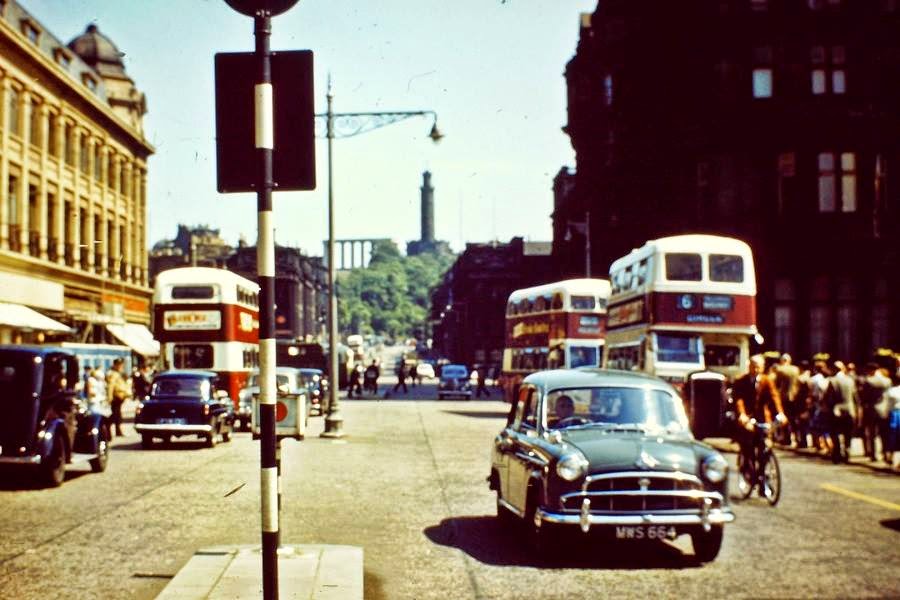
Beyond the physical buildings, there is a profound sense of social deterioration. Commenters contrast the ‘clean streets and polite people’ of the 1960s with a modern environment that feels chaotic and unsafe to the older generation. Users express fear and disdain regarding ‘black clothed face covered on there [sic] bikes,’ graffiti, and beggars, leading to a feeling that the area is no longer a ‘street of class.’ The street is described as ‘far too congested’ and ‘overrun,’ with several lamenting that the city no longer serves its residents but has been surrendered to ‘too many tourists.’
Ultimately, this sense of decline has resulted in a deep alienation of the local population from their own city centre. Many long-term residents and former locals express a heartbreaking resignation, stating they are ‘afraid to go to Princes Street’ or simply refuse to visit. The nostalgic ‘memories of a gentler lifestyle’ have been replaced by a reality that many find depressing. As one commenter definitively concludes regarding the so-called modern progress: ‘You can keep it.’ In truth, the discussion is mild, in similar forums, I have observed darker currents. In short, while it would be wrong to see such comments as inherently radical right, they do often fuse with such narratives, especially the notion that our cities are losing their Scottishness.
Nostalgia, Grievance, and the Ethno-Nationalist Jolt
What is striking is the way radical viewpoints are frequently expressed in comments on seemingly innocent posts. A recent post on the Past Glasgow page featured a nostalgic photo showing ‘a couple walking along Bank St in Hillhead, 1955.’ While the discussion began with gentle anecdotes, the evocative scene quickly prompted commenters to decry the present, with frustration evident in remarks like, ‘Look at [the] state of it now.’ Most provocatively, one commenter stated the photo was taken ‘back when we had a great city and full of Scots.’
A similarly anodyne photo posted on Picture This Scotland (2025) elicited familiar themes (‘spotlessly clean too unlike now,’ ‘I miss old Edinburgh as well… It’s a disgrace what they are doing to Edinburgh’), culminating in the comment: ‘It no longer feels like our town let-alone capital, as a Scotsman it doesn’t even feel Scottish when you walk around.’
Using ethnic/national identity (‘Scotsman,’ ‘Scottish’) as the sole measure for judging the authenticity and ownership of the capital is consistent with an ethno-nationalist viewpoint, which often hinges on the idea that the territory inherently belongs to a specific ethnic group. Such a sudden expression of ethno-nationalism provides a jolt to the discourse, appearing to many to be at odds with the view that civic nationalism defines most of those who embrace a distinct Scottish identity.
Challenging the ‘Incompetent Council’ Trope
A recurring feature in these urban decline debates, exemplified by Andrew Neil’s comments on Sauchiehall Street, is the tendency to frame ‘the council’ as the primary villain. This implies that local authorities throughout Europe are uniformly incompetent or malign—a perspective that lacks context. When, on a recent visit, I heard very similar declinist narratives emerge concerning central Athens, it became clear that local governance alone cannot account for a widespread phenomenon. Is the ‘clowncil’ in the ‘Athens of the North’ at fault for the current state of the Greek capital? Without embracing conspiratorial thinking (which pollutes many of these forums), broader forces are clearly at play.
A deeper analysis reveals that the decline is not simply a product of local incompetence, but rather a result of profound, long-term forces: seismic shifts in shopping habits, the disruptive impact of the internet, the lingering effects of the 2008 financial crisis, and the accelerated changes brought by the pandemic. In the case of the decline of Princes Street as a shopping destination, we might point to the impact of the new St. James Quarter, where many of the high-street big players have moved, as well as out of town shopping centres (such as Fort Kinnaird).
Similarly, we might highlight the – influencer fuelled – growth of areas such as Stockbridge, Bruntsfield and Leith as attractive destinations for ‘high end’ shopping at ‘artisanal’ independent shops. Unfortunately, the nuanced counter-argument that ‘it’s a very complicated picture’ is ill-suited to modern media debate and risks being drowned out by the radical right, who thrive on offering clear, definitive takes.
Reconceptualising Decline as Transition
We must also question the fundamental acceptance of the declinist narrative itself. Would it not be more coherent to view our current era as one of transition? Consider Princes Street’s history, which is marked by a series of significant evolutions, with another one now in full swing. When I recently attempted to walk along the section of Rose Street nearest the back of what was Jenners, I had to dodge construction workers and machinery while cranes swept above me. Such activity, which is evident in many places along the street, hardly seems like evidence of a street in its death throws.
Instead, it suggests a street changing directly in front of our eyes. For instance, it’s often suggested that Princes Street is full of empty units. Yet, on a late November bus ride along the street, I counted only three units that were not visibly occupied, being refitted, or let out (with new users due to move in). Yet the narrative persists that things are in terrible decline: ‘I used to love going to Princes Street when l was young, a great choice of shops now there is nothing.’ Change, not decline, seems the far more accurate description. Previous generations may have mourned the initial commercialisation of the street, which started as planned residential terraces. Subsequently, the era of grand department stores was itself a radical change, necessitating widespread rebuilding. In short, what was once new will one day be superseded. This perspective is lacking in online discourse.
The pervasive notion in these discussions—that a previous era represented a ‘natural state’—is a fallacy. In truth, the character of a city centre in any era is the result of deliberate decisions and plans that were often controversial and highly contested at the time. However, a simple contrast between an idealised past and the present, rather than a nuanced picture of a city in transition, is perhaps easier to make sense of, intellectually and emotionally. As one commenter on the post about Princes Street in 1962 put it, ‘please, please continue to post them in order to bring back memories of a gentler lifestyle.’
Urban Decline as a Political Weapon
The evidence reviewed – from the high-profile criticisms made by Andrew Neil to the widespread, emotionally charged grievances found in online civic forums – demonstrates that anxieties over urban decay, perceived mismanagement, and cultural alienation are prevalent across Scotland. These issues create a ready-made political vacuum that the radical right is expertly positioned to fill.
While the narrative of Scotland’s historical ‘immunity’ to the radical right is powerful, the current discourse suggests a more complex reality. The fusion of nostalgia, economic grievance, and mildly ethno-nationalist rhetoric observed in the commentary around Sauchiehall and Princes Street provides clear evidence that the seeds for the radical right are not only present but actively germinating in the fertile ground of local discontent. Counter-narratives must therefore move beyond broad political arguments and engage specifically with these profound city-level anxieties.

We are supported only by our readers. We don't have corporate backers and we don't take advertising, so we rely entirely on your support.
Help to support independent Scottish journalism
The problem is, the decades of deterioration in Sauchiehall Street; from the running eyesore allowed to persist for years on the BHS, graffiti spattered derelict store at the key corner site on Renfield Street and Sauchiehall Street; to the two fires that finally destroyed the Mackintosh Art School (the jewel in the Sauchiehall Street area crown) as a commentary on the vibrancy of the area; I think suggests there is more to this theme than Urban Myths, whoever is exploiting it for political purposes. The street was so decayed and depreciated it would deserve a reboot as Sauchiehell Street.
So far the redevelopment plans Sauchiehall Street look relatively small scale (compare the constant reiterations and upgrades around the Concert Hall); consisting of student accommodation (Heritage groups disapprove of the scale, blocking the MacIntosh, as if it has not suffered enough), and a frankly rather badly executed cycleway, speaking as a pedestrian who experienced it. All a rather perfunctory effort (I have excluded the M&S site here because I know little about it). Sauchiehall Street needs and desrves a co-ordinated plan that links it to the standard, gold-plated Z-plan that is all the Council ever seem interested in.
The problem is that there has been a complete political failure at Holyrood and Glasgow Council level, to develop a Land Reform policy that established for derelict city centre sites, a time limited, ‘use-it-or-lose-it’ site development or compulsory purchase order option, where the owners (known or unknown) are able simply to hold derelict property that prevents redevelopment, or indeed drag down the value, footfall or business opportunities of other neighbouring sites, and increases crime and vandalism through the problems its dereliction causes; simply by doing nothing at all. It isn’t acceptable, and we cannot afford to allow to continue. The problem here is inertia, lack of imagination, of drive, and of co-ordinated politics by the key City and Scottish political stakeholders in the community.
It is too easy just to blame Right Wing opportunists. A robust article deserves a robust response.
Your point about derelict property and a fixed time span for the owner to do something about it or forfeit it, are very appealing. However, councils can under some circumstances size buildings, but with no money, why place an agitated monkey on your own back?
The lack of imagination characteristic are also well made, but I believe inevitable under devolution. Holyrood’s main role is to manage the day to day mess made by Westminster, there is little leg room for much else.
Internet, peripheral shopping centres and working from home post covid, have and will continue to dictate how our city centres look, this is bigger than Holyrood, Westminster or any government. There are options, open more entertainment venues and eating establishments whilst renovating redundant office blocks into flats for young people.
Glasgow faces an impossible task, as do other cities in the uk except London. London is still getting billions poured into it to keep its world city status. From Canary Wharf to Battersea, a skyline of cranes, building, building, building, subsidised to a large extent by the rest of the uk and for the past 50 years, Scotland’s Oil &Gas.
Not sure where we go from here, but there are options, one thing I do know, Brillo and his cohorts, are response for Brexit and austerity that has seen decline of the uk and Scotland put on steroids!
Sometimes the Council itself is the problem. Redhall House has been in Edinburgh Council possession since 1944. It is a category B listed building. For 15 years the Council have swithered about what to do with it while it deteriorats.
It is now surrounded by attractive private housing and could be a centrepiece but despite all the consents being in place nothing is happening.
The Royal High School is the worst example however. It has been unoccupied for so long that there is the inevitable dampness. Just opposite is St Andrews House a magnificent building, arguably the last really good piece of architecture built in Edinburgh, but surplus to requirements since New St Andrews House was built. No one knows what to do with it. It is on a care and maintenance basis and rarely open to the public.
Both Mr MacLean and Mr Tully make good points. It is, however in part the Scottish electorate that makes matters more difficult; because it votes in such a way at Westminster and Holyrood, to ride two horses (only one of which definitively can prioritise Scottish interests); and thus are moving in opposite directions – simultaneously. That makes life difficult for people running the politics of devolved institutions; who are given a task, without the required or co-ordinated resources, and often with central Government deliberately trying to obfuscate their efforts.
The problem, however is compounded by our political parties in Scotland, which rely too much on recruiting people who are poorly equipped for the task of Executive Government; they lack the talent or imagination, or managerial competence, or the initiative required to create answers from the limited tools they possess. Our institutions also have a long history of attracting the wrong people, for the wrong reasons (the wrong people are often the most adept at exploiting the opportunities created by necessarily bureaucratic institutions); who do not have the ability, either to think for themselves (political parties hate people thinking for themselves); or to do anything but follow a script they are given, or follow an ideology they stumbled on, and they think does everything for them, and think political parties take seriously. They don’t take them seriously. Ideologies do nothing – but disappoint. Always. They have no purchase on reality.
The quality of minister in some cases in Scotland since 1997, there has been room for improvement.
That said the quality of minister and prime minister of the uk has been truly pathetic, unsettling and distressing since Wilson!
Talk of Angela Rayner being taken back into the cabinet highlight the dearth of talent in Labour, desperation and splits within!
Under devolution capacity for improvement in Scotland on anything from energy to housing is curtailed and subject to Westminster’s whim.
Whilst we have the grim reaper looking over our shoulder with malevolence, it’s difficult to achieve significant positive change.
This percolates all the way down to local authorities in Scotland. Devolution is a con, one one hand those than devised it and maintain it, know it, as do those who mange it day to day!
I know the public don’t respond to facts the way they do to emotive speech, but here is some data for those that wish to formulate a counter-narrative, and i put it here because I quite like looking up these kinds of things;
approximate number of cars in Scotland
1963: 445,000
2024: 2,800,000
population of Scotland
1963: 5.2 million
2024: 5.55 million
World population:
1963: 3.2 billion
2025: 8.25 billion
Percentage of Scottish children living in poverty:
1963: 15%
2020: 22%
or by Gini coefficient: {0.0 is all equal, 1.0 is 1 person owning all the wealth}
1963: 0.19
2020: 0.25
https://share.google/UvLaBB8PFlUHOrnn0
https://ifs.org.uk/living-standards-poverty-and-inequality-uk
Crime rates I couldn’t find online, but it has declined in last 10 years in Scotland> I did find:
murders in 1963: 14 (increased during decade)
murders in 2024: 45 (50 year low)
prisoners in 1963: 6185
prisoners in 2024: 8126 (which doesn’t necessarily correlate with higher crime rates, but greater conviction rates which generally correlates with greater poverty and wealth inequality)
World average CO2 levels:
1963: 319ppm
2025: 425ppm
world average CH4 levels:
1963: 1.37ppm
2025: 1.93ppm
world EROEI of oil:
1963: ~45:1
2025: 6:1
Don’t forget there was no VAT before 1973, so everyone had 10% more purchasing power in the 1960s.
So of course enshitification is occuring as there is less surplus energy to go round for a greater population with a vastly increased car culture. A romantic view of 1963 Scottish city centres will appear to be true, because, a bit less people then, a lot less cars clogging city centres and less car parks; greater general energy surplus leading to more discretionary spending from governments downwards.
What I can see from this data:
a) Scotland’s population has bucked the world trend and remained largely static, which ecologically is a very good thing.
b) Scotland’s energy wealth has been stolen, simply put. A Norwegian style sovereign wealth fund in the 1980s would have led to dramatically different outcomes, whether it was Scotland on its own or the UK as a whole. Probably the biggest reason for declaring independence, as a republic. “The mineral wealth belongs to the crown” is merely a statement, I wouldn’t be surprised its not even written down somewhere. Even if it is, you can pass a law to cross it out.
c) For this wishing to recreate a past idyll, they should be hating on cars and the ultra-wealthy, not resource-starved councils, nor nomads, nor non-white peoples.
d) The biggest impact you can have is to tax urban non-disability cars to the hilt, and invest hugely in public transport systems across the nation. Once you get rid of most of the car parks, that’s more room for new shops or community structures.
The gentrification of your cities I know is a big thing. This is what happens when wealth inequality reaches absurd levels, as fewer and fewer individuals can own more and more of the real estate. Simply impose a legal maximum limit on ownership when you evolve your new constitution.
There is definitely a transition going on but it is unclear what will emerge from it. The grand department store seems doomed despite the best efforts of John Lewis. Partly it is down to the shopping habits of the British middle class which des like to be too visible. There’s not a big market for designer wear even in Glasgow. Personal services are expanding but nailbars and massage parlours are often as down market as the chicken joints and tiny convenience stores also largely Asian owned. Everywhere in Europe you now find these tatty areas which are a poor imitation of the ones in Asia itself.
Ironically in Edinburgh the leading tartan tat shops are owned by a Sikh family an interesting example of civic nationalism..
Scotland’s long had migrant communities, the Italians once ran many ice-cream parlours and chippies and only after WWII did they become Scots of Italian origin, the family names are well known. It’s the numbers that are making the difference. London is demographically different to England generally. 41% of its population are of non-UK birth. Bedford with probably the highest number of places of worship per capita, and the most varied in the UK feels like a Terry Pratchett fantasy.Althouugh there are no official State supported Muslim schools there are High Schools in Birmingham which are 99% Muslim of Pakistani descent. Now be honest would you send your child there?
I travel regularly on Edinburgh buses and I listen to the various languages trying to figure out what they are, Polish, Romanian, Arabic, Chinese, Hindi, Urdu, Xhosa, Igbo, Fante? There will probably be three foreign language phone calls at any time. I’ve heard fewer in officially multilingual countries. No wonder people feel estranged in their own country even if they try to be accepting.
Perhaps in a couple of generations it will have mixed a bit better if we all blend a bit at the edges.
Let’s not put too rosy a complexion on the past. The SNP today is run by the faction that was expelled by the old blood and soil nationalists of the 1930-1960s period. Wolfe wasn’t a Social Democrat, though Wend Wood was too much for him. Like other nationalist movements Scottish nationalism flirted with fascism while versions of British nationalism and imperialism was as Hitler pointed out very much of his opinion. Remember when Orange Tories won majorities in Scotland?
Ian – I think the two main commercial issues which have affected the town centres of all cities in UK is the rise of out of town shopping centres and online shopping . This has led to business’s being unwilling to invest in city centres due to high overheads and access problems.
I can see no realistic way that this trend can be reversed.
Allied to this is the reduction of local government budgets who have reduced funding available to invest in the redevelopment of town centres.
Perhaps the future for town centres are display shops where people can browse clothes, furniture etc which they can then order online. This could be supported with town centres being both more social centres and residential with good public transport links. Some way of ensuring the housing does not just become a form of yuppie ghettos would need to be put in place. One of the beauties of Scotland is it has 4 big cities the centres of which have clear individual characteristics and this must be maintained to avoid the homogeneous city centres seen in many places.
You are correct to point out that Scotland’s population is now pretty static which is a welcome change after years of falling numbers. This has been achieved against a backdrop of a very low birthrate and has required a significant level of immigration both from elsewhere in UK and further afield. This is essential whether people like it or not due to the large number of elderly people there are in Scotland. There are as you point out significant differences in population growth and immigration compared to England. This indicates why control of immigration needs to be devolved to Holyrood to better meet Scotland’s population and social requirements.
It is one of the achievements of Devolution that the migration from Scotland has slowed and there has even been some return from families settled in England, but we still have a very low birth rate largely down to low confidence in the future. We need more hope.
We cannot have a separate inward migration policy while part of the UK, and I don’t believe most people want higher rates of migration even if we could attract more people. Parts of Europe that are up to the 10% mark show signs of saturation, their societies simply cannot absorb more without strain. Migration in the past meant absorption today it can mean parallel communities. It has taken us long enough to fully accept those who came from Ireland with religion always the barrier reinforced by ghetto housing policies.
“but we still have a very low birth rate largely down to low confidence in the future”
and also:
PFAS chemicals
Micro-plastics
sperm count decline
https://www.commondreams.org/opinion/why-2-is-the-most-dangerous-number-no-one-is-talking-about
population saturation (there is another name for it I can’t recall, basically when mammal populations reach a certain level even with unlimited resources, they become lethargic, passive, unsocial and decline rapidly).
@Mark Bevis, perhaps you are thinking about the Behavioural Sink experiments of ethologist John B Calhoun on mice and rats?
https://en.wikipedia.org/wiki/Behavioral_sink
Aye, thats the one, thanks. I get the impression analysts are looking at this concept again in regards human behaviour under the current social environment worldwide..
In general my understanding is that historically it has been deducted that all other factors remaining equal, lower infant mortality rates are the biggest driver of reducing birth rates. Nowadays all other factors are not equal and there are multiple drivers of lowering birth rates. We’ve not got to the point where death rates internationally exceed birth rates, but that point is very near even without nuclear war.
Ecologically this is a good thing, economically not so much, especially if your society’s only metric is growth of GDP.
I am pretty sure that Scottish Labour were supportive of devolving immigration until UK Labour set their face against it. If you looked at the variety of measures and controls that Shabeena Mahmoud implemented around immigration in proposals last week there is no reason that immigration could not be devolved in a controlled manner. To refuse to do something that is appropriate for Scotland because it is not accepted as appropriate in another part of UK goes against the whole principle of devolution!
Due to the baby boomer population bulge in Scotland we require to sustain a working age of appropriate size to both care for and pay for the increased proportion of elderly people there will be in society for next 10-15 years. I fail to see how this can be accomplished without a level of controlled immigration that meets the health and economic requirements of country. It is ironic that the generation that appears most resistant to immigration is also the generation in greatest need of immigration.
The reasons behind the fall in birth rate are many and not easily answered. Women in society have more equal status and are more independent than in previous generations which allows them greater choice as to if and when they want children. Each successive generation has been brought up to expect more material goods and holidays etc and are therefore less willing to sacrifice these comforts to have children. People are consequently having less children later in life.
There are many other social and cultural reasons that mitigate against having children including an uncertain environmental future. Government cannot legislate to increase the birth rate but I am sure that if they tried to make having children more attractive economically and paid more attention to the immediate and longer term needs of the section of society that is raising children (& children themselves) this may help.
Immigration is not a Devolved matter. Even in actual federal states control over entry is a function of central government. We could have a provincial nominee system as in Canada but we would need a far better system of supervision to prevent people simply moving elsewhere in the UK. We cannot locate between 5000,000 and 750,000 unauthorized migrants in the UK. No one knows the real figures.
We certainly have a demographic problem as do most developed countries. Even those countries that had a population boom after WWII are seeing dramatic reductions in births. Whether the answer in Scotland is migration on very large scale is questionable. We need a different kind of economy with much higher rates of capital investment and consequent high productivity. Or you could have London’s 41% foreign born with a higher birthrate and accept that Scot Land was another country in the past.
Ian – I am fully aware that immigration is not currently devolved. One upside from this is that it shouldn’t therefore be an issue in next year’s Holyrood election. Reforms number one (only?) issue is immigration so they really don’t have a lot to talk about in next years election. No doubt this won’t stop them from banging on about it and blaming immigrants for every problem in Scotland and the Scottish government for immigration.
Scotland is not a preferred destination for illegal immigration due to geography but takes its fair share of asylum seekers. The problem is that Westminster controls rand undertakes this role with minimal discussion with Holyrood or local authorities.
If Westminster cannot work out a devolved immigration system that better meets Scotland’s needs then that is IMO yet another reason why Scotland needs to become independent.
You gloss over the demographic challenge provided by the post war baby boomers who are now entering old age. I repeat that this group (which includes myself) needs the economic and care support from younger people. We have insufficient younger people at present in Scotland to provide this support and I would like you to inform me how you would answer this problem without some immigration? To put in bluntly who is going to care for us and wipe our backsides in a few years time? I don’t know about you but I am really only interested in ensuring that I get good quality care when I need it rather than worrying about the colour of skin or religion of people providing the care.
Of course a lot of personal care is already being provided by immigrants and has been for the last 50 years. Naturally any migrant with any ambition aims to get out of the sector with its low wages, long hours and insecurity, as fast as possible. At least in England they are already seeing earlier generations of migrants becoming part of the care needing population; culturally appropriate of course.
I don’t see creating another demographic bump as a solution. We had this in many professions and it creates problems down the line. Integrated care and more effort on enabling older people to remain independent would be a start using mechanical aids and electronic personal security systems etc. Making working in the sector more attractive might help, there are many young people in deadend jobs that don’t utilise their skills. For a start bringing it back into Local Authority direct control with appropriate financing. Children’s Services too. Too much cost saving has proved costly in the long term.
Ian – thank you for your reply. I agree that health and social care are underfunded and need to do more to encourage people to work in these areas. I would add that a lot of elderly people suffer from loneliness and while electronic solutions may be attractive they are often no substitute for human care and contact. Demand is increasing due to percentage of people in the >60’s group growing. The 16-60 age group is stable and the economic pressures on this group to pay for pensions, health and social care are only going to grow. I still fail to see how we can square this circle without either drastically increasing retirement age, increasing taxation on working people or supplementing the workforce.
I would add that immigrants pay taxes and have children which in itself will help with longer term demographic challenges. The current Westminster strategy to drastically reduce immigration may suit the situation in England but could have serious consequences for Scotland. I note you again mention issues about immigration in England and this again only highlights the difference in immigration realities and needs between Scotland and England.
You rather betray yourself by sneaking in the phrase culturally appropriate which is a rather loaded phrase.
I feel I have made my point about Scotland’s demographic challenges and immigration differences and needs from England ad nauseam and since I have no wish to keep repeating myself I will say goodbye.
I used”culturally appropriate” because it is becoming an issue. As more people from migrant communities are not being cared for In family settings there is a greater need for adaptations not needed in our”one size fits all” system. How many Care Homes offer halal food or the kind of vegetarian diet people may be used to? How many residents simply hate the smell of curry?
Unfortunately there are people who have not had a wider social circle and find it difficult to adapt. That applies to all communities which may live in parallel but barely interact. Then add in dementia.
Scotland certainly has needs different to some parts of England but unless newcomers want to join the clan you will end up with a country where attachment to the things we think make us different is lost. There are plenty of migrants who proudly wear the kilt and may even play the pipes whatever their ethnicity. As for others they feel like sojourners down the generations which is not good.
Sperm counts are indeed dropping but are not yet having a significant effect on fertility. Birth rates have fallen as a result of people starting families later. All those teenage mothers the newspapers used to complain about are no longer an issue
“Remember when Orange Tories won majorities in Scotland?”
==========
The last majority won by the Tories in Scotland was in 1955. Anyone voting age at that election must’ve been born in 1934 or earlier. That would make such a person over 90 years of age just now. it is a rather big ask or such survivors to remember!
The victorious party of 1955 were The Unionists. They were seen as a sister party of the old Ulster Unionist Party, especially in the west of Scotland where your “working class Tories“ congregated.
Strangely enough the Unionist Party in Scotland came about through the majority of Scottish Liberals, staunchly Presbyterian and moderately progressive, opposing Irish Home Rule because Roman Catholicism was seen as reactionary and opposed to democracy across Europe. The Ulster Unionists were more progressive than Fianna Fail or Fine Gael remarkably. Carson had been a leading Liberal Minister.
Now that Ireland has become progressive it’s hard to remember why things might have been viewed differently in the past
Would those commenters want to return to 1962 levels of car use/ownership? To Edinburgh’s industrial era air quality? I had supposed all that acid rain eating away at Edinburgh’s architecture wasn’t some to be nostalgic about, but perhaps all that lead once used in petrol has had its long-term cognitive effects. Was this a welcome blast from the past?
https://www.ceh.ac.uk/news-and-media/blogs/atmospheric-sulphur-dioxide-levels-reach-historic-high-scotland
One might have thought that every scandal would etch away another layer of nostalgia (Edinburgh’s private schools come to mind for some reason), but perhaps some people are really nostalgic for a time when people knew their places, children weren’t listened to, and the sin of detraction was preached against from every pulpit.
Some people just don’t seem happy unless their urban crawl is decorated with statues of their favourite pro-slavery icons, although they still have the Melville Monument to corruption/vainglory/bondage/incompetent put-downs of other peoples’ self-liberation struggles.
Once, Edinburgh was famous enough for its cobbles, cockroaches, castle and skyscrapers to feature as a funky backdrop to the mutant battles of the Uncanny X-Men, but maybe its final demise will be less spectacular.
Interesting article. I have increasingly seen what you are describing happening on a few Facebook groups for the East of Scotland. I wonder to what extent the right wing comments on these sites are part of a deliberate far-right social media strategy, since the comments often seem to be strikingly similar across different sites and follow a pattern eg someone posts a picture of the high street with a nostalgic comment,
And within three or four responses someone has commented that it’s a ‘shithole’ now , then numerous comments flood in about vape shops , Turkish barbers , immigrants the council etc etc. So how much are far-right groups weaponising nostalgia?
I remember the 70s and streets were quieter cleaner safer and calmer but also stultifyingly dull. Pubs shut at 10pm (9pm in the 50s and 60s I believe). The retail offer was equally dull. There were few cafes, only tearooms, and all they could offer was also dull. No shops opened on a Sunday. Which was totally dead. There was also the Wednesday half day and shops closing for lunch. Nothing retail was open after 5.30pm. Food was dull. I had never heard of tomato puree. That was exotic. Older people, recalling the 1950s, said it was even worse and told me that ‘in Scotland, the war never seemed to end’. Rationing continued into the 1950s. Then there were the smogs (which everybody forgets about, though that was more the 50s). Things began to improve after we joined the common market in 1973. Delicatessens appeared and a more interesting variety of foods. Immigrants from India and Pakistan opened restaurants and grocery shops open in the evening. Sir Terence Conran opened Habitat shops bringing a range of continental items of kitchenware and home furnishings that were more beautiful and interesting and by the 1980s things were definitely better. But what I remember of the period before was not just its quietness but how crushingly mind numbingly dull it was. It might have looked prettier on the outside but from the inside it was just a different kind of alienation.
Charlie Ellis begins and ends his article by referencing Reform UK. In between, he highlights problems which have festered in Scotland’s towns and cities – Glasgow above all – for over forty years.
This approach gives the appearance that these chronic problems matter today because Nigel Farage is successfully exploiting them for electoral reasons.
Though his article concentrates on Glasgow and Edinburgh, Scotland’s post-industrial towns are in a similar, dilapidated state; Falkirk, Kirkcaldy, Greenock, Paisley and Clydebank come immediately to mind; the last has a population of under 30,000. In the 1960s, it was just under 50,000.
The people in these cities and towns are unlikely to be impressed by the prospect of ‘counter-narratives’ as a way forward.
FA – you are correct to point out that the issue discussed in this article is not just a city problem but a more general urban one. I dare say you will soon be able to add Grangemouth to your list.This is not a phenomenon restricted to Scotland but relates to many urban communities across the UK.
The roots of these problems lie in the economic model that has been prevalent in the Uk for last 40 years, globalisation and the fact that so many UK assets and industry are not owned by people resident in and with a stake in UK.
The remedy for this urban demise are not easy to identify in a shrinking world though UK politicians could do something they are notoriously poor at – looking abroad for how other countries have approached this problem. The Trump solution of tariffs is not the answer IMO as it increases the price of goods which hurts the poorest in society hardest. If it doesn’t work in the world’s most powerful economy it cannot work anywhere else.
Farage and Reform are very good at channelling the discontent that this urban decay engenders in the population mainly by blaming ‘the others’in society. They are also helped by the fact that they are not hindered by incumbency as they have not achieved power in any meaningful way and are therefore not considered accountable. This is not entirely true though as Farage was one of the earliest proponents of Brexit which is undoubtably another factor in current UK economic stagnation.
From what I can see Reform have no wish to change the current economic system only make it more extreme. This is no surprise as they are backed by billionaires and hedge fund holders who benefit most from the current economic system. They are essentially a one issue party (immigration) an issue that is not devolved and therefore the reality is that they will have little positive ir relevant in the way of policies to input to Holyrood election except stirring up unrest and hatred in Scotland. This is something they are undoubtedly very good at as we will no doubt find out between now and Holyrood election next year.
You write that UK governments ‘could do something.’ Correct but so could the Scottish government. Its record is lamentable, with a partial exception when Alex Salmond was First Minster. It has failed to do the basics; successfully educating school children, run a competent system of justice, build needed ferries. (Building ships – big ones – was till recently a Scottish speciality). I could go on.
One reason for this failure is that most Scottish politicians think Scotland is in good shape, with only the UK connection stopping us from being in great shape. SLAB were true believers in Scottish exceptionalism and the SNP is something of a tribute act.
A significant section of the voters has had enough of this ‘thinking’. They want to make their dissent known at the ballot box. Since the Scottish left has – just about – given up, they are willing to vote for Farage’s English National Party.
These voters are unlikely be discouraged by the constant denunciation of Farage, just as Trump won a clear cut victory in 2024 after eight years of relentless denunciation by progressives.
The unthinking despair of the ‘thinking’ ? That’s been obvious in Falkirk recently.
At least the author hasn’t bothered to go to Cumbernauld. A tourist attraction for weirdos like me. Or Scotland’s most bombed city (ssh – it’s a secret, and it might not be part of Scotland) – Aberdeen. Quite a bit of it currently looks like a bad day in Gaza. Hull was almost completely destroyed but that’s a serious secret -Hull even has boarded-up council schemes in the town center.
Oh, the joy of a skyscraper plonked on top of a multi-story pish-stained concrete car park and a Geiger counter to find the nearest tree in the center of your city, with lockdown on the 18th floor. All dreamed-up by people who owned cars.
Scottish citys are now places to park SUV’s. There are little enclaves in Glasgow and Edinburgh (nowhere else) where SUVists can park and gawp in shop windows and have coffee and cake at the weekends.
Talking Pictures TV is broadcasting The Omega Factor, a BBC Scotland drama series shot in Edinburgh c.1979, apparently featuring a number of landmarks etc.
https://en.wikipedia.org/wiki/The_Omega_Factor
I don’t remember it, and haven’t watched it yet, but it could be of local interest. If you missed the first episode, The Undiscovered Country, they usually repeat them.
Of course the economics surrounding the shopping streets everywhere are changing. I can only talk about Aberdeen – Union Street built 2 centuries ago – built as a residential/ shopping connector spine. But the residential population has largely moved out to the suburbs, and traffic and parking concerns have made easy access to the retail very difficult.
An answer to be discussed is to, whilst retaining the ‘historical facades’ that is emblematic of the street, give owners the right to built high (30 storeys ?) behind the present streetscape for all income groups. In my experience (overseas, admittedly in developing countries) to create the impetus, is first open a couple of towers to high income buyers/ tenants – with incentives if necessary. Then middle income, and finally (all within a contracted time-frame) build the low income (social housing) when the infrastructure and utilities should be virtually free. All incomes are interdependent and the rich have the money to get it all started. Developers would have be required to build for all 3 incomes on such as a 1:4:10 basis (high:middle:low incomes) with sizeable retentions sums retained till all are completed.
Union Street would become a ‘hike, bike and transit highway’, with a bus circuit connecting all the car parking buildings behind.
“Bring the customer back to live, work and play in the city centre.”
Happy to discuss.
Seems to be a city designed by and for existing social hierarchy. At times of extreme social breakdown and a long-term housing crisis this seems a woeful proposal.
“All incomes are interdependent and the rich have the money to get it all started.” You do know how that money was accumulated?