
Project Fear on Steroids
The British State’s refusal to negotiate an end to the Union is well documented, and it lays out starkly that this isn’t a voluntary union. That’s been clear for a long time [Scotland and the Constitution]. The idea that the Unionist commentariat plays a key role in holding this fiasco together has also been super obvious since we started publishing in 2007.
But now, faced with the collapse of the two-party political system that has dominated British politics in the post-war era, and confronted by the reality that Scottish Labour faces its worst result in either a Westminster or Holyrood election in 116 years [Scottish Labour’s Holyrood Disaster – Bella Caledonia] the Union’s most faithful scribes have descended to an incredible new position.
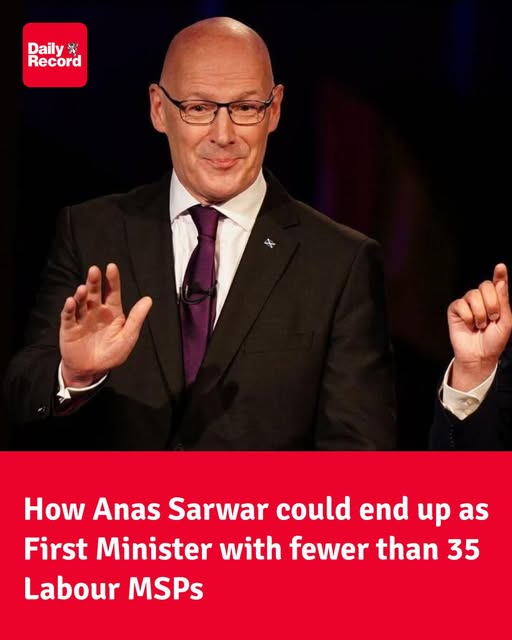
Rather than face head-on what any of this means, the Union’s leading cheerleader (in a crowded field), Paul Hutcheon of the Daily Record, states this, in an escape to fantasy land: “How Anas Sarwar could end up as First Minister with fewer than 35 Scottish Labour MSPs.”
Readers, current polling has Labour on 15 seats.
But the logic is that Anas Sarwar would ascend to Bute House in an electoral pact with the openly fascist Reform UK. Hutcheon writes: “If Labour, the Lib Dems, Tories and Reform reach 65, insiders say the pro-UK parties would vote for Sarwar as First Minister, despite Swinney leading the largest group.”
Hutcheon explains: “Such an outcome is a legacy of the divisions caused by the independence referendum.”
“How could we end up with a minority Labour Government if they only have 32 MSPs?” asks the Daily Record’s Political Editor into the void.

We are supported only by our readers. We don't have corporate backers and we don't take advertising, so we rely entirely on your support.
Help to support independent Scottish journalism
They’re clutching at straws again.
Sadly, the SNP don’t seem to show eagerness to act on such as majority “for independence”, should it happen.
Oh, and… “…does nothig but normalise wuch politics…”
Ach; “such as” should be “such a”. Eejit, eh?
Paul Hutcheon is saying out loud what is probably being discussed in Labour circles. Labour’s hatred of SNP for daring to disrupt their hegemony of Scotland is such that they would rather form a minority government with not only the Tories, their historical opponents based on political philosophy, but also Reform who are Europhobic, English nationalists with an unhealthy streak of racism at their core.
The SNP s current political philosophy is at best social democratic and should reasonably align with any moderately left of centre political party. The major difference between SNP and Labour shouldn’t be political philosophy but the constitution and whether Scotland would be better being an independent country. The difference does seem to have morphed into whether the Scottish electorate should even be allowed to decide whether they wish to be independent.
Scottish Labour should be campaigning on their belief that they would be better at implementing social democratic policies in Scotland and that this would be best way of preserving the union. Somehow Hutcheon and other Labour backers have managed to get themselves into the ludicrous position of wishing to join with parties whose political philosophy runs completely counter to the basic principles Labour was founded on and has espoused for 100 years. The rationale behind this nonsense is their opposition to Scottish independence which manifests itself in their undemocratic total rejection of agreement to another independence referendum if Holyrood (voted in by purely Scottish electorate) requests one. Hutcheon then blames the independence referendum held in 2014 which No won for him wishing Labour to form a coalition with people whose political ideas should be absolutely toxic to anyone with any interest in social justice. It is a perfect example and warning how hatred can warp an individual and possibly in Scottish Labour a political party.
Excellent response to a great analysis …
Helen – there are so many holes in Paul Hutcheon’s argument eg would Lib Dem’s be willing to join any coalition with Reform?
What happens in the not unlikely scenario where Reform get more seats than Labour? Does Paul think that Labour should join in a coalition with Reform as the biggest party supporting Malcolm Offord as First Minister taking direction from Nigel Farage?
Great article ..
The “pro-Independence majority” won’t matter as
a) The SNP needs for it to be a single party (SNP) majority
b) Even if they achieve that unlikely objective, Swinney’s ‘plan’ to ask for a S30 order gives a veto to Westminster over Scottish sovereignty.
c) Swinney’s request has already been knocked back in advance by Starmer.
Incidentally Mark McGeoghegan didn’t say HOW he’d projected seats allocation from the Yougov tracker. It looks to me, however, that he is assuming a proportional, rather than a uniform, swing across all seats and regions from the 2021 HR result. The former gives 64/65 seats to SNP whilst the latter predicts 58/59 seats. Quite different. When there is little movement in voting intention from one period to another – as there was between 2016 and 2021 – the seats projections are very similar. But where there is substantial change in voting intention, as indicated by polls for 2026 vis-a-vis 2021, the respective mapping from vote share to MSPs can be quite different.
One other observation is that Reform, by dint of standing in the constituencies, may have done the SNP a favour: If they had stood on the list only it is quite plausible that their circa 20% vote share would have gone (back?) to the big legacy Unionist parties (Con & Lab) and boosted their seat haul at the expense of the SNP (without damaging Reform’s prospects on the list).
Because of the state of flux due to i) significant change in voting intention from last time and ii) advent of Reform there may be a few surprises come the May election.
Thanks Duncanio, Mark accepts that
“So there’s a few things there. Firstly, that was based just on YouGov’s poll, this is based on the predicted values of LOESS regression models fitted to time-series data of all polling for all parties.
Secondly, different models will produce different results…E.g.
@devolvedelections.bsky.social
‘s model predicts 58 SNP seats based on YouGov’s numbers. We’ll see what
@ballotbox.scot
‘s predicts. This variation depends on what underlying model is being used (uniform national swing, proportional swing, strong transition, something else…) as well as data…Thirdly, that variation is amplified in this election: there are ~20 marginals of which the SNP are projected to win ~15, and if they lose those contests their list vote isn’t big enough to compensate. The gap between SNP on 64 and SNP on, say, 50, is a matter of a percentages in national polling.”
I think you’re largely right on the wider issues, although I think that British politics is collapsing in a way that makes the possibility of different dynamics very possible. Nothing is static in this situation and the political class and media mainstream are largely dead to what’s happening.
Thanks for the considered response. We are agreed.
There is much uncertainty and the large number of marginals makes the 2026 parliamentary outcome so much less predictable than has been the case in all Scottish elections since 1999.
There is still over 3 months till the election and things can happen that can change voters’ perceptions substantially such as the developing Queen Elizabeth hospital scandal and the on-going & multiple spats with the Scottish Information Commissioner at the Court of Session.
Reform and the legacy Unionist parties are bound to make much play on both of these issues in the run-up to polling day.
Yes all parties face jeopardy, as you say the SNP face massive incumbency issues, the Labour campaign seems to be failing badly, Reform UK are notoriously bad at vetting candidates and may face backwash from their close proximity to the MAGA madness, and so on.
My fear is that none of the parties have a particular fresh focus or anything truly impactful to say so we are reduced to camps.
Given what you say about the party challenges, and the general disillusionment with politicians and politics, voter participation will be of real interest.
At the 2024 UK election in Scotland participation nosedived to 59.8% from 68.5% in 2019 and an average of 67.9% across the 4 previous WM polls.
At the Scottish election of 2021 turnout was 63.5%, on an upward trend since 2011 and substantially higher than the average of 53.7% across all 5 prior HR elections.
Given the scunner factor with all parties I would be surprised if the number of registered voters showing up to vote doesn’t dip, and quite substantially at that.
Perhaps, although we are seeing in Wales Plaid emerging as the force to resist Farage & Co as the Labour vote collapses. Alternatives to fascism is a great motivator. Not a very positive reason to vote but an energising one nevertheless…
Duncanio – the 2021 Holyrood election had the holding of another independence referendum front and centre from SNP (for)and Tories (against). Considering those two parties received the highest number of votes I think it is fair to say that the referendum issue was a significant factor in the high turnout.
The blocking of the subsequent Holyrood request for an independence referendum post 2021 election has led to a lot of disillusionment with SNP within the independence movement. This feeling manifested itself in the drop in SNP support at the 2024 GE.
With an independence referendum seemingly blocked by all Westminster parties for the foreseeable future independence is no longer such a high priority for many voters. Simultaneously many voters have also become disenchanted with SNP governance due to their lacklustre performance, leadership shenanigans and media hostility. John Swinney has stabilised party but has done little to inspire the lost SNP voters to return at next Holyrood election.
Labour had an increase in votes in 2024, albeit on a reduced turnout, but this upturn in support looks short lived as voters have become quickly disillusioned with them in government.
The Tories are haemorrhaging votes to Reform who are also appear to be picking up votes from Labour on a significant scale and even some votes from disaffected socially conservative SNP voters.
It certainly looks like the overwhelming sense of the electorate is disillusionment and amongst independence supporters a sense of hopelessness. This will almost inevitably lead to a depressed voter turnout in May. Such is the discontent with all political parties it looks like the SNP will probably be the biggest party with a pro independence majority but all indications are the next 5 years will be much more of the same.
I should add that the blocking of any future independence referendum is primarily due to fear over potential outcome from Westminster parties. I also think it is a politically cynical approach to engender a sense of hopelessness amongst independence supporters. This is leading to stagnation in Scottish politics which allied to Westminster adopting a more hostile approach to Holyrood is bad for Scottish democracy in general. This is a very dangerous approach when you have a far right party such as Reform, with minimal interest in politics and democracy in Scotland hoping to benefit from the subsequent voter disenchantment
It appears that Paul Hutcheon and no doubt some people in the Labour Party are quite comfortable with fostering this disillusionment even if it mainly benefits Reform as long as it depresses SNP support.
As is often the case here on Bella, the comments and drop down on those comments are an insightful and thought provoking adjunct to the article being discussed. It’s fair heartening to see such rationality used to interrogate or illuminate aspects of the article and that comments are received without undue defensiveness but with a reciprocal fairness, respect, curiosity and willingness to explain, expand and evaluate. It’s what makes Bella the go to site for information and thought provoking content for me, though I’m not the greatest of contributors. I’m often in awe of the depth of knowledge, and willingness or ability to interrogate a subject from authors and audience and that petty point scoring seems generally well down any discernable agendas. You all do a great service to the cause of independence in my mind, and for that I’m very greatful to you all. Lang may yer lums reek!
Tips hat.
Thanks Alistair. I do agree that the level of contributions from readers is a major part of the project and being able to disagree without malice is really important and something missing from a lot of public discourse.
Interesting aside to Paul Hutcheon article but not unrelated in an article in ‘The I’ today. It is reported that some Labour MP’s are stating that they would prefer Reform winning in the upcoming Gorton & Denton by election rather than the Green Party. Their thought process is that if Greens win the by election there will be proof that the Green Party can win constituencies in next GE which will put the kybosh on Labour’s planned strategy to campaign on the platform of a vote for any party other than Labour will let Reform in. They are also reported as saying they will campaign harder against Green Party candidate than Reform one (who is a hard right ethic nationalist).
Labour strategists bring the ‘Oh what a twisted web we weave’ quote to mind!