
The Politics of Proximity and Place
A return to place‑based economics is the irresistible antidote to the madness of a world on fire.
From the bleak smear from the climate crisis we’re all pretending isn’t happening, to the horrific US-Israeli war on Iran and indiscriminate bombing of civilian populations, positive news is scarce. They’re carpet-bombing a city of 10 million people. A pickled Hegseth ripples with dystopian rage as the entire global economy shudders as the flow of oil gets turned off at the Gulf of Hormuz. The fragility of our petro-economy is thrown into stark relief.
— BELLA CALEDONIA (@bellacaledonia) March 5, 2026
Domestically, this week alone the husband of East Kilbride Labour MP Joani Reid was arrested as part of an investigation into an alleged Chinese spy ring, and Sally Donald told local SNP members in Edinburgh Southern that she has quit as their candidate. It comes after the Scotsman reported she was under investigation for alleged benefit fraud. Small beer in the bigger picture.
But politics seems broken, and dancing politicians as the bombs fall add to the atmosphere of doomed decadence. MPs at Westminster doing the Cha Cha as Trump’s regime beckons the Rapture, feels like the End Times.
Complicity

In a powerful piece in Equator, ‘After the Earthquakes, ‘ the editors write comparing our moment with that of the end of the Soviet Union:
“In 1956, the news that Nikita Khrushchev had recounted the crimes of Stalinism in a ‘secret’ speech provoked widespread shock and intellectual paralysis across the Soviet bloc. The Russian writer Ilya Ehrenburg was among those “shaken” by it, not because he was unacquainted with some widely known facts about Stalinism but because these had been uttered “by the first secretary of the party”. For Ehrenburg and many others compromised by a broken system, the confession forced a destabilising question: What made us suppress the obvious for so long?”
“Many in the free world today face a similar reckoning. The earthquakes of recent weeks – beginning with Trump’s kidnapping of Maduro, his threats to Europe over Greenland, ongoing strangulation of Cuba, and the lurid revelations of predation in the Epstein files – have confronted an Anglophone elite with a reality they either ignored or actively denied.”

“Hannah Arendt wrote that if the fundamental problem of postwar intellectual life after 1918 was death, then after 1945 it was evil. Today, the fundamental problem is complicity: reckoning with our acquiescence to a political system that suddenly appears criminal. These shocks all expose something rotten beneath the surface of liberal respectability: how elites participate in atrocity while maintaining prestige; how institutions supposed to safeguard justice in fact protect the powerful and exploit the vulnerable; how mass consent is secured through careful distribution of access and silence.”
But, like culpability for ecological collapse, we are not all equally responsible. If Western degeneracy is laid bare, its immediate consequence is the end of ‘enforced silence’. Now, as Equator write: “It is now a scramble to salvage reputations amid general collapse.”
Sounds like a description of the House of Windsor right now.
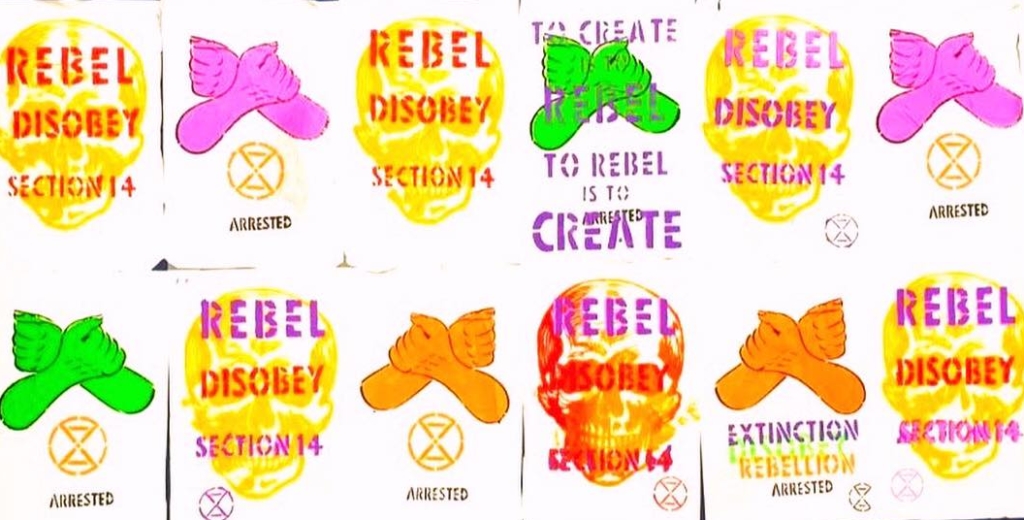
The idea that the victims should be exposed as the perpetrators are redacted itself reveals a level of elite disdain and confidence that is remarkable in itself. But even if prosecutions and incarcerations are slow in the US, the sense of imperial decay and decomposition is Weimarian. It does not feel like a containable crisis.
As elite failure rapidly unfolds, the systemic relationship between forces is revealed. Here Amy Westervelt from Drilled attempts to map out some of the relations: ” the details of this or that environmental policy might seem quite trivial in the face of the collapse of democracy all around us, these two things—the climate crisis and the democracy crisis—are deeply interconnected.”
The graphic’s only a few weeks old and already you’d have to add ‘Tehran’.
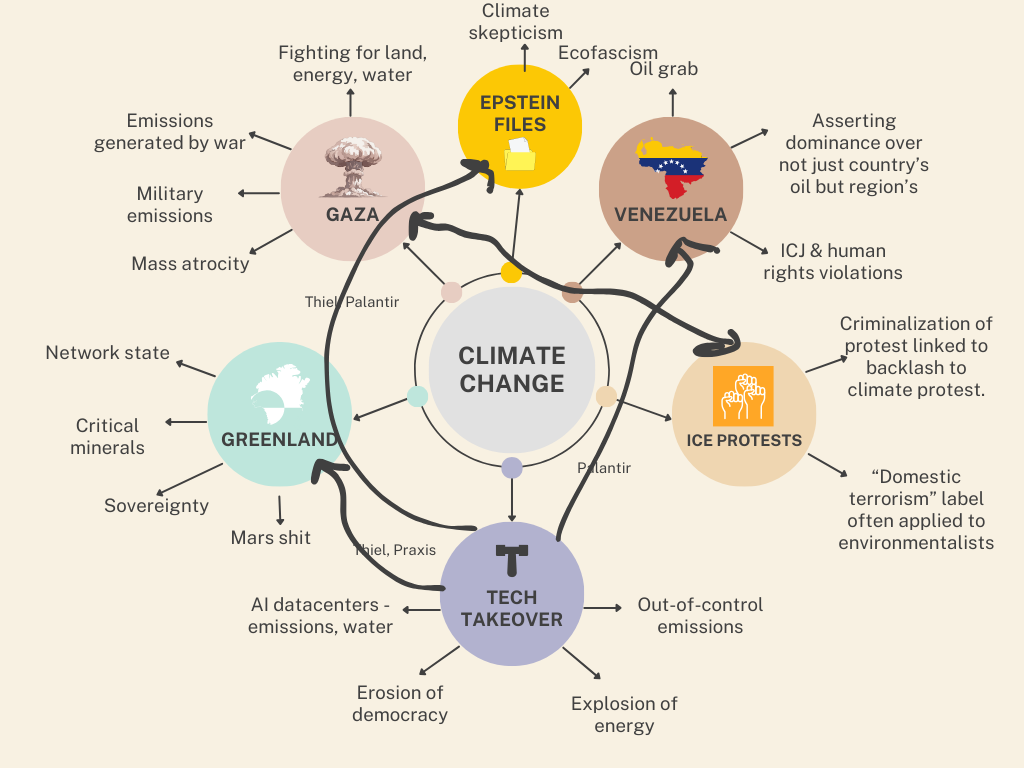
Of course, this rise in consciousness is derided by some as the ‘omnicause.’ But that derision is confined to a declining subset of legacy media. In reality, huge shifts are occurring beneath the surface.
Novara Media report that the Green Party is the most popular among all UK voters under the age of 65, new polling from YouGov shows. Writer Daniel Gerke notes: “We’re approaching the tipping point where older people’s higher propensity to vote is being cancelled out by there simply being far more under-65s in the electorate. There’s no going back after that.”
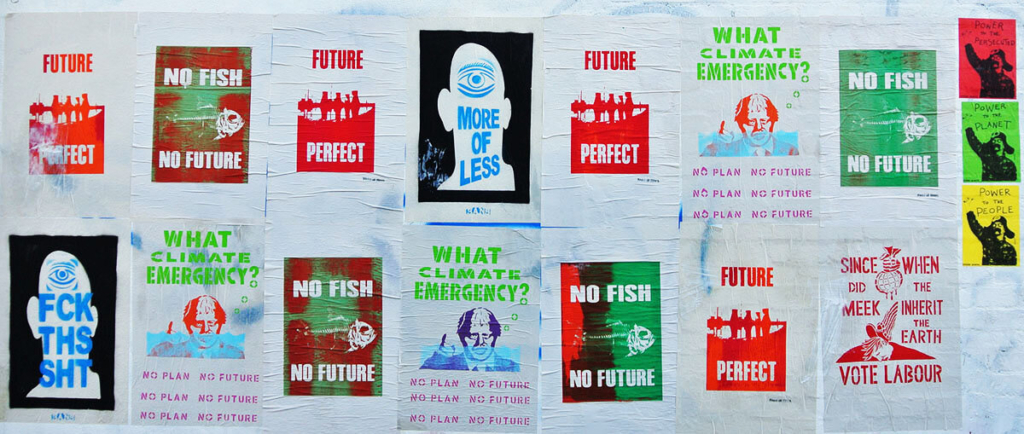
Subterranean shifts are happening despite, not because of our broken structures.
Shine On
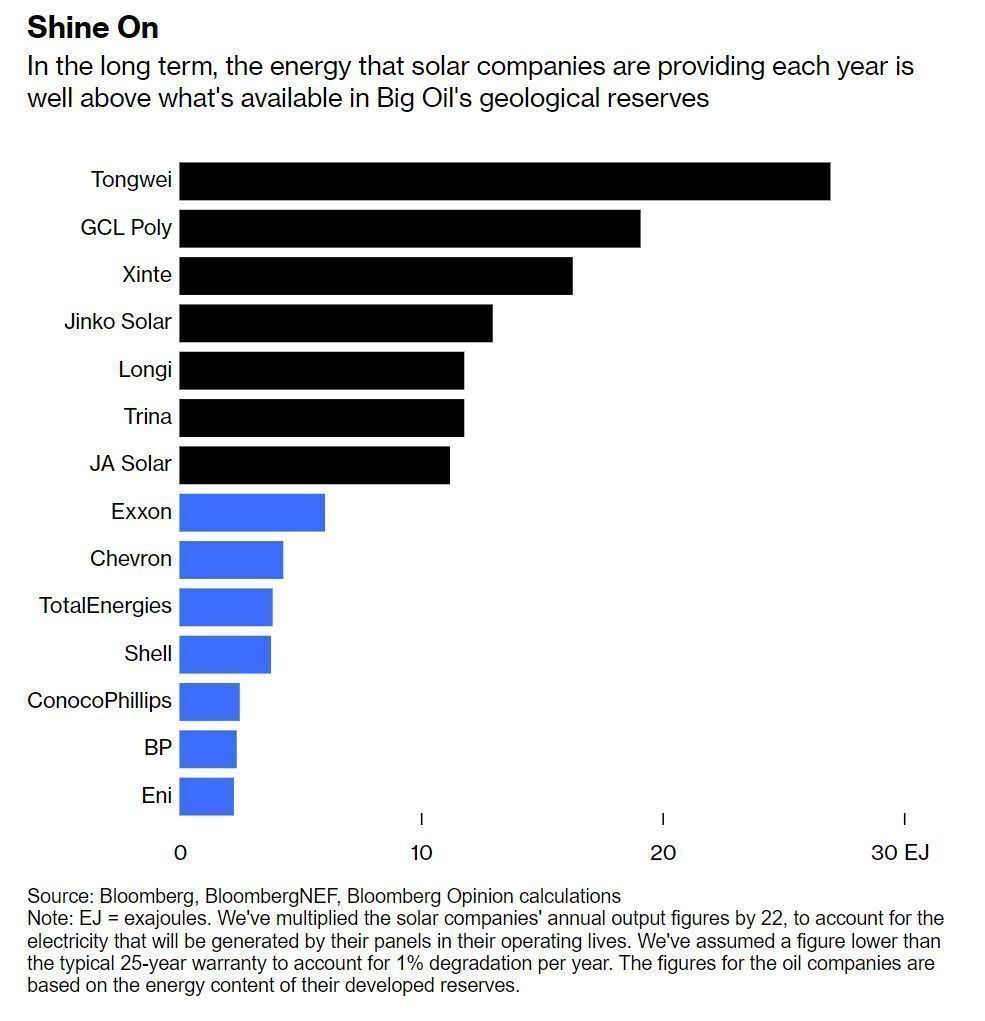
These shifts are technical, like the revelation that seven solar companies most people haven’t heard of, are ALREADY providing more energy for the global economy than Exxon, Chevron, Shell, and BP – and also anti-technical – like the massive backlash against AI that’s under way: “Open AI, the company behind ChatGTP is on track to lose $14 billion this year” – as people realise the relationship between AI, authoritarian rule and ecological catastrophe.
Economies of Place and Proximity
Some of these emerging forms seem prophetic. Here’s Polmaise, where “one energy era births another” from the Falling Thermal Minewater Energy Project:
“The village of Fallin, near Stirling is set to take a major step toward a sustainable future as the Fallin Thermal Minewater Energy Project announces it has secured a total of £150,000 in funding to explore the potential of heating the community using water from its abandoned coal mines”.
Others are more banal and pragmatic, like the recent legislation on Community Wealth Building. As Neil McInroy laid out here ‘Community Wealth Building and the Future of Scotland’s Economy‘:
“Climate breakdown is accelerating, the global economic order is shifting, and the geopolitical conditions that shaped the last seventy years are dissolving.
And these global pressures expose something closer to home—Scotland’s own long‑running vulnerability to extractive economic forces.
“For centuries, Scotland’s economy has been shaped by extraction of land, materials, labour, people, and resources. From the Highland Clearances, through North Sea Oil and Gas to mining, steel, and shipbuilding: the wealth created has been too readily dissipated or offshored.”
“The pattern is familiar: wealth is generated locally but extracted and captured elsewhere. And even today, as Scotland becomes a renewables powerhouse, profits and dividends from our energy boom risk once again leaving communities. This pattern must end.”
Every pound that leaks away is a pound lost for wages, for businesses, for skills and enterprise. The Scottish Parliament’s decision to pass Community Wealth Building (CWB) legislation represents a different approach which puts ownership, control, and local wealth circulation at the heart of our economic development.
“A key part of this shift is a return to place‑based economics in which we use what we have more effectively—our people, our scarce public resources, our land, institutions, and productive capacity. This is about improving productivity not only by growing sectors but by strengthening the systemic relationship between economic activity, place, and ownership.”
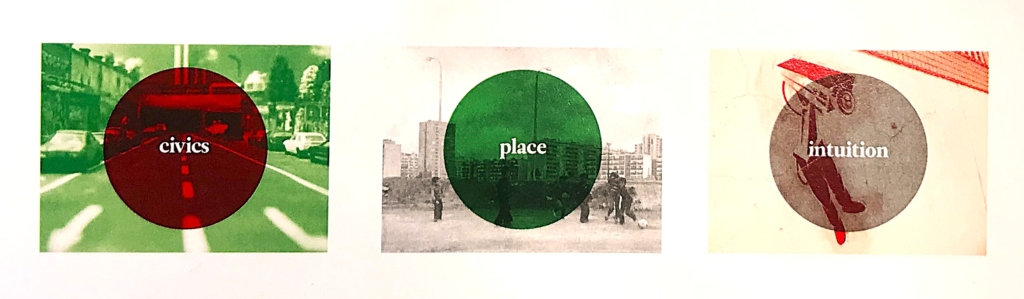
As Neil concludes: “The economies that prosper in the years ahead will be those who embrace economic democracy, build not just from outwith, but from within- through powerful and grounded circulation of wealth and investment. Scotland through CWB now has a platform to accelerate this transformation.”
The point is reiterated by Michael Roy [From Rust Belt experiments to Holyrood statute: how a ‘world’s first’ step could fuel a quiet revolution for local economies}:
“CLES (Centre for Local Economic Strategies ) codified Community Wealth Building into five ‘pillars’. Taken together, the goal could be considered simple, but it’s radical at heart: stop judging economic success by the volume of investment coming in. Instead, start judging it by how much wealth stays and circulates locally, under more democratic control.”
This idea of the return of ‘place’ as an organising principle is important in a world where everything is ‘displaced’ and outsourced from food to energy to labour – to the very idea of a future.
The idea of a sense of possibility will be resisted by those either in an ideological straightjacket or addicted to learned failure and reflexive impotence, or keen to deride literally anything as ‘hopium’.
The Oakeshott Paradox
If the US-Israeli war, or should it be the Israeli-US war, has exposed the extreme precarity of the global economy, it has also exposed the hypocrisy of the Dubai Influencer Set. Having emigrated to the paradise-based-on-slavery only to opine from a great distance about the terrible nature of the UK, such creatures like Isabel Oakeshott are now whining to be saved by the very British State they condemn. Isabel Oakeshott fled to Dubai, claiming that London was a warzone…only to end up in an actual warzone.
The paradox of ‘Brits’ fleeing a war-torn country only to demand safe return is astonishing. Isabel Oakeshott and her ilk are economic migrants living in Dubai, complaining about economic migrants in the UK.
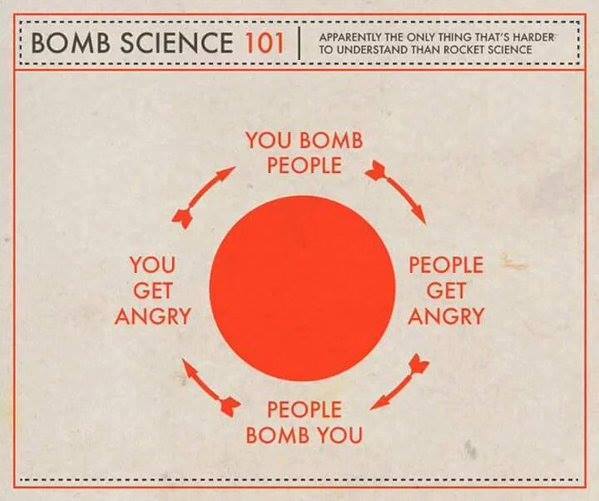
No doubt the far-right in Britain will be able to distinguish the merits of others fleeing the war-zone by the colour of their skin. But the scenario, though laced with schadenfreude underlines the basic instability of a world shaken by US state violence and the accelerating consequences of climate breakdown and the resultant displacement.
Democracy of Place and Proximity
In this global disorder, being tethered to Britain no longer has any coherent advantage. Britain, and its former European allies, are greatly diminished in geopolitics, being caught in the whirlwind of US-Israel-Russian aggression and imperialism. None of the mainstays of the idea of the Union hold anymore.
There was the idea that Britain was a multicultural country, that it was inherently progressive and pluralist. It’s an idea that has been exposed as a sham as the rise of Farage, Lowe and Robinson continues afloat a raging wave of far-right populism.
There’s the idea that, somehow, incredibly, being part of Britain offers some military security. Again, this now looks more ridiculous than ever, as a glance across the Holy Loch will tell you. There are reports that Starmer wanted to let the US use Diego Garcia to bomb Iran prior to initial strikes on Friday, but was only blocked by the Cabinet. Thankfully, his personal weakness prevented us being dragged into the current conflict. This is unlikely to last.
Thirdly was the idea of ‘broad shoulders’ – that being part of Britain offered long-term economic security. But now, as the long-awaited Labour government plummets in opinion polls, the idea of a socially progressive British polity is a joke.
Twelve years after the referendum, the British State and the state of Britain are indefensible.
The kind of economic strategies laid out by Neil McInroy and Michael Roy – see Community Wealth Building and the Future of Scotland’s Economy and From Rust Belt experiments to Holyrood statute: how a ‘world’s first’ step could fuel a quiet revolution for local economies – are admittedly only the start of the process to rebuild and re-imagine Scotland’s broken social-ecology. But the economics of place come with an impetus to renew, or rather salvage, democracy.
In Scottish terms, this means state-building from scratch and from a position of a public disillusioned with devolution and deeply cynical about politicians and politics, for very good reasons. And yet, improbably, polls suggest a pro-independence majority of 15, and some polls show the incumbent SNP getting an outright majority [A Catastrophic Collapse and a Holyrood Majority].
Some Unionist stalwarts are alarmed. Chris Deerin writes in the New Statesman that ‘Scottish independence is sneaking up on Westminster – the SNP are confident of calling and winning another referendum.’ This is almost certainly not true.
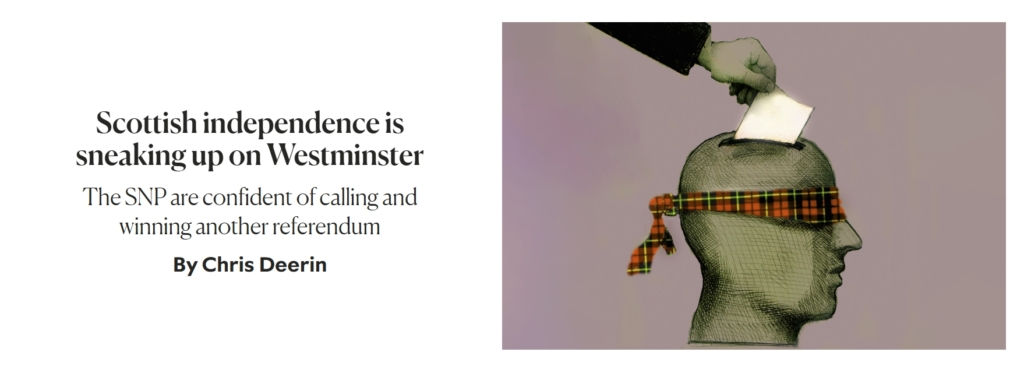
Deerin continues saying: “The consequences of John Swinney securing that overall majority could be seismic. It is the benchmark the First Minister has set for demanding a second independence referendum – and he has a point. It was after securing such a majority with 69 seats in 2011 that Alex Salmond sought and won the right to hold the first referendum, which resulted in a too-close-for-comfort 55-45 win for the union. Today, support for independence sits around 50 per cent. Again, it wouldn’t take much for that figure to tick higher. And you only have to win by one.”
He’s right about that. The idea of an outright majority for a single party was the benchmark set before, probably because the entire voting system is designed to make this nearly impossible to achieve, and Swinney himself set this as the aim, probably in the fervent hope it would never happen.
Interestingly, now that the challenge is looking possible, Unionist journalists are beginning to move the goalposts. In The Times Kenny Farquharson unpacks a new challenge, declaring that “An SNP majority in May won’t justify another independence push”.
Farquharson accepts that Swinney couldn’t have been any clearer at his autumn conference, saying: “We all face a choice. Decline, decay and despair with Westminster government, or hope, optimism and ambition with Scottish self-government. Now is the time for Scotland to become independent.”
But goes on to squirm that people voting for the SNP weren’t really voting for independence, or the chance to have a say in their future. No, for Farquharson, “An SNP majority in the next Holyrood parliament will be an accident of history.”
The language of a democratic event as being ‘sneaking up’ on Westminster and the desperation of attempts to move the goalposts and close down even the most unlikely scenarios in which a referendum might be granted are both pathetic and desperate.
The question remains: if this is a voluntary Union what is the mechanism to leave?
The fact that we are even in this position given the lack of coordinated leadership, the policy failure and the lack of strategy is, in itself incredible. So why is there so much panic in the Union Faithful? Possibly because they can see the Sarwar campaign bombing and they know that Starmer was the last chance to show a progressive Britain.
But also they know that, as journalist Neil Mackay has pointed out: “Of the 27 opinion polls since December 2024, Yes led 17 and No led 10. Supporting independence seems the settled majority view. If a referendum were held tomorrow, the No side would lose.”

We are supported only by our readers. We don't have corporate backers and we don't take advertising, so we rely entirely on your support.
Help to support independent Scottish journalism
“the British State and the state of Britain are indefensible.” Indeed. They always were. But now that is surely obvious to everyone. Who really thinks that Scotland is ‘Better Together’ as a colony of a fascist state run by organised crime?
I am reminded of the famous incident when the recruiting party visited Caithness at the start of the Crimean War (Crimea then being part of Russia). There was a flat refusal to sign up. “We have no country to fight for! You robbed us of our country and gave it to the sheep. Therefore, since you have preferred sheep to men, let sheep defend you!”
Plus ça change
Nice story! Kind of sums up where I am.
“Fight for your country”: What country?! It’s been sold; the energy, the land, democracy, the climate, our childrens’ future.
“There was the idea that Britain was a multicultural country, that it was inherently progressive and pluralist. It’s an idea that has been exposed as a sham…”
I disagree.
I reckon most of my fellow UK subjects are inherently tolerant, pluralist and multiculturalist. If only the likes of Farage, Tice, Tommeh and their billionaire backers would leave us all alone for a while and turn off their daily barrage of hate-inciting racist messaging. They’ve spent tens of millions trying to foment their race war and still the vast majority of us rub along perfectly well with each other.
The idea that multiculturalism is inherently tolerant is a joke. The Tories and Reform look pretty multicultural. People that preach tolerance as a religion tend to be very pale-skinned. Britain has a large population of Pakistani origin. Pakistan must be one of the most mysoginitic places in the World. There is a large population of Indian descent. India must be one of the most snobbish class-based places in the World. Those things are called cultures.
@Statan, why do you suppose that people who leave a country are representative of those who remain there?
I find Thucydides’ history of the Peloponnesian War very interesting in this respect. According to the author, exiles are not like those who stay behind (often belonging to distinct and rival factions, such as oligarchs versus democrats). And when Greek city states founded colonies in the expectation that these would continue the culture of the mother city, these colonies often became antagonistic towards their founders. Much the same could be said for Thirteen Colonies, although there was a greater population mix there.
https://en.wikipedia.org/wiki/Thirteen_Colonies
Within the British Empire, its settler colonists notoriously adopted different mores from those back home, and there was a culture clash when some of them returned in numbers. Although that possibly explains much of current British culture and foreign policy, as these returning settler colonists often gained considerable influence, partly through the systems of social cheating that lead to office and position. I think that would be a fruitful avenue for Bella to explore.
Well, Statan, are you claiming that tolerance is not a good thing? I am white, I believe in toerance not ‘as a religion’ but for its own sake, because I think it is of practical use in creating a safe and livable future. It has limits of course and it does not mean I accept abuse from others who don’t believe in tolerance. It means we have to listen to and try to understand each other. And if need be agree to differ. We can’t expect others with different views to tolerate us otherwise. Your comment suggests to me an endless war of all against all, each insisting that their view, their fear of the’other’ justifies blind hatred and whatever comes from that.
It’s ironic that the US and Israelis first act in attacking the supposedly mysoginistic Iranians was to massacre a school ful of young girls.
And it is simply disgusting hypocrisy for so-called right wing commentators to hold Muslims responsible for grooming and raping young girls after the Epstein revelations.
Motes and beams?
Another version of the goalposts being moved is along the lines of ‘A majority may want independence, but they don’t really want it that strongly’.