

Economic Security, and Security without Economics
Both the British and Scottish economies are struggling to produce economic growth, in spite of the proclaimed aspirations of both. In the predicament Britain finds itself in 2026 there are few upsides left to find. In the new geopolitics of America’s rediscovered but essentialist isolationism, which is less a bizarre passing phenomenon than a reminder of older, deeper United States themes; but themes Britain finds to difficult to contemplate. Britain is the worst affected politically and psychologically by the American recalibration, of all the NATO allies, because more than anyone in NATO, Britain’s convinced illusions in a false, complacent narrative have been most enduring, and most relied on by British Governments and commentariat for both security, and its geopolitical prospects.
In a world of competing economic blocs, of war-driven supply-chain crises of globalism; and specifically for Britain; which has an economy based on energy imports at international market prices, and possesses a catastrophic hole in its trade left by the post-Brexit fall-out, the IMF has now pronounced on this cocktail of toxic problems: “On 14 April 2026, the IMF published new forecasts for the world economy. The IMF forecast slower growth and higher inflation as a result of the conflict in the Middle East and the disruption to energy supply. The OECD lowered its forecast for UK GDP growth in 2026 from 1.3% to 0.8%. It also forecast UK inflation to average 3.2% in 2026.” (House of Commons Library). The IMF Forecast for the Eurozone GDP Growth is 1.1%.
The OECD has also given its verdict: “On 26 March 2026, the OECD published new forecasts for the world economy. The OECD raised its forecast for inflation around the world due to the conflict in the Middle East and the disruption to energy supply. The OECD lowered its forecast for UK GDP growth in 2026 from 1.2% to 0.7%. It also raised its forecast for UK inflation in 2026 from 2.5% to 4.0%” (House of Commons Library)
Deep in this darkest of self-created black-holes, nurtured by illusions nurtured for decades, and believed to be forever; in the middle of a cost-of-living crisis still not fixed, and with the tax burden on ordinary people unrelenting; the aspiration of growth, is still somehow to be created by entrepreneurs ex-nihilo. Since Britain couldn’t deliver any growth or investment in Britain in fourteen years, under a supposed growth-motivated Conservative Government, with interest rates long held at the lower bound, this is a problematic ambition (the Bank of England held interest rates at 0.5%, or below effectively from 2009-2022). Capital still didn’t invest in Britain. The task is clearly difficult, if not impossible (short of throwing the population to the wolves), unless there is an opportunity. And Britain is an opportunity deprived place; largely subject to Chinese, or American technology (often monoplies), and in the case of British business, too many are privatised monopolies that have failed disastrously, but are protected by TPTF political protocols.
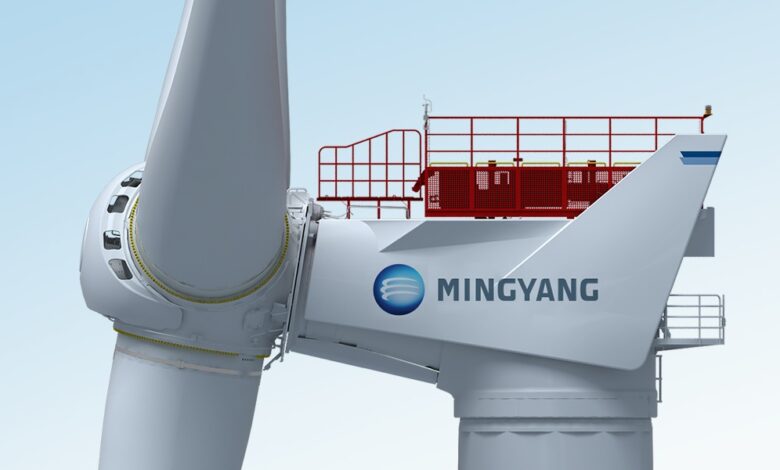
Scotland faces the same problem, but its bitter experience is notable for highlighting the nature of the underlying problem (Catch 22); which for Scotland is serious. The Case in point is the proposed £1.5Bn investment by the Chines Ming-Yang Corporation in a renewables turbine plant planned for Ardeseir (a brownfield site of the old oil boom). The investment was rejected by the British government on security grounds. There will always be a serious case for security scrutiny of major Chinese technology investments, because China is an extremely advanced country in digital networks, and the relationship between private capital and the State in China need scarcely be rehearsed (China has demonstrated how, uniquely the Chinese Communist State has been able to exploit the capacity and potential of capitalism to the full, and better than most). China has also become the leading developer of renewable technology in the world; it has no oil.
Chinese firm Ming Yang has been blocked by the UK Government from building what would have been the world’s largest wind turbine manufacturing facility in Scotland.
The British Government has not, however chosen to explain the specific reasons why Ming-Yang is uniquely dangerous to British security, save that it is an infrastructure threat. The Scottish Government has not, apparently been informed. The reason the security issue in Scotland is particularly important is twofold.
First, several major Chinese infrastructure or otherwise critical (to infrastructure) projects have been passed on security grounds elsewhere. They include a Chinese stake of around 27% in the vast Hinkley Point C Nuclear Plant (£48Bn cost estimate, and higher electricity prices to follow); Heathrow (with a £49Bn expansion plan, is 10% owned by China Investment Consortium). The Chinese Super-embassy has passed security checks, although it is located close to British digital infrastructure. Most solar panels in the UK are manufactured in China (perhaps 70%). A Hong-Kong based firm owns UK Power Networks, which runs electricity distribution networks in London, South-East, and East of England. The Beatrice offshore wind farm, Caithness is 25% owned by a Chinese state-owned company. The list is long.
It appears, speculatively the security services have decided Yang-Ming is a special threat, providing access both to British infrastructure and defence, and particularly (or presumably) through access to the Scottish Marine geology, bathymetry and hydrography. This may be true, but sits a little uncomfortably with the access given to China elsewhere, across the board. It is especially difficult for Scotland, when it impacts so directly on the development of the Scottish renewables sector.
Second, and worse, the project is rejected, but no alternative is offered. Scotland is under pressure to grow the economy, not least by the British Government and media, but it is actually under a countervailing British demand. Scotland is expected to exist primarily in a British context, as a passive platform protecting British security (from Faslane to the Shetlands), and simply eschew development and growth, for no return or reward; but simply to serve the interests of British security, and the greater good, which others are better placed to enjoy the rewards.
It will be argued that one project in Ardeseir doesn’t make a case. But this expectation, a passive Scotland that accepts the avoidance of economic growth for a British security purpose, is well established. In the 1980s, the Clyde estuary was established as having serious potential for oil development. For example, the Clyde Field is illustrative (‘Development of the Oil and Gas Resources’; Department of Energy, April 1985), which establishes acknowledgement that the production licenses had been picked up: “During 1984 five production licences were awarded for areas in the Firth of Clyde”, and elsewhere p.5).
Both BP and BNOC were interested in developing the potential, and a license was sought. The story can be found here, from which this is an extract: “A licence gives the holder exclusive rights to explore in an area for a certain period and BP held this licence for four years from 6th April 1984 until April 1988. During that time they collected the seismic data and analysed the results. We obtained some of that data, although it was previously thought to have been lost. We can confirm that there is a large structure there that would be a good target for exploration. Despite this when the licence period came to an end BP and Britoil relinquished the licence. No wells were ever drilled in the region and it is possible that the prospect was considered to be too high risk or too small to warrant a well, especially since gas is more likely than oil. Recently de-classified documents suggest that BP’s reasons for giving up on the area were not necessarily related to the geological risks of the project. The MOD who had two submarine bases in the region, Faslane and the American Holy Loch, were not keen to allow other activates in the region that might interfere with their clandestine activities. The prospect sits directly below the deepest part of the main navigation channel between Arran and the mainland” ( ‘Opinion: Potential on the Clyde’;‘Energy Voice’, 16th September, 2014).
It appears that it was only in 2014 that the relevant facts were “declassified”. It may well be that in every case an argument can be made to sacrifice economics for national security; but there comes a point that Scotland simply cannot grow, if there is always a British reason that Scotland’s economy must be sacrificed, and Scotland carries the burden of the nation’s security. And yet Scotland is expected to grow, nevertheless, whatever hidden trip-wires are thrown in its path, and delivered in secret. Let us be clear, there has been no provision made from elsewhere adequately to compensate for Scotland continually failing to benefit from the economic opportunities it is obliged to give up. In renewables, they are costing us dearly in many different ways.
There comes a point when it is time to ask; how much is Scotland expected to give up, how many opportunities discarded? For what? For whom? We simply cannot go on like this.
Timely article. Thanks. The cost of missed opportunity? Incalculable.
We are often told, when the issue of self-rule for Scotland comes up, how poor and unable to support itself Scotland is. We should be grateful for the broad shoulders of the UK carrying our poor, wee, disabled country through turbulent waters.
We are never asked to consider how come a country so rich and gifted in energy, land, natural resources, educated people, technical skills, benign climate, renewables potential etc still needs to be on life-support within a union that is supposedly doing us so much good?
What is it that is so uniquely disabling for Scotland compared to other small, Northern European developed countries of a similar size and geography?
Ourselves.
1st rate article Mr Warren. Not mentioned: the total failure of the UK state to force tech transfer wrt e.g. off-shore wind turbines to the UK – so it could have its own turbine industry. The Spanish state did this in the 1990s/2000s when it started to build out high-speed rail. The message to the French state/Alstom was: want orders? then tech transfer. Sadly the UK state is populated by imbeciles that lack such commercial? nous.
Kind of you, Mr Parr as an expert in electricity provision. Good to share a BTL thread with you again.
I take your point entirely on technical transfer; Britain thinks it’s too smart and sophisticated for manufacturing industry. They can rely on the City to turn everything into a rent instead; and ruin for everyone else.
You refer to the Clyde field as if it was actually sited in the Firth of Clyde. It is nothing of the kind.
In reality, the Clyde Field is slap bang in the middle of the North Sea on the other side of Great Britain from the Firth of Clyde.
Production from the field started in 1987, and it was still producing oil in 2021.
There may well be substantial hydrocarbon deposits ín the Firth, but it wouldn’t be classified as a North Sea field for obvious reasons.
Mr Lennox, you are correct. The file I picked up should have been “Development of the Oil and Gas Resources, April 1985” (Department of Energy), to establish public acknowledgement the production licenses had been picked up: “During 1984 five production licences were
awarded for areas in the Firth of Clyde”, and elsewhere (p.5). It is only one reference to the Firth of Clyde in ten references to Clyde production (North Sea Field). There are very few official acknowledgements of the licenses that can be sourced. Part of the search problem is that the information for so long appears to have been classified, as ‘Energy Insider’ suggests.
I hold my hand up, and do not excuse the inaccuracy; I had a plethora of files in my searches for the Clyde licences, and of course they included numerous picking up the Clyed North Sea field (I had to keep the search wide, in case I missed something). In the event, I simply copied and referenced the wrong file, and didn’t notice. I submit that it does not alter the case I made; the information I provided was the presentation of my independent sources, and is now corrected. Thanks for pointing it out.
The fact that this is so difficult, I submit is down to the secrecy of official sources at the time, and even subsequently. The official reluctance to be transparent leads to these difficulties.
Growth rates in the UK/Scotland are low but higher than Japan. Germany, France, Italy and Spain.
Of the G7 only the USA has a reasonable growth rate of 2%.
The reason?
Collapsing birth rates combined with ageing populations.
Demographics is destiny and the ‘developed world’ is in a death spiral with no way out.
Mr Learmonth, you are right about birthrates; Scotland is exceptionally low at 1.3 births per woman (replacement rate, 2.1). China, ironically has the same problem, but realizes this is a disaster, and is using tax and financial support to encourage larger families. In Britain e have a two-child cap, and a tax system that penalizes larger families; and just in case the Scots not slowly become extinct, our Government doesn’t care For the EU or immigrants either. I would say, however this thread is about renewable industry, growth, energy self-sufficiency, and as Mr Parr underscored, technical transfer.
Eh?
Spain grows per quarter what the UK grows in a year, and this has been so for the last four or five years, or longer..
.
They have also just regularized 800,000 non official immigrants, meaning that people born outwith Spain now make up 20% of the population…
That is a radical transformation of Spanish society, one which has taken place over the last 25 years…
On the downside, they have no diversity policies whatsoever in the world of culture…
I’m not sure what the figures are for Britain in terms of people born elsewhere, but, in any case, and notwithstanding the very nasty Vox Party, the Spanish far right, on aboout 15% of the vote, threre doesn’t seem to me to be the same hysterical headlines about immigration in Spain as in the UK, which arguably has the worst press in the world…
Basically, if you want to grow, you need immigration, and, no, immigrants don’t have to blend in perfectly with their new culture, what they must do is obey the law, just like the rest of us…
As for wind turbines, it’s important to remember that the Britain is basically an outsized casino, with finance, banking, the stock market, insurance etc all being given priority since Thatcher…
The people who run the UK dislike manufacturing per se, they see organized labour as a threat of course, and are committed to the ideological idea of Britain being a trading island first and foremost…
Why else would they allow Scotland’s only oil refinery to close?
It’s also worth mentioning that, when I was recently in Tenerife, and reading up a little about the Canary Islands, which are as far away from Madrid as Edinburgh is by plane, I was struck by how successfull their island are compared to ours…
As many as 3 million people live in the Canary Islands. Almsot one million in Tenerife.
They have, of course, a fully autonomous Canary Island government, so they can make decisions based on the ground…
Our islands seem to be in perpetual crisis. Housing is impossible for locals. There is a lack of infrastructure. No one in government seems to care much about Scotland’s islands…
And yet, they could be a vibrant and much more important part of our country and economy it seems to me, because, like the Canaries, they are beautiful places to live and work…
I’m afraid the big problem with the UK are the issues Tom Nairn identified. The British elite can’t think out the box, see any place except London as second best, refuse to decentralize or go for a higher taxation model with better public services… We’re stuck with this rancid way of doing things and the system is designed not to change…
Douglas – The fact that so many Scottish MP’s, including Labour one who told us they wanted to change so much of the system when they were young, end up sitting in the House of Lords in Westminster paying deference to the very same system validates Tom Nairn’s analysis .
All too true, John… And this lack of a modernizing spirit, of ambition, of vision for the country leads to monsters being born…
The immigration panic, for example, which has been largely created by the nauseating UK press, who have nothing else to talk about. Today, Libbie Brooks of the Guardian making sure Scotland is tarred as being just as anti-immigration as England…As if it were a good thing deep down… Shame on her…
According to Wiki, 76.80% of the UK population is British born… That’s the same figure as Spaniards born in Spain these days…
Yesterday, the Far Right Vox announced that, as part of their power-sharing agreement with the Conservative PP in the region of Extremadura, they would be prioritising Spaniards over immigrants in terms of social housing and other such considerations…
Presidente Sánchez immediately said that any such move would be taken to the courts by Spain’s central government…
But that wasn’t a surprise. What was a surprise was that the Conservative govt leader of the Madrid region also immediately came out and announced that such a move would be illegal and contrary to the Spanish Constitution, which of course it would be…
We don’t have a Constitution of course. We just have “the chaps” and their “British sense of fair play” etc etc to rely on…
We are about 80 years behind the rest of Europe and running into a huge crisis if Reform win in England…
Douglas – my observations from reading Guardian’s (online now) Scottish political correspondents over the last 40+ years.
Up until 2007 when Scotland returned big majority of Labour MP’s, there were Labour ministers from Scotland at Westminster and Labour were in power at Holyrood – Guardian correspondents highlighted the political and social differences in Scotland and held the more politically progressive Scotland up as a model for rest of UK.
Post 2014 – Labour wiped out in Scotland, SNP the dominant political party and Scotland voted ~2:1 against Brexit Guardian correspondents play down and minimise any political differences and use social attitudes surveys to determine we are really not different in Scotland.
I also liked the way Libby Brooks tries to infer that Reform support in Scotland comes from former Tories and ‘people that supported independence in 2014’. I believe this actually contradicts polling on where Reform support comes from which highlights a significant number of anti independence Labour supporters switching to Reform.
In short it is a politically motivated article trying to counter the Labour working with Reform on Scotland to beat SNP controversy.
I share your impressions of reading The Guardian on Scotland and its changing tone under Labour and the SNP (and remember fondly / not at all fondly Kevin McKenna writing off all Scottish indie supporters as frustrated bearded keyboard warriors, before effortlessly flipping onto the side of YES in time for 8/19 in true Uncle Kev style; he is so phoney he should run for Westminster).
I don’t really care what the Guardian thinks, but Reform shouldn’t be the big talking point given they haven’t even hit 20% in the polls and are basically picking up the collapsed Tory vote… It isn’t necessarily immigration driven…
No one in the London press seems to have noticed that Britain has become an ungovernable country more or less, a combination of rampant corruption, the strangling of internal party political democracy, serial incompetence across the English political and media elite, and a deeply toxic media environment have made a semblance of democratic government almost impossible…
The English / British elite have become the most stupid elite in Europe…
Scandal, slease, incompetence, dreadful decision making, and total cynicism are the order of the day and have been since Brexit more or less, a folly Starmer is now trying to undo without saying as much…
The Mandelson scandal shows Labour is rotten to the core… Who overrode the vetting is irrelevant…. in any case, it was almost certainly Morgan McSweeney who was running the show in the shadows behind that patsy Starmer, but he was just as incompetent as the rest of them, despite the English media never passing up a chance to tell us how smart he really was (if he was so smart, why didn’t he even last two years?)
How will it all end?
McKenna’s flip was spectacular.
The Guardian shift was noticeable. I was employed for years then completely ditched: https://www.theguardian.com/profile/mikesmall
Thanks Mike / Bella, I hadn’t realized you’d been kicked off the Guardian roster by the English jackboot on ideological grounds, that is, for writing of the Anschluss of 1938, sorry, I mean 1707…
They’d much rather have that good old Brit Nat establishment cheer leader Brooks, quoting the Reform candidate about immigrants getting HIV treatment for free which, “is not fair”…
Presumably, Brooks and Reform believe that non UK born citizens really shouldn’t entitled to live with AIDS in a manageable way and that, to all extents and purposes, they should be left to die…
Plus, a doctor can’t do that. They swear the hippocratic oath (at least in the movies) and are obliged to cure people if they can be so cured..
We need to close the private schools, all of them, we are run by an incestuous, in-bred cadre of ignorant toffs with no moral compass who don’t know their arse from their elbow…