
Irreversible Change
Since the start of 2026, YES has led or tied in 11 out of 15 major polls. Single polls can be outliers but when you begin to see multiple polls you get a direction of travel.
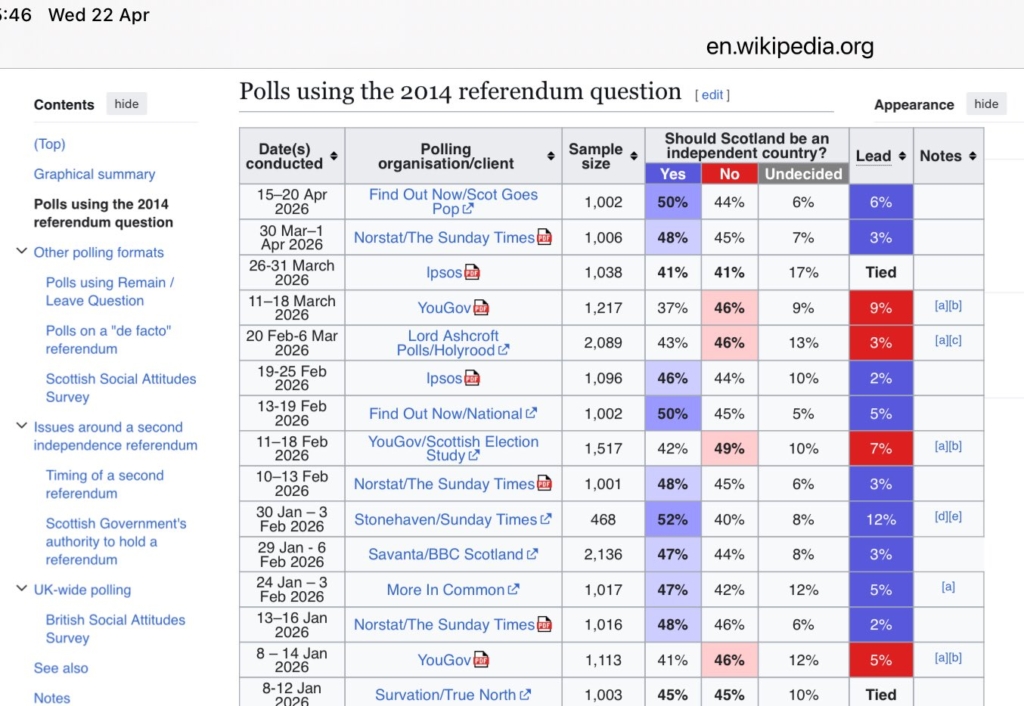
As the days count down until the Holyrood election, and the prospect of a huge pro-indy majority, the desperation of the Unionist bloc is becoming more and more apparent.
There’s three different responses to the constitutional crisis that’s unravelling across the ‘UK’.
The first is the Scare and Smear campaign. The second is to engage in Deep Denial. The third is to Flood the Zone.
Scare and Smear is simple. It’s tried and tested. Today the media used the fact that John Swinney said he would seek to work with Sinn Féin and Plaid Cymru to ‘change the dynamics’ of the United Kingdom to scaremonger Unionist voters.
The SNP leader said “the Union will be irreversibly changed” if SNP, Plaid Cymru and Sinn Féin are the largest parties after next month’s elections. That’s a statement of fact.
Scottish Tory deputy leader Rachael Hamilton said: “Pro-UK voters will be appalled and terrified at the prospect of John Swinney working in cahoots with Sinn Féin to break up the United Kingdom. This shows his and the SNP’s true colours — they will gladly team up with any party, in any corner of the UK, so long as they share his obsession with tearing it apart. That is why the prospect of an SNP majority, which Swinney reckons is in the bag, is so frightening.”
Reform UK’s Thomas Kerr said: “The people of Scotland will be absolutely appalled to hear John Swinney cosy up to terrorist sympathisers in Sinn Féin. They harbour ties to some of the most prolific murders and domestic terrorists our country has seen – Swinney is being clumsy at best, and stoking hatred at worst.”
It’s 2026.
Michelle O’Neill has been in office in Stormont since Sinn Féin’s victory in the 2022 elections and the restoration of the devolved government in 2024. All the right people are apoplectic but stirring up the Orange Vote won’t really help. They will still be confused as to which of the Better Together parties to vote for. The reality is that for the first time ever, three Celtic nations are converging in their bids for independence. Even The Economist this week noticed saying: “British politics has entered a centrifugal period. After the May elections, each devolved part of the United Kingdom will be run by a party seeking its abolition.”
This situation is deeply disturbing for the British Nationalists who realise three things: the rise of Reform UK is a grave danger to the idea of the Union; it’s untenable to retain the pretence of a Voluntary Union that has no means to escape; Labour’s failure means it will lose both Scotland and Wales. Taken together, these forces put Britain in jeopardy. They know it.
Raising the Sinn Féin bogeyman will play well in the heartlands but few voters in the real world will be swayed by such historical desperation.
Other versions of Scare and Smear are, of course, available. For this one to really work you’ve got to pretend that Reform UK is a legitimate political party, and forget that the Good Friday Agreement was signed in 1998.
Deep Denial is more fun. It’s a game played by the media and the politicians, sometimes interchangeably. It goes like this. Simultaneously, you’ve got to pretend that an electoral deal between Labour and Reform is an outrageous slander AND an inevitable truth. If you leave about half an hour between publishing these two different versions of reality, it’s normally just fine.
In the next round of Deep Denial you’ve got to pretend that a party that is projected to get around 18 seats at Holyrood would somehow form a government. It’s not so much wishful thinking as engaging in a online fantasy role-play to imagine Anas Sarwar arriving at Bute House in Lord Offord’s Jaguar with Jackie Baillie riding shotgun and Alex-Cole Hamilton in the back.
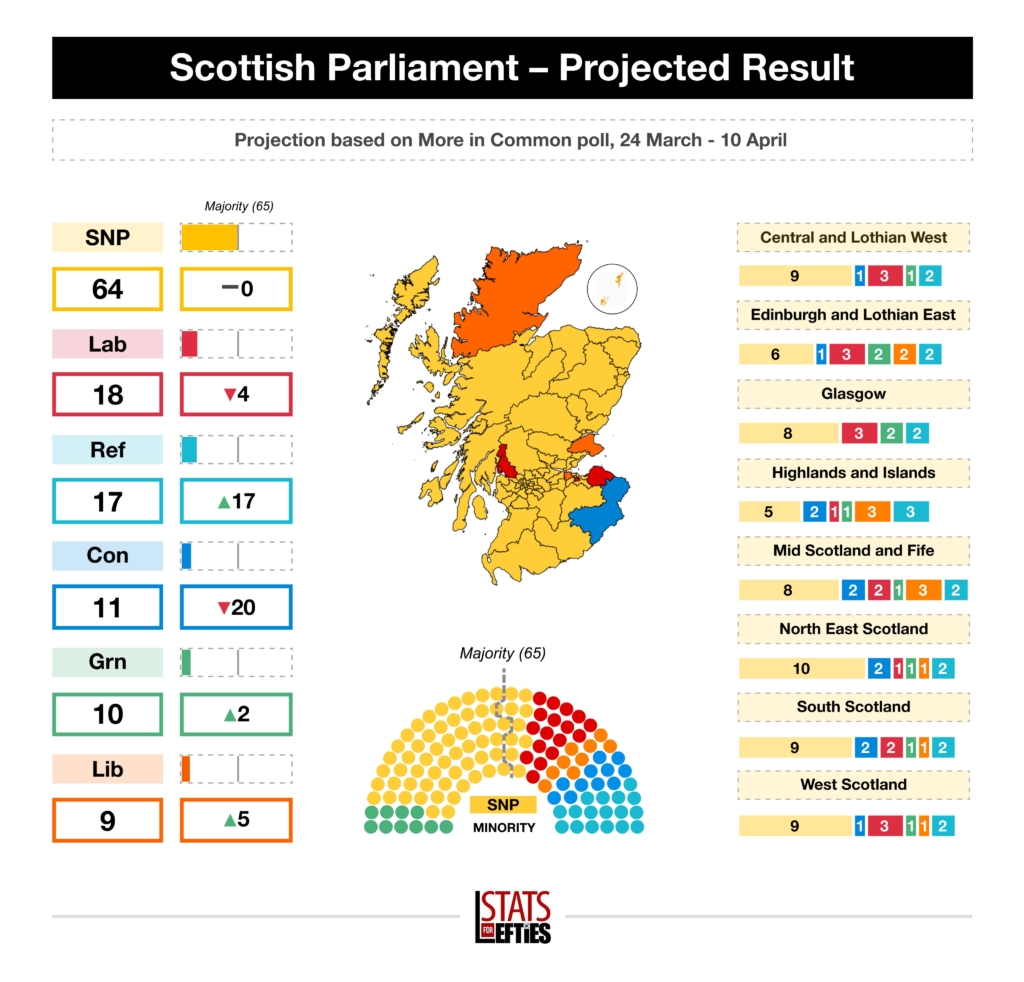
Deep Denial is also being used in therapeutic circles as an alternative to Elisabeth Kübler-Ross’s understanding of the process of grief. If we understand the Unionist parties in terms of Kübler-Ross’s five stages of grief for the Union – denial, anger, bargaining, depression and acceptance – we are definitely in the denial and anger phases (remember they are not in sequence).
The latest polling from Mark McGeoghegan shows the following:
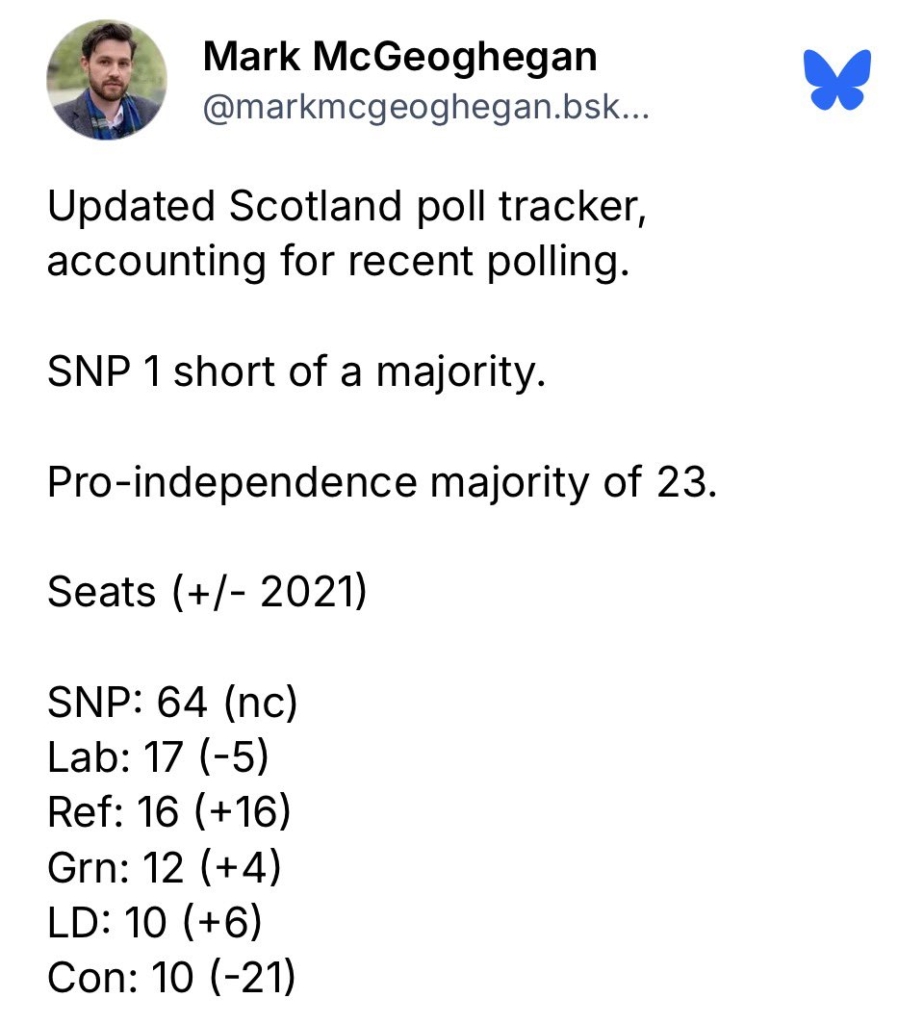
This means that even if you had the Grand Unionist Pact (which both definitely won’t happen, how dare you! and definitely will!) the numbers 17, 16, 10, 10 just don’t add up.
The last response to the constitutional crisis that’s quietly rolling out here is called Flood the Zone, invented by the wonderful Steve Bannon, here seen with recent convert to the cause Gorgeous George.

This ranges from the sort of hysterical ‘the breakup of Britain is imminent’ to the idea that independence is a wild pipedream.
Like the Deep Denial game it depends on simultaneously believing in two diametrically opposed statements. Not just that but projecting them into the public discourse without even blushing.
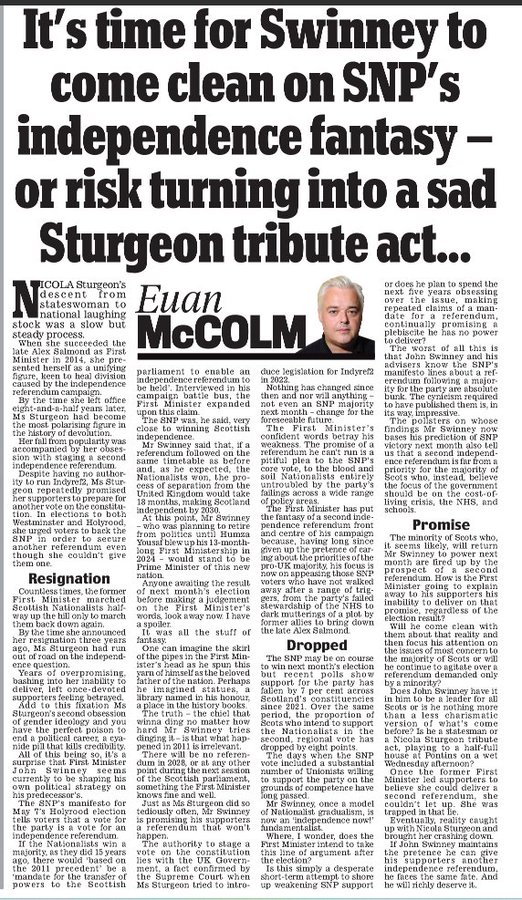
Flood the Zone also includes regurgitating the Alex Salmond conspiracy, a desperate tactic that unites the Alt-Nats, WingNuts, ex-Alba, er, frontrunners and the faithful scribes like Iain Macwhirter.
Unfortunately, like the Sinn Féin bogeyman, this plays well in social media silos and on late-night YouTube seances but has little cut-through with the actual electorate who either never believed the conspiracy or don’t care at all.
The Union is in peril and the tactics of Scare and Smear, Deep Denial and Flood the Zone are only hastening its demise.

We are supported only by our readers. We don't have corporate backers and we don't take advertising, so we rely entirely on your support.
Help to support independent Scottish journalism
“a huge pro-indy majority”
lets see.
Indeed, lets see, but that’s what the polling shows
I guess a question to be asked is if the SNP fall short and the greens provide the muscle for a pro indie majority where dose that leave honest John’s indie policy????
I suppose the issue here is that this is an election, not a referendum. Given the consistent support for independence despite there being no overt campaign, it is reasonable to consider that a referendum campaign that focuses on the issues will change some people’s minds. Being able to compare the reality of the Union since 2014 with the confident projections will mean quite a lot when Project Fear 2 kicks up a gear.
Yeah, I’ve wondered that too.
Association with terrorists seems to be Reform’s selling point:
https://www.declassifieduk.org/no-war-crimes-in-gaza-says-nigel-farages-israel-tsar/
But these poll numbers are terrible for Scottish Independence. What if, when we get Independence, there are similar levels of polling for returning to the Union? Ancient Athenian democratic self-curse, if I fail my promise, may I win by a single vote, etc. This is really weak support compared to many historical examples elsewhere (if you can trust polls, which…).
Set the bar to leave higher to avoid what the ancient Greeks called stasis (civil strife driven by polarised factionalism), and negotiate a smoother path (for starters, via a new British imperial/UK codified constitution that many people in England seem to want anyway). England isn’t likely to want up to three failed states on or near its borders, so there is scope for give and take.
But remember, ‘democracy’ may simply be suspended when we move into the permergency of polycrises where electoral activity may just cease, and the British imperial state will revert to royal prerogative rule, and the iron fist will emerge from the velvet glove.
Name a country that’s changed its mind re.Indy. Your prediction of the non celts turning nasty is all too obvious. Why would a United Ireland be a failed state?
@Hugh McShane, in what metaphorical sense would Scotland have made up its mind on the polling shown above? As for buyer’s remorse after a referendum, you could provide polling evidence about Brexit. A narrow ‘leave’ vote in Northern Ireland could be extremely destabilising, and it wouldn’t necessarily get to the ‘united Ireland’ stage before stasis set in. To tip towards failure, other crises are likely to play a role, and maybe local/regional variations in support (which tensions can occur in borderlands and peripheries and militarised localities). The point of having, say, a 2:1 electoral bar to pass is that you’ll get majorities across a wide enough range of demographics, geographies and strata so that general acceptance is far more likely, and schisms dampened. The Independence movement might be able to count on increasing support from a younger demographic, but the trend is by no means certain (support might just drop off as people age, for example).
If you can cite examples where successful separation occurred on a 52% vote in favour (the maximum that is quoted above, the lowest being 37%) then why haven’t you already? I repeat, these poll numbers are terrible indications if Scotland is to be plunged into Independence. And then of course, what if Unionists get 52+% as more problems emerge and doubts thicken (I doubt there will be many pleasant surprises in the first years of Independence, although events elsewhere may provide suggestive examples of worse fates).
You seem to be inventing numbers now “a 2:1 electoral bar to pass”.
“To tip towards failure, other crises are likely to play a role” – Why are you so filled with doom?
@Editor, you accuse me of ‘inventing numbers’ now? When I studied for my Political Science degree, my lecturers were serious people, we studied the works of serious authors, we had serious discussions and I wrote serious essays. In contrast, I find a lack of seriousness here. Most of the surveying and statistics I did came from Psychology lessons, where I learnt important caveats.
There was also a sense that these lecturers cared about the effects of the teachings they imparted (some students appeared more apathetic, but that might have been affectation) on society. A social conscience that at least made an effort to avoid Othering.
All our examples came before the recent technological and psychological exploits of the accelerating social media engineering we are grappling with today. Perhaps in some sense we have moved towards a more anonymised version of the face-to-face confrontations of participatory democracy of ancient Athens (no formal parties but some factions led by demagogues, reportedly).
Of course, the 2:1 ratio comes from basic group decision-making, the most elementary and organic majority that many non-human animal species can employ. Even then, as Minority Report reminds us, the two can be wrong, prediction-wise. Because the two-thirds rule is so commonly observed in political science, Wikipedia’s page on Supermajority tells us that the “‘Two-thirds rule’ redirects here.”:
https://en.wikipedia.org/wiki/Supermajority
As for all the ridiculous assertions that 52% constitutes the will of the majority for Independence, what happens when 52% vote to return to the Union? This is deeply unserious, deeply uncaring (frivolous and reckless, if you prefer) stuff. If your big thing is polls then study some political science (and related fields). Learn about ratchet effects and fuzzy logic, and about political psychology. Avoid the sense (surely a massive turn-off for voters) that you’re running a gigantic Romance Scam on the electorate, laced with poetry and promises of future happiness, with just a little request upfront.
There are also very good reasons to replace the UK/British imperial quasi-constitution with a codified one *before* Independence (no time to discuss those here). This will also be a useful dry run for the Scottish constitution and give time for more radical alternatives to develop and take root in the public imagination.
I’ll make a prediction here: raising the bar to 2:1 will have a significant positive effect on the numbers of people voting for Independence. Why? See seriousness and caring, but also people are more comfortable in those kinds of (real) majorities, and they won’t fear so much that their vote will tip their country into stasis (factional civil strife), nor that a re-run of the vote in a couple of years will reverse the decision.
No-one is arguing that 52% constitutes the will of the majority for Independence, but that if, as the article outlines since the start of 2026, YES has led or tied in 11 out of 15 major polls, there is clearly a situation in which at least half the country want constitutional change, yet there is no mechanism to do so. So what is it? And who decides an arbitrary figure we need to exceed?
Under the Good Friday Agreement, Northern Ireland can leave the United Kingdom only through the “principle of consent”—a majority of its people must vote for a united Ireland in a referendum (or “border poll”). If this happens, the British and Irish governments are legally obligated to implement that choice. Why is that a right for the people of Northern Ireland but not for the people of Scotland?
@Editor, I don’t know enough about the Good Friday Agreement to comment in detail, but unlike Scotland, the ratchet effect applies formally at least twice in the case of Northern Ireland, if you consider completing decolonisation (an international obligation under the UN, hence push as well as pull) a one-way arrow, and thenceforth potential reincorporation into the Republic of Ireland whereby the six provinces would lose secession rights.
As far as I know, not only did the Good Friday Agreement referendums pass the 2:1 threshold in both NI and Eire, and a majority of NI Protestants voted for it too:
https://en.wikipedia.org/wiki/Good_Friday_Agreement#Referendums
As I understand it, the Constitution of the Irish Republic says that a third of voters can veto a constitutional amendment referendum (essentially a form of 2:1).
There are some unsafe assumptions people have made about demographics and whether the rulers of the British Empire really care about retaining control of the province (a uranium discovery or oil strike might change minds, after all). But essentially there is much less concern there that a second vote could ever undo a first in favour of secession. What may be an option is, like elsewhere, running an Independence referendum three times in successive years, to provide evidence that there wasn’t a single ‘bounce’ but a detectable positive trend.
I’m not arguing for democracy as a solution to all political problems. After all, perfectly valid votes can lead to atrocities. America’s Use of Terror: From colonial times to the A-bomb by Stephen Huggins (2019) p138 “In April 1871, the Committee of Public Safety in Tucson voted to make an example of the unarmed Apache village at Camp Grant, Arizona. It took only half an hour for the civilian volunteers to kill, capture, or drive off every Apache in the village of five hundred. They sold twenty-nine surviving children into slavery in Mexico.” Democracy in action.
My concern is much more about the Health rather than the Will of polities and the living world they are part of. And that Health generally means avoiding stasis. And, of course, the ravaging effects of climate change, war, famine, pestilence, ecological degradation and destruction etc.
“I don’t know enough about the Good Friday Agreement to comment in detail” – no, obviously, but I do, and I asked you a specific question. Why do the people of Northern Ireland have a clear way to trigger a referendum and the people of Scotland do not?
You’ve gone from accusing me of being ‘unserious’ to suggesting “running an Independence referendum three times in successive years.”
@Editor, multi-round votes are more common in France. I’d have thought you might have been aware of this one:
https://en.wikipedia.org/wiki/2018_New_Caledonian_independence_referendum
I imagine that multi-round referendums might be become attractive to some states looking to minimise the impact of foreign interference, partly to make such interventions a little more costly, but much more likely because it will be easier to detect and expose such activities. There was suspicious (and potentially illegal) online activity in the days before the Brexit vote, for example, that only really came to light after the referendum had passed. I would have thought that, with your interest in dark money campaigns designed to undermine democratic decisions, you would be able to come to the same conclusion.
Although some states might manipulate multi-round votes to keep the status quo (or at least drag their feet), as France was accused of, they may add some legitimacy while allows preparation time and preventing a precipitous event (like the Partition of India, for example). They could even be offered as an alternative to a high bar (although, while multiple rounds address the issue of fluctuation to some degree, they don’t necessarily address the issue of a large oppositional minority).
Taking a step back in time, although I view military alliances as fundamentally undemocratic, in ancient Greece there were some peace treaties and alliances that were both voted for and time bound. So, in abstract, we have the idea of democratic renewal of participation (in a peace or an alliance).
Apply that principle, and we might imagine a case where every year or so, each member of a larger body like the British Empire or alliance like NATO might vote on whether to renew membership. I’d not make it the same time every year to avoid cyclical patterns, so in our thought experiment, say every 15 months. Now, for various reasons (like shirking unpopular military services or for inequitable investments or indeed events like foreign interference or mass bribery), a sudden ‘leave’ vote might be considered unfair. So a ‘leave’ vote sets a clock running. If two subsequent ‘leave’ votes occur, in 2.5 years from the first ‘leave’ vote, the decision has been made, and a planned separation occurs, else the clock/counter is reset.
As I said, I’m wearing my serious political science hat here, not making particular recommendations, but drawing on ideas and practices outside the narrow confines of the British imperial quasi-Constitution, which creates so many problems for political reform (small ‘r’). You know who else has an uncodified Constitution? Israel. Thanks for that, British imperialists.
Scotland was asked question in 2014 and made a a decision then. Polling since then indicates that the issue has not been decisively settled. Demographic polling also indicates that the issue will not go away despite the wishes of anti independence supporters. We don’t know the real will of electorate in 2026 re independence because the electorate have not been asked. Opponents of independence are frightened to ask the question because they fear the answer.
Re what indicates a mandate your argument doesn’t stack up. How can you argue for the status quo when majority vote for change – you are effectively disenfranchising the majority. The real success of 2014 independence referendum was the high engagement (85% turnout). Are you trying to tell me that if result in 2014 had been other way round that this wouldn’t have constituted a mandate for independence? To do so would have disenfranchised 2 million voters.
I get the argument that if you don’t vote in a change vs status quo referendum you are effectively showing you aren’t enthusiastic for change. You could also argue that if you don’t vote No you are not resistant to change. I would add that in any subsequent referendum that if Yes vote wins it would be surprising and disappointing if the total votes for independence were less than the total Yes vote in 2014. That may lead to questions about enthusiasm of electorate for independence but not about validity of result.
Sleeping Dog – if you look at polling on independence you are effectively arguing for a pensioner veto. This highlights how ridiculous your argument about different sections of electorate having a mandate on a constitutional issue is.
Support for Brexit was highest amongst the older generation and indeed by the time Brexit was passed into law in 2021 so many Brexit voters had died that there was no longer a Brexit majority amongst the 2016 voters. If this proves anything it is that older voters should consider whether they should vote on a constitutional referendum when they are very unlikely to live for many years with consequences of outcome of result. This is most relevant in cases where the older generation’s vote contradicts the wishes of younger people who will have to live for much longer with the consequences of the vote. Independence vote in Scotland is a prime example of this.
The number of pensioners in Scotland is about one in five, rising pretty rapidly, due to rise for decades, and nothing realistic is going to stop that. There is no sign that people will stop becoming more conservative as they age.
Billy – I. would say people generally become more resistant to changing their views as they get older which means they appear more conservative to younger people.
I would question how much this correlates to support for independence which for many people, on either side of debate, is a more fundamental question of democracy and identity.
Older people in Scotland lived during a period when the UK was socially more cohesive (nationalised industries, greater support for monarchy etc) when independence for Scotland was frankly a minority, fringe issue. Many older people still view independence through this lens. Younger people have lived in a Scotland with a parliament at Holyrood, Brexit being implemented against wishes of Scottish electorate, post nationalised industries and diminishing support for monarchy. In addition the 2014 referendum brought the concept of independence into mainstream and normalised it as a concept to much of the younger sections of the electorate.
From what I understand very few people that voted in 2014 referendum have switched their view- excepting possibly some minor switching both ways because of Brexit. The gradual drift upwards from 45% support to polling 50% plus can best be explained by the loss of older people more predisposed to vote No being replaced by younger people more predisposed to vote Yes .
Following your analogy of people becoming more resistant to independence as they grow older one would expect no change in overall polling are possibly even a drop in support, as the number of pensioners as a proportion of population is rising as baby boomer generation ages. I would suggest that evidence supports the view that older people are if anything more resistant to changing their minds on most issues, including independence, than any other section of society because in most cases they will have held their view for most of their life.
In short Billy if you are relying on people switching their views on independence just because they are growing older you are rather clutching at straws.
I agree with you that the pro-independence majority remains on a knife edge and although shifting slowly towards a steady majority it still cannot be said to be the fixed opinion of the Scottish people.
The federalist option has been on the table since the later quarter of the 19th century when Home Rule was an option in an Imperial context, including Canada, Australia, New Zealand and South Africa as well as Ireland. Ironically the Liberal Imperialists wrecked it. England is always the problem, despite the current enthusiasm for metropolitan mayors the English voters do not want regional states; even in Yorkshire they could not agree to unite. There is no wish for anything larger than counties and county boroughs. That makes for a very lopsided federal union and for England would create a massive democratic deficit if the Scots and Welsh had a veto. Independence for Northern Ireland means re-unification and exit from the British Union.
England has been a unitary state for much of its history going back perhaps to William I’s deliberate scattering of feofs. This contrasts with most European countries which had powerful regional, semi-autonomous rulers and strong local identities. No English regional assemblies only Quarterly Sessions of magistrates.
I think the main reason the English tend to be against regional states is the sense they will just become another layer of bureaucracy, pocket-lining, venality and minor-corruption whilst at the same time doing little for local democracy, public services and genuine autonomy.
I mean what if the suggestion was regional states in Scotland? It is big enough to have several along with several more in England, or are you imagining several in England, then add in Scotland as one ‘regional state’ (ditto Wales)? That makes no sense to me especially when you add in the fact that no matter how regionally proud some are, being a Geordie or Scouser is not the same as being a Scot, a different nationality, as the Scouser is still very much English, even if they think of themselves as Liverpudlian first. So the Scouser and Geordie are just as united in their allegiance to England as someone from Skye and someone from Glasgow is in their allegiance to Scotland.
Niemand – I worked and lived down south for a few years. It was pretty annoying to hear people equate being a Yorkshireman (for example) with being Scottish. I used to reply saying that geography determined they were a Yorkshireman and English just as I was a Fifer and Scottish.
Most of the people that equated English regions with Scotland had little knowledge Scotland as a whole and virtually no knowledge of the different regions and countries in Scotland. In short it is an attitude borne primarily out of ignorance with a dash of arrogance.
The idea that the electorate neither know nor care re. the Salmond fit-up is shameful.
Shameful to state it or that its true?
The only remotely interesting thing about the AS saga today is that the Unionists are seeking to use it against the SNP.
This may be true but justice and the truth should matter no matter political allegiance. The capacity of people to throw their morals and belief in justice (especially to Salmond’s family) out of the window when it suits them is depressing. It is now pretty clear a group of people were out to get Salmond, and were partially successful. It was corruption at a pretty high political level. How can anyone be comfortable with saying this is now ‘old news’? It quite possibly drove the man into his grave.
And let’s be plain – the reason people don’t care about any of that is they think Salmond was guilty of the crimes he was acquitted of and therefore deserved to be cast out and shamed, his record in the movement expunged, his name forever so much mud; his death was unfortunate, but whatever, he was yesterday’s man anyway, and a creep who got away with sexual crimes.
Indeed. If there was stitch-up – and there is troubling evidence that there was – the public should certainly be concerned. The evidence of criminality on Alex Salmond’s part was so weak and questionable that the case should never have been brought to trial. I believe that the jury got it right. That said, there was sufficient evidence of reprehensible bevaviour to make it inappropriate for Salmond to resume a prominent political role.
Whilst the average voter may be indifferent to the Salmond conspiracy notion, that is largely due to the lack of details in the public domain.
Should there be substance to it, our country will have been made to look tiny by the very folks advocating that it should be independent. That would be likely to play very very badly both within Scotland, and internationally – and would be weaponised with glee by a desperate British establishment.
‘Sir’ David Davis might not have a vote in Mays election, but he is very much on the case and ain’t no WingsNut ……
Sir David Davis? Brilliant.
I guess a question to be asked is if the SNP fall short and the greens provide the muscle for a pro indie majority where dose that leave honest John’s indie policy????
It leaves it where he want it … in the bin.
And where it should be.
A pro-indy majority is irrelevant. We’ve already got one. What we need is an SNP majority. That’s the unarguable mandate, a repetition of the once-in-a-generation result. Without that, Independence simply won’t happen, and we can grumble as much as we like. This will, of course, result in being part of a union which is about to fall to Reform. In 2014, Independence was the vaccine we foolishly refused. Now it’s the treatment we urgently need. Only an SNP majority has any hope at all of getting it for us.
“A pro-indy majority is irrelevant. We’ve already got one. What we need is an SNP majority. That’s the unarguable mandate, a repetition of the once-in-a-generation result.”
Westminster will argue.
In fact it has already on multiple occasions pre-emptively told Swinney and his SNP that under no circumstances would there be a referendum, most recently two weekends ago in the shape of Wes Streeting.
So both a “pro-indy majority” and an “SNP majority” is irrelevant … for as long as Swinney and other would be liberators continue to acknowledge a Westminster veto that totally undermines and compromises the sovereignty of the Scottish people.
PS
If there was a ” repetition of the once-in-a-generation result” then … it wouldn’t be a “once-in-a-generation result”.
Once a generation? There was no time limit on an independence referendum in the Edinburgh Agreement signed by Salmond and Cameron.
On the other hand a generation in Northern Ireland appears to be seven years.
“Once a generation?”
You’re asking the wrong person – look again
“As the days count down until the Holyrood election, and the prospect of a huge pro-indy majority”
The opinion polls actually point towards majority support for those expressing a view and likely to vote point to a majority in favour of British unionist parties. It is only (some) mappings from surveys to MSPs that indicate a significant parliamentary majority of SNP combined with Scottish Greens.
“Since the start of 2026, YES has led or tied in 11 out of 15 major polls. Single polls can be outliers but when you begin to see multiple polls you get a direction of travel.”
Actually, we have been here a number of times before since the Scottish Independence referendum of 2014. Boris Johnson as PM, Brexit (vote and actual EU withdrawal) and the pandemic to name but a few instances where there were prolonged periods of apparent majority support for independent statehood.
These upswings in YES sentiment didn’t last because successive SNP Scottish Governments failed harness the momentum and act. Until such time as they develop a plan and implement it this cyclical movement in YES support will continue to repeat itself.
hmm, hate tae say Scottish voters are stuck in a repetitive cycle where tactics at the ballot box are athing but am expectin the usual almost indy in May followd by reversal in the 2029 UK general election by which time these islands will likely be on a war footing aiding & abetting the Trumpy, hope am wrang but
I guess that gaining political independence based on a 51% referendum result would be a World first. Personally, I don’t think it is a viable basis for a new State. Must try much harder. With the current and long-running inertia, that wouldn’t be difficult.
Billy – a 51% vote in favour would be democratically acceptable to declare independence. I would agree that the bigger the majority in favour the more cohesive an independent country would be as was demonstrated with the 1997 devolution referendum. In addition the first few years post any independence vote in favour will be challenging and a large majority would be beneficial in navigating the years until an independent country is fully established.
I agree the independence movement needs to up its game in persuading the electorate of the advantages of independence and relevance to their day to day life. I would also add that the current economic uncertainties and Westminster’s ongoing refusal to even discuss the circumstances in which another referendum could be held are probably depressing support for independence.
I would add that the longer support for the union remains <50% and continues to drift lower the less tenable the current constitutional position appears.
@Billy, and if you cannot get a supermajority for Independence, what chance do we have to get one for a new Constitution, a more complicated and potentially vastly more differentiated choice? Given that political legitimacy will probably always be contested, anything like a 51% or 52% vote looks certain to trigger constitutional deadlock before we even have a Constitution. It’s fundamentally unserious and careless to claim such a vote is sufficient. And some people will simply refuse to accept that such a narrow victory was fairly obtained (which will be made more plausible every time actual illegal interventions are exposed, even if the cheating went mostly the other way).
Anyway, the United Nations constitutional primer recommendations suggest consensus, which is not realistic supposing the simple majority referendum model:
“Arriving at decisions through consensus is usually preferable to ensure that there are no ‘losers’ and all groups buy into the decision. Even super-majority voting may leave some small groups side-lined if their numbers are not enough to be material to the voting balance.”
https://peacemaker.un.org/sites/default/files/document/files/2023/06/05-rules-procedure0.pdf
Incidentally, the UN experts must be hallucinating the same numbers as me, ‘cos they say “supermajorities (usually two-thirds)”…
SD –
There is a template for an independence referendum called the Edinburgh Agreement which was internationally recognised. This is why the SNP are so keen to have another referendum that has Westminster agreement.
21st century Scotland is a mature democracy with laws in place to protect the rights of ethnic and religious minorities. There is a good argument to say that Westminster currently poses a bigger threat to these minorities rights. In the 2014 independence referendum analysis has shown that neither ethnic nor religious background were a significant determining factor in deciding how an individual would vote. The most significant factor between Yes and No voters was identified as home ownership. Are you suggesting home owners qualify as a threatened minority group?
In addition we have the GFA which identifies a minimum of 7 years between any referendum on reunification which should be used as a template for Scottish independence.
The outstanding issue is the fact that Westminster has sole power for deciding if a referendum should be held. The suspicion is that the more likely Scotland is to vote for independence the less likely Westminster is to agree to one. in any fair and equitable Union there would be an agreement on timeframe (eg GFA)between referendums Westminster & Holyrood with Holyrood (ie Scottish electorate) having power to be able to decide on whether to hold one or not.
Lastly on Constitutional matters there is a template from the work undertaken by Constitutional Convention where agreement was reached between civic groups representing a broad spectrum of society and the majority of political parties (Tories excepted) on many issues prior to 1997 referendum. With polling for independence regularly exceeding 50% and significant numbers of Labour & Lib Dem voters supporting independence it would be in everyone interests if another similar Constitutional Convention could be set up to at least start preparing for possibility of independence. The Westminster unionist parties are however, so opposed to independence, that they will not even talk about the concept of independence except using the need to block it as a way of garnering votes. They also lack so much faith in the current constitutional structure that they fear talking about independence will increase support for it. I hope this utterly negative attitude will change if/as support for independence rises.
If the lack of engagement in independence of political parties, media and vested interests continues and the majority of voters back independence at a referendum then more of these issues will require to be resolved post independence vote. This is obviously not ideal but circumstances and other parties lack of engagement may dictate .
SD – what you are advocating in 21st century is not protection of minority ethic or religious groups but a veto for vested minority interest groups.
While a large majority in any referendum is preferable and the type of widespread positive vote across regions in 1997 referendum would be ideal outcome it is not essential to meet democratic needs. Scotland is an internationally recognised country with a relatively cohesive society and even if there was a relatively narrow majority for independence I have little doubt the vast majority would accept result and be willing to work together to make an independent country function to its best ability.
@John, what do you think the future of democracy in the 21st century will be like? If the polycrisis unfolds as predicted, states of emergency will be declared and roll into one another (if nations and empires survive, that is). ‘Democracy’ will be suspended, probably indefinitely. Under the British imperial quasi-constitution, emergency powers will be granted to the royal prerogative (essentially variations on martial law).
“Although emergency scenarios have also been covered by statute, these have reserved the prerogative.”
https://researchbriefings.files.parliament.uk/documents/CBP-9877/CBP-9877.pdf
Commons Library Research Briefing, 1 August 2025
None of the conventional constitutional proposals I’ve seen for Scotland address this. They seem to be largely based on centuries-old traditions (admittedly that would be an abrupt modernisation of the British imperial model, but they belong in the past).
We have a closing window of opportunity to put in place radically different kinds of constitutions that address the new and forthcoming problem-scape: constitutions which have democratic legitimacy (because publics will have minds focused on them for a sustained burst) but are based on the needs of the living planet, on the primacy of Health in its broadest sense, rather than Will (the essence of democracy).
We also have a limited opportunity to push these radical constitutional options onto the agendas of international bodies, which might otherwise refuse membership to nations which adopt them. Obviously the benefits of partial autarkies and simplified/diverse/local/redundant/circular economies with fewer points of failure are highlighted by globally destabilising events.
Whether humans will do right by the living planet is another question. I started watching a series of lectures on literary censorship, which begun with a book banned in the USA: Dr Seuss’ The Lorax (read the book, ignore the movie based on it). We can certainly create a political constitution that speaks for the trees, birds, mammals, ecosystems and all, and treats capitalistic growth as the tumour it is.
#biocracynow
Sleeping Dog – I consider independence
as a step towards making Scotland a fairer, greener, more prosperous and democratic country than if we were to remain part of the UK and Westminster system.
Your response where you seem to be opposing independence unless it has a perfect constitution supported by the whole electorate exemplifies the phrase about making perfection the enemy of progress.
@John, most of the other successful Independence referendums I’m aware of achieved much more than the customary 2:1 bar, see again my comments on seriousness and care. I don’t have exact figures to hand, but this Guardian article from back in 2014:
“We’ve looked at about 50 independence votes since 1846, and the vote for independence has averaged 82.9%, and came out on top in 88% of the votes”
https://www.theguardian.com/news/datablog/2014/sep/16/when-given-the-chance-countries-tend-to-say-yes-to-independence
It will be a narrow vote in favour of Independence that will be most dangerous to the project. Another Guardian article today criticised the unpopularity of reactivating an armed struggle in Northern Ireland by pointing out that people there overwhelmingly voted for the Good Friday Agreement. We need an overwhelming majority for safety, and so we can attempt to establish a politically legitimate constitution (which is an issue for Wales too but not so much for the Irish question).
Elaine Scarry warns sensibly in Thinking in an Emergency that emergency clauses can destroy constitutions. Front-loading decision-making can bring reasonable deliberation into decisions that are later made under crisis conditions. We surely would want a constitutional brake on getting into another imperial war, and make sure everyone was designated for emergency protections.
Unfortunately, the SNP’s puerile interim constitutional proposal prefers to set the hereditary monarch of our neighbours (commander-in-chief of its armed forces, secret and security services and foreign/diplomatic services) as head of state for an Independent Scotland. Is that the 21st-century democracy you promise?
I’m not demanding a ‘perfect’ constitution, and I’m not in the position of Solon of Athens to impose one, but if we have dry run at codifying the British imperial/UK one (we would have common cause, not merely an uneasy alliance with many people living in England) we will be better able to choose a more radical one for Scotland when our time comes, if we’re all still around to do it. And who knows, the monarchy might go before the union.
Sleeping Dog – I repeat the question I asked earlier but you have not answered.
Simply put – if 2014 vote had been reversed and the Yes vote had been 55% and No vote 45% are you seriously trying to tell me that this was not a mandate?
@John, clearly it wasn’t a mandate because it never happened. If you look at the polls, which is some of a Bella obsession, then 55% presumably represents a high-water mark. So, what would have happened if, as I asked, two years after the referendum and there was a 55% poll for returning to the Union, would that be a mandate? And why pluck 55% instead of 51%, which would also have sufficed? Anyway, I have long argued for a high bar, which is simply normal for constitutional decisions.
What the SNP and Greens need to do is not demand a referendum on gaining a majority of Independence-supporting MSPs, but demand that the British Empire/UK adopts a properly-codified and democratically-legitimised political constitution.
Some crucial components of this (non-radical) constitution should include:
• new treason laws (currently it is felony treason to imagine depriving the hereditary monarch and heirs of territory, punishable by life in prison, which is hardly in the spirit of allowing Independence)
• release subjects from livelong official secrets oaths when they become independent citizens of new republics (among other needful revisions of official secrets)
• recognise the UN view of British decolonisation and complete the processes, including demilitarisation and the cessation of extractivist and navigation-right claims
• design and limit emergency clauses so that executive powers cannot simply declare states of emergency (including by imposing martial law), suspend democracy and rule without constitutional checks
• modernise the constitution’s ability to provide safeguards against modern modes of undermining democracy
• optionalise, remove or bring up to the level of international norms the various institutions and relations which control and bind the British Empire, so no royal prerogatives, transparency and accountability in government, no secret treaties, removing foreign and corporate captures, and
• developing smoothed-path, high-bar routes out of the union and empire for the various components including Scotland as a matter of right and subject to democratic renewal (no more opinion polls required).
Like some examples elsewhere, a synchronicity boost to Independence might add a few % points to leave votes, if say Wales and Northern Ireland and Scotland voted on the same day.
There is a common view that the Brexit referendum was only granted because of a split in the British ruling elite. There might have been another such split in the ruling elite which granted the Scottish Independence referendum, one faction hoping for a No vote, the other for a narrow Yes vote which would have fractured and punished Scotland for its impudence. I don’t know what the Latin for ‘be careful of what you wish for’ is, but I imagine many a glass might have been raised to the toast of ‘Caveat Emptor’.
SD – thankfully you are in a minority in your thinking on what constitutes a democratic mandate for independence in 21st century Scotland.
With all your preferences for what is required to establish an independent country I have only one piece of advice – declare independence for yourself and you can devise the ideal constitution and you will have a 100% majority in favour of it from an electorate of one.
I am however happy to take my chance with the wishes of the majority of my fellow countrymen. If they vote for independence, the constitution may not be perfect, in your eyes, but it will be bound to be a great improvement on the constitution of UK we currently live under.
All the best
John
@John, aside from your bizarrely-gendered formulation of “the wishes of the majority of my fellow countrymen”, a 55% vote on an 85% turnout does not constitute a majority of the electorate.
SD – last comment to you.
I am not sure whether you actually answered my rhetorical question on a 55% Yes vote but I will answer yours about a narrow Yes vote. The demographic polling on independence shows a much higher support in younger groups thus I would be more relaxed about a narrow Yes vote as indicating on going and future support for independence. This is in direct contrast to the Brexit vote where the more elderly demographic were in favour which has led to the current unsatisfactory situation of majority of voters polled preferring to rejoin EU.
Not one country that has become independent from UK has ever wished or tried to rejoin. In the highly unlikely event that Scotland was to be unique in this respect and wish to rejoin UK in future then a political party representing this view would need to win power in Holyrood on this prospectus, win a subsequent referendum on rejoining UK and then negotiate terms with Westminster.
Lastly having read all your objections to achieving independence via a simple majority in a referendum I have never read so many frankly obscure and tangential arguments. I think they would qualify as being described as a shoal of red herrings!
Cheers
John