
Scotland’s Wasted Decade after the Indyref
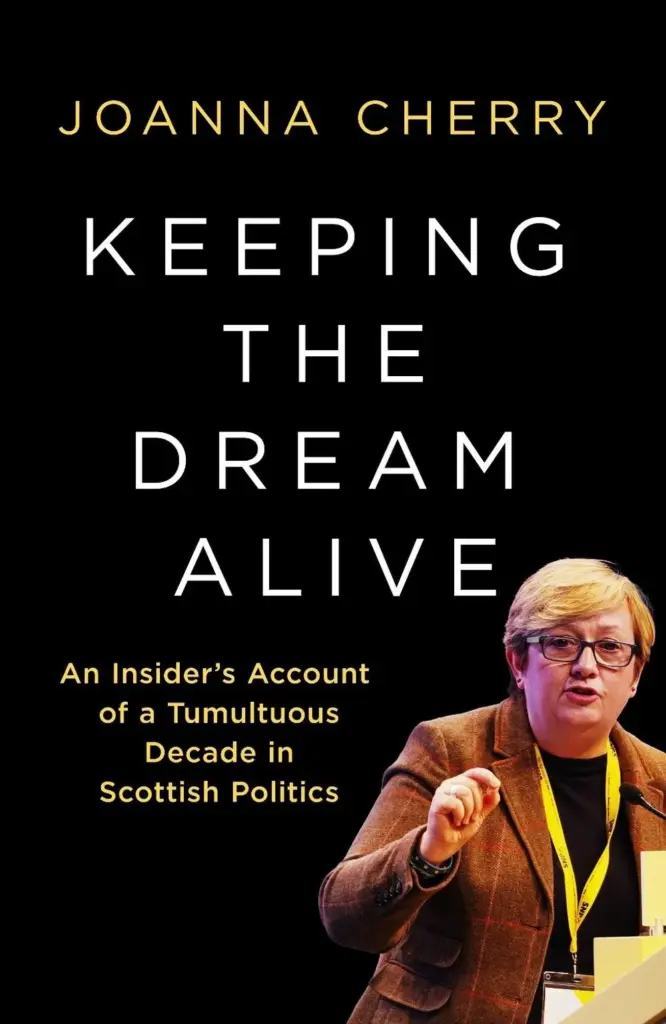
Keeping the Dream Alive: An Insider’s Account of a Tumultuous Decade in Scottish Politics, Joanna Cherry, Icon Books £20.
Reviewed by Jim Sillars
A spokesman for Nicola Sturgeon described Joanna Cherry’s book Keeping the Dream Alive as ‘a work of fiction – and not a very good one at that.’ That barb won’t stick. Fiction is invention, whereas in page after page Cherry, who has a prosecutorial background and an LLM in Law, provides, as one would expect from a KC, detailed footnote references to every one of the charges she makes against the former First Minister, the SNP Westminster group leadership of Ian Blackford, the party’s NEC, officials, and individual members of the party including MPs and MSPs.
The author tells us right at the start that she had ‘found it hard to write’ this book because what she found herself writing about ‘was fundamentally very upsetting.’ Those from within the independence movement and especially SNP members who still have the power of objectivity, will find it upsetting as they discover why the damage Nicola Sturgeon did to the SNP, and the idea of independence, outweighed any good she had done before she succeeded Alex Salmond as leader.
I am listed in the Acknowledgements as a political ally, and I have given her support whenever possible when she came under attack for standing up to proponents of trans rights. But Joanna and I take profoundly different positions on the aftermath action of the Brexit vote by her and other Remainers. She writes with a degree of pride of her involvement in the attempt to reverse the Brexit vote, still unaware of how disastrous it is to the democratic idea that you should seek to de-legitimise and over-turn a democratic decision of the people, because you did not like their decision. It did not trouble her as she engaged in the ploy for a second vote, that she was gifting a useful precedent to Scottish unionists who might lose a future close-result independence referendum. As one Labour member said to me at the timer ‘that one is now filed away for the future.’
And I think her pursuit of a Plan B, invested in a manipulation/interpretation of the 1998 Act, in the event of Westminster refusing a Section 30, shows a failure to understand the importance of power. In the famous 1953 case on the Queen’s insulting choice of title, Lord Cooper referring to the Statute of Westminster (when the Dominions countries required Westminster to acknowledge their independence) drew the ‘contrast between academic logic and political reality.’ What lay at the heart of that historic document was the power the Dominions then exercised, which could no longer be contested by the British government. No matter what the legalities may be, the day and hour the Scottish people manifest an unmistakeable power for independence, it will happen.
I thought it important to set out where I have real differences with Joanna so that people will understand that I did not come to read her book, or write this review afterwards, as an uncritical admirer.
Life at Westminster as an SNP MP
What I do find admirable in Cherry is the moral courage as evidenced in this book, and I do have every sympathy for her isolated situation at Westminster, subject to spurious accusations and investigations, attempts get her expelled, the target of real rape and death threats, and how Nicola Sturgeon the self-proclaimed ‘first feminist’ did nothing to stop the viciousness she suffered from within the party.
Joanna Cherry comes out of this book as someone whose priorities are to retain and defend the hard won right of lesbians to be recognised as women who love women; a fact that impels her to contest the opposite as adumbrated by what many see as ‘trans ideology’; a lawyer’s concern with the protection law must give to individuals; a searing sense of the injustice visited upon Alex Salmond; and a desire so see Scotland become independent.
She comes out of this book more lawyer than politician. The lawyer, used in her professional life to calm dispute with colleagues without rancour, where she was highly respected for her integrity and ability, was bewildered and deeply hurt when viciously attacked for her principled views on the trans issue by SNP MPs, who were also motivated by a good measure of jealousy as she commanded the respect across the House of Commons in her role as Justice spokesperson, and the publicity it brought her. The old saw in the House of Commons that your opponents are those on the other side of the chamber, while your enemies are around you, applied in spades in her case.
It wasn’t because Joanna was a QC that made her stand out from the SNP group, always listened to with respect, and was welcomed into the all-party organisations concerned with human rights, it was the ability with which she handled her brief and her thoughtful, often penetrating, interventions on wider issues. Her high-level performance also meant that she would attract media coverage – to the discomfort of others who thought they were not getting the attention they deserved.
Although a lawyer first she did not lack political instincts, and while her admiration for Alex Salmond was genuine she confesses to feeling ‘uneasy at the total adoration’ of him she witnessed at the 2011 SNP conference. She notes, as ‘the cult of personality’ developed around him that ‘he could have read out the local phone directory rather than give a speech and the audience would have swooned and clapped like seals.’ And she was aware, as her Westminster colleagues seemingly were not, that their fate in subsequent elections would hang on what the Scottish electorate thought of the Scottish government rather than anything they said or did in London.
That was something I tried to persuade Ian Blackford of when he became leader. The SNP group I told him, would be judged by the policy performance of the government at Holyrood, and suggested he form a small sub-group which would meet the Scottish Cabinet at least every two weeks to discuss policy, and so have an input to the issues that would determine what would happen to them at the nest election. I also advised that to advance independence he should rotate his group, sending half north to campaign for a month, then return them to Westminster while he sent the other half on the campaign trail. He thought it a good idea, but it never happened.
And so, it came to pass. In the elections that followed, Westminster MPs were not judged by their constituents on their individual worth, but became electoral scapegoats for the failures of the Scottish government at Holyrood, the calamitous adventure to bring down Alex Salmond (well documented in the book), and the scandals that emerged from the way the party was run.
This is an illuminating book for those in the independence movement to read and learn lessons from – as well as SNP members about what went on in their party. While a good part of it would appear to be mainly about the appalling harassment, bullying, smearing, vicious campaign against Joanna during the Sturgeon era when the cult of personality was taken to a level Salmond never contemplated; when the party was controlled by a politburo of two – Sturgeon and her enforcer husband – it delivers insight into how ‘the spirit of the Yes campaign was crushed’; and how it was taken for a ride on a roundabout of promised referendum that was never on.
The astonishing revelation by Cherry of just how the trans rights agenda captured the SNP leadership, the 2015 Westminster group, the MSP group, the NEC, and some party members, goes some way to explaining why the movement, in terms of gathering support for independence, got very little out of the large numbers of MPs (56) who were sent to Westminster in 2015. If her colleagues had spent more time on policy development on what really matters to most people – analysis of Scotland’s economic tie-down with its subservience to the Treasury and the Bank of England, housing, education, the NHS – we would not have the fractured and listless movement of today. But they spent little time and resources on such matters of substance and were prevented doing so by the Sturgeon leadership’s culture of control.
The SNP’s Wasted Decade Post-2014
In the decade of Westminster parliaments from 2015-24 the SNP group had around £1.2 million per year in Short money – which amounted to a staggering figure of over £11 million overall – to aid them in their parliamentary work, with a large research team financed by it. They also had on hand the House of Commons Library, a superb research facility. But as becomes clear in what the book describes correctly was a ‘Tumultuous Decade in Scottish Politics’ that group had no independent character. It took its orders from Nicola Sturgeon. Events have proved that the cult of personality brought inevitable disasters. Let that lesson be learned for the future: all our political Gods have feet of clay.
As I concluded in the recently published The New Case for Optimism: ‘If the independence movement is to win, then we need to face facts that cannot be avoided.’ Many who support the SNP and/or independence have for understandable reasons for too long being encouraged by the party leadership to not face up to inconvenient facts or embrace debate, discussion and pluralism about Scotland’s future and independence.
The SNP in the Sturgeon era became a party which not only disrespected and bypassed its own members, it damaged democracy and the Scottish body politic, while ultimately not progressing the cause of independence and consciously refused to engage in the serious work which needs to be undertaken.
Scotland has had a wasted decade politically post-2014. The damage done to the SNP, democracy and independence has to be recognised if it is to be corrected and put right. It cannot as the current SNP leadership insist just be ignored or wished away as if the past decade never happened. The governance of the SNP, the Scottish Parliament and public institutions has been diminished and damaged.
Difficult questions about the nature of our politics and quality of our elected representatives need to be asked. Joanna Cherry’s book is a contribution to understanding what went wrong and while it will be difficult reading for many, it is an important book which can contribute to making sure such problematic politics never happens again.

We are supported only by our readers. We don't have corporate backers and we don't take advertising, so we rely entirely on your support.
Help to support independent Scottish journalism
This isn’t a review, it’s just an uncritical summary of Cherry’s account, with no scrutiny or analysis. Like Cherry, Sillars has an axe to grind with the SNP, and he’s bought into her transphobia and the absurd notion that “sleepy cuddles” Salmond was the innocent victim of a conspiracy.
It would be great to read an objective account of the SNP machine, but this ain’t it.
Well done, Jim, you’ve got your wee insular fantasy come true by Nigel Farage… I resent it, I resent people like you, who have left us high in dry, one and half million Uk citizens in Europe whose rights you succeeded in stripping away…you have seriously fck up my life, don’t think we’ll forget…
As for trans rights, you people are just a never-ending national embarrassment…
Trans people exist in all societies, in all cultures, in some cultures they are far more prominent than in the West.
So what do we do with them? If we’re a democratic society, we can’t just brush them under the carpet and say, “well, that’s your problem”.
That’s not a reasonable answer if you believe in a democratic society with equal rights for all…
Come on Johanna, you have a lawyer’s brain, instead of just tearing down their rights, and with your knowledge of universal rights, what is your answer?
There are several trans folk in my neighbourhood in Madrid. No one gives a FF. They’re part of the community.
Not like you people, you Scots, with your warped mentality, always seeing ulterior motives in people…
A national fckn embarrassment…
The squarest most churchy and backward country in Europe…
Can we have some modernity please, someone, anyone?
Modenrity? Modern buildings? Art galleries? Trains? Airports like they do in Europe?
I hold my breath as the SNP prepare to take us into the 20th century, yeah, we’re a century behind Europe roughly…
What would we do without the ramblings of uncle Jim eh?
An EMBARRASSMENT…
No, seriously, let’s hear it from Jim, what did he get out of Brexit?
Immigration in the UK has gone up, partly because the UK is no longer part of the EU Dublin Accords, which allowed for “illegal” immigrants to be shared out between the 27 member States…
Nationalisation? That was always the argument from the Left against the EU, you couldn’t 100% nationalise companies, you could take up to 50% as the State…
Is that what happened at Grangemouth and I missed it?
Did the Scot Gov step in and say, “you know what, we’re going to take 100% of Grangemouth, we need to save it…”
Did it happen and I missed it?
It didn’t happen…
As for the results of Brexit for us in Europe.
Divorce. Marital breakdown. Families divided. Stress. Paperwork. Resenment (a real problem to deal with). Mental health problems..
A serious obstacle to your life plans….
And for what Sillars? For what, man?
I think I know the answer. They wanted to punish people like me… people who have forged identities outside of Scotland… a klind of control…
He’s a seriously pathetic man, I mean that…
The problem is with Scotland that the people who run the country are small town folks with no clue about the rest of the world….
They graduate, they may do a wee bit of work in the law or whta not, then they join the party of their choice and start lecturing us….
I graduated from Glasgow Uni in 92. It was great experience to live in Glasgow for 5 year, I love Glasgow(I took a year out and went to Barcelona, which is when it all started for me, the Spain thing / obsession )but all those pals of mine went to Barna in the early nineties: Ann, Emma, Gordon, there was a whole Scottish crew who went to Barcelona. I didn’t want that. I wanted to go to Madrid. But the point is, we lot, and I miss not being in touch with them, know what a modern European city is like, whereas J Sillars simply doesn’t. He has no clue (Cherry neither)..
In my neighbourhood in Madrid, on a Sunday, the calle Calatrava, just around the corner, is a meeting point for queer folk. Queer is the word. You don’t really know if somone is gay, straight, bi, trans, you wouldn’t be rude – or dumb – enough to ask… they just live a different life in that sense from the rest of us. It’s not my scene, it’s just that it happens every week in my neighbourhood and I know some of the bar folk (which become regular bars for the rest of the week)…
It’s the same in Barcelona or Berlin or Paris, there are areas where queer folk hang out.
The idea, the mere notion, that some of these people – always a few trans folk – are actually plotting to rape women in public bathrooms is an idea so bizarre as to be unspeakable. If you even mentioned something like that, they’d take you for a nutjob…
And that’s what the anti-trans lobby are in Scotland IMO, a bunch of total uptight, square nutjobs with zero life experience…
Working class Spain, “la España cañi”…. it’s absolutely unbelieveable the people you meet…
When you’re a Scot and you move to the south of Europe, it takes you a few years to thaw out and get it, that is, aye, no one gives a shit how I look or dress or walk or talk or whether I’m gay or straight or spend my Saturdays watching the BBC Scottish Football Newsfeed…
Sillars can go off home to his house and retire, we need new blood in Scotland… that’s obvious…
If you can understand these lyrics, you’re as good as a Spaniard (like me)
Joder macho, cómo te lo montas
Con más rabo que la pantera rosa
Tengo cardíacos a toda la pasma
Al Jaro nunca nadie lo achanta
Liar a muchos pibes, llamar a to’a la vasca
Buscar al marqués y arreglarle la tasca
Pillar a Mari Trini y le damos la revancha
Por ti, guapa, me hago una farmacia
La madre que parió a la democracia
Chulo putas, le rajo to’a la cara
El gil, las J’Hayber, la chusta y la navaja
El paro la loca para salir de najas
Rumba Tres, no te quedan lágrimas
Eloy de la Iglesia me prestó su cámara
Pepe Risi tocaba la guitarra
Y El Pirri me dijo que hiciera la macarra
Ponte Las Grecas, el Jarfa o el Coleta
Venga, a ver si te buscas una musiquilla guapa, ¿no colega?
Ponte Las Grecas, el Jarfa o el Coleta
Venga, a ver si te buscas una musiquilla guapa, ¿no colega?
Tres putas en cada esquina
Tres pastillitas en cada litrona
Tres zetas en cine Luna
Tres niñatos en un coche de alta gama
Familia rota, puta heroína
Campo de la bota, barrio de La Mina
El butano petando cabinas
Yo no sé cantar y en Madrid no hay gallinas
Puto taleguero (Sí), navajeros
El pirri, el Coleta, el Jarfa, el Jaro
Con la recortá’ y el cuchillo jamonero
Ventas y tirones, bugas marroneros
Vuelan botellas, mesas, sillas
Vieja escuela, Tetuán, La Ventilla
Con 12 años en coche patrulla
Madrid morralla, hay que darla tralla
Ponte Las Grecas, el Jarfa o el Coleta
Venga, a ver si te buscas una musiquilla guapa, ¿no colega?
Ponte Las Grecas, el Jarfa o el Coleta
Venga, a ver si te buscas una musiquilla guapa, ¿no colega?
Ya es hora que nos hablemos claro y de frente
No queda ya entre nosotros ni compasión
Tus cosas me dejan seco e indiferente
Tus besos ya no me dan frío ni calor
Y no te quedan lágrimas, y no te quedan lágrimas
Y no te quedan lágrimas que ablanden mi corazón
Y no te quedan lágrimas, y no te quedan lágrimas
Y no te quedan lágrimas, me marcho, queda con Dios
que tremendo, Madrid is fckn tremendous…
Seriously, we’re to be governed by folks like cherry and sillers?
@Douglas, hasn’t Spain been particularly backward in addressing the crimes of the Catholic Church there?
“A 2023 study by the Spanish ombudsman’s office, which investigates public complaints, estimated that 1.1% of the population had suffered sexual abuse at the hands of members of the clergy or individuals linked to the Church – the equivalent of 440,000 people.”
https://www.bbc.co.uk/news/articles/c78e99pzr25o
while the country seems not to have fully come to terms with its fascist dictatorship past, and as for their royals…
It seems like a country in state of denial. And you say you fit right in.
Hi Sleeping
You never miss a chance to stick in the knife and, quite frankly, I find you to be a rude person…
Spain is still a deeply divided country. Progresssive Spain is very progressive and reactionary Spain is deeply reactionary…
The current government has agreed with the catholuc church, with the mediation of the Vatican, to a compensation scheme for those sexually abused by catholic priests…
It’s token stuff, no one has been charged, but I supose it’s better than nothing…
The Catholic Church is an outrage, an offense to humanity IMO…
@Douglas, gadfly and midwife, it’s my training. I’m not here to make friends. But thanks for your reply.
So, would you agree that a social group or culture can be both reactionary and queer? If Herodotus is correct that the open-minded Persians learned pederasty from the Greeks, was that progress? And aside from the basic patriarchy of priests enslaving nuns for sex, piercing its hypocrisy: isn’t the homosocial Catholic Church significantly queerer than the general population? And extrapolating backwards the abuses against children were likely endemic and a major driver of violent anti-clericalism at the time of the Spanish Civil War? And (because I’ve read some of the reports) it is clear that this institutional sexually abusing (torture, rape, grooming, traumatising) of children by authority figures has messed with their sexuality?
We can map this on to Catholic involvement in European settler colonialism, partly because the Jesuits were apparently so proud of introducing their brand of give-me-the-child practices to natives of the New World.
There are plenty of Spaniards – millions of them – who hate the Catholic Church with more zeal than the staunchest Orange Lodge… It’s a serious misunderstaning to equate all Spaniards with Catholicism…
It might be more interesting to equate them with Anarchism. After all, Spain had by far the biggest Anarchist movement in Europe…
As G Brenan put it with reference to the Civil War, Spain is the only country in Europe where aetheists are as fanatical in their disbelief as Catholics in their belief…
Only the Basque priests stayed loyal to the Republic. Franco had them shot for being “reds” anyway…
There are some amazing photos of some of Franco’s armed priests out there, in their habits and with guns…
Anti-SNP book ? Review needed ? Jim’ll Fixit it ! ( Like he Fixed his political career ?)
Indeed, with a large research team, the superb resources of the House of Commons Library, and Parliamentary privilege, SNP MPs could have mounted a sustained constitutional challenge to the British Empire, defied convention to speak about the role of the monarchy (Crown, royal secrecy, prerogatives, treason law etc) and ask all kinds of awkward questions that could have accelerated a move towards a new codified constitution (where Scottish membership of the Union would be optional). Force the British Establishment on the defensive. Instead of joining it.
I agree with Jim Sillars view of the period after the referendum of 2014 as a ‘wasted decade.’
That being so, you have to ask why the group with most responsibility for this failure, the SNP, looks set to win the 2026 Holyrood election and form a government.
Several possible explanations come to mind, none of them flattering to Scotland.
1 The SNP remains – for many voters – the best of a ‘bad bunch.’
2 Many voters fail to appreciate the mediocrity of public services after nearly two decades of SNP rule.
3 For a large section of the population, the middle class, life remains very comfortable. For many of this group, the fact that there is a large
minority for whom it far from comfortable fails to register at election time.
4 Voting is tribal, though in a different way from most of the 20th century. Then, the tribalism was class based; now it is based on national
identity. The party which identifies most strongly as Scottish is guaranteed votes from those who identify as Scottish, or more accurately,
as not being British.
5 Scottish politics has become much more fragmented. Thus it is possible to win an election with fewer votes than previously. This is identical
to what happened at Westminister in 2021.
FA – even although it is now 12 years since independence referendum and independence is not the most important single issue at this election it is still a major underlying factor in the upcoming election.
I think it is fair to say that post 2014 referendum the Scottish electorate split along lines of how they voted in referendum. Very few No voters will now vote for SNP and very few Yes voters will now vote Tory though some may still vote Labour, Lib Dem’s as shown in 2024 GE. If you don’t appreciate this simple fact then it is difficult to understand the electorate in Scotland in 2026.
Having read your reasons on why SNP look likely to win a virtually unprecedented 5th successive Holyrood election I make the following comments:
1)This is undoubtedly a factor and reflects very badly on Labour & Tories in Scotland who have little to offer other than knee jerk opposition to anything the SNP does. In many cases this manifests itself in negatively and appearing to talk Scotland down rather than constructive criticism and offering workable alternative policies. It has also helped Reform build up support amongst scunnered voters.
2)I respectfully disagree with you here. It is the problems with public services that has been a major factor in decreased support for SNP since 2021. The same problems, sometimes worse, are seen in all other countries across UK.
3)I again disagree with your observation. The most identifiable difference between Yes and No voters in 2014 referendum was home ownership. From this perspective it is fair to say that the comfortable middle class will all be home owners and therefore more opposed to independence. The comfortable middle class is therefore more likely to vote against the SNP whose support is overwhelmingly in favour of independence. Polling indicates that in central Scotland that a lot of Labour and Lib Dem support comes from middle class tactical voting in opposition to SNP. It is true that the middle class do get some benefits from SNP policies (free tuition fees, free prescription etc) which is why no other party is proposing to reverse these policies. The support for Reform seems to complaint from previously Tory voters who are comfortably middle class though there are some Labour and a few SNP voters who may vote Reform as well,
4)The SNP core support (~30%) is also the section of electorate most in favour of independence. They normally attract some additional support which again is primarily from voters who although they are generally in favour of independence do not see it as such an important issue.
5. I agree that the fragmentation of politics is testing the current electoral systems to breaking point. Though the Holyrood system may give the SNP 50% of seats on 35-40% of votes it is less unfair than the pure FPTP Westminster system which gave Labour 2/3rd of seats with 1/3rd of vote in 2024 GE.
The d’Hondt system at Holyrood was set up by Labour to specifically avoid the possibility of an SNP majority. The Sennyd in Cardiff has changed the voting system for this weeks election and it will be interesting to compare the results of this new system with Holyrood results. It will also be interesting to see which parties, if any, propose a change to the voting system at Holyrood post election.
If the SNP win again on Thursday (they are polling with a ~ 15% lead) despite being incumbent party during difficult economic conditions and regularly shooting themselves in the foot during last parliament it is difficult to envisage any party other than SNP winning Holyrood elections in foreseeable future, regardless of voting system in place.
The SNP’s primary aim is independence for Scotland and many of their current supporters would be likely to look at alternative political parties post independence. The depressing reality for opponents of independence who dislike SNP rule is that independence may actually be the best way of removing the SNP from power in Scotland.
Thanks for your comments.
Perhaps the most interesting thing about your response is that you did not contest Jim Sillars’ comment on a decade having been ‘wasted.’
Thinking further about my own contribution, I see a similarity between the success of Labour in Scotland from 1959 till 2005 and the success of
SNP since 2007.
Both parties made great play of their defence of Scotland against – at various times – Tories/Thatcherism/Neo-Liberalism/Austerity.
Neither’s record of success was impressive.
Its an interesting comparison. Of course labour became labelled ‘The Feeble Fifty’ but it was their impotence – and Scotland having a democratic deficit – that led to the devolution settlement itself. Labour during much of that period literally couldn’t do anything as they were out of office, the SNP record is while in government in Edinburgh, so the comparison is a bit uneven.
At the time, in 1987, I thought the label ‘the feeble fifty’ was very effective.
However, if you look at succeeding general election results, three of which Labour won handsomely, they tell a different story.
In 1992, Labour won 49 seats out of 72.
In 1997 56seats.
In 2001 56 seats.
In 2005 41 seats out of 59.
In 2010 41 seats.
With that record of electoral success, it is not totally surprizing that Labour’s collapse took the party be surprize; a surprize that SLAB has never
recovered from.
FA – I have replied to your individual comment and in particular the 5 points that you mentioned. I did so because I thought that some of your comments were rather at odds with the published evidence I had read.
If I had wanted to comment on the article itself I would have posted a stand alone comment but as I didn’t have anything that of any real substance to share I didn’t comment on it.
One reason I responded to Jim Sillars’ article, when I mostly agreed with it was that there was no real engagement with it. There were insults. Bearing in mind Jim Sillars’ political and intellectual track record, I thought it deserved better.
I do find it interesting that you have nothing ‘of real substance’ to contribute in response to such a pessimistic analysis of the last decade in Scottish politics.
Usually an opinion such as Jim Sillars made remains that, an opinion. However, in the next few days – when election results are counted – we may be able to judge how much the Scottish electorate agrees with him.
One reason I responded to Jim Sillars’ article, when I mostly agreed with it was that there was no real engagement with it. There were insults. Bearing in mind Jim Sillars’ political and intellectual track record, I thought it deserved better.
I do find it interesting that you have nothing ‘of real substance’ to contribute in response to such a pessimistic analysis of the last decade in Scottish politics.
Usually an opinion such as Jim Sillars made remains that, an opinion. However, in the next few days – when election results are counted – we may be able to judge how much the Scottish electorate agrees with him.
FA – I would recommend you to read the IPSOS and Public Policy Research study- ‘Does Independence still matter in Scotland elections’
We’ll be publishing on that John