

Football: The Sport Scotland Gave to the World
100 Reason Why Scotland Founded Modern World Football, Ged O’Brien, Fairfoul, £18.
Reviewed by John McIntosh
Football historian Ged O ‘Brien is deeply committed to setting the record straight about how and where football first appeared. In his new book, 100 Reasons Why Scotland Founded Modern World Football, he burns with indignation about the false narratives that have become the official version of the origins of the game. It quickly becomes apparent that he has much to be indignant about. O’Brien argues that a game recognisable as the direct ancestor of modern football first appeared in Scotland hundreds of years before the 1860s, the decade commonly assumed to be when football first appeared, and goes on to suggest that that reality has been deliberately covered up by those keen to preserve a fictional version. The credit for inventing football, he argues, has been quietly stolen from the Scottish nation.
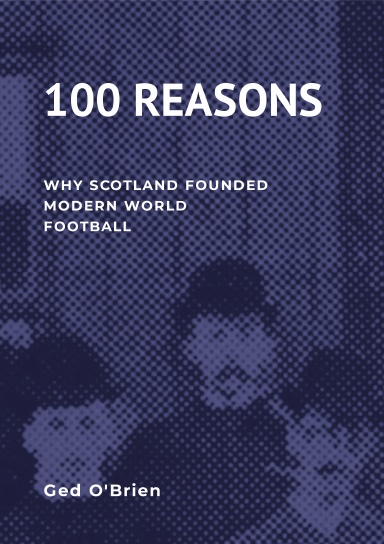
Years of meticulously poring over parish records and newspaper reports have led O’Brien to conclude that ‘the Beautiful Game’ really is Scotland’s gift to the world. It can safely be added to the list of Scottish inventions adorning tea towels in tourist shops around the country. Modern football, and its basic universal principles – passing between teammates; playing as a team and not individuals; picking around 11 players to specialise in specific positions; playing with a plan – were born in Scotland. We, you, us, the Scots, invented the damned thing. Who knew?
The English Lineage of Football
Well, very few apparently. O’Brien is clear about why we have never been given the proper credit for this invention. It seems the dastardly English have been determined to prove that it was in fact them wot dun it. This has led eventually to the common misconception that, when England hosted the European Championships in 1996, football was, apparently, ‘coming home’. It is not difficult to imagine how and why this might happen. The English ruling class consistently claim that all good things have sprung from England’s green and pleasant land. Having, it says here, ‘civilised’ half the world, it surely makes sense that the credit for creating something as generally loved as football should go to the English. It’s really just common sense. And if one or two facts have to be lost down the sofa along the way, well then – no great mischief.
It was, of course, the visionaries of the English private school system who invented football and graciously passed it down to the lower orders. Old Etonians eh? Why are they so good? The hitherto unchallengeable orthodoxy is that modern football emerged when the English private schools decided to get involved by codifying ‘mob football’, basically a street brawl with unlimited numbers of players and a ball somewhere in the middle of it all. O’Brien will have absolutely none of this. Mob football was undoubtedly a very real phenomenon, but modern football did not emerge from it in the 19th century. O’Brien shows that a game recognisable as modern football was being played in Scotland for hundreds of years before that.
Telling Scotland’s Story of Football
O’Brien argues that there is no connection between this mob football, with its hundreds of drunks rampaging up and down the town, and modern football. He refers to numerous accounts from Scotland from the 16th century which suggest that football already existed as a game between two teams, limited in numbers, with rules, and little excessive physicality. For example, he describes a game in 1599 between 6 Border Armstrongs and 6 Englishmen of Bewcastle – organised six-a-side football being played in the 16th century – and refers to another incident, in Blairgowrie in 1603, when the local minister ‘kicked and hacked’ at people to get them to stop playing. The locals were playing what O’Brien calls an ‘intelligent and scientific’ game, a game that evidently did not allow ‘kicking and hacking’. So no. This was not mob football or anything like it.
Much of the evidence cited by O’Brien comes from Kirk records, usually accounts of ministers railing against people wasting their time playing football when they could be engaging in more godly activities. Interestingly, O’Brien makes the suggestion that football was often viewed as a Papist activity, a remnant of ‘the old times’, i.e. pre-Reformation times, when poor people might take advantage of Saints day holidays to enjoy getting together for a game. Predictably, many Presbyterians felt that such frivolity had to be curtailed. O’Brien describes a incident in Lamington in Lanarkshire in 1656, when locals were dragged before the Kirk Session for:
… participating in one superstitious and abominable custome… promiscuously to play at foot-ball upon Fasting’s even.
O’Brien does not pull any punches in pursuit of ecumenical harmony:
All the fun things people did, were seen as bad. This tells you what an amazingly pleasant place Presbyterian Scotland must have been.
The English claim that they invented football clearly irritates O’Brien. He sees this as an example of what inevitably happens in partnerships when one of the partners is ten times bigger than the other. English historians of the game have used a variety of familiar tactics – ignoring or downplaying Scottish involvement; bigging up the role of ‘posh’ English people; dismissing any objections as just the usual disgruntled Scots’ instinctive anti-Englishness. A version of this very successful tactic is still routinely trotted out by many Scottish politicians during election campaigns. You can hear it in almost any statement by spokespersons from any of the anti-Independence parties. Support for the English position on football is of course also reinforced by sheer weight of numbers – for every Ged O’Brien crying in the wilderness, there are ten opponents explaining how he is obviously wrong.
The pioneering role of the Scotch Professors
Somewhat thrillingly for Scottish football fans, O’Brien argues persuasively that Scottish players and teams played a fundamentally different and more modern style of football than the English. Crucially, ‘Scottish Combination’ involved players passing the ball to their team-mates and running into positions to receive passes. In other words, a proper team game, not just a collection of individuals. This style brought early Scottish teams great success, and players known as ‘Scotch Professors’ were in great demand. O’Brien states that…
… Scotland were the first nation to realise that planning a game and carrying out particular tactics was the way to success. When England got really really tired of being gubbed again and again by Scotland, their complaint was that the Scotch Professors knew one another’s play.
The English game was based around individual dribbling, while the Scots played as a team. Perhaps controversially, O’Brien goes as far as to suggest that this is a reflection of different national characteristics – the Scottish clan system, for all its faults, encouraged a kind of shared group ethos – the community (or team) was all in this together. The rugged individualism of the English was not conducive to success in a team game. England did earn a draw in the very first International match in 1872, and actually managed to win the return fixture in 1873, but O’Brien explains that Scotland had only been able to afford to send 8 players down for that game. The other three players had to be drawn from Scots living in England, who were upper class and steeped in the English style. O’Brien says that these three ‘weak links were not capable of intelligent Scottish Combination play’. By 1878, the pattern was set, and Scotland ran out 7-2 winners.
At a time when Scottish football has for years been plummeting down the international rankings, and is routinely dismissed and mocked by English pundits as a sub-standard product, it is good to know that this has not always been the case – we were the best in the world, streets ahead of our southern neighbours, who played a basic and predictable version of the game. Scotch Professors brought their Scottish Combination game to the rest of the world, where it took root and flourished.
At one point Liverpool FC and Sunderland FC, two of the most successful English sides, were turning out teams of eleven Scots. I myself remember echoes of this as late as the 1970s, when no top English team played without a sizeable quota of Scottish players – Law, Dalglish, Souness, McQueen, Gray, Lorimer, Holton, Hansen, Cooke to name but a few.
Sadly, Scotland’s pivotal role in creating ‘the beautiful game’ has, like so many other inconveniently positive Scottish facts, been largely air-brushed from history. The thrilling climax to this domestic season, however, one of the most gripping in living memory, has caught the attention of the international media and with the Scotland men’s national team finally qualifying again for the FIFA World Cup Finals, football’s Scottish origin story needs to be told and retold.
Thanks are due to Ged O’Brien for reminding us of the true history – as always, it is buried deep. So, if football has played a small part in making our lives a bit more colourful, a bit noisier, a bit more joyous, and we’re counting the minutes to the fantastic circus of the World Cup this June even if it is being cynically exploited by Trump – you’re welcome.
Can you hear us David Baddiel?
100 Reason Why Scotland Founded Modern World Football can be purchased from Lulu HERE.
We continue publishing as we crowdfund for the next twenty years.
Support us here: https://www.crowdfunder.co.uk/p/bella-caledonia-2020

So… did the Scots ban women’s football *before* the English, then?
Skara Brae had indoor flushing toilets around 3000 BCE, I hear, but I’m not going to read a book about how Scots gave flushing toilets to the world. I’ve heard too much ‘we Scots invented everything’ bunkum in my lifetime.
You seem really triggered by the idea that Scots invented anything? Why is that? It comes across as inferioirism.
@Editor, well, it’s not superiorism either.
The English FA may well have indulged in foul play. And maybe their propaganda and censorship have been found out. So let’s leave that to one side.
Philosophically, we can consider the invention of invention; politically, what purpose does ‘invention’ serve; sociologically (sorry) if there is such a thing as a Cult of the Inventor; economically, what is the commercial value of invention (even if being recognised as the ‘Home of Golf’, say).
I was impressed with the arguments of Michael Burke’s television series Connections (“an Alternative View of Change”):
https://en.wikipedia.org/wiki/Connections_(British_TV_series)
which rejects the Great Man (Occasionally Woman) View of History, in favour of a complex web of connections, serendipity, incrementalism, and long chains of causation behind each ‘invention’ featured. But this is not the traditional (establishment) view of invention, which credits typically a man, occasionally a small team, or possible a Guiding Spirit of a Nation. If we are curious, we should also ask who and what is left out (as apparently Scotland is in the development of association soccer here). Some human ‘inventions’ are directly cribbed from Nature, of course.
Accreditation biases are rife in history, and I surely don’t need to spell these out to Bella readers. Let’s hear no more of ‘national genius’. Wikipedia notes something about gender discrepancy in its page on Invention, something that various between nation and culture. Of course, in some cultures, significant inventions were attributed to the gods.
But another relevant side is Unionism. When, for example, the BBC shows another quite dreadful episode of Modern Who featuring John Logie Baird, it not only claims his invention for Britain whilst placating Scots with pablum, it completely misrepresents history and technology (in a field of many pioneers, JLB was not the father of television and certainly not of modern screens).
Even weirdo and failed speculator on slavery Isaac Newton produced some fairly humble quotes on his scientific achievements, apparently, but importantly referencing a tradition. The BBC comedy-drama series The Upstart Crow has a running joke about Shakespeare’s inventions.
We should also look at the suppression of inventions and innovations, which as the article notes, the Scots seem to have been very systematic in (when they weren’t digging up corpses, perfecting the plantation system, inventing racial pseudoscience and such, I suppose). Yeah, there are some really bad inventions too, but these are more likely to appear in things like Horrible Histories.
Finally, on what you do with inventions. The alchemists were among the worst examples of the privatisation of research, scrawling encoded notes in hidden books. The opposite is openly sharing. And if early modern Scottish footballers put the game into the public domain and relinquished their moral rights of authorship, good on them. You are just a dick if you claim to give a gift to the world then claim it back again.
Aye, we’ve ayeways got the fitba, eh?
Celtic and Rangers, where would we be without them?
I’m not anti-football, far from it, but you would expect a national State broadcaster to be offering a wider and more diverse menu of cultural experiences than just the fitba…
Count the hours per week devoted to the fitba on our screens.
Count the hours per week devoted to cultural activities.
Film, the theatre, painting, exhibitions and happenings.
It’s embarrassing..
Last night, watching the 9.00 pm news bulletin on TVE, the Spanish BBC, there were 4 news stories about culture to round off the news: a Spanish film director about to premiere his film in Cannes. A Mexican novelist promoting her book in Spain. A Spanish singer playing in a festival in Spain. And I can’t remember the fourth, though I counted them, it struck me. You’d never get such largess from the Beeb.
But then again, we don’t have a State broadcaster, we have BBC Scotland which is a kind of national joke…
Not that there arent hours of football and analysis of football in Spanish TV, even more than in Scotland…
But they also pay attention to culture, which the powers that be in Scotland just ignore…
The comments so far seem to miss the big point.
An English version of the history of football in its formative years has become the dominant story.
It has pushed out other histories including how Scotland played a massive role in the invention of what became association football. And then played a huge part in the creation of the modern game as we have come to know it. Modern football scholars such as David Goldblatt in his seminal history of the global game: The Ball is Round have laid out the pioneering role of Scottish football – and for example the global reach of ‘the Scotch Professors’.
Why is it so hard for some Scots to take seriously the importance of reclaiming their histories? This book and its history is a small part of that.
Why, Gerry, are you so keen to reclaim the history of football, but not, say, painting or philosophy or Gaelic or Scots for that matter?
How come there still isn’t a general history of the Scottish Renaissance, for example? I find that bewildering… There should two or three by now.
All you have to do is count how many books there are on Scottish football…. Hundreds of them…
What about film? There are maybe 5-10 books written by Scots on film, if we count Marc Cousins as Scottish, a few more…
It’s not balanced. We are so passionate about football because that’s the cultural diet force fed us as bairns…
I’m not anti-football. I just think too much passion goes into it at the expense of other areas of Scottish cultural life…
And we have the added problem which is 5 world class universities in a country of 5.5 million, which sucks the life out of generalist Scottish culture for a dry specialism…
Douglas with all due respect that is one of the most daft comments I have ever read on this site.
“Why, Gerry, are you so keen to reclaim the history of football, but not, say, painting or philosophy or Gaelic or Scots for that matter?”
One does not as I hope you know preclude the other; in fact it can be said that the reclaiming of football histories is part of the wider trend of the reclaiming of Scottish histories plural.
Daft or not, would you not agree that too much of the nation’s time and energy goes into football?
I’m hardly making a new point, William.McIlvanney used to.make the same point back in the 80s…
Douglas,
As you keep telling us you live in Spain where people (according to you)are far more concerned about culture/cinema etc than football despite been home to (arguably) the 2 biggest and most successful clubs on the planet.
As the late great (Scottish) Bill Shankly once said (with a bit of tongue in cheek I suspect,)
‘Footballs not a matter of life and death, it’s far more important than that’.
Having watched the embarrassing events of last 7 days with referee’s bizarre decisions, Celtic fans invading pitches and assaulting opposition players I am not so this is the appropriate time to boast about Scottish football?
Exactly, John, plus look at the fans, look at the photos of the fans on the BBC webpage most of them are overweight, young people suffering from obesity, sweating away in the sun… What’s going on!
What happened to the great athletic northern race of men so oft described in the history books? We were once the crack troops of the biggest Empire the world had ever seen!
The football just papers over all the cracks. I understand it. I’ve lived the feeling. But where do you start wi changing Scottish culture? No one even sees it… (not even Gerry Hassan, who, let’s remember is a Dunjee Utd fan)
PS: I think it was a penalty, and, in any case, I can understand why the ref blew for it. I do feel sorry for Derek McInnes I have to say. A brilliant manager and a good guy.
Douglas – the ref did not blow for a penalty he was referred to review the incident on VAR. In your wish to denigrate people that love football you are are demonstrating your ignorance of the subject.
Football is loved by many people in Scotland and is a source of joy for many either playing or watching.
The majority of fans are tribal, passionate and happy. The problem is there is a minority (mainly within 2 big Glasgow clubs) who are so invested in their clubs culture they create a poisonous environment. Neither of these 2 clubs seem willing or able to eliminate this element from their support and the vast majority of fans of other clubs are sick to the back teeth of them. The Old Firm away support is so obnoxious that many other fans stay away from games with them and they also regularly vandalise grounds.
There was a prime demonstration of this today where Celtic fans invaded pitch and assaulted Hesrts players. The police told Hesrts players who were still in their kit to get on team bus and leave ground assp as they obviously couldn’t guarantee their safety. This reflects appallingly on Celtic Football Club who have hosted Hearts without being able to protect them from Celtic supporters. One can only wonder what mayhem might have ensued if Hearts had won lest Celtic Park?
The SFA underpins this culture indulging Celtic & Rangers due to their size and are about as much use as a wet fart,
Couldn’t agree more John…
And absolutely predictable, the end of the game…
This is what I mean by Scottish football being too intense…
Nothing will change until finally someone gets hurt or dies…
It’s embarrassing…
But as you rightly say, the fans lap it up eh? The fans are loving it..
My team of the year would be Motherwell, with a manager who has exposed just how mediocre most of our managers are…
Douglas / Motherwell were a breath of fresh air and their manager was obviously tactically a cut above most others. I would add that Hearts finished nearly 20 points ahead of Motherwell and were undefeated against them so I think Derek McInness has to be best manager this season.
Cheers
@John, well, I think we have an inkling about the plot of the next season of The Capture. It’s practically an open goal.
https://en.wikipedia.org/wiki/The_Capture_(TV_series)
WTF do you mean by that?
Some of the detail in this book sounds very well-researched, fascinating and new. Yet, the problem here is the assumption that everyone thinks football is an ‘English game’ in the first place. I am not saying the false narrative has not been real and significant, but it is of itself becoming a false narrative since it is pretty widely known as far as I am concerned that Scotland had a huge part in the ‘invention’ of football and this has been written about and promulgated for many decades.
I find the desire to know exactly what ‘country’ invented’ the modern game a distraction and odd way at looking at human society and developments as it is so intrinsically interconnected to people’s from many different places and cultures. Whenever someone claims an invention, there is always someone else that points out there was a precedent to this, decades earlier, somewhere very different, and then someone else says, ah yes but there was this 1000 years ago in China . . . (I saw, for example, a claim that the Chinese were playing a form of golf around 2000BC or something, and this kind of thing also asks what exactly is the point in trying to claim / prove to be the ‘real’ origins?).
Part of the problem of playing the victim of injustice so much is that firstly you always see / seek out the injustice even if it is hardly there in the first place, and secondly, victim status becomes a mentality, an identity, and some point you have to throw it off. Scotland’s crucial role in the creation of modern football is now well-established, so what next? Hopefully not returning it to again and again and again . . .
Tell Gerry, Niemand, get Hassan on the phone, and gie him laldy..-
Scottish intellectuals of the past used to if not openly lament, at least point out that an over reliance on the fitba could be a sign of some failing elsewhere (personal, cultural or political)… which it clearly is…
Nowadays, they just lap it up…
Whether it’s Stuart Cosgrove or G Hassan, they seem to see no problem with it…
“History is a nightmare from which I am trying to awake” as Stephen Dedalus says in Joyce’s “The Portrait of the Artist as a Young Man”
Yeah, I think football is taken far too seriously in general. I like it and have followed the game since I was a young child, my very early experiences of going to matches were magical, but I have noticed over the years how the hype, hyperbole and ridiculous overblown status of it has grown a lot.
The more we pay the players for running around a field kicking a ball cleverly, the more we treat them like gods and the more we go on about ‘market prices’ and so on. And we now get more incredible arrogance from fans than ever talking as if they and their club are entitled to success, demanding millions and millions of pounds be spent to maintain that. I remember the first time I heard a fan complain about a bad refereeing decision, not because it affected the match’s outcome but because of how much money it might cost the club. No-one used to talk in such terms, yet now it is normalised.
The oft-quoted Shankly saying that ‘‘Football’s not a matter of life and death, it’s far more important than that’, is of course, a load of nonsense and having heard a good programme on hiss footballing life, he also didn’t believe it.
Shankly was being ironic, of course, he was a wry, witty man (though quite possibly he wouldn’t have known what ironic meant), as smart as they come ( you don’t need to know the word ironic to be ironic)…
He was hyperbolic in Lisbon 67 – the only British manager there – when he said, without a trace of envy, “John, now you’re immortal”…
What would big Jock have said about Celtic fans yesterday and the way L Shankland and Derek McInnes were treated??
Jock Stein would have been absolutely horrified by the way Celtic fans behaved yesterday, sure he would… No doubt whatsoever…
If Celtic are a world famous club, it’s down to Jock Stein…
It’s Big Jock who made Celtic what they are…
Celtic fans and players seem to have forgotten what Stein stood for…
Celtic should apologize to Hearts. They should apologize to Lawrence Shankland, our number 9 in the world cup, and they should apologize to the bold McInnes…
Hearts maybe didn’t deserve to win the league after all. But they deserved to walk out Celtic Park yesterday with their dignity…
They were humiliated…
Stein would be turning in his grave…
I mean, the status of Scottish football is built on. 3 names: Stein, Busby, Shankly…
The moral seriousness of those three men is legendary the world over…
Stein, famiusly, refused to play dirty against Inter Milan, with their cattenacio, and beat them…
Busby’s feat, when you think about it, is possibly the greatest of them all. To see all these young lads die, to be hospitalized for 2 years, and then come back to.glory with Best, Charlton and Law…what a guy.!!!
3) And then, Shankly. What he is saying witj his famous qoute is that ethics are more important than life and death…
These 3 guys are the moral rock on which Svottish football was founded. They are the 3 men who gave us an international status way beyond our size as a country…
Forget them at our peril…
I would suggest that you should add Slex Ferguson to that list. He is regarded as possibly the greatest manager of all time in UK for what he achieved with Aberdeen & Man Utd.
@Niemand, I broadly agree with your points, well put.
If the English Football Association is portrayed as a moustache-twirling villain, I am sure there is an element of truth in this, as the FA hasn’t played well with others, and hypocritically flung accusations of corruption and wrongdoing it would better apply to itself, and been a rotten host.
However, the Scottish footballing authorities followed the English FA in banning women’s football and in doing so helped steal the game from billions of people (yes, women are people) around the world. Which theft is certainly the opposite of a gift. The ban was never total of course, but it set the pattern:
https://150.scottishfa.co.uk/scottish-football-history/a-history-of-womens-football-in-scotland/
Whereas the torchbearers of women’s football could be found in other countries, like the communist bloc.
Indeed and the shocking thing for me is that until the women’s game in the UK started to gain real traction (again) a few years ago, I had no knowledge of the FA and SFA’s bans on women’s football. It was only as the women’s game grew and got more credence that it was pointed out how successful and popular it once was and that it was banned because of that! Beyond the obvious crass sexism of the ban, you have to wonder just how much more advanced the women’s game would be now (in both quality and fan interest) if it had been allowed to develop just like the men’s.
@Niemand, yes, and some people are shocked that the English FA finally apologised in 2026:
https://www.itv.com/news/granada/2026-03-24/fa-issues-historic-apology-to-pioneering-womens-football-team
Has the SFA? I’m not sure.
you need to get out more buddy!
@Stiubhart Stuart, why not stay in tonight and learn something?
“The real-life story of the original rebel girls of football, Corinthians Ladies FC, who defied the English Football Association’s 50-year ban on women playing to become global champions.”
https://www.bbc.co.uk/iplayer/episode/m002wnjw/the-corinthians-we-were-the-champions
I thought the first written down rules for what could pass for modern football was in Ayrshire in the late 15th century in the reign of James IV? Yes we did give the world the game.
The wise old men of Mt Florida knew
If football was to progress
Some changes were due
When the science of football came out of the dark
It was due to the men of Queens Park
etc.
One song covers it.
Just a late word about the state of the game up here. I’m an Accies fan and this year along with a couple of others our club – the fans – has been through the mill. Points deducted right left and centre for situations out with fan control. Players not paid on time by an owner who isn’t deemed fit to run a club by the SFA yet we were coerced by the SFA to allow our club to move away from Hamilton to Cumbernauld because of that guy’s dispute with the owners of New Douglas Park. As far as I’m concerned that means the SFA and SPFL are involved. I’m not going to go into too much detail but a club – my club – who should have been in the playoffs for promotion ended up in the playoffs for demotion. That’s unfair as far as I’m concerned not just for us but for Clyde. Clyde should have been playing a demoralised club with limited talent instead they faced a club just off the top of the table – that’s not right. They lost (thankfully) but they fought all season for a shot at promotion and missed because our team was too good. Think how it would be if Patrick Thistle were playing Rangers tonight for promotion not St. Mirren. The trouble with football in this country is that it is run for the benefit of the Old Firm.
The laws are bent to suit bigger clubs. Down here in the lower leagues where it’s damp and misty they come down hard. Up there in the clouds punishment is more ‘considered’.
League structure is crap and boring, almost every fan wants it changed to 16 or 18 teams but the folk in charge think that the four games of the OF is what brings in the money from TV. Is it? Possibly, but who gets the lion’s share of that money? The OF. It’s a circle and it’s geared against the rest of us. Football is second best to TV money – is that what the SFA and SPFL are meant to be about? This is why I believe we invented football – only up here could it be so primitive and medieval.
Plus, how mad is it that our home game was at Clyde’s old ground and theirs at our old ground? The whole game up here needs a rebuild. This is franchise stuff.