

Celtic Alliances
The esteemed journalist Peter MacMahon wrote this week in The Times: “Picture the scene: a bright, crisp afternoon in Edinburgh’s New Town. Three podiums are set out in Charlotte Square. Out of a grand Georgian door come the First Ministers of Scotland, Wales and Northern Ireland, who have just concluded a historic meeting of the emerging “Celtic alliance”.
John Swinney, Rhun ap Iorwerth and Michelle O’Neill proclaim a new era in constitutional politics, which, choosing their words carefully, they imply will result in the end of the United Kingdom. They publish what they call the Bute House Accord, promising to work together in a joint project to effect radical change.
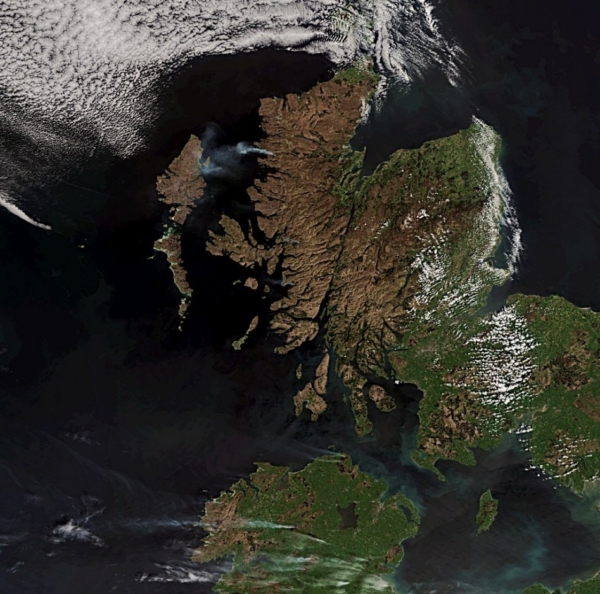
A far-fetched scenario? It might not happen quite like that, but after the elections outside England, it is a vision SNP politicians are getting very excited about, and some UK politicians are already fretting about.”
What followed was a predictable bromide about how such an alliance is wracked with problems and tensions and is, ultimately, futile. It is true that the three parties represented have (very) different backgrounds, histories and outlooks. But MacMahon claims that “It is naive — both for those who see great opportunity and those who see great danger in a first ministerial troika — to believe their movements are homogeneous, or even share the same objectives.”
But they really do. They share the objective, from different places, of the breakup of the United Kingdom, which has been bubbling away since the Good Friday Agreement signed on April 10, 1998, that ended 30 years of violent conflict in Northern Ireland; since the Scotland Act of the same year, and since Plaid Cymru took Wales from Labour, only a few weeks ago.
Such is the intensity of the Westminster Bubble, obsessed with the Labour soap-opera of the Burnham/Streeting/Starmer love triangle, that such historical undercurrents are underplayed or completely ignored.
The mantra within specifically Scottish media, that the SNP are dreadful, and that the election victory was a pyrrhic one, plays alongside this narrative. This week, we saw the Scottish Press Awards celebrating Kevin McKenna of the Herald winning the Columnist of the Year award, with Alex Massie of the Times being runner-up. The Record’s Paul Hutcheon was named as the “political journalist of the year”. Such awards and backslapping are great for the silo-community of Scottish journalism, and no doubt the three champions had a great election, but the awards don’t cover-up the fact that they backed the losing ticket.
Russell Findlay and Anas Sarwar remain in post despite leading their respective parties to their worst-ever Holyrood results, compounding the impression of a political elite completely divorced from reality, wedded to managed decline and mired in hubris and self-deceit. This is a very slow learning curve.
The problem is both political and demographic.
The political problem is that an insurgent Welsh nationalism brings new demands to the table, as does the Northern Irish situation in quite a different way. The attempt to smear and demonise Sinn Fein works when speaking to the Daily Mail’s readership, but fails badly when speaking to the young people of Northern Ireland, or Scotland, who have no lived experience of the Irish Troubles.
As the Irish writer Emma DeSouza wrote in 2024 (‘Why would we want to be part of the UK?‘):
“A recent Lucid Talk/Sunday Times survey showed that 57% of 18 to 24-year-olds in Northern Ireland would vote “yes” to reunifying Ireland if a border poll were held today, despite there being no official campaign or unity plan in place. More than 600,000 people have been born in Northern Ireland since the signing of the Good Friday agreement, and they have grown up during a sustained period of peace that has given rise to a new set of priorities. This is a generation that wants more rights, more progressive change – and to confine the division of the past to the dustbin of history.”
The Unionist incantation to talk of a ‘Generation’ loses credibility as each day passes. As DeSouza explained, Jeffrey Donaldson’s recalcitrance had made a rod for his own back: “The DUP has enabled a stasis in which Northern Ireland’s devolved assembly has been non-operational for 70% of the past six and a half years, and repeatedly blocked attempts for more devolved government. This has forced many younger people to advocate for constitutional change as it feels like the only route to a functional political system.”
Some of this will sound familiar to readers of The National.
Everywhere we see Unionist politicians just saying “No”. No to a referendum, No to more powers for Holyrood. No to anything that breaks with the internal market.
Just Say No. Every time there is an attempt to institute change that affects in any way the neoliberal consensus, whether that be rent controls, a bottle deposit scheme, a minimum price on alcohol, or, more recently, the idea of making food more affordable, there is a cacophony of Unionist scribes howling against them. Many of them have just been given accolades in back-slapping ceremonies by their peers. But these are paltry, minor policy changes being proposed, and just rejecting them constantly because they don’t fit with Unionist ideology just seems increasingly ridiculous to large swathes of the electorate. A more generous and confident Union would be fine with these sorts of changes and would benefit politically from such goodwill. If the Union is just something that can’t cope with any change it just comes across as increasingly brittle, bitter and broken.
This relentless “No” is a disavowal of the future, and it speaks increasingly to a sullen and bitter minority, ignoring the youthful clamouring for some discernible future.
But now new fronts are appearing.
In January 2024 I wrote: “For the past ten or twelve years the independence movement in Scotland has seen itself as the lead or most advanced part of any one of the nations that might cause the break-up of the British State. We were in some ways the most developed and the most articulate in putting the case for independence, or so we thought. Another way to look at these relations, in the light of the foundering of part of the project north of the border, is to look at the wider cracked edifice of the UK. The idea is to look at ourselves with less self-regard and instead look at the whole of the UK and Ireland. To look less at a binary Scotland-England relationship and more at the wider systemic constitutional failing.”
And this has a new dynamic. The emergence of Wales as an aspect of constitutional change has blindsided most of the British Establishment. Wales is a new front on the constitutional question, where years of economic neglect, cultural appropriation and social disregard have fed a political movement that less than twenty years ago wouldn’t have been treated seriously at all.
Now, people are asking, why does the entire Welsh Cabinet speak fluent Welsh and no one in the Scottish Parliament speak Gaelic? Of course, we are comparing apples and pears, or ùbhlan and piorran, but the point stands. Issues of cultural status, and anglicisation read differently across Scotland and Ireland and Wales. Of course, these have different histories and contexts – we are a ‘three-voiced nation’ – but the lessons and the markers resonate nevertheless. Even if the cultural and political histories are very different, it still leaves people asking: why aren’t our languages recognised and alive?
The problem for the Unionist media and political class therefore, is not just political (constitutional) it is demographic and deeply cultural. These are not easy things to bat away but speak to deeper problems of shifting understanding of place and identity. This is the Long Game, and we’re here for it.
As Liz Loyd wrote in 2024 (‘The path to independence is longer than the SNP would like – but it will lead there in the end‘):
“The belief that Scotland should be independent is a sticky one. Continued high levels of support are not just a consequence of Brexit or Boris Johnson, but a mark of a longer-term evolution in the underlying thinking of the Scottish population. Importantly, that is not unique to those who voted 10 years ago. Two-thirds of under-25s, all of whom were too young to vote in 2014, support independence. Equally, the enthusiastic young voters of 2014 have not become significantly more pro-union or conservative as they have entered their 30s. For them and many of the under-50s who consistently produce a polling majority in favour of independence, two ideas have been normalised: first, that Scotland should be independent; and second, that patience is a virtue.” She continues:
“For new young voters, the belief that Scotland should be independent is now the prevailing norm. The idea strikes a chord with a generation growing up in a political context that gives them more confidence in Scotland and less in the UK. A change of UK government may temper support for a while, but unlike previous generations of Scottish voters, this generation will always know there is an alternative.”
That idea of ‘an alternative’ is a powerful one – a generational game-changer – when the only option in the past was the election of some kind of social democratic Labour government at a UK level – to act as a bulwark against the predation of the Conservatives.
But all that has gone. Not only are young Scots not disabled by the crippling sense of cultural cringe and inferiorism that their parents and grandparents had – they look to and expect policy and change to come from their devolved government as much as they do Westminster.
You could argue that successive policy failures at Holyrood – take housing, drugs and land for starters – would undermine belief in devolution or independence itself. There’s no denying any of the grand policy failures of the SNP. But the point is that the prospect for change, despite historic and unforgivable leadership failures, remains in people’s minds. In a world in which actual futures, of jobs, or affordable housing or food (!) or planetary survival are derided as utopian or radical or “woke” – the idea of transformative change has an allure despite the politicians’ determined failure to provide leadership or direction.
Critics of this analysis will say that Starmer is not under real threat, or that Burnham and ‘Manchesterism’ are just around the corner.
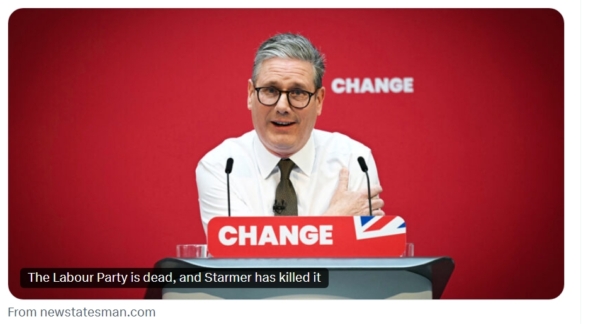
But these ideas are undermined this week by a truly brutal article for the Starmer project from one of Britain’s great living historians, David Edgerton in the New Statesman, of all places. It was in a piece called, rather uncompromisingly, “The Labour Party is dead, and Starmer has killed it” [The Labour Party is dead, and Starmer has killed it – New Statesman].
It was more of an obituary than a feature article. Edgeron wrote:
“The question is not whether Labour values have been usurped by Starmer’s faction. It is what kind of party could be built out of the corpse of Starmer’s party. One option is clearly a more Blairite party: pro-tech giants, the US, and privatisation. But are there any serious options to create a progressive party, one that dares speak out on the issues of the day, that actually communicates with a progressive electorate? It is hard to see at the moment whether the ambition or capacity exists within it. It is worth noting that Starmer’s Party is only barely the official party of the organised working class. Whereas Labour had affiliated to it nearly every major trade union, today only just over half of union members are in party-affiliated unions. And even then some may leave. This is hardly surprising: as it stands its policies, Starmer’s Party’s political instincts, are far closer to those of the Tories and Reform than to the progressive parties that are eating it up. And that is not accidental, or the result of a lack of vision. It was the whole point.”
The consequences of this abject collapse and surrender haven’t yet been processed by the recipients of the Scottish Press Awards, nor will they.
But the idea, as Starmer’s political project recedes into the rear-view mirror of history, that, somehow, improbably, the solution is ‘Andy Burnham’ is far-fetched. But it does make sense if you are caught only in the Soap-Opera of politics. Burnham’s project is undeniably tied to the failed and oddly still alive Morgan McSweeney project, but the idea of a transference across from Starmerism to Manchesterism is being nurtured.
This is a sort of deep-denial, akin to the Sarwar groupie belief that actually this was brilliant.
Revelations come in the most surprising places. Here’s Andy Maciver talking about a “process, an event and a decision.”
Maciver writes: “Political trends move at pace, nowadays. To paraphrase Lenin, decades now happen in the space of weeks. There are only three things required for Scotland to be independent within the next 10 years: a process, an event and a decision.”
However, there is another side of that coin, and that is the event. Because as well as running Scotland better, independence also depends on Nigel Farage becoming Prime Minister at Westminster. Although Reform UK’s policies have good traction in Scotland, Mr Farage does not, and he never will. He is an English nationalist. That is perfectly reasonable – as reasonable as being a Scottish nationalist – but it places a very low ceiling on his popularity in Scotland and it means that his ascendency to Downing Street is a material risk to the UK, particularly at a time when nationalists are in control in Edinburgh, Belfast and Cardiff.
“This, the event, is linked to the decision, which is to grant the Scottish Government a Section 30 order allowing another independence referendum to be held. Unionist parties comfort themselves in the decision by the Supreme Court that the power over a referendum resides at Westminster, combined with repeated promises from Tory and Labour Prime Ministers that they would never grant one.”
This may not be as ridiculous as it sounds.
The reality is, that as Celtic alliances coalesce, there is no answer to the question, what is the democratic route out of the Union? It’s evocative of what Peter MacMahon conjures. “Picture the scene.”
DONATE TO OUR FUNDRAISER HERE:
BELLA CALEDONIA 2020

As an almost 80 person, it is glorious to read of the high percentage of young people who believe independence is feasible in the Celtic nations. My political life has been varied, maybe even wide, and I have lived in Scotland ( born here) and England where I had a successful business career. For my sins, I campaigned in Edinburgh for Malcolm Rifkind (Tory – in case some young people don’t know) and without really realising it I was a Thatcherite. It took me until early 1990s to join SNP in Angus region under the enthusiasm of MIke Weir & Co. Now having been 35 years in SNP and worked with people like Mike Russell and Aileen Orr in the Borders I have concluded that SNP hierarchy are not really demonstrating they want actual separation. They appear comfortable with status quo whilst “enjoying” the trappings of power.
I resigned from SNPandcontinued my ongoing support of Believe in Scotland and attempted to join in the on- line discussions, thinking that doing this this in a non- political was the way to go. Sadly I came to conclude that this doesn’t work together. I struggled to get a word in the on line meetings and while I respect GMk and what he has achieved, I still feel detached from the independence process.
So what next?
I have always felt that if Indy supporters channelled their support through a more “combined ” vehicle we would succeed more effectively. I almost voted SNP 1 & 2 as dictated by the party but due to the enthusiasm of my neighbour Terry Howson in Coldstream, I was comfortable to vote for her and her party,The Alliance to Liberate Scotland, for my second Regional vote. I have joined ATLS and hope to contribute that cause.
This article from Mike is superb and is the catalyst for me to go forward.
1. McKenna & Co are lazy journos who write any old nonsense; McKenna seems to have an editorial licence to write about what he feels today rather than fact-based?
2. UK politics has been stuck in a monochrome era; like b/w telly with only three channels? It has not reflected the actual demographic diversity of the population; now that seems to be changing, the status quo brigade don’t like it?
3. Whether events pan out as described, only time will tell. The next UK GE could be existential for the Union, but this will require an intense & rapid period of cooperation within each of the three nation’s indy movements & across the three?
4. At 64, which is now allegedly “middle age” but feels more brittle than that, I have no problem with “the young” setting the constitutional agenda. Folks who have lived almost a full life should not have a veto on those yet to taste its full pleasures & pains. However, hopefully youthful energy & new modes can be balanced with learning from systemic errors of the past?
We should be bold & clear as to what we want & why. The break up of the UK is the objective; it only requires one constituent nation to achieve independence & then the impossible becomes attainable. We need to set out our respective positive cases and the negative (to escape a Reform dominated Anglosphere). The message will be distorted in reporting by our “top” journos so we need to find alternative communications?
Thanks Ian, good comment. As for alternative communications, you’re on one, there are many others, but they need your support, they can’t exist for free: https://www.crowdfunder.co.uk/p/qr/Xy28pd7W?utm_campaign=sharemodal&utm_medium=referral&utm_source=shortlink
Mike Small writes of the Scottish media claiming that the recent ‘electoral victory was a pyrrhic one.’
Perhaps it would be better to ignore the Scottish media – as so many Scots manage to do – and look at the numbers voting.
In the constituency section, the SNP got 877,077 compared with 1,291,204 in the equivalent election in 2021. In 2026 the SNP got 68% as many votes as five years before.
In the list section, the figures were 625,949 votes in 2026; 1,094,374 in 2021. here again there was a huge drop; only 57% of the votes five years earlier.
SNP membership tells a similar tale; 125,000 in 2019 falling to 56,000 in 2025.
If you think independence for Scotland is important, these are very concerning figures. The fall in membership echoes what happened to the Scottish Labour Party; a ‘canary in the mine’ warning that was ignored.
The Labour Party in Wales, especially in the Senedd, before the current one when it had exactly half the seats, has long highlighted its Welshness, and, for many of those in ministerial positions this seemed sincere.
They often positioned themselves in opposition to UK Labour policies, which they felt were not appropriate for Wales.
To some extent this was because they had to rely on agreement with PC to pass, amongst other things, the Budget. In the run up to the recent elections its candidates and leadership were overtly hostile to Starmer and his government. It did not do them much good.
The question it’s few members have to address is whether they support PC on key PC policies or let an alliance between Reform and the Tories defeat them. Where stands their Welshness now?
Contrast that with the Labour Party in Scotland who, since 2007 have been almost entirely unconstructively oppositionist. In stark contrast to their colleagues in Wales they have always evinced contempt for anything Scottish. They would rather not be Scottish and, indeed, an increasing proportion of its MSPs and MPs are not Scottish either by birth or by self identification.
Given that the recent elections its candidates has stripped its numbers to being the reactionary clique of Baillie, McNeill, Sarwar, Marra, etc, with the few more independent figures like Monica Lennon unseated.
Given the pre election kite flying the the Daily Ranger of a grand unionist alliance of Reform, Labour and Tories and Mr Offord’s revelation of Sarwar’s suggestion of a deal between them, I think it is likely that Labour’s will tend to drift towards Reform, especially as the literally thuggish former Labour MP, Ian Davidson, is now an adviser to Mr Offord. He is a long time crony of the rump of Labour at Holyrood.
I think it likely that Reform, Labour and the Tories at Holyrood might well merge.
Given that a fairly significant proportion of the dwindling Labour vote favours independence or is not hostile to it, I foresee them drifting towards the Greens and SNP, thereby increasing the pro-independence parties in Councils, at the next Westminster elections and the next Holyrood elections.
Alasdair – having lived in Wales until recently I would agree with your assessment of the differences between Labour in Wales & Scotland.
I listened to a discussion with Alan Roden, a senior Labour strategist, during which he ruled out the Labour Party in Scotland becoming a separate entity from UK Labour and Labour in Scotland coming to an agreement about the criteria for another independence referendum.
It will be interesting to see whether Labour in Wales will adopt the same ‘head in the sand’ approach as Scottish Labour?
There’s some small signs of questioning from within Scottish Labour. This is from the Record:
Paul O’Kane said Labour focused too much on constituencies over regional Lists and lacked “ambition” in their manifesto.
He also said “everything should be on the table” after being asked about the creation of an independent Scottish Labour party.
Insiders say targeting 38 first-past-the-post seats was too ambitious and claim there was no strategy for the regional lists, where Labour does best.
O’Kane, a moderate who was Sarwar’s shadow education secretary, was one of three sitting MSPs to lose his seat on May 7th.
In an interview with the Record’s Planet Holyrood podcast, he said Starmer was a “principal” factor in the result, but warned:
“It would be wrong for us not to take time to have self-reflection in Scotland as well, and in the Scottish Party, about what happened in the campaign, about the way the campaign was run, about the decisions that were made around various issues of policy.
“I wouldn’t want us to just see the issues with the UK Government and the Prime Minister as a reason not to have a wider reflection and a wider piece of work that looks at all of the issues in the round.”
He criticised the failure to focus on the regional lists when polling showed Labour trailing the SNP in the constituencies:
“I do think there are questions to ask about that sort of 38 seat strategy, whether that was a strategy that could evolve with the changing picture of polling.”
O’Kane is also in favour of greater autonomy for Scottish Labour from the UK party.
While he did not back an independent Scottish party, he kept the door open on the idea:
“As part of any wider review…I think everything should be on the table. I think it would be wrong if we sort of closed off ideas about how we might move forward.”
It does however feel too little too late, and I fully expect SLab to continue with the same people in charge and the same policies …
From interview I watched it very much sounded as though Scottish Labour were frightened that if they became a stand alone organisation or endorse the right of Holyrood to decide on holding another independence referendum they would lose even more support. An astonishing admission when they have lost support in every Holyrood election since 1999.
@Alasdair Macdonald, perhaps it is significant that Monica Lennon, the Member in Charge of the Ecocide Bill, who was praised by Committee for the ‘huge amount of work undertaken’, was a Labour MSP and not a Green.
https://www.parliament.scot/chamber-and-committees/committees/committee-reports/nzet/2026/1/23/nzets062026r04#dp59870
Who is going to take up this unsuccessful Bill now? Is the public going to be satisfied with wrist-slaps for offenders?
Why is it an unsuccessful Bill?
@Editor, the Ecocide (Scotland) Bill ‘fell at Stage 2’:
https://www.parliament.scot/bills-and-laws/bills/s6/ecocide-scotland-bill
It may be reintroduced in this Parliament “and the process would begin again from the start”, but as it was a Member’s Bill, and its Member in Charge is no longer in Parliament, I’m not sure what life is left in it. I did take part in the public consultation, but perhaps my contribution was too radical…
The Scottish Green manifesto aimed to introduce a:
Corporate Accountability and Ecocide Bill.
For sanity’s sake, an Ecocide Bill would make anyone committing (or preparing to commit) ecocide an outlaw, and give legal immunity to anyone trying to stop them by any means necessary (as if they were sabotaging the life support systems of a generation ship). If you extended this to anyone planning to commit ecocide, you would of course outlaw NATO and anyone working for it. I don’t think the Scottish Greens’ fines and imprisonments takes our living planet very seriously.
Ah, thanks
Just remember voters that politicians always want to kiss your babies. Not only that but they also want a photograph of themselves kissing your babies. If that’s not a sure sign of a highly suspect individual then I don’t know what is.
Mike Small writes that much of the Scottish media views the SNP success in the recent Holyrood election as a ‘pyrrhic’ victory.
The numbers should give the SNP pause for thought.
In the ‘constituency’ section, the SNP got 877,077 votes. In 2021, the SNP had scored 1,291,204. This amounts to a 32% fall.
In the ‘list’ section, 625,949 votes in 2026 compares with 1,094,374 five years previously. Here the drop was 43%.
Membership of the SNP has fallen from 125,000 in 2019 to 56,000 in 2025.
Today’s news is unlikely to lead to a resurgence in support.
Its certainly true that the SNP vote is significantly down Florian. But its also true that despite an overwhelmingly hostile media landscape, and policy failures they have more MSPs than the entire Unionist bloc combined. This is testimony, I think, not to great SNP strategy but to the enduring belief that they are the vehicle to achieve constitutional change, whether you agree with that or not.
The media in Scotland was not much different in 2021 when the SNP vote was significantly higher.
I agree that the SNP has more MSPs but unionist parties won a clear majority of votes.
Another interesting article comparing things with Wales, thanks, a good read.
What is suggests to me, again, is that things are very different there. Perhaps the simplest thing to say, is that at present anyway, Labour are not hated in the same way, are not reviled and dismissed, the political culture not as divided and vicious overall, party politics still not the be-all-and-end-all. This makes it far more likely that co-operation between parties will happen, parties, that let’s face it, have pretty similar political outlooks. When it comes to the cause of independence, Plaid are nationalist but are still a way yet from pushing for independence in a serious way, again making it easier for unionists like Labour to co-operate, especially with Reform waiting in the wings.
Starmer said yesterday about the Murrell(s) scandal that ‘I think anybody looking at what’s happening up in Scotland will be baffled that those at the top of the SNP say they didn’t know anything about what was going on’, something I suspect what the majority of people are thinking, but not Swinney apparently: ‘I don’t really think I’ll be listening much to what Keir Starmer says to me about anything’. On one level you could say his response was hardy surprising for various reasons, but his blanket dismissal is indicative of the deep divisions which are so great, the FM thought it easier to dismiss Starmer, the PM, so sweepingly and on a very serious issue, than be honest. Will he do the same with Labour in Scotland and anyone who dares ask the questions very, very many still have? I think the answer is ‘yes’, and what that indicates is that party politics is more important than transparency, let alone co-operation for the benefit of Scotland, and even further down the line, independence.
Niemand – the people Swinney should listen to are be the people who donated money to the SNP for independence campaign ie the people whose money was embezzled. I think he also has a need to address questions raised by people within party whose concerns were ignored.
I would imagine that the fallout from Murrell conviction allied to failure to advance independence cause will result in Swinney being replaced by someone younger at some point during this Parliament. I suspect that Swinney’s role was to provide stability and distance from Sturgeon until a younger candidate was ready and willing to takeover.
While the SNP need to provide clarity over Murrell affair to restore public confidence in the integrity of SNP I see no reason why they should take advice from a PM who ignores Scottish government advice, is antagonistic and is highly unlikely to even be PM by the autumn. I would ha ve thought Starmer had enough problems with his own party without trying to give advice to other parties?
I should add a PM of a party whose leader had been calling him to stand down and a PM who Scottish Labour are blaming for the party recording its worst ever Holyrood. Election result earlier this month.