

The Scottish Languages Act’s Areas of Decreasing Significance
The need for focus is becoming clear in the implementation of the Scottish Language Act. Màrtainn Mac a’ Bhàillidh explores the problems.
Around four years after work started on what became the Scottish Language Act 2025, we’re finally seeing the Act being introduced incrementally. Section 4 of the Act, which introduces new “Areas of Linguistic Significance” (ALS) became law in March this year, with Na h-Eileanan Siar and The Highland Council given one year to consider their designations.
Throughout the bill’s passage through Parliament there were many voices who raised concerns that these designations would prove meaningless, and early signs are that those voices were correct. Highland Council’s Gaelic Committee are meeting on Wednesday 3rd of June to consider a report from their officers which recommends designating the whole Highland Council area – ⅓ of the Scottish mainland – as a single ALS. There are also suggestions that Na h-Eileanan Siar will take a similar approach and designate their whole area.
From the very early stages of the Bill, Misneachd argued that without limits on the maximum size of an ALS we would end up in a position where Councils make meaningless designations of their whole areas and continue with business as usual, essentially duplicating the work of their existing area-wide Gaelic Language Plans. And here we are.
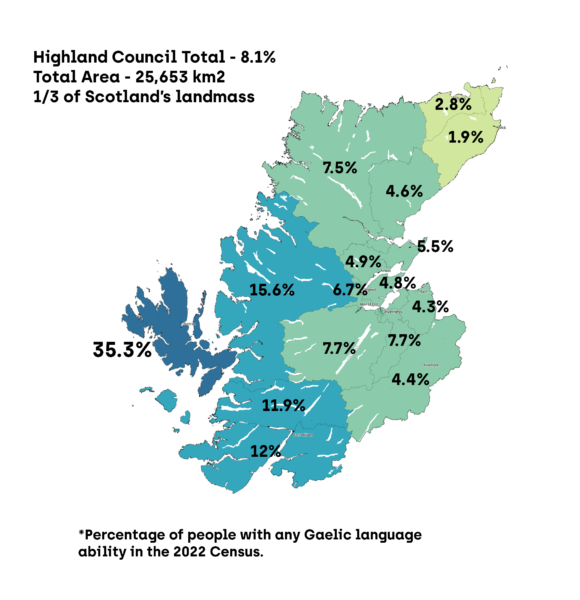
Let’s be clear – legislation was not required for Comhairle nan Eilean Siar or Highland Council to take a “place-based approach” to policy, or to do more for Gaelic across their areas. Legislation in this area was made in part in response to The Gaelic Crisis in the Vernacular Community (Soillse 2020) and a widely recognised need for more community-focused local intervention and more granular policy, particularly where the language is strongest. Not at the expense of Gaelic nationally, but to ensure that the areas where more can be done are not moving at the pace of the area where the language is weakest.
To take the Highland region as the most pertinent example, in Eilean a’ Cheò (Isle of Skye and Raasay) 35.3% of the population have some Gaelic skills, compared to 8.1% Highland wide, and would therefore be designated under Criterion 1 of the Statutory Guidance on Designation with maximum implementation of the, as yet unpublished, ALS ‘Standards and Requirements’.
After 40 years of GME in the Highlands, something being celebrated this year, there are staggeringly only 507 pupils in GME at High School level in the Highland region, 3.8% of a total of 13,375, and 209 of these are at Portree High School, accounting for 45% of the current Portree school roll. The remaining 298 are spread across 14 schools offering GME in the rest of Highland out of a total of 29 high schools in the region.
There are policies and interventions which could be taken in Skye and Raasay which could not be implemented in Wick and East Caithness where only 1.9% of people have any Gaelic ability – a similar percentage to Dundee City at 1.7%. Glasgow City has a higher percentage at 2.9% than in Thurso and Northwest Caithness at 2.8%. The region also has both Nairn and Cawdor at 4.3% and Wester Ross, Strathpeffer and Lochalsh at 15.6%.
ALS designation is about equity. Equity of policy and provision for Gaelic-speaking communities and areas where the language might yet be preserved as a habitual spoken language.
This is not to suggest for a minute that Highland Council should not be encouraging and supporting Gaelic and Gaelic speakers across all areas of the Highlands – they should, and they should be doing more across the region. But the purpose of ALS designation is to target support and strengthen policy as far as possible in the areas where more can be, and desperately needs to be, done.
If we proceed with pointless pronouncements that we are all “significant”, regardless of where we live, what level of Gaelic we have, or how often we use the language, we negate the very meagre shift in the community language support framework intended by the 2025 Act.
While the slow, and by all appearances increasingly irrelevant ALS designation process trundles on, two Gaelic communities; North-west Lewis and Uist, have prepared their own Community Language Plan for their local areas. A similar plan is currently being developed for Skye and Raasay. These plans have the backing of Bòrd na Gàidhlig and their respective communities of Gaelic speakers. It is imperative that the ALS structure supports and responds positively to these community-driven initiatives. That means Comhairle nan Eilean Siar and The Highland Council designating a distinct ALS for the area covered by each of these community plans.
The Highland Council’s proposed approach will take all impetus out of the community-driven initiative in Skye and Raasay, demonstrating once again that the actual speaker communities, their needs, and their aspirations for their language and culture, will be ignored by Highland-wide considerations, as dictated from Inverness. That cannot be allowed to happen.
ag aontachadh riut gu mòr a Mhàrtainn, taing airson a’ phìos seo.
As someone with unfortunately no knowledge of Gaelic, I agree sopport should be given to local community initiatives to ensure progress is made suitable for these areas to increase knowledge and use of Gaelic. It is a pity, though not surprising, that the percentages are so low and very important that they are able to increase the use of Gaelic.
yes, & simultaneously let us ignore the language the majority of Scots talk & think with, in fact let us extinguish thim a’ thigithir, time those backward thinking chavs bit the dust wance & fur a’
Fit ye speirin aboot? Aye, Scotlan’ his anithir leid. Dinnae ken fit ‘at his tae dae we a scrivin aboot the Gaelic in the Heelins?
let us debate the spellin of heilans (correct) vs. heelans (incorrect & disparaging to those of heilan origin)
If you truly believe that, then why did you not, like Babs NicGriogair above, post in the language you champion but in English peppered with a few cod Scotticisms?
one must always be 100% sincere in every comment one makes online, otherwise the point is liable to fall upon deaf ears
This either / or Scots v Gaelic is really divide and rule stuff. Supporting Gaelic doesn’t mean denigrating Scots.
Indeed, but what many will no doubt find when engaged in whatever Gaelic studies they are able to afford in terms of time & or money is that such studies might enhance the Scots they already know since the 2 are not the mutually exclusive entities that some would wish them to be.
True I speak both and most I know seem pretty cool with as well as writing in English , most people these days would like both to prosper, there not mutually exclusive.
Exactly, this divide and rule is well passed it when you speak to most folks, I speak some gealic and Scots though I right in English, the two aren’t mutually exclusive, and most people are fine with that, I’ve even found the attitude of English folks a lot less hostile. It’s logistics now, people will and are following.
The article is in English.
Abair thusa duine glic a th’ againn an seo! Bualadh bhasan dha Billy.
the article is also an architect, tintresting.
I have no linguistics training and am only fluent in English. At one point I acquired something like ‘holiday French’ which I lost from not holidaying in France.
So I’ve tried to learn a bit more about the nature of human languages, and am halfway through John McWhorter’s jolly series of short lectures on Language A to Z (Great Courses), having just reached M for Maltese, Europe’s only official Arabic language (uses Latin alphabet, half its vocabulary is Italian, and its Catholic majority call their god Allah, apparently).
McWhorter has some interesting things to say about linguistic impurity, porosity, hybridity, drift and complexity (the now-isolated Ket being extremely irregular and so complicated linguists have struggled to make head or tail of its rules). One main way languages are regularised and simplified, he says, is if adults (beyond childhood plasticity) have to learn it, which has happened many times to English (Vikings etc), which in its variants may have lost some of those unnecessary complications of our neighbours (like gendered nouns, say).
But McWhorter also says that influential British Grecophiles and Latinlovers contributed to complicating English spelling by sticking various silent letters in to make the written language appear more classical.
We don’t have access to an alternate timeline where the suppression of Scottish Gaelic did not happen, it was allowed to flourish, grow, adapt, be the subject of many debates between reformers and traditionalists, be changed by incomers and boomerang from foreign shores. Then it might have been modified like English.
But surely linguists have some prognosis in the future direction, shape and flow of Scottish Gaelic? What patterns of interactions are likely from adult learners of the language, and from kindred languages? And to thrive in homes, Scottish Gaelic must have a compelling digital presence these days, particularly in interactive media like computer games and their mods? I understand the geographical approach but linguistic interchanges are increasingly online, I gather. Bibles don’t cut it these days.
Somehow I have to agree with you and this is yet another example of the problems beset with supersize councils in Scotland. I certainly don’t think Caithness, more traditionally Scots-speaking, should be part of such an ALS. These designated areas should be better concentrated with the relevant local communities that have their own plans. More money and resources poured into those areas to help support their plans while the rest of Scotland can benefit from a wider national plan.
That way communities revive Gaelic far quicker whilst an increased take-up of Gaelic across Scotland, a larger population area, will help provide additional personal support for the ALS and the wider Gaidhealtachd e.g. more Gaelic teachers to call on for recruitment.
The national plan could still be zonal with the non-ALS Gaidhealtachd benefitting from more support and Lowland Scotland being given opportunities to access Gaelic services locally albeit more limited.